What should Christians make of Muslims who dream about Jesus?

Acts 10:3-6
3 One day at about three in the afternoon he had a vision. He distinctly saw an angel of God, who came to him and said, “Cornelius!”
4 Cornelius stared at him in fear. “What is it, Lord?” he asked. The angel answered, “Your prayers and gifts to the poor have come up as a memorial offering before God.
5 Now send men to Joppa to bring back a man named Simon who is called Peter.
6 He is staying with Simon the tanner, whose house is by the sea.”
New International Version (NIV)
The answer
Christians should neither dismiss these reports as impossible nor accept every dream as a message from God. God can use dreams, but no dream is self-authenticating, none may revise the gospel, and dreaming about Jesus is not itself salvation. Every report must be tested by Scripture, and every person—Muslim or not—must repent and trust the crucified and risen Jesus, the only Savior.
God can use dreams
God said in Numbers 12:6, “I will speak with him in a dream.” At Pentecost, Peter identified the outpouring of the Spirit as the fulfillment of Joel’s prophecy, which included visions and dreams (Acts 2:16-17). It is therefore wrong to say that God cannot or never does use dreams today. That does not mean every vivid dream about Jesus comes from him.
Cornelius shows the right direction
Cornelius’s experience was a waking vision, not a dream, but it addresses an important question: what did a genuine heavenly message accomplish for a religious outsider? The angel acknowledged his prayers and generosity, yet did not declare him saved. Instead, Cornelius was told to send for Peter (Acts 10:3-6). Peter later explained that he would speak “words by which you will be saved, you and all your house” (Acts 11:14).
Peter then preached Jesus’ death, resurrection, and the forgiveness received by everyone who believes in his name (Acts 10:39-43). As they heard that word, the Holy Spirit fell on them, and they were baptized (Acts 10:44-48). A genuine heavenly experience does not make Christ, the Scriptures, or gospel preaching unnecessary. Sincerity, prayer, charity, and supernatural experiences are not substitutes for saving faith.
Test the message and respond with the gospel
- Ask which Jesus is being presented. The Jesus of Scripture died for our sins, was buried, and was raised on the third day (1 Corinthians 15:3-4). Salvation is found in no one else (Acts 4:12). A dream cannot validate Islam or present a Jesus who denies these truths. Even a fulfilled sign would not authenticate a message leading people after other gods (Deuteronomy 13:1-4), and even an angel preaching another gospel must be rejected (Galatians 1:8-9).
- Do not presume the dream’s origin. Ecclesiastes 5:7 warns that many dreams contain vanity, while Jeremiah 23:25-32 condemns people who used lying dreams to lead others astray. Christians cannot establish whether an individual modern report is genuine merely from its telling. First John 4:1 commands believers not to believe every spirit, but to test the spirits.
- Listen kindly, then open the Bible. There should be neither ridicule nor gullibility. Hear the person’s account, compare its contents with Scripture, and explain who Jesus is and what he has done. Having such a dream does not make a Muslim a Christian. Romans 10:9 says that salvation comes through confessing Jesus as Lord and believing in one’s heart that God raised him from the dead; Romans 10:17 adds, “So faith comes by hearing, and hearing by the word of God.”
God’s saving grace reaches people of every nation (Acts 10:34-35). Christians should therefore use such a report as an opportunity to speak plainly about Christ, calling the person to the repentance that leads to life (Acts 11:18), faith in Jesus, and baptism, as Cornelius’s household received (Acts 10:48).
Answered from Scripture · reviewed November 24, 2026
Responding to a Dream About Jesus
Read top to bottom: how a Christian should handle a reported dream, from listening kindly to calling the person to repentance, faith in Christ and baptism. No dream replaces the gospel.
- Know God can use dreams · God spoke in dreams, and Peter tied dreams to the Spirit's outpouring. Not every vivid dream is from Him. · Acts 2:16-17
- Listen kindly · Hear the account with neither ridicule nor gullibility, then open the Bible.
- Ask which Jesus · The Jesus of Scripture died for our sins, was buried and rose on the third day. · 1 Corinthians 15:3-4
- Test the message · Do not believe every spirit. A dream cannot validate Islam or another gospel. · 1 John 4:1
- Point to the Word · As with Cornelius, a heavenly message leads to gospel preaching. Faith comes by hearing the word. · Romans 10:17
- Call to repent and believe · Salvation comes by confessing Jesus as Lord and believing God raised Him. There is no other name. · Romans 10:9
- Baptism · Cornelius's household believed, received the Spirit and was baptized. · Acts 10:48
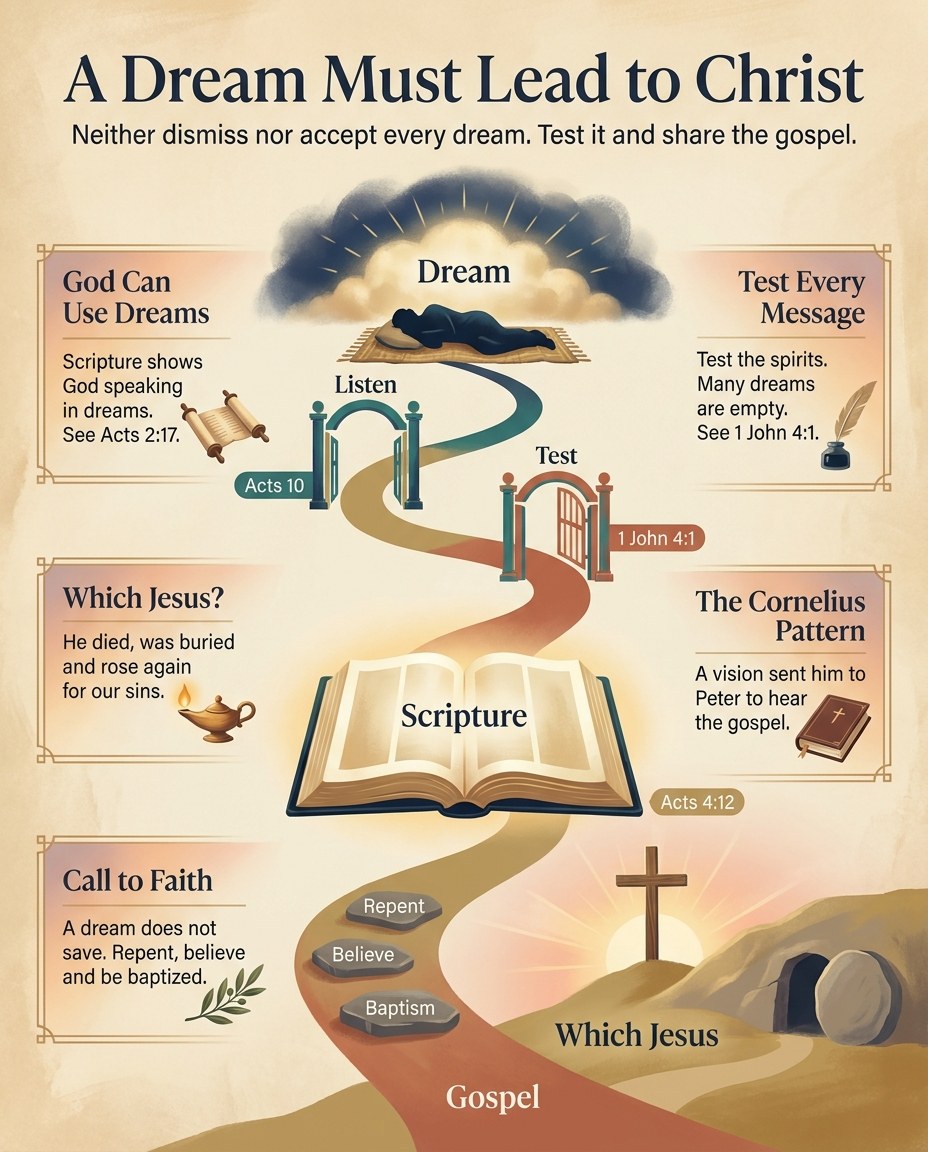
Reports of Muslims encountering Jesus in dreams should neither be dismissed with rigid skepticism nor embraced with uncritical gullibility. Scripture confirms that God can communicate through nocturnal visions, yet no supernatural encounter replaces the proclaimed gospel of the crucified and risen Christ. Every experience must be tested against the inerrant Word of God, which remains the sole instrument through which saving faith is born.
Sovereign Revelation
God Has Spoken and Can Speak Through Dreams

he said, “Listen to my words: “When there is a prophet among you, I, the LORD, reveal myself to them in visions, I speak to them in dreams.
Numbers 12:6 (NIV)
It establishes as a general principle that the Lord explicitly chooses dreams and visions as a valid medium of divine communication.
In Numbers 12:6, the Lord explicitly establishes that dreams and visions remain within His sovereign repertoire of divine communication: “Hear my words: If there is a prophet among you, I the Lord make myself known to him in a vision; I speak with him in a dream.” Far from being an eccentric anomaly, night visions have repeatedly served the living God across redemptive history. He is neither constrained by borders nor deaf to those living in spiritual darkness. As Job 33:14-18 explains, God speaks in dreams while deep sleep falls upon men, breaking through human obstinacy to turn a soul away from pride and rescue his life from destruction.
Scripture shows that God does not speak through dreams exclusively to covenant insiders. In Genesis 20:3, God spoke to Abimelech, a pagan king, warning him in a dream of the night; similarly, in Genesis 31:24, the Aramean Laban received a divine night warning. The New Testament records decisive divine directives given through dreams to direct and preserve the family of the Messiah. In Matthew 1:20, Matthew 2:13, and Matthew 2:19-20, an angel of the Lord repeatedly guided Joseph regarding Mary’s virgin conception, the flight to Egypt, and the safe return to Israel. Divine warnings in dreams also came to the eastern magi in Matthew 2:12, and troubled the sleep of Pilate’s pagan wife in Matthew 27:19.
Moreover, the prophet Joel foretold a time of expanded spiritual distribution: in Joel 2:28, the Lord promised to pour out His Spirit on all flesh, so that old men would dream dreams and young men see visions. On the day of Pentecost, Peter quoted this promise in Acts 2:16-17, proving that God continues to employ visions in the new covenant era. A report of a Muslim seeing a radiant figure in the night is entirely within God’s revealed power.
| Passage | What it says |
|---|---|
| Numbers 12:6 | God declares that when there is a prophet among them, He makes Himself known in a vision and speaks in a dream. |
| Genesis 20:3 | God comes to Abimelech, a pagan king, in a dream by night to warn him regarding Sarah. |
| Genesis 31:24 | God speaks to Laban the Aramean in a dream at night, warning him not to speak harm to Jacob. |
| Matthew 1:20 | An angel of the Lord appears to Joseph in a dream to announce the virgin conception of Jesus. |
| Matthew 2:12 | The wise men are warned by God in a dream not to return to Herod. |
| Joel 2:28 | The Lord promises to pour out His Spirit on all flesh, so that old men dream dreams and young men see visions. |
| Acts 2:16-17 | Peter identifies the outpouring of the Holy Spirit at Pentecost as the fulfillment of Joel's prophecy concerning visions and dreams. |
| Job 33:14-18 | God speaks in dreams and night visions to turn man from pride and preserve his soul from the pit. |
| Matthew 2:13 | An angel appears to Joseph in a dream directing him to flee to Egypt to preserve Jesus' life. |
| Matthew 2:19-20 | The angel of the Lord directs Joseph in a dream to return safely to Israel after Herod's death. |
| Matthew 27:19 | Pilate's wife suffers greatly in a dream concerning Jesus and warns her husband to have nothing to do with Him. |
The Cornelius Pattern
Supernatural Encounters Point Directly to Gospel Preaching
He will bring you a message through which you and all your household will be saved.’
Acts 11:14 (NIV)
It proves that heavenly visitations do not bypass the spoken message through which a person must be saved.
When an angel appeared to the Roman centurion in Acts 11:14, the heavenly messenger did not explain the cross; instead, he declared: “He will declare to you a message by which you will be saved, you and all your household.” Supernatural apparitions are not an end in themselves, nor do they replace the human herald. In Acts 10:3-6 and Acts 10:22, Cornelius received an angelic visitation directing him to fetch Simon Peter, who then proclaimed the historic death and bodily resurrection of Jesus (Acts 10:39-43). Only as Peter spoke the word did the Holy Spirit fall upon the listeners, leading directly to their baptism and repentance unto life (Acts 10:44-48).
This pattern repeats across the book of Acts. When the risen Lord stopped Saul on the Damascus road in blinding glory, Jesus did not unfold the full doctrine of justification right there; He ordered him into the city where a disciple would instruct him (Acts 9:4-6). God then commanded Ananias in a vision to minister to Saul (Acts 9:10-18). In Acts 8:26-35, an angel did not evangelize the Ethiopian eunuch, but dispatched Philip to open the text of Isaiah and preach Jesus.
Similarly, divine nocturnal visitations in the apostolic mission always funneled into the public preaching of the cross. The famous night vision of the Macedonian man in Acts 16:9-10 drove Paul and his companions to travel immediately and preach the gospel to them, just as the Lord’s encouragement in a night vision in Acts 18:9-10 urged Paul to keep speaking boldly. Wherever reports of Jesus appearing to Muslims arise, God’s established pattern demonstrates that supernatural visions serve as divine providential pointers toward the preached gospel, never as substitutes for it.
| Passage | What it says |
|---|---|
| Acts 10:3-6 | Cornelius sees an angel instructing him to send for Simon Peter, rather than receiving the gospel directly from the heavenly messenger. |
| Acts 10:22 | The messengers explain that Cornelius was directed by a holy angel to hear a message from Peter. |
| Acts 10:39-43 | Peter preaches the historic death and physical resurrection of Jesus, declaring forgiveness of sins through faith in His name. |
| Acts 10:44-48 | The Holy Spirit falls upon the hearers while Peter speaks the word, leading immediately to water baptism. |
| Acts 11:14 | The angel promised Cornelius that Peter would declare words by which he and his household would be saved. |
| Acts 9:4-6 | The risen Lord confronts Saul on the Damascus road but directs him into the city to be told what he must do. |
| Acts 9:10-18 | The Lord commands Ananias in a vision to go lay hands on Saul so that he might receive sight and the Holy Spirit. |
| Acts 8:26-35 | An angel directs Philip to an Ethiopian seeking truth, where Philip preaches the gospel of Jesus from Scripture. |
| Acts 16:9-10 | A night vision of a Macedonian man leads Paul directly to preach the gospel to the people there. |
| Acts 18:9-10 | The Lord speaks to Paul in a night vision encouraging him to continue speaking the word boldly. |
Biblical Discernment
Every Dream and Spirit Must Be Tested by Scripture
Dear friends, do not believe every spirit, but test the spirits to see whether they are from God, because many false prophets have gone out into the world.
1 John 4:1 (NIV)
It issues an unequivocal command to test every spiritual manifestation against divine truth because false spirits abound.
Scripture never permits uncritical credulity toward spiritual experiences, commanding in 1 John 4:1: “Beloved, do not believe every spirit, but test the spirits to see whether they are from God, for many false prophets have gone out into the world.” Dreams are not self-authenticating. As Ecclesiastes 5:7 cautions, many dreams and many words produce vanity; our duty is to fear God and test all things by His written Word. Paul issues a solemn warning in Galatians 1:8-9: even if an angel from heaven should preach a gospel contrary to the apostolic message, he is to be accursed.
Satan often clothes his deception in beauty, for “even Satan disguises himself as an angel of light” (2 Corinthians 11:14). Deceptive nocturnal experiences have led millions astray across history. In Jeremiah 23:28-32, the Lord rebukes prophets who lead His people away by deceitful dreams, contrasting their chaff with His word that strikes like a fire and a hammer. A dream that affirms false doctrines, softens the offence of the cross, or presents Jesus as merely a prophetic messenger rather than the incarnate Son of God is an instrument of deception (Jeremiah 29:8-9; Zechariah 10:2).
From the Torah onward, miraculous signs were subordinated to divine revelation. Deuteronomy 13:1-4 warns that even if a sign or wonder foretold by a dreamer comes to pass, if he says, “Let us go after other gods,” he must be rejected. The standard remains uncompromising: “To the teaching and to the testimony! If they will not speak according to this word, it is because they have no dawn” (Isaiah 8:20; Deuteronomy 18:20-22). While Christians should not despise prophetic promptings, they must rigorously examine every experience and hold fast only to that which is good (1 Thessalonians 5:20-21; 2 Peter 1:19).
| Passage | What it says |
|---|---|
| 1 John 4:1 | Believers are commanded not to believe every spirit, but to test whether they are from God. |
| Deuteronomy 13:1-4 | Even if a sign or wonder comes to pass, a dreamer who calls people after other gods must be rejected. |
| Jeremiah 23:28-32 | God rebukes false prophets who speak deceptive dreams, contrasting deceitful dreams with His word that is like fire and a hammer. |
| Ecclesiastes 5:7 | The text warns that many dreams and many words produce vanity, instructing the hearer instead to fear God. |
| Galatians 1:8-9 | Paul pronounces anathema upon anyone, even an angel from heaven, who preaches a gospel contrary to the apostolic message. |
| 2 Corinthians 11:14 | Satan disguises himself as an angel of light to deceive people. |
| Isaiah 8:20 | Any teaching or manifestation that does not agree with the law and the testimony has no dawn of light. |
| Deuteronomy 18:20-22 | A prophet speaking in God's name whose word fails or departs from the Lord is not from Him. |
| Jeremiah 29:8-9 | God warns His people not to be deceived by false dreams and divinations spoken deceitfully in His name. |
| Zechariah 10:2 | False diviners see lies and tell false dreams, comforting in vain and leaving people wandering like sheep. |
| 1 Thessalonians 5:20-21 | Do not despise prophetic utterances, but test all things carefully and hold fast to what is good. |
| 2 Peter 1:19 | The prophetic word of Scripture is fully confirmed and serves as a sure light shining in darkness. |
Saving Faith
Salvation Comes Exclusively Through the Word Heard and Believed

Consequently, faith comes from hearing the message, and the message is heard through the word about Christ.
Romans 10:17 (NIV)
It identifies the proclamation of the word of Christ as the non-negotiable source of saving faith.
The decisive principle governing all conversion is declared in Romans 10:17: “So faith comes from hearing, and hearing through the word of Christ.” No dream saves a soul; only the gospel of Jesus Christ crucified for sins and bodily raised from the dead imparts eternal life. Romans 10:9-10 demands conscious, explicit confession: if you confess with your mouth that Jesus is Lord and believe in your heart that God raised Him from the dead, you will be saved. Paul hammers home the absolute necessity of verbal proclamation in Romans 10:14-15: people cannot call upon a Savior they have not believed, nor believe in one of whom they have never heard, nor hear without a preacher.
The apostolic gospel is precise and historical. As 1 Corinthians 15:3-4 summarizes, Christ died for our sins according to the Scriptures, was buried, and was raised on the third day. There is no other name under heaven given among men by which we must be saved (Acts 4:12), for Jesus declared, “I am the way, and the truth, and the life. No one comes to the Father except through me” (John 14:6). Regeneration is not wrought through subjective dreams, but through the imperishable seed of the living and abiding Word of God (1 Peter 1:23-25).
Jesus affirmed this priority in Luke 16:29-31, stating that if people do not hear the written Scriptures, neither will they be convinced though someone should rise from the dead. The Holy Scriptures are fully sufficient to make one wise for salvation through faith in Christ Jesus (2 Timothy 3:15; John 20:30-31). Having spoken in diverse ways in times past, God has now spoken definitively in His Son (Hebrews 1:1-2). If a Muslim receives a dream of Christ, the church must meet them with the open Bible, preaching the crucified Lord who alone saves.
| Passage | What it says |
|---|---|
| Romans 10:17 | Faith comes from hearing, and hearing comes through the word of Christ. |
| Romans 10:9-10 | Confessing with the mouth that Jesus is Lord and believing in the heart that God raised Him from the dead brings salvation. |
| Romans 10:14-15 | People cannot call on the Lord without believing, cannot believe without hearing, and cannot hear without a preacher. |
| 1 Corinthians 15:3-4 | The core gospel declares that Christ died for our sins according to the Scriptures, was buried, and rose on the third day. |
| Acts 4:12 | Salvation exists in no one else, for there is no other name under heaven given among men by which we must be saved. |
| John 14:6 | Jesus declares that He is the way, the truth, and the life, and no one comes to the Father except through Him. |
| 1 Peter 1:23-25 | Believers are born again not of perishable seed but of imperishable, through the living and abiding word of God. |
| Luke 16:29-31 | Abraham declares that if men do not hear Moses and the Prophets, even a resurrection will not persuade them. |
| John 20:30-31 | Scripture is written so that readers may believe Jesus is the Christ and have eternal life in His name. |
| 2 Timothy 3:15 | The sacred Scriptures are able to make one wise for salvation through faith which is in Christ Jesus. |
| Hebrews 1:1-2 | God, who formerly spoke through prophets in various ways, has in these last days spoken conclusively through His Son. |
Where in the Bible
| Book | Passages |
|---|---|
| Genesis | 2 · Genesis 20:3, Genesis 31:24 |
| Numbers | 1 · Numbers 12:6 |
| Deuteronomy | 2 · Deuteronomy 13:1-4, Deuteronomy 18:20-22 |
| Job | 1 · Job 33:14-18 |
| Ecclesiastes | 1 · Ecclesiastes 5:7 |
| Isaiah | 1 · Isaiah 8:20 |
| Jeremiah | 2 · Jeremiah 23:28-32, Jeremiah 29:8-9 |
| Joel | 1 · Joel 2:28 |
| Zechariah | 1 · Zechariah 10:2 |
| Matthew | 5 · Matthew 1:20, Matthew 2:12, Matthew 2:13, Matthew 2:19-20, Matthew 27:19 |
| Luke | 1 · Luke 16:29-31 |
| John | 2 · John 14:6, John 20:30-31 |
| Acts | 12 · Acts 2:16-17, Acts 10:3-6, Acts 10:22, Acts 10:39-43, Acts 10:44-48, Acts 11:14, Acts 9:4-6, Acts 9:10-18, Acts 8:26-35, Acts 16:9-10, Acts 18:9-10, Acts 4:12 |
| Romans | 3 · Romans 10:17, Romans 10:9-10, Romans 10:14-15 |
| 1 Corinthians | 1 · 1 Corinthians 15:3-4 |
| 2 Corinthians | 1 · 2 Corinthians 11:14 |
| Galatians | 1 · Galatians 1:8-9 |
| 1 Thessalonians | 1 · 1 Thessalonians 5:20-21 |
| 2 Timothy | 1 · 2 Timothy 3:15 |
| Hebrews | 1 · Hebrews 1:1-2 |
| 1 Peter | 1 · 1 Peter 1:23-25 |
| 2 Peter | 1 · 2 Peter 1:19 |
| 1 John | 1 · 1 John 4:1 |
The story in order
- God speaks to pagan king in a dream (c. 2000 BC) · Genesis 20:3 · God can communicate with non-believers through dreams.
- God warns Laban in a dream (c. 1900 BC) · Genesis 31:24 · Dreams can convey divine warnings and guidance.
- God speaks through prophets in visions and dreams (c. 1450 BC) · Numbers 12:6 · God uses dreams and visions for prophetic communication.
- God speaks to turn man from pride (c. 1000 BC) · Job 33:14-18 · Dreams can be used for correction and preservation.
- Prophecy of Spirit's outpouring with dreams (c. 800 BC) · Joel 2:28 · Dreams and visions are part of the Spirit's work.
- False prophets speak deceptive dreams (c. 600 BC) · Jeremiah 23:28-32 · Not all dreams are from God; they must be tested.
- Angel warns Joseph about Jesus' birth (c. 4 BC) · Matthew 1:20 · Dreams confirmed the miraculous conception of Jesus.
- Wise men warned in a dream (c. 4 BC) · Matthew 2:12 · God used dreams to protect the infant Jesus.
- Pilate's wife warned in a dream (AD 30) · Matthew 27:19 · A dream conveyed a warning about Jesus' innocence.
- Pentecost: Spirit poured out, fulfilling Joel (AD 30) · Acts 2:16-17 · Dreams and visions are signs of the Spirit's presence.
- Cornelius sees angel, sent to Peter (c. AD 40) · Acts 10:3-6 · Supernatural encounters direct people to the gospel.
- Saul confronted by Jesus, directed to Ananias (c. AD 35) · Acts 9:4-6 · Even direct encounters lead to human messengers.
- Philip directed to Ethiopian eunuch (c. AD 35) · Acts 8:26-35 · Angelic direction leads to gospel proclamation.
- Paul sees vision of Macedonian man (c. AD 50) · Acts 16:9-10 · Visions guide the spread of the gospel.
Supernatural Encounters Lead to Gospel Preaching
| Encounter | Direction Given | Outcome | Passage |
|---|---|---|---|
| Angel appears to Cornelius | Send for Peter | Peter preaches the gospel, hearers saved (Acts 10:3-6, 44-48) | |
| Risen Lord appears to Saul | Go into the city to be told what to do | Ananias commissioned to preach and heal Saul (Acts 9:4-6, 10-18) | |
| Angel directs Philip | Go south to the Gaza road | Philip preaches Jesus to the Ethiopian (Acts 8:26-35) | Acts 8:26-35 |
| Vision of Macedonian man | Come over and help us | Paul preaches the gospel in Macedonia (Acts 16:9-10) | Acts 16:9-10 |
Testing Spiritual Manifestations
| Command/Warning | Basis for Test | Consequence of Failure | Passage |
|---|---|---|---|
| Do not believe every spirit | Test whether they are from God | Discernment is required (1 John 4:1) | 1 John 4:1 |
| Reject dreamer calling to other gods | Even if signs/wonders occur | Protection from idolatry (Deuteronomy 13:1-4) | Deuteronomy 13:1-4 |
| Do not listen to false prophets | Their dreams are deceitful; God's word is true | Avoid vanity and deception (Jeremiah 23:28-32) | Jeremiah 23:28-32 |
| Test all things | Hold fast to what is good | Discernment of prophetic utterances (1 Thessalonians 5:20-21) | 1 Thessalonians 5:20-21 |
| Teachings must agree with law and testimony | If not, they have no light | Rejection of false teaching (Isaiah 8:20) | Isaiah 8:20 |
Key words
- Dream (ḥalom, חֲלוֹם)
- A series of thoughts, images, and sensations occurring in a person's mind during sleep. · Genesis 20:3
- Vision (mar'eh, מַרְאֶה)
- A supernatural experience of seeing something not present to the waking senses. · Numbers 12:6
- Spirit (pneuma, πνεῦμα)
- The supernatural agent who indwells believers, guides, and empowers them. · 1 John 4:1
- Gospel (euangelion, εὐαγγέλιον)
- The good news of salvation through Jesus Christ's death and resurrection. · Acts 10:39-43
- Faith (pistis, πίστις)
- Trust or belief in God and His promises, especially in Jesus Christ. · Romans 10:17
- Word of God (logos, λόγος)
- The divinely inspired and authoritative Scripture. · 1 Peter 1:23-25
A vivid dream about Jesus does not save anyone, but it provides an urgent open door for believers to step in with the Word of God. When a Muslim speaks of dreaming of Christ, listen with gracious discernment and immediately direct their eyes to the Scriptures. Faith comes only through hearing the proclamation of the cross and resurrection, calling every seeker to repentance and true life in the Son of God.
44 passages, each cited once.
Scripture cited
- Acts 10:3-6
- Acts 10:1-48
- Acts 11:13-18
- Numbers 12:6-8
- Deuteronomy 13:1-5
- Galatians 1:8-9
- Romans 10:9-17
- 1 John 4:1-3
- Ecclesiastes 5:3-7
- Jeremiah 23:25-32
- Acts 2:14-21
- Acts 4:8-12