How did Noah fit all the animals on the ark?
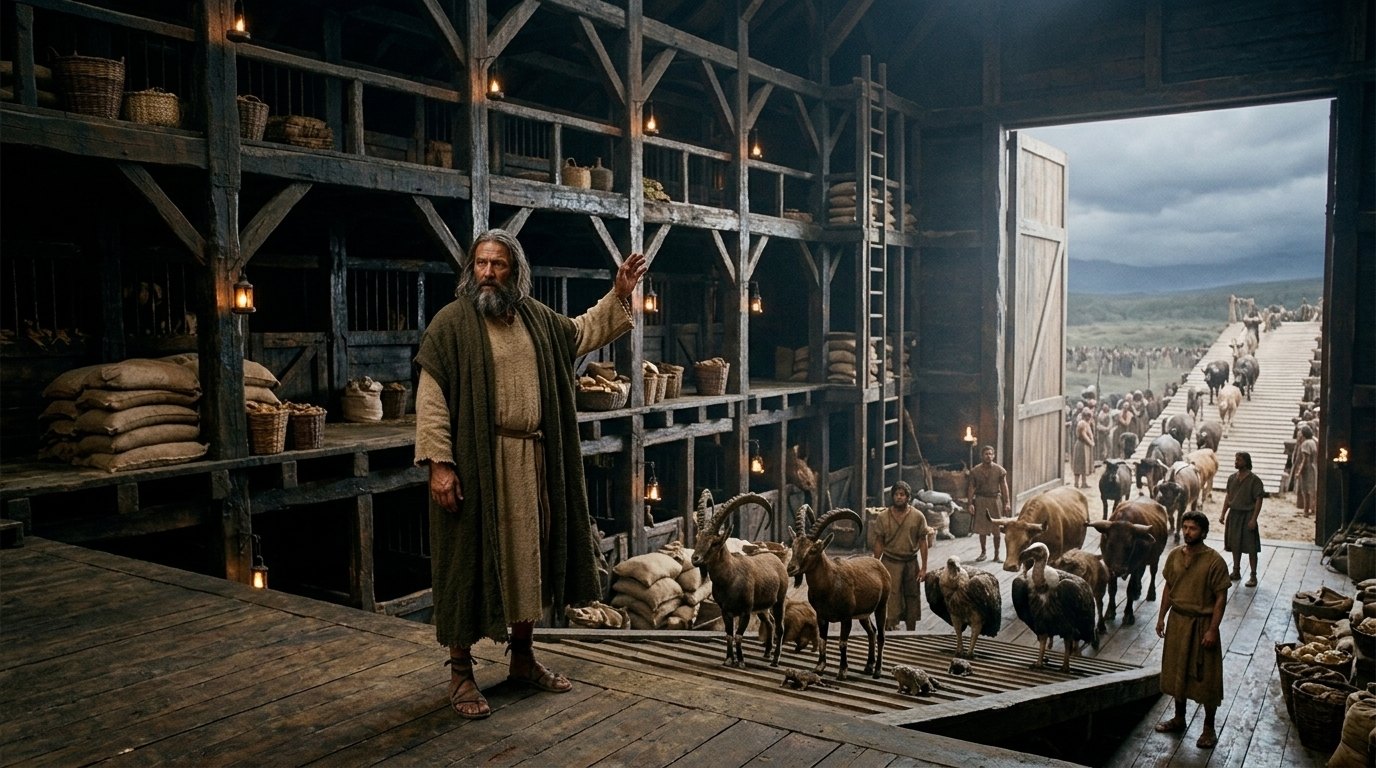
Genesis 6:19-22
19 You are to bring into the ark two of all living creatures, male and female, to keep them alive with you.
20 Two of every kind of bird, of every kind of animal and of every kind of creature that moves along the ground will come to you to be kept alive.
21 You are to take every kind of food that is to be eaten and store it away as food for you and for them.”
22 Noah did everything just as God commanded him.
New International Version (NIV)
The answer
Noah fit them in a vast, purpose-built, three-level vessel, carrying animals according to their “kinds,” with food stored aboard. Genesis also says the animals came to Noah under God’s direction; it does not give an animal-by-animal inventory or a detailed loading plan.
- The ark was enormous: God specified a length of 300 cubits, a width of 50 cubits, and a height of 30 cubits, with rooms inside and lower, second, and third levels (Genesis 6:14-16). The precise length of an ancient cubit is uncertain. Using a common estimate of about 20.24 inches gives approximate dimensions of 506 feet long, 84 feet wide, and 51 feet high—about 154 by 26 by 15 metres.
- Genesis classifies the animals by “kind”: Birds, livestock, creeping things, and other animals are repeatedly described as entering “after their kind” (Genesis 6:20; Genesis 7:14). Genesis does not define how a biblical kind corresponds to modern species classifications, nor state how many kinds there were. Calculations based on today’s total number of species therefore involve assumptions that the passage does not supply.
- The numbers were specific: The general command was to bring two of every sort, male and female, to preserve them (Genesis 6:19-20). Genesis 7:2-3 then gives the fuller requirement: seven pairs of every clean animal, one pair of every unclean animal, and birds “seven and seven, male and female.”
- God directed the gathering: The animals came by pairs to Noah rather than Noah having to capture them himself, and the Lord shut them inside (Genesis 7:9; Genesis 7:16). Noah’s responsibility was obedient preparation, including gathering food for his family and the animals; he did what God commanded (Genesis 6:21-22).
The text does not disclose the animals’ individual ages and sizes or how the rooms were allocated, so claims about those details go beyond what Genesis states.
Answered from Scripture · reviewed November 12, 2026
Scripture reveals that Noah housed the animal kingdom within a massive, three-decked vessel engineered to God's exact specifications, accommodating representatives of air-breathing life according to their created kinds. Rather than rounding up millions of modern species, Noah prepared compartments and provisions, while God supernaturally brought the required pairs to the ark and sealed them safely inside.
The Vessel
God Designed a Massive Three-Decked Sanctuary
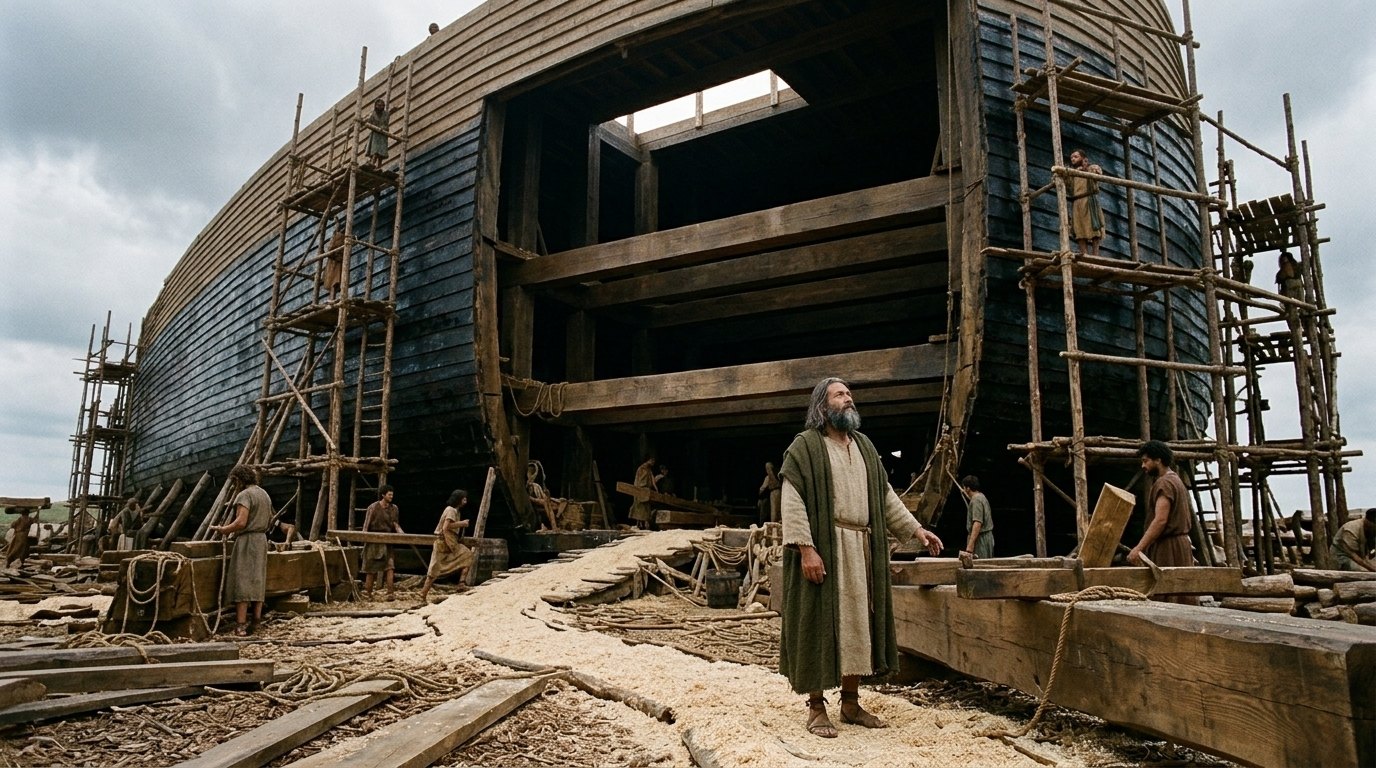
This is how you are to build it: The ark is to be three hundred cubits long, fifty cubits wide and thirty cubits high.
Genesis 6:15 (NIV)
This verse specifies the ark's enormous proportions—three hundred cubits long, fifty cubits wide, and thirty cubits high.
The scale of the vessel was divinely calculated to endure catastrophic waters while providing immense carrying capacity. In Genesis 6:15, God revealed the blueprints to Noah: "The length of the ark shall be three hundred cubits, its width fifty cubits, and its height thirty cubits." Using the standard biblical cubit of at least eighteen inches, the ark measured approximately 450 feet in length, 75 feet in width, and 45 feet in height. This yielded an interior volume of roughly 1.5 million cubic feet—the volumetric equivalent of over five hundred standard American railroad stock cars, offering an extraordinary amount of enclosed space.
Every structural detail answered the practical demands of sheltering thousands of creatures. Before specifying its external dimensions, the Lord ordered Noah in Genesis 6:14 to construct the ark of "gopher wood" and to arrange it with "rooms" (literally qinnim, nests or compartments) throughout, coating the hull inside and outside with pitch to guarantee complete waterproofing. These internal cells provided structural stability, partitioned the animals safely, and prevented cargo from shifting during turbulence.
To maximize usable surface area, Genesis 6:16 mandated "lower, second, and third decks", tripling the floor space to over 100,000 square feet. This same verse ordered an opening for light and ventilation finishing a cubit from the top, alongside a single entrance set into the vessel's side. Rather than a modern ornamental boat, the ark was an immense, stable cargo barge engineered precisely to hold life securely.
| Passage | What it says |
|---|---|
| Genesis 6:14 | God commands Noah to construct the ark of gopher wood with inner rooms and to seal it inside and out with pitch. |
| Genesis 6:15 | God sets the dimensions of the vessel at 300 cubits long, 50 cubits wide, and 30 cubits high. |
| Genesis 6:16 | God specifies an upper window, a side door, and lower, second, and third decks throughout the ark. |
Created Kinds
Animals Entered According to Created Kinds
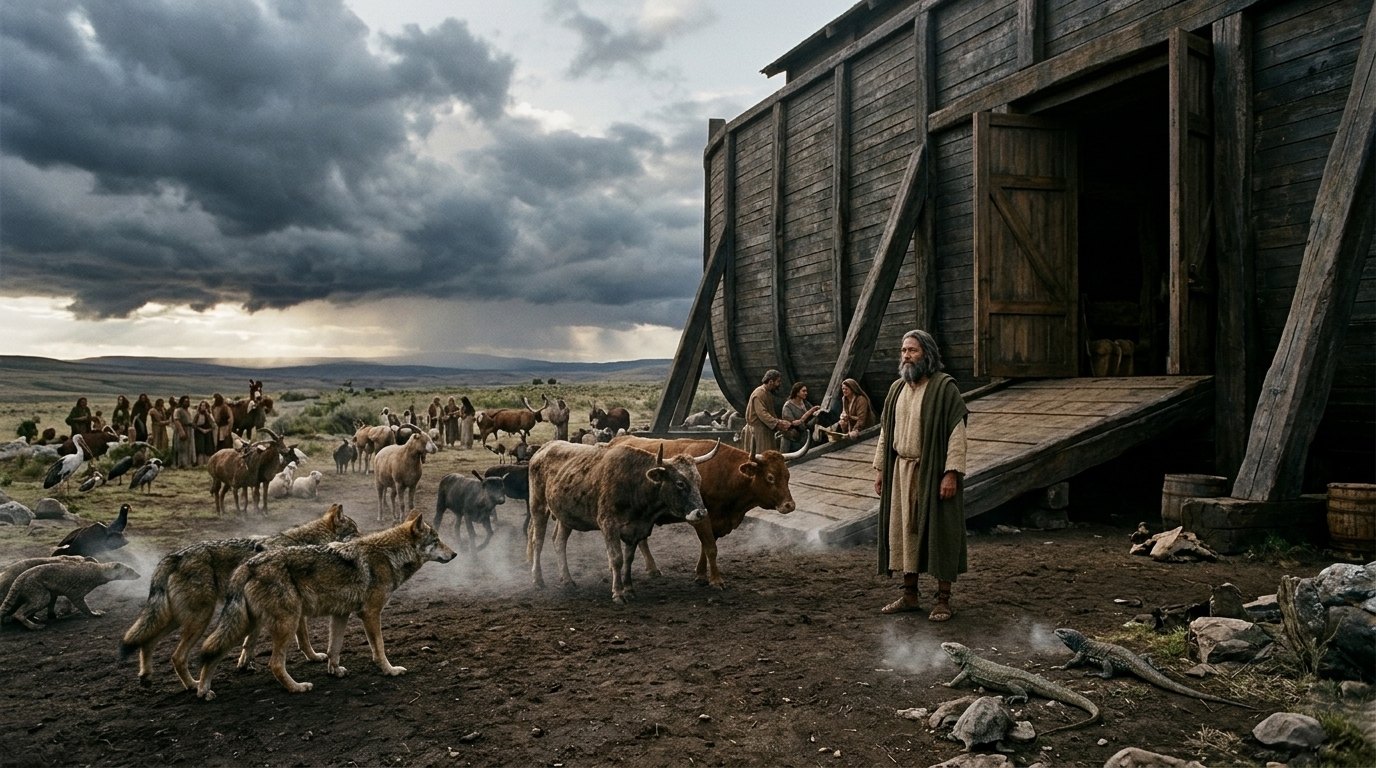
Two of every kind of bird, of every kind of animal and of every kind of creature that moves along the ground will come to you to be kept alive.
Genesis 6:20 (NIV)
The text restricts the animal cargo to representatives of each broader kind rather than every modern diversified variety.
A critical key to understanding how the animals fit lies in Scripture's classification of life. In Genesis 6:20, God promised Noah: "Of the birds after their kind, of animals after their kind, and of every creeping thing of the earth after its kind, two of every kind will come to you to keep them alive." The Bible does not state that Noah gathered every modern species, breed, or variety known today. Instead, preservation focused on foundational ancestral pairs according to their created "kinds" (min).
This term matches the biological boundaries God established at the original creation week in Genesis 1:21 and Genesis 1:24-25, where beasts, livestock, and winged fliers were made to reproduce strictly according to their kinds. A single ancestral canine pair, for example, contained the genetic capacity to produce all subsequent wolves, foxes, jackals, and domestic dogs. Noah needed only two representatives of each ancestral family, dramatically reducing the required passenger roster to thousands rather than millions.
Furthermore, the ark's cargo was strictly defined by habitat and respiration. As Genesis 7:21-23 records, the global deluge destroyed all flesh that moved on the dry ground, "all in whose nostrils was the breath of the spirit of life." Noah was not required to house marine life, fish, or aquatic invertebrates, which survived in the surrounding waters. Insects and many small invertebrates could easily survive on floating debris mats or occupied minimal room. According to Genesis 6:19 and Genesis 7:14, only air-breathing terrestrial vertebrates boarded the vessel, keeping the required kind count remarkably compact.
| Passage | What it says |
|---|---|
| Genesis 1:24-25 | God creates living creatures, livestock, creeping things, and beasts of the earth according to their distinct kinds. |
| Genesis 6:19 | Noah is commanded to bring two of every sort of living flesh into the ark to keep them alive. |
| Genesis 6:20 | Birds, livestock, and creeping things come to Noah by pairs according to their distinct kinds. |
| Genesis 7:14 | Every beast, livestock, creeping thing, and winged bird enters the ark strictly according to its kind. |
| Genesis 1:21 | God created winged birds and sea creatures according to their kinds, establishing distinct reproductive boundaries. |
| Genesis 7:21-23 | The flood destroyed every creature possessing the breath of life on dry land, defining what needed ark preservation. |
Divine Census
Precise Numbers for Clean and Unclean Beasts
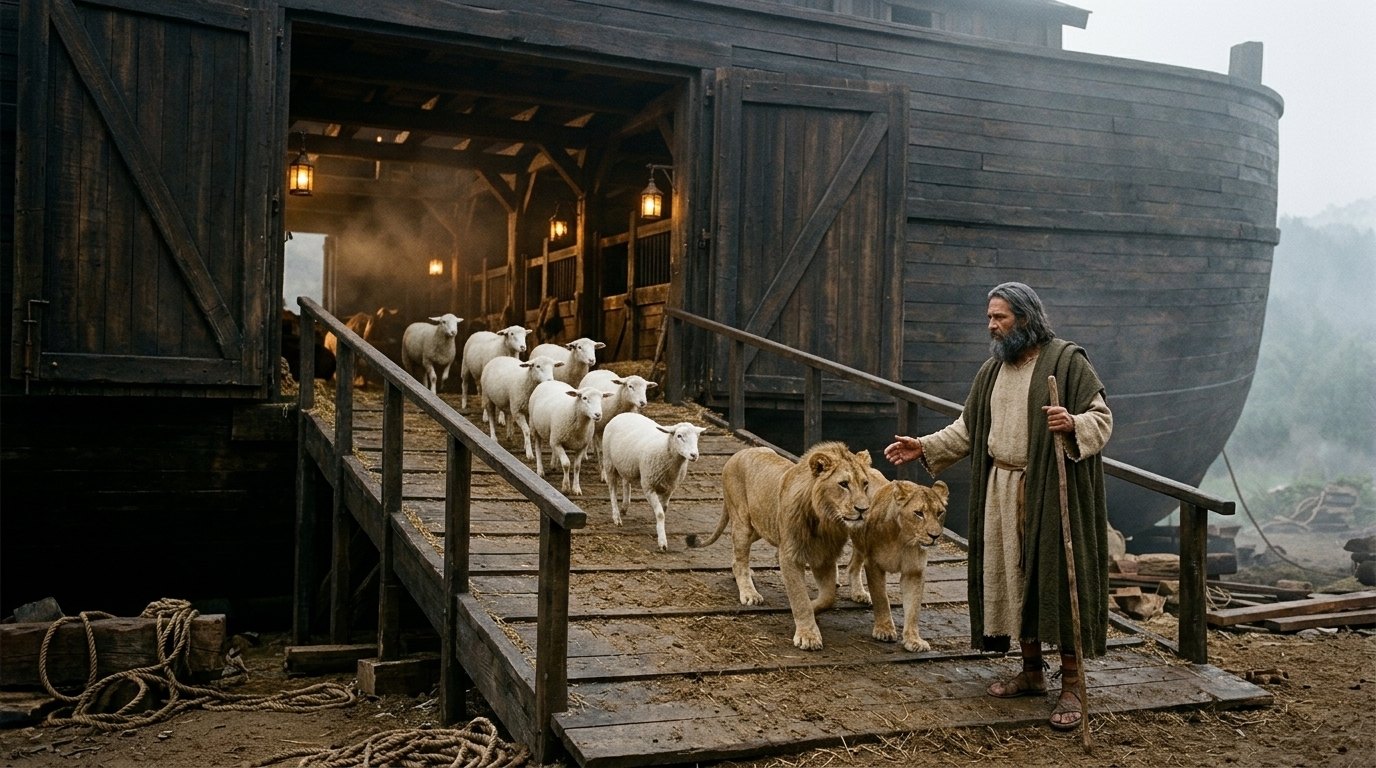
Take with you seven pairs of every kind of clean animal, a male and its mate, and one pair of every kind of unclean animal, a male and its mate,
Genesis 7:2 (NIV)
God distinguishes between clean animals taken in sevens and unclean animals preserved in single pairs.
God established specific numerical counts for each group of animals boarding the vessel. In Genesis 7:2, the Lord commanded: "You shall take with you seven each of every clean animal, a male and his female; two each of animals that are unclean, a male and his female." The additional clean animals were designated for post-flood sacrifices of worship and immediate sustenance before newly planted crops and livestock herds could mature.
Scripture extends this expanded count to birds as well. In Genesis 7:3, Noah was instructed to bring clean winged fowl "also seven each of the birds of the air, male and female, to keep the species alive on the face of all the earth." Because clean animals and birds made up a small fraction of overall terrestrial kinds, this additional census added only a modest volume to the overall load.
Noah did not have to scour the continents to locate these specimens. Genesis 7:8-9 and Genesis 7:15 make clear that clean and unclean animals, creeping creatures, and birds "went into the ark to Noah, two by two, as God had commanded." Just as God directed the creatures into existence at creation, He instinctively guided each chosen pair—most likely juvenile or young specimens whose smaller size, lesser food intake, and longer future reproductive life made them ideal for the journey—directly into the waiting rooms.
| Passage | What it says |
|---|---|
| Genesis 7:2 | Noah is instructed to take clean beasts by sevens, male and female, and unclean beasts by twos. |
| Genesis 7:3 | Birds of the air are to be taken by sevens, male and female, to preserve their seed on earth. |
| Genesis 7:8-9 | Pairs of clean and unclean beasts, birds, and creeping things go into the ark to Noah as God commanded. |
| Genesis 7:15 | Representatives of all flesh possessing the breath of life enter the ark in pairs. |
Sovereign Provision
God Gathered the Animals and Sustained Them
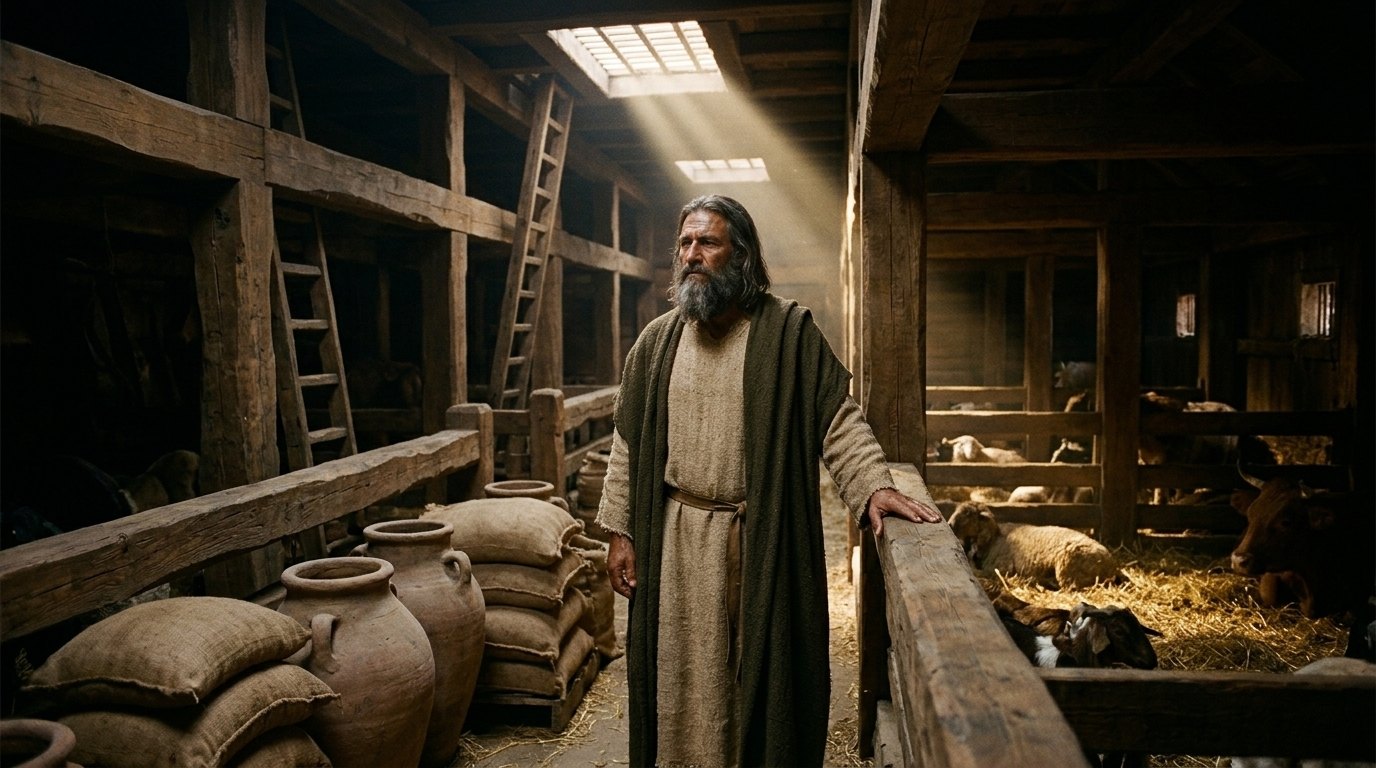
The animals going in were male and female of every living thing, as God had commanded Noah. Then the LORD shut him in.
Genesis 7:16 (NIV)
After the animals enter under God's sovereign guidance, the Lord Himself shuts the door of the ark.
The preservation of life aboard the ark was sustained throughout by God's sovereign hand. In Genesis 7:16, Moses records the decisive culmination of the boarding process: "So those that entered, male and female of all flesh, went in as God had commanded him; and the Lord shut him in." God Himself sealed the single massive door, protecting the inhabitants against the raging deluge and securing the integrity of the vessel.
Practical human obedience accompanied divine provision. According to Genesis 6:21-22, Noah obeyed God's command to gather and store "all food that is eaten" for his family and the animal cargo. With eight human caretakers on board (Genesis 7:7; 1 Peter 3:20), dried grains, seeds, fodder, and stored water filled the remaining capacity of the spacious decks. The Lord who commanded the voyage sustained life within, fulfilling the ancient truth of Psalms 36:6 that "Lord, You preserve man and beast."
When the waters finally abated, Genesis 8:1 notes that "God remembered Noah, and every living thing, and all the animals that were with him in the ark." Under divine command, Noah opened the doors in Genesis 8:15-19, and as promised in Genesis 8:17, every creature came forth "family by family" to breed abundantly, recolonize the continents, and repopulate the post-diluvian world.
| Passage | What it says |
|---|---|
| Genesis 6:21 | Noah is directed to gather and store every sort of edible food to sustain his family and the animals. |
| Genesis 6:22 | Noah completes all preparations exactly as God commanded him. |
| Genesis 7:16 | Those that entered went in male and female of all flesh, and the Lord shut Noah in. |
| Psalms 36:6 | The psalmist proclaims that the Lord faithfully preserves both man and beast in His righteous judgment. |
| Genesis 8:1 | God remembers Noah and all the beasts and livestock that were with him inside the ark. |
| Genesis 8:17 | God commands Noah to bring out every living creature to breed abundantly and multiply upon the earth. |
| Genesis 7:7 | Noah, his sons, his wife, and his sons' wives entered the ark with the animals to care for them. |
| Genesis 8:15-19 | Every animal, creeping thing, and bird left the ark family by family after God remembered and preserved them. |
| 1 Peter 3:20 | God waited patiently in the days of Noah while the ark was prepared, preserving eight human souls safely inside. |
Where in the Bible
| Book | Passages |
|---|---|
| Genesis | 20 · Genesis 6:14, Genesis 6:15, Genesis 6:16, Genesis 1:24-25, Genesis 6:19, Genesis 6:20, Genesis 7:14, Genesis 1:21, Genesis 7:21-23, Genesis 7:2, Genesis 7:3, Genesis 7:8-9, Genesis 7:15, Genesis 6:21, Genesis 6:22, Genesis 7:16, Genesis 8:1, Genesis 8:17, Genesis 7:7, Genesis 8:15-19 |
| Psalms | 1 · Psalms 36:6 |
| 1 Peter | 1 · 1 Peter 3:20 |
The story in order
- God creates living creatures (c. 4004 BC) · Genesis 1:24-25 · Establishes the principle of distinct created kinds.
- God commands Noah to build the ark (c. 2348 BC) · Genesis 6:14 · God gives specific instructions for the ark's construction.
- God gives ark dimensions and features (c. 2348 BC) · Genesis 6:15-16 · Details the size and structure of the vessel.
- Noah instructed to gather food (c. 2348 BC) · Genesis 6:21 · Provisioning for sustenance of all aboard.
- Noah commanded to bring animals (c. 2348 BC) · Genesis 6:19 · Two of every kind to be brought for preservation.
- Noah takes clean animals by sevens (c. 2348 BC) · Genesis 7:2 · Specific numbers for clean and unclean animals.
- Animals enter the ark (c. 2348 BC) · Genesis 7:14 · Animals come to Noah by their kinds.
- The Lord shuts Noah in (c. 2348 BC) · Genesis 7:16 · Divine sealing of the ark for protection.
- The flood destroys life on land (c. 2348 BC) · Genesis 7:21-23 · Defines what life needed preservation.
- God remembers Noah and the ark (c. 2347 BC) · Genesis 8:1 · God's faithful preservation of those inside.
- Animals leave the ark (c. 2347 BC) · Genesis 8:17 · Command to multiply and fill the earth.
- Peter reflects on Noah's preservation (c. AD 60-64) · 1 Peter 3:20 · Highlights God's patient preservation through the flood.
Key words
- Kind (min, מִין)
- A distinct category of created life, established by God, with boundaries for reproduction. · Genesis 1:24
- Ark (tevah, תֵּבָה)
- The massive vessel constructed by Noah under God's specific instructions to preserve life during the flood. · Genesis 6:14
- Pitch (kopher, כֹּפֶר)
- A waterproof substance used to seal the ark, inside and out. · Genesis 6:14
- Cubit (ammah, אַמָּה)
- An ancient unit of measurement, approximately the length from the elbow to the fingertips. · Genesis 6:15
The historical account of the ark demonstrates that God's judgment is accompanied by an all-sufficient, carefully designed refuge for those who trust His word. Just as the ark securely preserved man and beast through the waters of destruction, Christ stands as the sole, perfect shelter who preserves all who come to Him from the judgment to come.
22 passages, each cited once.
Scripture cited
- Genesis 7:2-3
- Genesis 6:14-16
- Genesis 7:1-16