Who was Hagar?
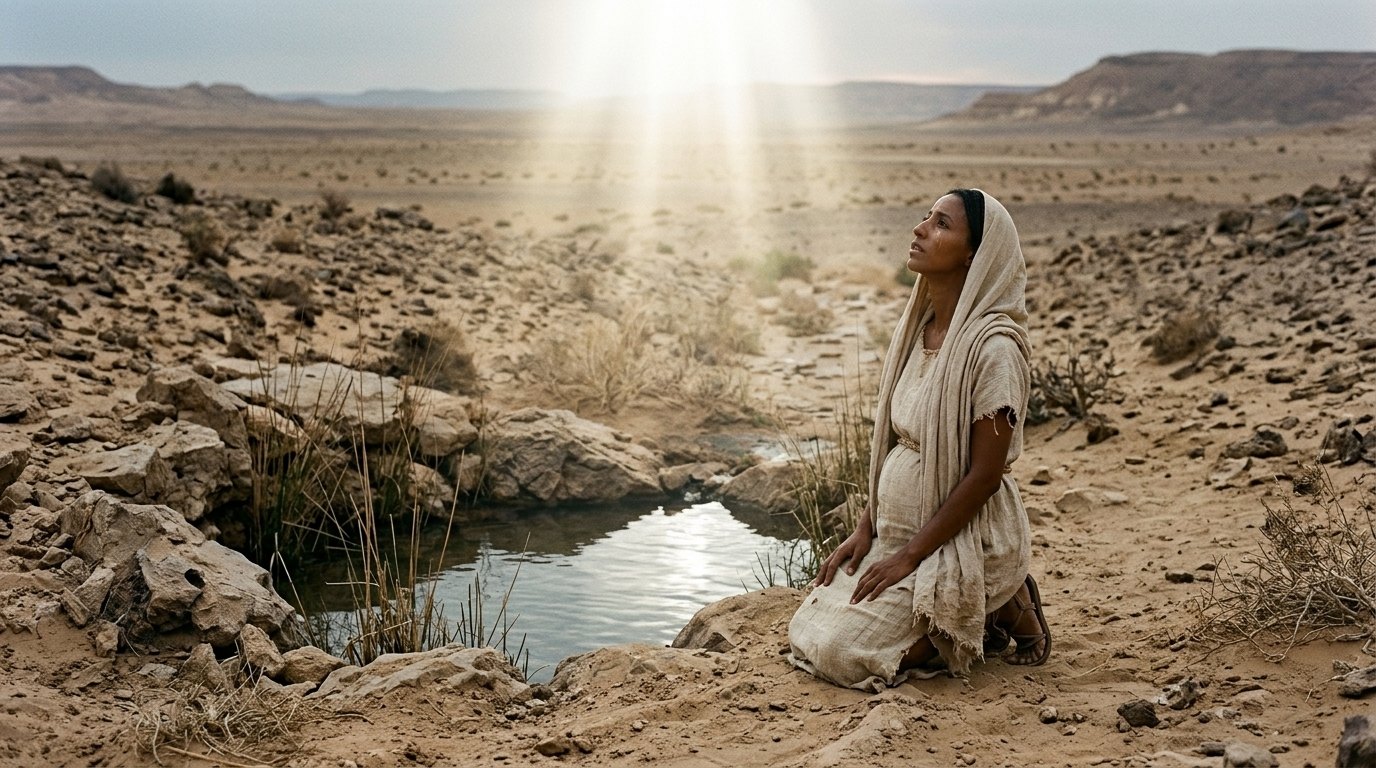
Genesis 16:7-13
7 The angel of the LORD found Hagar near a spring in the desert; it was the spring that is beside the road to Shur.
8 And he said, “Hagar, slave of Sarai, where have you come from, and where are you going?” “I’m running away from my mistress Sarai,” she answered.
9 Then the angel of the LORD told her, “Go back to your mistress and submit to her.”
10 The angel added, “I will increase your descendants so much that they will be too numerous to count.”
11 The angel of the LORD also said to her: “You are now pregnant and you will give birth to a son. You shall name him Ishmael, for the LORD has heard of your misery.
12 He will be a wild donkey of a man; his hand will be against everyone and everyone’s hand against him, and he will live in hostility toward all his brothers.”
13 She gave this name to the LORD who spoke to her: “You are the God who sees me,” for she said, “I have now seen the One who sees me.”
New International Version (NIV)
The answer
Hagar was Sarah’s Egyptian servant, given to Abraham as a wife, and the mother of his first son, Ishmael. Her story is recorded chiefly in Genesis 16 and Genesis 21, where God repeatedly sees, hears, and cares for her in distress.
Her place in Abraham’s household
Because Sarai had borne no children, she gave her servant Hagar to Abram as a wife, hoping to obtain children through her. Hagar conceived, but then despised her mistress; Sarai treated her harshly, and Hagar fled into the wilderness (Genesis 16:1-6).
The angel of the LORD found her beside a spring on the way to Shur. He told her to return and submit to Sarai, promised to multiply her offspring greatly, and instructed her to name her son Ishmael, “because Yahweh has heard your affliction.” Hagar responded by calling the LORD who spoke to her “You are a God who sees.” The well was consequently named Beer Lahai Roi (Genesis 16:7-14). She returned and bore Ishmael when Abram was eighty-six years old (Genesis 16:15-16).
Her dismissal and God’s care
Years later, after Isaac was born and weaned, Sarah saw Ishmael mocking and demanded that Hagar and her son be sent away, declaring that Ishmael would not inherit with Isaac. Abraham was deeply grieved, but God told him to listen to Sarah: his covenant offspring would be named through Isaac, while Ishmael would also become a nation because he was Abraham’s son (Genesis 21:8-13).
Hagar and Ishmael wandered in the wilderness of Beersheba until their water was gone. Expecting her son to die, Hagar wept, but God heard the boy’s voice. His angel called to her, told her not to fear, and renewed the promise to make Ishmael a great nation. God then opened her eyes to a well of water. Ishmael grew up under God’s care, became an archer, lived in the wilderness of Paran, and married an Egyptian woman (Genesis 21:14-21).
Her significance in the New Testament
Paul uses Hagar and Sarah’s history as an allegory of two covenants. Hagar corresponds to Mount Sinai, bearing children into bondage and answering to the earthly Jerusalem; the free Jerusalem above is the mother of God’s people (Galatians 4:22-26). Christians are therefore identified with Isaac as children of promise, not children of the servant: “So then, brothers, we are not children of a servant, but of the free woman” (Galatians 4:28-31).
Answered from Scripture · reviewed November 12, 2026
Scripture cited
- Genesis 16:1-16
- Genesis 21:8-21
- Galatians 4:21-31