Who was Esau?
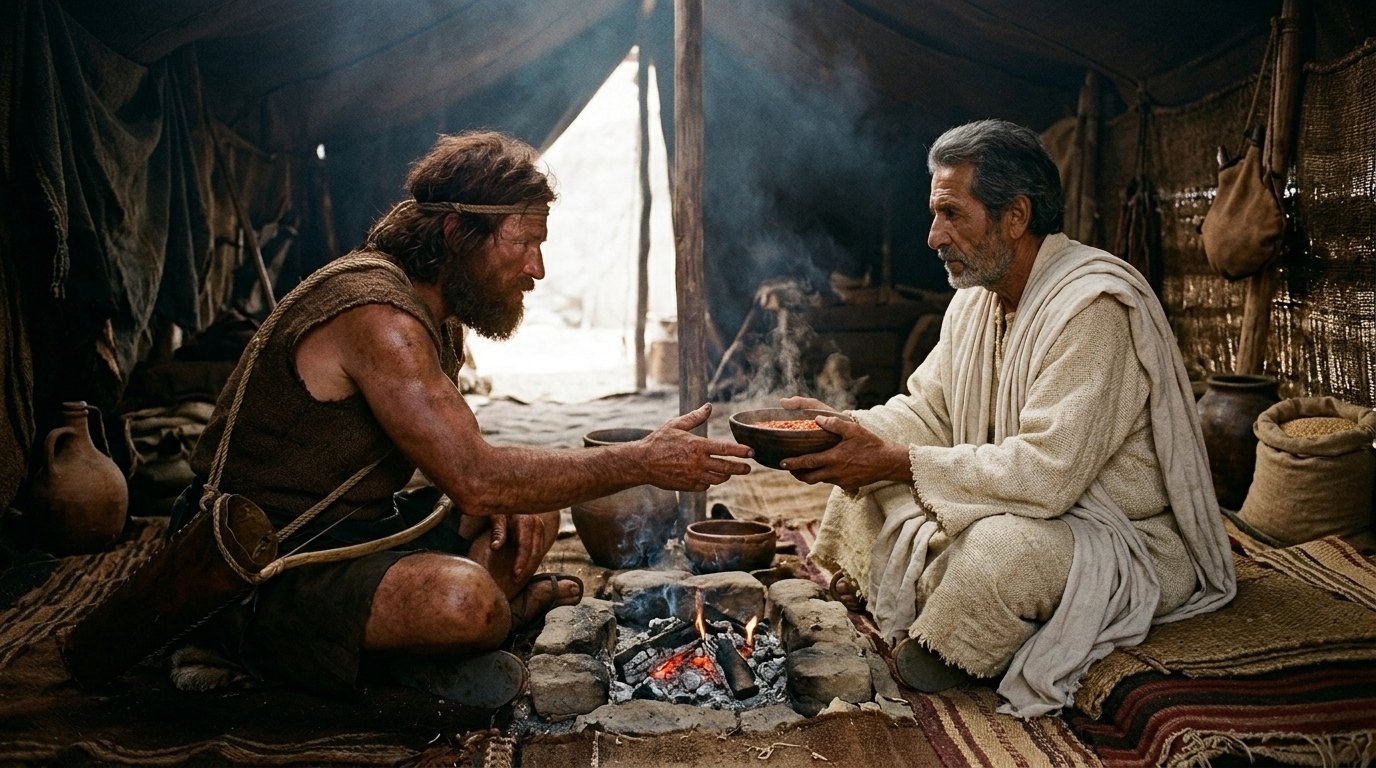
Genesis 25:29-34
29 Once when Jacob was cooking some stew, Esau came in from the open country, famished.
30 He said to Jacob, “Quick, let me have some of that red stew! I’m famished!” (That is why he was also called Edom.)
31 Jacob replied, “First sell me your birthright.”
32 “Look, I am about to die,” Esau said. “What good is the birthright to me?”
33 But Jacob said, “Swear to me first.” So he swore an oath to him, selling his birthright to Jacob.
34 Then Jacob gave Esau some bread and some lentil stew. He ate and drank, and then got up and left. So Esau despised his birthright.
New International Version (NIV)
The answer
Esau was the firstborn son of Isaac and Rebekah, the older twin brother of Jacob, a grandson of Abraham, and the ancestor of the Edomites. His story appears chiefly in Genesis 25–36.
- His birth and character: Before the twins were born, God told Rebekah that two nations would come from her and that “the elder will serve the younger” (Genesis 25:23). Esau was born red and hairy, followed by Jacob. He grew into “a skillful hunter, a man of the field,” while Jacob was a quieter man who lived in tents. Isaac favoured Esau, while Rebekah loved Jacob (Genesis 25:25-28).
- He sold his birthright: Returning famished from the field, Esau asked Jacob for some red stew. Jacob demanded Esau’s rights as firstborn in exchange, and Esau formally sold them with an oath for bread and lentil stew. Because of the red stew, he was also called Edom, meaning “red.” Genesis gives God’s verdict on the transaction: “So Esau despised his birthright” (Genesis 25:29-34). Jacob’s craftiness was wrong, but Esau was still responsible for treating his inheritance as worth less than an immediate meal.
- He lost Isaac’s blessing: Years later, Jacob deceived his father and received the blessing Esau expected. This was a separate event from the sale of the birthright. Esau wept bitterly, accused Jacob of supplanting him twice, and then planned to kill him after Isaac’s death (Genesis 27:30-41).
- He was later reconciled with Jacob: When the brothers met again, Esau did not attack him. Instead, “Esau ran to meet him, embraced him, fell on his neck, kissed him, and they wept” (Genesis 33:4).
- He became the father of Edom: Esau eventually settled in the hill country of Seir. Scripture twice identifies him with the nation that descended from him: “Esau is Edom” (Genesis 36:1-8).
The New Testament remembers Esau as a warning. Hebrews 12:16 calls him a “profane person” because he sold his birthright for one meal; his later tears did not recover the lost blessing (Hebrews 12:17). His life warns against valuing immediate appetite above God’s gifts and assuming that careless choices will never have lasting consequences.
Answered from Scripture · reviewed November 12, 2026
Scripture cited
- Genesis 25:29-34
- Genesis 25:19-28
- Genesis 27:30-41
- Genesis 33:1-11
- Genesis 36:1-8
- Hebrews 12:14-17