What are the Dead Sea Scrolls?
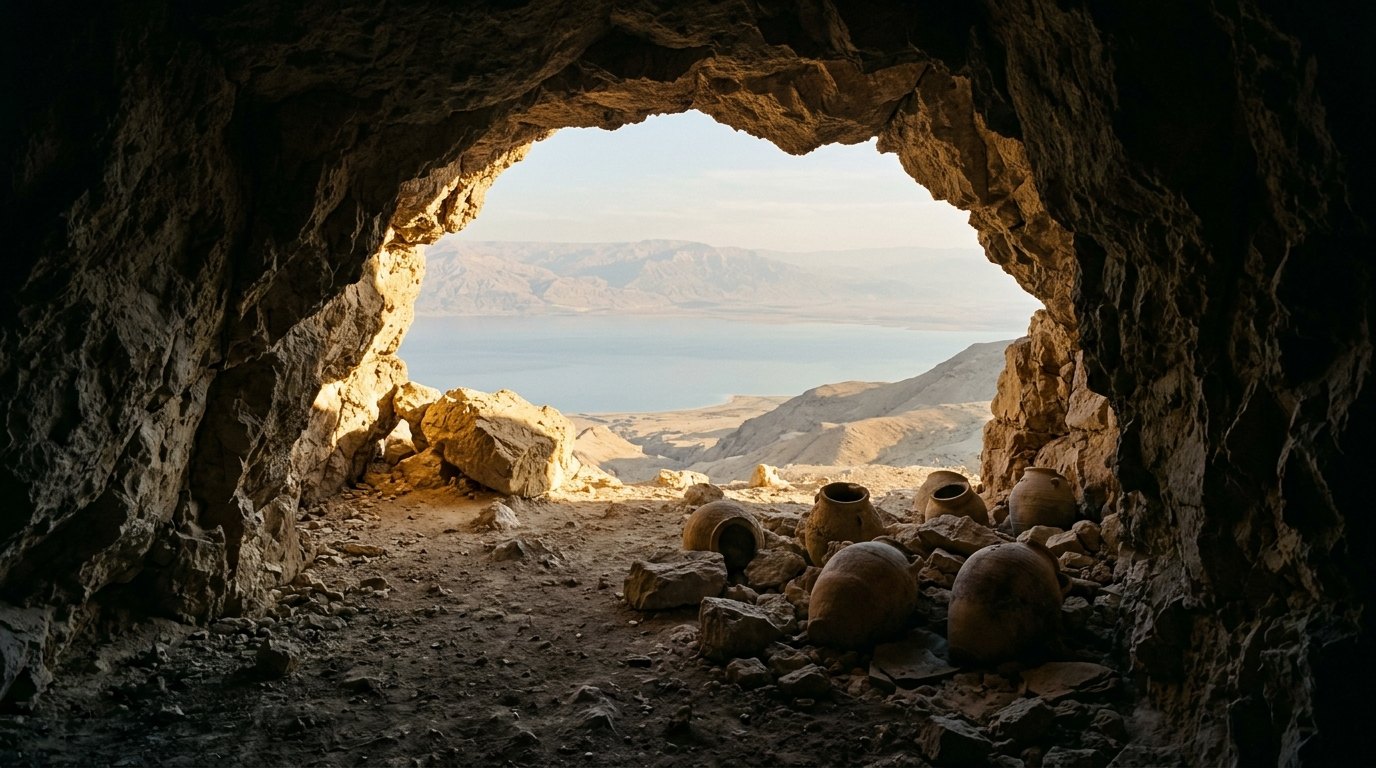
Isaiah 40:8
8 The grass withers and the flowers fall, but the word of our God endures forever.”
New International Version (NIV)
The answer
The Dead Sea Scrolls are ancient Jewish manuscripts discovered near the Dead Sea, mostly dating from about the third century BC to the first century AD. They include the oldest known surviving copies of many Old Testament writings, but they are not a replacement Bible or a collection of Christian gospels.
The first discoveries were made in 1947 in caves near Qumran, with further discoveries following in surrounding caves and other locations near the Dead Sea. Most were written in Hebrew, with some in Aramaic and Greek. Many survive only as fragments.
What they contain
- Old Testament manuscripts: Portions of nearly every Old Testament book were found. The best-known example is the Great Isaiah Scroll, a nearly complete copy of Isaiah.
- Other Jewish religious writings: These include works such as Jubilees, 1 Enoch and Sirach, as well as interpretations of biblical books.
- Community writings: Rules, prayers, hymns and other documents shed light on a Jewish community commonly associated with Qumran. Its members are often identified as Essenes, although some details of that identification remain debated.
The presence of a religious book among the scrolls does not itself make that book Scripture. Many of the non-biblical documents are valuable chiefly for understanding Jewish life and thought before and during the time of Jesus.
Why they matter for the Bible
The scrolls allowed scholars to compare Old Testament manuscripts separated by roughly a thousand years. They show substantial continuity with the later Hebrew text, alongside the kinds of variations found in handwritten copies. They should therefore not be described as identical in every detail, but neither do they support the claim that the Old Testament was completely rewritten over the centuries. Variations among copies are not errors in the inspired originals.
Their archaeological value does not create Scripture’s authority; it supplies historical evidence of careful textual preservation. Isaiah 40:8 declares, “The grass withers, the flower fades; but the word of our God stands forever.” The scrolls also illuminate the religious world into which Jesus came, but they contain no New Testament book and do not disclose a hidden gospel.
Answered from Scripture · reviewed November 11, 2026
Discovered in desert caves between 1947 and 1956, the Dead Sea Scrolls represent the most significant biblical manuscript discovery in history. Dating from the third century BC to the first century AD, these ancient texts pushed our oldest Hebrew witnesses back more than a thousand years, offering tangible confirmation that God has faithfully preserved His inspired Word across generations.
The Unbroken Word
God's Word Stands Unshaken Through the Ages

The grass withers and the flowers fall, but the word of our God endures forever.”
Isaiah 40:8 (NIV)
This verse plainly declares that while all mortal life decays and fades, the divine word remains utterly permanent.
In Isaiah 40:8, the prophet sets forth an immovable contrast: the grass withers and the seasonal flower fades, but the word of our God will stand forever. Human empires decline, libraries crumble, and civilizations return to the dust of the earth, yet the living speech of God endures untouched by decay. The psalmist mirrors this absolute confidence in Psalm 119:89, declaring that God's word is firmly settled in heaven beyond the reach of earthly corruption, while Psalm 119:152 and Psalm 119:160 testify that His righteous judgments were founded of old to endure for all generations.
This preservation is never passive; it is the active, purposeful outworking of God's sovereign will. Just as rain waters the soil to yield bread, Isaiah 55:10–11 guarantees that the Lord's word will accomplish everything He pleases without returning void. The Apostle Peter takes up these ancient promises in 1 Peter 1:24–25, reminding the church that while mortal flesh passes away like common grass, the enduring word of the Lord is the very gospel preached across every generation.
Scripture's durability rests upon its purity. In Psalm 12:6–7, the words of the Lord are described as pure silver refined in an earthen furnace seven times, coupled with the divine pledge that the Lord Himself will preserve His speech forever. The discovery of ancient manuscripts like the Dead Sea Scrolls merely unearths what God had already promised to keep: an unbroken, uncorrupted witness to His truth.
| Passage | What it says |
|---|---|
| Isaiah 40:8 | Proclaims that earthly glory withers like grass, but the Word of God endures forever. |
| Psalms 119:89 | Affirms that God's Word is forever established and settled securely in the heavens. |
| Isaiah 55:10 | Compares God's speech to rain watering the earth, never returning void without accomplishing His desire. |
| Isaiah 55:11 | Guarantees that the spoken and written decree of the Lord will achieve every divine purpose. |
| 1 Peter 1:24 | Cites Isaiah to remind believers that mortal flesh withers like seasonal vegetation. |
| 1 Peter 1:25 | Identifies the enduring Word of the Lord with the gospel proclaimed to the church. |
| Psalms 12:6 | Affirms the pure words of the Lord, tested like silver in a furnace of earth, refined seven times. |
| Psalms 12:7 | Promises that the Lord will keep and preserve His words from generation unto generation forever. |
| Psalms 119:152 | Testifies that God established His ancient testimonies of old to endure forever. |
| Psalms 119:160 | Declares that the entirety of God's word is truth, enduring in righteousness through every age. |
Jot and Tittle
Christ Testified to the Exact Preservation of Scripture
For truly I tell you, until heaven and earth disappear, not the smallest letter, not the least stroke of a pen, will by any means disappear from the Law until everything is accomplished.
Matthew 5:18 (NIV)
Jesus asserts that not even the smallest stroke of the Hebrew text will vanish until all is fulfilled.
In Matthew 5:18, Jesus leaves no room for doubt regarding the meticulous preservation of divine revelation: not one jot or tittle will pass from the Law until every single decree is brought to its appointed fulfillment. A jot represents the yod, the smallest letter of the Hebrew alphabet, while a tittle refers to the tiniest pen stroke distinguishing one consonant from another. In Matthew 5:17, Christ established that His mission was not to abolish this sacred deposit, but to fulfill it completely, emphasizing in Luke 16:17 that it is easier for the cosmos to pass away than for the smallest stroke of the Law to fail.
Our Lord consistently treated the written text of Scripture as an absolute and immovable authority. Proclaiming that heaven and earth will vanish, but My words will not pass away (Matthew 24:35; Mark 13:31), He grounded our faith upon God's unchanging communication. In John 10:35, Jesus declared flatly that the Scripture cannot be broken, anchoring His theological arguments in the exact wording of the ancient manuscripts.
This profound preservation reflects the divine origin of the text itself. In Romans 3:2, Paul explains that the Jewish people were entrusted with the very oracles of God, guarding them with scrupulous fidelity. Because all Scripture is breathed out by God (2 Timothy 3:16), human writers did not invent prophecies of their own accord; rather, men spoke from God as they were carried along by the Holy Spirit (2 Peter 1:21).
| Passage | What it says |
|---|---|
| Matthew 5:17 | Declares that Christ came not to abolish the Law or Prophets, but to fulfill them. |
| Matthew 5:18 | States that the smallest Hebrew letter or pen stroke will not pass until heaven and earth pass. |
| Matthew 24:35 | Assures the disciples that heaven and earth will vanish, yet His words will never perish. |
| Mark 13:31 | Reiterates the absolute durability of divine revelation over the passing creation. |
| Luke 16:17 | Affirms that it is easier for heaven and earth to pass than for one tittle of the Law to fail. |
| John 10:35 | Emphasizes the unbreakable authority of the Scripture delivered to God's covenant people. |
| Romans 3:2 | Reveals that the Jewish people were entrusted with the very oracles and scriptures of God. |
| 2 Timothy 3:16 | States that all Scripture is breathed out by God and profitable for doctrine and righteousness. |
| 2 Peter 1:21 | Explains that prophecy came not by human will, but men spoke from God carried by the Holy Spirit. |
The Desert Witness
Ancient Manuscripts Bear Testimony to the Messiah
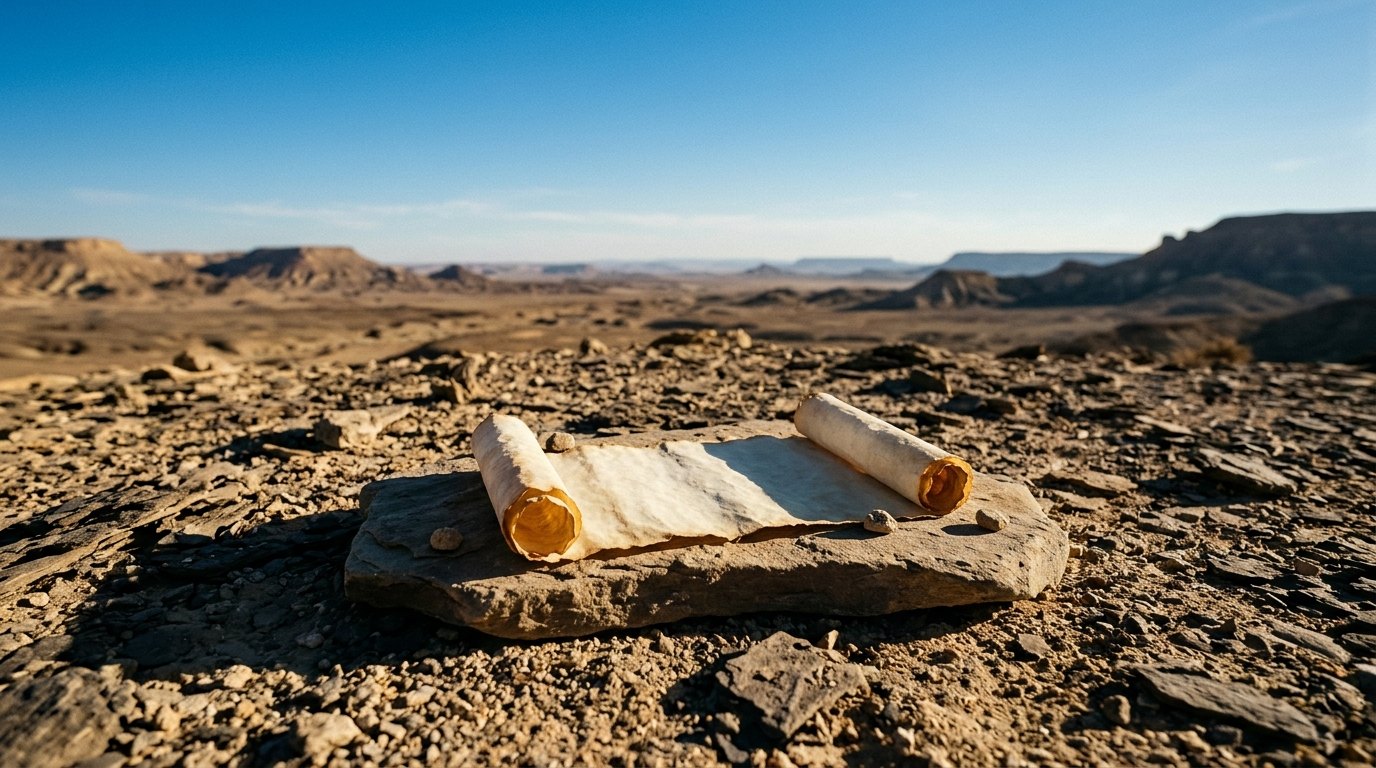
But he was pierced for our transgressions, he was crushed for our iniquities; the punishment that brought us peace was on him, and by his wounds we are healed.
Isaiah 53:5 (NIV)
Preserved fully intact in the Great Isaiah Scroll, this passage details the substitutionary piercing of the Messiah.
The discovery of the Great Isaiah Scroll at Qumran offered the world a pristine, complete Hebrew copy of Isaiah copied more than a century before the incarnation. Central to this desert treasure is Isaiah 53:5, which explicitly prophesies that the Messiah would be pierced for our transgressions and crushed for our iniquities, an exact portrait of Christ's substitutionary atonement fulfilled at Calvary (Romans 4:25; 1 Peter 2:24). In Isaiah 53:7, the prophet foresaw the Servant's silent submission as a lamb led to slaughter, fulfilled when Jesus stood before His accusers and brought salvation to the ends of the earth (Acts 8:32–35).
The wilderness scrolls corroborate the entire biblical tapestry of messianic expectation. Centuried before Bethlehem's star appeared, Isaiah 7:14 promised that a virgin would conceive and bear a son named Immanuel, fulfilled in the birth of Christ (Matthew 1:22–23). Isaiah 40:3 foretold a herald crying in the wilderness to prepare the Lord's highway, fulfilled in the fiery ministry of John the Baptist (Matthew 3:3; Mark 1:3; Luke 3:4).
Likewise, Psalm 22:16 captured the physical horror of the crucifixion centuries before Roman execution was practiced, foretelling that wicked men would pierce His hands and feet, fulfilled when Jesus showed His wounds to His disciples (John 19:37; John 20:25). Micah 5:2 named tiny Bethlehem as the birthplace of the eternal Ruler (Matthew 2:5–6). Alongside Genesis 3:15 and Daniel 9:26, these ancient manuscripts prove that every detail of Christ's redemptive work was preordained by God.
| Passage | What it says | Fulfilled |
|---|---|---|
| Isaiah 7:14 | Prophesies that a virgin shall conceive and bear a son called Immanuel. | Matthew 1:22-23 |
| Isaiah 40:3 | Announces a voice crying in the wilderness to prepare the way of the Lord. | Matthew 3:3, Mark 1:3, Luke 3:4 |
| Isaiah 53:5 | Foreteells that the Servant would be pierced for our transgressions and crushed for our iniquities. | Romans 4:25, 1 Peter 2:24 |
| Isaiah 53:7 | Describes the silent submission of the Servant led like a lamb to the slaughter. | Acts 8:32-35 |
| Psalms 22:16 | Depicts evildoers piercing the hands and feet of God's righteous sufferer. | John 19:37, John 20:25 |
| Micah 5:2 | Designates tiny Bethlehem Ephrathah as the ancient birthplace of Israel's eternal ruler. | Matthew 2:5-6 |
| Genesis 3:15 | The foundational messianic promise that the seed of the woman would crush the serpent's head. | |
| Daniel 9:26 | Prophesies that the Anointed One would be cut off before the destruction of the temple. |
Earthen Vessels
Scripture Stored in Clay Jars Endures for Generations
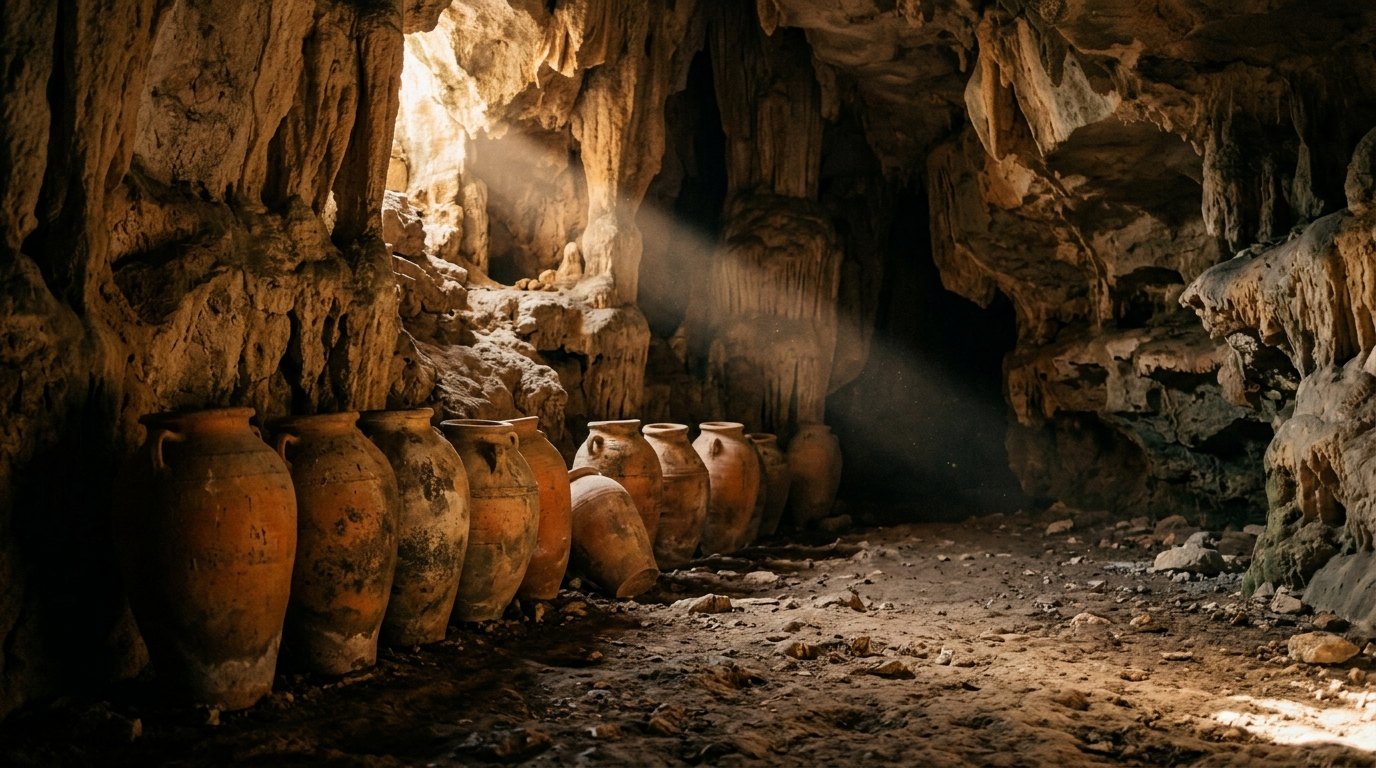
‘This is what the LORD Almighty, the God of Israel, says: Take these documents, both the sealed and unsealed copies of the deed of purchase, and put them in a clay jar so they will last a long time.
Jeremiah 32:14 (NIV)
It shows God's ancient instruction to preserve sacred writings in earthen jars so they survive for centuries.
The practical preservation of the Dead Sea Scrolls within dark desert caves mirrors an ancient, God-ordained practice recorded across the Old Testament. In Jeremiah 32:14, the Lord instructed the prophet to take the deed of purchase and place it in an earthenware jar so that it may last many days. In antiquity, fired pottery formed a durable, airtight fortress against the elements, protecting delicate animal-skin parchments from moisture, insects, and decay for millennia.
From the dawn of Israel's national life, God demanded the careful preservation and public custody of His written words. In Exodus 24:7, Moses took the Book of the Covenant and read it aloud to the assembled nation, sealing their covenant loyalty to the Lord. In Deuteronomy 31:26, Moses commanded the Levites to place the Book of the Law beside the Ark of the Covenant, establishing a secure, sacred archive that would testify to God's holiness throughout all generations.
The Lord never intended His truth to be lost to the fog of memory or oral drift. In Habakkuk 2:2, He commanded the prophet to write the vision clearly on durable tablets so that the reader might run with it. When Bedouin shepherds cast a stone into a dark cave in 1947 and heard shattering pottery, they stumbled upon this very biblical method: God using fragile clay vessels to preserve His eternal testimony for the modern world.
| Passage | What it says |
|---|---|
| Jeremiah 32:14 | Commands storing written legal deeds in earthenware vessels so they endure for many days. |
| Habakkuk 2:2 | Instructs the prophet to write the divine vision plainly on tablets for generations. |
| Exodus 24:7 | Records Moses reading the Book of the Covenant aloud in the audience of all the people. |
| Deuteronomy 31:26 | Commands the placement of the Book of the Law beside the ark of the covenant. |
Where in the Bible
| Book | Passages |
|---|---|
| Genesis | 1 · Genesis 3:15 |
| Exodus | 1 · Exodus 24:7 |
| Deuteronomy | 1 · Deuteronomy 31:26 |
| Psalms | 6 · Psalms 119:89, Psalms 12:6, Psalms 12:7, Psalms 119:152, Psalms 119:160, Psalms 22:16 |
| Isaiah | 7 · Isaiah 40:8, Isaiah 55:10, Isaiah 55:11, Isaiah 7:14, Isaiah 40:3, Isaiah 53:5, Isaiah 53:7 |
| Jeremiah | 1 · Jeremiah 32:14 |
| Daniel | 1 · Daniel 9:26 |
| Micah | 1 · Micah 5:2 |
| Habakkuk | 1 · Habakkuk 2:2 |
| Matthew | 3 · Matthew 5:17, Matthew 5:18, Matthew 24:35 |
| Mark | 1 · Mark 13:31 |
| Luke | 1 · Luke 16:17 |
| John | 1 · John 10:35 |
| Romans | 1 · Romans 3:2 |
| 2 Timothy | 1 · 2 Timothy 3:16 |
| 1 Peter | 2 · 1 Peter 1:24, 1 Peter 1:25 |
| 2 Peter | 1 · 2 Peter 1:21 |
The story in order
- The foundational messianic promise (c. 1450 BC) · Genesis 3:15 · God promises the seed of the woman will crush the serpent.
- God's Word established forever (c. 1000 BC) · Psalms 119:152 · God's testimonies are established to endure forever.
- Pure words tested and preserved (c. 1000 BC) · Psalms 12:6 · The Lord's words are pure, tested, and preserved forever.
- Prophecy of Immanuel (c. 700 BC) · Isaiah 7:14 · Foretells a virgin will conceive and bear a son.
- Voice crying in the wilderness (c. 700 BC) · Isaiah 40:3 · Announces a herald preparing the way of the Lord.
- Suffering Servant prophesied (c. 700 BC) · Isaiah 53:5 · The Servant would be pierced for our transgressions.
- Birthplace of the ruler (c. 700 BC) · Micah 5:2 · Bethlehem is named as the birthplace of Israel's ruler.
- Vision written on tablets (c. 600 BC) · Habakkuk 2:2 · The prophet is told to write the vision plainly.
- Deeds stored in vessels (c. 580 BC) · Jeremiah 32:14 · Written deeds are to be stored in jars to endure.
- Anointed One cut off (c. 500 BC) · Daniel 9:26 · Prophesies the Anointed One will be cut off.
- Christ fulfills the Law (c. AD 30) · Matthew 5:17 · Christ came to fulfill, not abolish, the Law and Prophets.
- Jesus' words endure forever (c. AD 30) · Matthew 24:35 · Heaven and earth will pass away, but His words will not.
- Scripture breathed out by God (c. AD 65) · 2 Timothy 3:16 · All Scripture is God-breathed and profitable.
- The gospel proclaimed (c. AD 65) · 1 Peter 1:25 · The enduring Word of the Lord is the gospel.
The Enduring Word of God
| Earthly glory fades | God's Word endures | Passage |
|---|---|---|
| Earthly glory withers like grass | The Word of our God stands forever | Isaiah 40:8 |
| Mortal flesh withers like grass | The Word of the Lord endures forever | 1 Peter 1:24 |
Christ's Affirmation of Scripture's Preservation
| Christ's teaching | Scripture's permanence | Passage |
|---|---|---|
| Came not to abolish the Law or Prophets, but to fulfill | The Law will not pass until all is accomplished | Matthew 5:17 |
| Not to abolish, but to fulfill | Smallest letter will not pass until all is accomplished | Matthew 5:18 |
| Heaven and earth will pass away | My words will never pass away | Matthew 24:35 |
| Easier for heaven and earth to pass | Than for one stroke of the Law to fail | Luke 16:17 |
| Scripture cannot be broken | Unbreakable authority of Scripture | John 10:35 |
Key words
- Scripture
- The inspired and inerrant Word of God, written by men guided by the Holy Spirit. · 2 Timothy 3:16
- Endures forever
- God's Word is established, settled, and will never pass away or fail. · Psalms 119:89
- God-breathed (theopneustos (θεόπνευστος))
- All Scripture originates directly from God through the Holy Spirit's inspiration. · 2 Timothy 3:16
- Tittle
- The smallest stroke or part of a Hebrew letter, signifying the precise preservation of Scripture. · Matthew 5:18
- Messianic Promise
- Prophetic declarations concerning the coming Savior, Jesus Christ. · Genesis 3:15
The scrolls preserved in the arid cliffs of Qumran show that the text believers read today is the very message recorded centuries before Christ walked the earth. Though kingdoms, cultures, and mortal generations crumble like dried grass, God has kept His promise: His Word endures, unchanged and unfailing, forever.
31 passages, each cited once.
Scripture cited
- Isaiah 40:8