What did Jesus look like?

Isaiah 53:2
2 He grew up before him like a tender shoot, and like a root out of dry ground. He had no beauty or majesty to attract us to him, nothing in his appearance that we should desire him.
New International Version (NIV)
The answer
Scripture gives no detailed physical portrait of Jesus. It records neither His height and build nor His hair, eye colour, or facial features. What it does reveal is that He was genuinely human and came without outward royal splendour. John 1:14 says, “The Word became flesh and lived among us,” and Philippians 2:7 says He was “made in the likeness of men.”
The clearest statement about His earthly appearance is Isaiah 53:2: “He has no good looks or majesty. When we see him, there is no beauty that we should desire him.” This describes His lowliness and lack of the visible majesty people might expect in the Messiah. It is not a feature-by-feature description, nor does it establish exactly what His face looked like. His arrest also fits an unremarkable human appearance: Judas had to identify Him to the arresting crowd with a kiss, as Matthew 26:48-50 records; He was not distinguished by some visibly unearthly form.
His suffering brought severe disfigurement. Isaiah 52:14 prophesies, “his appearance was marred more than any man, and his form more than the sons of men.” That belongs to the servant’s humiliation and suffering, rather than describing how Jesus ordinarily looked throughout His life. Detailed artistic portraits therefore go beyond anything Scripture records.
Answered from Scripture · reviewed November 11, 2026
Scripture provides no physical portrait of Jesus during His earthly life, withholding details of His height, hair, or facial features. Instead, God's Word reveals that He took on true human flesh without outward regal splendour or unearthly appearance, stepping into our world as an ordinary man. The biblical focus is never on His physical profile to be drawn, but on His true humanity, His suffering servant role, and His heavenly glory.
Ordinary Humanity
He Came in True Flesh Without Outward Splendour

He grew up before him like a tender shoot, and like a root out of dry ground. He had no beauty or majesty to attract us to him, nothing in his appearance that we should desire him.
Isaiah 53:2 (NIV)
It foretells that the Messiah would have no arresting outward majesty or physical beauty to compel desire on appearance alone.
The prophet Isaiah set down the definitive word on the Messiah's outward appearance centuries before His birth, declaring in Isaiah 53:2 that He had no form or majesty that we should look at Him, and no beauty that we should desire Him. Rather than stepping into history draped in the unmistakable splendour of earthly royalty or angelic grandeur, the eternal Son entered our fallen world in ordinary human frailty. The New Testament confirms this exact posture of divine humility, showing in Philippians 2:7 how He emptied Himself by taking the form of a servant and being born in the likeness of men. When the time came for His betrayal, Matthew 26:48-50 demonstrates that He blended so thoroughly with ordinary men that an armed arresting cohort needed an intimate sign from Judas simply to tell Him apart from His followers.
This lack of outward spectacle underscores the reality of the incarnation. As John 1:14 records, the eternal Word became flesh and tabernacled among us, possessing authentic human flesh rather than an ethereal or illusory guise. Paul affirms in Philippians 2:6-7 that Christ truly made Himself nothing, embracing human limitation. The writer of Hebrews stresses this essential solidarity in Hebrews 2:14, explaining that since children share in flesh and blood, Christ Himself likewise partook of the exact same nature to destroy the devil's power. He was not an untouchable monarch; Hebrews 2:17 states that He had to be made like His brothers in every respect to serve as a merciful and faithful High Priest. God accomplished our redemption by sending His own Son in the likeness of sinful flesh to condemn sin, as Romans 8:3 declares. In this authentic, unadorned flesh, God was manifest, seen of angels, and taken up into glory (1 Timothy 3:16).
| Passage | What it says | Fulfilled |
|---|---|---|
| Isaiah 53:2 | Prophesies that the Servant would have no regal form, good looks, or physical majesty to attract the natural eye. | Philippians 2:7, Matthew 26:48-50 |
| John 1:14 | Affirms that the eternal Word became flesh and dwelt among us, truly sharing human nature. | |
| Philippians 2:6-7 | Declares that Christ emptied Himself by taking the form of a servant and being born in the likeness of men. | |
| Hebrews 2:14 | Explains that because children share in flesh and blood, Christ likewise partook of the same human nature. | |
| Hebrews 2:17 | Notes that Jesus had to be made like His brothers in every respect, becoming a faithful High Priest. | |
| Romans 8:3 | God sent His own Son in the likeness of sinful flesh to condemn sin in the flesh. | |
| 1 Timothy 3:16 | God was manifest in the flesh, seen of angels, and received up into glory. |
Gospel Witness
His Unremarkable Appearance Among Ordinary Men
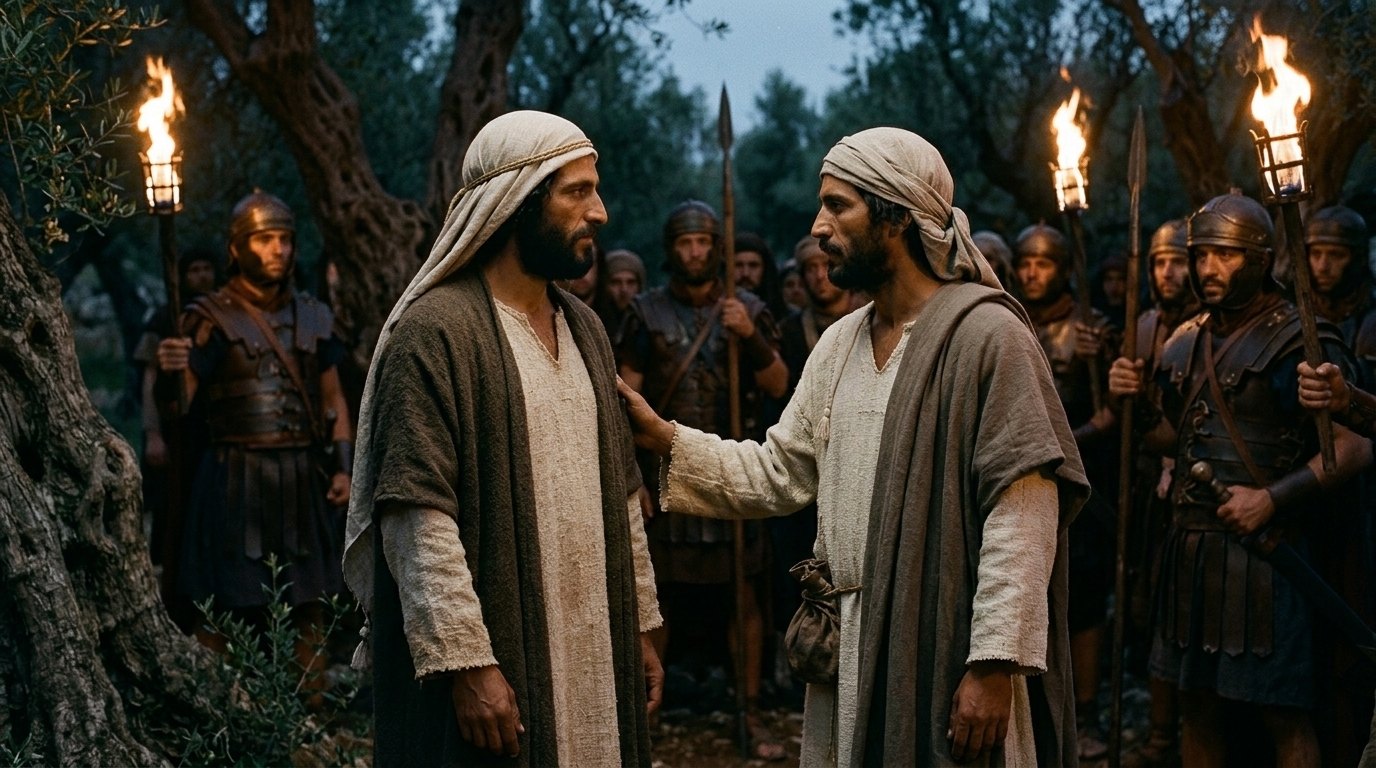
Now the betrayer had arranged a signal with them: “The one I kiss is the man; arrest him.” Going at once to Jesus, Judas said, “Greetings, Rabbi!” and kissed him.
Matthew 26:48-49 (NIV)
Judas had to give a sign to identify Jesus, proving He did not stand apart physically from His disciples.
The Gospels consistently portray Jesus walking among His contemporaries without any distinct, striking physical marker. In Matthew 26:48-50, Judas had to arrange a pre-arranged signal—a kiss—because the armed temple guards could not distinguish Jesus from the disciples in the dim torchlight of Gethsemane. If Jesus possessed an ethereal aura, unusual stature, or an unmistakable halo, no such betrayer's cue would have been necessary. His fellow villagers in Nazareth were similarly blinded by His ordinary presentation; Mark 6:3 records their blunt dismissal: 'Is not this the carpenter, the son of Mary?' They had watched Him mature for thirty years and saw nothing in His outward frame to indicate the Lord of glory.
Scripture describes a genuine human development. Luke 2:52 notes that Jesus increased in wisdom and in physical stature, growing through childhood just like any other boy of His time. The rigours of His earthly ministry and authentic human aging were visible on His face; in John 8:57, His opponents scoffed, 'You are not yet fifty years old, and have you seen Abraham?'—suggesting His weathered countenance bore the weight of human grief and toil. After His resurrection, His recognisable humanity remained evident. In John 20:15, Mary Magdalene turned and mistook the risen Lord for the cemetery gardener, while the two disciples on the road in Luke 24:15-16 walked and conversed alongside Him for miles, perceiving only a fellow traveller until their eyes were opened. He slipped through hostile crowds unnoticed (Luke 4:30), traveled to feasts quietly without public display (John 7:10), and stood on the morning shore of Galilee looking like any other bystander until His miracle revealed His identity (John 21:4).
| Passage | What it says |
|---|---|
| Matthew 26:48-50 | Judas identifies Jesus to the armed arresting crowd using a sign and a kiss, showing He blended with His disciples. |
| Mark 6:3 | Neighbors recognise Jesus merely as the local carpenter and Mary's son, offended by His ordinary village background. |
| Luke 2:52 | Records Jesus growing in wisdom, physical stature, and favour with God and men like any human child. |
| John 8:57 | Listeners observe Jesus is not yet fifty years old, indicating normal visible human aging and wear. |
| John 20:15 | Mary Magdalene mistakes the risen Jesus for the gardener outside the tomb, demonstrating His recognisable human form. |
| Luke 24:15-16 | Two disciples walk alongside Jesus on the road to Emmaus, seeing a fellow traveller before their eyes are opened. |
| Luke 4:30 | Jesus passed through the midst of a hostile crowd unseen by distinct appearance. |
| John 7:10 | Jesus went up to the feast not publicly but as it were in secret. |
| John 21:4 | The disciples standing on shore did not immediately know it was Jesus by sight. |
The Suffering Servant
His Visage Marred in Humiliation and Crucifixion
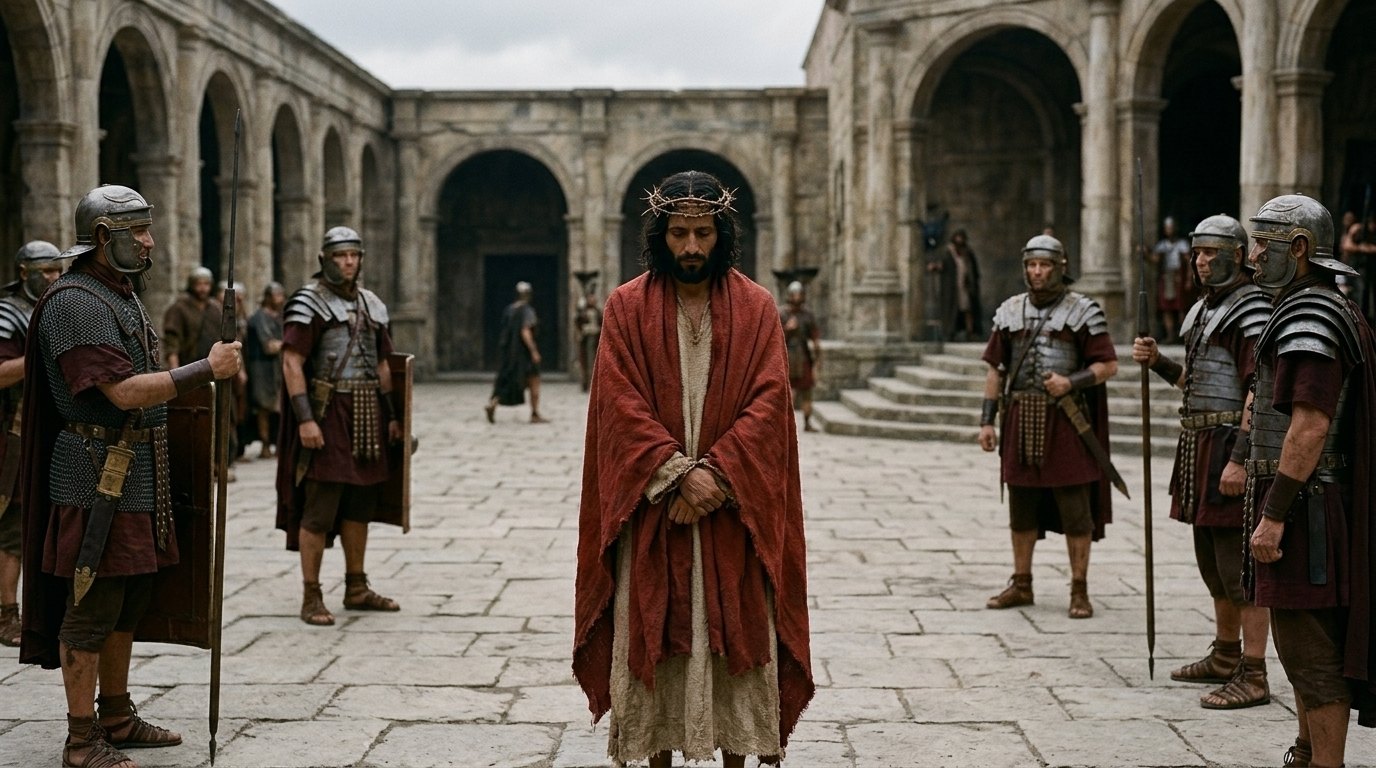
Just as there were many who were appalled at him— his appearance was so disfigured beyond that of any human being and his form marred beyond human likeness—
Isaiah 52:14 (NIV)
It prophesies the horrific physical toll of the passion, where Christ's appearance would be disfigured by human brutality.
While Scripture gives no description of Jesus' features in health, it provides a vivid, terrible record of what His body looked like during His passion. The prophet Isaiah spoke directly of His physical devastation in Isaiah 52:14: His appearance was so marred, beyond human semblance, and His form beyond that of the children of mankind. This horrific prophecy met literal fulfillment at the hands of Roman scourgers and temple guards in Matthew 27:26-30 and John 19:1-5, where the brutalized Lamb of God was beaten into an unrecognizable figure before being led away to be crucified.
Every wound had been mapped out in the prophetic Scriptures. Isaiah 50:6 foretold the physical shame: 'I gave My back to those who strike, and My cheeks to those who pull out the beard; I hid not My face from disgrace and spitting,' which came to pass in Matthew 26:67 and Mark 14:65 when the Sanhedrin struck Him with their fists and spat in His face. In Psalm 22:16-17, David recorded the agony of crucifixion: dogs surrounded Him, a pack of evildoers pierced His hands and His feet, and His body was so stretched that He could count all His bones while onlookers gloated. John 19:1-3 shows the soldiers pressing a jagged crown of thorns into His scalp and draping a purple robe over His torn back, leading Pilate to parade Him before the mob with the cry, 'Behold the man!' (John 19:5). Even in His resurrected victory, Jesus deliberately retained these physical scars, bidding Thomas in John 20:25-27 to place his fingers into the nail marks and his hand into His pierced side.
| Passage | What it says | Fulfilled |
|---|---|---|
| Isaiah 52:14 | Prophesies that His appearance and form would be marred beyond that of any man through suffering. | Matthew 27:26-30, John 19:1-5 |
| Isaiah 50:6 | Speaks of giving His back to those who strike, His cheeks to plucking, and hiding not His face from spit. | Matthew 26:67, Mark 14:65 |
| Psalms 22:16-17 | Describes pierced hands and feet and bones counted while an onlookers' crowd stares at His battered body. | John 19:34-37, John 20:25-27 |
| John 19:5 | Pilate presents Jesus wearing the crown of thorns and purple robe, visibly beaten before the crowd. | |
| Matthew 26:67 | They spat in His face and struck Him with their fists and open palms. | |
| Matthew 27:28-30 | They stripped Him, put on a scarlet robe and crown of thorns, and beat Him. | |
| John 19:1-3 | Pilate had Jesus scourged, and soldiers pressed a thorny crown onto His head. | |
| John 20:25-27 | The bodily marks of the nails and spear remained visible in His resurrected body. |
Glorified Vision
The Splendour of the Transfigured and Exalted Lord
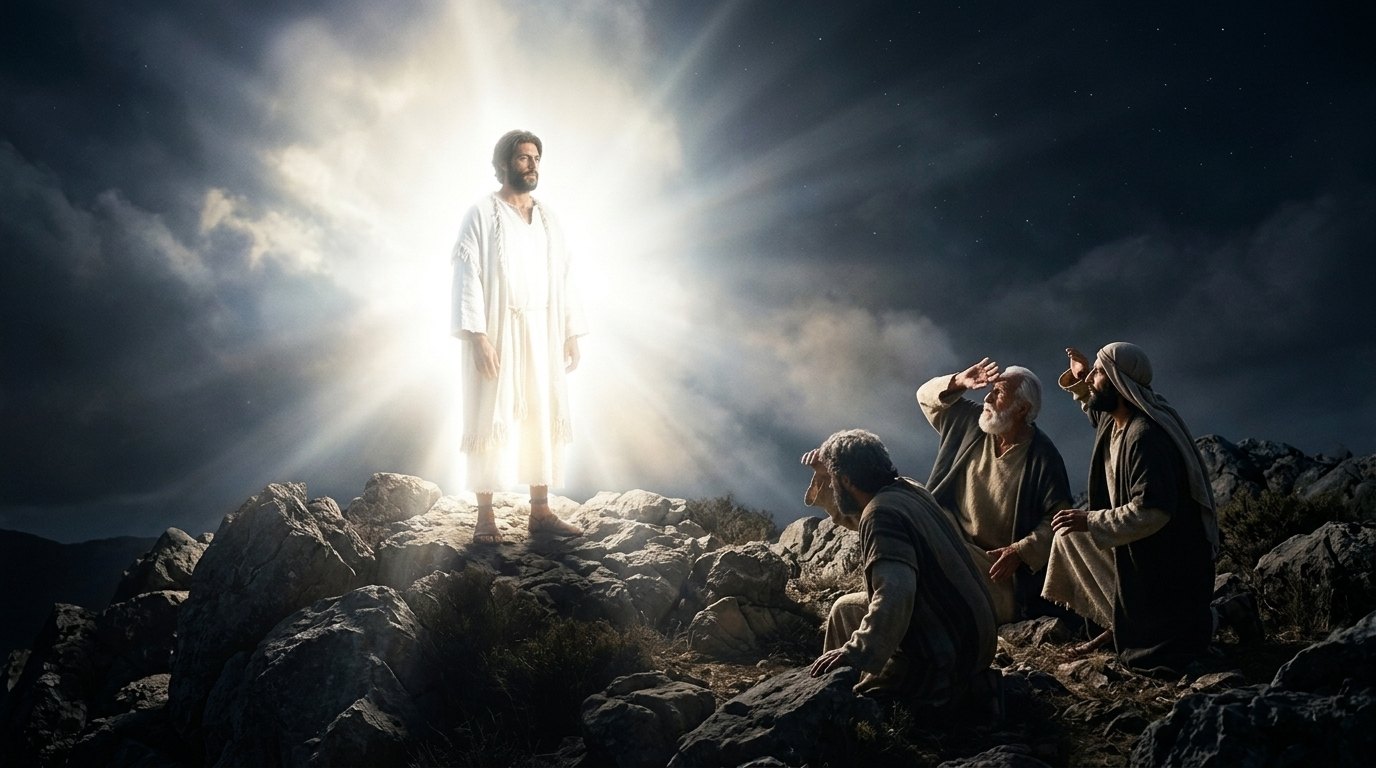
and among the lampstands was someone like a son of man, dressed in a robe reaching down to his feet and with a golden sash around his chest. The hair on his head was white like wool, as white as snow, and his eyes were like blazing fire. His feet were like bronze glowing in a furnace, and his voice was like the sound of rushing waters. In his right hand he held seven stars, and coming out of his mouth was a sharp, double-edged sword. His face was like the sun shining in all its brilliance.
Revelation 1:13-16 (NIV)
John sees the exalted Christ not in humble Galilee dust, but in radiant, apocalyptic holiness and divine power.
The humble, dusty appearance Jesus maintained during His earthly pilgrimage gives way in Scripture to the blinding majesty of His exalted, divine state. The Apostle John, who once reclined against Jesus' chest at the Last Supper, fell at His feet like a dead man when he saw Him in Revelation 1:13-16: His eyes were like a flame of fire, His feet were like burnished bronze, and His face was like the sun shining in full strength. The unvarnished humanity that concealed His deity during His earthly ministry was pulled back to show the ascended King of kings radiating unapproachable, eternal light.
This heavenly radiance was previewed during His earthly life at the Transfiguration. In Matthew 17:2, Mark 9:2-3, and Luke 9:29, Jesus took three disciples up a high mountain, and as He prayed, His face shone like the sun, and His clothing became dazzling white, flashing like lightning with a brilliance that no earthly launderer could match. When the risen Lord intercepted Saul on the road to Damascus in Acts 9:3-5, Acts 22:6-8, and Acts 26:13-15, the glory emanating from Jesus was brighter than the midday Syrian sun, immediately striking the persecutor blind. After completing His redemptive work and ascending into the clouds (Acts 1:9), Christ assumed the fullness of heavenly splendour. Revelation 19:11-13 depicts Him returning on a white horse, His eyes blazing with fire, crowned with many diadems, and cloaked in righteousness. As 1 John 3:2 comforts the church, our present ignorance of His earthly appearance matters little, for when He appears, we shall see Him as He truly is in this everlasting glory.
| Passage | What it says |
|---|---|
| Matthew 17:2 | At the Transfiguration, Jesus' face shines like the sun and His garments become dazzling white as light. |
| Acts 9:3-5 | A blinding light from heaven flashes around Saul on the Damascus road as the risen Lord speaks to him. |
| Acts 26:13-15 | Paul recounts seeing a midday light brighter than the sun shining around him and his companions. |
| Revelation 1:13-16 | John sees the Son of Man with eyes like fire, feet like polished bronze, and a face like the shining sun. |
| 1 John 3:2 | Promises believers that when Christ appears, we will be like Him, because we will see Him as He truly is. |
| Mark 9:2-3 | His clothes became radiant, intensely white, as no launderer on earth could bleach them. |
| Luke 9:29 | As He prayed, the appearance of His countenance changed and His clothing became flashing white. |
| Acts 1:9 | He was taken up into a cloud out of their physical sight into heaven. |
| Acts 22:6-8 | A bright heavenly light shone round Paul about noon as the risen Lord spoke. |
| Revelation 19:11-13 | His eyes are like a flame of fire, wearing many crowns and a robe dipped in blood. |
Daily Dress and Jewish Identity
His Attire and Observance as a Faithful Jewish Man
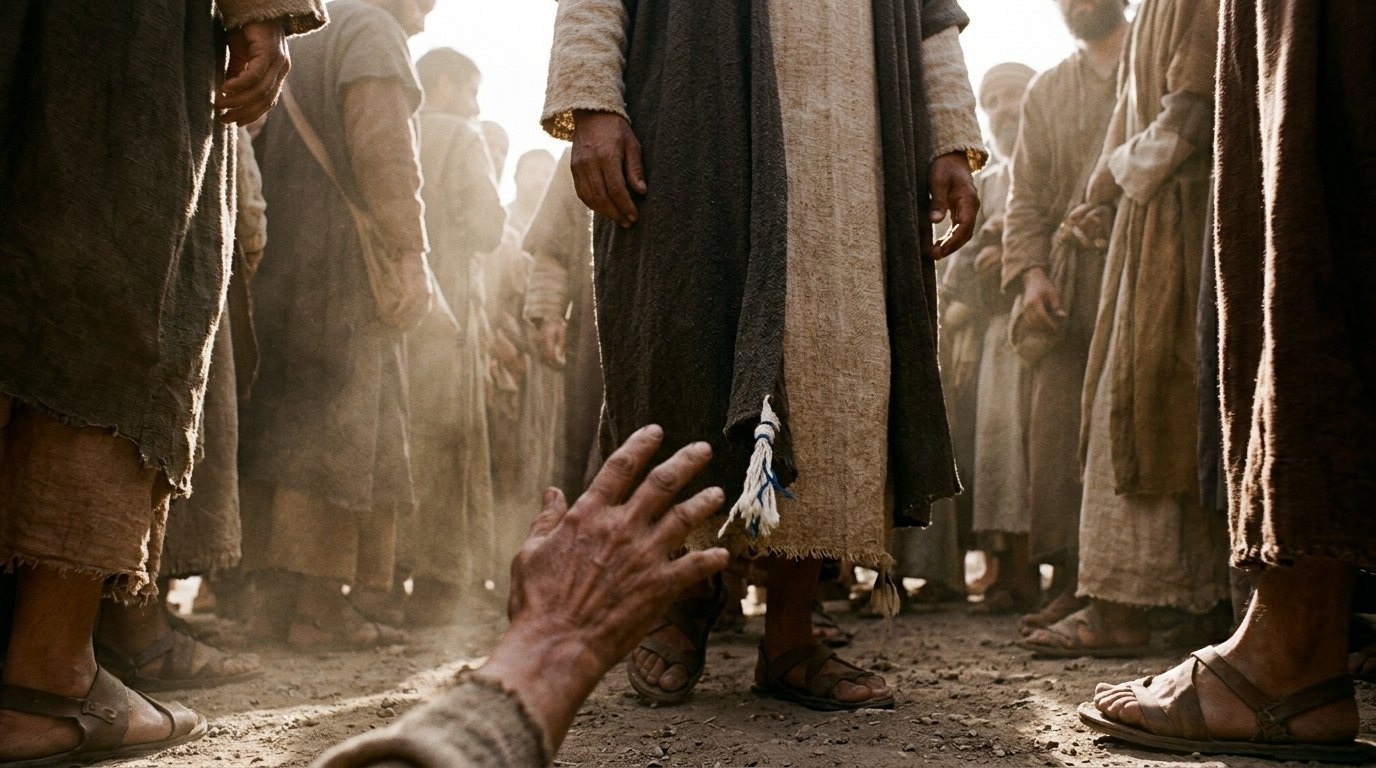
Just then a woman who had been subject to bleeding for twelve years came up behind him and touched the edge of his cloak.
Matthew 9:20 (NIV)
It confirms Jesus wore the traditional four-tasseled garment commanded of faithful Jewish men in Torah.
In Matthew 9:20, a woman suffering from a discharge of blood came up behind Jesus and touched the fringe of His garment, demonstrating that Christ walked among His contemporaries in the typical dress of an observant Jewish man. The Greek term used for this fringe, kraspedon, points directly to the four corner tassels (tzitzit) prescribed by Mosaic law. Rather than dressing in exotic, royal, or ascetic robes that set Him apart physically from ordinary citizens, the Incarnate Son took the form of a servant who lived under the Law.
This observable attire was rooted in the direct command of God. In Numbers 15:38-39, the Israelites were commanded to make tassels on the four corners of their outer cloaks throughout their generations, weaving in a cord of blue to remind them of all the commandments of the Lord. The New Testament records that Jesus faithfully observed this command, as seen when the afflicted woman touched the fringe in Matthew 9:20-21 and Luke 8:44. Similarly, His grooming conformed to the Law: Leviticus 19:27 instructed the men of Israel regarding their beards and hair, which Jesus kept blamelessly, being born under the Law to redeem those under the Law (Galatians 4:4).
Christ's ordinary attire served as a conduit of divine power through faith. In Matthew 14:36, whole multitudes begged merely to touch the fringe of His cloak, and all who touched it were completely healed. Even at His crucifixion, His ordinary garments reveal His humble, daily life: in John 19:23-24, the Roman soldiers divided His outer garments into four parts but cast lots for His inner tunic (chiton), which was woven without seam from the top throughout. Jesus looked like a faithful first-century Jewish craftsman and teacher, whose ordinary clothing clothed the holy power of the living God.
| Passage | What it says | Fulfilled |
|---|---|---|
| Numbers 15:38-39 | Israelites were commanded to make tassels on the corners of their garments with blue thread. | Matthew 9:20, Luke 8:44 |
| Leviticus 19:27 | Men of Israel were commanded not to round the corners of their beards or hair. | Galatians 4:4 |
| Matthew 9:20-21 | A woman touched the fringe or tassel of His outer garment in faith to be healed. | |
| Matthew 14:36 | Crowds begged to touch just the fringe of His garment and were completely restored. | |
| John 19:23-24 | His inner tunic was seamless, woven in one piece from top to bottom. |
Where in the Bible
| Book | Passages |
|---|---|
| Leviticus | 1 · Leviticus 19:27 |
| Numbers | 1 · Numbers 15:38-39 |
| Psalms | 1 · Psalms 22:16-17 |
| Isaiah | 3 · Isaiah 53:2, Isaiah 52:14, Isaiah 50:6 |
| Matthew | 6 · Matthew 26:48-50, Matthew 26:67, Matthew 27:28-30, Matthew 17:2, Matthew 9:20-21, Matthew 14:36 |
| Mark | 2 · Mark 6:3, Mark 9:2-3 |
| Luke | 4 · Luke 2:52, Luke 24:15-16, Luke 4:30, Luke 9:29 |
| John | 9 · John 1:14, John 8:57, John 20:15, John 7:10, John 21:4, John 19:5, John 19:1-3, John 20:25-27, John 19:23-24 |
| Acts | 4 · Acts 9:3-5, Acts 26:13-15, Acts 1:9, Acts 22:6-8 |
| Romans | 1 · Romans 8:3 |
| Philippians | 1 · Philippians 2:6-7 |
| 1 Timothy | 1 · 1 Timothy 3:16 |
| Hebrews | 2 · Hebrews 2:14, Hebrews 2:17 |
| 1 John | 1 · 1 John 3:2 |
| Revelation | 2 · Revelation 1:13-16, Revelation 19:11-13 |
The story in order
- Creation of Man and Woman (c. 4000 BC) · Genesis 1:27 · God made humanity male and female in His image.
- Israel's Law Given (c. 1450 BC) · Numbers 15:38-39 · Command to wear tassels on garments.
- Prophecy of Suffering Servant (c. 700 BC) · Isaiah 52:14 · His appearance marred beyond human recognition.
- Jesus' Birth and Childhood (c. 4 BC - AD 15) · Luke 2:52 · Jesus grew in stature and wisdom.
- Jesus' Ministry Begins (AD 27) · John 1:14 · The Word became flesh and dwelt among us.
- Jesus' Appearance to Saul (AD 33) · Acts 9:3-5 · Blinding light and voice from heaven.
- Transfiguration (AD 31) · Matthew 17:2 · Face shone like the sun, garments dazzling white.
- Arrest and Trial (AD 33) · Matthew 26:67 · Spit on, struck, and mocked.
- Crucifixion (AD 33) · John 19:5 · Presented with crown of thorns, visibly beaten.
- Resurrection Appearances (AD 33) · John 20:15 · Mary mistook Him for the gardener.
- Ascension (AD 33) · Acts 1:9 · Taken up into a cloud out of sight.
- Apostle Paul's Vision (AD 35) · Acts 26:13-15 · Midday light brighter than the sun.
- John's Vision of Christ (c. AD 95) · Revelation 1:13-16 · Eyes like fire, face like the sun.
Key words
- Flesh (sarx, σάρξ)
- True human nature, including its weaknesses and mortality. · John 1:14
- Likeness (homoíōma, ὁμοίωμα)
- Resemblance, similarity, indicating true humanity without sin's corruption. · Romans 8:3
- Appearance (eidos, εἶδος)
- Outward form, visage, or look. · Isaiah 53:2
- Splendor (megaleíōsis, μεγαλεῖωσις)
- Majesty, magnificence, outward glory. · Philippians 2:7
- Tassel (tsitsith, צִיצִית)
- Fringe on the corner of a garment, signifying obedience. · Numbers 15:38
Rather than satisfying human curiosity with an earthly portrait, Scripture points our eyes toward the reality of Christ's incarnation and the glory of His exaltation. He came in lowliness to bear our sins in His bruised body, so that we might fix our eyes on Him by faith. Today, we anticipate the day when faith turns to sight and we behold the exalted King face to face.
39 passages, each cited once.
Scripture cited
- Isaiah 53:2
- Isaiah 52:14
- John 1:10-14
- Philippians 2:6-8
- Matthew 26:47-50
- Isaiah 52:13-15