Who were the twelve tribes of Israel?
Genesis 49:28
28 All these are the twelve tribes of Israel, and this is what their father said to them when he blessed them, giving each the blessing appropriate to him.
New International Version (NIV)
The answer
The twelve tribes of Israel were the twelve sons of Jacob, each becoming the father of a tribal clan. Genesis 35:22-26 names them by their mothers, and Genesis 49:28 records that Jacob blessed each of them as the head of a tribe.
The twelve tribes (by their mothers)
- Leah's sons: Reuben, Simeon, Levi, Judah, Issachar, Zebulun (Genesis 35:23)
- Rachel's sons: Joseph, Benjamin (Genesis 35:24)
- Bilhah's sons (Rachel's servant): Dan, Naphtali (Genesis 35:25)
- Zilpah's sons (Leah's servant): Gad, Asher (Genesis 35:26)
Jacob's blessings in Genesis 49
Before he died, Jacob called each son in turn and spoke over him what would happen to his descendants — Reuben (49:3), Simeon and Levi (49:5-7), Judah (49:8-12), Zebulun (49:13), Issachar (49:14-15), Dan (49:16-18), Gad (49:19), Asher (49:20), Naphtali (49:21), Joseph (49:22-26), and Benjamin (49:27). Genesis 49:28 sums it up: "All these are the twelve tribes of Israel, and this is what their father spoke to them, and blessed them. He blessed everyone according to his own blessing."
Why they stayed twelve
When Joseph received a double portion in the land (his two sons, Ephraim and Manasseh, each became a tribal head), Levi was set apart for the priesthood and received no land allotment — so the tribal count held at twelve throughout Israel's history. Elijah later built an altar with twelve stones "according to the number of the tribes of the sons of Jacob" (1 Kings 18:31), and John saw 144,000 sealed "of all the tribes of the children of Israel" (Revelation 7:4), showing the twelve-tribed people of God carried through from Jacob's tent to the end.
Answered from Scripture · reviewed November 7, 2026
The twelve tribes of Israel were the patriarchal families descended from the twelve sons of Jacob, whom God renamed Israel. Across the unfolding narrative of Scripture, these twelve sons became twelve distinct tribal nations, sustained through wilderness wandering, land allotment, and prophetic history to mirror God's covenant order into the New Jerusalem.
The Patriarchal Sons
The Twelve Sons Born to Jacob
While Israel was living in that region, Reuben went in and slept with his father’s concubine Bilhah, and Israel heard of it. Jacob had twelve sons:
Genesis 35:22 (NIV)
This verse explicitly states for the first time in Scripture that the sons of Jacob were twelve, listing them by their mothers.
In Genesis 35:22, the sacred narrative pauses at a critical juncture to declare that now the sons of Jacob were twelve. This explicit summary marks the transition from a wandering family to the foundational patriarchs of God's covenant nation. The origins of these twelve sons began during Jacob's years in Paddan-aram. Leah bore the first four sons in succession: Reuben, Simeon, Levi, and Judah, each name reflecting her longing for affection and praise to God (Genesis 29:32-35). Rachel's maidservant Bilhah then bore Dan and Naphtali (Genesis 30:5-8), followed by Leah's maidservant Zilpah, who gave birth to Gad and Asher (Genesis 30:10-13). Leah later conceived again, bearing Issachar and Zebulun (Genesis 30:17-20). Finally, God remembered Rachel, who gave birth to Joseph (Genesis 30:22-24). The full roster was completed upon the family's return to Canaan, where Rachel died giving birth to Benjamin on the journey toward Ephrath (Genesis 35:16-18).
Scripture immediately codifies this holy structure in Genesis 35:23-26, formalizing the twelve brothers according to their four respective mothers. This sacred lineage carried the covenant promises forward when the family relocated to Egypt during the great famine. Exodus 1:1-5 meticulously catalogs the names of these twelve sons who went down into Egypt, numbering seventy souls who would multiply into a vast people. Centuries later, the chronicler reaffirms this historic framework in 1 Chronicles 2:1-2, listing the sons of Israel in order as the eternal ancestral fathers of the tribal commonwealth.
| Passage | What it says |
|---|---|
| Genesis 29:32-35 | Leah bears Jacob's first four sons: Reuben, Simeon, Levi, and Judah. |
| Genesis 30:5-8 | Bilhah, Rachel's servant, bears Dan and Naphtali to Jacob. |
| Genesis 30:10-13 | Zilpah, Leah's servant, bears Gad and Asher to Jacob. |
| Genesis 30:17-20 | Leah conceives again and bears Issachar and Zebulun. |
| Genesis 30:22-24 | God remembers Rachel, and she gives birth to Joseph. |
| Genesis 35:16-18 | Rachel dies giving birth to Benjamin on the way to Ephrath. |
| Genesis 35:23-26 | Scripture catalogues the twelve sons according to their four mothers. |
| Exodus 1:1-5 | Lists the sons of Jacob who came down into Egypt with him, numbering seventy souls. |
| 1 Chronicles 2:1-2 | Registers the sons of Israel according to their birth as the fathers of the tribes. |
Prophetic Blessings
Jacob Blesses the Twelve Tribes
All these are the twelve tribes of Israel, and this is what their father said to them when he blessed them, giving each the blessing appropriate to him.
Genesis 49:28 (NIV)
Jacob pronounces individual prophetic blessings over all twelve sons, establishing them formally as the twelve tribes of Israel.
Before his death in Egypt, Jacob gathered his household around his bed to speak words of prophetic destiny, summarized in Genesis 49:28 where all these are the twelve tribes of Israel and he blessed each with an individualized blessing. The patriarch addressed Reuben first, stripping him of the preeminence of the firstborn due to moral compromise (Genesis 49:3-4), an inheritance forfeiture documented in 1 Chronicles 5:1. Simeon and Levi were rebuked for unbridled wrath and foretold to be scattered throughout Israel (Genesis 49:5-7), which came to pass when Simeon was absorbed within Judah (Joshua 19:1) and Levi received scattered priestly cities rather than a distinct territorial province (Joshua 21:1-3).
By contrast, Genesis 49:8-12 crowned Judah with the royal scepter, promising an unending kingly line that finds supreme fulfilment in our Lord Jesus Christ, the Lion of Judah (Hebrews 7:14; Revelation 5:5). Jacob then prophesied Zebulun's maritime border (Genesis 49:13), fulfilling prophetic light centuries later in Galilee (Matthew 4:13-15). Issachar was portrayed as a sturdy beast of burden laboring beneath a double load (Genesis 49:14-15), while Dan received the role of judge and a serpent striking the horse's heels (Genesis 49:16-18). Gad was promised final triumph over raiders (Genesis 49:19), Asher rich bread fit for kings (Genesis 49:20), and Naphtali swift freedom and gracious words (Genesis 49:21; Matthew 4:15-16). Joseph received boundless blessings of heaven and earth (Genesis 49:22-26), while Benjamin was characterized as a ravenous warrior dividing the morning and evening prey (Genesis 49:27), a line producing notable leaders and the apostle Paul (Romans 11:1; Philippians 3:5).
| Passage | What it says | Fulfilled |
|---|---|---|
| Genesis 49:3-4 | Reuben forfeits preeminence due to defiling his father's couch. | 1 Chronicles 5:1 |
| Genesis 49:5-7 | Simeon and Levi are rebuked for violence and scattered in Israel. | Joshua 19:1, Joshua 21:1-3 |
| Genesis 49:8-12 | Judah receives the royal scepter and eternal ruler over the nations. | Hebrews 7:14, Revelation 5:5 |
| Genesis 49:13 | Zebulun is promised a haven for ships bordering Sidon. | Matthew 4:13-15 |
| Genesis 49:14-15 | Issachar is characterized as a strong donkey bearing heavy tasks. | |
| Genesis 49:16-18 | Dan is promised judgment and likened to a serpent by the way. | |
| Genesis 49:19 | Gad will be attacked by raiders but will triumph at the last. | |
| Genesis 49:20 | Asher will yield rich food and royal delicacies. | |
| Genesis 49:21 | Naphtali is described as a doe set free yielding beautiful words. | Matthew 4:15-16 |
| Genesis 49:22-26 | Joseph is given bountiful blessings of heaven and deep as a fruitful bough. | |
| Genesis 49:27 | Benjamin is described as a ravenous wolf devouring prey and dividing plunder. | Romans 11:1, Philippians 3:5 |
| Genesis 49:28 | Affirms that these are the twelve tribes of Israel and records that Jacob blessed each according to his blessing. |
The Double Portion
Why the Number Remained Twelve
“Now then, your two sons born to you in Egypt before I came to you here will be reckoned as mine; Ephraim and Manasseh will be mine, just as Reuben and Simeon are mine.
Genesis 48:5 (NIV)
Jacob adopts Joseph's sons Ephraim and Manasseh as his own, providing the mechanism for twelve territorial inheritances alongside Levi's priesthood.
The preservation of the number twelve across Israel's territorial history hinges on Jacob's legal adoption in Genesis 48:5, where he declared that thy two sons, Ephraim and Manasseh, which were born unto thee in the land of Egypt, are mine. By elevating Joseph's two sons to equal status with his own eldest sons, Jacob effectively bestowed the ancestral double portion upon Joseph. When Jacob laid hands upon the boys, he crossed his arms to set the younger Ephraim ahead of the firstborn Manasseh, establishing their respective tribal prominence (Genesis 48:13-20). Consequently, 1 Chronicles 5:1-2 explains that while Judah prevailed over his brethren and produced the royal ruler, the formal birthright of the firstborn belonged to Joseph's sons.
This structural elevation allowed the physical number of territorial allotments to remain exactly twelve while accommodating the divine appointment of the tribe of Levi. When the Lord organized the nation at Sinai, He exempted Levi from military conscription and common land division, setting them apart exclusively to minister before the ark of the covenant (Numbers 1:47-50). When Joshua divided the land of Canaan, Joshua 14:3-4 records that Levi received forty-eight designated levitical cities rather than an expansive provincial territory, while the children of Joseph were reckoned as two distinct tribes, Manasseh and Ephraim. In accordance with the divine mandate in Numbers 26:52-56, the promised land was divided precisely by lot among twelve territorial tribes, keeping the covenant count intact.
| Passage | What it says |
|---|---|
| Genesis 48:13-20 | Jacob blesses Ephraim ahead of the firstborn Manasseh. |
| Numbers 1:47-50 | The tribe of Levi is exempted from military muster to serve the tabernacle. |
| Joshua 14:3-4 | Joseph's line constitutes two distinct land portions while Levi receives cities instead of territory. |
| 1 Chronicles 5:1-2 | The birthright of Reuben was given to the sons of Joseph. |
| Genesis 48:5 | Jacob adopts Joseph's sons Ephraim and Manasseh as his own, placing them on equal standing with Reuben and Simeon. |
| Numbers 26:52-56 | Commands that the promised land be divided by lot according to the names of the tribes of their fathers. |
Wilderness Order
The Encampment and Marching Standards
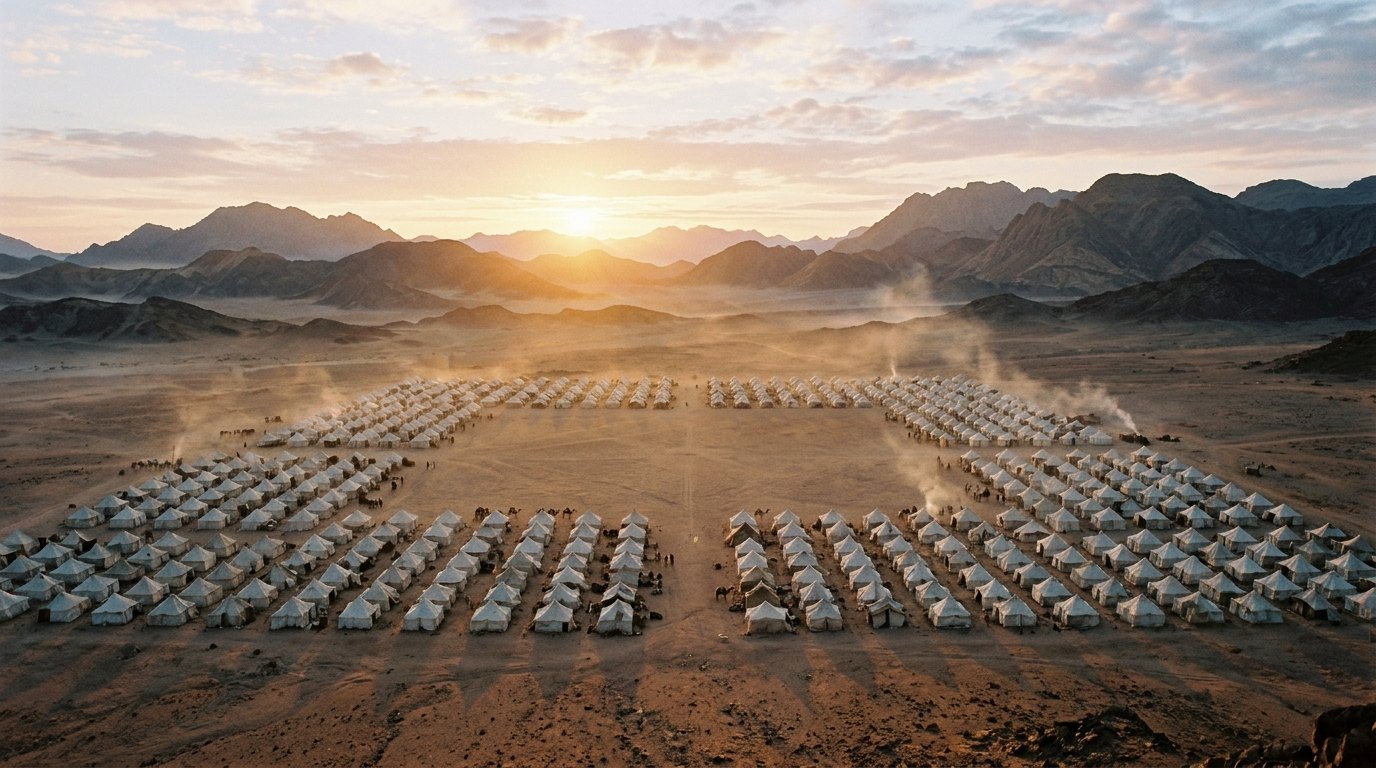
The LORD said to Moses and Aaron: “The Israelites are to camp around the tent of meeting some distance from it, each of them under their standard and holding the banners of their family.”
Numbers 2:1-2 (NIV)
The Lord commands the twelve tribes to camp around the tabernacle in four ordered divisions under their standards.
The divine encampment in the wilderness revealed that the children of Israel shall pitch every man by his own standard, with the ensign of their father's house, as ordered around the tabernacle in Numbers 2:1-2. God organized the redeemed multitude into four grand divisions facing the four cardinal directions, establishing absolute order around His holy presence. In Numbers 1:1-46, a census counted 603,550 fighting men across the twelve tribes, providing the military roster for this wilderness march. Facing east toward the sunrise, the leading camp marched under the standard of Judah, flanked by Issachar and Zebulun (Numbers 2:3-9).
On the south camped the division of Reuben, flanked by Simeon and Gad (Numbers 2:10-16). On the west, facing behind the Holy of Holies, the camp of Ephraim pitched under its standard alongside Manasseh and Benjamin (Numbers 2:18-24). On the north stood the camp of Dan, flanked by Asher and Naphtali (Numbers 2:25-31). When the pillar of cloud lifted from the tabernacle, Numbers 10:11-28 records how these twelve tribes set forth in strict ceremonial sequence, surrounding the Levites who carried the sanctuary. This unity and individual honor was further dramatized in Numbers 7:1-89, where each of the twelve tribal princes brought identical, magnificent offerings on twelve consecutive days before the altar, displaying their equal devotion before the living God.
| Passage | What it says |
|---|---|
| Numbers 2:3-9 | The eastern camp camps under Judah, alongside Issachar and Zebulun. |
| Numbers 2:10-16 | The southern camp camps under Reuben, alongside Simeon and Gad. |
| Numbers 2:18-24 | The western camp camps under Ephraim, alongside Manasseh and Benjamin. |
| Numbers 2:25-31 | The northern camp camps under Dan, alongside Asher and Naphtali. |
| Numbers 10:11-28 | The twelve tribes set out in orderly ranks as the cloud lifts. |
| Numbers 1:1-46 | Records the military census of the twelve fighting tribes in the wilderness of Sinai. |
| Numbers 7:1-89 | Lists identical offerings brought successively over twelve days by the prince of each of the twelve tribes. |
Moses' Farewell
The Blessings on the Tribes at Sinai
This is the blessing that Moses the man of God pronounced on the Israelites before his death.
Deuteronomy 33:1 (NIV)
Moses blesses the children of Israel tribal family by tribal family prior to his death on Mount Nebo.
Before ascending Mount Nebo to die, Moses gathered the congregation to bestow a prophetic benediction, recorded in Deuteronomy 33:1, where the man of God blessed the children of Israel before his death. Standing on the plains of Moab, he looked over the camp and addressed the tribal households by name. He opened with Reuben, interceding in Deuteronomy 33:6 that Reuben live and not die, though his numbers were small. Turning to Judah in Deuteronomy 33:7, Moses asked the Lord to hear his voice, grant him aid against his adversaries, and bring him safely back to his people. For Levi, Deuteronomy 33:8-11 celebrated the sacred Urim and Thummim, confirming their priestly charge to teach God's statutes and burn incense at the altar. Benjamin was marked in Deuteronomy 33:12 as the beloved of the Lord, resting securely beside the shoulder of God's sanctuary.
Upon Joseph's sons, Moses poured an abundance of divine favors, as Deuteronomy 33:13-17 promised prime produce from the earth, the fullness of heaven, and the horns of a wild ox representing the ten thousands of Ephraim and thousands of Manasseh. He grouped Zebulun and Issachar in Deuteronomy 33:18-19, directing them to draw riches from the seas and hidden treasures of the sand. Gad was portrayed in Deuteronomy 33:20-21 as a resting lion who seized a commander's portion east of the Jordan, while Dan leaped like a young lion from Bashan in Deuteronomy 33:22. Naphtali received the blessing of being satisfied with favor and filled with the blessing of the Lord in Deuteronomy 33:23, inheriting south toward the lake. Asher, according to Deuteronomy 33:24-25, would bathe his foot in rich oil, protected by bars of iron and bronze. This covenantal scene recalled the solemn assembly in Deuteronomy 27:11-13, where six tribes stood upon Mount Gerizim to pronounce blessing and six stood on Mount Ebal to recite warnings. Moses then concluded his life's ministry in Deuteronomy 33:29 by praising the happy estate of an entire nation saved and shielded by the Lord.
| Passage | What it says |
|---|---|
| Deuteronomy 33:6 | Moses prays that Reuben live and not die. |
| Deuteronomy 33:7 | Moses asks the Lord to bring Judah to his people. |
| Deuteronomy 33:8-11 | Moses pronounces Levi the priestly covenant keeper teaching God's law. |
| Deuteronomy 33:12 | Moses blesses Benjamin as the beloved dwelling securely beside the Lord. |
| Deuteronomy 33:13-17 | Moses pours out expansive agricultural and territorial blessings upon Joseph's sons. |
| Deuteronomy 33:18-19 | Moses blesses Zebulun's going out and Issachar's tents. |
| Deuteronomy 33:20-21 | Moses blesses Gad who enlarges his territory like a lion. |
| Deuteronomy 33:22 | Moses calls Dan a lion's whelp leaping from Bashan. |
| Deuteronomy 33:23 | Moses blesses Naphtali as satisfied with the favor of the Lord. |
| Deuteronomy 33:24-25 | Moses blesses Asher with oil and iron-and-bronze defenses. |
| Deuteronomy 27:11-13 | Stationing six tribes on Mount Gerizim to bless and six tribes on Mount Ebal to curse. |
| Deuteronomy 33:29 | Moses' concluding blessing over the tribal confederation as a people saved and defended by the Lord. |
Covenant Memory
Twelve Stones and Tribal Unity
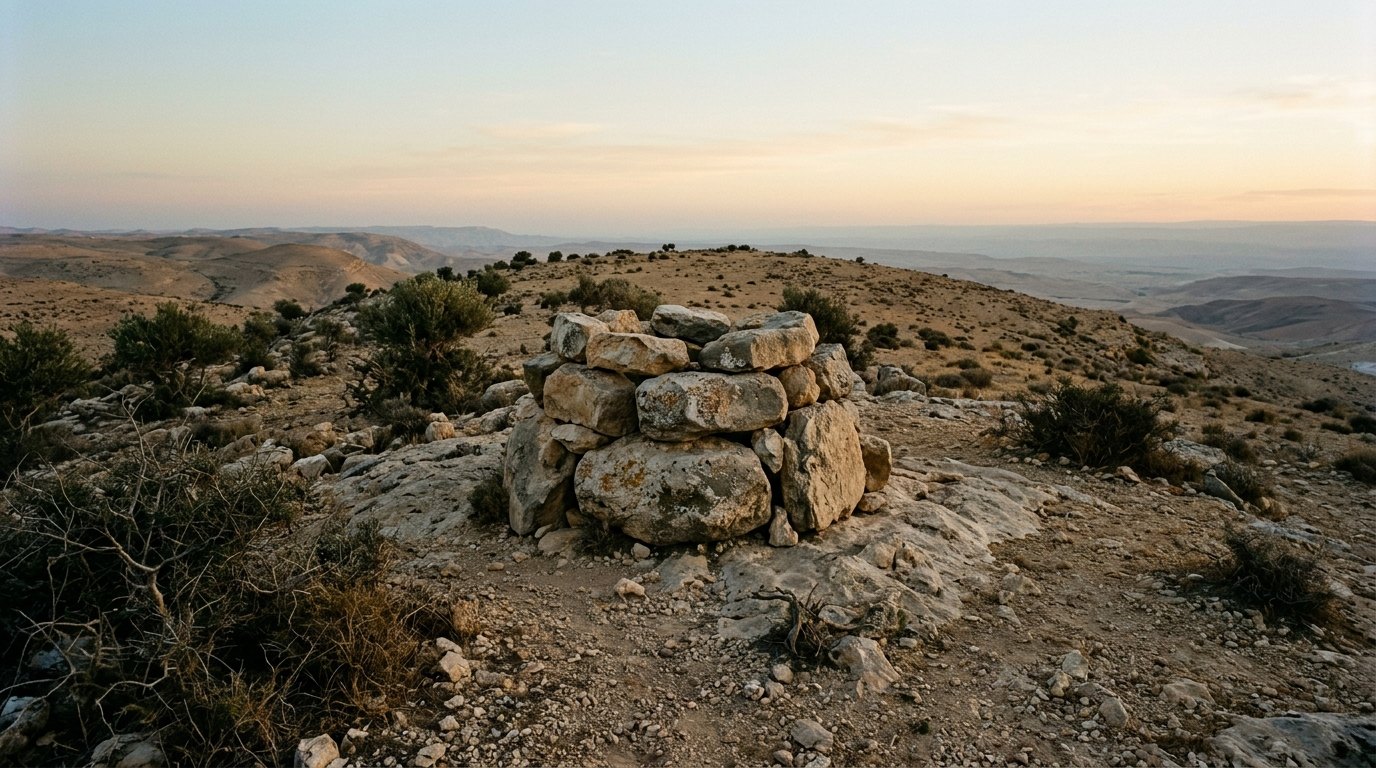
Elijah took twelve stones, one for each of the tribes descended from Jacob, to whom the word of the LORD had come, saying, “Your name shall be Israel.”
1 Kings 18:31 (NIV)
Elijah explicitly takes twelve stones to rebuild the Lord's altar according to the number of the tribes of Jacob.
When Elijah confronted apostasy on Mount Carmel, he demonstrated that the spiritual identity of Israel was indivisible, for in 1 Kings 18:31, Elijah took twelve stones, according to the number of the tribes of the sons of Jacob, to whom the word of the Lord came. That public act reclaimed an enduring scriptural pattern of covenant memory rooted in the wilderness. At the foot of Mount Sinai, as recorded in Exodus 24:4, Moses rose early and built an altar accompanied by twelve pillars representing the twelve tribes of Israel before ratifying the covenant with blood. Inside the sacred sanctuary, the identical number remained continually before God's presence: Exodus 28:21 commanded that the high priest wear a breastplate bearing twelve precious stones engraved like signets with the names of the tribes, carried over Aaron's heart.
Similarly, Leviticus 24:5-8 established the perpetual bread of the presence, commanding Aaron to set twelve loaves in two rows upon the pure table every Sabbath day as an everlasting covenant on behalf of the tribes. When the nation crossed into Canaan under Joshua, Joshua 4:8-9 documented how twelve men lifted twelve stones from the middle of the dry Jordan riverbed to erect a permanent memorial for their children. Even after the devastating division of the monarchy and the later Babylonian exile, the physical returnees maintained this unbroken twelvefold identity. In Ezra 6:17, when the modest second temple was joyfully dedicated in Jerusalem, the assembly offered twelve male goats as a sin offering for all Israel, confessing that God's covenant family remained one whole people before Him.
| Passage | What it says |
|---|---|
| Exodus 24:4 | Moses builds an altar with twelve pillars representing the twelve tribes. |
| Exodus 28:21 | The high priest's breastplate carries twelve engraved stones for the twelve tribes. |
| Joshua 4:8-9 | Twelve memorial stones are taken from Jordan to mark the tribes' crossing. |
| Ezra 6:17 | The returned exiles offer twelve male goats for all twelve tribes. |
| Leviticus 24:5-8 | Arranging twelve loaves of showbread before the Lord continually as an eternal covenant representing the tribes. |
| 1 Kings 18:31 | Elijah builds an altar of twelve stones according to the number of the tribes of the sons of Jacob. |
Eternal Fulfillment
The Twelve Tribes in the New Testament

Then I heard the number of those who were sealed: 144,000 from all the tribes of Israel.
Revelation 7:4 (NIV)
John hears the exact count of one hundred forty-four thousand sealed from all the tribes of Israel.
The apostolic writings demonstrate that God's ancient tribal architecture reaches its climax in the eternal city of God, as John recorded in Revelation 7:4 when he heard the number of those who were sealed, one hundred and forty-four thousand, sealed from every tribe of the sons of Israel. In Revelation 7:5-8, the text methodically enumerates twelve thousand sealed servants from each named tribe, testifying that God preserves and knows His covenant servants through every earthly trial. This continuity was anticipated by Jesus during His earthly ministry; in Matthew 19:28, Christ promised His apostles that in the regeneration, when the Son of Man sits on His glorious throne, they also will sit on twelve thrones judging the twelve tribes of Israel. He reiterated this promise in Luke 22:30 at the Last Supper, assigning them a kingdom where they will eat and drink at His table and judge the tribes.
The New Testament epistles treat this twelve-tribe identity as an active, living reality. Writing to the scattered diaspora, James 1:1 addressed his epistle to the twelve tribes dispersed abroad, reminding them of steadfast faith. When the apostle Paul defended his gospel before King Agrippa in Acts 26:7, he declared that our twelve tribes earnestly serve God day and night in hope of the resurrection promise sworn to the patriarchs. The grand architecture of redemption is ultimately unveiled in Revelation 21:12, where the New Jerusalem descends from heaven possessing a great, high wall with twelve gates, attended by twelve angels, with the names of the twelve tribes of the sons of Israel inscribed upon them forever.
| Passage | What it says |
|---|---|
| Matthew 19:28 | Jesus promises the twelve apostles thrones judging the twelve tribes of Israel. |
| Luke 22:30 | The apostles will sit on thrones judging the twelve tribes in Christ's kingdom. |
| James 1:1 | James writes his epistle directly to the twelve tribes scattered abroad. |
| Revelation 7:5-8 | Scripture enumerates the twelve thousand sealed out of each specified tribe. |
| Revelation 21:12 | The New Jerusalem possesses twelve gates inscribed with the names of the twelve tribes. |
| Acts 26:7 | Paul speaks of our twelve tribes serving God day and night hoping to attain the promise of resurrection. |
Territorial Division
The Promised Land Divided by Lot
So the LORD gave Israel all the land he had sworn to give their ancestors, and they took possession of it and settled there.
Joshua 21:43 (NIV)
This verse summarizes the faithful realization of God's sworn promise to Israel through tribal apportionment.
The distribution of Canaan among the tribes stood as the ultimate historical verification of God's covenant fidelity, summarized in Joshua 21:43: the Lord gave to Israel all the land that He swore to give to their fathers, and they took possession of it and dwelt in it. Before the Jordan was crossed, Moses had assigned the eastern pastoral tablelands: Joshua 13:15-23 recorded the borders given to the tribe of Reuben, while Joshua 13:24-28 detailed the rugged territory of Gad. West of the Jordan, the sacred lots were cast at Gilgal and Shiloh to allocate the inheritance. Joshua 15:1-63 defined the extensive southern boundaries of Judah, stretching from the Salt Sea to the Mediterranean coast and southward toward the wilderness of Zin. The house of Joseph received fertile central lands, with Ephraim's boundary described in Joshua 16:1-10 and Manasseh's western territory mapped in Joshua 17:1-18.
At Shiloh, the remaining parcels were distributed to the northern and interior tribes. Benjamin's border between Judah and Ephraim was set down in Joshua 18:11-28, encompassing sacred sites like Bethel and Jerusalem. Simeon received an inheritance within the borders of Judah as outlined in Joshua 19:1-9, while Joshua 19:10-16 marked the southern borders of the Jezreel Valley for Zebulun. Joshua 19:17-23 designated the arable plain of Issachar, and Joshua 19:24-31 traced Asher's coastal and hill country north toward Tyre. Naphtali inherited the fertile heights and fortified cities toward the Sea of Galilee in Joshua 19:32-39. Dan received its original coastal lot in Joshua 19:40-48 before migrating north to Leshem. Finally, Joshua 21:1-8 recorded the distribution of forty-eight designated towns and surrounding pasturelands given to the priestly tribe of Levi across all tribal borders.
| Passage | What it says |
|---|---|
| Joshua 15:1-63 | Defines the territorial boundary and inheritance allotted to the tribe of Judah. |
| Joshua 16:1-10 | Delineates the tribal allotment for the descendants of Joseph, specifically the tribe of Ephraim. |
| Joshua 17:1-18 | Describes the boundaries and town allocations given to the tribe of Manasseh west of the Jordan. |
| Joshua 18:11-28 | Details the lot and border of the territory inherited by the tribe of Benjamin. |
| Joshua 19:1-9 | Designates the cities inherited by the tribe of Simeon inside the broader territory of Judah. |
| Joshua 19:10-16 | Specifies the boundaries and inheritance allotted to the tribe of Zebulun. |
| Joshua 19:17-23 | Sets forth the border lines and towns inherited by the tribe of Issachar. |
| Joshua 19:24-31 | Outlines the coastal and northern territory distributed to the tribe of Asher. |
| Joshua 19:32-39 | Records the fortified cities and northern boundary allotted to the tribe of Naphtali. |
| Joshua 19:40-48 | Lists the towns allotted to the tribe of Dan prior to their migration north to Leshem. |
| Joshua 13:15-23 | Details the trans-Jordanian territory Moses gave to the tribe of Reuben. |
| Joshua 13:24-28 | Describes the land east of the Jordan assigned by Moses to the tribe of Gad. |
| Joshua 21:1-8 | Assigns forty-eight cities and pasturelands distributed among all the tribes to the tribe of Levi. |
Kingdom Fracture and Hope
Division, Exile, and the Prophesied Reunion

say to them, ‘This is what the Sovereign LORD says: I am going to take the stick of Joseph—which is in Ephraim’s hand—and of the Israelite tribes associated with him, and join it to Judah’s stick. I will make them into a single stick of wood, and they will become one in my hand.’
Ezekiel 37:19 (NIV)
The Lord declares He will take the stick of Joseph and join it with Judah into one undivided nation.
In Ezekiel 37:19, the Lord reveals His ultimate purpose for the fractured descendants of Jacob, declaring that He will join the stick of Joseph with the stick of Judah into one unified people in His hand. Centuries earlier, the united commonwealth of Israel had been torn apart as judgment for Solomon's idolatry. Through the prophet Ahijah, God dramatically illustrated this judgment by tearing a new cloak into twelve pieces, assigning ten tribes to Jeroboam while preserving a lamp for the line of David in Jerusalem (1 Kings 11:31-36). When Solomon's son Rehoboam refused wise counsel, the ten northern tribes rebelled, crying out that they had no portion in David, which left only Judah and Benjamin standing with the Davidic throne (1 Kings 12:16-24). This division produced two rival kingdoms—Israel in the north and Judah in the south—frequently marred by war and compromise. The northern kingdom plunged into persistent calf-worship and covenant unfaithfulness until God sent the Assyrian empire to conquer Samaria and scatter the ten tribes across the nations, leaving only the southern tribe of Judah in the land (2 Kings 17:18-23). Yet exile was not God's final word for the twelve sons of Jacob. The Lord commanded Ezekiel to bind two carved sticks together, signifying that the divided houses of Ephraim and Judah would one day be gathered from every nation and restored under one Davidic shepherd (Ezekiel 37:15-22). Ezekiel's closing vision seals this promise by measuring out the healed land in equal territorial strips, assigning an enduring home to every single tribe from Dan in the north to Gad in the south (Ezekiel 48:1-29). The fracture caused by human sin would ultimately yield to God's unbreakable covenant faithfulness.
| Passage | What it says |
|---|---|
| 1 Kings 11:31-36 | The prophet Ahijah tears his garment into twelve pieces, giving Jeroboam ten tribes while reserving Judah for David. |
| 1 Kings 12:16-24 | Ten northern tribes break away from Rehoboam, leaving only Judah and Benjamin loyal to the house of David. |
| 2 Kings 17:18-23 | Assyria exiles the northern ten tribes of Israel because of persistent idolatry, leaving only Judah. |
| Ezekiel 37:15-22 | The prophetic vision of the two sticks reuniting Judah and the tribes of Joseph into one kingdom. |
| Ezekiel 48:1-29 | The visionary restoration apportioning strips of the land equally among all twelve named tribes. |
Where in the Bible
| Book | Passages |
|---|---|
| Genesis | 21 · Genesis 29:32-35, Genesis 30:5-8, Genesis 30:10-13, Genesis 30:17-20, Genesis 30:22-24, Genesis 35:16-18, Genesis 35:23-26, Genesis 49:3-4, Genesis 49:5-7, Genesis 49:8-12, Genesis 49:13, Genesis 49:14-15, Genesis 49:16-18, Genesis 49:19, Genesis 49:20, Genesis 49:21, Genesis 49:22-26, Genesis 49:27, Genesis 49:28, Genesis 48:13-20, Genesis 48:5 |
| Exodus | 3 · Exodus 1:1-5, Exodus 24:4, Exodus 28:21 |
| Leviticus | 1 · Leviticus 24:5-8 |
| Numbers | 9 · Numbers 1:47-50, Numbers 26:52-56, Numbers 2:3-9, Numbers 2:10-16, Numbers 2:18-24, Numbers 2:25-31, Numbers 10:11-28, Numbers 1:1-46, Numbers 7:1-89 |
| Deuteronomy | 12 · Deuteronomy 33:6, Deuteronomy 33:7, Deuteronomy 33:8-11, Deuteronomy 33:12, Deuteronomy 33:13-17, Deuteronomy 33:18-19, Deuteronomy 33:20-21, Deuteronomy 33:22, Deuteronomy 33:23, Deuteronomy 33:24-25, Deuteronomy 27:11-13, Deuteronomy 33:29 |
| Joshua | 15 · Joshua 14:3-4, Joshua 4:8-9, Joshua 15:1-63, Joshua 16:1-10, Joshua 17:1-18, Joshua 18:11-28, Joshua 19:1-9, Joshua 19:10-16, Joshua 19:17-23, Joshua 19:24-31, Joshua 19:32-39, Joshua 19:40-48, Joshua 13:15-23, Joshua 13:24-28, Joshua 21:1-8 |
| 1 Kings | 3 · 1 Kings 18:31, 1 Kings 11:31-36, 1 Kings 12:16-24 |
| 2 Kings | 1 · 2 Kings 17:18-23 |
| 1 Chronicles | 2 · 1 Chronicles 2:1-2, 1 Chronicles 5:1-2 |
| Ezra | 1 · Ezra 6:17 |
| Ezekiel | 2 · Ezekiel 37:15-22, Ezekiel 48:1-29 |
| Matthew | 1 · Matthew 19:28 |
| Luke | 1 · Luke 22:30 |
| Acts | 1 · Acts 26:7 |
| James | 1 · James 1:1 |
| Revelation | 2 · Revelation 7:5-8, Revelation 21:12 |
The story in order
- Jacob's twelve sons are born (c. 1800 BC) · Genesis 35:23-26 · Establishes the patriarchal foundation for the twelve tribes.
- Jacob blesses his twelve sons (c. 1800 BC) · Genesis 49:3-27 · Foretells the future character and destiny of each tribe.
- The tribes are numbered and organized (c. 1450 BC) · Numbers 1:1-46 · Details the census and military organization in the wilderness.
- Tribal encampment and marching order (c. 1450 BC) · Numbers 2:3-31 · Shows God's ordered structure for the twelve tribes.
- Moses blesses the twelve tribes (c. 1400 BC) · Deuteronomy 33:6-29 · Pronounces final blessings and prophetic words for each tribe.
- Twelve stones mark the Jordan crossing (c. 1370 BC) · Joshua 4:8-9 · A memorial of God's faithfulness to all twelve tribes.
- Levi receives cities, not territory (c. 1350 BC) · Joshua 21:1-8 · Explains the special status of the priestly tribe.
- Kingdom divides after Solomon (c. 931 BC) · 1 Kings 11:31-36 · The nation splits, with ten tribes forming a separate kingdom.
- Northern tribes are exiled (c. 722 BC) · 2 Kings 17:18-23 · Assyria exiles the ten northern tribes for disobedience.
- Prophetic vision of reunification (c. 580 BC) · Ezekiel 37:15-22 · God promises to reunite the divided kingdoms.
- Jesus promises thrones to apostles (AD 30) · Matthew 19:28 · The twelve tribes will be judged by the twelve apostles.
- New Jerusalem has twelve gates (c. AD 95) · Revelation 21:12 · Symbolizes the eternal dwelling place of God's people.
Twelve Stones as Covenant Symbols
| Context | Number of Stones | Significance | Passage |
|---|---|---|---|
| Altar built by Moses | Twelve | Representing the twelve tribes | Exodus 24:4 |
| High Priest's breastplate | Twelve | Engraved stones for the twelve tribes | Exodus 28:21 |
| Memorial stones from Jordan | Twelve | Marking the tribes' crossing into the land | Joshua 4:8-9 |
| Showbread before the Lord | Twelve | An eternal covenant representing the tribes | Leviticus 24:5-8 |
| Elijah's altar at Carmel | Twelve | According to the number of the tribes | 1 Kings 18:31 |
| Offerings after exile | Twelve | For all twelve tribes | Ezra 6:17 |
Key words
- Tribe (שֵׁבֶט (shevet))
- A division of people descended from a common ancestor, specifically the descendants of Jacob. · Genesis 49:28
- Israel (יִשְׂרָאֵל (yisrael))
- The name God gave to Jacob, and by extension, to his descendants, the nation. · Genesis 35:10
- Inheritance (נַחֲלָה (naḥalah))
- The portion of land allotted to each tribe in the Promised Land. · Joshua 14:3-4
- Covenant (בְּרִית (berit))
- A solemn agreement or promise between God and his people, symbolized by the tribes. · Leviticus 24:8
- Blessing (בְּרָכָה (berakhah))
- Divine favor or prosperity bestowed upon individuals or groups, as prophesied for the tribes. · Genesis 49:28
From Jacob's deathbed blessings in Egypt to the emerald gates of the New Jerusalem, the twelve tribes demonstrate God's unwavering faithfulness to His covenant promises. Each distinct tribe bore its own calling, chastening, and inheritance, yet together they revealed the full tapestry of God's redemptive purpose culminating in Jesus Christ.
76 passages, each cited once.
Scripture cited
- Genesis 49:28
- Revelation 7:4
- Genesis 35:22
- 1 Kings 18:31
- Genesis 49
- Genesis 35:22-26