Why did God test Abraham with Isaac?

Genesis 22:1-14
1 Some time later God tested Abraham. He said to him, “Abraham!” “Here I am,” he replied.
2 Then God said, “Take your son, your only son, whom you love—Isaac—and go to the region of Moriah. Sacrifice him there as a burnt offering on a mountain I will show you.”
3 Early the next morning Abraham got up and loaded his donkey. He took with him two of his servants and his son Isaac. When he had cut enough wood for the burnt offering, he set out for the place God had told him about.
4 On the third day Abraham looked up and saw the place in the distance.
5 He said to his servants, “Stay here with the donkey while I and the boy go over there. We will worship and then we will come back to you.”
6 Abraham took the wood for the burnt offering and placed it on his son Isaac, and he himself carried the fire and the knife. As the two of them went on together,
7 Isaac spoke up and said to his father Abraham, “Father?” “Yes, my son?” Abraham replied. “The fire and wood are here,” Isaac said, “but where is the lamb for the burnt offering?”
8 Abraham answered, “God himself will provide the lamb for the burnt offering, my son.” And the two of them went on together.
9 When they reached the place God had told him about, Abraham built an altar there and arranged the wood on it. He bound his son Isaac and laid him on the altar, on top of the wood.
10 Then he reached out his hand and took the knife to slay his son.
11 But the angel of the LORD called out to him from heaven, “Abraham! Abraham!” “Here I am,” he replied.
12 “Do not lay a hand on the boy,” he said. “Do not do anything to him. Now I know that you fear God, because you have not withheld from me your son, your only son.”
13 Abraham looked up and there in a thicket he saw a ram caught by its horns. He went over and took the ram and sacrificed it as a burnt offering instead of his son.
14 So Abraham called that place The LORD Will Provide. And to this day it is said, “On the mountain of the LORD it will be provided.”
New International Version (NIV)
The answer
God tested Abraham with Isaac to prove the depth of his faith and his willingness to obey God above everything else, including the son through whom the promised offspring would come (Genesis 22:1-2). The verse itself names the purpose: "God tested Abraham," and Deuteronomy 8:2 makes the principle plain — testing reveals "what was in thine heart, whether thou wouldest keep his commandments."
Why Isaac, specifically
- Isaac was the promised son. He was the child of the covenant, the one through whom God had sworn to multiply Abraham's descendants (Genesis 17:19; 21:12). To surrender him was to surrender the future God had promised.
- God named him twice. "Take your son, your only son, Isaac, whom you love" (Genesis 22:2). The threefold description — your son, your only son, the one you love — was designed to press on every natural tie Abraham had.
What the test proved
- Faith, not doubt. Hebrews 11:17 says, "By faith Abraham, when he was tried, offered up Isaac: and he that had received the promises offered up his only begotten son." Faith held even when the command seemed to contradict the promise.
- Faith made complete by obedience. James 2:21: "Was not Abraham our father justified by works, when he had offered Isaac his son upon the altar?" The test drew obedience out of faith and so completed it.
- Hope in resurrection. Hebrews 11:17-19 (read elsewhere) shows Abraham reasoned that God could raise Isaac from the dead — his faith was not blind but rested on God's power to keep His word.
What the test produced
- A worship that endures. Abraham told his servants, "We will worship, and come back to you" (Genesis 22:5). He did not lie — he went with Isaac expecting God to provide.
- The great confession of provision. "God will provide himself the lamb for a burnt offering" (Genesis 22:8). That saying became the name of the place: "Yahweh Will Provide" (Genesis 22:14), and the ram caught in the thicket became the immediate answer (Genesis 22:13).
- Enduring blessing, confirmed in the oaths. The angel of the Lord swore by Himself that Abraham's obedience would bring the multiplied descendants and the blessing to the nations (Genesis 22:15-18).
How this applies to believers
- Testing is not punishment. James 1:12-14 frames it as the path to "the crown of life" for those who love God. Trials reveal and refine faith, they do not replace God's love.
- Testing is bounded. 1 Corinthians 10:13: God "will not suffer you to be tempted above that ye are able." Like Abraham, the faithful are carried to the mount and met with provision.
- Testing produces praise. 1 Peter 1:7: "That the trial of your faith, being much more precious than of gold that perisheth, though it be tried with fire, might be found unto praise and honour and glory at the appearing of Jesus Christ."
In short, God tested Abraham with Isaac to expose and deepen a faith that treasured God above His own gift, and to set a pattern for every believer: obedience that trusts God to provide, even when His command seems to cost the most precious thing.
Answered from Scripture · reviewed November 7, 2026
God tested Abraham on Mount Moriah to prove the depth of his faith and demonstrate that he loved the Giver far above the gift. By commanding Abraham to offer Isaac—the long-awaited son of covenant promise—God brought Abraham's faith to full maturity while unveiling an enduring shadow of His own sacrificial love.
The Call to Moriah
God tests the heart of the patriarch

Then God said, “Take your son, your only son, whom you love—Isaac—and go to the region of Moriah. Sacrifice him there as a burnt offering on a mountain I will show you.”
Genesis 22:2 (NIV)
God explicitly names Isaac as Abraham's only son whom he loves, focusing the trial entirely on his deepest natural affection and covenant hope.
In Genesis 22:2, God speaks into the deepest affections of a father’s heart: "Take your son, your only son Isaac, whom you love, and go to the land of Moriah, and offer him there as a burnt offering." Every single word of the summons is measured. This trial was not arbitrary cruelty; it was a divine summons aimed squarely at Abraham's supreme love and covenant hope. In Genesis 22:1, God tests Abraham, who answers immediately with reverent readiness. Decades earlier, in Genesis 12:1, the Lord had summoned him to abandon his past—his country, his kindred, and his father's house. In Genesis 15:6, Abraham believed God's staggering promise of offspring, and the Lord counted that faith as righteousness. Yet Isaac was not merely a son of nature; he was the child of miraculous promise. God had explicitly declared in Genesis 17:19 that the everlasting covenant would be established through Isaac alone, and in Genesis 21:12 that through Isaac his offspring would be named. To command Isaac’s sacrifice appeared to place God’s command at war with God’s covenant promise. As Moses later explained to Israel in Deuteronomy 8:2, God tests His people to know what is in their hearts, proving whether their ultimate allegiance belongs to the gifts of His grace or to the Giver Himself. Abraham had to discover whether he loved Isaac more than he loved the God who gave him.
| Passage | What it says |
|---|---|
| Genesis 22:1 | God tests Abraham, who readily answers the Lord's summons with reverent readiness. |
| Genesis 22:2 | God commands Abraham to take his beloved son Isaac and offer him as a burnt offering on Moriah. |
| Genesis 17:19 | God had earlier established an everlasting covenant specifically through Isaac and his future offspring. |
| Genesis 21:12 | God declared to Abraham that through Isaac his offspring would be named. |
| Deuteronomy 8:2 | Moses explains that the Lord tests His people to know what is in their hearts and whether they will obey. |
| Genesis 12:1 | God previously called Abraham to leave country and kin, setting a precedent of total surrender of earthly ties. |
| Genesis 15:6 | Abraham believed the Lord, and it was counted to him as righteousness, establishing the root of his faith. |
Faith in Action
Prompt obedience and unshakable expectation
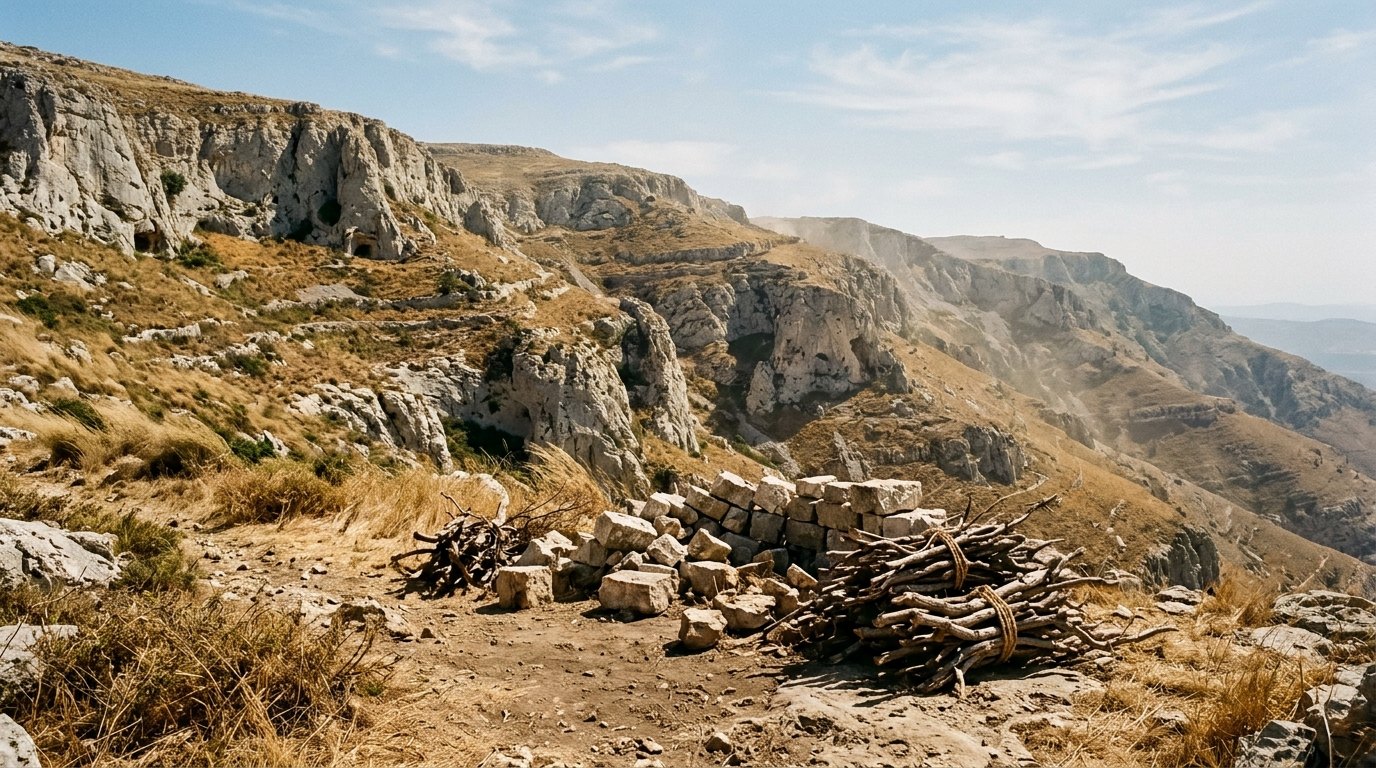
He said to his servants, “Stay here with the donkey while I and the boy go over there. We will worship and then we will come back to you.”
Genesis 22:5 (NIV)
Abraham declares to his young men that both he and the boy will go to worship and come back again.
When Abraham reached the foot of the mountain in Genesis 22:5, he spoke with staggering conviction to his servants: "I and the boy will go over there and worship and come again to you." There is no hesitation, debate, or despair in the patriarch’s conduct. According to Genesis 22:3, Abraham rose early in the morning, cleaved the wood for the burnt offering, saddled his donkey, and set out without delay. By Genesis 22:4, on the third day of their solemn journey, he lifted up his eyes and saw the appointed mountain afar off. In Genesis 22:6, Abraham laid the wood of the burnt offering upon Isaac his son, while he took the fire and the knife in his own hands, and the two walked together. The New Testament pulls back the curtain on Abraham's inner faith during that silent trek. As Hebrews 11:17 records, Abraham offered up Isaac by faith, holding fast in Hebrews 11:18 to the irrevocable promise that his seed would be called through this very boy. In Hebrews 11:19, Abraham reasoned that God was able even to raise the dead, from which figuratively speaking he did receive him back. James confirms in James 2:21 that Abraham was justified by works when he offered Isaac upon the altar. As James 2:22 notes, faith worked alongside his actions, bringing his faith to full maturity, and in James 2:23, the Scripture was fulfilled and he was called God's friend.
| Passage | What it says |
|---|---|
| Genesis 22:3 | Abraham rises early, splits wood for the offering, and sets out without delay or complaint. |
| Genesis 22:4 | On the third day of the journey Abraham sees the designated place in the distance. |
| Genesis 22:5 | Abraham instructs his servants to wait while he and Isaac worship and return together. |
| Genesis 22:6 | Abraham places the firewood upon Isaac, carrying the fire and the knife as they walk together. |
| Hebrews 11:17 | Hebrews records that by faith Abraham offered Isaac, believing God could raise the dead. |
| Hebrews 11:18 | Abraham held fast to the promise that his seed would be named through Isaac. |
| Hebrews 11:19 | Abraham concluded that God was able to raise Isaac even from death, receiving him back figuratively. |
| James 2:21 | James explains that Abraham's faith was vindicated and completed by offering Isaac on the altar. |
| James 2:22 | Scripture explicitly notes that faith was working with his works, and by works faith was made complete. |
| James 2:23 | The offering fulfilled the Scripture that Abraham believed God, earning him the title friend of God. |
Jehovah Jireh
The Lord provides a substitute sacrifice

So Abraham called that place The LORD Will Provide. And to this day it is said, “On the mountain of the LORD it will be provided.”
Genesis 22:14 (NIV)
Abraham names the site Yahweh-Yireh, commemorating God's mountain as the perpetual place of divine provision.
On the heights of Moriah, Abraham named the place in Genesis 22:14: "The Lord will provide; as it is said to this day, 'On the mount of the Lord it shall be provided.'" As the father and son ascended the ridge, Isaac broke the silence in Genesis 22:7, asking where the lamb was for the burnt offering. Abraham responded with prophetic foresight in Genesis 22:8, declaring that God would provide Himself the lamb. That prophecy pointed straight to Christ, whom John 1:29 proclaims as the true Lamb of God taking away the sin of the world. In Genesis 22:9, Abraham built the altar, bound Isaac, and laid him on the wood, anticipating Christ being bound and led away in Matthew 27:2. As Abraham stretched out his hand with the knife in Genesis 22:10, the angel of the Lord called from heaven in Genesis 22:11 to stay the blade. In Genesis 22:12, God declared that Abraham's reverent fear was proven, having not withheld his only son, an act that foreshadowed Romans 8:32, where the Father did not spare His own Son, and John 3:16. In Genesis 22:13, Abraham saw a ram caught by its horns in a thicket and offered it instead of his son, demonstrating substitutionary atonement as fulfilled in Galatians 3:13. On that very mountain, as Jesus revealed in John 8:56, Abraham rejoiced to see Christ’s day, beholding God's generous provision that overflows in 2 Corinthians 9:8.
| Passage | What it says | Fulfilled |
|---|---|---|
| Genesis 22:7 | Isaac asks his father where the lamb for the burnt offering is. | John 1:29 |
| Genesis 22:8 | Abraham prophesies that God Himself will provide the lamb for the burnt offering. | John 8:56 |
| Genesis 22:9 | Abraham builds the altar, lays the wood, and binds Isaac upon it. | Matthew 27:2 |
| Genesis 22:10 | Abraham stretches out his hand with the knife to slay his son. | Romans 8:32 |
| Genesis 22:11 | The angel of the Lord calls from heaven to halt Abraham. | |
| Genesis 22:12 | God declares He now knows Abraham fears Him, having not withheld his only son. | John 3:16 |
| Genesis 22:13 | Abraham spots a ram caught in the thicket and sacrifices it in place of his son. | Galatians 3:13 |
| Genesis 22:14 | Abraham names the place 'Yahweh Will Provide,' establishing an enduring proverb. | 2 Corinthians 9:8 |
| John 1:29 | John identifies Jesus as the Lamb of God who takes away the sin of the world, fulfilling the provision. | |
| John 8:56 | Jesus declares that Abraham rejoiced to see His day, saw it on Moriah's mount, and was glad. | |
| Romans 8:32 | God did not spare His own Son, directly echoing Abraham not withholding his only son Isaac. |
The Confirmed Covenant
God swears by Himself to bless the nations

and through your offspring all nations on earth will be blessed, because you have obeyed me.”
Genesis 22:18 (NIV)
God promises that through Abraham's seed all nations of the earth will be blessed because he obeyed.
From heaven, the voice of the Lord spoke the crowning word of the covenant in Genesis 22:18: "In your offspring shall all the nations of the earth be blessed, because you have obeyed my voice." The trial on Moriah ended not merely with a son restored, but with an unconditional divine oath. In Genesis 22:15, the angel of the Lord summoned Abraham a second time. In Genesis 22:16, the Lord declared that because Abraham had not withheld his only son, He had sworn by Himself, an oath that Hebrews 6:13 and Hebrews 6:14 explain was immutable, resting on the highest possible authority. In Genesis 22:17, God promised to multiply Abraham’s descendants like the stars of heaven and the sand of the seashore, granting his seed victory over the gates of their enemies, a triumph celebrated in Luke 1:73-74. Yet the pinnacle of the oath looked beyond ethnic Israel to the entire world. In Galatians 3:8, Paul shows that this very gospel was preached beforehand to Abraham, and in Galatians 3:16, he identifies the singular Seed: Christ Himself. Through Abraham’s tested and proven faith, God manifested the lineage through which the Redeemer would come, securing the eternal blessing of righteousness for believers from every nation across the earth.
| Passage | What it says | Fulfilled |
|---|---|---|
| Genesis 22:15 | The angel of the Lord calls out to Abraham a second time from heaven. | |
| Genesis 22:16 | The Lord swears by Himself because Abraham has not withheld his only son. | Hebrews 6:13-14 |
| Genesis 22:17 | The Lord promises to multiply Abraham's seed and give them victory over their enemies. | Luke 1:73-74 |
| Genesis 22:18 | God confirms that all the nations will be blessed through Abraham's obedient lineage. | Galatians 3:8, Galatians 3:16 |
| Hebrews 6:13 | God swore by Himself since He could swear by no one greater when giving the promise to Abraham. | |
| Hebrews 6:14 | The divine oath assured that blessing He would bless him, and multiplying He would multiply him. | |
| Galatians 3:16 | Paul clarifies that the promised Seed of Abraham, through whom all nations are blessed, is Christ. |
The Nature of Testing
How God refines and crowns the believer

These have come so that the proven genuineness of your faith—of greater worth than gold, which perishes even though refined by fire—may result in praise, glory and honor when Jesus Christ is revealed.
1 Peter 1:7 (NIV)
Peter shows that testing purges our faith like gold in fire so that it results in eternal praise.
In 1 Peter 1:7, the Apostle Peter explains that the proving of faith is far more precious than gold refined by fire, designed to result in praise, glory, and honor at the revelation of Jesus Christ. When God tested Abraham on Mount Moriah, He was not attempting to discover something unknown to His omniscience; rather, He was refining and publicly demonstrating the authenticity of Abraham's devotion. Scriptural testing is divine refinement rather than malicious enticement, operating to purge away self-reliance and solidify unwavering trust in God's promises.
James draws a vital theological boundary by warning in James 1:13 that God never tempts anyone with evil, explaining in James 1:14 that sinful temptation springs directly from our own fallen desires. God's test of Abraham was therefore not a trap designed to induce wickedness, but a sanctifying crucible. As Moses declared in Deuteronomy 13:3, the Lord tests His covenant people to reveal whether they love Him with all their heart and soul. Solomon similarly observes in Proverbs 17:3 that while crucibles refine silver and furnaces purify gold, the Lord examines and strengthens the human heart through adversity.
Believers can rest in the sovereign goodness of God during such trials because of His covenant faithfulness. As Paul promises in 1 Corinthians 10:13, God never permits His people to be tested beyond their ability, but always provides the necessary way of escape so they may endure. For Abraham, that divine provision appeared as a ram caught in the thicket; for every believer, perseverance under trial yields eternal fruit. Those who endure receive what James 1:12 calls the crown of life, the unfading reward promised to all who love Him through the fiercest fires of testing.
| Passage | What it says |
|---|---|
| James 1:12 | Blessed is the person who perseveres under trial, for they will receive the crown of life. |
| James 1:13 | God Himself tempts no one with evil, distinguishing godly testing from sinful solicitation. |
| James 1:14 | Temptation toward evil originates in a person's own fleshly desire rather than from God. |
| 1 Corinthians 10:13 | God is faithful and sets limits on testing, always providing a way of escape so believers may endure. |
| 1 Peter 1:7 | Trials test the genuineness of faith, proving it more precious than perishable gold. |
| Deuteronomy 13:3 | Moses teaches that the Lord tests His people to know whether they love Him with all their heart. |
| Proverbs 17:3 | The refining pot is for silver and furnace for gold, but the Lord tests the hearts of men. |
Where in the Bible
| Book | Passages |
|---|---|
| Genesis | 22 · Genesis 22:1, Genesis 22:2, Genesis 17:19, Genesis 21:12, Genesis 12:1, Genesis 15:6, Genesis 22:3, Genesis 22:4, Genesis 22:5, Genesis 22:6, Genesis 22:7, Genesis 22:8, Genesis 22:9, Genesis 22:10, Genesis 22:11, Genesis 22:12, Genesis 22:13, Genesis 22:14, Genesis 22:15, Genesis 22:16, Genesis 22:17, Genesis 22:18 |
| Deuteronomy | 2 · Deuteronomy 8:2, Deuteronomy 13:3 |
| Proverbs | 1 · Proverbs 17:3 |
| John | 2 · John 1:29, John 8:56 |
| Romans | 1 · Romans 8:32 |
| 1 Corinthians | 1 · 1 Corinthians 10:13 |
| Galatians | 1 · Galatians 3:16 |
| Hebrews | 5 · Hebrews 11:17, Hebrews 11:18, Hebrews 11:19, Hebrews 6:13, Hebrews 6:14 |
| James | 6 · James 2:21, James 2:22, James 2:23, James 1:12, James 1:13, James 1:14 |
| 1 Peter | 1 · 1 Peter 1:7 |
The story in order
- God calls Abraham (c. 2090 BC) · Genesis 12:1 · Establishes a precedent of total surrender of earthly ties.
- Abraham believes God (c. 2090 BC) · Genesis 15:6 · His faith is counted as righteousness, the root of his faith.
- Covenant through Isaac (c. 2066 BC) · Genesis 17:19 · God establishes the covenant specifically through Isaac.
- God tests Abraham (c. 2066 BC) · Genesis 22:1 · Abraham readily answers the Lord's summons.
- Command to offer Isaac (c. 2066 BC) · Genesis 22:2 · God commands Abraham to offer his beloved son Isaac.
- Abraham journeys to Moriah (c. 2066 BC) · Genesis 22:4 · On the third day, Abraham sees the place.
- Abraham binds Isaac (c. 2066 BC) · Genesis 22:9 · Abraham builds the altar and binds Isaac.
- Angel halts Abraham (c. 2066 BC) · Genesis 22:11 · The angel of the Lord calls from heaven to halt Abraham.
- Ram provided (c. 2066 BC) · Genesis 22:13 · Abraham sacrifices a ram in place of his son.
- God swears by Himself (c. 2066 BC) · Genesis 22:16 · God swears to bless Abraham because he obeyed.
- Jesus identified as Lamb (AD 28) · John 1:29 · Fulfills the provision of a sacrifice for sin.
- Abraham rejoiced to see His day (AD 30) · John 8:56 · Jesus states Abraham saw His day on Moriah.
Shadow and Substance: Sacrifice
| Shadow (Abraham's Offering) | Substance (Christ's Sacrifice) | Passage |
|---|---|---|
| Abraham offered his son Isaac | Romans 8:32 | Genesis 22:2 |
| Ram provided as substitute | John 1:29 | Genesis 22:13 |
| God declared He knows Abraham fears Him | Romans 8:32 | Genesis 22:12 |
| God did not spare His own Son | Romans 8:32 | Romans 8:32 |
Key words
- Test (nassah (נָסָה))
- To examine or prove the quality or genuineness of something or someone. · Genesis 22:1
- Faith (aman (אָמַן))
- Belief and trust in God's promises and power, even when unseen. · Genesis 15:6
- Obedience (shama (שָׁמַע))
- Compliance with an order, request, or law; submission to another's will. · Genesis 22:18
- Covenant (berit (בְּרִית))
- A solemn agreement or promise between God and humans, often sealed by an oath. · Genesis 17:19
- Provide (ra'ah (רָאָה))
- To supply what is needed, especially by divine action. · Genesis 22:14
- Lamb of God (amnos tou theou (ἀμνὸς τοῦ θεοῦ))
- Jesus Christ, the ultimate sacrifice for the sins of the world. · John 1:29
The testing of Abraham reminds believers that God tests His servants not to destroy them, but to refine their devotion and reveal His own sufficiency. When we are called to place our deepest treasures on the altar, we discover that God remains utterly faithful to provide.
42 passages, each cited once.
Scripture cited
- Genesis 22:1-14
- Hebrews 11:17
- Deuteronomy 8:2
- James 2:21
- James 1:12-14
- 1 Corinthians 10:13
- 1 Peter 1:7