Does the Bible say the earth is flat?
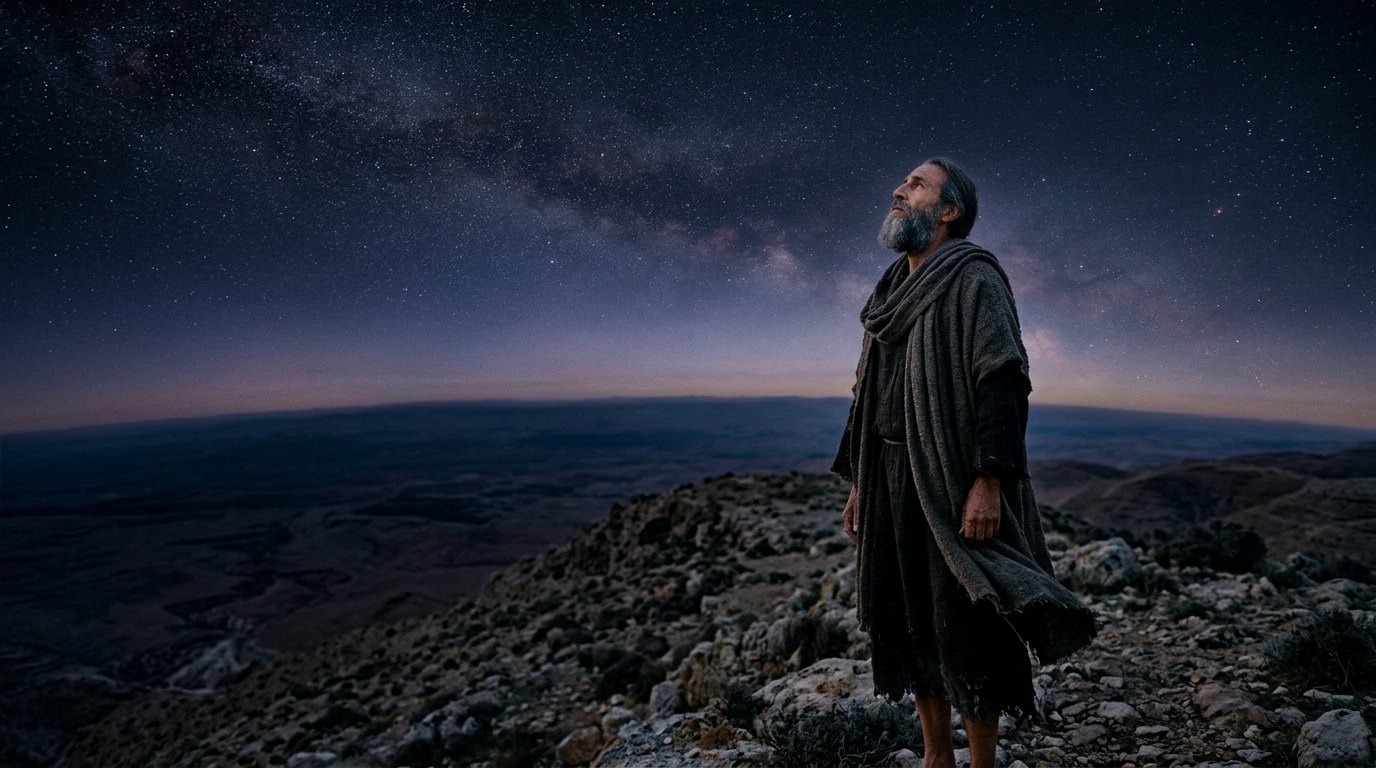
Isaiah 40:22
22 He sits enthroned above the circle of the earth, and its people are like grasshoppers. He stretches out the heavens like a canopy, and spreads them out like a tent to live in.
New International Version (NIV)
The answer
No. Scripture does not teach that the earth is flat. Isaiah 40:22 is sometimes used to support that idea, but its poetry exalts God’s rule over creation rather than supplying a geometrical description of the planet.
What Isaiah 40:22 says
The verse says that God sits above “the circle of the earth,” that its inhabitants are “like grasshoppers,” and that he stretches out the heavens “like a curtain” and “like a tent to dwell in” (Isaiah 40:22). The repeated comparisons show the kind of language being used: people are not literally insects, and the heavens are not literally fabric. The point is God’s majesty and humanity’s smallness before him.
The Hebrew word translated “circle” is chug, elsewhere rendered “circuit” or “compass” (Job 22:14; Proverbs 8:27). It does not mean “flat,” but neither is it a technical term that by itself proves a sphere. Proverbs 8:27 uses the same word when wisdom says that God “set a circle on the surface of the deep,” describing his ordering of creation. Isaiah 40:22 therefore should not be forced into serving either as a flat-earth proof text or as a stand-alone scientific demonstration of sphericity.
What other creation language shows
Job 26:7 says, “He stretches out the north over empty space, and hangs the earth on nothing.” This emphasizes God’s sustaining power and the earth’s lack of any visible support; it gives no support to the claim that the earth is a flat platform.
Scripture is completely true, including when it speaks through poetry, comparisons, and ordinary observational language. Reading such language according to its kind is not explaining it away; it is understanding what God actually says. Isaiah 40:22 calls for humility before the Creator who reigns above all creation, not belief in a flat earth.
Answered from Scripture · reviewed November 12, 2026
Scripture does not teach that the earth is flat, nor was it written to serve as a manual of physical cosmology. When biblical authors speak of the earth, its boundaries, or the heavens, they employ observational and exalted poetic language to magnify the sovereign power, wisdom, and majesty of God the Creator.
The Circle of the Earth
Isaiah Exalts God's Sovereignty Over Creation
He sits enthroned above the circle of the earth, and its people are like grasshoppers. He stretches out the heavens like a canopy, and spreads them out like a tent to live in.
Isaiah 40:22 (NIV)
This verse describes God enthroned above the circle of the earth while drawing vivid similes of people like grasshoppers and heavens stretched like a tent.
In Isaiah 40:22, the prophet lifts our eyes above the earthly horizon to behold the transcendent majesty of God: it is He who sits above the circle of the earth, and its inhabitants are like grasshoppers. The Hebrew term translated "circle" is chug, pointing to roundness, a circuit, or the sweeping curvature of the visible horizon where sky meets sea and land. Isaiah’s aim is not to deliver a technical treatise on physical mechanics, but to humble human pride by contrasting the fleeting frailty of man with the sovereign Creator who stretches out the heavens like a veil and spreads them out like a tent to dwell in.
This same profound sense of divine order appears across the wisdom literature. In Proverbs 8:27, personified Wisdom rejoices at creation, testifying that she was present when God inscribed a circle on the face of the deep, establishing the primordial boundaries of ocean and atmosphere. Similarly, Eliphaz in Job 22:14 describes God walking on the vaulted circuit or vault of heaven, hidden from human sight by the thick veil of clouds.
When read in their proper literary context, these passages celebrate God's supreme transcendence. The biblical authors employ soaring poetry to direct the worshipper's heart toward the limitless power of the Lord, whose eternal throne towers over all created things.
| Passage | What it says |
|---|---|
| Isaiah 40:22 | Proclaims that God sits above the circle of the earth and spreads the heavens like a tent to inhabit. |
| Proverbs 8:27 | Affirms wisdom was present when God marked out a circle on the face of the deep. |
| Job 22:14 | Refers poetically to God walking on the vaulted circuit of heaven beyond the veil of thick clouds. |
The Architecture of the Cosmos
Poetic Imagery Magnifies the Sustaining Hand of God
He spreads out the northern skies over empty space; he suspends the earth over nothing.
Job 26:7 (NIV)
Job boldly proclaims that God stretches the north over void space and suspends the earth upon nothing.
Job 26:7 presents a striking statement that defies ancient mythological cosmology: He stretches out the north over empty space and hangs the earth on nothing. While the surrounding nations imagined the land resting on giant beasts, rafts, or turbulent cosmic deities, Scripture declares that the terrestrial world is suspended securely by the unseen, effortless command of the Almighty.
When the Bible employs architectural metaphors—such as foundations, pillars, and cornerstones—it does so with vivid poetic intentionality. In Job 38:4-7, the Lord answers Job out of the whirlwind, asking where he was when God laid the foundations of the earth, determined its measurements, and set its cornerstone while the morning stars sang together. This is the language of purposeful design, stability, and enduring structure. Psalm 104:2-5 praises God for wrapping Himself in light and setting the earth on its bases so that it will not totter. In Hannah’s song of praise, 1 Samuel 2:8, she declares that the pillars of the earth belong to the Lord, using the term to emphasize His absolute moral and political sovereignty over human rulers. Job 9:6 speaks of God shaking the earth until its pillars tremble, while Job 26:11 notes that the pillars of heaven shake at His rebuke, portraying physical creation reacting in awe to divine majesty.
Job 26:10 further observes that God drew a circular horizon on the waters at the boundary between light and darkness. In Job 38:8-11, God sets bars and doors to tame the wild sea, declaring that its proud waves must stop. Verse 14 of the same chapter marvels at how the land takes form like clay under a signet seal at dawn. Psalm 75:3 draws these threads together: when the earth totters, it is God who holds its pillars firm. These architectural images signify unbreakable stability and divine governance, not a literal flat platform bolted onto physical stilts.
| Passage | What it says |
|---|---|
| Job 26:7 | States God stretches the north over empty space and hangs the earth on nothing. |
| Job 38:4-7 | Poetically frames creation in architectural terms with foundations, measurements, and a cornerstone laid amid angelic praise. |
| Psalms 104:2-5 | Depicts God wrapping Himself in light, stretching heavens like a curtain, and setting the earth on unshakeable foundations. |
| 1 Samuel 2:8 | Celebrates in Hannah's prayer that the pillars of the earth belong to the Lord, who set the world upon them. |
| Job 9:6 | God shakes the earth out of its place, and its pillars tremble under His sovereign power. |
| Job 26:10 | God inscribes a circular horizon upon the face of the waters at the boundary between light and darkness. |
| Job 26:11 | The pillars of heaven tremble and are astonished at God's rebuke. |
| Job 38:8-11 | God sets limits and bars for the sea so its proud waves proceed no further. |
| Job 38:12-14 | The earth takes shape like clay under a seal as the dawn reveals its features. |
| Psalms 75:3 | Though the earth and its inhabitants totter, God firmly establishes its pillars. |
Four Corners and Observational Speech
Idioms of Extent and Daily Phenomenological Language
After this I saw four angels standing at the four corners of the earth, holding back the four winds of the earth to prevent any wind from blowing on the land or on the sea or on any tree.
Revelation 7:1 (NIV)
The four corners of the earth depict universal, total geographic scope rather than physical geometry.
In Revelation 7:1, the Apostle John receives a vision of four angels standing at the four corners of the earth, holding back the four winds. Interpreting "four corners" as a literal geometric claim ignores both apocalyptic imagery and universal human idiom. The phrase four corners represents the cardinal directions—north, south, east, and west—signifying the comprehensive, worldwide scope of God’s redemptive and judicial activity. Isaiah 11:12 uses the identical idiom when promising that the Lord will assemble the dispersed of Judah from the four corners of the earth, and Ezekiel 7:2 uses it to announce judgment covering the whole land of Israel. In Revelation 20:8, Satan marches out to deceive the nations in the four corners of the earth, denoting humanity across every geographic quadrant.
Scripture routinely employs phenomenological language—describing natural events from the viewpoint of an observer on the ground. Ecclesiastes 1:5 records that the sun rises and the sun sets, and hurries back to where it arose, just as modern weather reports speak of sunrise and sunset. In Psalm 19:4-6, the sun is likened to a bridegroom coming out of his chamber and running his joyous course across the sky. Genesis 19:23 notes that the sun had risen over the earth when Lot reached Zoar. In Joshua 10:12-14, Joshua commands the sun and moon to stand still in the sight of Israel, describing the miraculous extension of daylight in straightforward observational terms.
Job 37:3 and Job 38:13 speak of lightning flashing to the ends of the earth and morning light seizing the earth’s edges. In Matthew 4:8, the devil takes Jesus to an exceedingly high mountain to show Him all the world's kingdoms, a supernatural visionary temptation rather than a lesson in line-of-sight optics. Scripture communicates God’s truth clearly in the everyday language of human sight.
| Passage | What it says |
|---|---|
| Revelation 7:1 | Shows four angels standing at the four corners of the earth, holding back the four winds of the earth. |
| Isaiah 11:12 | Promises God will gather the scattered remnant of Judah from the four corners of the earth. |
| Ecclesiastes 1:5 | Employs everyday observational language to describe the sun rising and hastening to where it arose. |
| Psalms 19:4-6 | Poetically likens the sun to a bridegroom running its course from one end of heaven to the other. |
| Genesis 19:23 | The sun rises over the land of Zoar using ordinary observational, phenomenological description. |
| Joshua 10:12-14 | Joshua commands the sun and moon to stand still from an earthly, observational perspective. |
| Job 37:3 | God unleashes His lightning across the heavens to the ends and corners of the earth. |
| Job 38:13 | Dawn grasps the ends and edges of the earth to shake wickedness out. |
| Ezekiel 7:2 | The end comes upon the four corners of the land of Israel. |
| Matthew 4:8 | Satan shows Jesus all the kingdoms of the world from a high mountain in a visionary temptation. |
| Revelation 20:8 | Satan goes out to deceive the nations in the four corners of the earth, Gog and Magog. |
Creator and Sustainer
Creation Proclaims the Majesty of the True King
But God made the earth by his power; he founded the world by his wisdom and stretched out the heavens by his understanding.
Jeremiah 10:12 (NIV)
Creation exists by God's personal power, wisdom, and understanding, leaving no room for idolatry.
Jeremiah 10:12 establishes the true theological center of biblical cosmology: He made the earth by His power, He established the world by His wisdom, and by His understanding He stretched out the heavens. Creation is not an accidental, self-existent machine, nor is it the body of a pagan deity; it is the deliberate handiwork of the living God. Isaiah 42:5, Isaiah 44:24, and Zechariah 12:1 celebrate the Lord alone who stretched out the heavens without assistance and laid the foundation of the earth. In Isaiah 66:1, God declares, "Heaven is My throne, and the earth is My footstool," a majestic figure of speech reminding us that no earthly sanctuary can ever contain Him.
From the opening declaration of Genesis 1:1, God speaks the heavens and the earth into being out of nothing. Psalm 24:1-2 rejoices that the earth is the Lord’s and all its fullness, founded upon the seas and established upon the rivers—a poetic celebration of terra firma raised out of the waters. Psalm 33:6-9 tells us that by the word of the Lord the heavens were made, commanding the deep into storehouses. Psalm 89:11 and Psalm 102:25 affirm that the earth and heavens belong to Him because His hands formed them of old. In Proverbs 3:19 and Jeremiah 51:15, divine wisdom and understanding are the instruments through which the universe was ordered. Isaiah 45:18 adds that God formed the earth not to be a chaotic void, but specifically to be inhabited by mankind, a purpose underscored in Isaiah 48:13 and 51:13.
The New Testament reveals that this sovereign work centers on Jesus Christ. Colossians 1:16-17 reveals that all things were created through Him and for Him, and in Him all things hold together. Hebrews 1:10-12 applies Psalm 102 directly to the Son: He laid the foundation of the earth, and while the creation will wear out like a garment, Christ remains unchanged, the eternal King who upholds the cosmos by the word of His power.
| Passage | What it says |
|---|---|
| Jeremiah 10:12 | Declares that the Lord made the earth by His power and established the world by His wisdom. |
| Isaiah 42:5 | Names God as the One who created and stretched out the heavens and spread out the earth. |
| Isaiah 66:1 | Proclaims heaven as God's throne and earth as His footstool, defying any human house to contain Him. |
| Genesis 1:1 | God creates the heavens and the earth in the beginning by His supreme authority. |
| Psalms 24:1-2 | The earth is the Lord's and its fullness, founded upon the seas and established upon rivers. |
| Psalms 33:6-9 | By the word of the Lord the heavens and their host were made; He spoke and it stood fast. |
| Psalms 89:11 | The heavens and the earth belong to God because He founded the world and all it contains. |
| Psalms 102:25 | Of old the Lord laid the foundation of the earth, and the heavens are the work of His hands. |
| Proverbs 3:19 | The Lord by wisdom founded the earth and by understanding established the heavens. |
| Isaiah 44:24 | The Lord alone stretches out the heavens and spreads out the earth by Himself. |
| Isaiah 45:18 | God formed the earth to be inhabited, establishing it not as empty waste but with divine purpose. |
| Isaiah 48:13 | God's hand laid the foundation of the earth, and His right hand spread out the heavens. |
| Isaiah 51:13 | The Lord stretched out the heavens and laid the foundations of the earth. |
| Jeremiah 51:15 | God made the earth by His power and established the world by His wisdom. |
| Zechariah 12:1 | The Lord stretches out the heavens, lays the foundation of the earth, and forms the human spirit. |
| Colossians 1:16-17 | All things in heaven and on earth were created by Christ, through Him, and hold together in Him. |
| Hebrews 1:10-12 | The Son laid the foundation of the earth in the beginning, outlasting the creation He sustains. |
Where in the Bible
| Book | Passages |
|---|---|
| Genesis | 2 · Genesis 19:23, Genesis 1:1 |
| Joshua | 1 · Joshua 10:12-14 |
| 1 Samuel | 1 · 1 Samuel 2:8 |
| Job | 10 · Job 22:14, Job 26:7, Job 38:4-7, Job 9:6, Job 26:10, Job 26:11, Job 38:8-11, Job 38:12-14, Job 37:3, Job 38:13 |
| Psalms | 7 · Psalms 104:2-5, Psalms 75:3, Psalms 19:4-6, Psalms 24:1-2, Psalms 33:6-9, Psalms 89:11, Psalms 102:25 |
| Proverbs | 2 · Proverbs 8:27, Proverbs 3:19 |
| Ecclesiastes | 1 · Ecclesiastes 1:5 |
| Isaiah | 8 · Isaiah 40:22, Isaiah 11:12, Isaiah 42:5, Isaiah 66:1, Isaiah 44:24, Isaiah 45:18, Isaiah 48:13, Isaiah 51:13 |
| Jeremiah | 2 · Jeremiah 10:12, Jeremiah 51:15 |
| Ezekiel | 1 · Ezekiel 7:2 |
| Zechariah | 1 · Zechariah 12:1 |
| Matthew | 1 · Matthew 4:8 |
| Colossians | 1 · Colossians 1:16-17 |
| Hebrews | 1 · Hebrews 1:10-12 |
| Revelation | 2 · Revelation 7:1, Revelation 20:8 |
The story in order
- God creates the heavens and earth (c. 4000 BC) · Genesis 1:1 · Establishes God as the sovereign Creator of all that exists.
- The earth is founded on pillars (c. 1000 BC) · 1 Samuel 2:8 · Poetic imagery of God's power sustaining the earth.
- God sets limits for the sea (c. 900 BC) · Job 38:8-11 · Demonstrates God's authority over the chaotic forces of nature.
- God marks out a circle on the deep (c. 900 BC) · Proverbs 8:27 · Wisdom present at creation, defining the earth's form.
- God sits above the circle of the earth (c. 700 BC) · Isaiah 40:22 · God's transcendence and perspective over the entire earth.
- Sun and moon stand still (c. 1400 BC) · Joshua 10:12-14 · Observational language used for miraculous events.
- Four angels at the earth's corners (AD 95) · Revelation 7:1 · Symbolic language for extent and divine control.
- Christ created and sustains all (AD 60) · Colossians 1:16-17 · Affirms Christ's role in the creation and ongoing existence of the cosmos.
Cosmic Imagery for God's Sovereignty
| Poetic Description | Biblical Support | Passage |
|---|---|---|
| Earth hung on nothing | God stretches the north over empty space and hangs the earth on nothing. | Job 26:7 |
| Earth's foundations and pillars | He set the world on its foundations; it can never be moved. | Psalms 104:5 |
| God's throne is heaven, earth is His footstool | Thus says the Lord: 'Heaven is my throne, and the earth is my footstool.' | Isaiah 66:1 |
| God sets limits for the sea | When I broke it with bars and set its doors in place, | Job 38:10 |
Observational Language for Daily Phenomena
| Phenomenon | Biblical Description | Passage |
|---|---|---|
| Sun's movement | The sun rises, and the sun goes down, and hastens to its place where it rises. | Ecclesiastes 1:5 |
| Sun's course | Its rising is from the end of the heavens, and its circuit to the end of them | Psalms 19:6 |
| Sun's halt | Sun, stand still over Gibeon, and moon, over the Valley of Aijalon. | Joshua 10:12 |
| Dawn revealing the earth | It changes like the softening of clay under a seal, and its features appear like a garment. | Job 38:14 |
Four Corners: Symbolic Extent
| Concept | Biblical Reference | Passage |
|---|---|---|
| Holding back winds | I saw four angels standing at the four corners of the earth, holding the four winds... | Revelation 7:1 |
| Gathering Israel | And he will raise a signal for the nations, and will gather the exiles of Israel, and assemble the dispersed of Judah from the four corners of the earth. | Isaiah 11:12 |
| Deceiving nations | and go out to deceive the nations that are in the four corners of the earth, Gog and Magog... | Revelation 20:8 |
| End of the land | The end has come; the end has come, it has dawned for you; behold, it has come. | Ezekiel 7:2 |
Key words
- Circle of the earth (ḥûg-hā’āreṣ (חוּג־הָאָרֶץ))
- Poetic phrase referring to the earth's expanse or horizon, not a flat disc. · Isaiah 40:22
- Pillars of the earth (Yĕdê-’āreṣ (יִדֵי־אֶרֶץ))
- Figurative language for the foundational stability and support of the earth. · Job 9:6
- Four corners of the earth (Arba gōnōt hā’āreṣ (אַרְבַּע גּוֹנֹת הָאָרֶץ))
- Idiomatic expression for the entire extent of the earth, not literal corners. · Revelation 7:1
- Phenomenological language
- Describing things as they appear to the senses, from an observational perspective. · Ecclesiastes 1:5
Reading Scripture according to its genre honors its divine truth and preserves us from forcing modern debates onto ancient poetic praise. The biblical testimony points beyond physical contours to the living God who suspended the world on nothing, reigning over all that He has made.
41 passages, each cited once.
Scripture cited
- Isaiah 40:22
- Proverbs 8:27
- Job 22:14
- Job 26:7-10