Who was Aaron?
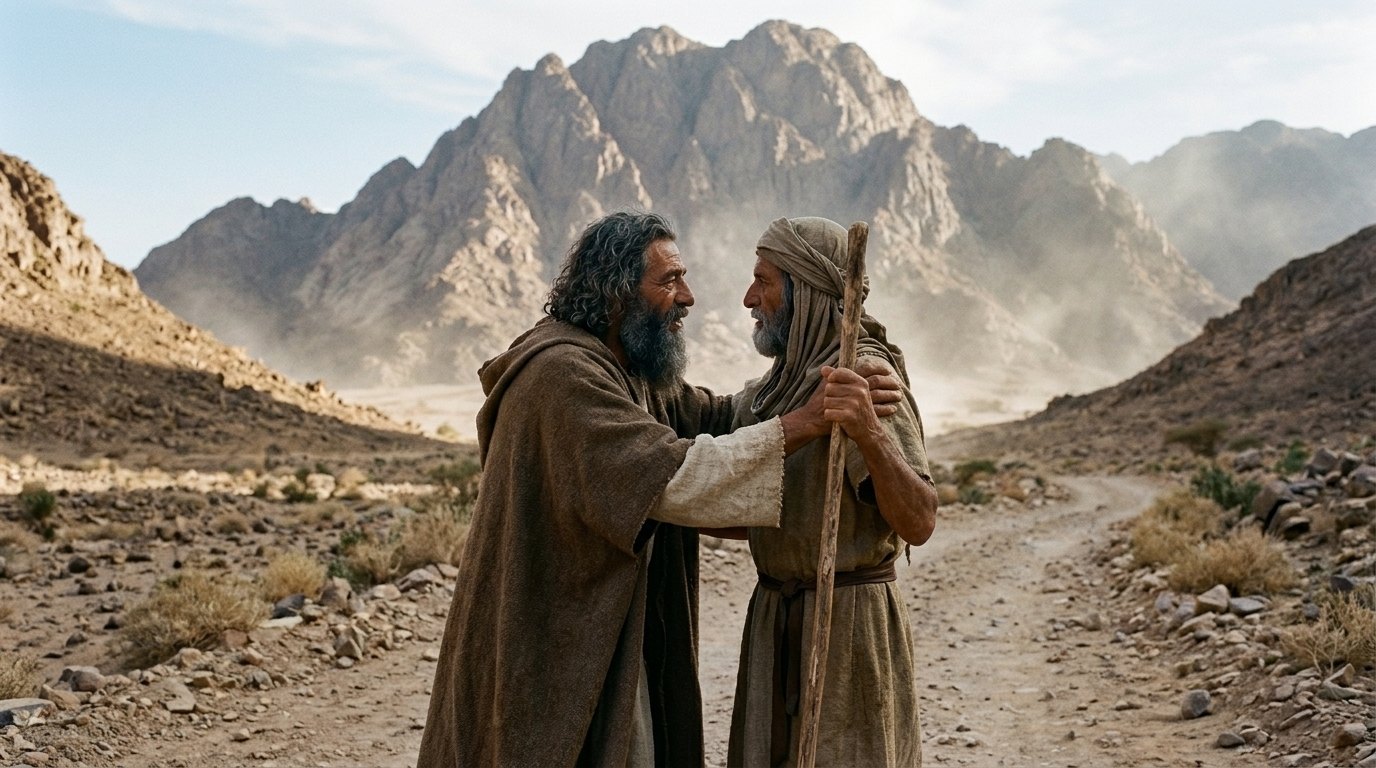
Exodus 4:14-16
14 Then the LORD’s anger burned against Moses and he said, “What about your brother, Aaron the Levite? I know he can speak well. He is already on his way to meet you, and he will be glad to see you.
15 You shall speak to him and put words in his mouth; I will help both of you speak and will teach you what to do.
16 He will speak to the people for you, and it will be as if he were your mouth and as if you were God to him.
New International Version (NIV)
The answer
Aaron was Moses’ older brother, Israel’s first high priest, and the man God appointed to speak for Moses before Pharaoh and the people. He belonged to the tribe of Levi, and his descendants formed the priestly line of Israel.
His family
Aaron was the son of Amram and Jochebed, of the tribe of Levi (Exodus 6:16-20). He married Elisheba, and their four sons were Nadab, Abihu, Eleazar, and Ithamar (Exodus 6:23). He was three years older than Moses: when the brothers confronted Pharaoh, Moses was eighty and Aaron eighty-three (Exodus 7:7).
His work with Moses
When Moses protested that he was slow of speech, God named Aaron as the answer: “I know that he can speak well” (Exodus 4:14). God told Moses, “He will be your spokesman to the people. It will happen that he will be to you a mouth, and you will be to him as God” (Exodus 4:16). Aaron therefore spoke the words Moses received from God, stood with him before Pharaoh, and shared in the work of bringing Israel out of Egypt. God described the relationship plainly: “Aaron your brother shall be your prophet” (Exodus 7:1).
His priesthood
God Himself chose Aaron for the priest’s office; Aaron did not appoint himself. “Bring Aaron your brother, and his sons with him, near to you from among the children of Israel, that he may minister to me in the priest’s office” (Exodus 28:1). His holy garments included a breastplate, ephod, robe, tunic, turban, and sash (Exodus 28:4).
When Israel later challenged his position, God confirmed His choice through a miracle: Aaron’s rod “sprouted, budded, produced blossoms, and bore ripe almonds,” while the other tribal rods remained unchanged (Numbers 17:8). The rod was then kept as a sign against rebellion (Numbers 17:10).
His failures
Aaron was a chosen servant of God, but not a sinless one. While Moses was on Mount Sinai, Aaron yielded to the people’s demand, fashioned the golden calf, built an altar before it, and proclaimed a feast (Exodus 32:1-5). Moses charged him with bringing “a great sin” on the people, and Aaron’s attempt to explain it away did not remove his guilt (Exodus 32:21-24).
Later, Aaron shared in the rebellion at Meribah. Because of this, God told him that he would not enter the promised land (Numbers 20:24). He died on Mount Hor after Moses transferred his priestly garments to Eleazar, and all Israel mourned him for thirty days (Numbers 20:25-29).
Why Aaron matters
Aaron’s priesthood shows both the necessity of mediation between sinful people and the holy God and the weakness of every merely human priest. A high priest offered sacrifices for the people and also for himself, because he too was surrounded by weakness (Hebrews 5:1-3). His office came by God’s call, “just like Aaron was” called (Hebrews 5:4).
Aaron and his successors eventually died, but Jesus Christ lives forever and holds an unchangeable priesthood (Hebrews 7:23-24). Unlike Aaron, Christ is “holy, guiltless, undefiled, separated from sinners,” and He offered Himself once for all rather than repeatedly offering sacrifices for His own sins and the people’s (Hebrews 7:26-27). Aaron’s ministry therefore points beyond itself to Jesus Christ, the perfect and eternal High Priest, who is able to save completely those who draw near to God through Him (Hebrews 7:25).
Answered from Scripture · reviewed November 12, 2026
Scripture cited
- Exodus 4:14-16
- Exodus 4:10-16
- Exodus 6:16-25
- Exodus 28:1-4
- Numbers 20:22-29
- Exodus 7:1-7
- Exodus 32:1-6
- Exodus 32:21-24
- Numbers 17:1-10
- Hebrews 5:1-5
- Hebrews 7:23-28