Is it a sin to hide my faith to avoid persecution?

Matthew 10:32-33
32 “Whoever acknowledges me before others, I will also acknowledge before my Father in heaven.
33 But whoever disowns me before others, I will disown before my Father in heaven.
New International Version (NIV)
The answer
Yes—if hiding your faith means denying Christ or refusing to confess him because of fear. Prudent caution is not the same as denial, but escaping persecution never makes denial permissible.
Jesus draws the line between confession and denial: “Everyone therefore who confesses me before men, I will also confess him before my Father who is in heaven” (Matthew 10:32). He immediately warns that whoever denies him before others, he will also deny before his Father (Matthew 10:33). Scripture joins inward faith with outward confession: Romans 10:9-10 speaks both of believing in the heart and confessing Jesus as Lord.
This is not a command to seek out persecution, and not every precaution or private act amounts to denial. What Jesus condemns is fear-driven self-protection that disowns him. Paul accordingly tells Timothy not to be ashamed of the Lord's testimony, but to share in afflictions for the gospel through God's power (2 Timothy 1:8). To those who overcome, Christ promises that he will confess their names before his Father and his angels (Revelation 3:5).
Where fear has already led to denial, the answer is repentance, not despair or excuse. Christ died for sinners and bore their sins (Romans 5:8; 1 Peter 2:24). God promises forgiveness to those who confess their sins, and Christ gives new life rather than leaving people bound to their former sin (1 John 1:9; 1 Corinthians 6:11).
Answered from Scripture · reviewed November 24, 2026
Confession, Caution and Denial
Read each row across to see how confessing Christ, prudent caution, and denying Him out of fear differ. Caution is not denial, but fear never makes denial permissible.
| Confessing Christ | Prudent caution | Denying Christ from fear | |
|---|---|---|---|
| What it is | Owning Jesus before others, believing in the heart and confessing Him as Lord | Taking precautions without disowning Him; not every private act is denial | Fear-driven self-protection that disowns Him |
| Is it sin? | No: it is what Jesus calls us to | Not in itself: there is no command to seek out persecution | Yes: escaping persecution never makes denial permissible |
| Christ's word | He will confess them before His Father in heaven | Christ condemns denial, not every precaution | He will deny them before His Father in heaven |
| In suffering | Not ashamed of the Lord's testimony; sharing afflictions by God's power | Wisdom without shame about the gospel | Shame and fear rule instead of Christ |
| The promise | Christ confesses the overcomer's name before His Father and angels | The same call holds: never disown Him | Repent: God forgives those who confess, and Christ gives new life |

Scripture draws an uncompromising line between prudent caution and cowardice: disowning Christ or concealing allegiance to Him out of fear of man is sin. Jesus plainly warns that whoever denies Him before others will be denied before the Father, while outward confession belongs inseparable to genuine saving faith.
The Solemn Demand
Confessing Christ Before Others Is Commanded

“Whoever acknowledges me before others, I will also acknowledge before my Father in heaven.
Matthew 10:32 (NIV)
Jesus explicitly links our public confession of Him on earth to His personal confession of us before the Father in heaven.
In Matthew 10:32, Christ establishes an inseparable link between acknowledging Him publicly before men and His reciprocal confession of us before the Father in heaven. Public confession is neither an optional grace nor an advanced stage of Christian growth; it is the natural, obligatory expression of true faith. In the very next breath, Matthew 10:33 delivers the counterpart warning: whoever denies Christ before others will be denied before the throne of God.
Jesus reiterates this solemn truth in Luke 12:8, promising that the Son of Man will openly acknowledge before the angels of God everyone who stands for Him. In contrast, Luke 12:9 announces that those who shrink back and disown Him among humanity will find themselves disowned before the heavenly host. This eternal principle is rooted in the unchanging holiness of God, who declared in 1 Samuel 2:30 that He will honour those who honour Him, but treat with contempt those who despise Him. Concealing one's allegiance out of worldly fear is a repudiation of His sovereignty.
Christ reinforces this warning in Luke 9:26, stating that whoever is ashamed of Him and His words will find the Son of Man ashamed of them when He returns in glory. This is echoed in 2 Timothy 2:12, where Paul writes that if we endure, we will also reign with Him, but if we deny Him, He will also deny us. To disown the Saviour to shield one's earthly safety is an affront to His cross, declaring temporal comfort more precious than eternal life.
| Passage | What it says |
|---|---|
| Matthew 10:32 | Christ promises to confess before His Father everyone who acknowledges Him before men. |
| Matthew 10:33 | Jesus warns that anyone who denies Him before men will be denied before the Father. |
| Luke 12:8 | Jesus declares that whoever confesses Him before men will be acknowledged before the angels of God. |
| Luke 12:9 | The Son of Man will deny before God's angels anyone who denies Him before humanity. |
| 1 Samuel 2:30 | The Lord declares that He will honour those who honour Him, but despise those who scorn Him. |
| Luke 9:26 | Whoever is ashamed of Jesus and His words, the Son of Man will be ashamed of him at His coming. |
| 2 Timothy 2:12 | If we endure, we will reign with Him; if we deny Him, He also will deny us. |
Faith and Confession
True Faith Must Be Spoken Aloud

If you declare with your mouth, “Jesus is Lord,” and believe in your heart that God raised him from the dead, you will be saved.
Romans 10:9 (NIV)
Scripture binds heart belief and oral confession together as necessary markers of true salvation.
In Romans 10:9, Scripture binds heart belief and spoken confession together as the unified work of saving faith. Paul teaches that salvation is not a silent, hidden abstraction; believing in the heart that God raised Jesus from the dead necessarily produces the vocal confession that Jesus is Lord. Romans 10:10 confirms this divine order: with the heart one believes unto righteousness, and with the mouth confession is made unto salvation. Where genuine spiritual life exists within, it cannot remain perpetually sealed from the ears of men.
John similarly anchors Christian assurance to public testimony in 1 John 4:15, declaring that whoever confesses that Jesus is the Son of God abides in God, and God in him. Consequently, Paul urges Timothy in 2 Timothy 1:8 never to be ashamed of the testimony of our Lord nor of His imprisoned servants, but rather to share in suffering for the gospel. This echoes Christ's rebuke in Mark 8:38 against anyone who compromises under the gaze of an adulterous and sinful generation.
Believers are called to an active readiness. In 1 Peter 3:15, Peter instructs us always to be prepared to give a defense for the hope that is in us. Paul demonstrated this posture in Philippians 1:20, desiring that with full courage Christ would be honoured in his body, whether by life or by death. In Hebrews 10:23, the church is commanded to hold fast the confession of our hope without wavering, resting entirely on the faithfulness of God.
| Passage | What it says |
|---|---|
| Romans 10:9 | Confessing with the mouth that Jesus is Lord and believing God raised Him brings salvation. |
| Romans 10:10 | Heart belief leads to righteousness, while confession with the mouth results in salvation. |
| 1 John 4:15 | Whoever confesses that Jesus is God's Son abides in God and God in him. |
| 2 Timothy 1:8 | Paul instructs Timothy never to be ashamed of the testimony of our Lord. |
| Mark 8:38 | Christ will be ashamed of anyone ashamed of Him and His words in an adulterous generation. |
| 1 Peter 3:15 | Always be prepared to make a defense to anyone who asks for a reason for your hope. |
| Philippians 1:20 | Paul prays that with full courage Christ will be honored in his body, by life or death. |
| Hebrews 10:23 | Hold fast the confession of our hope without wavering, for He who promised is faithful. |
Wisdom Versus Cowardice
Prudence Flees Danger Without Disowning Truth

When you are persecuted in one place, flee to another. Truly I tell you, you will not finish going through the towns of Israel before the Son of Man comes.
Matthew 10:23 (NIV)
Jesus Himself directs His disciples to flee persecution to continue gospel ministry, demonstrating that avoidance of unnecessary danger is not denial.
In Matthew 10:23, Jesus commands His disciples to flee persecution from one city to another, proving that wise avoidance of danger is entirely distinct from disowning the truth. Christ does not call His people to reckless martyrdom or unnecessary exposure. In Matthew 10:16, He sends His flock into the world as sheep among wolves, charging them to be wise as serpents yet innocent as doves. Prudence protects life to continue gospel proclamation; cowardice betrays Christ to save one's skin.
Scripture models this holy prudence repeatedly. In Acts 9:25, disciples lowered Saul over the Damascus wall in a basket by night to escape assassination, preserving the apostle for decades of fruit. Jesus Himself withdrew from walking openly in Judea in John 7:1 because the authorities sought His life, preserving His hour for the cross. In the Old Testament, 1 Kings 18:3-4 records how Obadiah, who feared the Lord greatly, hid a hundred prophets in caves, supplying them with bread and water to preserve their lives from Jezebel's slaughter.
Yet Scripture strictly distinguishes strategic discretion from sinful compromise. In John 12:42-43, authorities who believed quietly refused to confess Christ because they loved human praise more than God's. Although Nicodemus came by night in John 3:1-2 and Joseph of Arimathea hid his allegiance initially in John 19:38, both men ultimately cast off fear to publicly honour Christ's corpse. When authorities commanded silence, the apostles stood resolute in Acts 5:29: we must obey God rather than men.
| Passage | What it says |
|---|---|
| Matthew 10:23 | Jesus tells His disciples to flee to the next town when persecuted in one. |
| Matthew 10:16 | Believers are sent out as sheep among wolves, commanded to be wise as serpents and innocent as doves. |
| Acts 9:25 | The disciples lower Saul through an opening in the city wall to escape assassination plots. |
| John 7:1 | Jesus withdrew from walking openly in Judea because the religious leaders sought to kill Him. |
| John 12:42 | Many authorities believed in Jesus secretly but refused to confess Him for fear of the Pharisees. |
| John 12:43 | The fearful rulers loved human praise and approval more than the praise that comes from God. |
| John 19:38 | Joseph of Arimathea was a secret disciple for fear of the Jews before boldly asking for Jesus' body. |
| John 3:1-2 | Nicodemus came to Jesus by night to inquire in secret before later defending Him publicly. |
| 1 Kings 18:3-4 | Obadiah feared the Lord greatly and hid a hundred prophets in caves to save them from Jezebel. |
| Acts 5:29 | Peter and the apostles declare they must obey God rather than men when forbidden to speak. |
Repentance and Victory
Grace Restores the Fallen to Fearless Witness
The one who is victorious will, like them, be dressed in white. I will never blot out the name of that person from the book of life, but will acknowledge that name before my Father and his angels.
Revelation 3:5 (NIV)
Christ assures the overcomer that He will never erase their name and will personally confess them before heaven.
In Revelation 3:5, the risen Christ promises that He will never blot the overcomer's name out of the book of life but will confess it before His Father. This glorious promise brings immense hope to those tempted by fear. Even when a believer stumbles into cowardly compromise, God's grace in Christ remains powerful to pardon, restore, and transform. The cross offers complete forgiveness to every repentant heart, breaking the paralysis of guilt and raising up bold witnesses.
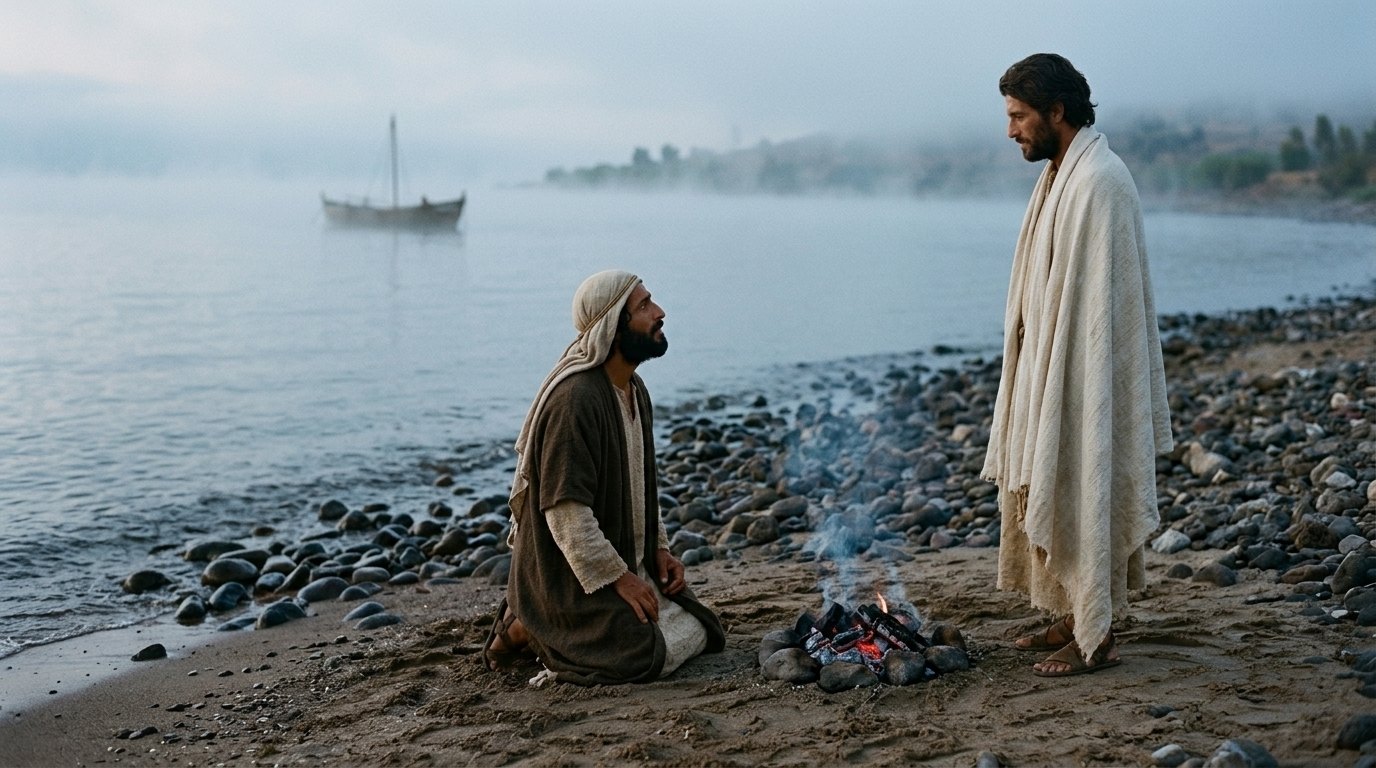
Peter's collapse in Matthew 26:74 is Scripture's most piercing picture of the flesh's weakness, where he denied his Lord three times with curses. Yet Jesus had already prayed for him in Luke 22:31-32, ensuring his faith would not fail so that, once restored, he would strengthen his brothers. In John 21:15, the risen Jesus met Peter on the shore, tenderly questioning his love and reinstating him to shepherd His sheep. The forgiven denier was transformed into the lion-hearted preacher of Acts 4:19, who looked the ruling council in the eye and refused to stop speaking in Jesus' name.
This same cleansing belongs to all who stumble; 1 John 1:9 promises that if we confess our sins, He is faithful and just to cleanse us from all unrighteousness. We must heed Revelation 21:8, which warns that the cowardly who remain in their unbelief face the lake of fire. Instead, Revelation 12:11 shows the saints conquering through the blood of the Lamb and their testimony, while Revelation 2:10 urges us not to fear suffering, promising the crown of life to those faithful unto death.
| Passage | What it says |
|---|---|
| Revelation 3:5 | Christ promises to confess the name of the overcomer before His Father and angels. |
| Matthew 26:74 | Peter denies knowing Jesus with curses and swearing when confronted by a servant girl. |
| John 21:15 | The resurrected Jesus gently questions Peter's love and commissions him to feed His lambs. |
| Acts 4:19 | Peter and John declare to the council that they must obey God rather than men. |
| 1 John 1:9 | God is faithful and just to forgive our sins and cleanse all unrighteousness when confessed. |
| Revelation 21:8 | Scripture explicitly lists the cowardly alongside the unbelieving as subject to the second death. |
| Luke 22:31-32 | Jesus prayed for Peter that his faith would not fail, commanding him to strengthen his brothers when restored. |
| Revelation 12:11 | The saints conquer the accuser by the blood of the Lamb and the word of their testimony. |
| Revelation 2:10 | Jesus commands not to fear suffering and promises the crown of life to those faithful unto death. |
Where in the Bible
| Book | Passages |
|---|---|
| 1 Samuel | 1 · 1 Samuel 2:30 |
| 1 Kings | 1 · 1 Kings 18:3-4 |
| Matthew | 5 · Matthew 10:32, Matthew 10:33, Matthew 10:23, Matthew 10:16, Matthew 26:74 |
| Mark | 1 · Mark 8:38 |
| Luke | 4 · Luke 12:8, Luke 12:9, Luke 9:26, Luke 22:31-32 |
| John | 6 · John 7:1, John 12:42, John 12:43, John 19:38, John 3:1-2, John 21:15 |
| Acts | 3 · Acts 9:25, Acts 5:29, Acts 4:19 |
| Romans | 2 · Romans 10:9, Romans 10:10 |
| Philippians | 1 · Philippians 1:20 |
| 2 Timothy | 2 · 2 Timothy 2:12, 2 Timothy 1:8 |
| Hebrews | 1 · Hebrews 10:23 |
| 1 Peter | 1 · 1 Peter 3:15 |
| 1 John | 2 · 1 John 4:15, 1 John 1:9 |
| Revelation | 4 · Revelation 3:5, Revelation 21:8, Revelation 12:11, Revelation 2:10 |
The story in order
- Elijah confronts prophets of Baal (c. 870 BC) · 1 Kings 18:3-4 · Obadiah hid prophets out of fear of Jezebel.
- Jesus warns disciples (c. AD 30) · Matthew 10:16 · Be wise as serpents and innocent as doves.
- Jesus withdraws from Judea (c. AD 30) · John 7:1 · He withdrew due to threats on His life.
- Secret believers fear Pharisees (c. AD 30) · John 12:42 · Many believed but feared confession.
- Joseph of Arimathea's secret discipleship (AD 30) · John 19:38 · He was a secret disciple out of fear.
- Nicodemus visits Jesus at night (c. AD 30) · John 3:1-2 · He came secretly before later defending Jesus.
- Peter denies Jesus (AD 30) · Matthew 26:74 · Peter denied Jesus out of fear.
- Paul's conversion and escape (c. AD 33) · Acts 9:25 · Disciples helped Paul escape Damascus.
- Peter and John before the council (c. AD 33) · Acts 4:19 · They declared obedience to God over men.
- Paul before Felix (c. AD 59) · Acts 24:25 · Paul spoke boldly, causing Felix to tremble.
- Paul's instruction to Timothy (c. AD 67) · 2 Timothy 1:8 · Do not be ashamed of the testimony of the Lord.
- The church conquers by testimony (c. AD 95) · Revelation 12:11 · They conquer the accuser by their testimony.
Confession and Denial of Christ
| Confesses Christ | Denies Christ | Passage |
|---|---|---|
| Christ promises to confess before His Father everyone who acknowledges Him. | Christ will deny before God's angels anyone who denies Him. | Matthew 10:32-33 |
| Confessing with the mouth that Jesus is Lord brings salvation. | Whoever is ashamed of Jesus and His words will be ashamed of. | |
| Whoever confesses that Jesus is God's Son abides in God. | If we deny Him, He also will deny us. | |
| Christ will confess the name of the overcomer. | Peter denied knowing Jesus with curses and swearing. |
Key words
- Confess (homologeō (ὁμολογέω))
- To acknowledge, admit, or declare openly and boldly. · Romans 10:9
- Deny (arneomai (ἀρνέομαι))
- To disown, refuse to acknowledge, or reject. · Matthew 10:33
- Ashamed (epaischunomai (ἐπαισχύνομαι))
- Feeling embarrassed or guilty, leading to concealment. · Luke 9:26
- Fear (phobos (φόβος))
- An unpleasant emotion caused by the threat of danger, pain, or harm. · John 12:42
- Testimony (marturion (μαρτύριον))
- A public declaration or evidence of something. · 2 Timothy 1:8
- Cowardly (deilos (δειλός))
- Lacking courage; easily intimidated. · Revelation 21:8
Believers are never summoned to reckless bravado, but they are strictly forbidden from disowning their Lord to spare their own flesh. Where fear has caused anyone to stumble into denial, repentance finds full mercy at the cross, where Christ restores the contrite to courageous witness.
34 passages, each cited once.
Scripture cited
- Revelation 3:5
- Romans 10:9-10
- 2 Timothy 1:8
- Matthew 10:16-33
- 1 John 1:9