Was Jesus only a prophet?
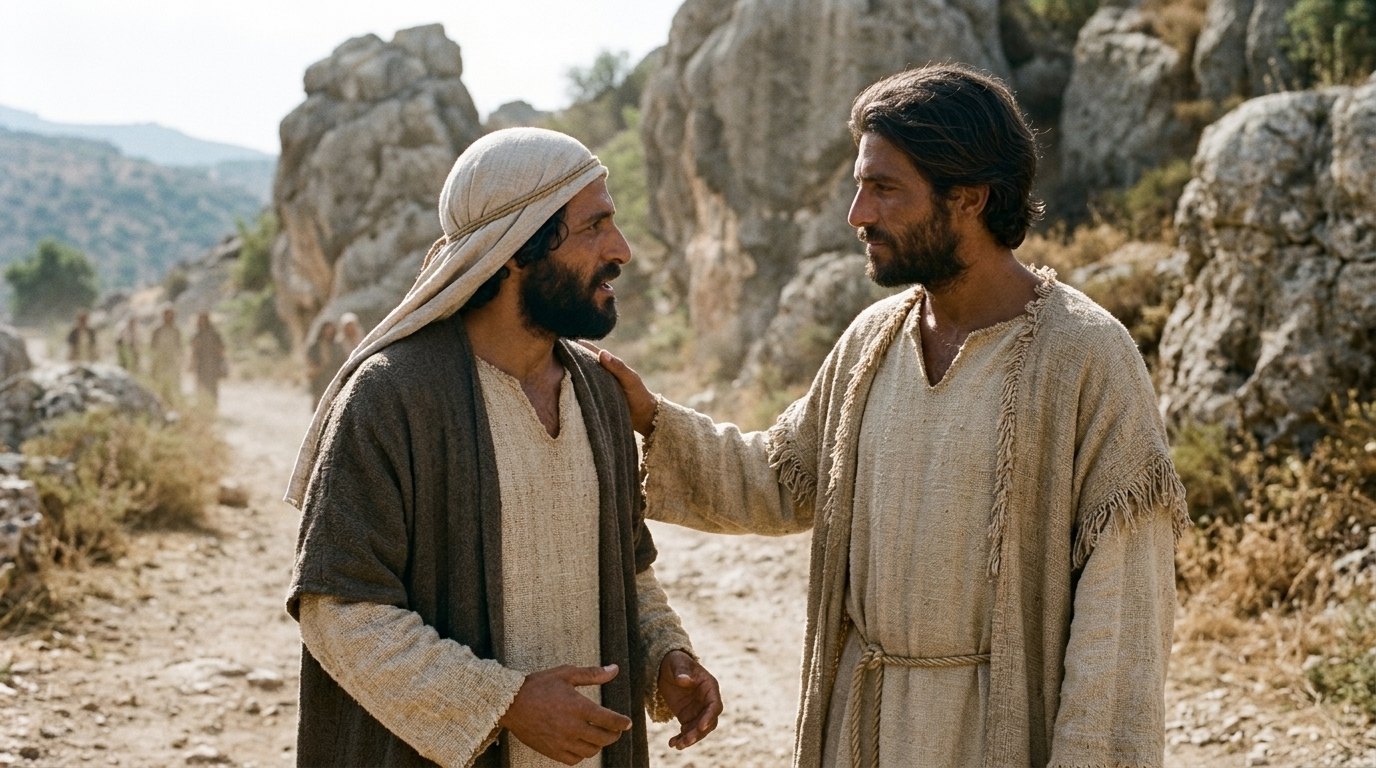
Matthew 16:13-17
13 When Jesus came to the region of Caesarea Philippi, he asked his disciples, “Who do people say the Son of Man is?”
14 They replied, “Some say John the Baptist; others say Elijah; and still others, Jeremiah or one of the prophets.”
15 “But what about you?” he asked. “Who do you say I am?”
16 Simon Peter answered, “You are the Messiah, the Son of the living God.”
17 Jesus replied, “Blessed are you, Simon son of Jonah, for this was not revealed to you by flesh and blood, but by my Father in heaven.
New International Version (NIV)
The answer
No. Jesus was not merely a prophet: He is the Christ, the Son of the living God.
In Matthew 16:14, the crowds place Him alongside John the Baptizer, Elijah, Jeremiah, or another prophet. Peter’s confession goes decisively further: “You are the Christ, the Son of the living God” (Matthew 16:16). Jesus does not correct Peter; He blesses him and says that His Father in heaven revealed this truth to him (Matthew 16:17).
Jesus’ authority also exceeds that of a prophet who simply delivers God’s message:
- He has power on earth to forgive sins (Matthew 9:6).
- He has authority to execute judgment (John 5:27).
- He took on flesh and blood so that, through His death, He would destroy the devil, who held the power of death (Hebrews 2:14).
Calling Jesus a prophet while denying His identity as Messiah and Son of the living God therefore stops short of the confession Jesus Himself blessed.
Answered from Scripture · reviewed November 24, 2026
Why Jesus Is More Than a Prophet
Read top to bottom. The answer moves from the crowds' guess to Peter's confession, which Jesus blessed, and then to the authority that belongs to Jesus alone.
- The crowds' answer · They placed Him alongside John the Baptizer, Elijah, Jeremiah, or another prophet. · Matthew 16:14
- Peter's confession · You are the Christ, the Son of the living God. · Matthew 16:16
- Jesus blesses Peter · He does not correct him. The Father in heaven revealed this truth. · Matthew 16:17
- Power to forgive sins · Jesus has power on earth to forgive sins, beyond a prophet who simply delivers God's message. · Matthew 9:6
- Authority to judge · The Father has given Him authority to execute judgment. · John 5:27
- Victory over the devil · He took on flesh and blood so that through His death He would destroy the devil, who held the power of death. · Hebrews 2:14
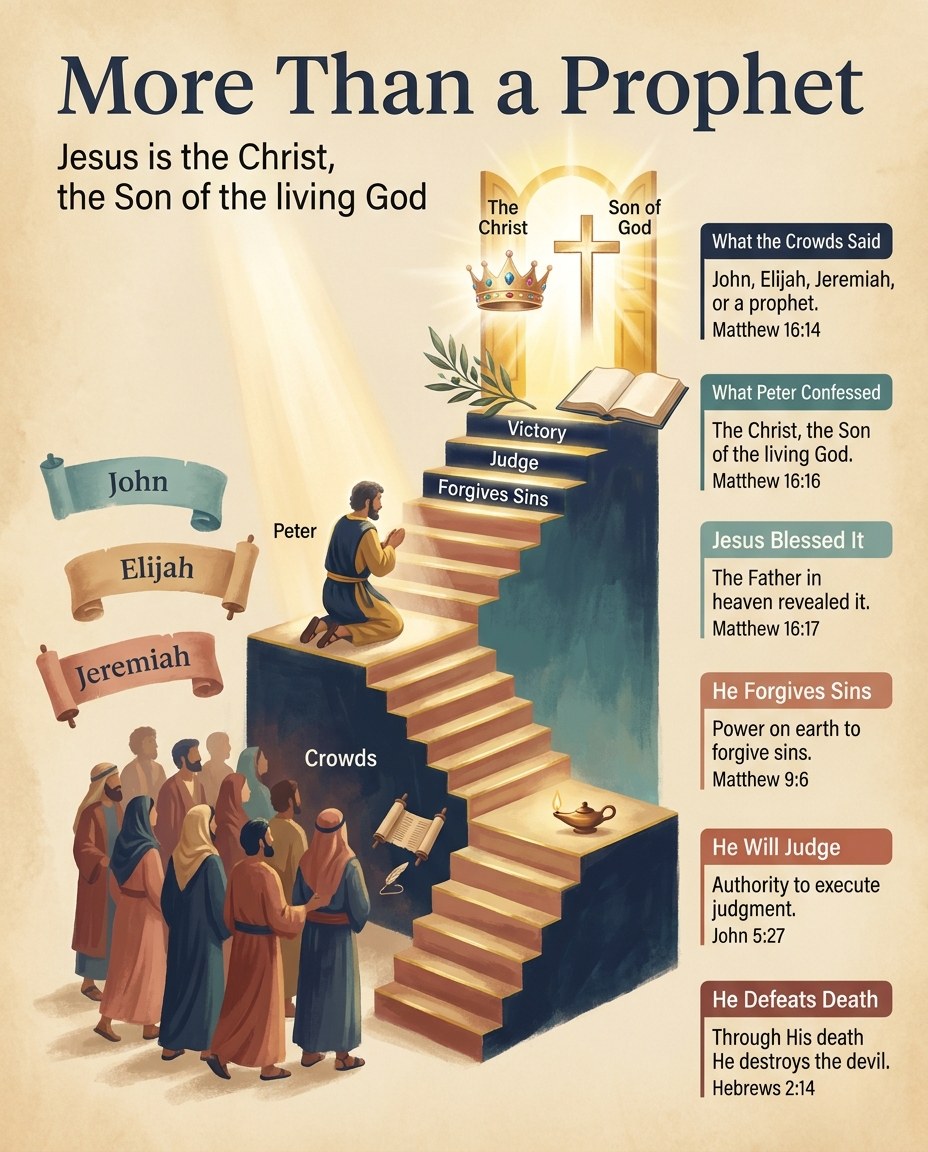
Scripture honors Jesus as a prophet, yet it decisively forbids reducing Him to one. While the crowds of His day mistook Him for a resurrected seer or a messenger of old, God the Father revealed His true identity as the Christ, the eternal Son of the living God. To call Jesus merely a prophet stops short of His divine authority to forgive sins, execute universal judgment, and conquer death.
The Great Confession
Peter Distinguishes the Son from the Prophets
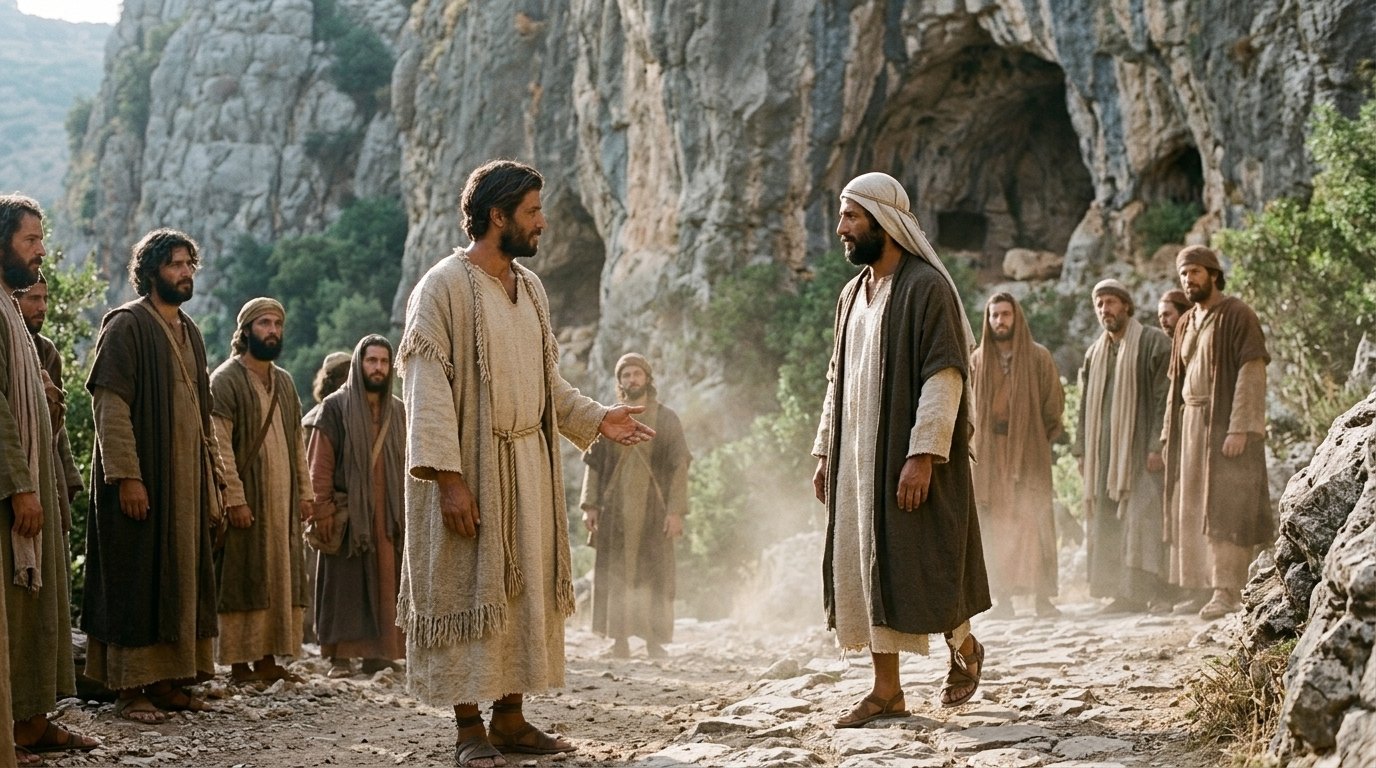
Simon Peter answered, “You are the Messiah, the Son of the living God.”
Matthew 16:16 (NIV)
Simon Peter explicitly moves past public opinion of Jesus as a mere prophetic messenger to confess His unique divine Sonship.
When Simon Peter spoke in Matthew 16:16, he cut through the swirling public chatter to declare the truth: "You are the Christ, the Son of the living God." The Lord had posed the question directly to His followers in Matthew 16:13-17, contrasting popular opinion with authentic faith. The crowds readily recognized Jesus as an extraordinary man of God, but their categories remained earthbound. As recorded in Mark 8:27-29 and Luke 9:18-20, many assumed Jesus was John the Baptist returned, Elijah reappearing, or Jeremiah restored to life. Popular acclaim praised Him, as when the crowds at the triumphal entry shouted that He was the prophet from Nazareth of Galilee in Matthew 21:10-11. Likewise, witnesses who watched Him raise the widow's son in Luke 7:16 proclaimed that a great prophet had arisen among them, and the travelers walking to Emmaus in Luke 24:19 spoke of Him as a prophet mighty in deed and word before God.
Even those who drew near to Him in personal conversation struggled to see beyond that initial impression. The Samaritan woman at the well perceived that He was a prophet in John 4:19 before He unveiled His identity as the Messiah. The multitude that ate the multiplied bread in John 6:14 declared that He was truly the Prophet coming into the world, yet they immediately sought to make Him an earthly ruler by force. In John 7:40-41, the populace divided sharply over whether He was merely the Prophet or the Christ Himself. Calling Jesus a prophet was not inherently insulting, but reducing Him to a prophet missed His eternal glory. Public opinion perceived His prophetic power, but divine revelation alone unveiled His divine Sonship.
| Passage | What it says |
|---|---|
| Matthew 16:13-17 | Jesus asks His disciples who people say He is, then blesses Peter for confessing Him as Christ and Son of God. |
| Mark 8:27-29 | Jesus inquires about public opinion on the road to Caesarea Philippi, prompting Peter to declare Him the Christ. |
| Luke 9:18-20 | After praying privately, Jesus questions the disciples, and Peter identifies Him specifically as the Christ of God. |
| Matthew 21:10-11 | The Jerusalem crowds identify Jesus as the prophet from Nazareth, reflecting the common contemporary perception. |
| Luke 7:16 | After raising the widow's son, witnesses glorify God, saying a great prophet has arisen among them. |
| Luke 24:19 | Disciples on the road to Emmaus describe Jesus as a prophet mighty in deed and word before God. |
| John 4:19 | The Samaritan woman perceives Jesus is a prophet before He reveals Himself as the promised Messiah. |
| John 6:14 | Following the multiplication of loaves, the multitude declares Jesus is truly the Prophet coming into the world. |
| John 7:40-41 | People debating Jesus' identity divide over whether He is the Prophet or the Christ. |
Divine Authority
Exercising Prerogatives Belonging to God Alone
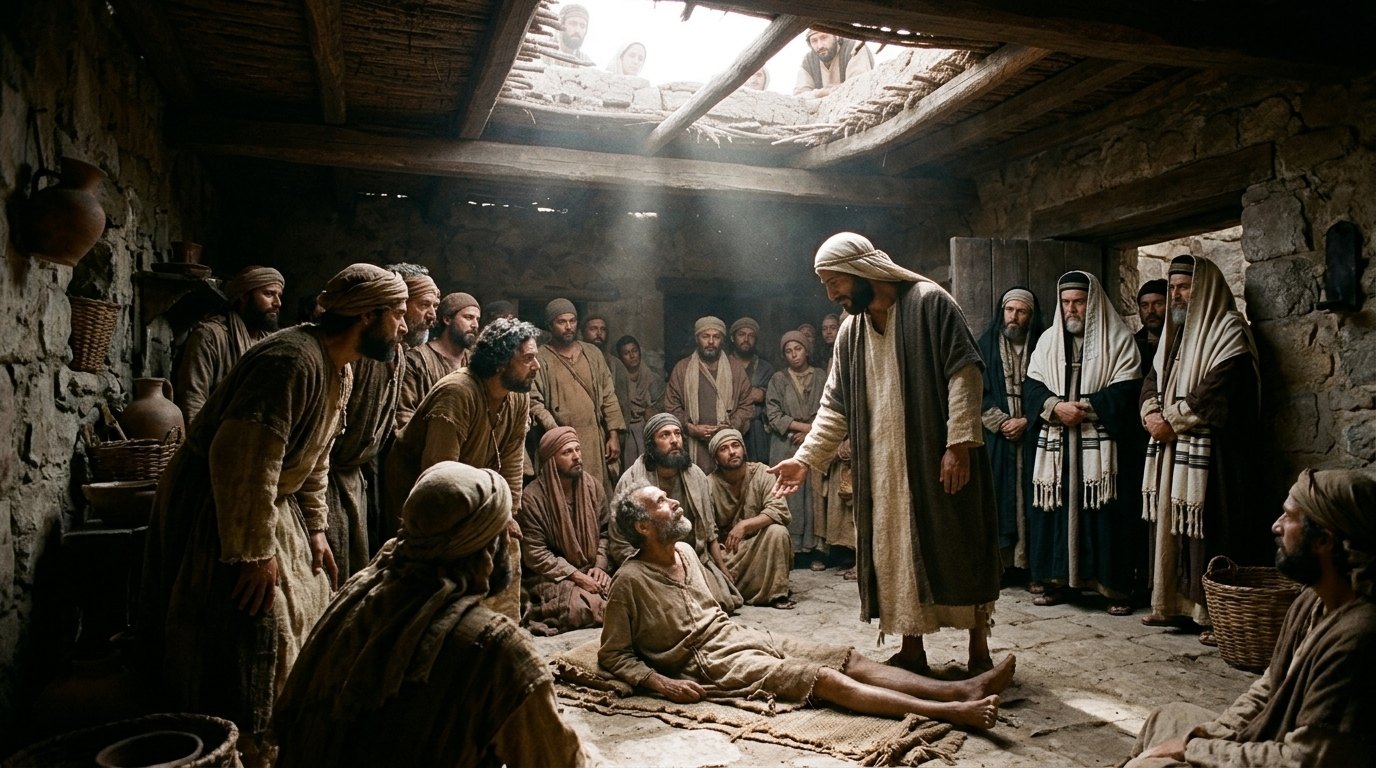
But I want you to know that the Son of Man has authority on earth to forgive sins.” So he said to the paralyzed man, “Get up, take your mat and go home.”
Matthew 9:6 (NIV)
Jesus demonstrates tangible power to forgive sins, a prerogative reserved strictly for God Himself and never granted to prophets.
In Matthew 9:6, Jesus directly demonstrated divine prerogative by healing the paralytic "that you may know that the Son of Man has authority on earth to forgive sins." The scribes standing by rightly reasoned that God alone can wipe away guilt, yet Jesus proved His title by commanding the crippled man to take up his bed and walk, as recorded in Matthew 9:2-8 and Mark 2:5-12. No prophet ever dared to pardon sins against the Almighty in their own name. Furthermore, Jesus stated in John 5:21-27 that just as the Father raises the dead, the Son gives life to whom He will, because all judgment has been handed over to Him. This echoes Daniel 7:13-14, where the Son of Man appears before the Ancient of Days to receive an everlasting dominion and universal reverence from every tribe and tongue.
Jesus consistently operated with an authority that shattered purely prophetic bounds. In John 8:58, He stunned His hearers by declaring, "Before Abraham was, I am," taking upon His own lips the covenant name of Yahweh. When He announced His essential unity with the Father in John 10:30-33, His adversaries took up stones to kill Him precisely because a mere man claimed to be God. Before ascending to heaven, Jesus proclaimed in Matthew 28:18-20 that all authority in heaven and on earth had been committed to Him, ordering disciples to be baptized into the single name of the Father, Son, and Holy Spirit. Even creation answered His voice: in Mark 4:39-41, He rebuked the tempestuous wind and sea with a personal command, leaving seasoned fishermen trembling in awe at a power belonging to the Creator alone.
| Passage | What it says |
|---|---|
| Matthew 9:2-8 | Jesus heals a paralytic to prove the Son of Man possesses genuine authority on earth to forgive sins. |
| John 5:21-27 | The Father commits all judgment and the power to raise the dead directly to the Son of Man. |
| Daniel 7:13-14 | The Son of Man approaches the Ancient of Days to receive everlasting dominion, glory, and universal worship. |
| Mark 2:5-12 | Jesus forgives sins openly, demonstrating divine authority that scribes rightly recognize belongs to God alone. |
| John 8:58 | Jesus declares His eternal self-existence before Abraham using the divine covenant name, claiming absolute deity. |
| John 10:30-33 | Jesus asserts essential oneness with the Father, provoking opponents to stone Him for claiming to be God. |
| Matthew 28:18-20 | Jesus possesses all authority in heaven and on earth, commanding baptism into the single name of the Trinity. |
| Mark 4:39-41 | Jesus commands the wind and sea to be still by His own word, prompting awe at His identity. |
Incarnation and Supremacy
Far Above Every Messenger of Old

In the past God spoke to our ancestors through the prophets at many times and in various ways, but in these last days he has spoken to us by his Son, whom he appointed heir of all things, and through whom also he made the universe.
Hebrews 1:1-2 (NIV)
Scripture explicitly contrasts God speaking through the prophets of old with His definitive, supreme revelation in His Son.
The opening words of Hebrews 1:1-2 establish the definitive dividing line between all previous messengers and Jesus Christ: God spoke through the prophets, but now speaks through His Son. As Hebrews 1:1-4 explains, this Son is the radiance of God's glory, the exact imprint of His nature, and the One who upholds the entire universe by His powerful word. He is not a created messenger; as John 1:1-3 affirms, the Word was with God in the beginning and was God, the active agent of all creation. In John 1:14-18, this eternal Word became flesh and tabernacled among us, revealing the Father's grace and truth in a manner impossible for any created mortal.
Scripture constantly elevates the incarnate Son above the greatest servants of antiquity. Hebrews 3:1-6 reminds believers that while Moses served faithfully as an attendant within God's house, Christ reigns as a Son over His own house. According to Colossians 1:15-20, He is the image of the invisible God, the firstborn over all creation, in whom all the fullness of God was pleased to dwell bodily. In Philippians 2:5-11, the Apostle Paul traces His descent from eternal equality with God into the humility of human flesh and death upon a cross, resulting in His exaltation where every knee must bow. Hebrews 2:14-18 shows that He took on flesh and blood specifically to conquer the devil through death. Thus 1 Timothy 3:16 celebrates God manifest in the flesh, and Titus 2:13 calls believers to look for the glorious appearing of our great God and Savior, Jesus Christ.
| Passage | What it says |
|---|---|
| Hebrews 1:1-4 | God has spoken finally through His Son, who upholds all things and is far superior to any angelic or prophetic messenger. |
| Hebrews 2:14-18 | Jesus took on flesh and blood to destroy the devil through death and deliver believers from the fear of death. |
| John 1:1-3 | The Word was with God in the beginning, was fully God, and created all things that exist. |
| John 1:14-18 | The Word became flesh to manifest the glory of the only begotten Son, revealing God as no prophet ever could. |
| Hebrews 3:1-6 | Moses was faithful as a servant in God's house, but Christ is supreme as a Son over His house. |
| Colossians 1:15-20 | Christ is the image of the invisible God and Creator of all things, in whom all fullness dwells. |
| Philippians 2:5-11 | Existing in the form of God, Christ humbled Himself to death and is exalted with the name above every name. |
| 1 Timothy 3:16 | The mystery of godliness confesses God manifested in the flesh, vindicated by the Spirit, and taken up in glory. |
| Titus 2:13 | Believers await the blessed hope and glorious appearing of our great God and Savior, Jesus Christ. |
The True Prophet
Jesus Perfectly Fulfills the Prophetic Office
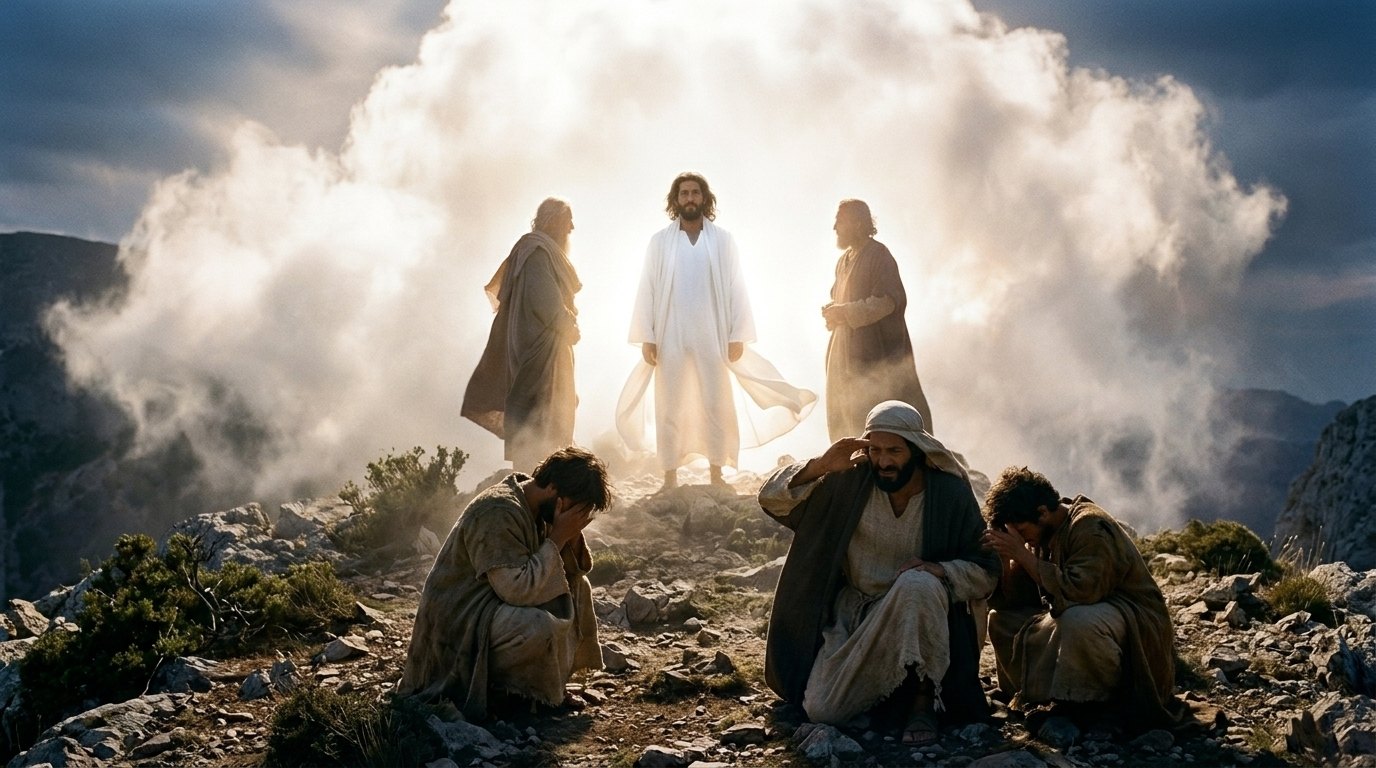
For Moses said, ‘The Lord your God will raise up for you a prophet like me from among your own people; you must listen to everything he tells you.
Acts 3:22 (NIV)
Peter identifies Jesus as the climactic prophet promised by Moses while calling the nation to repentance.
In Acts 3:22, Peter addressed the crowd gathered at Solomon's Portico by announcing: "Moses said, 'The Lord God will raise up for you a prophet like me from your brothers.'" This declaration directly cited Deuteronomy 18:15-19, where the Lord promised that a mediator would arise to speak the words of God with absolute authority, demanding full obedience from the covenant community. While Jesus is never only a prophet, He is indeed the ultimate Prophet who fulfills everything the office was designed to foreshadow. When Stephen stood before the Sanhedrin in Acts 7:37, he echoed this same passage to demonstrate that the entire Mosaic economy pointed forward to the coming of the Righteous One whom Israel's leaders had betrayed and murdered.
The supremacy of this prophetic fulfillment was visibly confirmed on the Mount of Transfiguration. In Matthew 17:1-5, Moses and Elijah—the very embodiments of the Law and the Prophets—appeared conversing with Jesus as His face shone like the sun. Yet when Peter offered to construct three separate tents to honor them equally, a bright cloud overshadowed them, and the voice of the Father thundered: "This is my beloved Son, with whom I am well pleased; listen to him." The ancient witnesses faded away, leaving Jesus standing alone before His disciples. The prophets of old pointed the way, but Jesus Christ is the final, supreme voice through whom God has spoken to humanity.
| Passage | What it says | Fulfilled |
|---|---|---|
| Deuteronomy 18:15-19 | The Lord promises to raise up a prophet like Moses from among Israel, whose words must be heeded. | Acts 3:22-26, Acts 7:37 |
| Acts 3:22-26 | Peter explicitly cites Deuteronomy, proclaiming that Jesus fulfills the promise of the prophet like Moses. | |
| Acts 7:37 | Stephen testifies before the council that Moses himself pointed forward to the Prophet whom God would raise up. | |
| Matthew 17:1-5 | At the Transfiguration, the Father commands to hear the beloved Son above Moses and Elijah. |
Object of Worship
Accepting Worship Reserved for the Almighty Alone
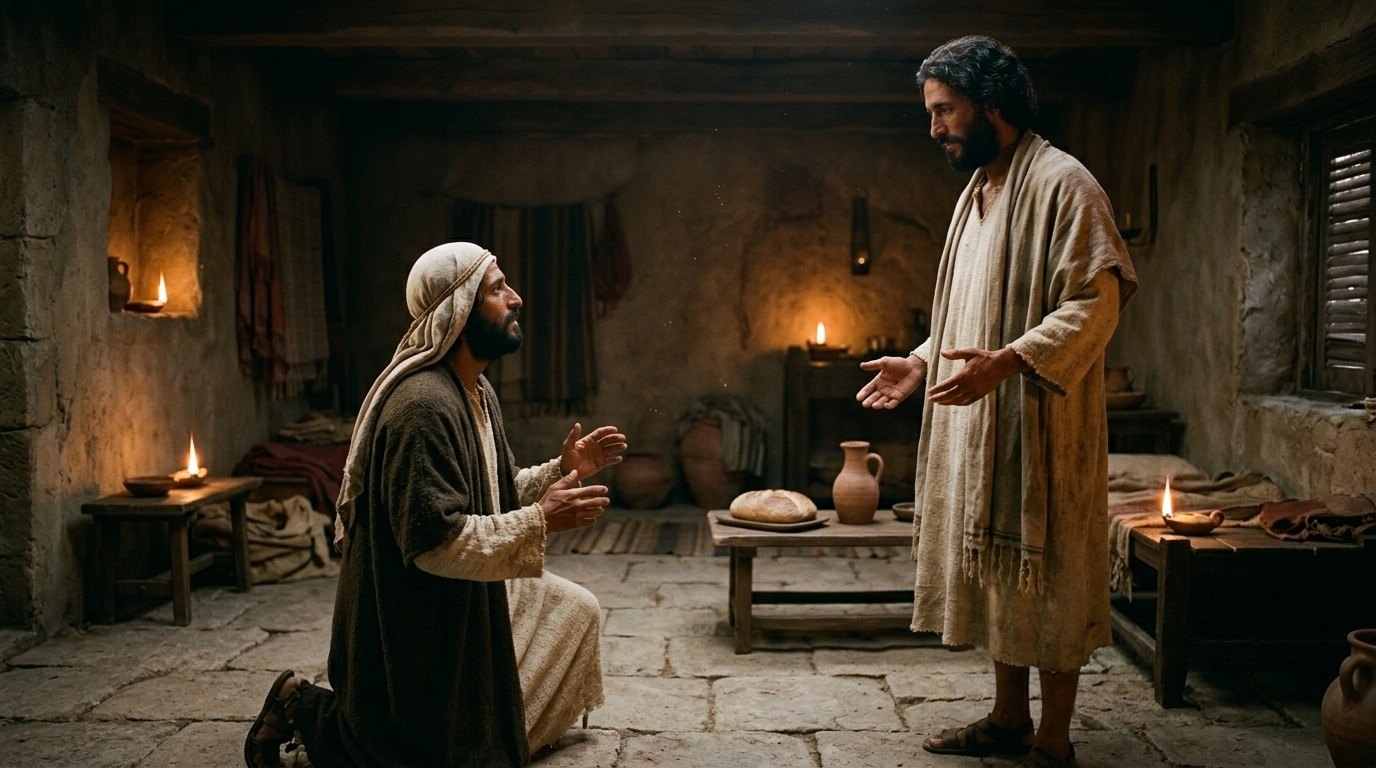
Thomas said to him, “My Lord and my God!”
John 20:28 (NIV)
Thomas gives Jesus the highest divine titles, which Jesus receives and approves as saving faith.
When Thomas fell before the risen Christ in John 20:28, he made an astonishing confession: "My Lord and my God!" Jesus did not silence him, nor did He correct a confused follower. Instead, He blessed those who believe without seeing. This acceptance separates Jesus entirely from every messenger God ever sent. During His wilderness testing, Jesus Himself laid down the unbending standard in Matthew 4:10, quoting Deuteronomy: "You shall worship the Lord your God and him only shall you serve." If Jesus were merely a prophet, receiving worship would be horrific blasphemy. Yet throughout His earthly ministry, Jesus received worship repeatedly without rebuke. In Matthew 14:33, after He stepped into the boat and stilled the tempest, the disciples fell down before Him, proclaiming Him the Son of God. When the man born blind received his sight in John 9:38, he confessed his belief in the Son of Man and immediately bowed before Him in worship, an act Jesus received as rightful devotion.
The reaction of mere men and heavenly messengers sets this divine right in stark relief. In Acts 10:25-26, when Cornelius fell at the feet of Peter, the apostle pulled him up at once, insisting, "Stand up; I too am a man." Even holy angels shudder at the thought of creaturely adoration; in Revelation 19:10, when John fell before an angel to worship him, the messenger commanded, "You must not do that! I am a fellow servant... Worship God." Prophets, apostles, and angels uniformly deflect worship back to the Almighty. Only Jesus stands on the other side of that infinite divide. The eternal scene of Revelation 5:11-14 displays the final truth: every creature in heaven and on earth falls down before the enthroned Lord and the Lamb together, offering both the exact same praise, honor, glory, and dominion forever. A prophet points toward heaven; the Son receives the worship of heaven and earth.
| Passage | What it says |
|---|---|
| Matthew 4:10 | Jesus affirms the absolute biblical command that worship is due only to the Lord God. |
| Matthew 14:33 | The disciples worship Jesus in the boat after He calms the storm, confessing Him as God's Son. |
| John 9:38 | The man born blind confesses belief in Jesus as the Son of Man and openly worships Him. |
| John 20:28 | Thomas confesses the resurrected Jesus directly as his Lord and his God without correction. |
| Acts 10:25-26 | Peter refuses worship from Cornelius, stressing that mere men and human messengers must never receive worship. |
| Revelation 19:10 | An angel strictly forbids John from worshiping him, stating worship belongs to God alone. |
| Revelation 5:11-14 | Every creature in heaven and on earth renders identical adoration, honor, and glory to the Lamb and God. |
Where in the Bible
| Book | Passages |
|---|---|
| Deuteronomy | 1 · Deuteronomy 18:15-19 |
| Daniel | 1 · Daniel 7:13-14 |
| Matthew | 7 · Matthew 16:13-17, Matthew 21:10-11, Matthew 9:2-8, Matthew 28:18-20, Matthew 17:1-5, Matthew 4:10, Matthew 14:33 |
| Mark | 3 · Mark 8:27-29, Mark 2:5-12, Mark 4:39-41 |
| Luke | 3 · Luke 9:18-20, Luke 7:16, Luke 24:19 |
| John | 10 · John 4:19, John 6:14, John 7:40-41, John 5:21-27, John 8:58, John 10:30-33, John 1:1-3, John 1:14-18, John 9:38, John 20:28 |
| Acts | 3 · Acts 3:22-26, Acts 7:37, Acts 10:25-26 |
| Philippians | 1 · Philippians 2:5-11 |
| Colossians | 1 · Colossians 1:15-20 |
| 1 Timothy | 1 · 1 Timothy 3:16 |
| Titus | 1 · Titus 2:13 |
| Hebrews | 3 · Hebrews 1:1-4, Hebrews 2:14-18, Hebrews 3:1-6 |
| Revelation | 2 · Revelation 19:10, Revelation 5:11-14 |
The story in order
- The Lord promises a prophet like Moses (c. 1400 BC) · Deuteronomy 18:15-19 · Foreshadows Jesus' unique prophetic role.
- Son of Man receives dominion (c. 550 BC) · Daniel 7:13-14 · Reveals a figure with eternal authority.
- The Word was with God (c. AD 30) · John 1:1-3 · Establishes Jesus' pre-existence and deity.
- Jesus asks about His identity (c. AD 30) · Matthew 16:13-17 · Peter confesses Jesus as Christ and Son of God.
- Jesus forgives sins (c. AD 30) · Mark 2:5-12 · Demonstrates divine authority to forgive.
- Jesus claims eternal existence (c. AD 30) · John 8:58 · Asserts His deity using the divine name.
- Jesus is declared God's Son (c. AD 30) · Matthew 14:33 · Disciples worship Jesus after He calms the storm.
- The Transfiguration (c. AD 30) · Matthew 17:1-5 · Father commands to hear the Son above Moses and Elijah.
- Jesus is the Prophet like Moses (c. AD 30) · Acts 3:22-26 · Peter proclaims Jesus fulfills Deuteronomy's prophecy.
- Jesus is superior to angels (c. AD 60s) · Hebrews 1:1-4 · God's final word is through His Son, far above messengers.
- Thomas confesses Jesus as Lord and God (c. AD 30) · John 20:28 · Resurrected Jesus is directly addressed as God.
- Worship due only to God (c. AD 95) · Revelation 19:10 · Angel forbids worship, reserving it for God alone.
Key words
- Prophet (nabi, נָבִיא)
- A spokesperson for God, conveying His message. · Deuteronomy 18:15
- Christ (Christos, Χριστός)
- Anointed one; Messiah. · Matthew 16:16
- Son of God (Huios tou Theou, Υἱὸς τοῦ Θεοῦ)
- Unique designation revealing Jesus' divine nature and relationship with the Father. · Matthew 16:16
- Son of Man (Ben 'Enosh, בֶּן־אֱנוֹשׁ / Huios tou Anthrōpou, Υἱὸς τοῦ…)
- A title for Jesus emphasizing His humanity and divine authority. · Daniel 7:13
- Lord (Adonai, אֲדֹנָי / Kyrios, Κύριος)
- Title of authority and deity. · John 20:28
Knowing Jesus as more than a prophet demands more than admiration: it calls for total faith, worship, and repentance. A prophet delivers God's message, but Jesus is the divine Word made flesh who redeems, pardons, and rules forever. Receiving Him as Lord and Son of the living God is the confession that leads to life eternal.
37 passages, each cited once.
Scripture cited
- Matthew 9:6
- John 5:27
- Hebrews 2:14-18