Who was King Xerxes, also called Ahasuerus?
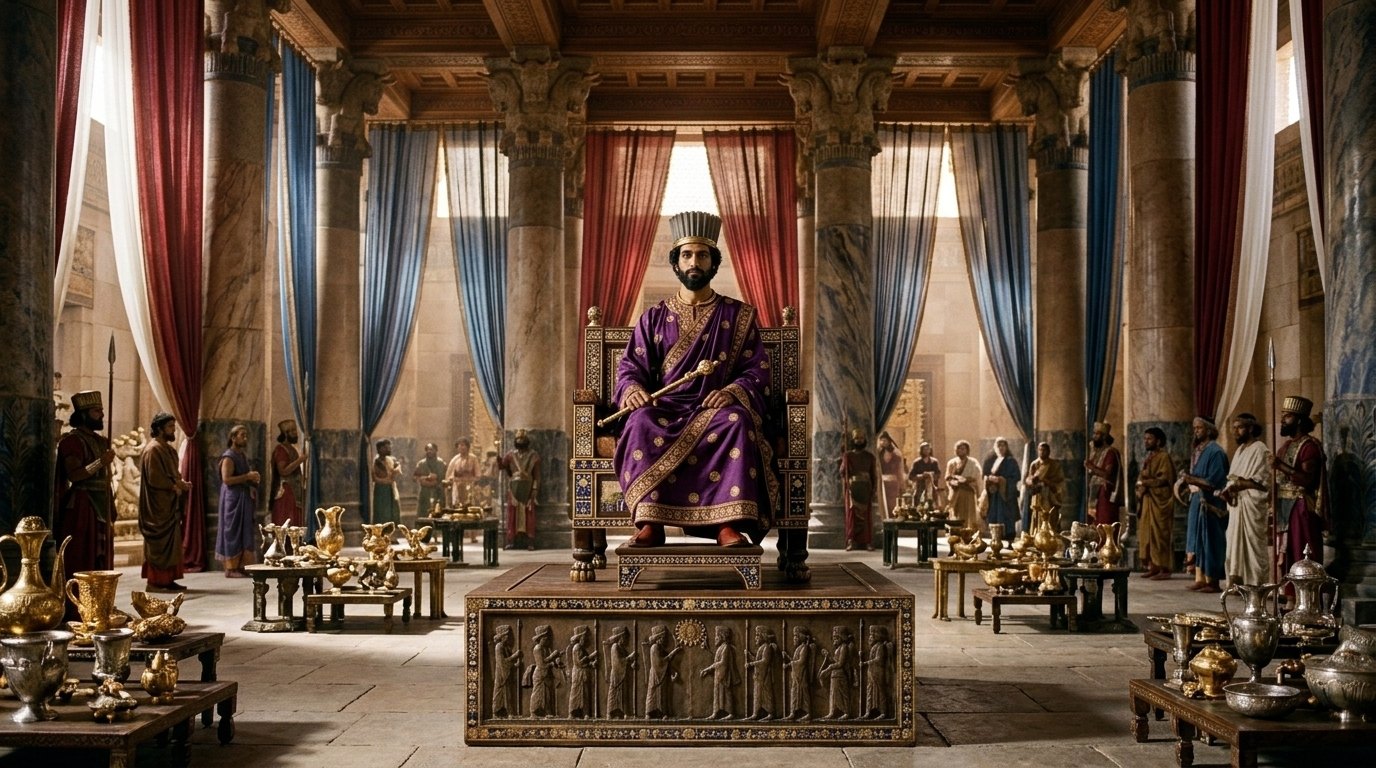
Esther 1:1-4
1 This is what happened during the time of Xerxes, the Xerxes who ruled over 127 provinces stretching from India to Cush:
2 At that time King Xerxes reigned from his royal throne in the citadel of Susa,
3 and in the third year of his reign he gave a banquet for all his nobles and officials. The military leaders of Persia and Media, the princes, and the nobles of the provinces were present.
4 For a full 180 days he displayed the vast wealth of his kingdom and the splendor and glory of his majesty.
New International Version (NIV)
The answer
Xerxes I was the Persian emperor whom the book of Esther calls Ahasuerus. The Hebrew name in Esther 1:1 is Achashverosh, rendered “Ahasuerus” in English. Persian history identifies him as the son and successor of Darius I, also called Darius Hystaspes, with his reign generally dated about 486–465 BC. Outside Scripture, he is especially remembered for invading Greece, including the fighting at Thermopylae and his defeat at Salamis.
What Scripture reveals about him
- His empire was immense. Ahasuerus ruled 127 provinces “from India even to Ethiopia,” with his royal throne at Susa, also called Shushan (Esther 1:1-2). His kingdom encompassed Persia and Media and many peoples, languages and provincial governments (Esther 8:9).
- His court was extraordinarily wealthy. In his third year, he spent 180 days displaying his kingdom’s riches and majesty, followed by a seven-day banquet in Susa featuring gold and silver couches, marble pillars and royal wine in abundance (Esther 1:3-7).
- His anger shaped the opening crisis. When Queen Vashti refused his summons, he became enraged and accepted counsel removing her from her royal position (Esther 1:10-22).
- He made Esther queen. In the seventh year of his reign, Esther was brought to him; he loved her, crowned her and made her queen instead of Vashti (Esther 2:16-17).
- He enabled Haman’s murderous decree. In his twelfth year, Ahasuerus gave Haman his signet ring and permitted an empire-wide order to destroy the Jews, young and old, women and children (Esther 3:7-13).
- He subsequently permitted the Jews to defend themselves. After Haman was exposed and executed, the king authorized Esther and Mordecai to write in his name and seal letters with his ring, granting the Jews the right to gather and defend their lives (Esther 8:7-12).
Esther closes by noting his tribute, his recorded acts of power and his advancement of Mordecai, who became second to the king and sought the good of the Jewish people (Esther 10:1-3). Thus, Xerxes was a powerful but fallible Gentile monarch whose court became the setting for God’s preservation of His people.
The name Ahasuerus also belongs to other rulers in Scripture. The Ahasuerus of Daniel 9:1 was the father of Darius the Mede, while Ezra 4:6 concerns a Persian ruler during an earlier period of opposition to Judah; neither is the Xerxes of Esther.
Answered from Scripture · reviewed November 25, 2026
The Reign of Ahasuerus in Esther
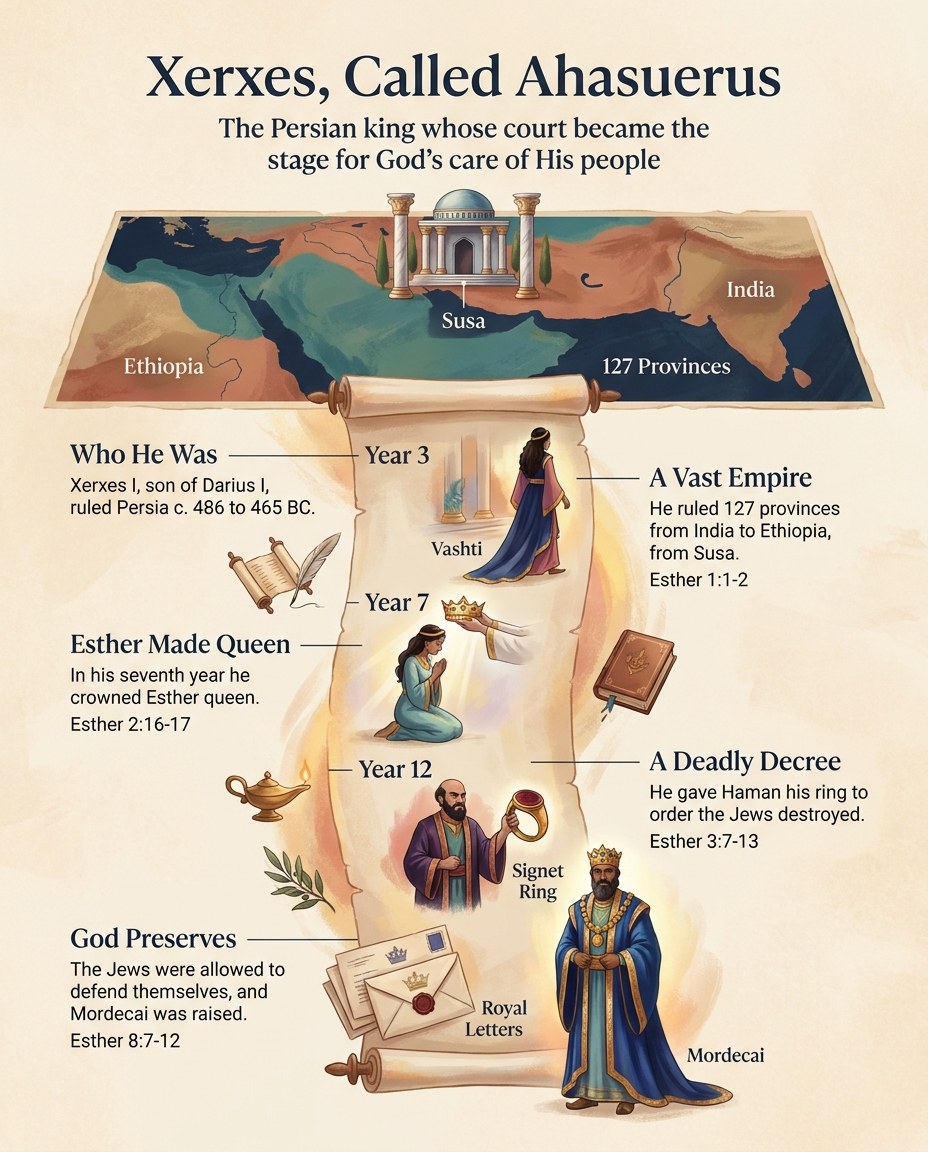
Read from top to bottom: the main moments of Xerxes' reign as Esther records them, dated by the year of his reign. Through each turn of this Gentile king's court, God preserved His people.
- Succeeds Darius I (c. 486 BC) · Persian history identifies Xerxes I as the son and successor of Darius I, also called Darius Hystaspes.
- Rules from Susa (His reign) · He rules 127 provinces from India to Ethiopia from his royal throne at Susa (Shushan). · Esther 1:1-2
- 180-day display and banquet (Year 3) · He shows the riches of his kingdom for 180 days, then holds a seven-day banquet in Susa. · Esther 1:3-7
- Vashti removed (Year 3) · Enraged when Queen Vashti refuses his summons, he accepts counsel that removes her from her royal position. · Esther 1:10-22
- Esther made queen (Year 7) · Esther is brought to him. He loves her, crowns her and makes her queen instead of Vashti. · Esther 2:16-17
- Haman's decree (Year 12) · He gives Haman his signet ring and permits an empire-wide order to destroy the Jews. · Esther 3:7-13
- Jews may defend themselves (After Haman's fall) · Esther and Mordecai write in the king's name, granting the Jews the right to gather and defend their lives. · Esther 8:7-12
- Mordecai second to the king (Later in his reign) · Mordecai is advanced to second place and seeks the good of the Jewish people. · Esther 10:1-3
- Reign ends (c. 465 BC) · His reign is generally dated about 486 to 465 BC.
King Xerxes I, identified in the book of Esther by his Hebrew name Ahasuerus, was the mighty Persian monarch who ruled an empire stretching from India to Cush. Scripture records his dazzling wealth, his erratic temper, and his unwitting role in a plot that threatened the Jewish people with total annihilation. Through his royal court at Susa, God sovereignly directed the actions of an earthly autocrat to preserve the covenant line of redemption.
The Great Empire
Ahasuerus Ruled an Vast Dominion from Susa
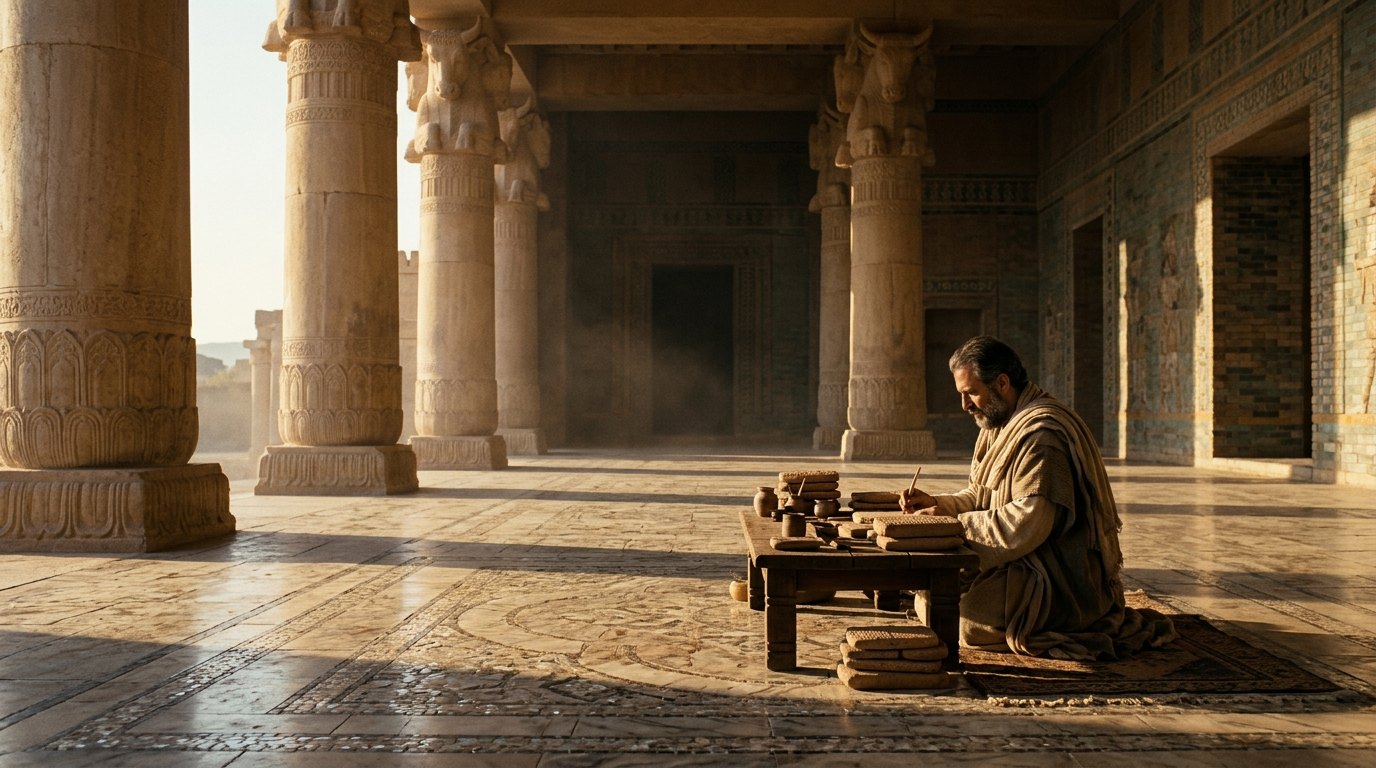
This is what happened during the time of Xerxes, the Xerxes who ruled over 127 provinces stretching from India to Cush:
Esther 1:1 (NIV)
It defines the enormous geographical extent of Xerxes' Persian dominion over one hundred and twenty-seven provinces.
The inspired account opens in Esther 1:1 by establishing the sovereign scale of world power: "Now it took place in the days of Ahasuerus, the Ahasuerus who reigned from India to Cush over 127 provinces." Known to Greek history as Xerxes I, this formidable monarch commanded an imperial expanse unmatched in the ancient Mediterranean world. Scripture grounds this history directly in the fortified winter fortress described in Esther 1:2, where the king sat upon his royal throne in Susa, reigning over nations with unquestioned geopolitical dominion.
To consolidate his court and display his immense imperial grandeur, Esther 1:3 notes that in his third year, he summoned his officials, army leaders, and nobles for a state assembly. This was no fleeting gathering; Esther 1:4 records that he spent one hundred and eighty days displaying the glorious wealth and splendor of his realm. From this palatial center, imperial administration reached every corner of the known world. Esther 8:9 demonstrates how his formal decrees went out across all one hundred and twenty-seven provinces, translated meticulously into every regional language and script. Even the economic might of the ancient world felt his absolute rule, as Esther 10:1 concludes by recording that King Ahasuerus imposed forced tribute across both the mainland and the distant coastlands. Yet throughout this portrait of unrivaled earthly splendor, Scripture reveals that the heart of this mighty autocrat remained fully in the hands of the Lord, who sovereignly orders kings to fulfill His redemptive purposes.
| Passage | What it says |
|---|---|
| Esther 1:1 | Ahasuerus ruled from India to Cush over one hundred twenty-seven provinces. |
| Esther 1:2 | The king sat upon his royal throne in the fortified citadel of Susa. |
| Esther 1:3 | In his third year, he made a lavish feast for all his officials and nobles. |
| Esther 1:4 | He displayed the boundless riches and majesty of his kingdom for one hundred eighty days. |
| Esther 8:9 | His edicts were sent across all one hundred twenty-seven provinces in every local language. |
| Esther 10:1 | King Ahasuerus laid a tribute upon the mainland and the coastlands of the empire. |
The Deposition of Vashti
Royal Wrath Reshapes the Persian Court
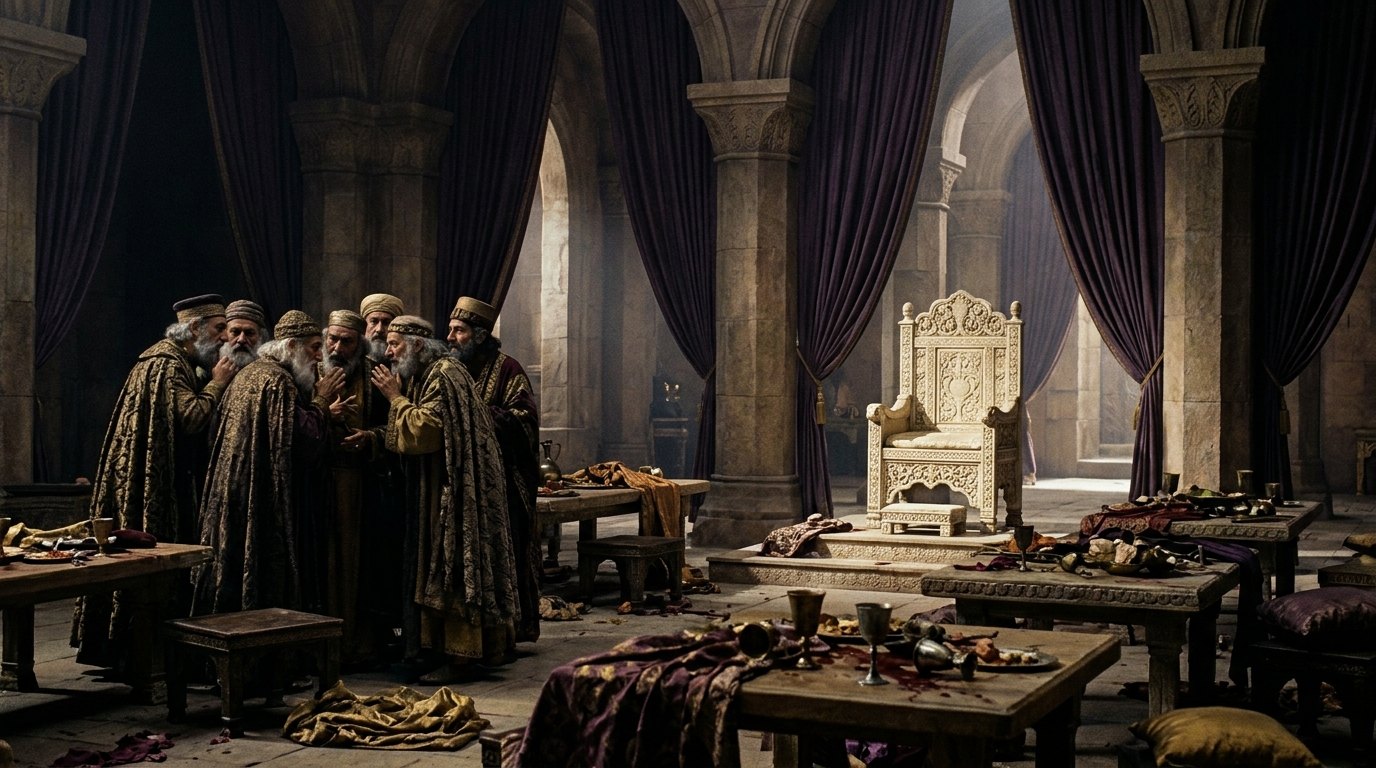
But when the attendants delivered the king’s command, Queen Vashti refused to come. Then the king became furious and burned with anger.
Esther 1:12 (NIV)
Vashti's refusal sparks the monarch's uncontrollable anger, setting the divine stage for Esther's elevation.
The volatile climate of the Persian throne comes into sudden view when domestic defiance shatters imperial decorum. In Esther 1:12, the pivotal turning point unfolds: "Queen Vashti refused to come at the king’s command conveyed by the eunuchs; then the king became very angry and his wrath burned within him." This royal crisis took root on the seventh day of an exhaustive banquet. As Esther 1:10 explains, the king's heart was merry with wine when he commanded seven royal chamberlains to summon Queen Vashti before his assembled guests.
His imperial directive had a clear, degrading intent: Esther 1:11 specifies that she was to appear wearing her royal crown in order to parade her personal beauty before the dignitaries. When her refusal humiliated the monarch before his subordinate princes, his vanity demanded retribution. Fearing that the queen's open insubordination would ignite an empire-wide revolt among wives of all estates, the king sought legal counsel from his seven chief advisors. In Esther 1:19, Memucan urged the king to issue an unalterable royal edict decreeing that Vashti never again enter the presence of Ahasuerus and that her royal estate be given to another who was better than she. Esther 1:21 records that this harsh counsel pleased both Ahasuerus and his princes, and the king swiftly dispatched letters across his territories codifying the dismissal. While the court acted out of wounded male pride and administrative anxiety, God was actively orchestrating these events to place an unheralded Jewish maiden beside the Persian crown.
| Passage | What it says |
|---|---|
| Esther 1:10 | On the seventh day, merry with wine, the king commanded his chamberlains to bring Queen Vashti. |
| Esther 1:11 | He ordered Vashti brought wearing her royal crown to display her beauty to the guests. |
| Esther 1:12 | Queen Vashti refused the summons, and the king became enraged with burning fury. |
| Esther 1:19 | Memucan advised an unalterable royal decree to strip Vashti of her royal estate. |
| Esther 1:21 | The counsel pleased Ahasuerus, and he acted swiftly according to the word of Memucan. |
Esther Crowned Queen
A Jewish Maiden Finds Favor in the Citadel
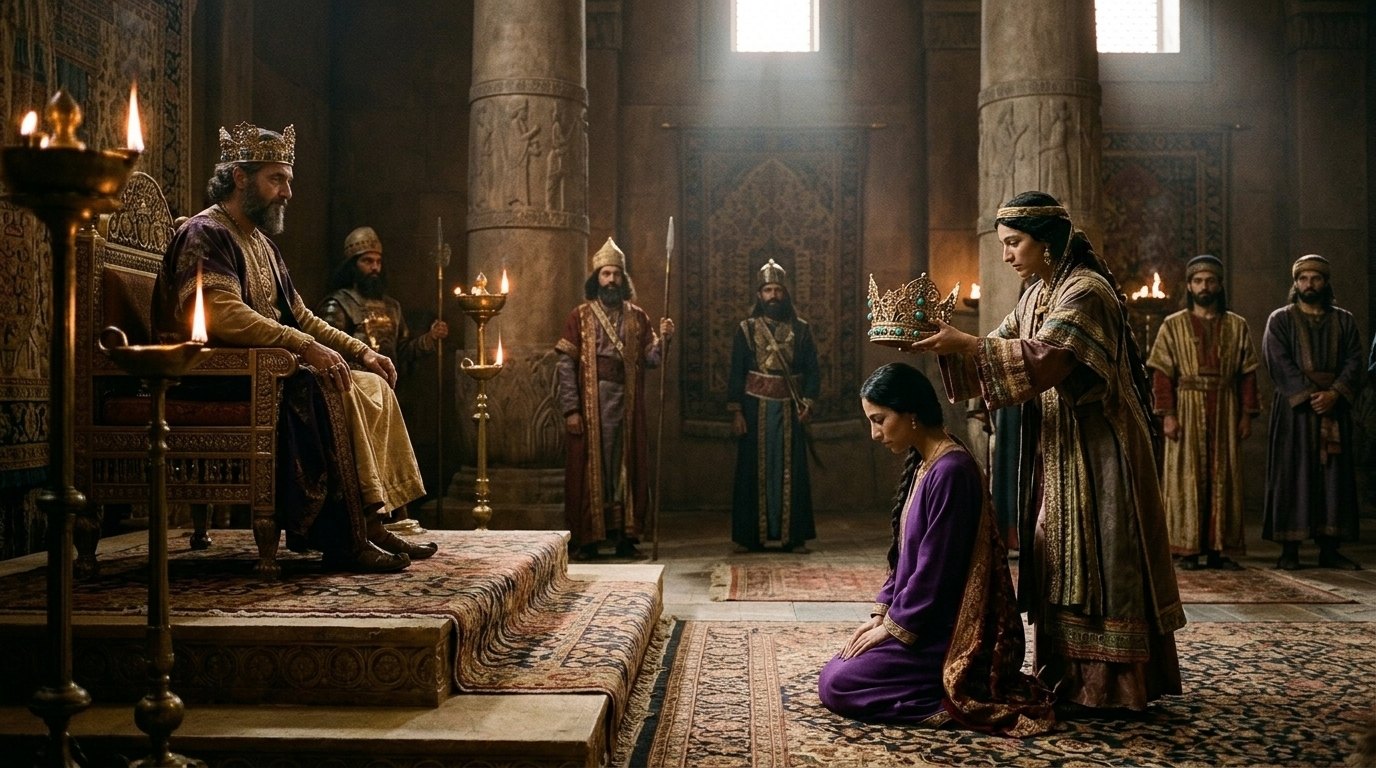
Now the king was attracted to Esther more than to any of the other women, and she won his favor and approval more than any of the other virgins. So he set a royal crown on her head and made her queen instead of Vashti.
Esther 2:17 (NIV)
The Persian monarch crowns Esther, placing a daughter of the covenant at the heart of imperial power.
Behind the opulent walls of Susa, God's hidden providence advanced through imperial decree. The heart of the narrative emerges in Esther 2:17: "The king loved Esther more than all the women, and she found favor and grace in his sight more than all the virgins, so that he set the royal crown on her head and made her queen instead of Vashti." This elevation came after long months of state-mandated cosmetics and royal selection. In Esther 2:1, after the king's volcanic fury cooled, he remembered Vashti and the irrevocable decree that barred her return, prompting a search across every province for a new royal consort.
In the seventh year of his reign, four years after Vashti’s deposition, Esther was brought directly into the royal palace before King Ahasuerus, as detailed in Esther 2:16. The sovereign God who controls the hearts of rulers granted her immediate favor before the autocrat. Ahasuerus celebrated her coronation in grand imperial fashion; Esther 2:18 recounts how he hosted Esther's feast for all his nobles and declared a holiday of tax relief and royal gifts across his realm. Yet court intrigue constantly threatened the throne. In Esther 2:21, two royal doorkeepers, Bigthan and Teresh, plotted to lay hands on King Ahasuerus. Esther 2:23 records that Mordecai discovered the conspiracy and informed Queen Esther, who warned the king in Mordecai’s name. The plot was thoroughly investigated and the conspirators executed, an event meticulously preserved in the royal daily chronicles that God would later use to preserve His covenant people.
| Passage | What it says |
|---|---|
| Esther 2:1 | When the anger of King Ahasuerus subsided, he remembered Vashti and what had been decreed. |
| Esther 2:16 | Esther was brought to King Ahasuerus into his royal palace in the seventh year of his reign. |
| Esther 2:17 | The king loved Esther more than all other women, placing the crown upon her head. |
| Esther 2:18 | The king made a great banquet called Esther's feast, granting tax remission across the provinces. |
| Esther 2:21 | Bigthan and Teresh, two royal doorkeepers, conspired to assassinate King Ahasuerus. |
| Esther 2:23 | Mordecai's discovery of the plot was investigated, verified, and recorded in the royal chronicles. |
Haman's Deadly Decree
A Blindly Conferred Ring Threatens God's People

So the king took his signet ring from his finger and gave it to Haman son of Hammedatha, the Agagite, the enemy of the Jews.
Esther 3:10 (NIV)
The king surrenders his signet ring to Haman, sealing an empire-wide sentence of death against the Jews.
The true vulnerability of the Persian empire lay in the careless ease with which absolute authority could be manipulated. The mortal crisis of the covenant people is crystallized in Esther 3:10: "Then the king took his signet ring from his hand and gave it to Haman the son of Hammedatha the Agagite, the enemy of the Jews." This tragic handover began when King Ahasuerus elevated Haman in Esther 3:1, promoting him above all other princes and commanding royal servants to bow in homage before him.
When Mordecai faithfully refused to bow before the Agagite, Haman sought the annihilation of all Jews throughout the Persian realm. In Esther 3:8, Haman approached the king with calculated slander, framing the Jews as a distinct, scattered people whose customs defied the royal statutes and whose presence offered no profit to the crown. Haman offered ten thousand talents of silver to the royal treasury to finance their extermination. With reckless detachment, Ahasuerus told Haman in Esther 3:11 that both the silver and the people were given into his hands to do as he saw fit. By handing over his royal signet ring, the monarch sealed an irreversible death warrant. Esther 3:13 shows couriers riding out under the king's authority to command every governor to destroy, kill, and annihilate all Jews—young and old, women and children—on a single day. Yet through this impending catastrophe, the Lord was preparing to shatter the enemy's snare and reveal His preserving faithfulness.
| Passage | What it says |
|---|---|
| Esther 3:1 | King Ahasuerus promoted Haman the Agagite and set his seat above all other princes. |
| Esther 3:8 | Haman slandered the Jews before Ahasuerus as a disobedient people whose laws differed from others. |
| Esther 3:10 | The king took his signet ring from his hand and gave it to Haman. |
| Esther 3:11 | Ahasuerus told Haman the silver and the people were given to him to do as pleased him. |
| Esther 3:13 | Couriers were dispatched to destroy, kill, and annihilate all Jews in a single day. |
The Scepter Extended
God Moves Xerxes to Deliver the Remnant
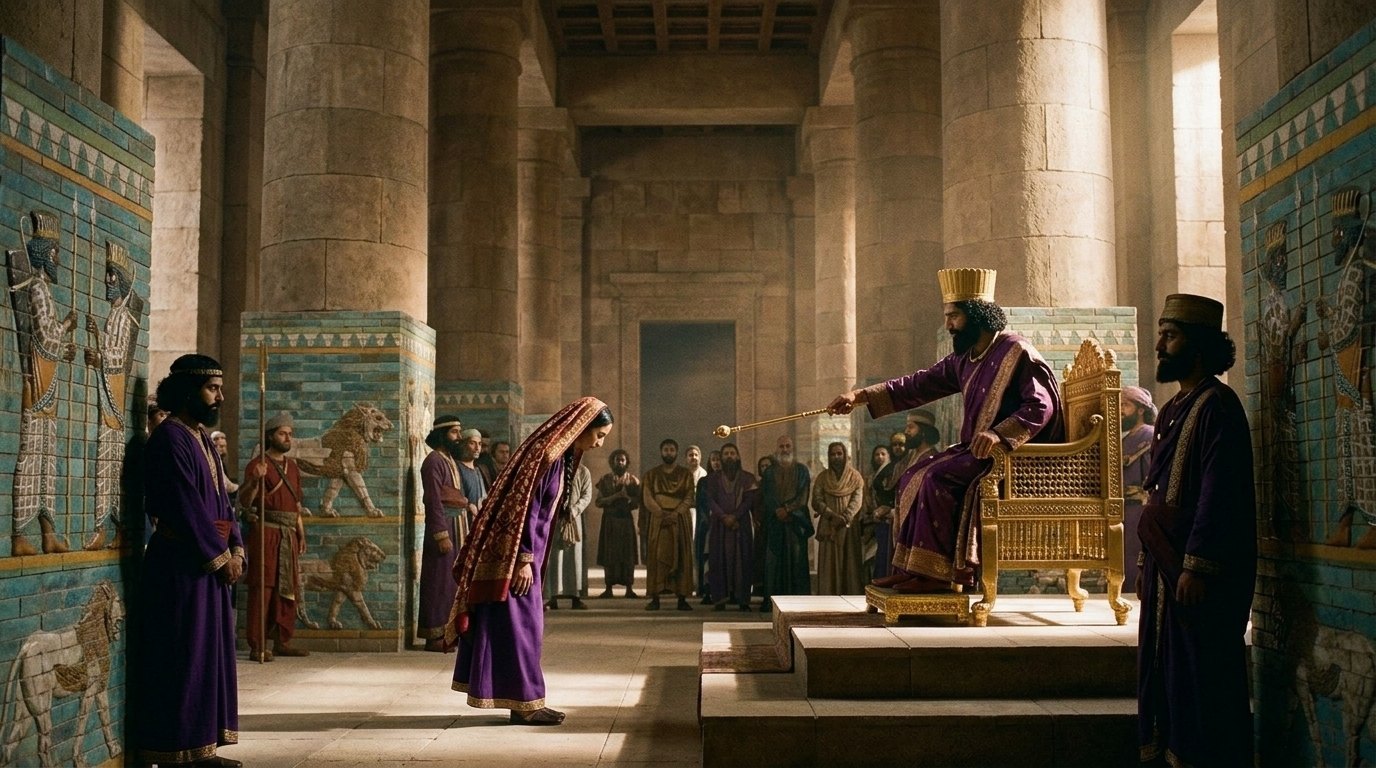
Now write another decree in the king’s name in behalf of the Jews as seems best to you, and seal it with the king’s signet ring—for no document written in the king’s name and sealed with his ring can be revoked.”
Esther 8:8 (NIV)
Ahasuerus empowers Mordecai to compose an unrevocable decree authorizing the Jews to defend their lives.
In Esther 8:8, King Ahasuerus hands over his sovereign prerogative, commanding Esther and Mordecai to draft an irrevocable decree in his own name to spare the Jewish people. This dramatic turning point demonstrates that the king's heart is in the hand of the Lord, turned like channels of water wherever He wills (Proverbs 21:1). The intervention had unfolded step by step in the royal palace. When Queen Esther risked her life by entering uninvited, Esther 5:2 records that the monarch held out the golden scepter, granting her favor and audience. That providential mercy deepened when divine insomnia struck the emperor in Esther 6:1; unable to sleep, Xerxes called for the court chronicles and discovered that Mordecai had never been rewarded for uncovering an assassination plot. During Esther’s banquet, the king's fury flared against Haman's treachery when he demanded to know who dared presume to exterminate Esther’s kindred (Esther 7:5). The sovereign order fell swiftly: Haman was hanged on the very gallows he had erected for Mordecai, and the imperial wrath was pacified (Esther 7:10). Because Persian law barred the annulment of a prior royal sealed decree, Esther 8:8 records how Ahasuerus empowered Mordecai to seal an opposing law giving the Jews the right to arm and defend themselves against their adversaries. This miraculous preservation preserved the seed of Abraham through whom the Messiah would come, culminating in Esther 10:2, which memorializes the full extent of Xerxes' sovereign acts and Mordecai's elevation beside the throne.
| Passage | What it says |
|---|---|
| Esther 5:2 | When the king saw Queen Esther standing in the court, he held out the golden scepter. |
| Esther 6:1 | On that night the king could not sleep, prompting him to read the book of records. |
| Esther 7:5 | Ahasuerus demanded to know who dared presume in his heart to destroy Esther's people. |
| Esther 7:10 | Haman was hanged upon the gallows he prepared for Mordecai, pacifying the king's wrath. |
| Esther 8:8 | The king commanded Esther and Mordecai to write an edict for the Jews in the king's name. |
| Esther 10:2 | All acts of Xerxes' authority and the greatness of Mordecai were written in the chronicles. |
Other Men Named Ahasuerus
Scripture Distinguishes Other Rulers of the Name
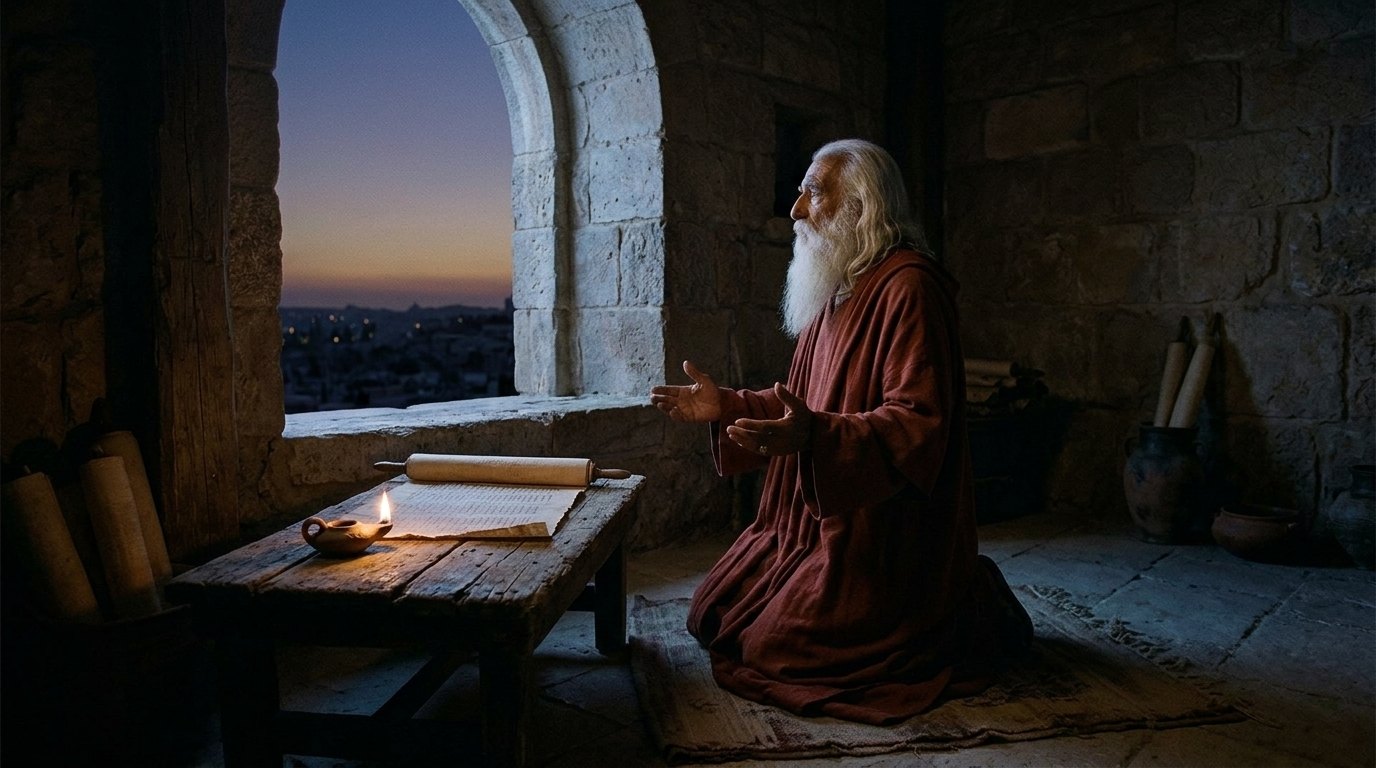
In the first year of Darius son of Xerxes (a Mede by descent), who was made ruler over the Babylonian kingdom—
Daniel 9:1 (NIV)
It shows that Ahasuerus was also borne as a royal Medo-Persian name by the father of Darius the Mede.
Daniel 9:1 records Daniel dating his momentous prayer to the first year of Darius the son of Ahasuerus, of Median descent, establishing that the name Ahasuerus was borne by multiple imperial figures in the Persian and Median spheres. Scripture is careful with its historical chronologies, distinguishing between royal persons who shared identical throne names or titles. In Daniel 9:1, this Ahasuerus is specifically designated as a Mede, the father of Darius who ruled over the Chaldean realm following the fall of Babylon, placing him earlier than the monarch of the book of Esther. Decades later, during the rebuilding of the temple in Jerusalem, another imperial transition brought renewed spiritual conflict. Ezra 4:6 records that at the very beginning of the reign of Ahasuerus, the hostile adversaries of Judah lodged a formal written accusation against the returning Jewish remnant. This mention in Ezra corresponds historically to the accession of Xerxes I, demonstrating that the enemies of God's covenant people sought to weaponize imperial bureaucracy at every succession of the Persian throne. The scriptural witness therefore exhibits the precision of historical truth, showing how Persian rulers carrying this royal name repeatedly intersected with God's unfolding purposes for His covenant people.
| Passage | What it says |
|---|---|
| Ezra 4:6 | Adversaries wrote an accusation against Judah at the accession of Ahasuerus during temple opposition. |
| Daniel 9:1 | Daniel dates his prayer to the first year of Darius the son of Ahasuerus the Mede. |
Where in the Bible
| Book | Passages |
|---|---|
| Ezra | 1 · Ezra 4:6 |
| Esther | 28 · Esther 1:1, Esther 1:2, Esther 1:3, Esther 1:4, Esther 8:9, Esther 10:1, Esther 1:10, Esther 1:11, Esther 1:12, Esther 1:19, Esther 1:21, Esther 2:1, Esther 2:16, Esther 2:17, Esther 2:18, Esther 2:21, Esther 2:23, Esther 3:1, Esther 3:8, Esther 3:10, Esther 3:11, Esther 3:13, Esther 5:2, Esther 6:1, Esther 7:5, Esther 7:10, Esther 8:8, Esther 10:2 |
| Daniel | 1 · Daniel 9:1 |
The story in order
- Ahasuerus rules vast empire (c. 483 BC) · Esther 1:1 · Ruled 127 provinces from India to Cush.
- Vashti deposed (c. 483 BC) · Esther 1:12 · Refused king's command, leading to her removal.
- Esther crowned queen (c. 480 BC) · Esther 2:17 · Loved by Ahasuerus, she became his queen.
- Haman promoted and plots against Jews (c. 479 BC) · Esther 3:1 · Given great authority, he devised a plan to destroy Jews.
- King cannot sleep, reads records (c. 479 BC) · Esther 6:1 · Led to Mordecai's honor and Haman's downfall.
- Haman's plot foiled (c. 479 BC) · Esther 7:10 · Haman hanged on gallows he prepared for Mordecai.
- Edict to protect Jews (c. 479 BC) · Esther 8:8 · King allows Jews to defend themselves.
- Ahasuerus' authority recorded (c. 479 BC) · Esther 10:1 · His tribute and greatness noted in chronicles.
Haman's Plot vs. God's Preservation
| Haman's Action | God's Intervention | Outcome | Passage |
|---|---|---|---|
| Haman slanders Jews to king | Esther pleads for her people | Haman's decree is reversed | Esther 3:8 |
| Haman prepares gallows for Mordecai | King cannot sleep, reads records | Haman is hanged on his own gallows | Esther 6:1 |
| Haman's decree to annihilate Jews | King extends scepter to Esther | Jews are given power to defend themselves | Esther 5:2 |
Key words
- Ahasuerus (ʾāḥašwērôš (אַחַשְׁוֵרוֹשׁ))
- Hebrew name for King Xerxes I, ruler of the Persian Empire. · Esther 1:1
- Susa (šûšān (שׁוּשָׁן))
- The fortified capital city of the Persian Empire where the king resided. · Esther 1:2
- Edict (dāt (דָּת))
- A royal decree or law issued by the king, carrying the force of law. · Esther 1:19
- Signet ring (ḥôtām (חוֹתָם))
- A ring bearing the king's seal, used to authenticate official documents. · Esther 3:10
- Golden scepter (šebṭaʾ (שֶׁבֶט))
- A symbol of royal authority, extended by the king to show favor or grant audience. · Esther 5:2
King Xerxes reigned over the known world with immense pomp and absolute decree, yet his heart remained in the hand of the Lord. For believers, the account of Ahasuerus stands as an enduring testimony that worldly rulers, however vast their dominion, are ultimately instruments in God's sovereign preservation of His people.
30 passages, each cited once.
Scripture cited
- Esther 1:1-4
- Daniel 9:1
- Ezra 4:6
- Esther 8:9
- Esther 1
- Esther 2:16-18
- Esther 3:7-15
- Esther 8:7-14
- Esther 10:1-3