Who was Zerubbabel?
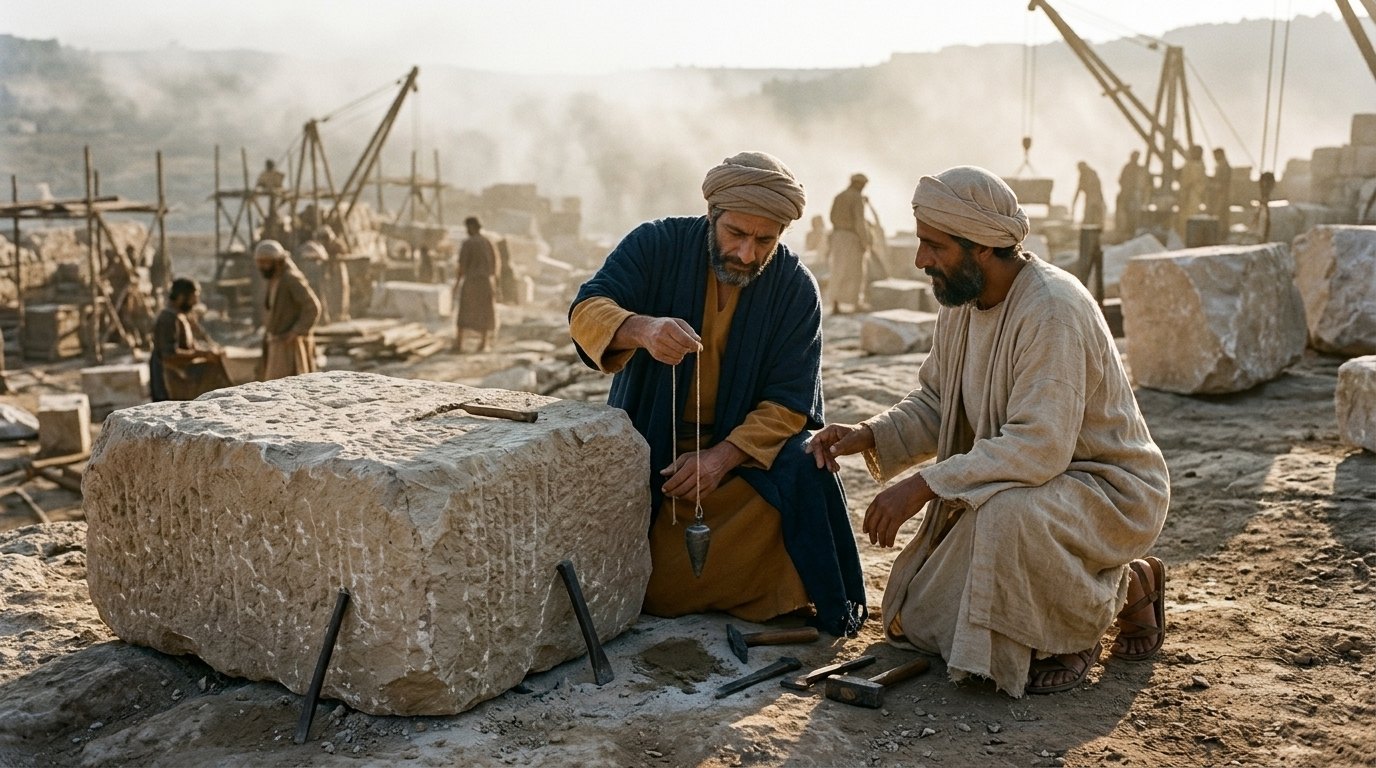
Zechariah 4:6-10
6 So he said to me, “This is the word of the LORD to Zerubbabel: ‘Not by might nor by power, but by my Spirit,’ says the LORD Almighty.
7 “What are you, mighty mountain? Before Zerubbabel you will become level ground. Then he will bring out the capstone to shouts of ‘God bless it! God bless it!’ ”
8 Then the word of the LORD came to me:
9 “The hands of Zerubbabel have laid the foundation of this temple; his hands will also complete it. Then you will know that the LORD Almighty has sent me to you.
10 “Who dares despise the day of small things, since the seven eyes of the LORD that range throughout the earth will rejoice when they see the chosen capstone in the hand of Zerubbabel?”
New International Version (NIV)
The answer
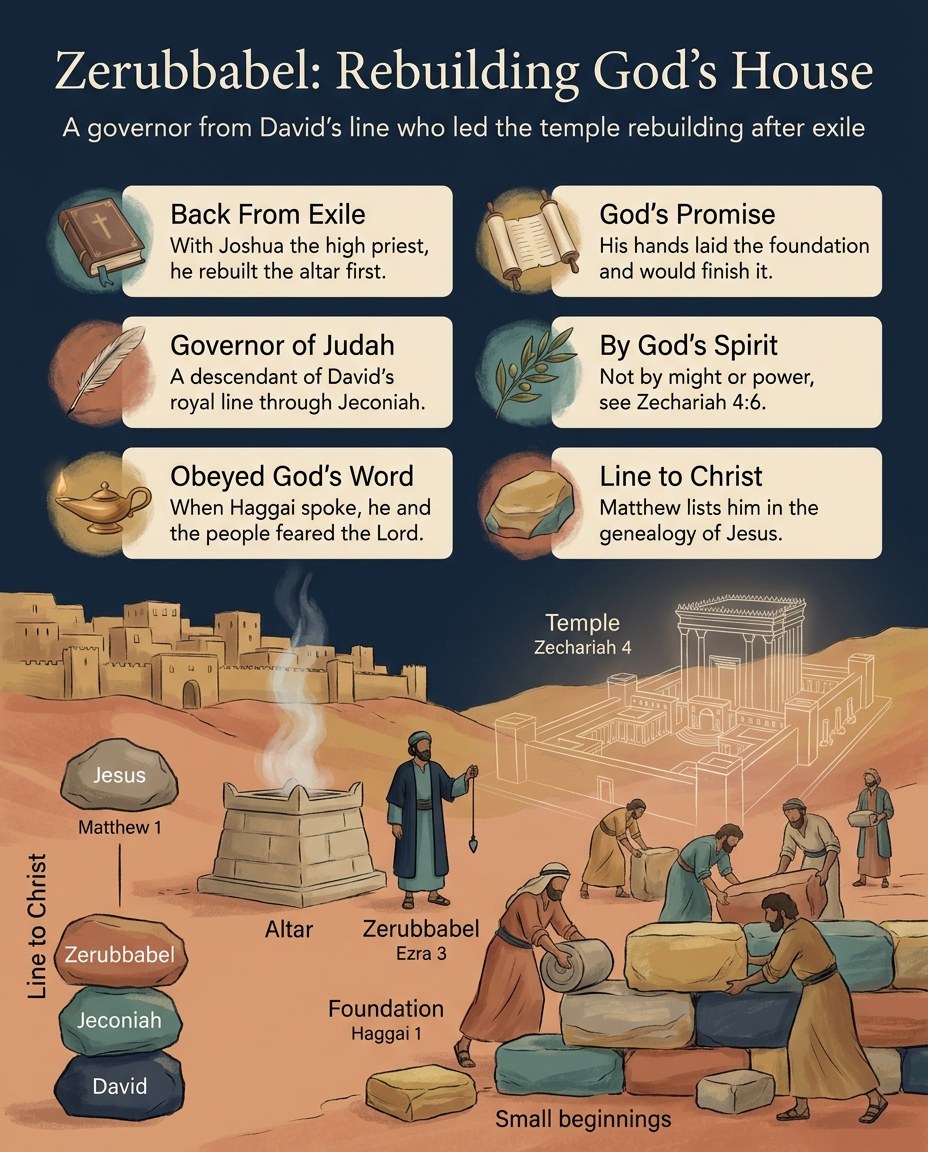
Zerubbabel was a Jewish governor and a descendant of David’s royal line who led God’s people in rebuilding the temple after the Babylonian exile. He is an important figure in Ezra, Haggai and Zechariah, and he also appears in the genealogy of Jesus.
- He helped lead the return from exile. Zerubbabel worked alongside Jeshua, also called Joshua, the high priest. Together they rebuilt the altar so that sacrifices could resume, and then began work on the temple (Ezra 3:2, 8).
- He served as governor of Judah. Haggai identifies him as “Zerubbabel the son of Shealtiel, governor of Judah” (Haggai 1:1). First Chronicles 3:19 names Pedaiah as his father, while Haggai and Matthew 1:12 name Shealtiel; the passages place him within the royal family descended from Jeconiah.
- He responded obediently to God’s word. When Haggai confronted the people for neglecting the temple, Zerubbabel, Joshua and the remnant obeyed and feared the Lord. God then stirred their spirits, and they resumed the work (Haggai 1:12-14).
- God promised to complete the temple through him. Zechariah 4:9 declares, “The hands of Zerubbabel have laid the foundation of this house. His hands shall also finish it.” The work would succeed not through human strength, but by God’s Spirit: “Not by might, nor by power, but by my Spirit” (Zechariah 4:6).
- He belongs to the history leading to Christ. Matthew traces Jesus’ legal genealogy through Joseph back to Zerubbabel, showing his place in the line through which the Messiah came (Matthew 1:12-16).
Zerubbabel therefore represents faithful leadership in a difficult restoration: the beginning looked small, but God promised to finish the work He had commissioned (Zechariah 4:10).
Answered from Scripture · reviewed November 25, 2026
Zerubbabel's Part in God's Restoration
Read top to bottom: the steps of Zerubbabel's work as the answer traces them, from rebuilding the altar after the exile to his place in the line leading to Christ.
- Rebuilds the altar · With Jeshua (Joshua) the high priest, he rebuilds the altar so sacrifices can resume. · Ezra 3:2
- Begins the temple · Zerubbabel and Jeshua start work on the house of God. · Ezra 3:8
- Serves as governor · Haggai names him governor of Judah, of the royal family descended from Jeconiah. · Haggai 1:1
- Obeys God's word · Confronted by Haggai, he and the remnant fear the Lord; God stirs their spirits and work resumes. · Haggai 1:12-14
- Receives God's promise · His hands laid the foundation and will finish it, by God's Spirit, not human might. · Zechariah 4:9
- Stands in Christ's line · Matthew traces Jesus' legal genealogy through Joseph back to Zerubbabel. · Matthew 1:12-16
Zerubbabel was the Davidic prince and Persian-appointed governor of Judah who led the Jewish exiles home from Babylon to rebuild the temple in Jerusalem. Operating under the prophetic guidance of Haggai and Zechariah, he preserved the royal lineage of David in a fragile post-exilic world. His life demonstrates that God accomplishes His redemptive purposes not through human might, but by His Spirit.
Royal Lineage
A Seed of David Preserved Across Exile
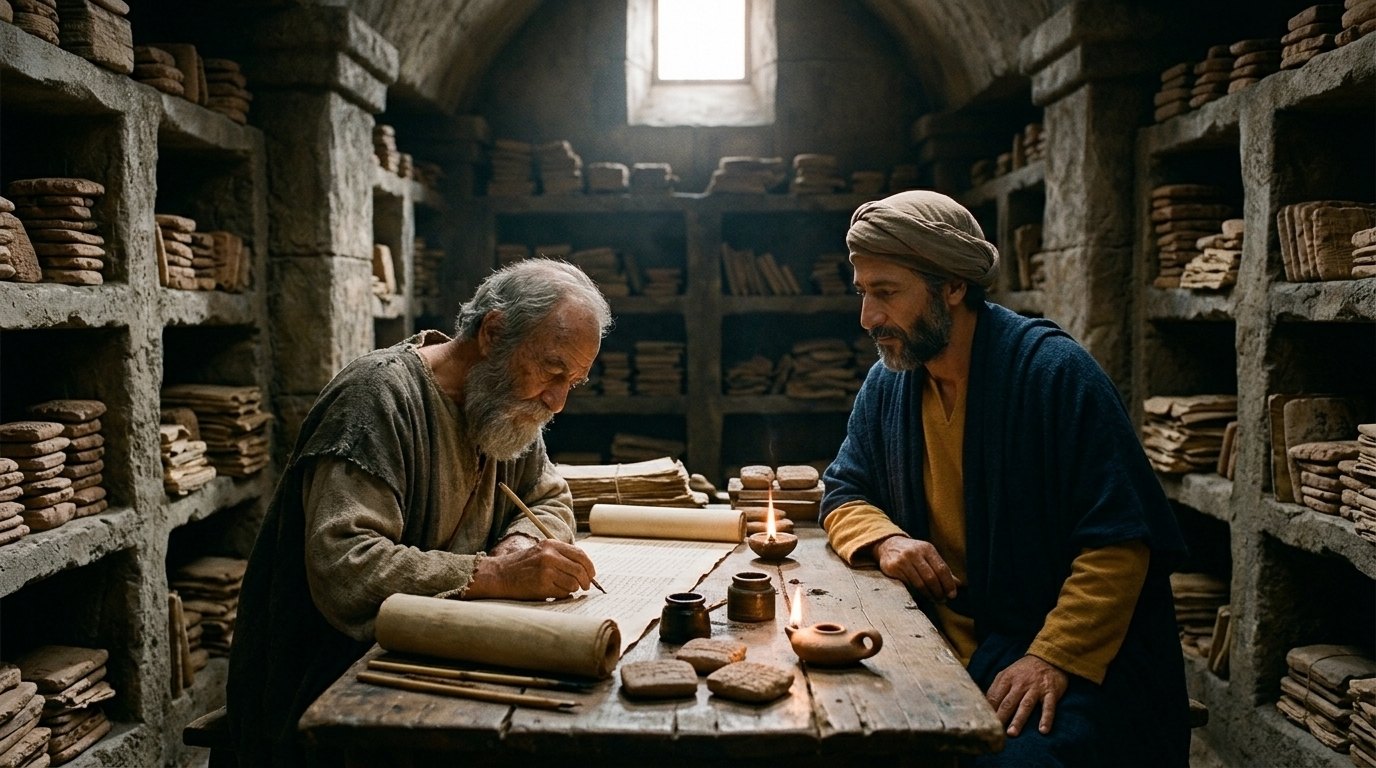
The sons of Pedaiah: Zerubbabel and Shimei. The sons of Zerubbabel: Meshullam and Hananiah. Shelomith was their sister.
1 Chronicles 3:19 (NIV)
This record anchors Zerubbabel firmly within the post-exilic royal Davidic line descended from Jeconiah.
First Chronicles 3:19 anchors Zerubbabel firmly within the post-exilic royal Davidic line descended from Jeconiah, providing tangible proof that God preserved the seed of David across the Babylonian judgment. Even though the crown appeared utterly severed when Babylon took the royal family captive, 1 Chronicles 3:17-19 catalogs Jeconiah's offspring in exile and establishes Zerubbabel within Judah's legitimate throne line. Scripture reveals how God guarded this shattered dynasty through Persian subjugation, presenting him in Haggai 1:1 as the civil governor of Judah rather than an autonomous monarch, yet maintaining royal blood.
This historical survival carries profound messianic consequence. In Matthew 1:12-13, the apostle traces the legal royal line directly through Jeconiah and Zerubbabel to Joseph, the adoptive father of Christ, confirming legal entitlement to David's throne. Likewise, Luke 3:27 includes Zerubbabel the son of Shealtiel in the ancestral line of Jesus, weaving him into both New Testament witnesses. Through Zerubbabel, God demonstrated that His sworn covenant with David stood unbreakable, guarding the royal bloodline until its ultimate fulfilment in Jesus Christ.
| Passage | What it says | Fulfilled |
|---|---|---|
| 1 Chronicles 3:17-19 | Lists the sons of Jeconiah during exile, identifying Zerubbabel within the royal lineage of Judah. | Matthew 1:12-16, Luke 3:27 |
| Haggai 1:1 | Introduces Zerubbabel the son of Shealtiel as the recognized civil governor of Judah. | |
| Matthew 1:12-13 | Places Zerubbabel directly in the legal messianic line descending from David to Joseph. | |
| Luke 3:27 | Names Zerubbabel the son of Shealtiel in the ancestral genealogy of Jesus. |
The Return
Leading the Exiles Back to Zion
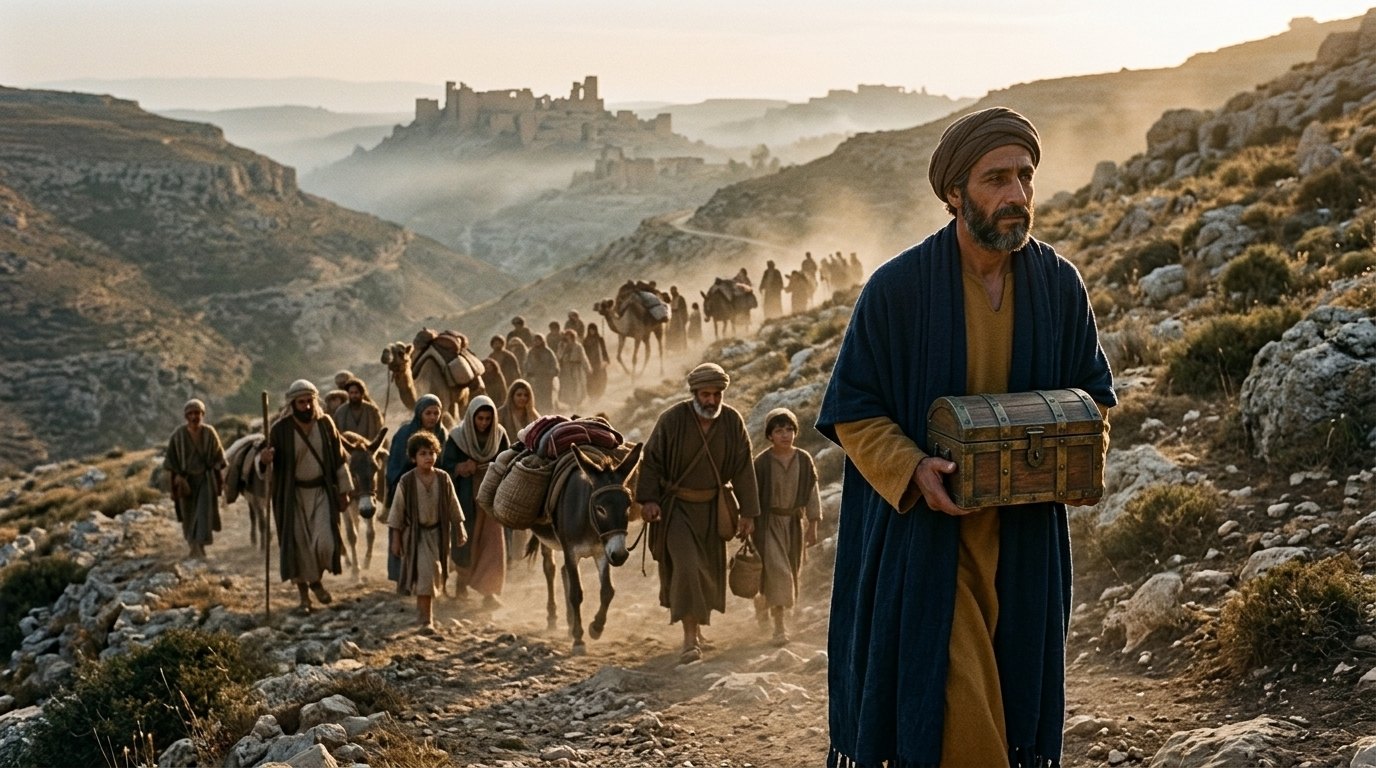
Now these are the people of the province who came up from the captivity of the exiles, whom Nebuchadnezzar king of Babylon had taken captive to Babylon (they returned to Jerusalem and Judah, each to their own town, in company with Zerubbabel, Joshua, Nehemiah, Seraiah, Reelaiah, Mordecai, Bilshan, Mispar, Bigvai, Rehum and Baanah): The list of the men of the people of Israel:
Ezra 2:1-2 (NIV)
It lists Zerubbabel at the head of the thousands of exiles returning to Jerusalem by imperial decree.
Ezra 2:1-2 names Zerubbabel at the head of thousands of exiles returning to Jerusalem, charting the sovereign reversal of Judah's long captivity. Decades after the sack of Jerusalem, Cyrus issued an imperial decree permitting the remnants of Israel to return to their ancestral homeland. Under royal Persian sanction recorded in Ezra 1:7-11, Cyrus restored the sacred gold and silver temple vessels plundered by Nebuchadnezzar, entrusting the treasury to the returning prince so that sacred worship might be re-established.
Nehemiah 7:6-7 reiterates this master register of redeemed captives, underscoring Zerubbabel's role as the civil leader appointed by God to lead Israel out of Babylon. Nehemiah 12:1 demonstrates that priests and Levites rallied behind his civil authority, maintaining order and covenantal structure for the journey. Upon arriving at the ruined mountain of the Lord, heads of ancestral houses gave generous freewill offerings under Zerubbabel's oversight, as Ezra 2:68-69 notes. His steadfast governance united the fragile community, establishing the daily upkeep for singers, Levites, and gatekeepers documented in Nehemiah 12:47.
| Passage | What it says |
|---|---|
| Ezra 1:7-11 | Cyrus restores the sacred temple vessels to the prince of Judah to carry back to Jerusalem. |
| Ezra 2:1-2 | Names Zerubbabel as the principal leader heading the initial wave of returning Jewish exiles. |
| Nehemiah 7:6-7 | Reiterates the historical register of the returning remnant led out of Babylonian captivity by Zerubbabel. |
| Nehemiah 12:1 | Records the priests and Levites who returned from Babylon under the civil leadership of Zerubbabel. |
| Ezra 2:68-69 | Heads of families give freewill offerings upon arriving at the house of the Lord under Zerubbabel's leadership. |
| Nehemiah 12:47 | All Israel in the days of Zerubbabel gives daily portions for the singers, gatekeepers, and Levites. |
Temple Foundations
Rebuilding the Altar and Laying Cornerstones
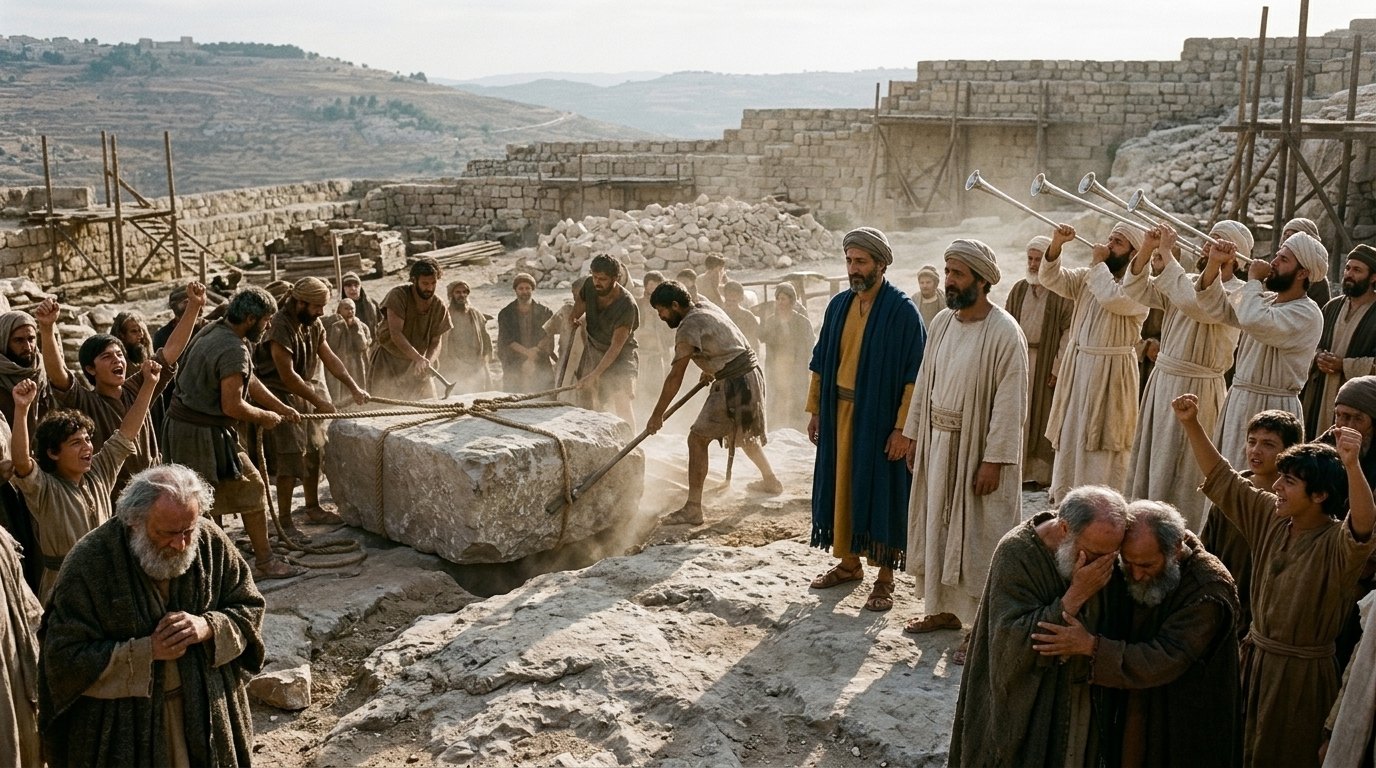
In the second month of the second year after their arrival at the house of God in Jerusalem, Zerubbabel son of Shealtiel, Joshua son of Jozadak and the rest of the people (the priests and the Levites and all who had returned from the captivity to Jerusalem) began the work. They appointed Levites twenty years old and older to supervise the building of the house of the LORD.
Ezra 3:8 (NIV)
This verse marks the precise historical moment Zerubbabel and Joshua began physical construction on the Lord's house.
Ezra 3:8 marks the critical turning point when Zerubbabel and Jeshua began physical construction on the house of God, moving from survival to holy restoration. Before a single wall rose, Ezra 3:1-3 shows them erecting the altar of burnt offering, immediately reinstituting the morning and evening sacrifices because fear of surrounding hostile peoples gripped them. Worship took precedence over security, placing the blood of atonement at the very center of their communal life.
When the builders laid the foundation of the Lord's house in Ezra 3:8-10, Zerubbabel appointed Levites with trumpets and cymbals to sound praise according to David's ordinance. Yet Ezra 3:11-13 records that the roar of celebratory shouting was inextricably mingled with the loud weeping of priests and elders who had seen the grandeur of Solomon's first temple. When surrounding adversaries arrived offering false collaboration, Ezra 4:1-3 records Zerubbabel's decisive refusal: he refused syncretism, safeguarding the purity of God's house from idolatrous compromise.
| Passage | What it says |
|---|---|
| Ezra 3:1-3 | Zerubbabel and Jeshua build the altar of God to resume daily burnt offerings despite surrounding dread. |
| Ezra 3:8-10 | Zerubbabel oversees the laying of the temple foundation amid trumpets, cymbals, and shouts of praise. |
| Ezra 3:11-13 | The sound of joy mingles with the weeping of older priests who remembered Solomon's magnificent temple. |
| Ezra 4:1-3 | Zerubbabel firmly rejects compromise with local adversaries seeking a corrupt share in building the temple. |
Prophetic Stirring
Rebuked and Revived by Haggai's Preaching
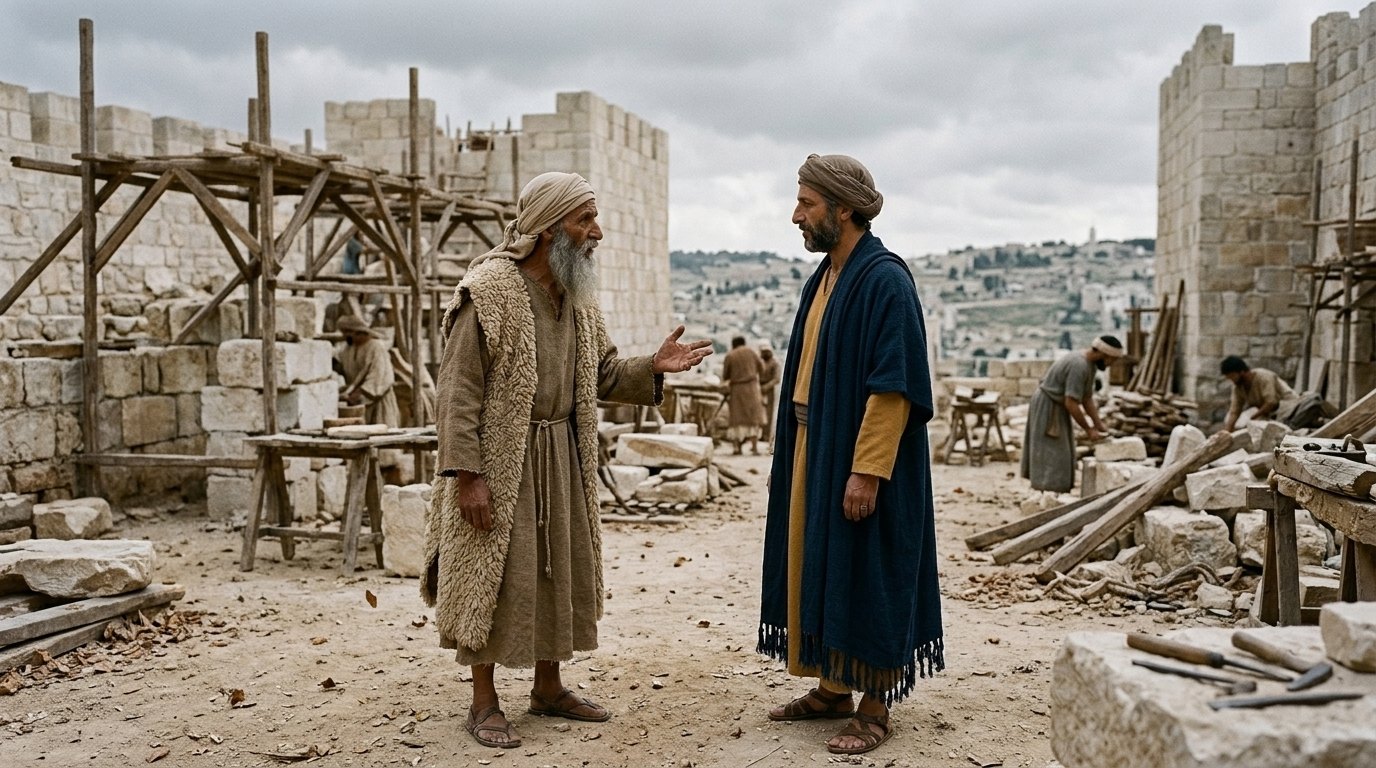
So the LORD stirred up the spirit of Zerubbabel son of Shealtiel, governor of Judah, and the spirit of Joshua son of Jozadak, the high priest, and the spirit of the whole remnant of the people. They came and began to work on the house of the LORD Almighty, their God,
Haggai 1:14 (NIV)
It demonstrates how God directly stirred the spirit of Zerubbabel to conquer fear and renew the stalled work.
Haggai 1:14 records that the Lord stirred up the spirit of Zerubbabel to conquer fear and renew the stalled work, shattering sixteen years of spiritual lethargy and political opposition. In Haggai 1:2-4, God sharply rebuked the returning remnant through the prophet Haggai for living in cedar-paneled houses while the temple of the Lord lay in desolate ruins. Israel had mistaken political obstruction for divine delay, settling into comfortable self-preservation.
Rather than hardening his heart, Zerubbabel immediately submitted to the rebuke. Haggai 1:12-14 and Haggai 1:15 record how he and the high priest Joshua obeyed the word of the Lord, leading the people back to the stone quarry on the twenty-fourth day of the sixth month. In Haggai 2:1-5, God commanded Zerubbabel to take courage, promising that the Holy Spirit remained abiding among them just as when Israel marched out of Egypt. As Ezra 5:1-2 affirms, when Haggai and Zechariah prophesied, Zerubbabel arose in faith, defying imperial threats to complete the sanctuary of the living God.
| Passage | What it says |
|---|---|
| Haggai 1:2-4 | God rebukes the people through Haggai for living in paneled houses while His temple lies in ruins. |
| Haggai 1:12-14 | Zerubbabel and Joshua obey the prophetic voice, leading the remnant back to resume temple construction. |
| Haggai 2:1-5 | The Lord commands Zerubbabel to be strong, assuring him that the Holy Spirit remains in their midst. |
| Ezra 5:1-2 | Prophets Haggai and Zechariah prophesy, prompting Zerubbabel to rise and successfully restart the building work. |
| Haggai 1:15 | Work on the temple resumes on the twenty-fourth day of the sixth month under Zerubbabel and Joshua. |
Spirit and Power
Not by Might but by God's Spirit
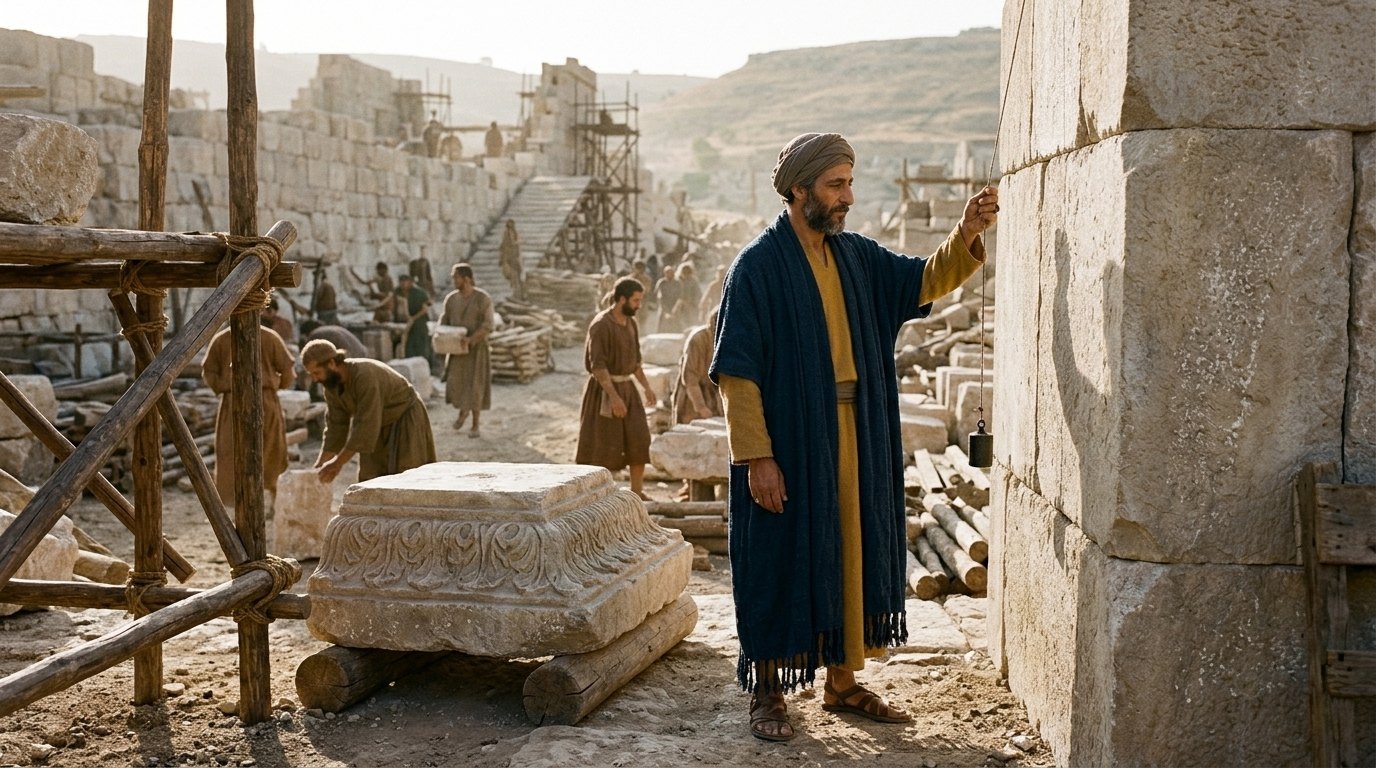
So he said to me, “This is the word of the LORD to Zerubbabel: ‘Not by might nor by power, but by my Spirit,’ says the LORD Almighty.
Zechariah 4:6 (NIV)
This pivotal oracle declares that God's work advances through His divine Spirit rather than human resources.
The prophet receives a decisive word for the governor in Zechariah 4:6: 'Not by might, nor by power, but by my Spirit, says the Lord of hosts.' Zerubbabel confronted formidable imperial surveillance, hostile neighbours, and an impoverished community, yet the Lord assured him that divine work depends entirely upon divine power. In the opening vision of Zechariah 4:1-5, the golden lampstand continually fed by living olive trees demonstrated this supernatural supply. Facing massive obstacles that loomed like an insurmountable peak, the governor heard that every towering mountain would collapse into level ground before him as he brought out the top stone amid cries of grace (Zechariah 4:6-7).
God confirmed that human weakness would not derail His purpose. The word declared in Zechariah 4:8-9 that the very hands of Zerubbabel which laid the foundation of the house would complete it, certifying the authenticity of the prophetic message. The surrounding community had looked upon the modest beginnings with sorrow, but the Lord commanded them never to despise the day of small things (Zechariah 4:10). The seven eyes of the Lord rejoiced to see the plumb line firmly held in Zerubbabel's hand. As explained in Zechariah 4:11-14, Zerubbabel and Joshua stood as the two olive trees, the anointed servants functioning side by side through the Spirit. Just as promised, Ezra 6:14-16 records the joyful completion and dedication of the finished temple.
| Passage | What it says |
|---|---|
| Zechariah 4:6-7 | The Lord declares every mountain will become a plain before Zerubbabel as he brings forth the capstone. |
| Zechariah 4:8-9 | The word promises that the hands of Zerubbabel which laid the foundation will also finish the house. |
| Zechariah 4:10 | God cautions against despising the day of small things as the plumb line rests in Zerubbabel's hand. |
| Ezra 6:14-16 | The house of God is completed under Zerubbabel and dedicated with rejoicing by the returning exiles. |
| Zechariah 4:1-5 | The vision of the golden lampstand and two olive trees given to reassure Zerubbabel of divine provision. |
| Zechariah 4:11-14 | The two olive trees represent the two anointed ones who stand beside the Lord of the whole earth. |
Messianic Signet
The Chosen Ring and Royal Foreshadowing
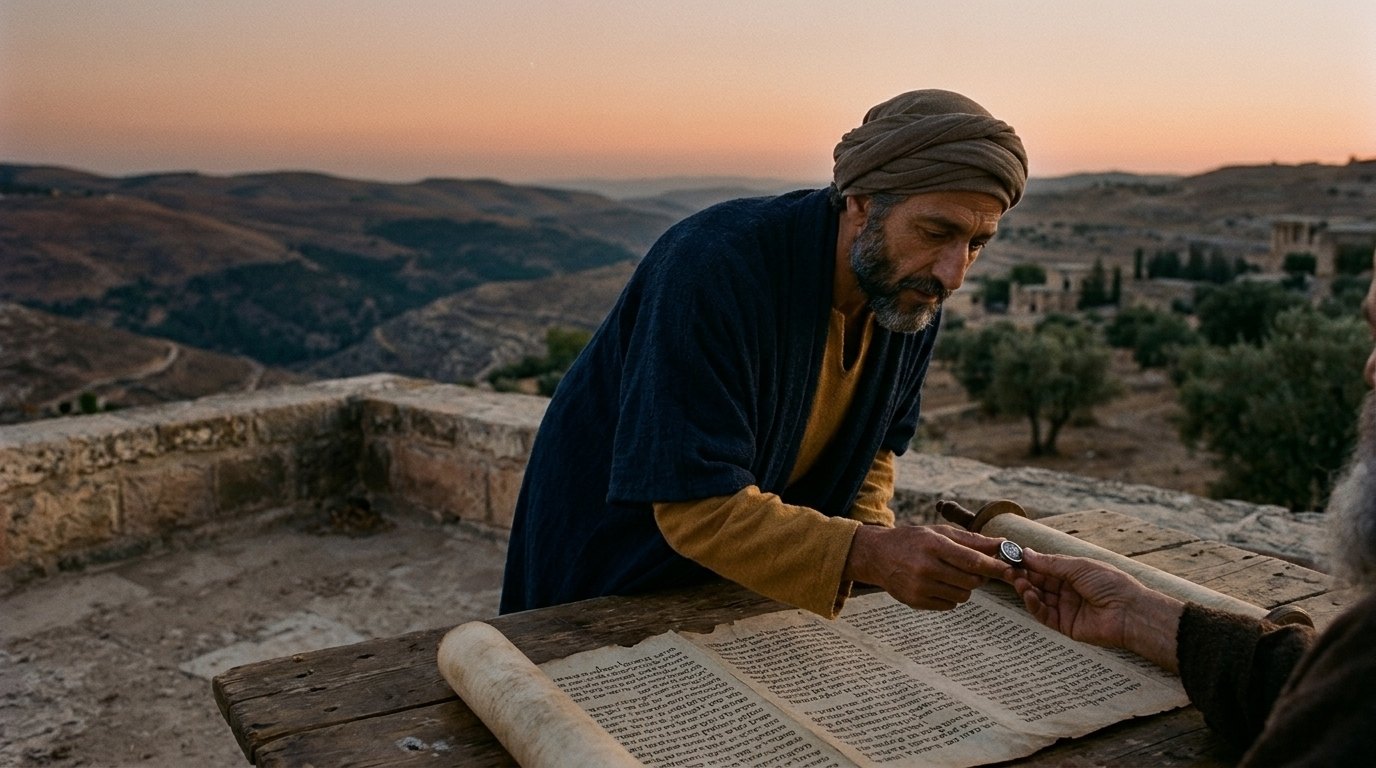
“ ‘On that day,’ declares the LORD Almighty, ‘I will take you, my servant Zerubbabel son of Shealtiel,’ declares the LORD, ‘and I will make you like my signet ring, for I have chosen you,’ declares the LORDAlmighty.”
Haggai 2:23 (NIV)
God reverses the curse pronounced on Jeconiah by making his descendant Zerubbabel His chosen signet ring.
In Haggai 2:23, the Lord delivers an extraordinary messianic promise: 'I will take you, O Zerubbabel my servant... and make you like a signet ring, for I have chosen you.' Decades earlier, the prophet Jeremiah had recorded God's severe judgment upon Zerubbabel's grandfather King Coniah in Jeremiah 22:24-30, stripping the Davidic king like a signet ring from His right hand and decreeing that none of his immediate seed would sit prospering upon David's throne. That devastating curse seemed to sever the royal line, yet Matthew traces the physical and legal line directly through this renewed branch, proving its true heir in Matthew 1:12-16.
God reverses the gloom of exile in Haggai 2:20-23 by pledging to shake the heavens, overthrow the thrones of foreign kingdoms, and establish Zerubbabel as His chosen seal of royal authority. While Zerubbabel himself never wore an earthly crown, he served as a living signpost pointing to the ultimate Davidic ruler promised in Luke 1:31-33. In Zechariah 3:8, God instructed the high priest Joshua that his generation stood as men who were signs of the coming Servant named the Branch, later fulfilled in Christ (Jeremiah 23:5-6; Luke 1:78). Finally, Zechariah 6:12-13 looks beyond the physical building to a royal figure who combines the offices of king and priest, a role perfectly and eternally realized in Jesus Christ as revealed in Hebrews 7:1-3 and Hebrews 8:1-2.
| Passage | What it says | Fulfilled |
|---|---|---|
| Jeremiah 22:24-30 | God strips the signet ring from King Coniah, declaring his offspring will not prosper on David's throne. | Matthew 1:12-16 |
| Haggai 2:20-23 | The Lord promises to overthrow kingdoms and make Zerubbabel His chosen signet ring in royal restoration. | Luke 1:31-33 |
| Zechariah 3:8 | God promises the coming of His servant 'the Branch' alongside Joshua and the post-exilic leadership. | Jeremiah 23:5-6, Luke 1:78 |
| Zechariah 6:12-13 | A future royal figure named the Branch will build the temple of the Lord and rule as priest-king. | Hebrews 7:1-3, Hebrews 8:1-2 |
Where in the Bible
| Book | Passages |
|---|---|
| 1 Chronicles | 1 · 1 Chronicles 3:17-19 |
| Ezra | 9 · Ezra 1:7-11, Ezra 2:1-2, Ezra 2:68-69, Ezra 3:1-3, Ezra 3:8-10, Ezra 3:11-13, Ezra 4:1-3, Ezra 5:1-2, Ezra 6:14-16 |
| Nehemiah | 3 · Nehemiah 7:6-7, Nehemiah 12:1, Nehemiah 12:47 |
| Jeremiah | 1 · Jeremiah 22:24-30 |
| Haggai | 6 · Haggai 1:1, Haggai 1:2-4, Haggai 1:12-14, Haggai 2:1-5, Haggai 1:15, Haggai 2:20-23 |
| Zechariah | 7 · Zechariah 4:6-7, Zechariah 4:8-9, Zechariah 4:10, Zechariah 4:1-5, Zechariah 4:11-14, Zechariah 3:8, Zechariah 6:12-13 |
| Matthew | 1 · Matthew 1:12-13 |
| Luke | 1 · Luke 3:27 |
The story in order
- Royal lineage preserved (c. 597 BC) · 1 Chronicles 3:17-19 · Zerubbabel identified in the lineage of David during exile.
- Exiles return to Jerusalem (c. 538 BC) · Ezra 2:1-2 · Zerubbabel leads the first wave of Jewish exiles back home.
- Temple altar rebuilt (c. 537 BC) · Ezra 3:1-3 · Zerubbabel and Jeshua restore the altar for daily sacrifices.
- Temple foundation laid (c. 537 BC) · Ezra 3:8-10 · Zerubbabel oversees the laying of the new temple's foundation.
- Compromise rejected (c. 537 BC) · Ezra 4:1-3 · Zerubbabel refuses to let adversaries join the temple rebuilding.
- Prophetic stirring (c. 520 BC) · Haggai 1:12-14 · Zerubbabel and Joshua obey Haggai, resuming temple construction.
- Spirit and power assured (c. 520 BC) · Zechariah 4:6-7 · God assures Zerubbabel of His Spirit's power for completion.
- Temple completed (c. 516 BC) · Ezra 6:14-16 · The temple is finished under Zerubbabel's leadership and dedicated.
- Messianic signet promised (c. 520 BC) · Haggai 2:20-23 · God promises to make Zerubbabel His chosen signet ring.
- Jesus' legal lineage (c. 4 BC - AD 30) · Matthew 1:12-13 · Zerubbabel is placed in Jesus' legal messianic line.
Key words
- Zerubbabel (זְרֻבָּבֶל (Zərubbāḇel))
- Sown in Babylon, or Seed of Babylon · Haggai 1:1
- Governor (פֶּחָה (pēḥâ))
- Appointed ruler or administrator · Haggai 1:1
- Signet ring (חוֹתָם (ḥōṯām))
- A ring worn as a symbol of authority, used for sealing documents · Haggai 2:23
- The Branch (צֶמַח (ṣeṁaḥ))
- A messianic title referring to a future royal shoot from David's line · Zechariah 3:8
Zerubbabel's life stands as a lasting testimony that God honors faithful obedience in the face of daunting adversity. Through him, the temple was completed and the Davidic seed was safely carried across the silent centuries toward Bethlehem. Believers today are reminded never to despise the day of small things, trusting the Holy Spirit to complete the good work God begins.
29 passages, each cited once.
Scripture cited
- Ezra 3:1-8
- Haggai 1
- 1 Chronicles 3:17-19
- Matthew 1:12-16