Who was Queen Vashti?
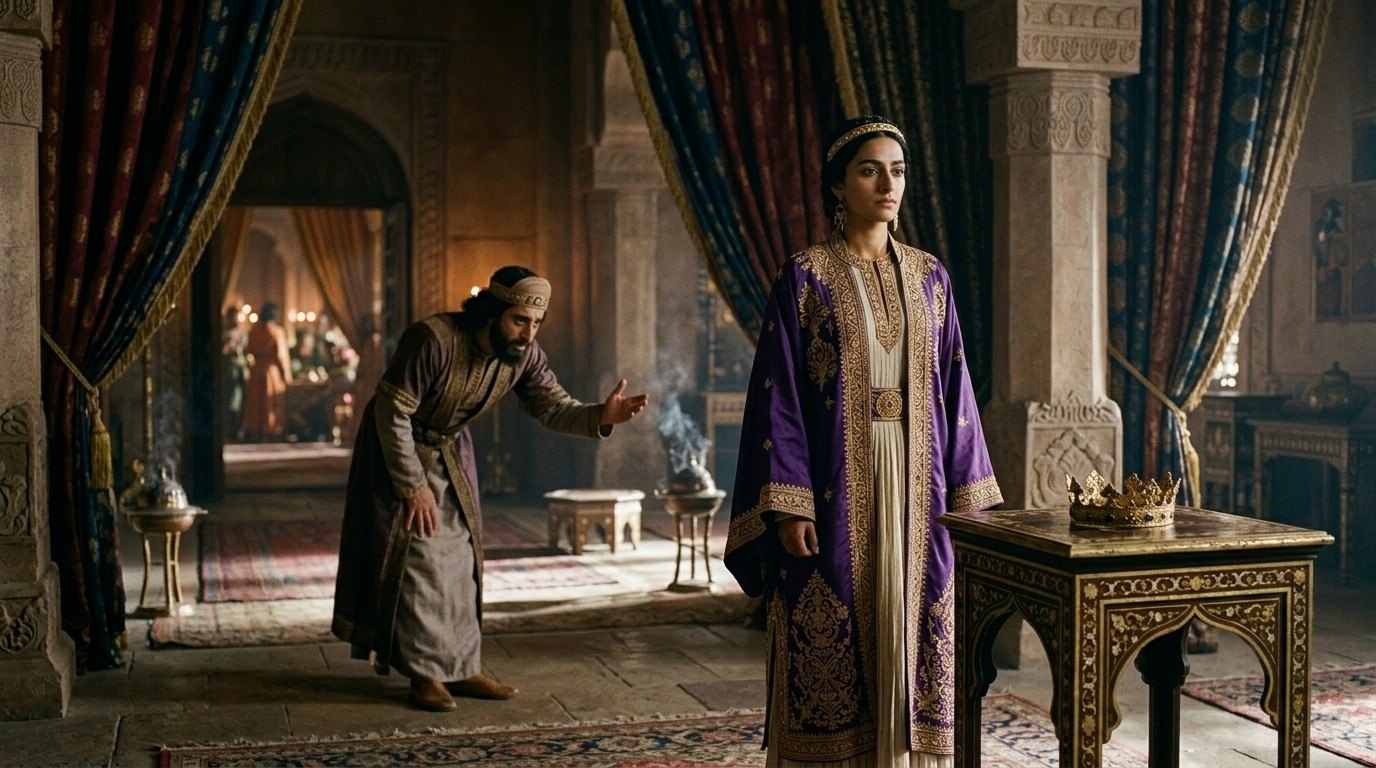
Esther 1:10-19
10 On the seventh day, when King Xerxes was in high spirits from wine, he commanded the seven eunuchs who served him—Mehuman, Biztha, Harbona, Bigtha, Abagtha, Zethar and Karkas—
11 to bring before him Queen Vashti, wearing her royal crown, in order to display her beauty to the people and nobles, for she was lovely to look at.
12 But when the attendants delivered the king’s command, Queen Vashti refused to come. Then the king became furious and burned with anger.
13 Since it was customary for the king to consult experts in matters of law and justice, he spoke with the wise men who understood the times
14 and were closest to the king—Karshena, Shethar, Admatha, Tarshish, Meres, Marsena and Memukan, the seven nobles of Persia and Media who had special access to the king and were highest in the kingdom.
15 “According to law, what must be done to Queen Vashti?” he asked. “She has not obeyed the command of King Xerxes that the eunuchs have taken to her.”
16 Then Memukan replied in the presence of the king and the nobles, “Queen Vashti has done wrong, not only against the king but also against all the nobles and the peoples of all the provinces of King Xerxes.
17 For the queen’s conduct will become known to all the women, and so they will despise their husbands and say, ‘King Xerxes commanded Queen Vashti to be brought before him, but she would not come.’
18 This very day the Persian and Median women of the nobility who have heard about the queen’s conduct will respond to all the king’s nobles in the same way. There will be no end of disrespect and discord.
19 “Therefore, if it pleases the king, let him issue a royal decree and let it be written in the laws of Persia and Media, which cannot be repealed, that Vashti is never again to enter the presence of King Xerxes. Also let the king give her royal position to someone else who is better than she.
New International Version (NIV)
The answer
Queen Vashti was the wife and queen of King Ahasuerus, the Persian ruler in the opening chapters of Esther. She is described as beautiful and held her own feast for the women in the royal house (Esther 1:9-11).
On the seventh day of the king’s feast, when Ahasuerus was merry with wine, he sent seven eunuchs to bring Vashti before him wearing her royal crown, so that the people and princes could see her beauty. Vashti refused to come, and the king’s anger burned against her (Esther 1:10-12).
Memucan, one of the royal advisers, argued that her refusal would encourage other women to treat their husbands with contempt. He advised an irrevocable decree that Vashti never again enter Ahasuerus’s presence and that her royal position be given to another woman. The king accepted this advice and sent the decree throughout his provinces (Esther 1:16-22).
Vashti was therefore removed as queen and barred from the king’s presence. Afterward, young women were gathered so that a new queen could be chosen, and Ahasuerus eventually crowned Esther as queen instead of Vashti (Esther 2:1-4, 17).
Scripture does not record Vashti’s ancestry, explain why she refused, or say what happened to her afterward. Claims about her motives or later life therefore go beyond the biblical account.
Answered from Scripture · reviewed November 25, 2026
Vashti's Fall and Esther's Rise
Read top to bottom: the events of Esther 1 and 2 in the order Scripture records them, from Vashti's feast to Esther crowned in her place.
- Vashti's feast (During the king's feast) · Vashti, the beautiful queen, holds her own feast for the women in the royal house. · Esther 1:9
- The king's summons (Seventh day of the feast) · Merry with wine, Ahasuerus sends seven eunuchs to bring Vashti in her royal crown. · Esther 1:10-11
- Vashti refuses (Seventh day of the feast) · Vashti refuses to come, and the king's anger burns against her. · Esther 1:12
- Memucan's counsel (After the refusal) · Memucan warns her refusal will spread and advises an irrevocable decree against her. · Esther 1:16-20
- The decree goes out (After the refusal) · Vashti is barred from the king's presence; her royal position is to go to another. · Esther 1:21-22
- A new queen sought (Afterward) · Young women are gathered so that a new queen can be chosen. · Esther 2:1-4
- Esther crowned (Afterward) · Ahasuerus crowns Esther as queen instead of Vashti. · Esther 2:17
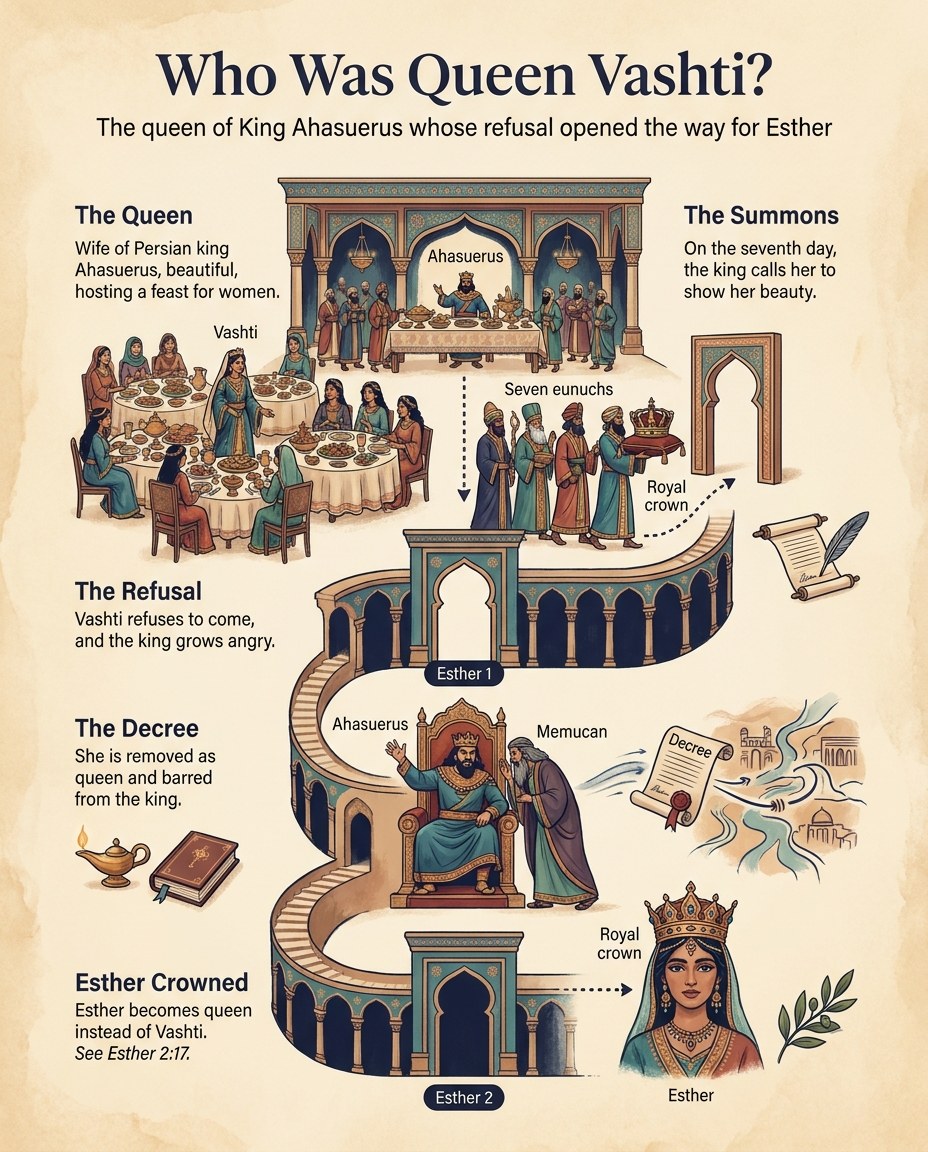
Queen Vashti was the Persian queen of King Ahasuerus whose refusal to be displayed before his drunken banquet cost her the crown. Her sudden deposition opens the book of Esther, setting the stage for God to raise up Esther for the deliverance of His people.
The Royal Feast
A Queen at the Center of Persian Splendor
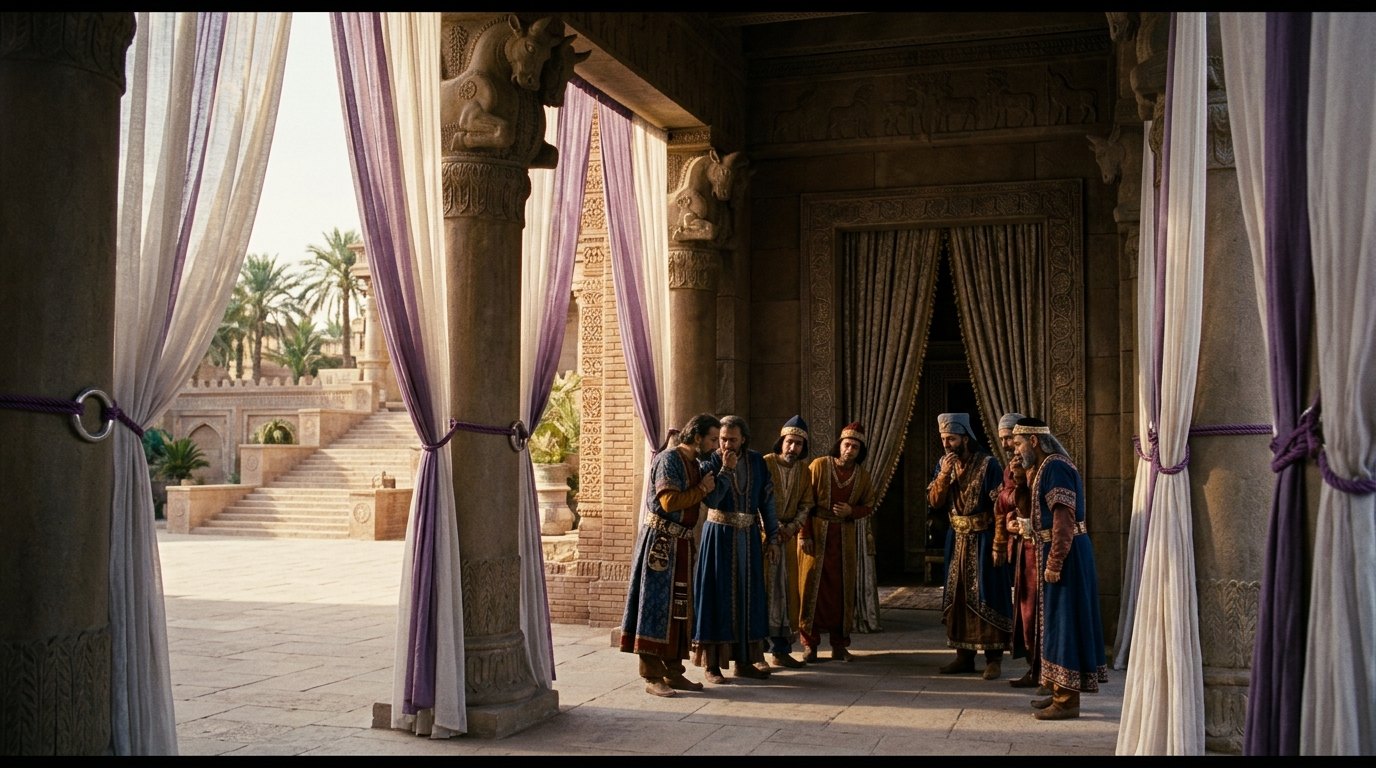
Queen Vashti also gave a banquet for the women in the royal palace of King Xerxes.
Esther 1:9 (NIV)
It introduces Vashti as the reigning queen hosting her own royal banquet for the women of the palace in Shushan.
The opening chapter of Esther introduces Queen Vashti against a backdrop of breathtaking imperial wealth and opulence. In Esther 1:9, Scripture records that Queen Vashti also gave a feast for the women inside the royal palace of King Ahasuerus in Shushan, showing her prominent position at the summit of the Persian empire. While the king entertained the nobles and governors of his one hundred and twenty-seven provinces with an extravagant display lasting one hundred and eighty days followed by a seven-day banquet, Vashti presided over her own assembly within the royal quarters.
Everything changed on the final day of the festivities. As Esther 1:10 explains, the heart of the king was merry with wine, prompting an impetuous command delivered through his seven trusted chamberlains: Mehuman, Biztha, Harbona, Bigtha, Abagtha, Zethar, and Carkas. The king intended to treat the queen not with dignity, but as a spectacle. In Esther 1:11, he commanded that Vashti be brought before the assembly wearing her royal crown, in order to show the peoples and the princes her beauty, for she was lovely to behold. What began as a celebration of sovereign splendor became an imperial crisis when Ahasuerus sought to parade his queen before a banquet hall full of intoxicated men.
| Passage | What it says |
|---|---|
| Esther 1:9 | Vashti the queen makes a separate feast for the women in the royal house of King Ahasuerus. |
| Esther 1:10 | On the seventh day of the banquet, Ahasuerus's heart is merry with wine, and he dispatches seven eunuchs to Vashti. |
| Esther 1:11 | The king commands Vashti to be brought before him wearing her royal crown to parade her beauty before the princes and people. |
The Refusal
Defying the King's Commandment
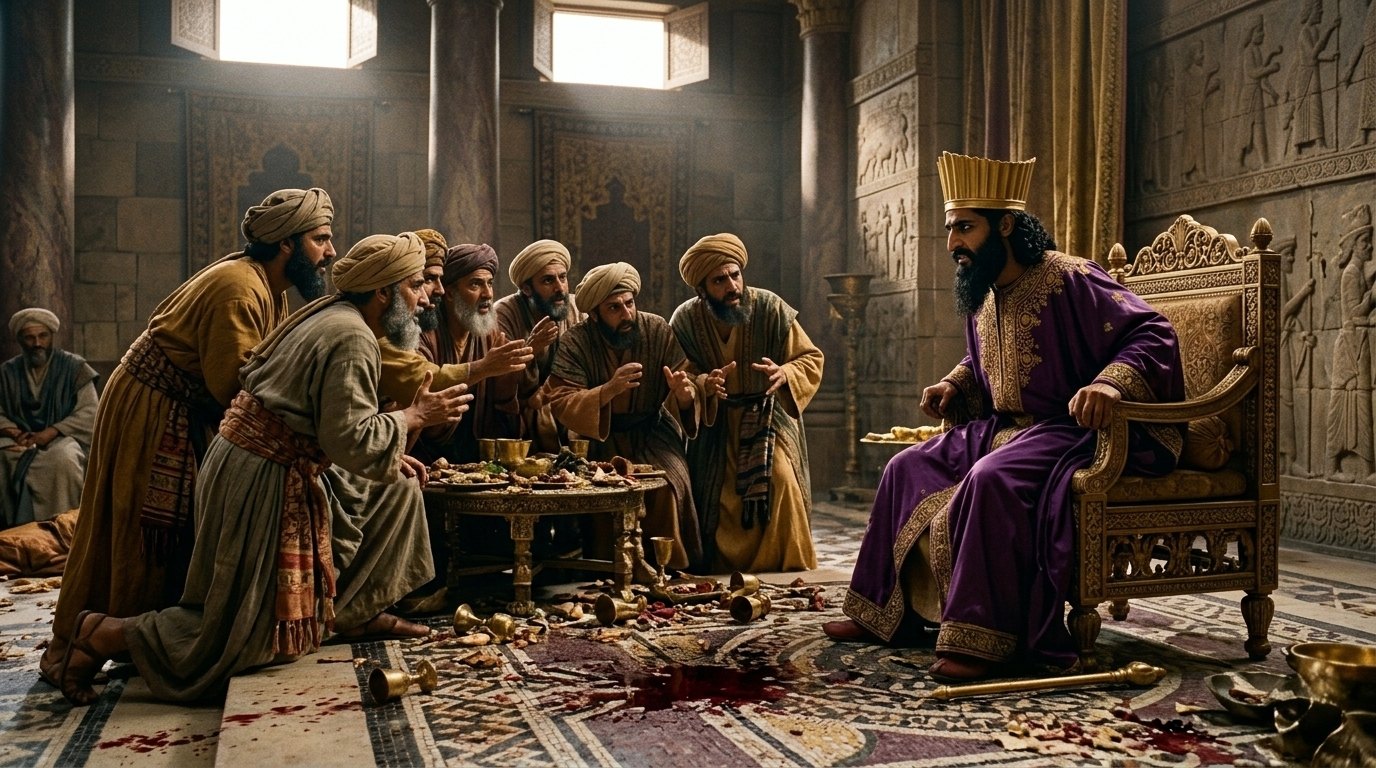
But when the attendants delivered the king’s command, Queen Vashti refused to come. Then the king became furious and burned with anger.
Esther 1:12 (NIV)
Vashti's direct refusal instantly sparks the king's burning wrath, setting the entire crisis into motion.
Faced with an imperial summons that violated her modesty and dignity, Vashti took a decisive stand. In Esther 1:12, the text states plainly that Queen Vashti refused to come at the king's command, delivered by his eunuchs. This flat refusal struck at the heart of absolute Persian sovereignty, and as a consequence, the king became furious, his anger burning within him. The public rejection stunned the court, instantly transforming a festive feast into an imperial scandal.
Rather than acting purely on impulse, Ahasuerus turned to the established legal machinery of the realm. Esther 1:13 records that he consulted the wise men who knew the times and the law, for this was royal procedure before all who understood law and justice. The monarch convened the inner circle described in Esther 1:14: Carshena, Shethar, Admatha, Tarshish, Meres, Marsena, and Memucan, the seven princes of Persia and Media who had access to the king's presence and sat first in the kingdom. In Esther 1:15, Ahasuerus posed the formal question: what must be done to Queen Vashti according to Persian law for failing to obey the king's royal decree? Her refusal demanded an immediate, empire-wide legal reckoning.
| Passage | What it says |
|---|---|
| Esther 1:12 | Vashti refuses to obey the king's royal summons brought by the eunuchs, provoking Ahasuerus to fierce anger. |
| Esther 1:13 | Ahasuerus confers with his seven wise men who know the law and judicial customs of the empire. |
| Esther 1:14 | The seven princes of Persia and Media who see the king's face and hold first place in the realm are assembled. |
| Esther 1:15 | The king demands what legal remedy exists against Queen Vashti for disobeying his imperial order. |
The Imperial Decree
Stripped of the Crown by Persian Law
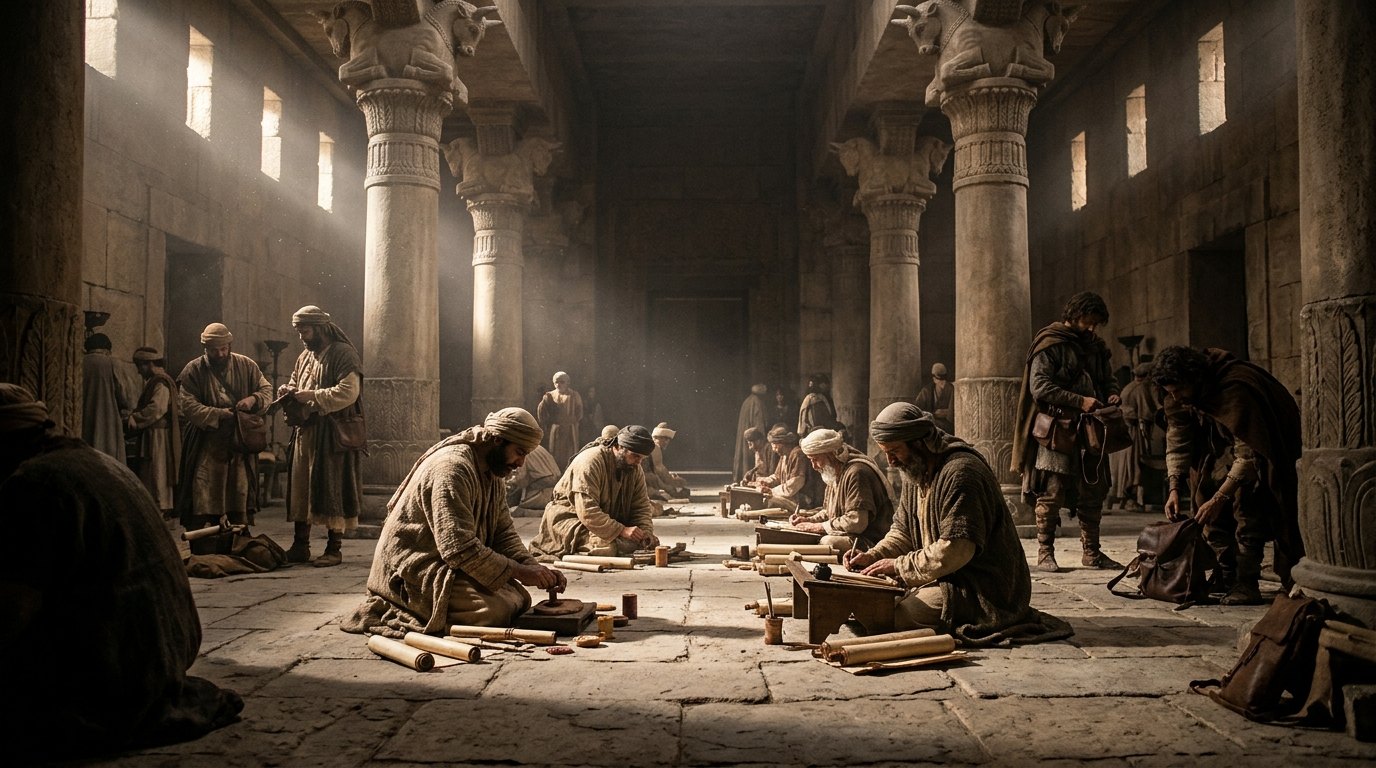
“Therefore, if it pleases the king, let him issue a royal decree and let it be written in the laws of Persia and Media, which cannot be repealed, that Vashti is never again to enter the presence of King Xerxes. Also let the king give her royal position to someone else who is better than she.
Esther 1:19 (NIV)
Memucan's counsel produces an unalterable Persian decree banishing Vashti forever and giving her estate to another.
The royal council framed Vashti's private refusal as a looming domestic crisis across the entire empire. In Esther 1:16, Memucan declared that Queen Vashti has done wrong not only to the king, but also to all the princes and people throughout the provinces. He argued in Esther 1:17 that when the queen's conduct became known, women everywhere would look with contempt on their husbands, citing the queen's open defiance. Esther 1:18 warned that the noblewomen of Persia and Media would respond similarly that very day, leading to endless contempt and wrath.
Memucan's solution was sweeping and permanent. In Esther 1:19, he proposed an irrevocable royal decree written into the laws of the Persians and Medes, declaring that Vashti could never again enter the presence of King Ahasuerus and that her royal position be given to another woman who was better than she. Esther 1:20 promised that such an imperial proclamation would instill universal respect among wives toward their husbands. Pleased with this advice, Ahasuerus carried it out in Esther 1:21, sending royal dispatches across all provinces in Esther 1:22, written in every language, decreeing that every man should be master in his own house. Vashti was permanently deposed.
| Passage | What it says |
|---|---|
| Esther 1:16 | Memucan declares that Vashti has wronged not only the king but all princes and subjects across the provinces. |
| Esther 1:17 | Memucan warns that reports of the queen's defiance will prompt women across the empire to despise their husbands. |
| Esther 1:18 | He argues that the noblewomen of Persia and Media will immediately follow Vashti's example with contempt and strife. |
| Esther 1:19 | Memucan urges an irrevocable law barring Vashti from the king and giving her royal estate to another woman. |
| Esther 1:20 | The decree is recommended for publication across the vast empire to enforce honor toward husbands. |
| Esther 1:21 | The counsel pleases King Ahasuerus and his princes, and the king adopts Memucan's proposal. |
| Esther 1:22 | Dispatches are sent to all imperial provinces in each language declaring that every man should rule his household. |
Providential Succession
Vacating the Throne for Esther
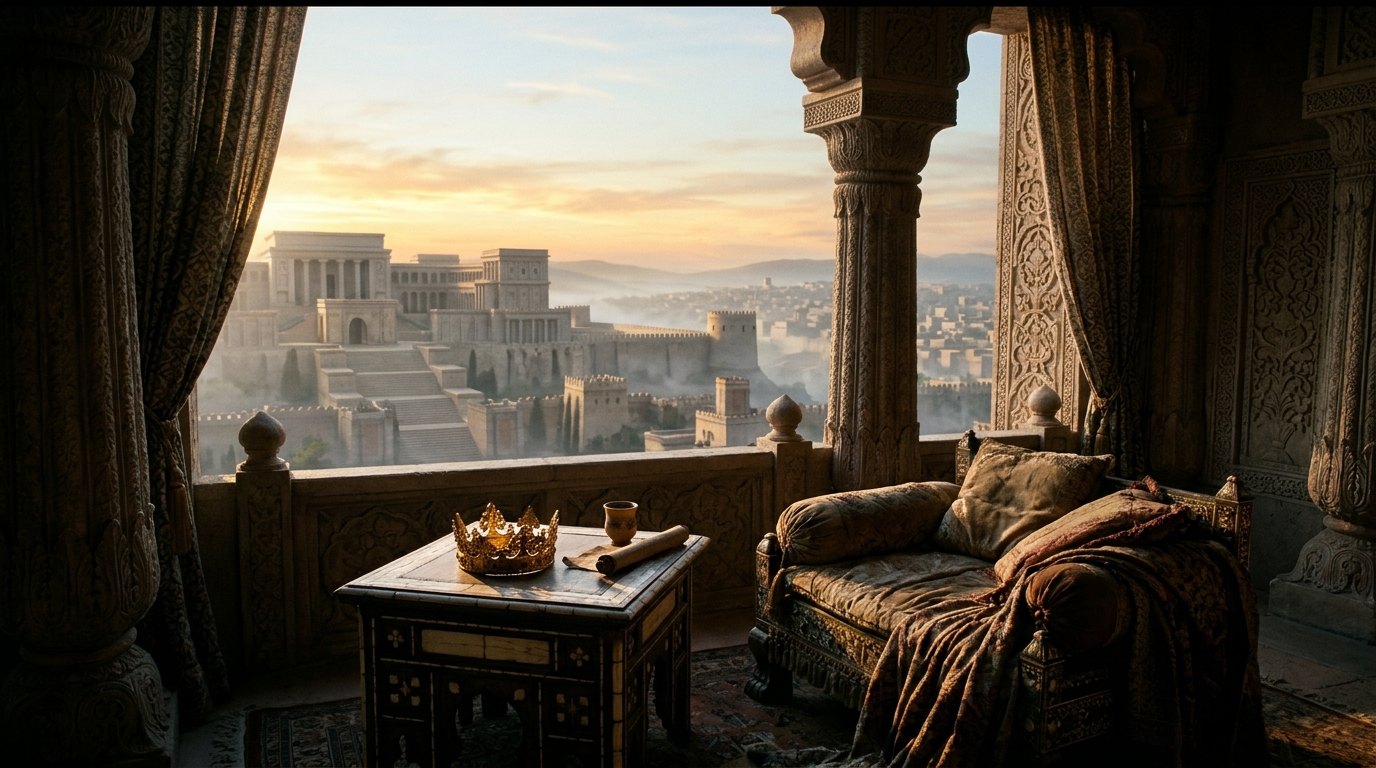
Now the king was attracted to Esther more than to any of the other women, and she won his favor and approval more than any of the other virgins. So he set a royal crown on her head and made her queen instead of Vashti.
Esther 2:17 (NIV)
Vashti's vacant place is ultimately filled by Esther, fulfilling God's sovereign arrangement to protect His people.
Behind the political intrigue and marital decrees of Shushan, the sovereign hand of God was quietly at work. In Esther 2:1, after the anger of Ahasuerus had cooled, he remembered Vashti, what she had done, and what had been decreed against her. The throne stood empty, but the law of the Medes and Persians could not be repealed. Seeing the king's unsettled mind, his attendants proposed in Esther 2:2 that beautiful young virgins be sought for the king, suggesting in Esther 2:3 that officers gather them under the custody of Hegai in the harem at Shushan. The king agreed in Esther 2:4 that the woman who pleased him would be queen instead of Vashti.
This imperial vacuum prepared the path for an orphaned Jewish maiden. God orchestrated the deposition of Vashti to place Hadassah, known as Esther, directly into the palace for the coming crisis. In Esther 2:17, the culmination arrived: the king loved Esther more than all the other women, and he placed the royal crown upon her head, making her queen in place of Vashti. Vashti's sudden fall was no historical accident, but the unseen providence of God positioning a deliverer for His people before Haman ever plotted their destruction.
| Passage | What it says |
|---|---|
| Esther 2:1 | After his anger cools, King Ahasuerus remembers Vashti, what she did, and the decree made against her. |
| Esther 2:2 | The royal attendants propose gathering beautiful young virgins throughout the empire for the king. |
| Esther 2:3 | Officers are appointed in all provinces to bring young women into the custody of Hegai in Shushan. |
| Esther 2:4 | The king agrees that the young woman who pleases him shall reign as queen in place of Vashti. |
| Esther 2:17 | Ahasuerus loves Esther above all women, places the royal crown upon her head, and makes her queen instead of Vashti. |
Where in the Bible
| Book | Passages |
|---|---|
| Esther | 19 · Esther 1:9, Esther 1:10, Esther 1:11, Esther 1:12, Esther 1:13, Esther 1:14, Esther 1:15, Esther 1:16, Esther 1:17, Esther 1:18, Esther 1:19, Esther 1:20, Esther 1:21, Esther 1:22, Esther 2:1, Esther 2:2, Esther 2:3, Esther 2:4, Esther 2:17 |
The story in order
- Vashti's Feast (c. 483 BC) · Esther 1:9 · Queen Vashti hosts a separate feast for women during Ahasuerus's banquet.
- The King's Command (c. 483 BC) · Esther 1:11 · Ahasuerus orders Vashti to appear at his banquet to display her beauty.
- Vashti's Refusal (c. 483 BC) · Esther 1:12 · Vashti defies the king's summons, provoking his anger.
- Counsel from Wise Men (c. 483 BC) · Esther 1:13 · Ahasuerus consults his advisors on how to deal with Vashti's disobedience.
- Memucan's Proposal (c. 483 BC) · Esther 1:16-19 · Memucan proposes an irrevocable law deposing Vashti and warning against female defiance.
- Imperial Decree Issued (c. 483 BC) · Esther 1:21-22 · The king enacts the decree, stating every man should rule his household.
- King Remembers Vashti (c. 483 BC) · Esther 2:1 · After his anger subsides, Ahasuerus recalls Vashti and the decree against her.
- Search for a New Queen (c. 483 BC) · Esther 2:2-4 · Attendants suggest gathering virgins to find a replacement queen for Vashti.
- Esther Becomes Queen (c. 483 BC) · Esther 2:17 · Ahasuerus crowns Esther queen, replacing Vashti.
Key words
- Queen (מַלְכָּה (malkah))
- The female ruler of an independent state, especially one who inherits the position by right of birth. · Esther 1:9
- King (מֶלֶךְ (melekh))
- The male ruler of an independent state, especially one who inherits the position by right of birth. · Esther 1:10
- Decree (דָּת (dat))
- An official order issued by a legal authority. · Esther 1:19
- Princes (שָׂרִים (sarim))
- Sons of kings or rulers; men of high rank. · Esther 1:14
Scripture records no lineage, motives, or later years for Vashti, refusing to indulge human speculation beyond what is written. Her removal stands as a vivid historical turning point through which the hidden hand of God prepared a throne for Esther and deliverance for His covenant people.
19 passages, each cited once.
Scripture cited
- Esther 1:9-22
- Esther 2:1-4
- Esther 2:17