What was Syria, or Aram, in the Bible?
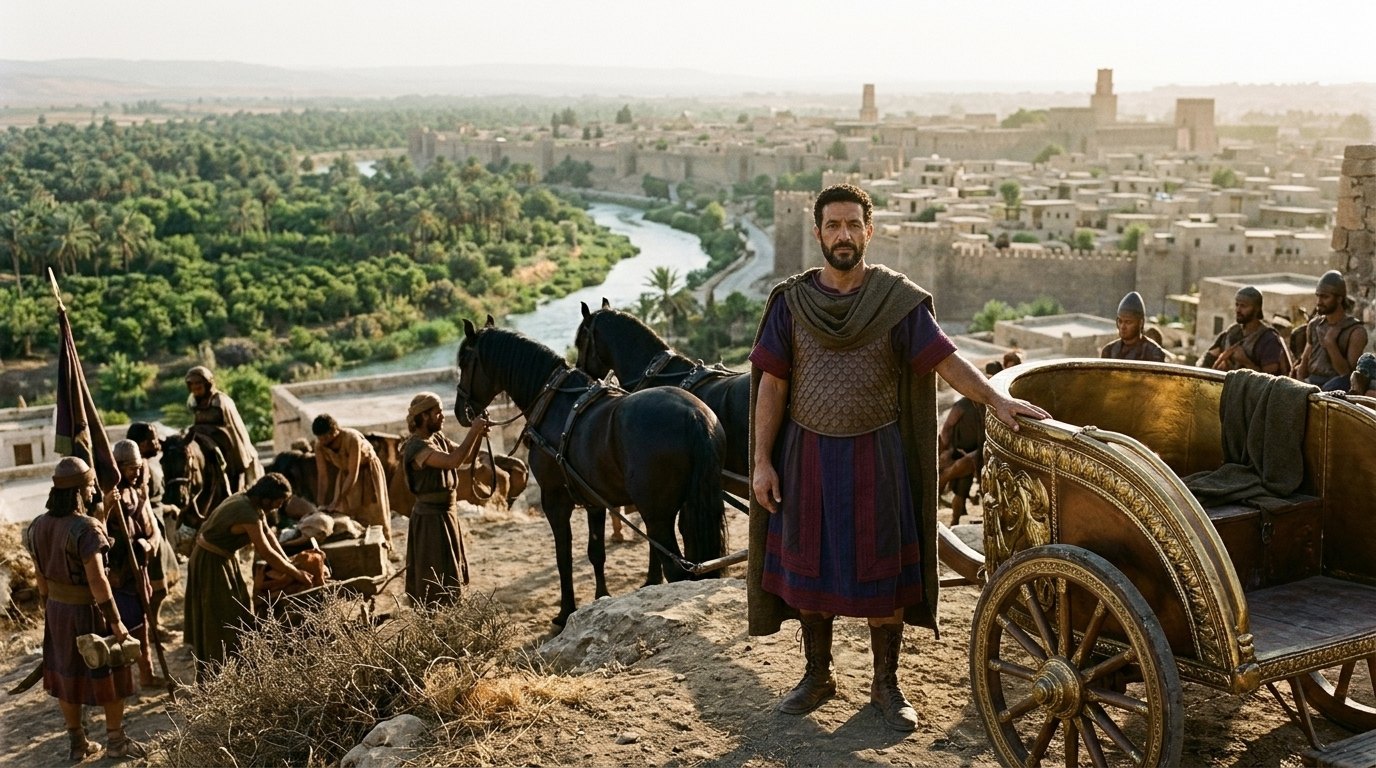
2 Kings 5:1-14
1 Now Naaman was commander of the army of the king of Aram. He was a great man in the sight of his master and highly regarded, because through him the LORD had given victory to Aram. He was a valiant soldier, but he had leprosy.
2 Now bands of raiders from Aram had gone out and had taken captive a young girl from Israel, and she served Naaman’s wife.
3 She said to her mistress, “If only my master would see the prophet who is in Samaria! He would cure him of his leprosy.”
4 Naaman went to his master and told him what the girl from Israel had said.
5 “By all means, go,” the king of Aram replied. “I will send a letter to the king of Israel.” So Naaman left, taking with him ten talents of silver, six thousand shekels of gold and ten sets of clothing.
6 The letter that he took to the king of Israel read: “With this letter I am sending my servant Naaman to you so that you may cure him of his leprosy.”
7 As soon as the king of Israel read the letter, he tore his robes and said, “Am I God? Can I kill and bring back to life? Why does this fellow send someone to me to be cured of his leprosy? See how he is trying to pick a quarrel with me!”
8 When Elisha the man of God heard that the king of Israel had torn his robes, he sent him this message: “Why have you torn your robes? Have the man come to me and he will know that there is a prophet in Israel.”
9 So Naaman went with his horses and chariots and stopped at the door of Elisha’s house.
10 Elisha sent a messenger to say to him, “Go, wash yourself seven times in the Jordan, and your flesh will be restored and you will be cleansed.”
11 But Naaman went away angry and said, “I thought that he would surely come out to me and stand and call on the name of the LORD his God, wave his hand over the spot and cure me of my leprosy.
12 Are not Abana and Pharpar, the rivers of Damascus, better than all the waters of Israel? Couldn’t I wash in them and be cleansed?” So he turned and went off in a rage.
13 Naaman’s servants went to him and said, “My father, if the prophet had told you to do some great thing, would you not have done it? How much more, then, when he tells you, ‘Wash and be cleansed’!”
14 So he went down and dipped himself in the Jordan seven times, as the man of God had told him, and his flesh was restored and became clean like that of a young boy.
New International Version (NIV)
The answer
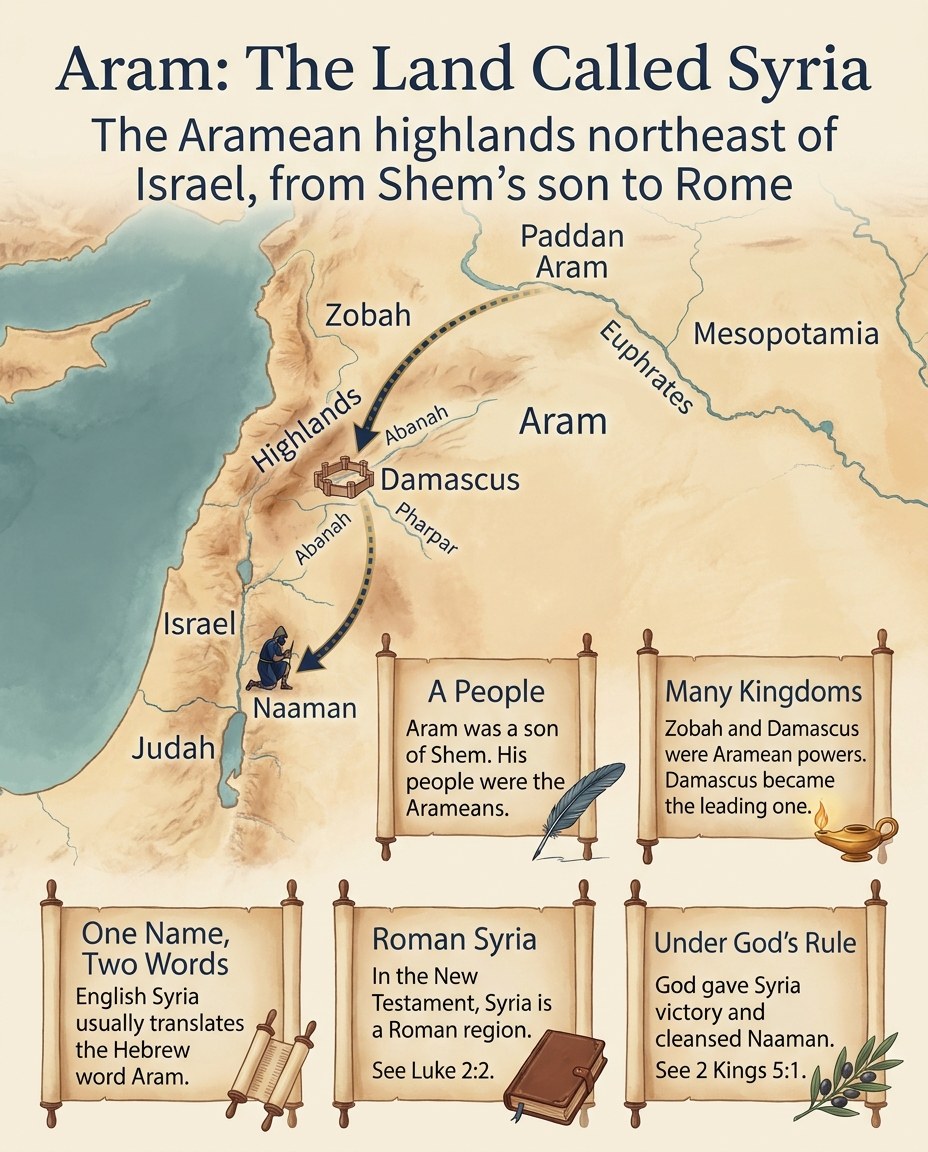
Syria and Aram usually name the same biblical region: the Aramean lands northeast of Israel. In the Old Testament, “Syria” commonly translates the Hebrew Aram (אֲרָם). Thus, 2 Kings 5:1 calls Naaman commander of the army of the “king of Syria,” and the underlying Hebrew word is Aram. Biblical Aram was not identical to the modern nation of Syria, and its boundaries varied across history.
The land and its people
- Aram is also a man’s name: he was a son of Shem, and his sons are listed in Genesis 10:22-23. The people associated with the region were called Arameans, often translated Syrians.
- The name means “high” or “highlands.” The region lay northeast of Palestine and extended toward the Euphrates; wider uses of Aram included territory in Mesopotamia.
- Paddan Aram belonged to this wider Aramean world. Genesis 25:20 identifies Bethuel and Laban with Paddan Aram, while Genesis 24:10 locates Abraham’s servant’s journey in Mesopotamia. This family background explains why Deuteronomy 26:5 calls Jacob “a Syrian ready to perish.”
A group of kingdoms, with Damascus becoming dominant
Aram was not always one unified kingdom. Scripture names several Aramean territories and powers. In 2 Samuel 8:3-6, for example, David defeats Hadadezer of Zobah and the Syrians of Damascus, then places garrisons in “Syria of Damascus.” Damascus subsequently became the leading Aramean royal center.
Naaman served the king of this Damascus-centered Syria. His pride in “Abanah and Pharpar, the rivers of Damascus” appears in 2 Kings 5:12. Later, Rezin king of Syria allied himself with Pekah king of Israel against Judah in Isaiah 7:1-2.
Syria in the New Testament
In the New Testament, Syria is a Roman-era geographical and political designation. Luke 2:2 names Quirinius as governor of Syria, and Galatians 1:21 records Paul travelling through “the regions of Syria and Cilicia.”
Aram’s people were outside Israel, but never outside God’s rule or mercy: 2 Kings 5:1 says that Yahweh had given victory to Syria, and Jesus later recalled the cleansing of “Naaman the Syrian” in Luke 4:27.
Answered from Scripture · reviewed November 25, 2026
Aram, or Syria, through the Bible
Read from top to bottom. Each moment shows how Scripture speaks of Aram and its people, from the son of Shem to the Roman province of Syria.
- Aram, son of Shem (Table of nations) · Aram is named among Shem's sons, and his own sons are listed. · Genesis 10:22-23
- Paddan Aram (Age of the patriarchs) · Bethuel and Laban, Rebekah's family, belong to Paddan Aram in the wider Aramean world. · Genesis 25:20
- Jacob, a Syrian (Age of the patriarchs) · This family background is why Israel confessed Jacob as a Syrian ready to perish. · Deuteronomy 26:5
- David defeats Zobah and Damascus (David's reign) · Aram was several kingdoms. David defeats Hadadezer of Zobah and garrisons Syria of Damascus. · 2 Samuel 8:3-6
- Naaman of Damascus (Days of Elisha) · The commander of the king of Syria's army. The Hebrew word behind Syria here is Aram. · 2 Kings 5:1
- Rezin allies with Pekah (Days of Isaiah) · Rezin king of Syria joins Pekah king of Israel against Judah. · Isaiah 7:1-2
- Quirinius, governor of Syria (Birth of Jesus) · In the New Testament Syria is a Roman-era region and political designation. · Luke 2:2
- Jesus recalls Naaman (Ministry of Jesus) · Jesus points to the cleansing of Naaman the Syrian as an example of God's mercy beyond Israel. · Luke 4:27
- Paul in Syria and Cilicia (Paul's early ministry) · Paul travels through the regions of Syria and Cilicia. · Galatians 1:21
In the Old Testament, 'Syria' translates the Hebrew name Aram, designating the ancient Aramean homelands and city-states stretching northeast of Israel toward the Euphrates. From shared ancestral roots with the patriarchs to fiery geopolitical conflicts with Israel and Judah, Aram played a pivotal role in redemptive history until it emerged as a Roman province in the New Testament. Tracing Aram throughout Scripture reveals not only the history of Israel's northern neighbor but also God's sovereign rule and merciful outreach beyond the borders of Israel.
Ancestry and Geography
Aram Originated as a Patriarchal Line and Ancient Highland
The sons of Shem: Elam, Ashur, Arphaxad, Lud and Aram. The sons of Aram: Uz, Hul, Gether and Meshek.
Genesis 10:22-23 (NIV)
This genealogy grounds Aram in history as a direct descendant of Shem whose family settled the northeastern highlands.
The inspired genealogy in Genesis 10:22-23 anchors Aram firmly in historical reality as a son of Shem alongside Elam, Asshur, Arpachshad, and Lud. Far from being a mythical designation, the name Aram originated with this post-flood patriarch, whose sons—Uz, Hul, Gether, and Mash—established tribal branches and territories across the fertile plains and high plateau stretching northeast toward the Euphrates River. When Scripture later details the wider family of Abraham in Genesis 22:21, the name appears again in the lineage of Abraham's brother Nahor, whose son Kemuel is identified as the father of Aram. Centuries later, the inspired record in 1 Chronicles 1:17 preserves this exact Shemite lineage word for word, confirming that the chronicler viewed Aram's historical identity as an essential strand in God's ordered ordering of the nations. These passages collectively demonstrate that before Syria existed as an organized military adversary or a network of competing city-states, it was a flesh-and-blood Semitic family line planted by God in the northern lands of the Fertile Crescent.
| Passage | What it says |
|---|---|
| Genesis 10:22 | Aram is listed alongside Elam, Asshur, Arpachshad, and Lud as a son of Shem. |
| Genesis 10:23 | Uz, Hul, Gether, and Mash are recorded as the sons of Aram. |
| Genesis 22:21 | Kemuel is identified as the father of Aram in the family line of Nahor, Abraham's brother. |
| 1 Chronicles 1:17 | The chronicler preserves the lineage of Shem, listing Aram and his sons. |
Patriarchal Roots
Israel's Forefathers Traced Their Heritage Through Paddan Aram
Then you shall declare before the LORD your God: “My father was a wandering Aramean, and he went down into Egypt with a few people and lived there and became a great nation, powerful and numerous.
Deuteronomy 26:5 (NIV)
Israel's confession explicitly describes Jacob as a wandering Aramean, binding Israel's ancestry to the land of Aram.
When an Israelite brought the basket of firstfruits to the sanctuary, his covenant confession opened with an astonishing declaration of family heritage in Deuteronomy 26:5: "A wandering Aramean was my father." This liturgical memory bound Israel’s earliest domestic history not to Egypt or Canaan, but to the land of Aram. In Genesis 24:10, Abraham's senior servant journeyed directly to Aram-naharaim, the river country between the Tigris and Euphrates, specifically to secure a wife from among his kin for Isaac. There he encountered Bethuel and Laban, explicitly identified in Genesis 25:20 as Arameans residing in Paddan Aram. Generationally later, Isaac charged Jacob in Genesis 28:5 to return to that same ancestral homeland to take a wife from the daughters of Laban the Aramean. Jacob spent two decisive decades tending flocks in Haran before departing secretly from Laban in Genesis 31:20. The prophet in Hosea 12:12 reiterated this formative episode, reminding a rebellious northern kingdom that their founding forefather fled to the country of Aram and labored there for a bride. Israel was blood-kin to the Arameans, sharing a maternal root that God used to preserve the holy seed.
| Passage | What it says |
|---|---|
| Genesis 24:10 | Abraham's servant travels to Aram-naharaim, or Mesopotamia, to find a wife for Isaac from Abraham's kin. |
| Genesis 25:20 | Bethuel and Laban are identified as Arameans from Paddan Aram when Isaac marries Rebekah. |
| Genesis 28:5 | Isaac sends Jacob to Paddan Aram to find a wife among the daughters of Laban the Aramean. |
| Genesis 31:20 | Jacob departs secretly from Laban the Aramean after serving him twenty years in Haran. |
| Deuteronomy 26:5 | Worshipers bringing firstfruits confess that their father was a wandering or perishing Aramean. |
| Hosea 12:12 | The prophet recalls that Jacob fled to the country of Aram and served there for a wife. |
The United Monarchy
David Subdued the Aramean Kingdoms and Fortified Damascus
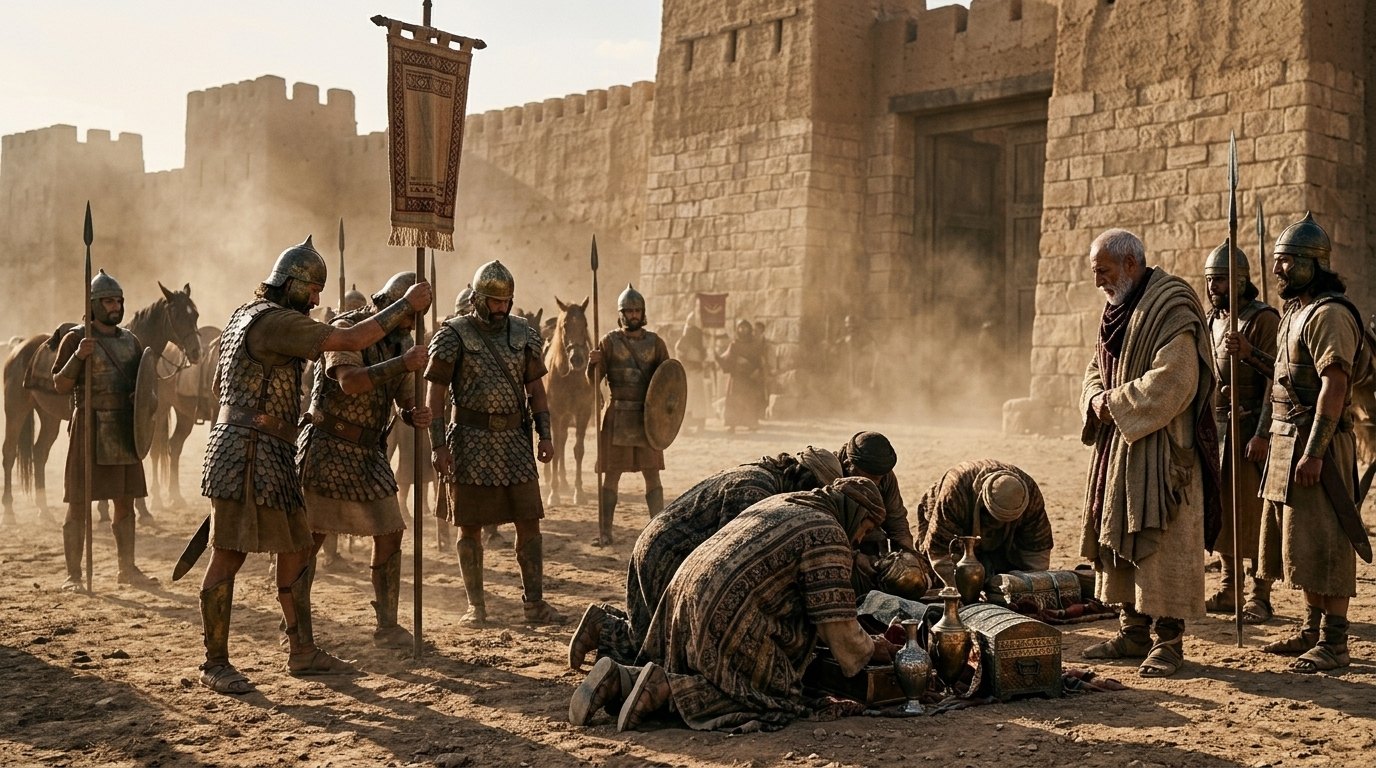
When the Arameans of Damascus came to help Hadadezer king of Zobah, David struck down twenty-two thousand of them. He put garrisons in the Aramean kingdom of Damascus, and the Arameans became subject to him and brought tribute. The LORD gave David victory wherever he went.
2 Samuel 8:5-6 (NIV)
David's victory established Israelite garrisons in Damascus and brought the fractured Syrian kingdoms under his tribute.
The regional balance of power shifted decisively under the united monarchy, encapsulated in 2 Samuel 8:5-6 where David struck down twenty-two thousand Arameans of Damascus and installed Israelite military garrisons throughout their territory. Earlier in that campaign, as recorded in 2 Samuel 8:3, David shattered Hadadezer king of Zobah as he marched to recover his border along the Euphrates River. When Damascus intervened to reinforce Zobah, David crushed their coalition, forcing the Arameans to become tributary subjects who yielded immense spoils of bronze and gold shields to the Jerusalem treasury. This Aramean hostility flared again in 2 Samuel 10:6, when the Ammonite royal court hired twenty thousand Aramean mercenaries from Beth-rehob and Zobah to crush David’s border outposts. Joab and David met this coalition in open field; in 2 Samuel 10:18-19, David routed seven hundred charioteers and forty thousand horsemen, compelling all the regional vassal kings to make peace and pay homage. Yet this subjugation was not permanent. Near the end of Solomon's reign, 1 Kings 11:23-25 records how Rezon son of Eliada fled Hadadezer, seized Damascus, and re-established Syria as a bitter adversary that harassed Israel throughout Solomon's remaining days.
| Passage | What it says |
|---|---|
| 2 Samuel 8:3 | David defeats Hadadezer king of Zobah as he attempts to restore his power at the River. |
| 2 Samuel 8:5 | The Arameans of Damascus come to aid Hadadezer, but David strikes down twenty-two thousand men. |
| 2 Samuel 8:6 | David places military garrisons in Aram of Damascus, and the Syrians become his tribute-paying servants. |
| 2 Samuel 10:6 | The Ammonites hire twenty thousand Aramean foot soldiers from Beth-rehob and Zobah against David. |
| 2 Samuel 10:18-19 | David defeats the allied Aramean chariot forces, prompting all vassal kings to make peace with Israel. |
| 1 Kings 11:23-25 | Rezon son of Eliada rises up against Solomon, reigns in Damascus, and becomes an adversary to Israel. |
Wars of the Kings
Syria Emerged as Israel's Chief Northern Opponent and Neighbor
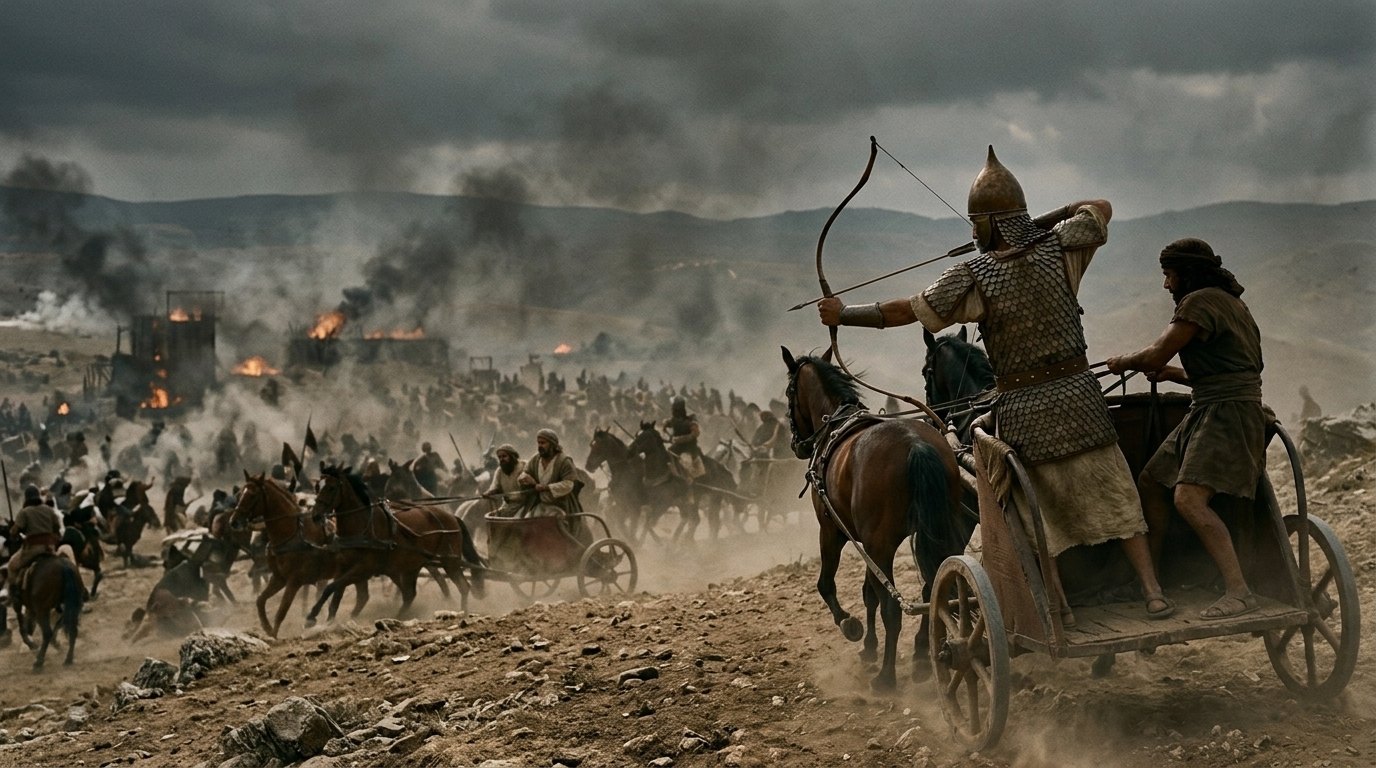
The man of God came up and told the king of Israel, “This is what the LORD says: ‘Because the Arameans think the LORD is a god of the hills and not a god of the valleys, I will deliver this vast army into your hands, and you will know that I am the LORD.’ ”
1 Kings 20:28 (NIV)
The Lord defended Samaria against Ben-hadad to demonstrate that Yahweh is God of the valleys as well as the hills.
During the divided kingdom, Syria emerged as Israel’s primary military nemesis, reaching a theological climax in 1 Kings 20:28 when a prophet declared that the Lord would crush Syria's vast army because the Arameans claimed Yahweh was merely a god of the hills and not of the valleys. This long cycle of warfare began when King Asa of Judah bribed Ben-hadad I in 1 Kings 15:18-20 to break his alliance with Baasha of Israel, unleashing Syrian raids across Dan and Naphtali. Decades later, Ben-hadad II besieged Samaria with thirty-two allied kings in 1 Kings 20:1, only to suffer disastrous defeat when God vindicated His universal sovereignty on the plains of Aphek. Syrian enmity proved fatal to Israel's corrupt royalty: in 1 Kings 22:34-37, an Aramean archer drew his bow at random at Ramoth-gilead, fatally piercing King Ahab between the joints of his harness. In the days of Elisha, the prophet routinely warned Israel of Syrian ambush sites through direct divine revelation in 2 Kings 6:8-12. Yet judgment soon fell upon Damascus itself; in 2 Kings 8:12-15, Elisha wept as he foretold the sheer savagery of Hazael, who murdered Ben-hadad and usurped the throne. Hazael devastated Israelite cities throughout Jehoahaz's reign (2 Kings 13:22-25) until King Jehoash reclaimed them, proving God's ultimate restraint over Syria's cruel sword.
| Passage | What it says |
|---|---|
| 1 Kings 15:18-20 | Asa of Judah hires Ben-hadad king of Syria in Damascus to break his treaty with Baasha of Israel. |
| 1 Kings 20:1 | Ben-hadad king of Syria gathers his entire army and thirty-two kings to besiege Samaria. |
| 1 Kings 20:28 | A prophet tells Ahab that God will deliver Syria's host to prove He is God of the lowlands. |
| 1 Kings 22:34-37 | Ahab is struck by a random Syrian arrow at Ramoth-gilead and dies in his chariot. |
| 2 Kings 6:8-12 | Elisha supernaturally reveals the tactical battle plans of the king of Syria to Israel's king. |
| 2 Kings 8:12-15 | Elisha weeps foreseeing the cruelty Hazael will inflict on Israel before Hazael assassinates Ben-hadad. |
| 2 Kings 13:22-25 | Hazael oppresses Israel throughout Jehoahaz's reign, but Jehoash recovers Israel's cities after Hazael dies. |
Sovereignty and Mercy
God Extended Rule and Miraculous Cleansing to Syrian Soil
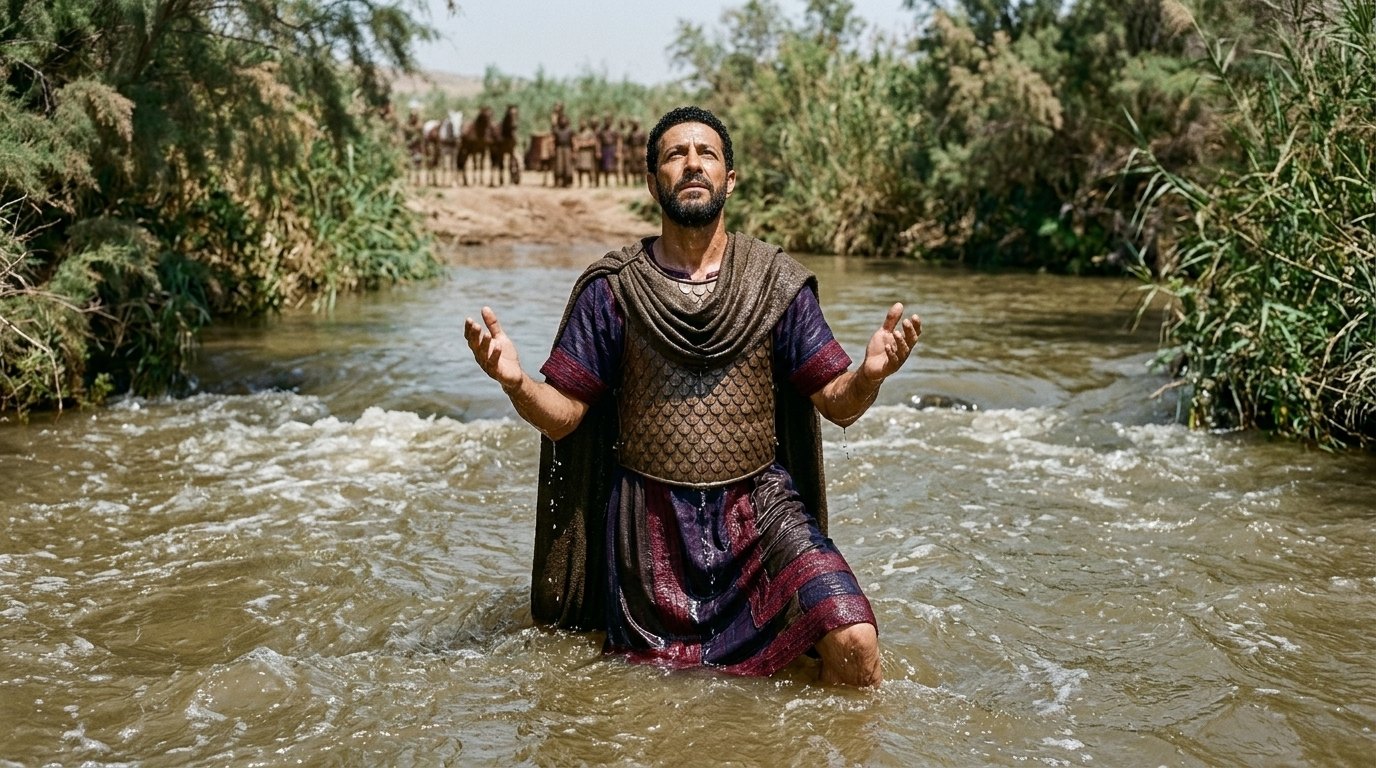
Now Naaman was commander of the army of the king of Aram. He was a great man in the sight of his master and highly regarded, because through him the LORD had given victory to Aram. He was a valiant soldier, but he had leprosy.
2 Kings 5:1 (NIV)
Scripture explicitly credits Yahweh with giving military victory to Syria through the Aramean general Naaman.
The sovereign rule of God extends far beyond the borders of Israel, a truth nowhere stated more bluntly than in 2 Kings 5:1, where Scripture affirms that by Naaman the LORD had given deliverance to Syria. Though Aram was often an adversary, Israel's God directed its battles and governed its commanders. Yet Naaman's power could not conquer his leprosy, prompting a captive Israelite maiden to point him toward Samaria's prophet. Humbling himself before the word of Elisha, Naaman obeyed the instruction to wash in the Jordan River, and 2 Kings 5:14 records that his flesh was restored clean like that of a little child. This dramatic physical healing yielded an immediate theological confession in 2 Kings 5:15, as the Syrian commander declared before all his servants that there is no God in all the earth except in Israel. Centuries later, our Lord Jesus Christ drew upon this historical event in Luke 4:27 to confront the unbelief of His hometown in Nazareth, demonstrating that divine mercy had sovereignly bypassed Israel's own lepers to cleanse an Aramean outsider. The apostle Paul would later expound this mystery in Romans 15:9, celebrating the prophetic purpose that the Gentiles might glorify God for His mercy.
| Passage | What it says | Fulfilled |
|---|---|---|
| 2 Kings 5:1 | Yahweh grants deliverance to Syria through Naaman, a valorous commander who suffers from leprosy. | Luke 4:27 |
| 2 Kings 5:14 | Naaman dips seven times in the Jordan River and his flesh is restored like that of a young child. | Luke 4:27 |
| 2 Kings 5:15 | Naaman confesses that there is no God in all the earth except the God of Israel. | Romans 15:9 |
| Luke 4:27 | Jesus reminds Nazareth that while many lepers lived in Israel during Elisha's day, only Naaman the Syrian was cleansed. |
Prophecy and Fall
The Prophets Declared Divine Judgment Upon Damascus and Aram
A prophecy against Damascus: “See, Damascus will no longer be a city but will become a heap of ruins. The cities of Aroer will be deserted and left to flocks, which will lie down, with no one to make them afraid. The fortified city will disappear from Ephraim, and royal power from Damascus; the remnant of Aram will be like the glory of the Israelites,” declares the LORD Almighty.
Isaiah 17:1-3 (NIV)
Isaiah foretells the utter desolation of Damascus and the end of Syrian sovereignty under the Assyrian advance.
When Aramean ambition overstepped God's appointed limits, the prophets declared that the pride of Damascus would be brought low under divine retribution. In Isaiah 17:1-3, the prophet delivers a sobering oracle against Damascus, warning that the fortress will cease from Ephraim and the kingdom from Damascus as the city collapses into a ruinous heap. This decree responded to a wicked coalition described in Isaiah 7:1-2, where Rezin king of Syria allied with Pekah of Israel to besiege Jerusalem, causing the royal house of David to shake like trees in the wind. In response, Isaiah 8:4 promised that before a child could cry father or mother, the riches of Damascus would be carried away by the king of Assyria. The prophet Amos 1:3-5 had already pronounced judgment for Syria's cruel atrocities, specifically for threshing Gilead with implements of iron, prophesying that the people of Aram would go into exile to Kir. History confirmed God's inerrant word precisely when 2 Kings 16:9 recorded that Tiglath-pileser marched against Damascus, captured it, killed Rezin, and deported its populace to Kir. Decades later, Jeremiah 49:23-27 affirmed that the fire of divine judgment would kindle the palaces of Ben-hadad.
| Passage | What it says |
|---|---|
| Isaiah 7:1-2 | Rezin king of Syria allies with Pekah of Israel against Judah, causing Ahaz's heart to tremble. |
| Isaiah 8:4 | Isaiah prophesies that the wealth of Damascus and spoil of Samaria will be carried off by Assyria. |
| Isaiah 17:1 | An oracle against Damascus declares it will cease to be a city and become a ruinous heap. |
| Amos 1:3-5 | Amos proclaims judgment on Damascus for threshing Gilead, predicting the Arameans will be exiled to Kir. |
| 2 Kings 16:9 | Tiglath-pileser king of Assyria captures Damascus, slays Rezin, and carries its inhabitants captive to Kir. |
| Jeremiah 49:23-27 | Jeremiah laments the impending destruction and panic overtaking Hamath, Arpad, and Damascus. |
The Roman Province
New Testament Syria Became the Cradle for Gentile Evangelism
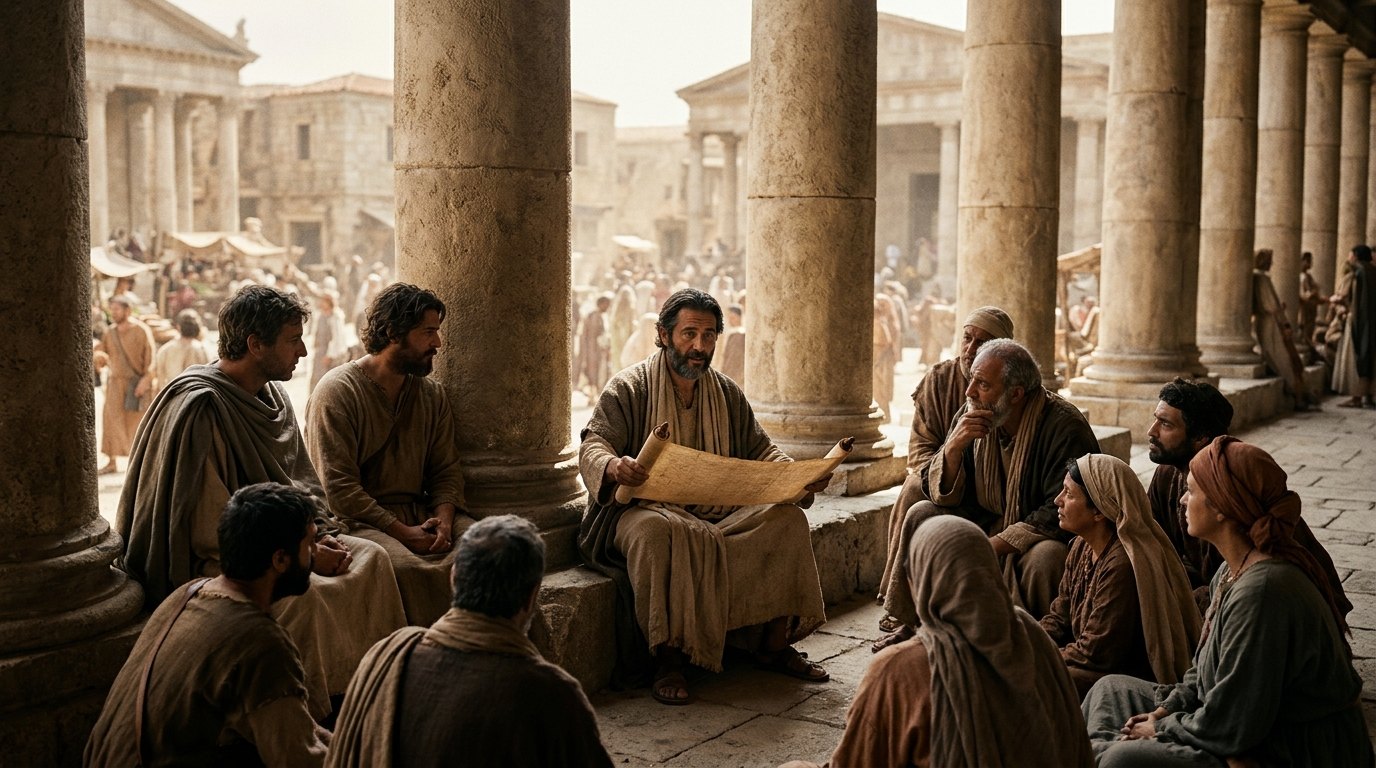
Now those who had been scattered by the persecution that broke out when Stephen was killed traveled as far as Phoenicia, Cyprus and Antioch, spreading the word only among Jews. Some of them, however, men from Cyprus and Cyrene, went to Antioch and began to speak to Greeks also, telling them the good news about the Lord Jesus. The Lord’s hand was with them, and a great number of people believed and turned to the Lord.
Acts 11:19-21 (NIV)
Antioch of Syria became the first major center where Hellenistic Gentiles turned to the Lord Jesus in vast numbers.
Under Roman administration, Syria was reorganized into a vast imperial province that served as the primary launching pad for the gospel across the Greco-Roman world. In Acts 11:19-21, Hellenistic Jewish believers driven from Jerusalem after the martyrdom of Stephen traveled as far as Syrian Antioch, preaching the Lord Jesus to Greek-speaking Gentiles so that a great number who believed turned to the Lord. Long before this apostolic expansion, Matthew 4:24 noted that the fame of Jesus had spread throughout all Syria, with multitudes of the sick and possessed brought to Him for healing. His nativity itself was tied to the region in Luke 2:2, which notes the first registration took place while Quirinius was governor of Syria. In Syrian Antioch, the church grew so rapidly that Acts 11:26 records Barnabas bringing Saul to minister for a full year, the city where the disciples were first called Christians. Following the Jerusalem Council, Paul embarked on his second missionary journey through the province, with Acts 15:41 detailing how he strengthened the churches of Syria and Cilicia, an ongoing labor he had also testified to in Galatians 1:21.
| Passage | What it says |
|---|---|
| Matthew 4:24 | Jesus' fame spreads throughout all Syria as sick and afflicted individuals are brought to Him for healing. |
| Luke 2:2 | The census at Jesus' birth occurs while Quirinius administers the Roman province of Syria. |
| Acts 11:26 | Barnabas and Saul teach for an entire year in Syrian Antioch, where believers are first called Christians. |
| Acts 15:41 | Paul travels through the regions of Syria and Cilicia, strengthening the newly planted churches. |
| Galatians 1:21 | Following his conversion on the road to Damascus, Paul ministers within the regions of Syria and Cilicia. |
Where in the Bible
| Book | Passages |
|---|---|
| Genesis | 7 · Genesis 10:22, Genesis 10:23, Genesis 22:21, Genesis 24:10, Genesis 25:20, Genesis 28:5, Genesis 31:20 |
| Deuteronomy | 1 · Deuteronomy 26:5 |
| 2 Samuel | 5 · 2 Samuel 8:3, 2 Samuel 8:5, 2 Samuel 8:6, 2 Samuel 10:6, 2 Samuel 10:18-19 |
| 1 Kings | 5 · 1 Kings 11:23-25, 1 Kings 15:18-20, 1 Kings 20:1, 1 Kings 20:28, 1 Kings 22:34-37 |
| 2 Kings | 7 · 2 Kings 6:8-12, 2 Kings 8:12-15, 2 Kings 13:22-25, 2 Kings 5:1, 2 Kings 5:14, 2 Kings 5:15, 2 Kings 16:9 |
| 1 Chronicles | 1 · 1 Chronicles 1:17 |
| Isaiah | 3 · Isaiah 7:1-2, Isaiah 8:4, Isaiah 17:1 |
| Jeremiah | 1 · Jeremiah 49:23-27 |
| Hosea | 1 · Hosea 12:12 |
| Amos | 1 · Amos 1:3-5 |
| Matthew | 1 · Matthew 4:24 |
| Luke | 2 · Luke 4:27, Luke 2:2 |
| Acts | 2 · Acts 11:26, Acts 15:41 |
| Galatians | 1 · Galatians 1:21 |
The story in order
- Aram's lineage established (c. 2000 BC) · Genesis 10:22 · Aram is listed as a son of Shem, establishing his ancestral line.
- Patriarchs trace heritage through Aram (c. 1800 BC) · Genesis 24:10 · Abraham's servant seeks a wife for Isaac from Abraham's kin in Aram-naharaim.
- Jacob serves Laban in Aram (c. 1700 BC) · Genesis 31:20 · Jacob flees from Laban the Aramean after twenty years in Haran.
- David subdues Aramean kingdoms (c. 1000 BC) · 2 Samuel 8:3 · David defeats Hadadezer king of Zobah and establishes control over Damascus.
- Syria becomes Israel's northern opponent (c. 900 BC) · 1 Kings 15:18 · Ben-hadad king of Syria allies with Judah against Israel.
- Syrian oppression and prophecy (c. 840 BC) · 2 Kings 8:12 · Hazael's cruelty to Israel is foreseen; he later oppresses them.
- Judgment declared on Damascus (c. 730 BC) · Isaiah 17:1 · Prophecy of Damascus ceasing to be a city and becoming a ruin.
- Assyria captures Damascus (c. 732 BC) · 2 Kings 16:9 · Tiglath-pileser conquers Damascus and exiles its people.
- Naaman's healing in Syria (c. 850 BC) · 2 Kings 5:1 · Naaman, a Syrian commander, is miraculously cleansed of leprosy.
- Jesus' ministry in Syria (AD 30s) · Matthew 4:24 · Jesus' fame spreads, and many are healed in the region of Syria.
- Syria as a Roman province (c. 6 BC) · Luke 2:2 · Quirinius administers the Roman province of Syria during Jesus' birth.
- First Christians in Antioch (AD 40s) · Acts 11:26 · Believers are first called Christians in Syrian Antioch.
- Paul's ministry in Syria (AD 50s) · Acts 15:41 · Paul travels through Syria and Cilicia, strengthening churches.
Key words
- Aram (Aram (ארם))
- Designates the Aramean homelands and city-states northeast of Israel. · Genesis 10:22
- Syria (Syria (Συρία))
- The Greek translation of the Hebrew name Aram. · Matthew 4:24
- Paddan Aram (Paddan Aram (פַּדַּן אֲרָם))
- A region in Mesopotamia where the patriarchs had ancestral roots. · Genesis 28:5
- Damascus (Damascus (דמשׂק))
- The capital city of Aram, often a center of conflict with Israel. · 2 Samuel 8:5
- Arameans (Arameans (אֲרַמִּי))
- The people descended from Aram. · Genesis 25:20
Recognizing Aram as biblical Syria anchors the narratives of patriarchs, kings, and apostles in historical reality. Even when Aramean kings opposed God's covenant people, the Lord remained sovereign over their borders and opened doors of mercy to Gentiles like Naaman. Scripture demonstrates that no earthly nation sits outside God's sovereign design or beyond the reach of His saving grace.
38 passages, each cited once.
Scripture cited
- Luke 4:27
- Genesis 10:22-23
- Deuteronomy 26:5
- Genesis 24:10
- Genesis 25:20
- 2 Samuel 8:3-6
- Luke 2:2
- Galatians 1:21
- Isaiah 7:1-2