Who was Jehu?
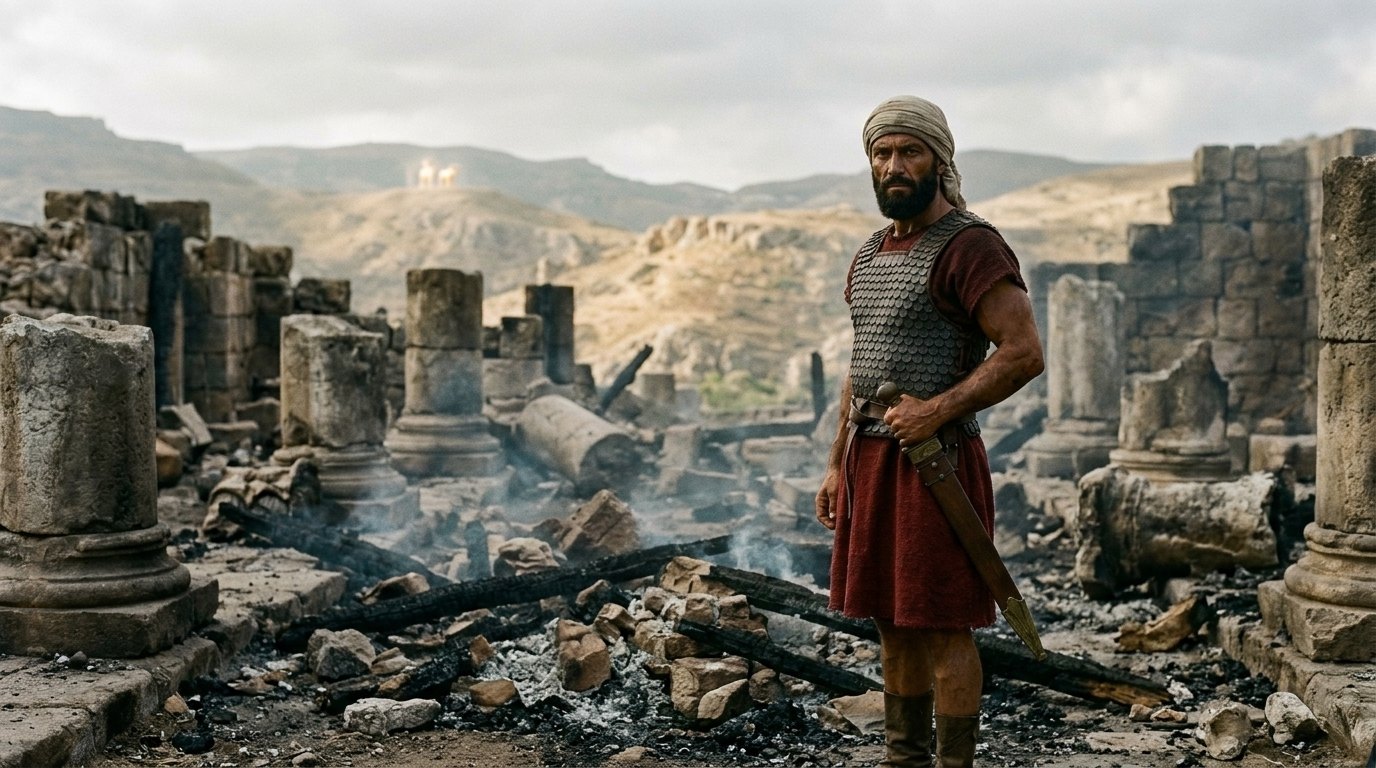
2 Kings 10:28-31
28 So Jehu destroyed Baal worship in Israel.
29 However, he did not turn away from the sins of Jeroboam son of Nebat, which he had caused Israel to commit—the worship of the golden calves at Bethel and Dan.
30 The LORD said to Jehu, “Because you have done well in accomplishing what is right in my eyes and have done to the house of Ahab all I had in mind to do, your descendants will sit on the throne of Israel to the fourth generation.”
31 Yet Jehu was not careful to keep the law of the LORD, the God of Israel, with all his heart. He did not turn away from the sins of Jeroboam, which he had caused Israel to commit.
New International Version (NIV)
The answer
Jehu was an Israelite army commander whom God raised up to rule the northern kingdom of Israel and execute judgment on Ahab’s dynasty. He is identified as “Jehu the son of Jehoshaphat the son of Nimshi,” and he reigned in Samaria for twenty-eight years (2 Kings 9:2; 2 Kings 10:36).
His rise and actions
- Anointed at God’s command: God had earlier told Elijah that Jehu would become king and would act against the evil associated with Ahab’s reign (1 Kings 19:16-17). Elisha later sent a prophet to anoint Jehu privately, commissioning him to strike Ahab’s house and avenge the blood of God’s servants shed through Jezebel (2 Kings 9:1-10).
- Overthrow of Ahab’s house: Jehu killed King Joram, had Jezebel thrown down, and brought about the destruction of Ahab’s family and supporters. Ahaziah king of Judah was also killed during Jehu’s revolt. The narrative explicitly connects these events with God’s earlier word through Elijah (2 Kings 9:24-37; 2 Kings 10:1-17).
- Destruction of Baal worship: Jehu deceptively assembled Baal’s prophets, priests and worshippers, had them killed, burned the sacred pillars, and demolished Baal’s temple. The decisive summary is: “Thus Jehu destroyed Baal out of Israel” (2 Kings 10:18-28).
God’s assessment of him
Jehu’s record combines real obedience with serious, continuing disobedience. God commended him for executing judgment on Ahab’s house and promised that his descendants would occupy Israel’s throne to the fourth generation (2 Kings 10:30).
Yet Jehu did not remove Jeroboam’s golden calves at Bethel and Dan. Although zealous against Baal, he did not take care to walk in God’s law with all his heart (2 Kings 10:29-31). His reign also saw Hazael take Israelite territory, and Jehu was eventually succeeded by his son Jehoahaz (2 Kings 10:32-35).
His life therefore shows that zeal against one form of idolatry is not the same as wholehearted obedience to God.
Answered from Scripture · reviewed November 25, 2026
Jehu's Rise, Reign and Record
Read from top to bottom: Jehu's story moves from God's word to Elijah, through judgment on Ahab's house and Baal, to God's mixed verdict on his reign.
- God names Jehu (Elijah's day) · God tells Elijah that Jehu will be king and will act against the evil of Ahab's reign. · 1 Kings 19:16-17
- Anointed king (Start of reign) · Elisha sends a prophet to anoint Jehu privately and commission him against Ahab's house. · 2 Kings 9:1-10
- Joram and Ahaziah fall (Start of reign) · Jehu kills King Joram. Ahaziah king of Judah is also killed in the revolt. · 2 Kings 9:24-29
- Jezebel thrown down (Start of reign) · Jezebel's end fulfils God's earlier word through Elijah. · 2 Kings 9:30-37
- Ahab's house ended (Start of reign) · Ahab's family and supporters are destroyed, as the Lord had spoken. · 2 Kings 10:1-17
- Baal destroyed (Early reign) · Baal's worshippers are killed, the pillars burned and the temple demolished. · 2 Kings 10:18-28
- Golden calves kept (Through his reign) · Jehu leaves Jeroboam's calves at Bethel and Dan and does not walk in God's law wholeheartedly. · 2 Kings 10:29-31
- God's promise (Through his reign) · He is commended for judging Ahab's house. His sons will reign to the fourth generation. · 2 Kings 10:30
- Hazael takes land (Later reign) · Hazael takes Israelite territory during Jehu's reign. · 2 Kings 10:32-33
- Jehoahaz succeeds (After 28 years) · Jehu reigned in Samaria twenty-eight years, and his son Jehoahaz followed him. · 2 Kings 10:35-36
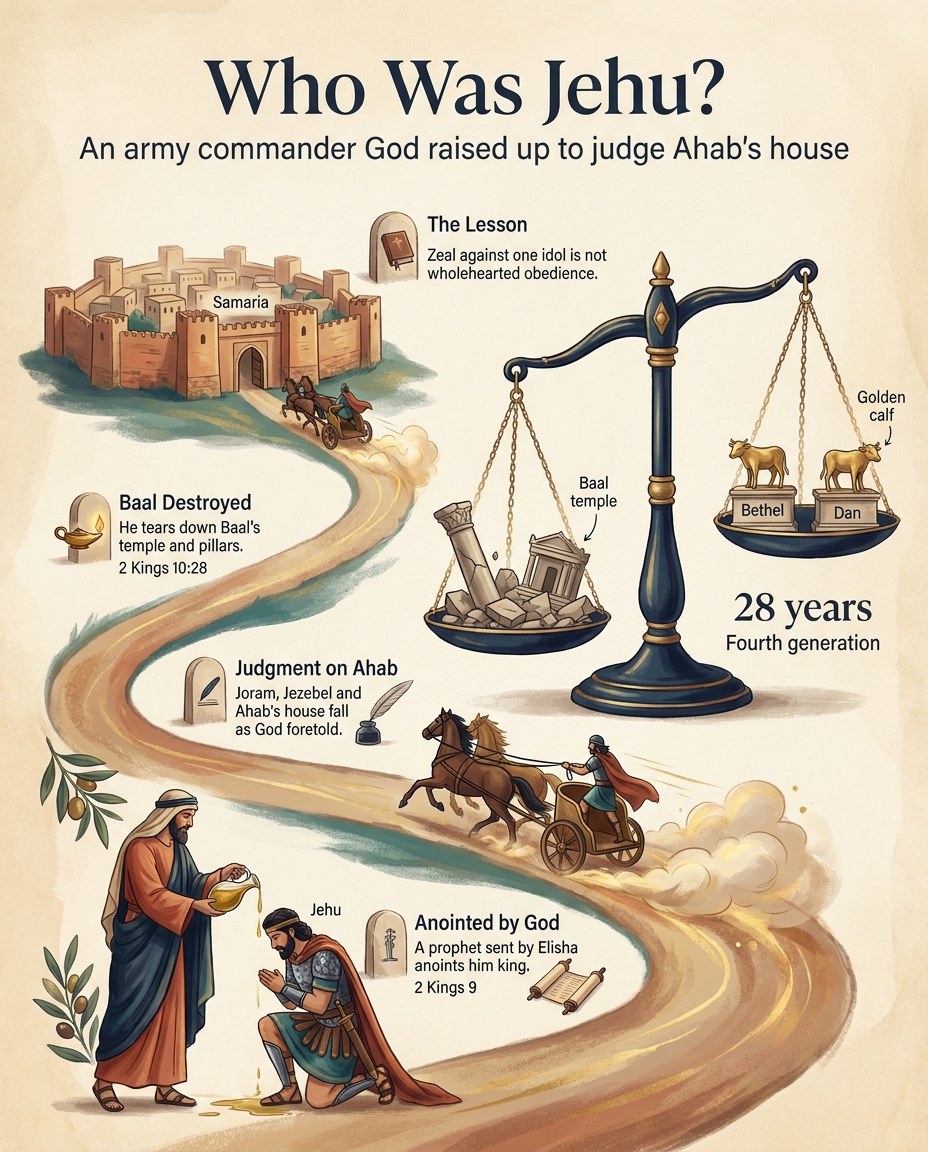
Jehu was a military commander anointed king over the northern kingdom of Israel to execute divine judgment against the idolatrous house of Ahab. His fierce reign eradicated Baal worship from Samaria, yet his failure to turn from the state-sponsored sins of Jeroboam left an enduring warning about partial obedience.
Divine Commission
Anointed to Avenge the Blood of the Prophets
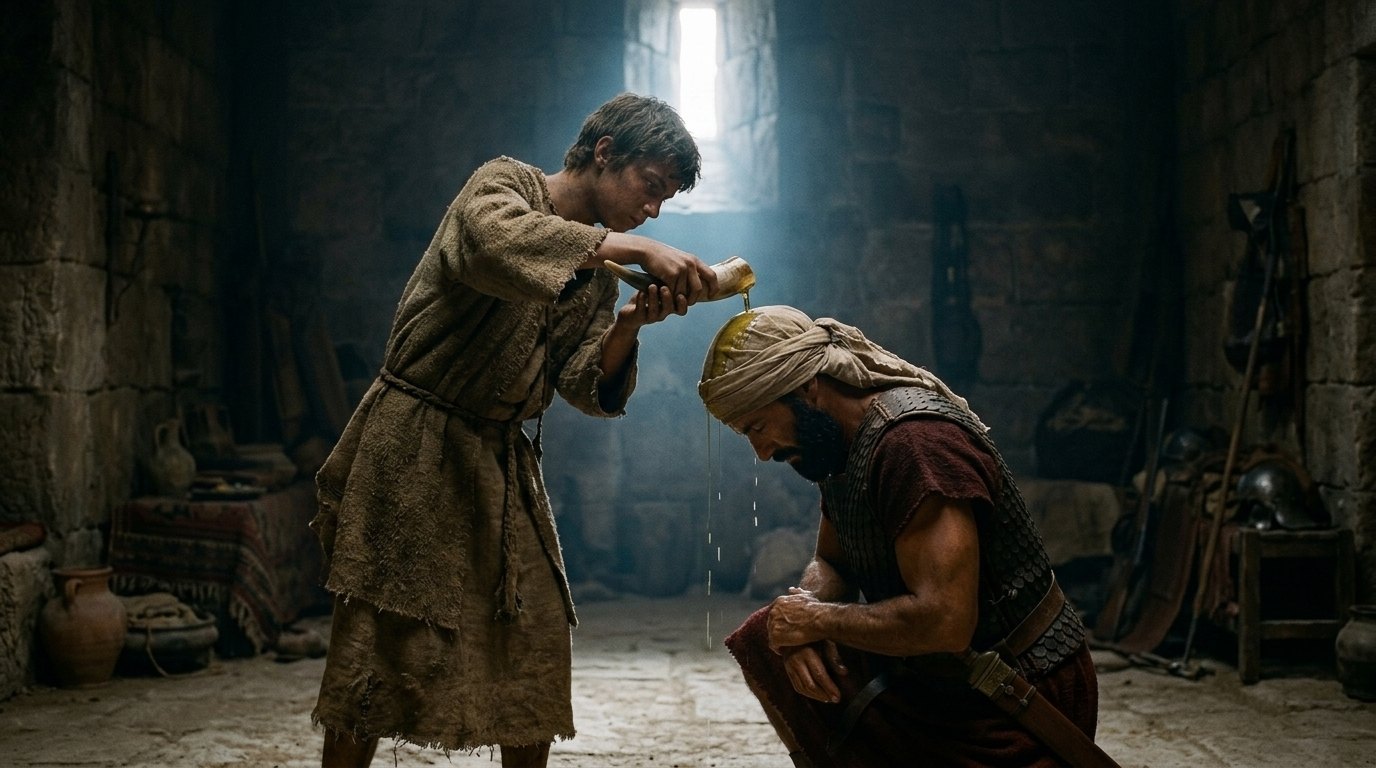
Jehu got up and went into the house. Then the prophet poured the oil on Jehu’s head and declared, “This is what the LORD, the God of Israel, says: ‘I anoint you king over the LORD’s people Israel. You are to destroy the house of Ahab your master, and I will avenge the blood of my servants the prophets and the blood of all the LORD’s servants shed by Jezebel.
2 Kings 9:6-7 (NIV)
The prophet's private anointing of Jehu specifies his exact mandate to eradicate Ahab's royal dynasty and avenge God's murdered servants.
In 2 Kings 9:6-7, the prophetic word delivered in secret cuts through all earthly pretense: the Lord God of Israel anoints Jehu king over the people of the Lord, explicitly commanding him to strike down the house of Ahab his master so that God may avenge the blood of His servants the prophets. This commission was neither a rash human coup nor an unexpected turn of military ambition; decades earlier at Mount Horeb, the Lord had already instructed Elijah in 1 Kings 19:16-17 to anoint Jehu the son of Nimshi king over Israel as an instrument of divine judgment against unrepentant idolatry.
The appointed hour arrives when Elisha summons a young prophet in 2 Kings 9:1-3, directing him to take a flask of oil to Ramoth-gilead, locate Jehu among his fellow commanders, lead him to an inner room, and anoint him king before fleeing without delay. Obedient to the task, the young man seeks out Jehu in 2 Kings 9:4-10, pours the oil upon his head, and delivers the full weight of the divine mandate: Ahab’s dynasty will perish like the house of Jeroboam, and Jezebel will be consumed by dogs in Jezreel with none to bury her.
When Jehu steps back out to the commanders of the army, they press him to reveal the message of the wild visitor, as recorded in 2 Kings 9:11-13. The moment Jehu discloses that the Lord has anointed him king over Israel, the officers waste no time; each man strips off his cloak to spread it under Jehu’s feet upon the bare steps, and blowing the trumpet, they proclaim his sovereign rise.
| Passage | What it says |
|---|---|
| 1 Kings 19:16-17 | The Lord instructs Elijah at Mount Horeb to anoint Jehu king over Israel as an instrument of divine judgment. |
| 2 Kings 9:1-3 | Elisha dispatches a young prophet to Ramoth-gilead to secretly anoint Jehu the son of Jehoshaphat. |
| 2 Kings 9:4-10 | The young prophet pours oil on Jehu's head, declaring God's vengeance on Jezebel and the total destruction of Ahab's house. |
| 2 Kings 9:11-13 | Jehu's fellow officers hear the prophet's message, blow trumpets, and proclaim Jehu king. |
Judicial Purge
The Downfall of Ahab's Corrupt Dynasty
Jehu said to Bidkar, his chariot officer, “Pick him up and throw him on the field that belonged to Naboth the Jezreelite. Remember how you and I were riding together in chariots behind Ahab his father when the LORD spoke this prophecy against him: ‘Yesterday I saw the blood of Naboth and the blood of his sons, declares the LORD, and I will surely make you pay for it on this plot of ground, declares the LORD.’ Now then, pick him up and throw him on that plot, in accordance with the word of the LORD.”
2 Kings 9:25-26 (NIV)
Jehu directly connects his execution of King Joram to the prophecy spoken against Ahab's bloodguilt in Naboth's vineyard.
Standing over the freshly slain body of King Joram in 2 Kings 9:25-26, Jehu commands his officer Bidkar to cast the corpse onto the plot of ground that belonged to Naboth the Jezreelite, expressly citing the oracle spoken by the Lord: surely I have seen yesterday the blood of Naboth and the blood of his sons, and I will repay you on this plot. The righteous vengeance long delayed was now being systematically applied to Ahab's wicked line.
Jehu moves with relentless velocity in 2 Kings 9:14-24, driving his chariot furiously across the plain toward Jezreel until Joram rides out to meet him; with a single drawn bow, Jehu shoots an arrow directly between Joram's shoulders, piercing his heart. The purge widens immediately in 2 Kings 9:27-29 as Jehu pursues King Ahaziah of Judah, an ally bound by marriage to Ahab's court, striking him down near Ibleam; 2 Chronicles 22:7-9 confirms that Ahaziah's ruin was ordained by God through Jehu's hand.
Arriving at the royal palace in 2 Kings 9:30-37, Jehu confronts Jezebel as she looks down from an upper window, ordering her eunuchs to cast her down; she is trampled beneath the horses, and when men go to bury her, only her skull, feet, and palms remain, fulfilling Elijah’s exact words. The purge culminates in 2 Kings 10:1-11 when the elders of Samaria, terrified by Jehu's letters, decapitate seventy sons of Ahab and stack their heads in two heaps at Jezreel's gate, followed by the slaughter of forty-two royal kinsmen of Ahaziah and the final remnant of Ahab’s loyalists in 2 Kings 10:12-17 alongside Jehonadab the son of Rechab.
| Passage | What it says |
|---|---|
| 2 Kings 9:14-24 | Jehu rides furiously toward Jezreel and executes King Joram with an arrow through the heart. |
| 2 Kings 9:27-29 | Jehu pursues and fatally wounds King Ahaziah of Judah, an ally and relative of the house of Ahab. |
| 2 Kings 9:30-37 | Jehu orders Jezebel thrown down from her window, fulfilling Elijah's prophecy that dogs would consume her flesh. |
| 2 Kings 10:1-11 | Samaria's leaders behead Ahab's seventy sons at Jehu's command, completely eradicating Ahab's remaining royal seed. |
| 2 Kings 10:12-17 | Jehu slaughters forty-two relatives of Ahaziah and joins with Jehonadab to wipe out Ahab's remaining supporters in Samaria. |
| 2 Kings 9:25-26 | Jehu commands Bidkar to throw Joram's corpse onto Naboth's plot, recalling the Lord's oracle against Ahab. |
| 2 Chronicles 22:7-9 | Chronicles records Ahaziah's downfall by Jehu as ordained by God, executing judgment upon Ahab's house. |
Religious Cleansing
The Ruthless Extermination of Baal Worship
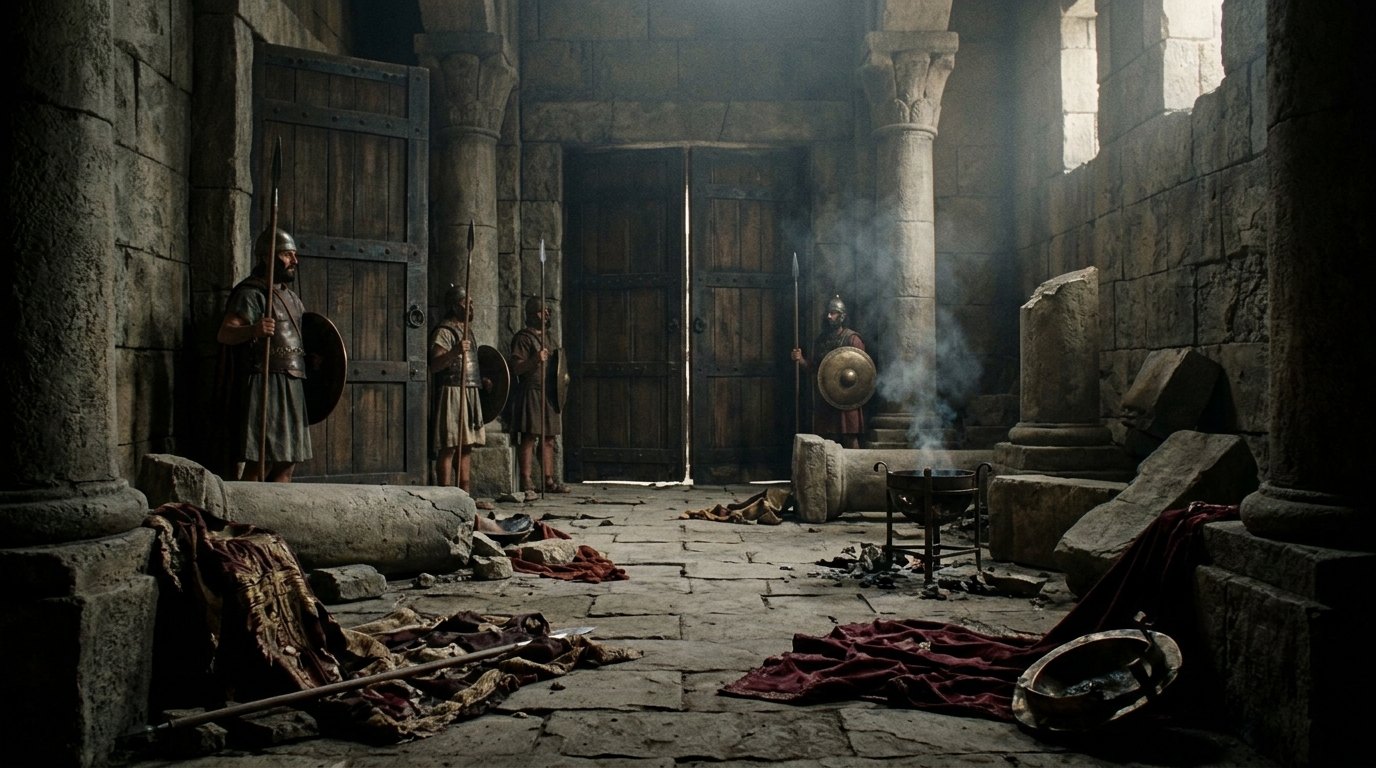
So Jehu destroyed Baal worship in Israel.
2 Kings 10:28 (NIV)
This decisive summary sentence records the permanent uprooting of the Phoenician Baal cult from Israel.
The inspired historian records the sweeping outcome of Jehu’s campaign in 2 Kings 10:28: thus Jehu eradicated Baal out of Israel. With calculated strategy and unwavering resolve, the foreign idolatry that had infected the northern kingdom under Ahab and Jezebel was violently stripped of its temples, its priests, and its public influence across the land.
To achieve this total eradication, Jehu employs an elaborate ruse in 2 Kings 10:18-24, proclaiming to the people that while Ahab served Baal a little, Jehu would serve him much. Summoning every prophet, priest, and devotee of Baal throughout the territories of Israel under penalty of death, Jehu fills the grand temple of Baal from one end to the other, even providing sacred vestments so that no worshipper remains indistinguishable. He verifies with scrupulous care that not a single servant of the Lord is mixed among the crowd, ensuring that only the devoted adherents of the pagan deity stand within the sanctuary.
Once the burnt offerings commence, the judgment falls with absolute finality in 2 Kings 10:25-27. Jehu posts eighty trusted guards and officers at the temple doors, commanding them to strike down every man without letting a single soul escape. Entering the inner shrine of the temple of Baal, the soldiers drag out the sacred wooden pillars and burn them to ashes, shatter the central stone pillar of Baal, tear the entire temple complex to the ground, and turn the site into a public latrine that stood as a permanent monument of disgrace.
| Passage | What it says |
|---|---|
| 2 Kings 10:18-24 | Jehu devises a ruse claiming devotion to Baal to assemble all Baal's prophets, priests, and worshippers inside their temple. |
| 2 Kings 10:25-27 | Jehu's guards strike down the worshippers, burn the sacred pillars, and turn the house of Baal into a latrine. |
| 2 Kings 10:28 | A summary declaration that Jehu wiped out the worship of Baal entirely from the land of Israel. |
Scriptural Assessment
A Limited Dynasty and an Incomplete Heart
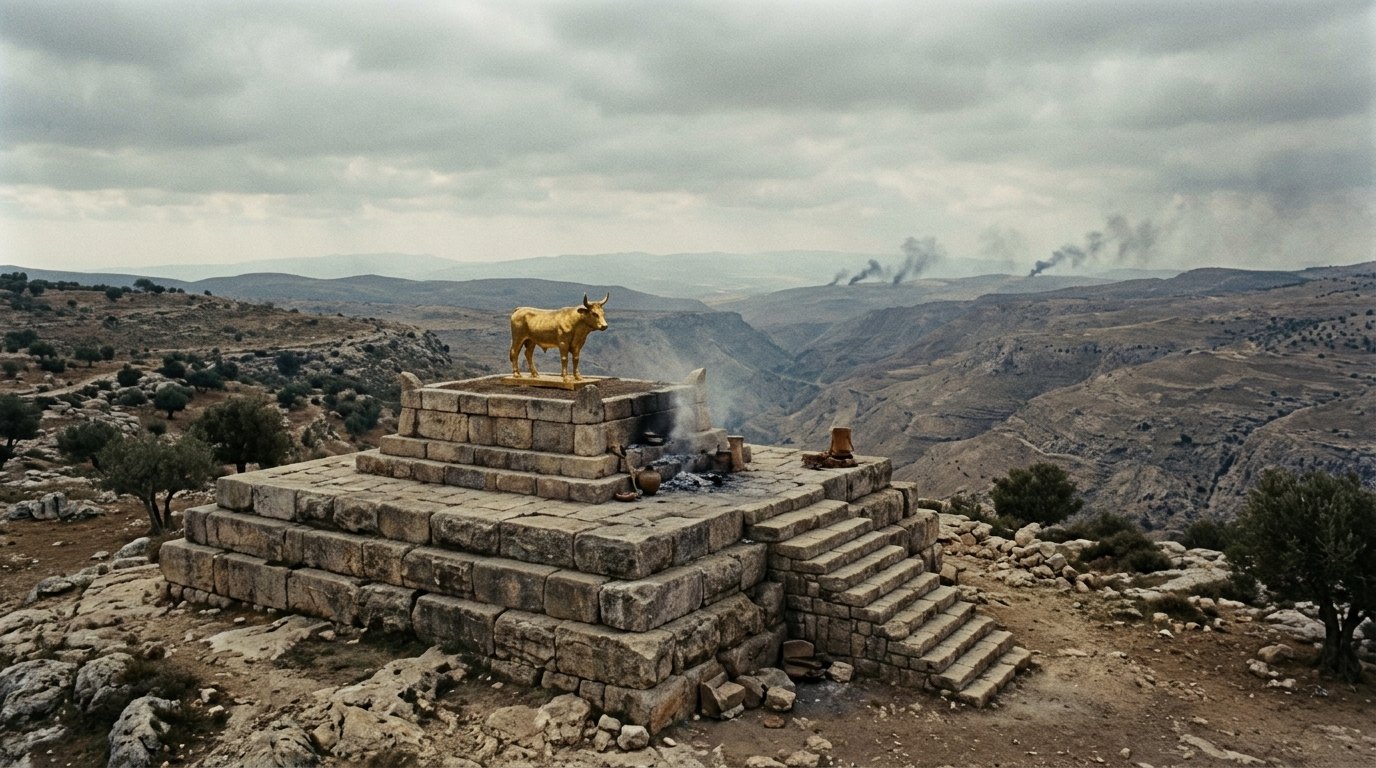
The LORD said to Jehu, “Because you have done well in accomplishing what is right in my eyes and have done to the house of Ahab all I had in mind to do, your descendants will sit on the throne of Israel to the fourth generation.” Yet Jehu was not careful to keep the law of the LORD, the God of Israel, with all his heart. He did not turn away from the sins of Jeroboam, which he had caused Israel to commit.
2 Kings 10:30-31 (NIV)
God commends Jehu's execution of judgment with a four-generation promise while convicting him of clinging to Jeroboam's golden calves.
Scripture balances divine commendation with sober indictment in 2 Kings 10:30-31, where the Lord acknowledges that Jehu did well in carrying out what was right in God’s eyes against the house of Ahab, promising that his descendants would sit on the throne of Israel to the fourth generation; yet the verse immediately records the tragedy of his spiritual life: Jehu took no heed to walk in the law of the Lord God of Israel with all his heart.
While Jehu had shattered the Phoenician cult of Baal, he stubbornly clung to the domestic political religion of the northern kingdom; as 2 Kings 10:29 specifies, he did not depart from the sins of Jeroboam the son of Nebat, preserving the golden calves at Bethel and Dan to safeguard his crown from southern pilgrimage. Because of this divided heart and unrepented sin, judgment pressed against the realm during his twenty-eight-year reign, recorded in 2 Kings 10:34-36; according to 2 Kings 10:32-33, Hazael of Aram carved away Israel’s borders, conquering the entire eastern territory of Gilead and Bashan.
Centuries later, the prophetic verdict remained exacting: through the prophet in Hosea 1:4-5, the Lord announced that He would visit the blood of Jezreel upon the house of Jehu and shatter Israel's bow in the valley of Jezreel, demonstrating that God weighs the inward motives and excesses of human vengeance. The dynastic promise of four generations was brought to its exact, sober completion in 2 Kings 15:8-12, when Jehu’s great-great-grandson Zechariah was struck down after reigning only six months, bringing Jehu's royal line to its appointed end just as the word of the Lord had spoken.
| Passage | What it says |
|---|---|
| 2 Kings 10:29 | Jehu refuses to turn away from the golden calves at Bethel and Dan established by Jeroboam. |
| 2 Kings 10:32-33 | Hazael king of Aram curtails Israel's borders during Jehu's reign, taking all the land of Gilead and Bashan. |
| 2 Kings 10:34-36 | Jehu reigns twenty-eight years in Samaria before dying, leaving the throne to his son Jehoahaz. |
| Hosea 1:4-5 | The Lord declares through Hosea that He will punish the house of Jehu for the bloodshed of Jezreel. |
| 2 Kings 10:30-31 | The Lord promises Jehu four generations on Israel's throne, yet notes he did not turn from Jeroboam's sins. |
| 2 Kings 15:8-12 | The fulfilment of God's promise to Jehu when his fourth-generation descendant Zechariah is assassinated. |
Where in the Bible
| Book | Passages |
|---|---|
| 1 Kings | 1 · 1 Kings 19:16-17 |
| 2 Kings | 17 · 2 Kings 9:1-3, 2 Kings 9:4-10, 2 Kings 9:11-13, 2 Kings 9:14-24, 2 Kings 9:27-29, 2 Kings 9:30-37, 2 Kings 10:1-11, 2 Kings 10:12-17, 2 Kings 9:25-26, 2 Kings 10:18-24, 2 Kings 10:25-27, 2 Kings 10:28, 2 Kings 10:29, 2 Kings 10:32-33, 2 Kings 10:34-36, 2 Kings 10:30-31, 2 Kings 15:8-12 |
| 2 Chronicles | 1 · 2 Chronicles 22:7-9 |
| Hosea | 1 · Hosea 1:4-5 |
The story in order
- Elijah anoints Jehu (c. 850 BC) · 1 Kings 19:16-17 · God commissions Jehu as an instrument of judgment against Ahab's house.
- Jehu proclaimed king (c. 841 BC) · 2 Kings 9:11-13 · Jehu's officers recognize his divine appointment and declare him king.
- Judgment on Joram and Ahaziah (c. 841 BC) · 2 Kings 9:14-29 · Jehu executes the kings of Israel and Judah, fulfilling prophecy.
- Jezebel's downfall (c. 841 BC) · 2 Kings 9:30-37 · Jezebel is killed, fulfilling Elijah's prophecy.
- Destruction of Ahab's sons (c. 841 BC) · 2 Kings 10:1-11 · Jehu eradicates the remaining royal seed of Ahab.
- Extermination of Baal worship (c. 841 BC) · 2 Kings 10:18-28 · Jehu ruthlessly destroys Baal worship in Israel.
- Jehu's partial obedience (c. 841 BC) · 2 Kings 10:29 · Jehu fails to remove the golden calves, continuing Jeroboam's sin.
- Territorial losses (c. 841 BC) · 2 Kings 10:32-33 · Hazael conquers parts of Israel during Jehu's reign.
- Jehu's death (c. 814 BC) · 2 Kings 10:34-36 · Jehu reigns for 28 years and is succeeded by his son.
- Judgment on Jehu's house (c. 750 BC) · Hosea 1:4-5 · God declares punishment for the bloodshed of Jezreel.
- Promise fulfilled (c. 753 BC) · 2 Kings 15:8-12 · Jehu's fourth-generation descendant is assassinated, ending the dynasty.
Key words
- Jehu (יֵהוּ (Yēhû))
- He who is Yahweh · 2 Kings 9:1-13
- Judgment (מִשְׁפָּט (mišpāṭ))
- Divine sentence or punishment upon sin · 1 Kings 19:16-17
- Idolatry (עֲבֹדָה זָרָה (ʿăḇōḏâ zārâ))
- Worship of false gods · 2 Kings 10:18-28
- Partial Obedience (Not a direct Hebrew/Greek term, but a concept)
- Obeying some commands but neglecting others · 2 Kings 10:29-31
Jehu's life reminds the believer that fierce outward zeal against prominent evils cannot substitute for sincere, wholehearted walking in God's commands. While the Lord faithfully keeps His promises and uses even flawed instruments to accomplish His purposes, true devotion requires clinging to Him with an undivided heart.
20 passages, each cited once.
Scripture cited
- 2 Kings 9:1-14
- 2 Kings 10:1-36
- 1 Kings 19:15-18
- 2 Kings 9:14-37