What does the Bible say about Gaza?
Amos 1:6-7
6 This is what the LORD says: “For three sins of Gaza, even for four, I will not relent. Because she took captive whole communities and sold them to Edom,
7 I will send fire on the walls of Gaza that will consume her fortresses.
New International Version (NIV)
The answer
Gaza was a Philistine city, a setting for Samson’s conflict with the Philistines, a city judged by God for capturing and handing over an entire community, and the destination of the desert road where Philip preached Jesus to the Ethiopian official. Its biblical history contains both God’s judgment on oppression and His grace reaching people beyond Israel.
Gaza in Israel’s history
- One of the Philistine cities: Gaza is listed alongside Ashdod, Ashkelon, Gath and Ekron when the Philistines made their trespass offering to the Lord (1 Samuel 6:17).
- Samson and the city gates: When the Gazites surrounded Samson and planned to kill him in the morning, he arose at midnight, tore up the city gates and carried them away (Judges 16:1-3).
- Samson’s imprisonment and death: Later, the Philistines blinded Samson, bound him and forced him to grind in a Gaza prison. When their rulers gathered to honour Dagon, Samson prayed for strength and pulled down the central pillars. The house collapsed, killing him and the assembled Philistines (Judges 16:21-31).
God’s judgment on Gaza
Amos 1:6-7 names both Gaza’s crime and its punishment. Gaza had “carried away captive the whole community, to deliver them up to Edom.” This was violent mass captivity and deportation: human beings seized and handed over as spoils. God’s sentence was, “I will send a fire on the wall of Gaza, and it will devour its palaces.”
Other prophets announce related judgments:
- Jeremiah 47:1-7 describes an overwhelming invasion against the Philistines, with Gaza mourning and shaving its head in grief.
- Zephaniah 2:4-7 declares that Gaza will be forsaken, while the coast will eventually become pasture for the restored remnant of Judah.
- Zechariah 9:5-8 foretells agony for Gaza, the loss of its king and the cutting off of Philistine pride.
Yet judgment is not Zechariah’s final word. Within that same passage, God says of the Philistines, “he also will be a remnant for our God” (Zechariah 9:7). God would judge idolatry and oppression, but He also spoke of a remnant belonging to Him.
The gospel on the road to Gaza
The New Testament’s Gaza scene is strikingly different. An angel directed Philip toward “the way that goes down from Jerusalem to Gaza,” identifying it as a desert road (Acts 8:26). There Philip met an Ethiopian official reading Isaiah. Beginning with that Scripture, Philip “preached to him about Jesus,” baptized him at his request, and the official continued his journey rejoicing (Acts 8:26-40).
These prophecies concern the ancient Philistine power and its crimes. They do not make every present-day resident of Gaza guilty of those sins, nor do they commission anyone today to attack Gaza in God’s name. Amos gives God’s verdict on oppression; Acts shows the saving message of Christ crossing national and ethnic boundaries.
Answered from Scripture · reviewed November 25, 2026
Gaza Through the Pages of Scripture
Read from top to bottom. Gaza's story moves from Philistine stronghold and God's judgment on its oppression to the desert road where Christ was preached to an Ethiopian.
- Samson carries off Gaza's gates (Time of the Judges) · Surrounded by the Gazites, Samson rose at midnight, tore up the city gates and carried them away. · Judges 16:1-3
- Samson's prison and death in Gaza (Time of the Judges) · Blinded and made to grind in prison, Samson prayed for strength and brought down Dagon's house. · Judges 16:21-31
- Gaza among the Philistine cities (Days of Samuel) · Gaza is listed with Ashdod, Ashkelon, Gath and Ekron in the trespass offering to the Lord. · 1 Samuel 6:17
- Amos names Gaza's crime (Days of Amos) · Gaza carried a whole community captive to Edom. God sends fire on its wall and palaces. · Amos 1:6-7
- Zephaniah: Gaza forsaken (Days of Zephaniah) · Gaza will be forsaken, and the coast will become pasture for Judah's restored remnant. · Zephaniah 2:4-7
- Jeremiah: invasion and mourning (Days of Jeremiah) · An overwhelming invasion against the Philistines leaves Gaza shaving its head in grief. · Jeremiah 47:1-7
- Zechariah: judgment and a remnant (Days of Zechariah) · Gaza loses its king and Philistine pride is cut off, yet a remnant will belong to God. · Zechariah 9:5-8
- The gospel on the Gaza road (The early church) · Philip preached Jesus to the Ethiopian official from Isaiah and baptized him. The man went on rejoicing. · Acts 8:26-40
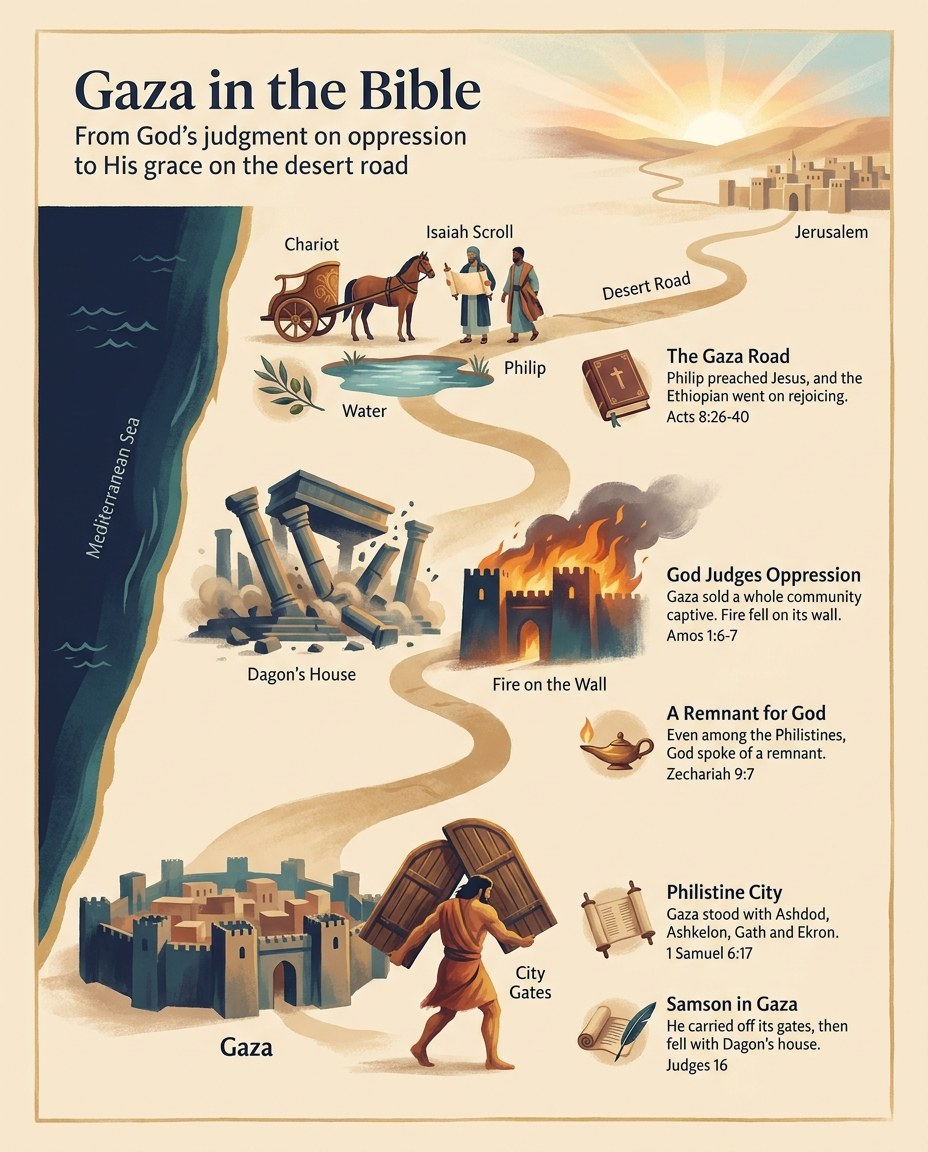
Scripture mentions Gaza from the earliest patriarchal records down to the apostolic mission, marking it as a strategic stronghold on the southern coast of Canaan. It stands in the biblical record as a center of Philistine resistance against Israel, the theater of Samson's final triumph, a recipient of solemn prophetic judgment for human trafficking, and finally the desert route where the gospel advanced toward Africa.
Ancient Boundaries
Gaza Marks the Edge of Canaan
and the borders of Canaan reached from Sidon toward Gerar as far as Gaza, and then toward Sodom, Gomorrah, Admah and Zeboyim, as far as Lasha.
Genesis 10:19 (NIV)
This verse establishes Gaza as the historic southwestern boundary mark of the Canaanite territory from the earliest post-flood generations.
The earliest post-flood record in Genesis 10:19 establishes Gaza as the defining southwestern boundary of Canaan, marking the outer reach of ancient territories before the desert sands took over. Moses reminded Israel that the Caphtorim displaced the Avvim living in villages as far as Gaza (Deuteronomy 2:23), signaling how this coastal hub remained a prized possession long before Joshua's campaign. During the conquest of the Promised Land, Joshua struck the territory from Kadesh-barnea as far as Gaza (Joshua 10:41), yet the campaign left fearsome enclaves untouched: the formidable Anakim survived only in Gaza, Gath, and Ashdod (Joshua 11:22). Consequently, when Joshua divided the land, Gaza was numbered among the five Philistine lordships that remained unconquered (Joshua 13:3), even though the sovereign tribal inheritance allotted Gaza with its peripheral towns to Judah (Joshua 15:47). The early judges saw Judah briefly take Gaza and its surrounding territory (Judges 1:18), but Israel struggled to maintain control against regional marauders. Generations later, the devastating Midianite swarms stripped the land bare of all sustainment, leaving no sustenance for Israel as far as Gaza (Judges 6:4). Across these foundational centuries, Gaza stood consistently as the contested horizon where Canaanite strongholds met the encroaching inheritance of God's chosen people.
| Passage | What it says |
|---|---|
| Genesis 10:19 | Records the Canaanite border extending from Sidon toward Gerar as far as Gaza. |
| Deuteronomy 2:23 | Notes that the Caphtorim destroyed the Avvim who lived in settlements as far as Gaza. |
| Joshua 10:41 | Describes Joshua conquering territory from Kadesh-barnea as far as Gaza. |
| Joshua 11:22 | States that Anakim remained only in Gaza, Gath, and Ashdod after the conquest. |
| Joshua 13:3 | Lists the Gazite among the five rulers of the Philistines in unconquered land. |
| Joshua 15:47 | Allots Gaza with its towns and villages to the tribe of Judah. |
| Judges 1:18 | Records Judah taking Gaza with its territory during the early tribal conquests. |
| Judges 6:4 | Describes Midianite invaders ravaging the crops of the land as far as Gaza. |
Samson and Philistia
Samson Breaks Gaza's Gates and Shakes Its Temple
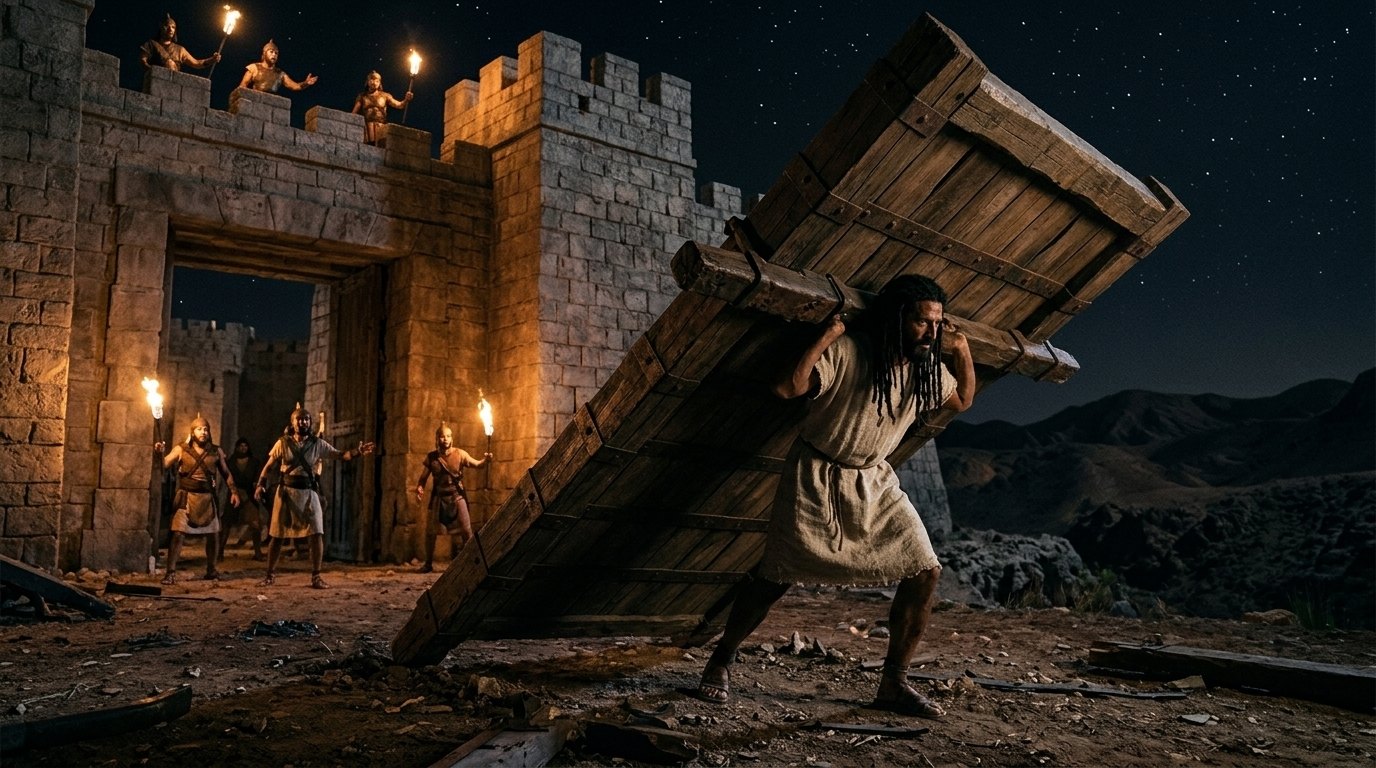
But Samson lay there only until the middle of the night. Then he got up and took hold of the doors of the city gate, together with the two posts, and tore them loose, bar and all. He lifted them to his shoulders and carried them to the top of the hill that faces Hebron.
Judges 16:3 (NIV)
Samson tears Gaza's massive gates from their hinges, exposing the city's vulnerability and demonstrating the Spirit's supernatural power.
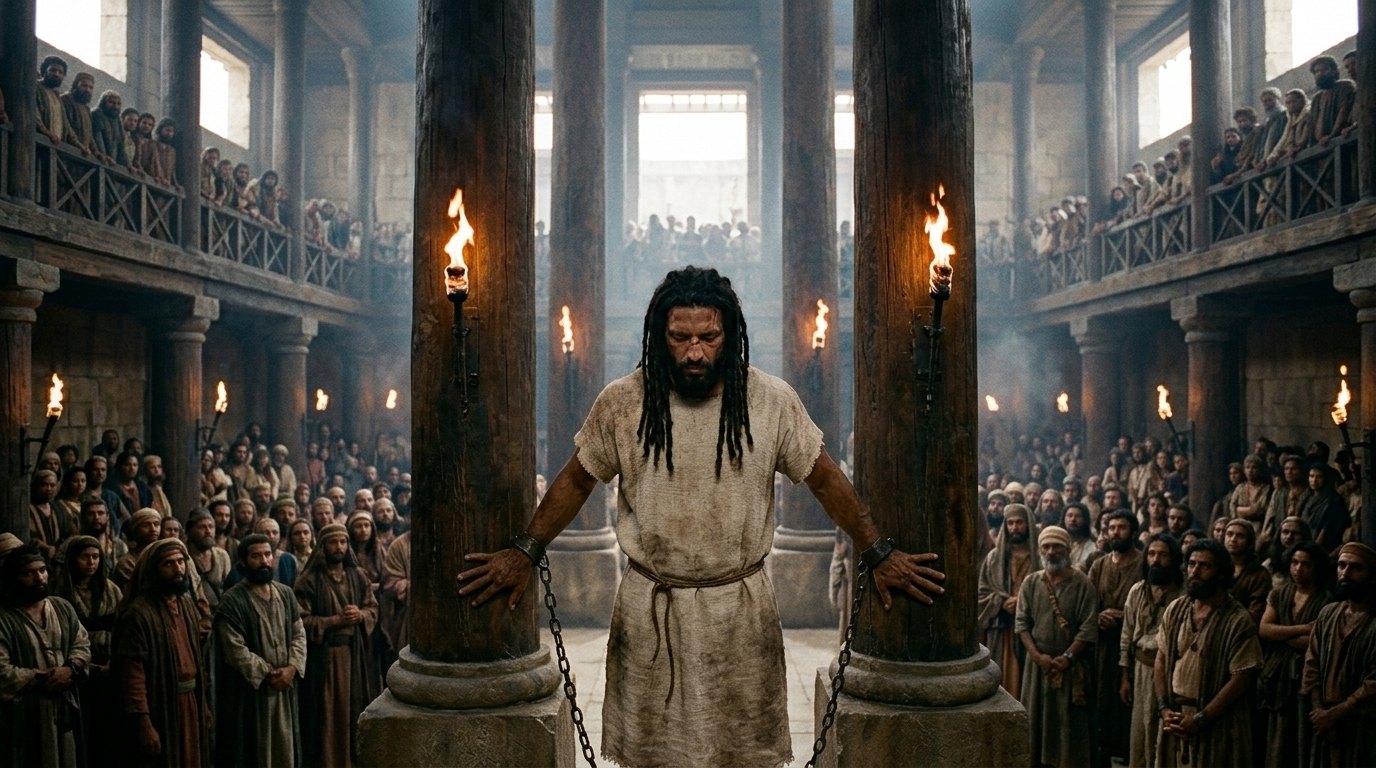
Judges exposes Gaza as the brutal theater of Israel's clash with Philistia, where spiritual compromise and divine deliverance met in the life of Samson. His fateful visit to a prostitute in Gaza (Judges 16:1) prompted the Philistines to surround the city gate, plotting to murder him at dawn (Judges 16:2). Yet at midnight, the Spirit empowered Samson to tear Gaza's massive gates, posts, and bar clean out of the ground, hoisting them upon his shoulders up to the hill facing Hebron (Judges 16:3), exposing the city's helpless vulnerability. When Delilah finally betrayed his secret, the Gazites bound the weakened judge, gouged out his eyes, and led him down to their prison to grind grain at the mill (Judges 16:21). Their triumph culminated in a grand idolatrous assembly, where the Philistine lords gathered in Gaza to offer sacrifice to Dagon their god (Judges 16:23) and brought the blinded warrior forth to mock him (Judges 16:25). Placed between the central supports, Samson grasped the two middle pillars holding up the temple roof (Judges 16:29), crying out to God for strength. With a final surge of divine power, Samson brought down the entire edifice, killing more enemies of the Lord in his death than in all his life (Judges 16:30).
| Passage | What it says |
|---|---|
| Judges 16:1 | Records Samson entering Gaza and visiting a prostitute there. |
| Judges 16:2 | Describes the men of Gaza surrounding the place to kill Samson at dawn. |
| Judges 16:3 | Recounts Samson carrying away the city gates, posts, and bar to Hebron. |
| Judges 16:21 | States the Philistines seized Samson, gouged out his eyes, and imprisoned him in Gaza. |
| Judges 16:23 | Records the Philistine lords gathering in Gaza to offer sacrifice to Dagon. |
| Judges 16:25 | Relates how the Philistines brought Samson out of prison to entertain them. |
| Judges 16:29 | Shows Samson grasping the two middle pillars supporting the roof in Gaza. |
| Judges 16:30 | Describes Samson bringing down the temple, killing more in his death than in life. |
Kingdom Conflicts
Gaza Yields to the God of Israel
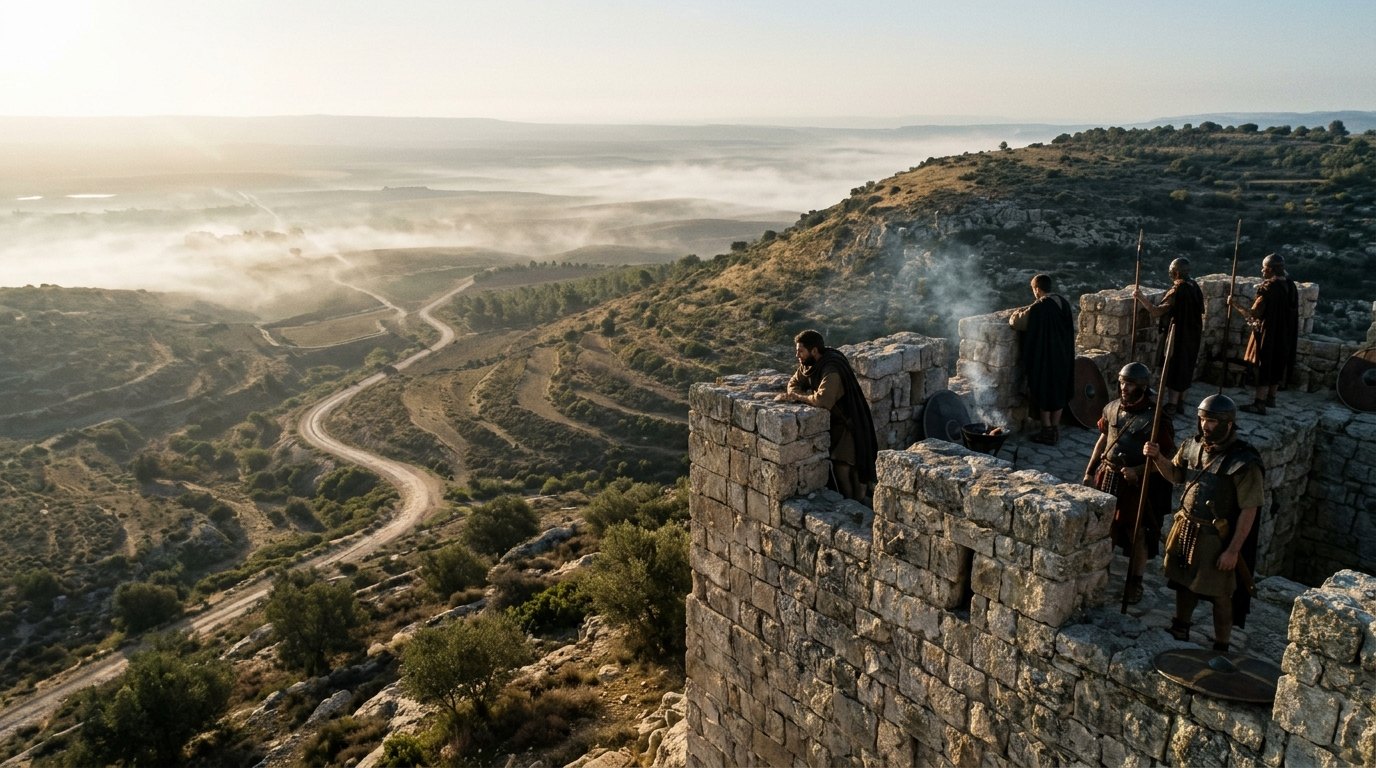
These are the gold tumors the Philistines sent as a guilt offering to the LORD—one each for Ashdod, Gaza, Ashkelon, Gath and Ekron.
1 Samuel 6:17 (NIV)
The Philistines send a guilt offering to Yahweh for Gaza, acknowledging His hand upon their plague after seizing the ark.
When Philistia captured the ark of the covenant, the resulting plagues forced the pagan rulers to acknowledge the supremacy of Israel's God. In 1 Samuel 6:17, the lords of Philistia returned the ark alongside a solemn guilt offering of golden tumors, including one golden tumor for Gaza, openly confessing Yahweh's judgment upon their five confederate cities. Decades later, God granted Solomon wide dominion over all the kingdoms west of the Euphrates, establishing his peaceful borders as far south as Gaza (1 Kings 4:24). Although Philistine incursions surged during the apostasy of King Ahaz, when they raided the foothills and seized towns across southern Judah (2 Chronicles 28:18), faithful leadership under Hezekiah restored Israel's borders. Trusting in the Lord, Hezekiah struck down the Philistines as far as Gaza and its territory, conquering everything from isolated watchtowers to fortified cities (2 Kings 18:8). Gaza thus stood as a barometer of Israel's covenant fidelity: whenever God's kings walked uprightly, the Philistine stronghold yielded before the power of the living God.
| Passage | What it says |
|---|---|
| 1 Samuel 6:17 | Lists one golden tumor offered for Gaza among the five Philistine cities. |
| 1 Kings 4:24 | Defines Solomon's western dominion as stretching across the region as far as Gaza. |
| 2 Kings 18:8 | Records Hezekiah striking down the Philistines as far as Gaza and its territory. |
| 2 Chronicles 28:18 | Notes the Philistines invading Judah's foothills and south during the reign of Ahaz. |
Prophetic Judgment
The Prophets Pronounce Doom on Gaza's Cruelty
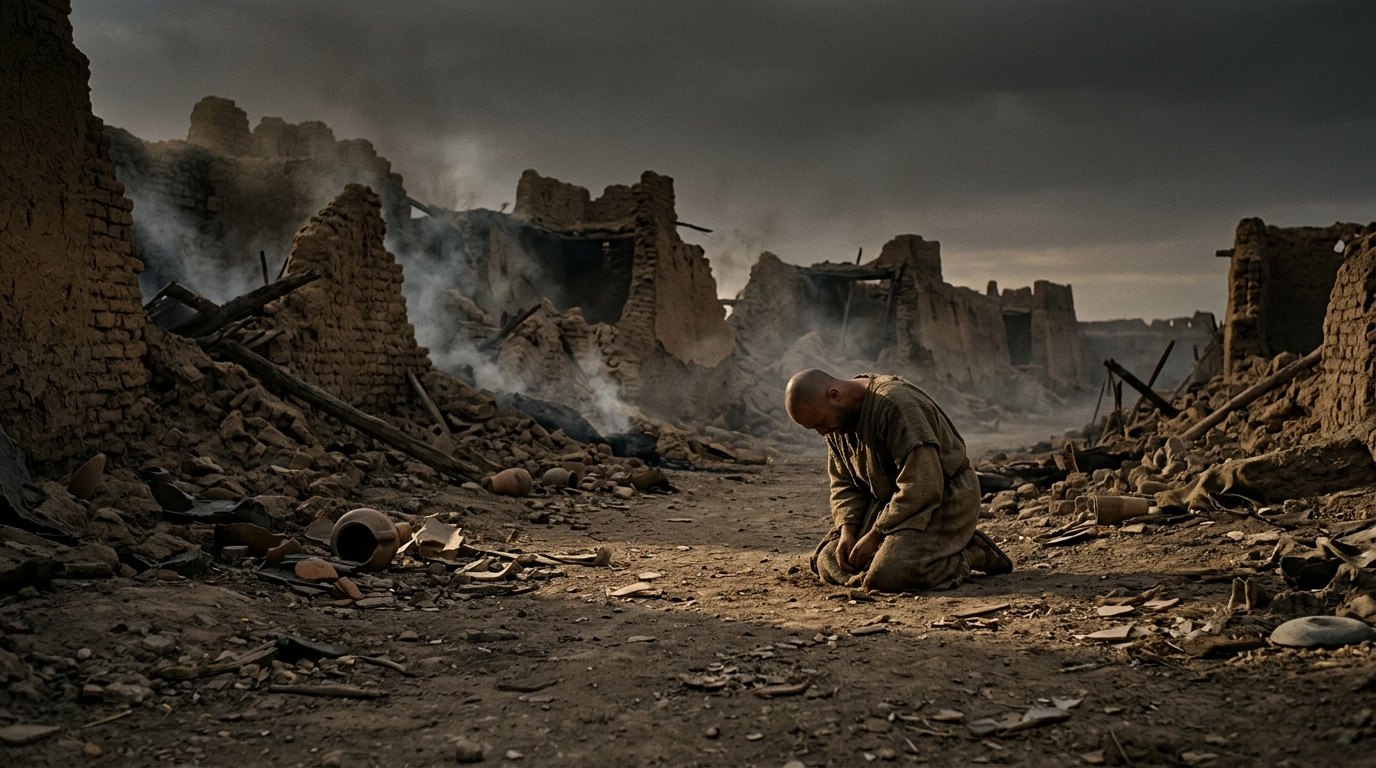
This is what the LORD says: “For three sins of Gaza, even for four, I will not relent. Because she took captive whole communities and sold them to Edom,
Amos 1:6 (NIV)
God explicitly condemns Gaza for the atrocity of deporting whole communities to Edom, promising fire on its walls.
The prophets reserved severe warnings for Gaza because of its cruel transgressions against God's covenant people. The Lord declared in Amos 1:6 that Gaza's judgment was sealed because they deported entire communities of captives to deliver them over to Edom, prompting the divine promise: I will send a fire upon the wall of Gaza, and it shall devour her strongholds (Amos 1:7). Isaiah warned Philistia that their relief over a fallen oppressor was short-lived, bidding the gates of Gaza to wail because smoke and ruin approached from the north (Isaiah 14:29, Isaiah 14:31). Jeremiah also prophesied doom before Pharaoh struck Gaza (Jeremiah 47:1), announcing that the Lord would spoil Philistia and cut off every helper (Jeremiah 47:4), leaving baldness and bitter mourning upon Gaza (Jeremiah 47:5) when the nations drank the cup of God's wrath (Jeremiah 25:20). Zephaniah foretold that Gaza would be forsaken (Zephaniah 2:4) so that its fertile coastland might eventually serve as pasture for the remnant of Judah (Zephaniah 2:7). Finally, Zechariah envisioned Gaza writhing in agony as its king perished and the pride of Philistia was stripped away (Zechariah 9:5, Zechariah 9:6), yet held out the ultimate redemptive hope that a remnant from the coastlands would be purified and belong to the household of God (Zechariah 9:7).
| Passage | What it says |
|---|---|
| Amos 1:6 | Pronounces judgment on Gaza for deporting an entire population into Edomite captivity. |
| Amos 1:7 | Promises to send a consuming fire on the walls and palaces of Gaza. |
| Isaiah 14:29 | Warns Philistia not to rejoice, for a worse destroyer will arise against them. |
| Isaiah 14:31 | Commands the gate and city to wail because smoke approaches from the north. |
| Jeremiah 25:20 | Includes the kings of the Philistines, specifically Ashkelon, Gaza, Ekron, and Ashdod, under judgment. |
| Jeremiah 47:1 | Mentions Pharaoh striking Gaza before the word of the Lord came against Philistia. |
| Jeremiah 47:5 | Declares that baldness has come upon Gaza as a sign of desperate mourning. |
| Zephaniah 2:4 | Foretells that Gaza will be abandoned and forsaken under divine visitation. |
| Zephaniah 2:7 | Promises that the coastland will belong to the remnant of Judah as pasture. |
| Zechariah 9:5 | Prophesies that Gaza will writhe in agony and lose its reigning king. |
| Zechariah 9:7 | Promises that a Philistine remnant will belong to God and be like a clan. |
| Jeremiah 47:4 | The Lord destroys Philistia, cutting off every survivor from Tyre and Sidon, including Gaza. |
| Zechariah 9:6 | A mixed race shall dwell in Ashdod, cutting off the pride of the Philistines. |
Gospel Advance
Grace Proclaimed on the Desert Road
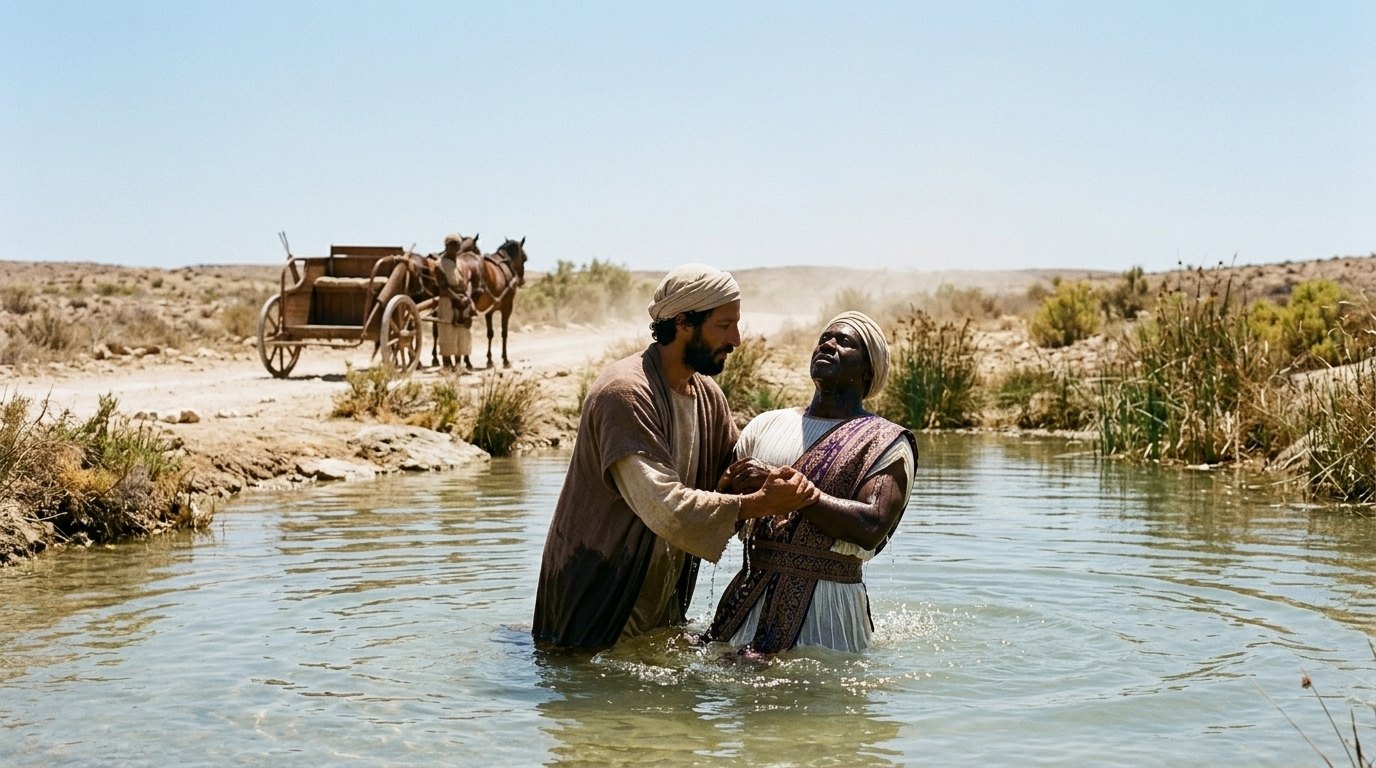
Now an angel of the Lord said to Philip, “Go south to the road—the desert road—that goes down from Jerusalem to Gaza.”
Acts 8:26 (NIV)
The Lord redirects an evangelist down the desert way toward Gaza, turning an ancient place of conflict into an avenue of grace.
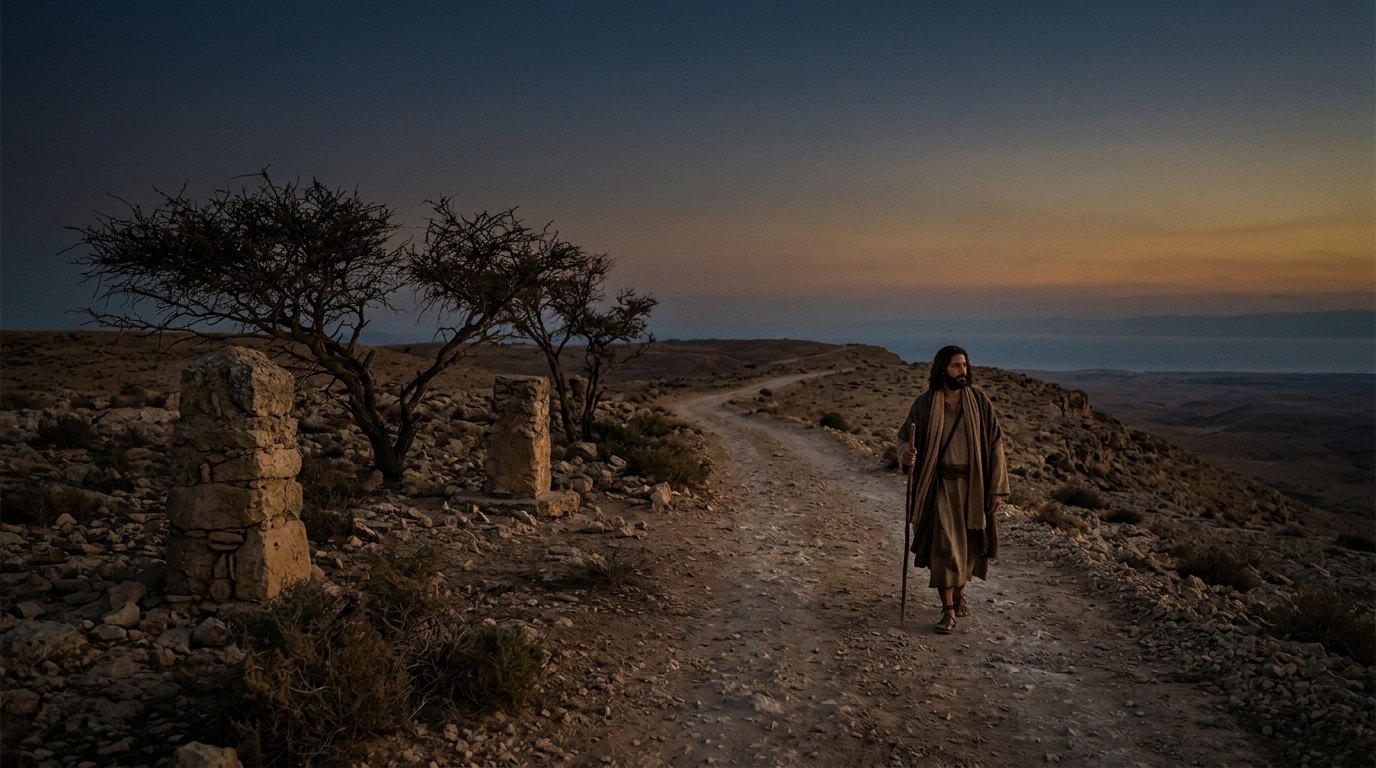
The final mention of Gaza in the biblical narrative appears in Acts 8:26, where an angel of the Lord directs Philip to arise and go toward the south along the road descending from Jerusalem to Gaza, noting specifically that this is a desert place. Throughout the Old Testament, Gaza represented persistent pagan resistance, military conflict, and solemn prophetic judgment; yet in the apostolic age, God marked this same corridor as an avenue of sovereign grace. Philip obeyed the divine summons and encountered an Ethiopian eunuch, a royal court official under Candace, queen of the Ethiopians, who had traveled to Jerusalem to worship and was returning home (Acts 8:27).
Sitting in his chariot traveling down this coastal descent, the official was reading aloud from the prophet Isaiah (Acts 8:28). Directed by the Holy Spirit to draw near to the chariot, Philip heard him reading the prophecy of the suffering Servant from Isaiah 53 and asked if he understood what he read. Beginning from that very passage of Scripture, Philip preached the good news of Jesus to him (Acts 8:35), explaining how Christ was led like a sheep to slaughter to bear sin and redeem the nations.
As they traveled together along the arid way, they came upon an unexpected body of water in the wilderness, leading the official to ask what prevented him from being baptized (Acts 8:36). Stopping the chariot, both Philip and the official went down into the water, and Philip baptized him upon his confession of faith in Christ (Acts 8:38). When they came up out of the water, the Spirit of the Lord suddenly caught Philip away, and the Ethiopian saw him no more, continuing on his journey south toward Africa rejoicing in his salvation (Acts 8:39). Thus, the historic road to Gaza witnessed the gospel crossing geographical and ethnic boundaries.
| Passage | What it says |
|---|---|
| Acts 8:26 | An angel commands Philip to go south to the desert road toward Gaza. |
| Acts 8:27 | Philip meets an Ethiopian eunuch, a court official returning from Jerusalem. |
| Acts 8:35 | Philip opens his mouth and preaches the good news of Jesus from Isaiah. |
| Acts 8:39 | The Spirit takes Philip away while the baptized official rejoices on his way. |
| Acts 8:28 | The Ethiopian official sits in his chariot reading the prophet Isaiah while travelling toward Gaza. |
| Acts 8:36 | They come across water along the desert route, prompting the eunuch's baptism. |
| Acts 8:38 | Philip and the official go down into the water where Philip baptises him. |
Where in the Bible
| Book | Passages |
|---|---|
| Genesis | 1 · Genesis 10:19 |
| Deuteronomy | 1 · Deuteronomy 2:23 |
| Joshua | 4 · Joshua 10:41, Joshua 11:22, Joshua 13:3, Joshua 15:47 |
| Judges | 10 · Judges 1:18, Judges 6:4, Judges 16:1, Judges 16:2, Judges 16:3, Judges 16:21, Judges 16:23, Judges 16:25, Judges 16:29, Judges 16:30 |
| 1 Samuel | 1 · 1 Samuel 6:17 |
| 1 Kings | 1 · 1 Kings 4:24 |
| 2 Kings | 1 · 2 Kings 18:8 |
| 2 Chronicles | 1 · 2 Chronicles 28:18 |
| Isaiah | 2 · Isaiah 14:29, Isaiah 14:31 |
| Jeremiah | 4 · Jeremiah 25:20, Jeremiah 47:1, Jeremiah 47:5, Jeremiah 47:4 |
| Amos | 2 · Amos 1:6, Amos 1:7 |
| Zephaniah | 2 · Zephaniah 2:4, Zephaniah 2:7 |
| Zechariah | 3 · Zechariah 9:5, Zechariah 9:7, Zechariah 9:6 |
| Acts | 7 · Acts 8:26, Acts 8:27, Acts 8:35, Acts 8:39, Acts 8:28, Acts 8:36, Acts 8:38 |
The story in order
- Canaanite border defined (c. 2000 BC) · Genesis 10:19 · Gaza marks the northern edge of Canaanite territory.
- Avvim destroyed near Gaza (c. 1450 BC) · Deuteronomy 2:23 · Caphtorim settled in the region, displacing earlier inhabitants.
- Joshua conquers to Gaza (c. 1400 BC) · Joshua 10:41 · Israelite conquest extended to the city of Gaza.
- Anakim remain in Gaza (c. 1400 BC) · Joshua 11:22 · Gaza was one of the last strongholds of the Anakim.
- Judah takes Gaza (c. 1350 BC) · Judges 1:18 · Judah captured Gaza, though it was later lost.
- Samson's exploits in Gaza (c. 1100 BC) · Judges 16:3 · Samson carried off Gaza's city gates.
- Samson destroys Dagon's temple (c. 1100 BC) · Judges 16:30 · Samson's death brought down the temple in Gaza.
- Ark of the Covenant returned (c. 1050 BC) · 1 Samuel 6:17 · Gaza paid tribute with a golden tumor.
- Solomon's dominion extends to Gaza (c. 950 BC) · 1 Kings 4:24 · Gaza was the western limit of Solomon's kingdom.
- Hezekiah strikes Philistines to Gaza (c. 725 BC) · 2 Kings 18:8 · Israelite victory extended to the region of Gaza.
- Prophetic judgment on Gaza (c. 750 BC) · Amos 1:6 · Judgment pronounced for human trafficking.
- Philip preaches near Gaza (AD 30s) · Acts 8:26 · The gospel advanced toward Africa via the Gaza road.
Gaza: From Stronghold to Gospel Route
| Era | Significance | Passage |
|---|---|---|
| Ancient Patriarchal Records | Marks the edge of Canaan; home to Anakim. | |
| Period of Judges | Site of Samson's triumphs and Philistine oppression. | |
| United and Divided Kingdoms | Western boundary of Israelite dominion; Philistine incursions. | |
| Prophetic Judgment | Condemned for human trafficking and cruelty. | |
| Apostolic Era | Desert road for the advance of the gospel. | Acts 8:26-39 |
Key words
- Philistines (Pelishtim (פְּלִשְׁתִּים))
- A seafaring people who settled on the southern coast of Canaan and were frequent adversaries of Israel. · Genesis 10:14
- Anakim (Anakim (אֲנָקִים))
- A race of giants dwelling in Canaan, some of whom remained in Gaza, Gath, and Ashdod. · Joshua 11:22
- Human Trafficking (Hebrew: shalach (שָׁלַח) - to send away, deport)
- Deporting an entire population into captivity, a sin for which Gaza was judged. · Amos 1:6
- Gospel (Greek: euangelion (εὐαγγέλιον))
- The good news of Jesus Christ, preached by Philip on the road to Gaza. · Acts 8:35
Tracing Gaza across the canon reveals God's sovereign justice over pagan cruelty alongside His unfailing intention to extend mercy to the nations. The ancient city stands as a reminder that earthly fortresses fall under divine scrutiny, while the road of the gospel carries life and salvation to all who believe.
40 passages, each cited once.
Scripture cited
- Amos 1:6-7
- 1 Samuel 6:17
- Judges 16:1-3
- Judges 16:21-31
- Acts 8:26-40
- Zephaniah 2:4-7
- Zechariah 9:5-8
- Jeremiah 47:1-7