What is Palm Sunday?
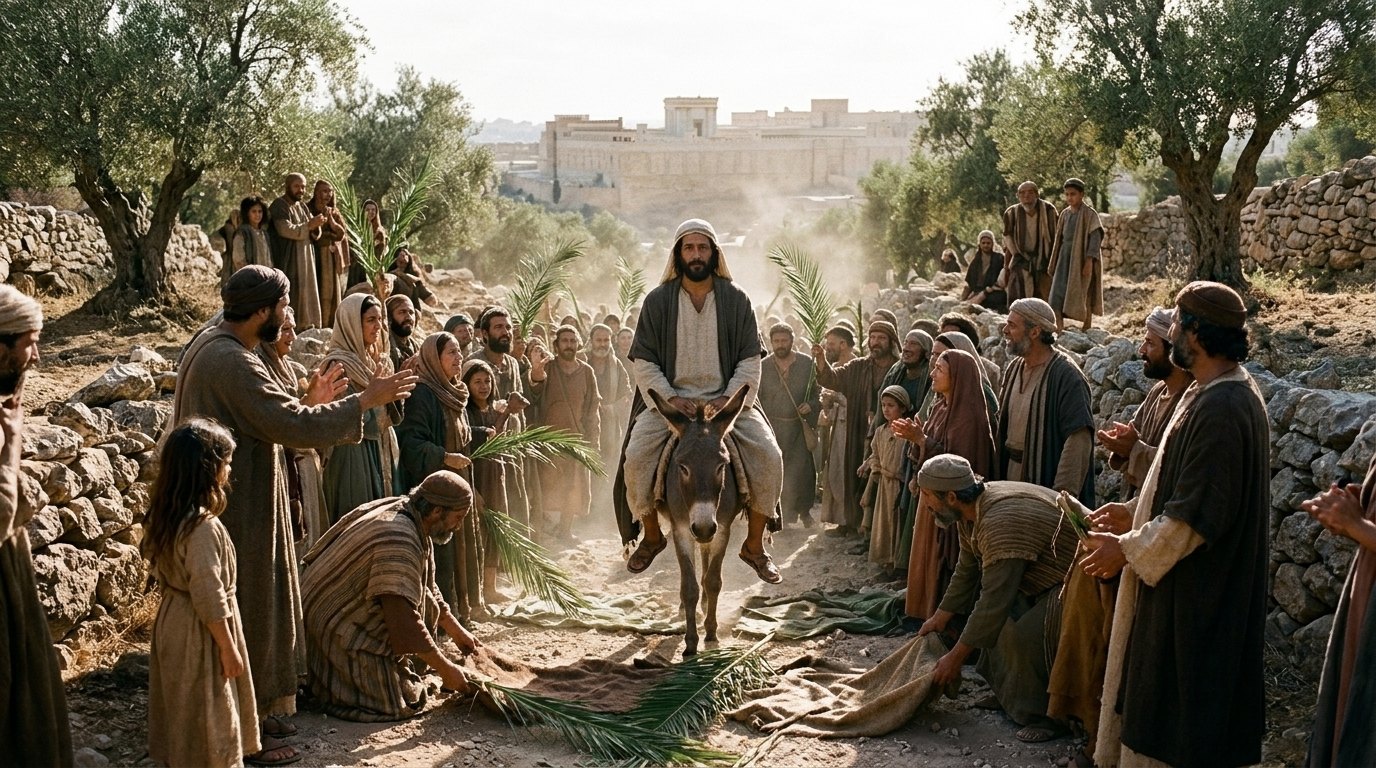
Matthew 21:1-11
1 As they approached Jerusalem and came to Bethphage on the Mount of Olives, Jesus sent two disciples,
2 saying to them, “Go to the village ahead of you, and at once you will find a donkey tied there, with her colt by her. Untie them and bring them to me.
3 If anyone says anything to you, say that the Lord needs them, and he will send them right away.”
4 This took place to fulfill what was spoken through the prophet:
5 “Say to Daughter Zion, ‘See, your king comes to you, gentle and riding on a donkey, and on a colt, the foal of a donkey.’ ”
6 The disciples went and did as Jesus had instructed them.
7 They brought the donkey and the colt and placed their cloaks on them for Jesus to sit on.
8 A very large crowd spread their cloaks on the road, while others cut branches from the trees and spread them on the road.
9 The crowds that went ahead of him and those that followed shouted, “Hosanna to the Son of David!” “Blessed is he who comes in the name of the Lord!” “Hosanna in the highest heaven!”
10 When Jesus entered Jerusalem, the whole city was stirred and asked, “Who is this?”
11 The crowds answered, “This is Jesus, the prophet from Nazareth in Galilee.”
New International Version (NIV)
The answer
Palm Sunday is the Sunday before Easter that commemorates Jesus’ triumphal entry into Jerusalem. It follows the Gospel account in which Jesus entered the city riding a donkey and a colt, while the crowd spread branches and clothing on the road and shouted, “Hosanna to the Son of David! Blessed is he who comes in the name of the Lord!” (Matthew 21:1-9).
What the day shows
- Jesus enters as the promised King: Matthew 21:4-5 explains that this fulfilled Zechariah’s prophecy: “Your King comes to you, humble, and riding on a donkey.”
- The crowd welcomes him: People spread garments and branches and praised him as the Son of David who comes in the Lord’s name (Matthew 21:8-9).
- The city is stirred: The whole city asked, “Who is this?” and answered, “This is the prophet, Jesus, from Nazareth of Galilee” (Matthew 21:10-11).
The palm branches celebrated a royal and messianic entrance, but Jesus’ humility also pointed toward the cross. The early church understood this celebration in light of his suffering and resurrection, which explains why the familiar hymn “All Glory, Laud, and Honor” moves from “Thou art the King of Israel” to “Thou to Thy passion comest.”
Palm Sunday is also called the Sunday of the Passion because it begins Holy Week, when Christians remember Jesus’ final days leading to the crucifixion on Good Friday and the resurrection on Easter Sunday.
Answered from Scripture · reviewed November 11, 2026
Palm Sunday commemorates Jesus Christ's royal entrance into Jerusalem as the long-promised King, riding humbly on a donkey days before his crucifixion. Recorded across all four Gospels, this event marks the beginning of Holy Week and shows the deliberate fulfillment of ancient messianic prophecy. Exploring the biblical accounts reveals a king arriving not to conquer by worldly force, but to offer himself as the true Passover Lamb.
Prophetic Anticipation
The Prophets Foretold the Coming Humble King
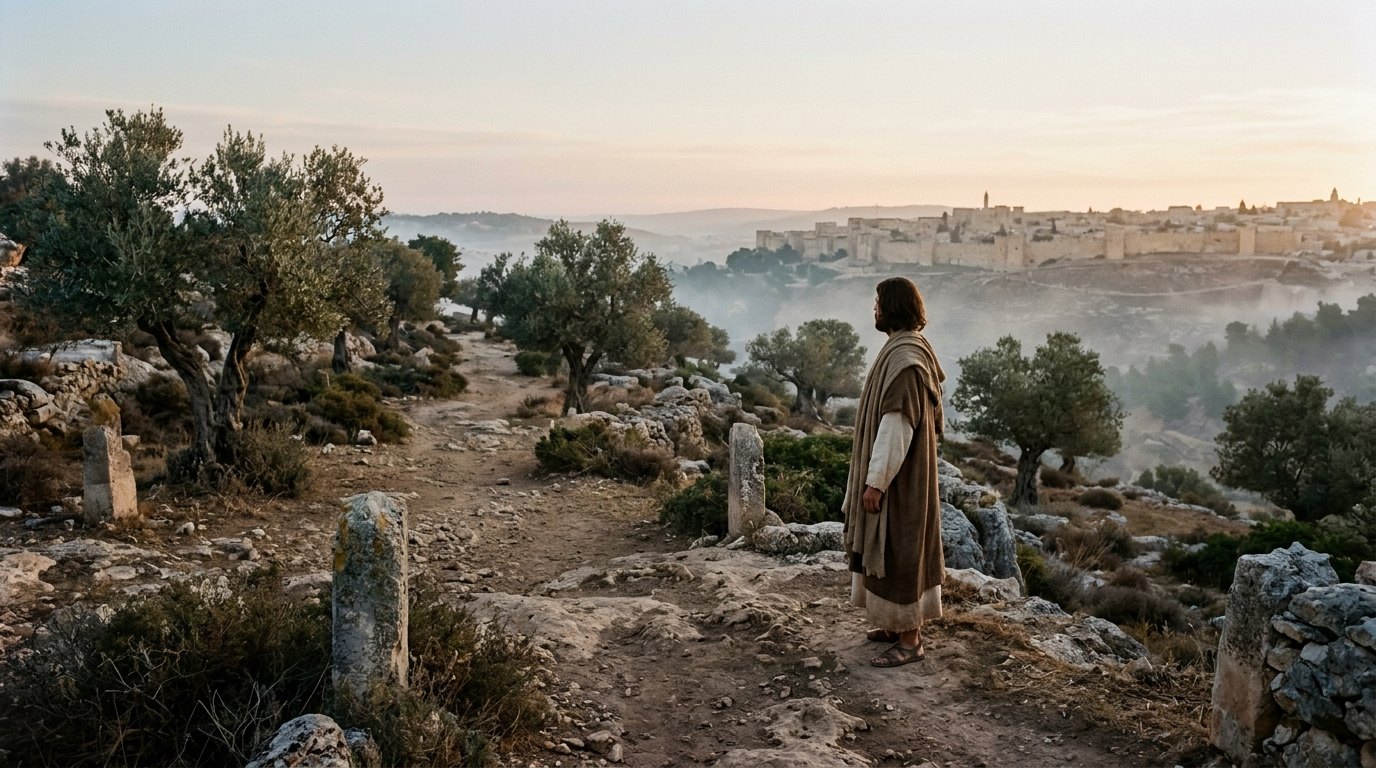
Rejoice greatly, Daughter Zion! Shout, Daughter Jerusalem! See, your king comes to you, righteous and victorious, lowly and riding on a donkey, on a colt, the foal of a donkey.
Zechariah 9:9 (NIV)
Zechariah explicitly announces that Zion's righteous King arrives riding upon the foal of a donkey.
Long before the shouts of Hosanna echoed through the Kidron Valley, the prophets charted the exact character and timing of the King's arrival. Zechariah 9:9 captures the heart of this royal advent: Zion's King comes righteous and bearing salvation, yet remarkably gentle, mounted on the foal of a donkey. Unlike earthly rulers who rode warhorses into conquered cities, this monarch enters in humility, fulfilling the ancient blessing in Genesis 49:10-11 where Judah’s ruler tethers his colt to the choice vine. Isaiah 62:11 joins Zechariah’s chorus, urging Jerusalem to behold her salvation arriving in person, a promise fulfilled when Jesus presented Himself to Israel as recounted in Matthew 21:4-5 and John 12:14-15.
Psalm 118:25-26 provided the explicit liturgical cry of the pilgrim crowds: "Save now, I beseech thee, O Lord; blessed is he that cometh in the name of the Lord." This messianic invocation looked for divine deliverance and met its literal target as Jesus descended toward the temple gates (Matthew 21:9; Mark 11:9-10; Luke 19:38). Daniel 9:25 had foretold the exact unfolding of sixty-nine prophetic weeks leading up to Messiah the Prince, setting the calendar for Jerusalem's decisive visitation (Luke 19:42). Finally, Malachi 3:1 warned that the Lord whom Israel sought would suddenly arrive at His temple—a sovereign convergence realized immediately after this procession when Christ entered the sanctuary courts to inspect and cleanse His Father’s house (Matthew 21:12).
| Passage | What it says | Fulfilled |
|---|---|---|
| Zechariah 9:9 | Rejoice greatly, daughter of Zion; your King comes to you righteous, having salvation, lowly and riding on a donkey's colt. | Matthew 21:4-5, John 12:14-15 |
| Psalms 118:25-26 | Save now, I beseech thee, O Lord; blessed is he that cometh in the name of the Lord. | Matthew 21:9, Mark 11:9-10, Luke 19:38 |
| Genesis 49:10-11 | The sceptre shall not depart from Judah, binding his foal unto the vine and his donkey's colt unto the choice vine. | Matthew 21:2, Matthew 21:7 |
| Isaiah 62:11 | Proclaims to Zion that her salvation comes, introducing the Messianic arrival quoted alongside Zechariah. | Matthew 21:5, John 12:15 |
| Daniel 9:25 | Prophesies the precise timeline until Messiah the Prince comes before Jerusalem's destruction. | Luke 19:42 |
| Malachi 3:1 | Foretells that the Lord whom they seek will suddenly come to His temple. | Matthew 21:12 |
Royal Preparation
Jesus Arranges His Entrance from the Mount of Olives
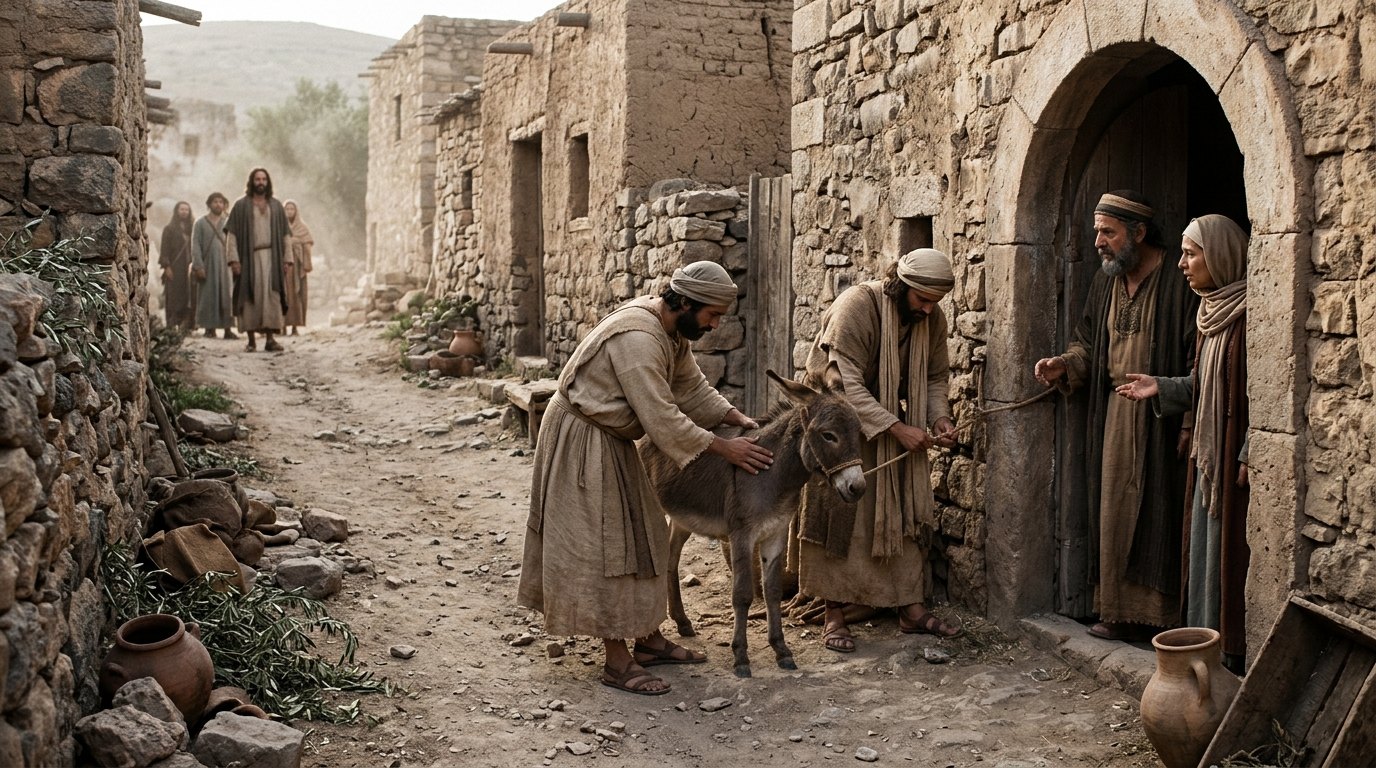
saying to them, “Go to the village ahead of you, and at once you will find a donkey tied there, with her colt by her. Untie them and bring them to me. If anyone says anything to you, say that the Lord needs them, and he will send them right away.”
Matthew 21:2-3 (NIV)
Jesus demonstrates divine authority and foreknowledge by commanding his disciples to secure the exact animal needed.
Jesus demonstrated sovereign foreknowledge and royal prerogative by orchestrating every detail of His entry from the crest of the Mount of Olives (Matthew 21:2-3). Pausing at Bethphage, He dispatched two disciples with explicit directions to untie an unbroken colt and its mother, instructing them to answer any inquiry with a simple declaration: "The Lord hath need of them" (Matthew 21:1; Mark 11:1-3). Mark 11:4-6 and Luke 19:29-35 record how the disciples found the colt tethered at a street corner door, exactly as Jesus spoke, and the owners willingly surrendered the animals upon hearing the Master's claim.
This deliberate procurement showed that the entry was neither spontaneous nor an accidental surge of crowd enthusiasm. Every action deliberately brought ancient prophecy to pass under Christ's direct guidance (Matthew 21:4-6). By choosing an unridden beast, Jesus signified sacred dedication, while draping the animal with disciples' cloaks acknowledged His true royalty (Luke 19:35). John 12:14-16 explains that even the disciples failed to grasp the full prophetic weight of these actions at the time; only after Jesus was resurrected and glorified did the Spirit bring to mind how every detail carried out the Scriptures written of Him.
| Passage | What it says |
|---|---|
| Matthew 21:1 | Jesus draws near to Jerusalem at Bethphage by the Mount of Olives and dispatches two disciples. |
| Matthew 21:2-3 | Jesus commands his disciples to bring a tied donkey and her colt, instructing them to say the Lord needs them. |
| Mark 11:1-6 | The disciples find the colt tied by the door in the street and untie it just as Jesus directed. |
| Luke 19:29-35 | The owners question the untying of the colt, and the disciples bring it to Jesus and put their clothes on it. |
| John 12:14-16 | Notes Jesus finding the young donkey, and that disciples understood these scriptures only after His glorification. |
| Matthew 21:4-6 | Records the disciples executing Jesus' command specifically to fulfil the prophet's words. |
Triumphal Entry
The Multitudes Welcome the Son of David
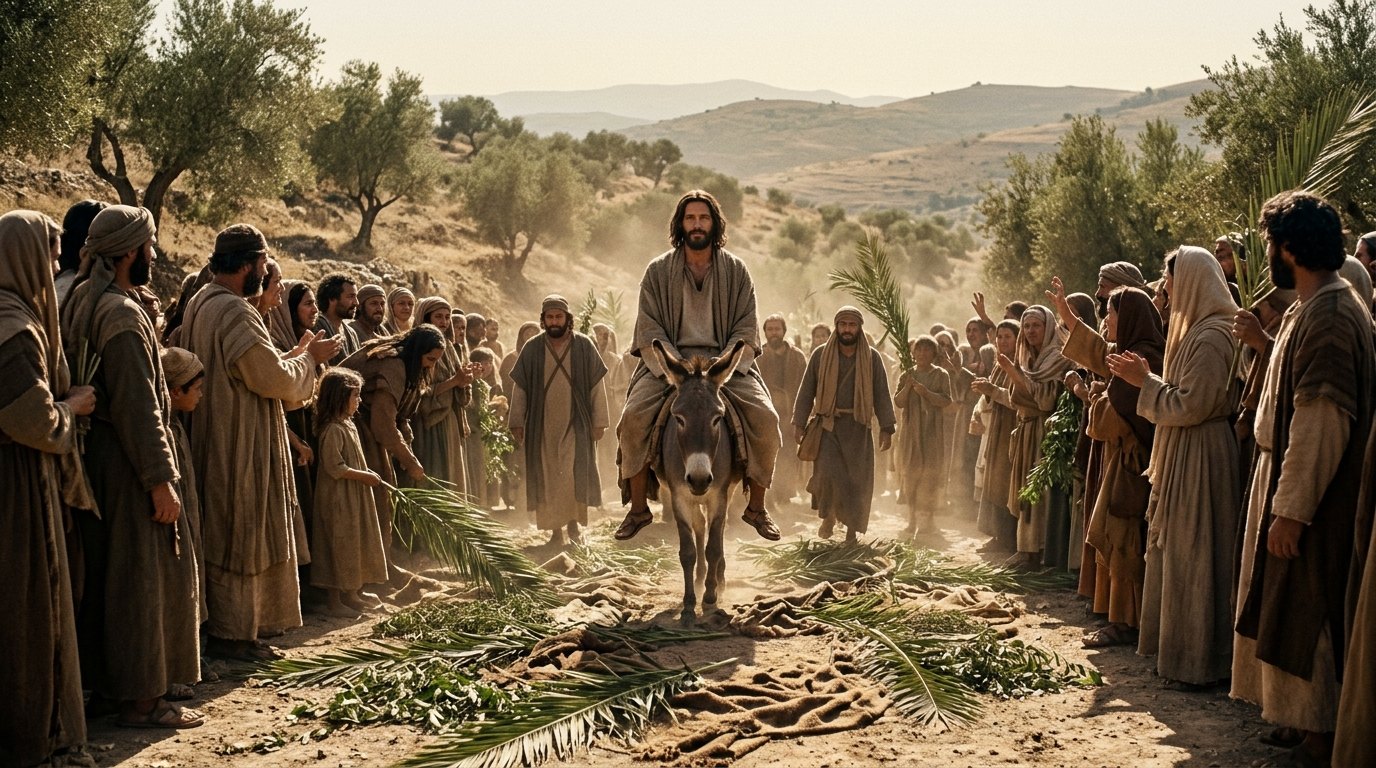
A very large crowd spread their cloaks on the road, while others cut branches from the trees and spread them on the road. The crowds that went ahead of him and those that followed shouted, “Hosanna to the Son of David!” “Blessed is he who comes in the name of the Lord!” “Hosanna in the highest heaven!”
Matthew 21:8-9 (NIV)
The crowd carpets the road with garments and branches, shouting messianic praise directly from the Psalms.
The road from the Mount of Olives into the holy city became a royal carpet as disciples and pilgrims cast their garments and leafy branches across the path (Matthew 21:8-9). In doing so, the multitudes echoed the ancient coronation precedent of 2 Kings 9:13, where Israel spread garments under Jehu's feet to proclaim him king. John 12:12-13 notes that pilgrims took fronds of date palm trees to greet Him—a festive act rooted in Leviticus 23:40, where waving boughs expressed joy before the Lord during holy feasts, here marking the joyous advent of the King of Israel.
Mark 11:7-10 captures the jubilant anthem of the procession, blessing the coming kingdom of their father David and crying out for salvation in the highest heavens. Luke 19:36-38 emphasizes that the entire company of disciples erupted in praise for all the mighty miracles they had witnessed, celebrating Jesus as the King who comes in the name of the Lord. As palm branches rustled and cloaks cushioned the donkey's steps, the humble procession openly declared the long-awaited Son of David, even as He journeyed forward toward His cross.
| Passage | What it says |
|---|---|
| Matthew 21:7-9 | Jesus sits on the cloaks, while crowds spread their garments and cut branches, crying 'Hosanna to the Son of David.' |
| Mark 11:7-10 | The people spread cloaks and leafy branches, blessing the coming kingdom of their father David. |
| Luke 19:36-38 | The whole multitude of disciples rejoices and praises God with a loud voice for all the mighty works they had seen. |
| John 12:12-13 | People take branches of palm trees and go out to meet Jesus, crying Hosanna and hailing the King of Israel. |
| 2 Kings 9:13 | Provides historical precedent for spreading cloaks on steps and blowing trumpets to proclaim a king. |
| Leviticus 23:40 | Commands rejoicing before the Lord with palm branches and boughs of leafy trees during Feast celebrations. |
City's Reaction
Jerusalem Is Stirred and the King Weeps
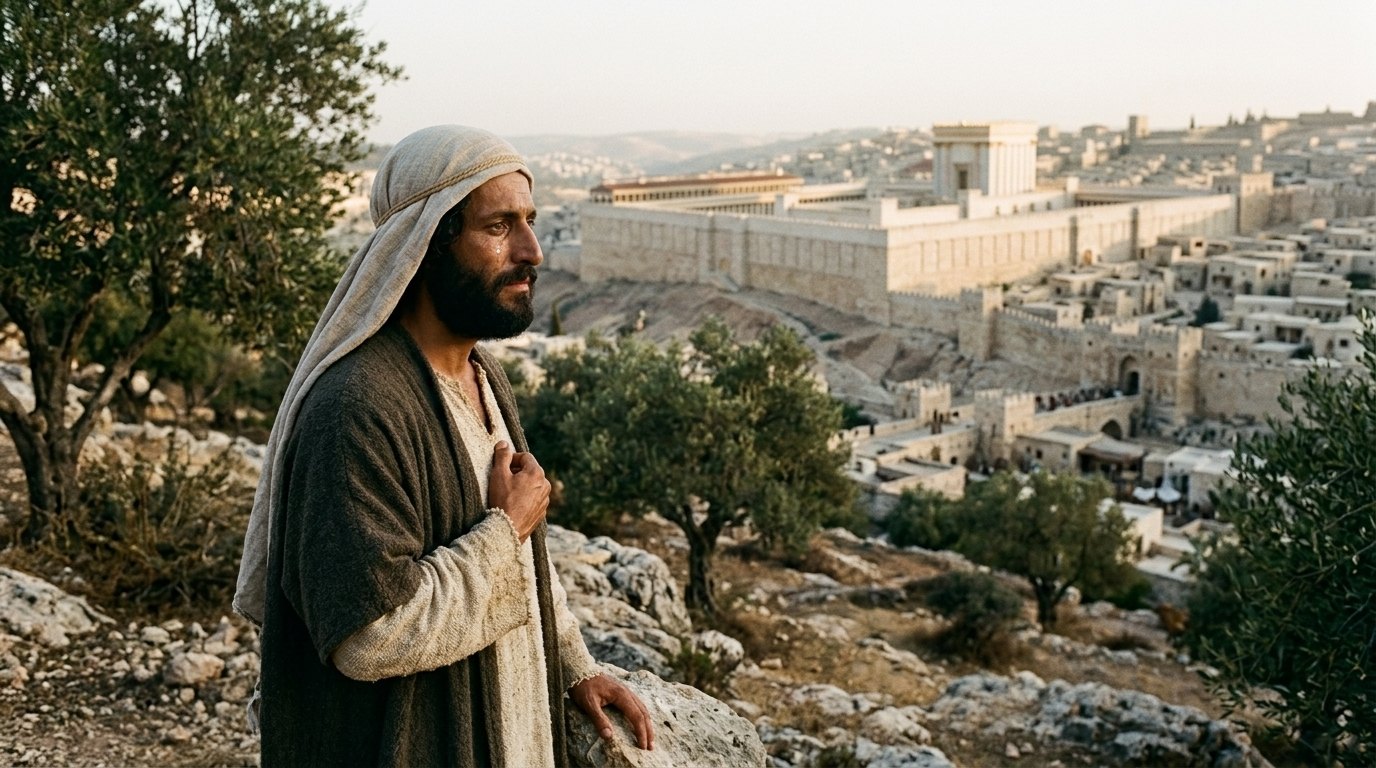
As he approached Jerusalem and saw the city, he wept over it and said, “If you, even you, had only known on this day what would bring you peace—but now it is hidden from your eyes.
Luke 19:41-42 (NIV)
Amid widespread adulation, Jesus weeps over Jerusalem's blindness to the things that belong to its peace.
As the joyful procession entered Jerusalem, the whole city was shaken with excitement and inquiry, asking, "Who is this?" (Matthew 21:10-11). Yet amid the thunderous adulation, the heart of the King broke. Luke 19:41-42 records Jesus weeping over Jerusalem as He saw its impending destruction, lamenting that the city failed to recognize the day of its divine visitation. When indignant Pharisees demanded that He silence His disciples, Jesus answered that if these should hold their peace, the very stones would immediately cry out (Luke 19:39-40).
The religious leaders grew increasingly desperate, lamenting that "the world is gone after him" as crowds continued testifying to His raising of Lazarus from the dead (John 12:9-11, 17-19). When Jesus entered the temple courts, children took up the anthem of Hosanna, prompting Christ to silence the indignant priests by quoting Psalm 8:2 on ordained praise (Matthew 21:14-16). Having inspected the temple precincts, Jesus quietly retired to Bethany with the twelve, His royal presentation complete and His path to the cross set (Mark 11:11).
| Passage | What it says |
|---|---|
| Matthew 21:10-11 | The whole city is stirred up asking who he is, and the multitudes identify him as the prophet from Nazareth. |
| Luke 19:39-40 | Pharisees tell Jesus to rebuke his disciples, but he declares that if they keep silent, the stones would cry out. |
| Luke 19:41-44 | Jesus weeps over Jerusalem, prophesying its coming siege and destruction because it did not know the time of its visitation. |
| John 12:17-19 | The crowd testifies of Jesus raising Lazarus, causing the Pharisees to lament that the whole world has gone after him. |
| Matthew 21:14-16 | Children cry Hosanna in the temple, and Jesus defends their praise citing Psalm 8:2. |
| Psalms 8:2 | Ordains praise from the lips of babes and nursing infants to silence the enemy. |
| John 12:9-11 | Large crowds gather not only for Jesus but to see Lazarus whom He raised. |
| Mark 11:11 | Jesus enters Jerusalem into the temple, inspects all things, and retires to Bethany at evening. |
Passover Fulfilment
The Passover Lamb Presented to the Nations
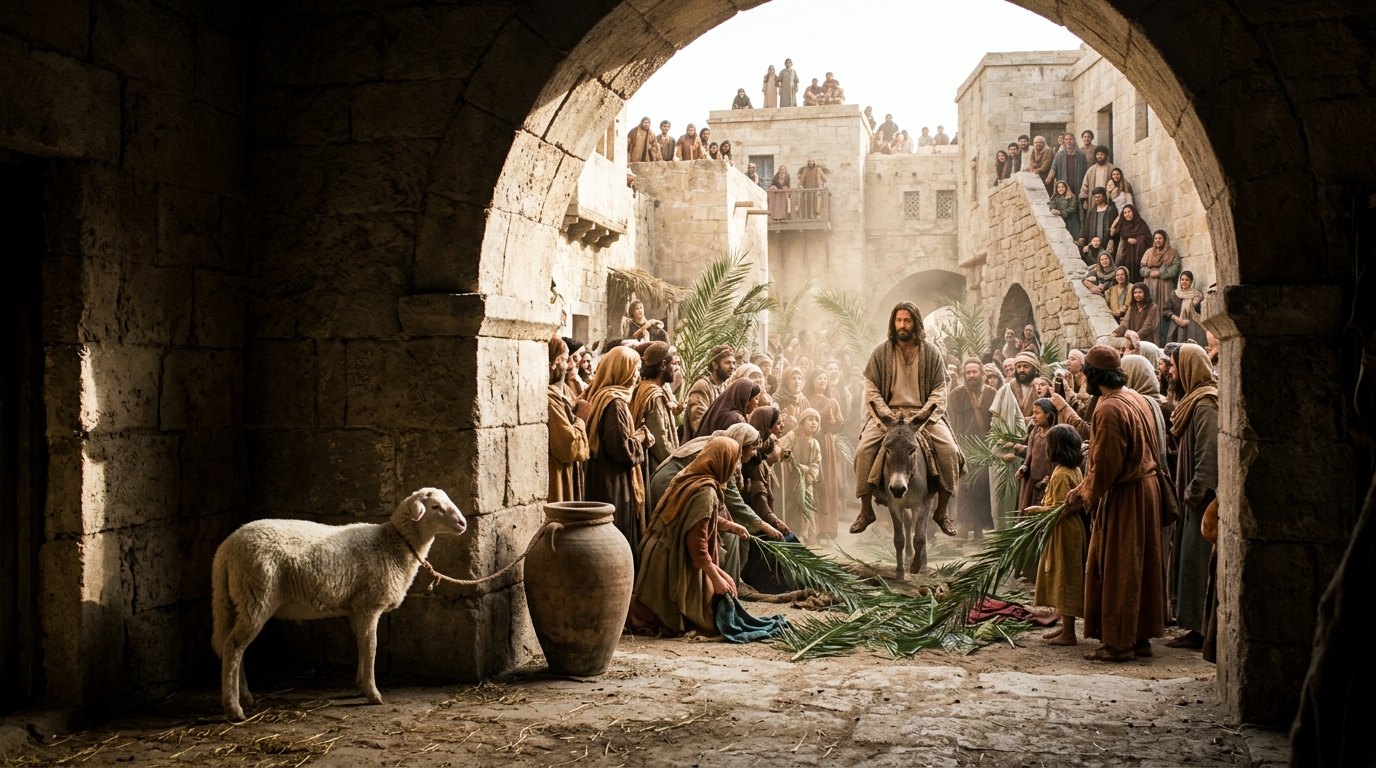
Tell the whole community of Israel that on the tenth day of this month each man is to take a lamb for his family, one for each household.
Exodus 12:3 (NIV)
On the tenth day of Nisan the Passover lamb was chosen and presented, matching the day of Christ's entry.
In Exodus 12:3, the Lord instructed Israel that on the tenth day of the first month, each household was to select an unblemished lamb and set it apart until its sacrifice at twilight on the fourteenth day. By riding into Jerusalem on the very day lambs were chosen throughout Judea, Jesus presented Himself publicly before the eyes of the priests, the elders, and the multitudes. Moses commanded in Exodus 12:3-6 that this lamb must be without blemish, examined thoroughly before its blood was struck against the doorposts to deliver God's people from death. The true antitype arrived when the spotless Son of God walked into the temple courts, inspected by His adversaries and proven entirely blameless.
The Apostle Paul explicitly unveils this divine pattern in 1 Corinthians 5:7, declaring that "Christ, our Passover lamb, has been sacrificed." His blood does not merely avert an earthly plague, but redeems guilty sinners once for all from the curse of the law and the wrath of God. Peter echoes this substance in 1 Peter 1:19, confirming that believers are ransomed by the precious blood of Christ, like that of a lamb without spot or blemish. The humble colt He rode carried the final, all-sufficient sacrifice to the altar of the cross.
The adoration that began on the dusty slopes of the Mount of Olives finds its eternal consummation in Revelation 7:9-10. There, John sees an innumerable multitude from every nation standing before the throne and before the Lamb, clothed in white robes, holding palm branches in their hands. Their cry echoes the ancient Hosannas with full clarity: "Salvation belongs to our God who sits on the throne, and to the Lamb!" The King who entered Jerusalem to die now reigns forever, received by a ransomed people whose praise never ends.
| Passage | What it says | Fulfilled |
|---|---|---|
| Exodus 12:3-6 | The tenth of Nisan requires selection of the spotless Passover lamb, kept until fourteenth-day slaughter. | 1 Corinthians 5:7, 1 Peter 1:19 |
| 1 Corinthians 5:7 | Declares that Christ, our Passover lamb, has been sacrificed for us. | |
| Revelation 7:9-10 | The redeemed stand before the Lamb holding palm branches and crying salvation belongs to God. |
Where in the Bible
| Book | Passages |
|---|---|
| Genesis | 1 · Genesis 49:10-11 |
| Exodus | 1 · Exodus 12:3-6 |
| Leviticus | 1 · Leviticus 23:40 |
| 2 Kings | 1 · 2 Kings 9:13 |
| Psalms | 2 · Psalms 118:25-26, Psalms 8:2 |
| Isaiah | 1 · Isaiah 62:11 |
| Daniel | 1 · Daniel 9:25 |
| Zechariah | 1 · Zechariah 9:9 |
| Malachi | 1 · Malachi 3:1 |
| Matthew | 6 · Matthew 21:1, Matthew 21:2-3, Matthew 21:4-6, Matthew 21:7-9, Matthew 21:10-11, Matthew 21:14-16 |
| Mark | 3 · Mark 11:1-6, Mark 11:7-10, Mark 11:11 |
| Luke | 4 · Luke 19:29-35, Luke 19:36-38, Luke 19:39-40, Luke 19:41-44 |
| John | 4 · John 12:14-16, John 12:12-13, John 12:17-19, John 12:9-11 |
| 1 Corinthians | 1 · 1 Corinthians 5:7 |
| Revelation | 1 · Revelation 7:9-10 |
The story in order
- Judah's Sceptre Assured (c. 1800 BC) · Genesis 49:10-11 · Foretells a ruler from Judah, linked to a donkey.
- King's Humble Arrival Foretold (c. 520 BC) · Zechariah 9:9 · Prophesies a righteous, lowly king riding a donkey.
- Messiah the Prince's Coming (c. 530 BC) · Daniel 9:25 · Precise prophecy of Messiah's arrival before Jerusalem's fall.
- Lord Comes to His Temple (c. 400 BC) · Malachi 3:1 · Foretells the Lord's sudden arrival at the temple.
- Jesus Approaches Jerusalem (AD 30) · Matthew 21:1 · Jesus begins his final journey to Jerusalem.
- Donkey Secured for Entry (AD 30) · Matthew 21:2-3 · Jesus directs disciples to bring a donkey colt.
- Crowds Welcome the King (AD 30) · Matthew 21:7-9 · Multitudes hail Jesus as Son of David with palm branches.
- Jerusalem Reacts and Is Judged (AD 30) · Luke 19:41-44 · Jesus weeps over Jerusalem's impending destruction.
- Praise in the Temple (AD 30) · Matthew 21:14-16 · Children cry 'Hosanna,' Jesus defends their praise.
- Passover Lamb Selected (c. 1445 BC) · Exodus 12:3-6 · Instruction for choosing a spotless lamb for Passover.
- Christ Our Passover Lamb (c. AD 55) · 1 Corinthians 5:7 · Identifies Christ as the sacrificed Passover lamb.
- Redeemed Before the Lamb (c. AD 95) · Revelation 7:9-10 · The redeemed in heaven cry salvation to God and the Lamb.
Key words
- Hosanna (Hoshia-na, הוֹשִׁיעָה נָּא)
- Save now, we pray; an exclamation of praise and supplication. · Psalms 118:25
- Son of David
- A messianic title referring to Jesus' lineage and kingly role. · Matthew 21:9
- Passover Lamb
- The lamb sacrificed during Passover, symbolizing Christ's atoning sacrifice. · 1 Corinthians 5:7
- Visitation
- God's coming to inspect, judge, or deliver his people. · Luke 19:44
Palm Sunday calls every believer to welcome Jesus not merely as a worldly deliverer, but as the humble King who went willingly to the cross for our sins. As we join the ancient cry of 'Hosanna,' we confess him as Lord and anticipate his glorious return in final victory.
29 passages, each cited once.
Scripture cited
- Matthew 21:1-11