What is propitiation?

1 John 4:9-10
9 This is how God showed his love among us: He sent his one and only Son into the world that we might live through him.
10 This is love: not that we loved God, but that he loved us and sent his Son as an atoning sacrifice for our sins.
New International Version (NIV)
The answer
Propitiation means that Jesus Christ, by His sacrificial death, satisfies God’s righteous judgment against sin and turns away God’s wrath, so that those who have faith in Jesus are forgiven and reconciled to God.
1 John 4:10 states:
Herein is love, not that we loved God, but that he loved us, and sent his Son to be the propitiation for our sins.
The Greek word translated propitiation is hilasmos, meaning atonement and, concretely, the one who makes atonement. The WEB renders it atoning sacrifice. John uses the same word in 1 John 2:2, where Jesus Himself is the atoning sacrifice for our sins. A related Greek word appears in Romans 3:25, where God sent Christ to be an atoning sacrifice through faith in his blood.
This includes several truths:
- Sin brings real guilt and judgment. Romans 3:23 says that all have sinned and fall short of God’s glory. God does not simply pretend sin never happened.
- Christ’s sacrifice deals with God’s wrath. Romans 5:9 joins being justified by Christ’s blood with being saved from God’s wrath through Him. Forgiveness therefore rests on Christ’s finished sacrifice, not on minimizing sin.
- God remains just when He justifies sinners. Romans 3:26 says God is just and the justifier of him who has faith in Jesus. Christ bears sin’s penalty, and justification is received through faith in Him rather than earned by human love or works.
- Christ’s death reconciles enemies to God. Romans 5:10 says that while people were enemies, they were reconciled to God through the death of His Son.
Propitiation is therefore not sinners bribing or placating an unwilling God. God’s love provides the sacrifice: Romans 5:8 says that while we were yet sinners, Christ died for us. The Father sent the Son, and the Son died for sinners, so that guilty people could be forgiven without God’s justice being set aside.
Answered from Scripture · reviewed November 11, 2026
Propitiation is the sacrifice that satisfies God's holy wrath against sin, reconciling guilty sinners to a righteous Judge. It is not an alternative to God's love, but love's supreme expression, where God himself provided the lamb to turn away his own righteous judgment.
The Holy Wrath
God's Righteous Anger Against Human Iniquity

Whoever believes in the Son has eternal life, but whoever rejects the Son will not see life, for God’s wrath remains on them.
John 3:36 (NIV)
It shows that divine wrath is not an ancient relic, but an active reality abiding on anyone outside of Christ.
The sobering reality of divine wrath is laid bare in John 3:36: the wrath of God remains upon him who does not obey the Son. Far from being an outdated relic or an uncontrollable burst of temper, God's wrath is His settled, pure, and necessary holy indignation against all moral evil. Scripture leaves no doubt regarding the universality of this dilemma. Romans 1:18 declares that God's wrath is actively unveiled against all ungodliness and unrighteousness of men who suppress the truth. Because of inherited corruption and personal rebellion, Paul confesses in Ephesians 2:3 that every human being was by nature a child of wrath, walking in the exact condemnation common to the rest of the world.
Psalms 7:11 reminds us that God is a righteous judge who expresses indignation toward the wicked continually. His holiness cannot casually tolerate rebellion; Colossians 3:5-6 warns that divine fury inevitably descends upon unrepentant disobedience. The gospel shines brightest against this stark backdrop: we cannot rescue ourselves from a righteous Judge who must punish transgression. Yet God has made provision. Romans 5:9 reveals that believers are now justified by Christ's shed blood and consequently saved from divine wrath through Him. Believers now wait with joyful hope for the Lord's return, as 1 Thessalonians 1:10 celebrates Jesus who delivers us entirely from the wrath to come.
| Passage | What it says |
|---|---|
| Romans 1:18 | Reveals that the wrath of God is revealed from heaven against all ungodliness and unrighteousness of men. |
| Ephesians 2:3 | States that by nature all human beings were children of wrath, deserving judgment like the rest. |
| Psalms 7:11 | Affirms that God is a righteous judge who feels indignation toward wickedness every single day. |
| John 3:36 | Warns that whoever rejects the Son shall not see life, but the wrath of God remains upon him. |
| Romans 5:9 | Believers are justified by Christ's blood and saved through Him from the wrath of God. |
| 1 Thessalonians 1:10 | Jesus delivers believers from the coming wrath through His finished work. |
| Colossians 3:5-6 | The wrath of God comes upon the sons of disobedience on account of sin. |
The Levitical Shadow
The Mercy Seat Sprinkled With Atoning Blood

He is to take some of the bull’s blood and with his finger sprinkle it on the front of the atonement cover; then he shall sprinkle some of it with his finger seven times before the atonement cover.
Leviticus 16:14 (NIV)
It establishes the blood sprinkled upon the mercy seat as the God-ordained place of averted wrath.
Under the Mosaic covenant, the horror of sin and the necessity of averted judgment centered upon the sanctuary. In Leviticus 16:14, the high priest took sacrificial blood and sprinkled it directly upon the mercy seat, where the sprinkled blood satisfied the demands of God's law and turned away judgment from the congregation. This pattern was foreshadowed in Exodus 25:17-22, where the golden mercy seat (kapporeth) sat atop the Ark of the Covenant, covering the stone tablets of the law; it was there that God promised to meet His people in grace, a type fulfilled in Romans 3:25 and Hebrews 9:5.
The ritual of Leviticus 16:14-15 required that atoning blood shield the priest and the people from death, which Hebrews 9:11-14 reveals was a type of Christ's superior entrance into the heavenly tent. Leviticus 17:11 explains the underlying spiritual reality: the life of the flesh is in the blood, given upon the altar to make atonement, pointing directly to the cross (Hebrews 9:22). Historical crises vividly illustrated this turning away of wrath: Numbers 16:46-48 records Aaron running between the living and the dead with incense to halt a lethal plague, while Numbers 25:11-13 commemorates Phinehas averting the Lord's anger through holy zeal. Leviticus 4:35 guaranteed that when the required sacrifice was brought, atonement was completed and guilt removed. All these shadows pointed toward the suffering Servant of Isaiah 53:5-10, who was crushed for our iniquities, making His soul a guilt offering to heal our souls (1 Peter 2:24).
| Passage | What it says | Fulfilled |
|---|---|---|
| Exodus 25:17-22 | Prescribes the construction of the golden mercy seat covering the testimony, where God promised to meet his people. | Romans 3:25, Hebrews 9:5 |
| Leviticus 16:14-15 | Commands the high priest to sprinkle the blood of the bull and goat upon the mercy seat for cleansing and atonement. | Hebrews 9:11-14 |
| Leviticus 17:11 | Explains that life is in the blood, given upon the altar to make atonement for human souls. | Hebrews 9:22 |
| Isaiah 53:5-10 | Prophesies that the Servant would be crushed for our iniquities, making his soul an offering for sin. | 1 Peter 2:24 |
| Numbers 16:46-48 | Aaron makes atonement with incense to halt the lethal wrath breaking forth from the Lord. | |
| Numbers 25:11-13 | Phinehas turns away God's wrath and makes atonement for the people by zeal for God's holiness. | |
| Leviticus 4:35 | The priest makes atonement for the sinner's trespass and his guilt is forgiven. |
The True Hilasterion
Christ Set Forth As The Mercy Seat
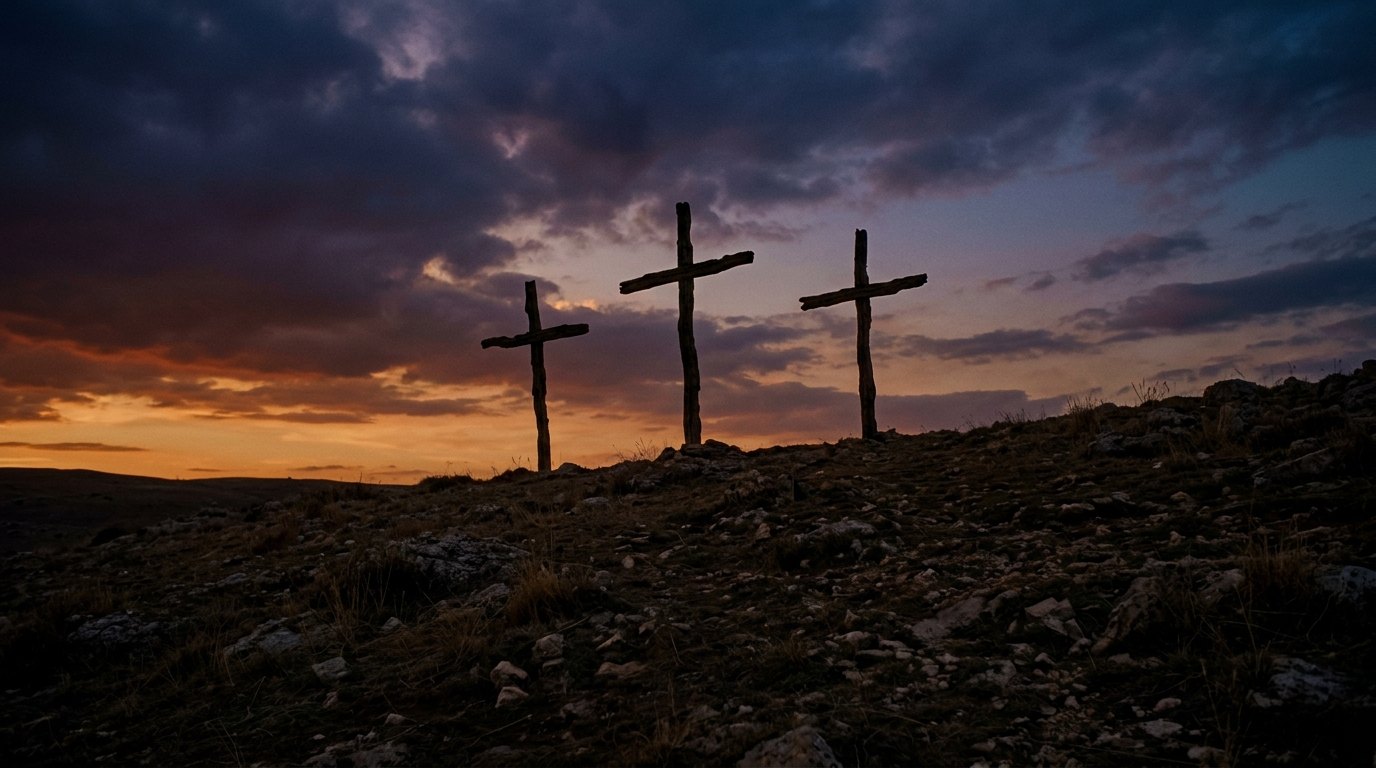
God presented Christ as a sacrifice of atonement, through the shedding of his blood—to be received by faith. He did this to demonstrate his righteousness, because in his forbearance he had left the sins committed beforehand unpunished—
Romans 3:25 (NIV)
It identifies Jesus himself as the true propitiatory sacrifice displayed publicly to show God's justice.
The full theological weight of redemption culminates in Romans 3:25, which proclaims that God publicly set forth Christ as a propitiation through faith in his blood. The apostle Paul employs the Greek term hilasterion—the very word used in the Septuagint and in Hebrews 9:5 for the golden mercy seat—to declare that Jesus is both the ultimate place and the supreme sacrifice where divine justice and divine mercy meet. Romans 3:26 explains the triumph of this transaction: by inflicting the full penalty for human transgression upon the Son, God remains immutably just while simultaneously acting as the gracious justifier of anyone who trusts in Jesus.
This required a mediator who could stand in the gap on our behalf. Hebrews 2:17 reveals that the Son had to be made like His brothers in every respect, becoming a merciful and faithful High Priest to make propitiation for the sins of the people. In this sovereign act, Romans 8:32 emphasizes that God did not spare His own Son, but freely delivered Him up for us all. Christ did not offer external animals, but as Hebrews 9:11-14 and Hebrews 10:10-14 attest, entered heaven by His own blood, offering a single, definitive sacrifice that perfects believers forever. He bore our penalty so thoroughly that 2 Corinthians 5:21 explains He was made to be sin for us, and Galatians 3:13 shows Him redeeming us from the law's curse by becoming a curse in our place. Even the humble tax collector in Luke 18:13 rightly perceived this desperate need, pleading for God to be propitious toward him as a sinner.
| Passage | What it says |
|---|---|
| Romans 3:25 | Declares that God publicly set forth Christ Jesus as a propitiation through faith in his blood. |
| Romans 3:26 | Demonstrates that God remains perfectly just while becoming the justifier of those who believe in Jesus. |
| Hebrews 2:17 | States that Jesus was made like his brothers to become a faithful High Priest to make propitiation. |
| Romans 8:32 | Reminds believers that God did not spare his own Son, but freely delivered him up for us all. |
| Hebrews 9:5 | Identifies the golden mercy seat covering the Ark by the exact Greek word hilasterion. |
| Hebrews 9:11-14 | Christ enters the heavenly sanctuary with His own blood, obtaining eternal redemption and purifying conscience. |
| Hebrews 10:10-14 | By a single offering Christ has perfected forever those who are being sanctified. |
| Luke 18:13 | The tax collector pleads for propitiatory mercy, crying out to be atoned for as a sinner. |
| 2 Corinthians 5:21 | God made Him who knew no sin to be sin for us, securing our righteousness. |
| Galatians 3:13 | Christ redeemed us from the curse of the law by becoming a curse for us. |
The Source of Love
Divine Affection Providing The Averting Sacrifice

This is love: not that we loved God, but that he loved us and sent his Son as an atoning sacrifice for our sins.
1 John 4:10 (NIV)
It defines authentic love not by our devotion, but by the Father sending the Son as propitiation.
Pagan mythologies conceived of propitiation as terrified humans bribing capricious deities, but Scripture reveals the exact reverse: in 1 John 4:10, divine propitiation is revealed as the ultimate measure and proof of God's unprompted love. True love does not originate in human devotion toward God, but in the glorious reality that the Father Himself took the initiative, sending His Son to be the wrath-averting sacrifice for our sins. The cross was never a device to persuade an unwilling Father to love sinners; rather, it was the costly means by which a loving Father satisfied His own unbending justice.
This truth anchors the global scope of the gospel. 1 John 2:2 assures believers that Jesus is the propitiation for our sins, and not for ours only, but for the sins of the whole world. In 1 John 4:9, this affection is made visible in history, as God sent His only begotten Son into the world so that dead sinners might live through Him. John 3:16 echoes this eternal purpose: God loved the world in this magnificent manner, giving His only Son so that whoever believes will never perish under judgment, but possess everlasting life. Romans 5:8 proves the matchless generosity of this grace, highlighting that Christ died for us while we were still helpless enemies. As Ephesians 2:4-5 celebrates, God, being exceedingly rich in mercy because of the great love with which He loved us, has raised us from spiritual death to life in Christ.
| Passage | What it says |
|---|---|
| 1 John 2:2 | Testifies that Jesus is the propitiation for our sins, and also for the sins of the whole world. |
| 1 John 4:9 | Shows God's love revealed through sending his only begotten Son into the world that we might live. |
| 1 John 4:10 | Defines love as God sending his Son to be the atoning propitiation for our sins. |
| John 3:16 | Proclaims that God so loved the world that he gave his only Son to save perishing sinners. |
| Romans 5:8 | God demonstrates His own love toward us in that while we were sinners, Christ died for us. |
| Ephesians 2:4-5 | Rich in mercy and motivated by great love, God made us alive together with Christ. |
Where in the Bible
| Book | Passages |
|---|---|
| Exodus | 1 · Exodus 25:17-22 |
| Leviticus | 3 · Leviticus 16:14-15, Leviticus 17:11, Leviticus 4:35 |
| Numbers | 2 · Numbers 16:46-48, Numbers 25:11-13 |
| Psalms | 1 · Psalms 7:11 |
| Isaiah | 1 · Isaiah 53:5-10 |
| Luke | 1 · Luke 18:13 |
| John | 2 · John 3:36, John 3:16 |
| Romans | 6 · Romans 1:18, Romans 5:9, Romans 3:25, Romans 3:26, Romans 8:32, Romans 5:8 |
| 2 Corinthians | 1 · 2 Corinthians 5:21 |
| Galatians | 1 · Galatians 3:13 |
| Ephesians | 2 · Ephesians 2:3, Ephesians 2:4-5 |
| Colossians | 1 · Colossians 3:5-6 |
| 1 Thessalonians | 1 · 1 Thessalonians 1:10 |
| Hebrews | 4 · Hebrews 2:17, Hebrews 9:5, Hebrews 9:11-14, Hebrews 10:10-14 |
| 1 John | 3 · 1 John 2:2, 1 John 4:9, 1 John 4:10 |
The story in order
- Creation and Fall (c. 4000 BC) · Genesis 3 · Introduces sin and God's judgment, the need for atonement.
- Abrahamic Covenant (c. 2000 BC) · Genesis 12 · God's promise to bless all nations through Abraham's seed.
- Exodus and Law (c. 1446 BC) · Exodus 12 · Passover lamb's blood averts wrath; Law reveals sin and need for atonement.
- Tabernacle and Priesthood (c. 1445 BC) · Exodus 25 · Mercy seat and blood sacrifices prescribed for atonement.
- Phinehas' Zeal (c. 1400 BC) · Numbers 25 · Zeal for God's holiness averts wrath and makes atonement.
- Prophecy of the Suffering Servant (c. 700 BC) · Isaiah 53 · Foretells the Servant crushed for iniquity, making his soul an offering.
- Jesus' Ministry Begins (c. AD 27) · Luke 3 · John the Baptist calls for repentance and points to Jesus.
- Jesus' Crucifixion (AD 30) · John 19 · Christ's death as the ultimate propitiation for sin.
- Resurrection and Ascension (AD 30-33) · Acts 1 · Confirms Christ's victory and his role as High Priest.
- Apostolic Teaching (c. AD 55) · Romans 3 · Explains Christ as propitiation, demonstrating God's righteousness.
- New Testament Church (c. AD 90) · 1 John 2 · Affirms Jesus as propitiation for the sins of the world.
Key words
- Propitiation (hilasterion (ἱλαστήριον))
- The sacrifice that satisfies God's wrath against sin, reconciling sinners to God. · Romans 3:25
- Wrath of God (orge (ὀργή))
- God's righteous, holy anger against all sin and ungodliness. · Romans 1:18
- Atonement (kaphar (כָּפַר))
- The act of making amends or reconciliation, especially for sin. · Leviticus 16:14
- Righteousness (dikaiosune (δικαιοσύνη))
- God's perfect moral character and His just judgment. · Romans 3:26
- Justification (dikaiosis (δικαίωσις))
- Being declared righteous by God through faith in Christ's atoning work. · Romans 5:9
Because Christ bore the curse in our place, believers stand before God entirely justified, with no condemnation remaining. Resting in his finished propitiation brings enduring peace, assuring our hearts that divine justice is fully satisfied forever.
30 passages, each cited once.
Scripture cited
- 1 John 4:10
- Romans 3:23-26
- 1 John 2:1-2
- Romans 5:8-11