What is the meaning of Nehemiah chapter 4?
The answer
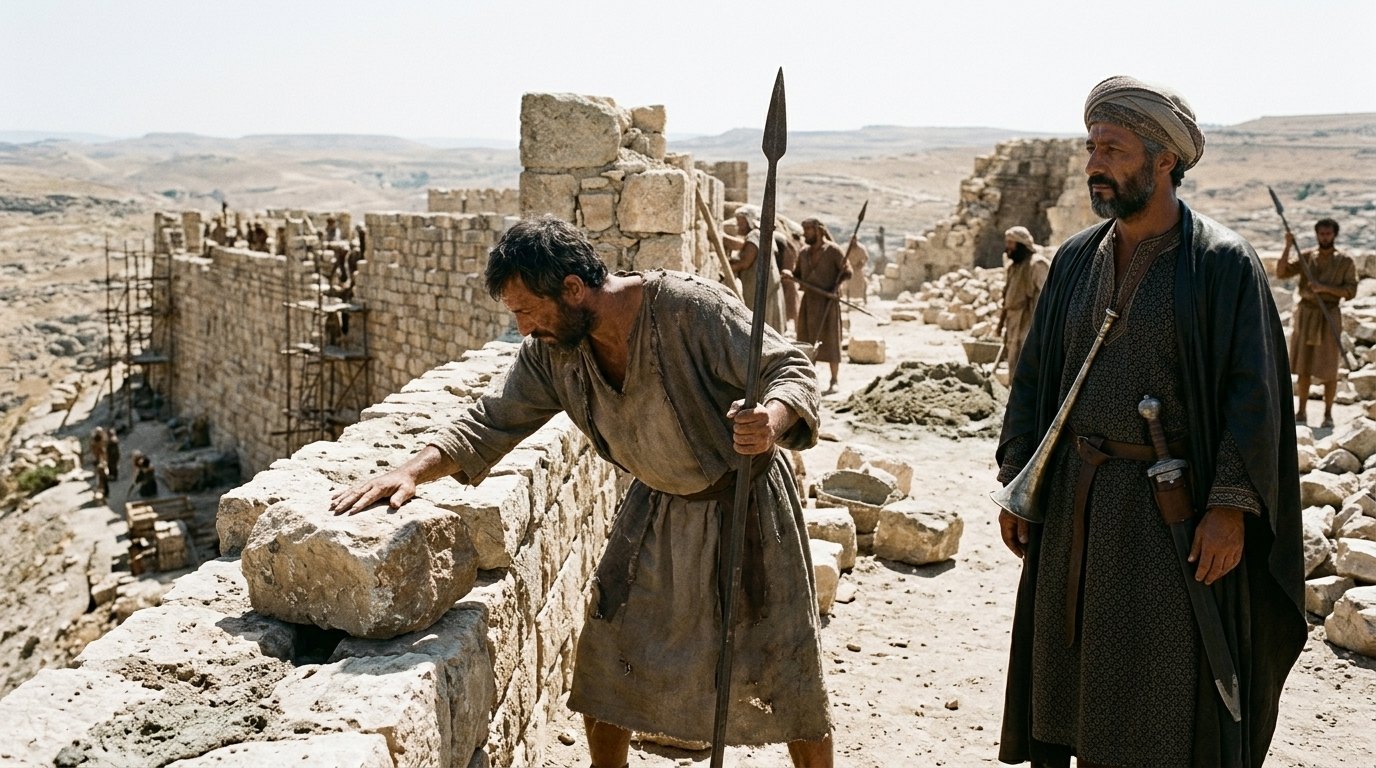
Nehemiah 4 shows God’s people continuing His work under intense opposition through prayer, practical action, courage, and perseverance. The rebuilding of Jerusalem’s wall is threatened first by ridicule and then by violence, but God frustrates the enemies’ plans while the builders remain at their work.
How the chapter unfolds
- Ridicule meets prayer and progress. Sanballat mocks the Jews as weak, and Tobiah jokes that even a fox could knock down their wall. Nehemiah answers by praying, and the people continue building until the wall reaches half its height because they are determined to work (Nehemiah 4:1-6).
- Threats produce discouragement. Surrounding enemies conspire to attack Jerusalem. The builders are exhausted by the rubble, frightened by reports of attack, and tempted to believe the work cannot continue (Nehemiah 4:7-12).
- Nehemiah combines faith with preparation. The people pray and post a guard, while Nehemiah stations families with weapons at vulnerable places. He tells them not to fear their enemies but to remember the great and awesome Lord and to defend their families and homes (Nehemiah 4:9, 13-14).
- God defeats the plot, and the work continues. The enemies’ counsel is brought to nothing. The builders return to the wall, some working and others standing guard; some work with one hand while holding a weapon in the other. A trumpet is ready to summon help, and Nehemiah grounds their confidence in God’s promise to fight for them (Nehemiah 4:15-20). Their vigilant labor continues from morning until night (Nehemiah 4:21-23).
What the chapter teaches
- Prayer and responsible action belong together. Nehemiah neither acts without praying nor treats prayer as a reason to neglect wise preparation.
- Courage comes from remembering God, not denying danger. The threats, exhaustion, and fear are real, but Nehemiah directs the people’s attention to the Lord’s greatness (Nehemiah 4:14).
- God’s sovereignty does not make human effort pointless. God brings the enemies’ plan to nothing, yet the people still guard, organize, build, and persevere.
- Faithful work is sustained together. Families, rulers, laborers, guards, and the trumpet caller all have their place. The people protect one another rather than facing the crisis as isolated individuals.
The armed precautions belong to this historical situation of physical attack; they are not a general command for Christians to take up weapons. The chapter’s enduring pattern is dependence on God expressed through prayer, wise preparation, mutual care, and steadfast obedience.
Nehemiah’s severe prayer in Nehemiah 4:4-5 should also be faced honestly. He asks God not to overlook his enemies’ sin and to bring their reproach back upon them. He does not treat their evil as insignificant or take personal revenge; he appeals to God’s justice and then continues the work entrusted to him.
Answered from Scripture · reviewed November 12, 2026
Nehemiah 4 records how God's covenant people preserved His work under severe mockery, imminent threat of bloodshed, and inner exhaustion. By coupling heartfelt prayer with unyielding vigilance, Nehemiah demonstrates that trusting a sovereign God fuels steadfast labor rather than passive retreat.
Mockery and Prayer
Answering Ridicule with Intercession and Unbroken Labor
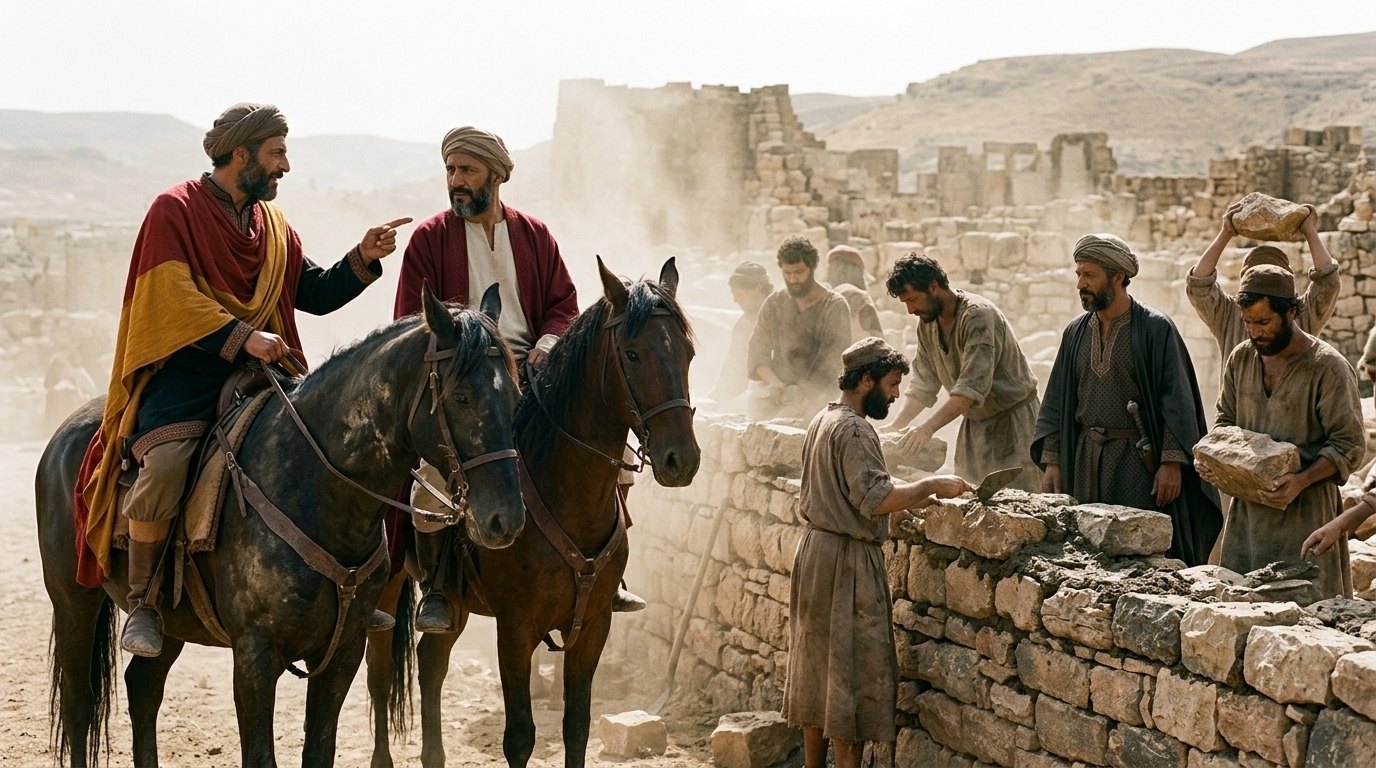
Hear us, our God, for we are despised. Turn their insults back on their own heads. Give them over as plunder in a land of captivity. Do not cover up their guilt or blot out their sins from your sight, for they have thrown insults in the face of the builders.
Nehemiah 4:4-5 (NIV)
Nehemiah commits the enemies' taunts directly into God's hands for righteous judgment rather than seeking personal vengeance.
In Nehemiah 4:4-5, the governor refuses to trade insult for insult, crying out instead: "Hear, O our God, for we are despised." Nehemiah casts the entire crisis upon the Lord's righteous court, demonstrating that true faith neither cowers before contempt nor retaliates in the flesh.
The chapter opens under a barrage of venomous hostility. Sanballat burns with wrath over Jerusalem's renewal, venting his scorn before the army of Samaria in Nehemiah 4:1-3, while Tobiah the Ammonite sneers that even a wandering jackal climbing on their stone wall would break it down. Their psychological warfare aims to sap the builders' resolve and make the covenant community despise their own labors. Instead of issuing an earthly manifesto, Nehemiah answers by intercession in Nehemiah 4:4-5, asking God to turn the adversaries' reproach upon their own heads because they have provoked Him to anger before the builders.
Prayer does not lead to passive disengagement; it fuels renewed obedience. Because their plea rests on God's covenant purpose, Nehemiah 4:6 records that "we built the wall; and all the wall was joined together unto the half thereof: for the people had a mind to work." Believers learn here that the proper answer to godless mockery is urgent prayer matched with unrelenting faithfulness to the calling God has commanded.
| Passage | What it says |
|---|---|
| Nehemiah 4:1-3 | Sanballat and Tobiah mock the Jewish builders and sneer that a fox could topple their stone wall. |
| Nehemiah 4:4-5 | Nehemiah prays for God to hear their reproach and turn the malice of the adversaries back on them. |
| Nehemiah 4:6 | The people rebuild the wall to half its height because their heart is set on working. |
Threats and Discouragement
Surrounded by Enemies and Wearied by the Rubble
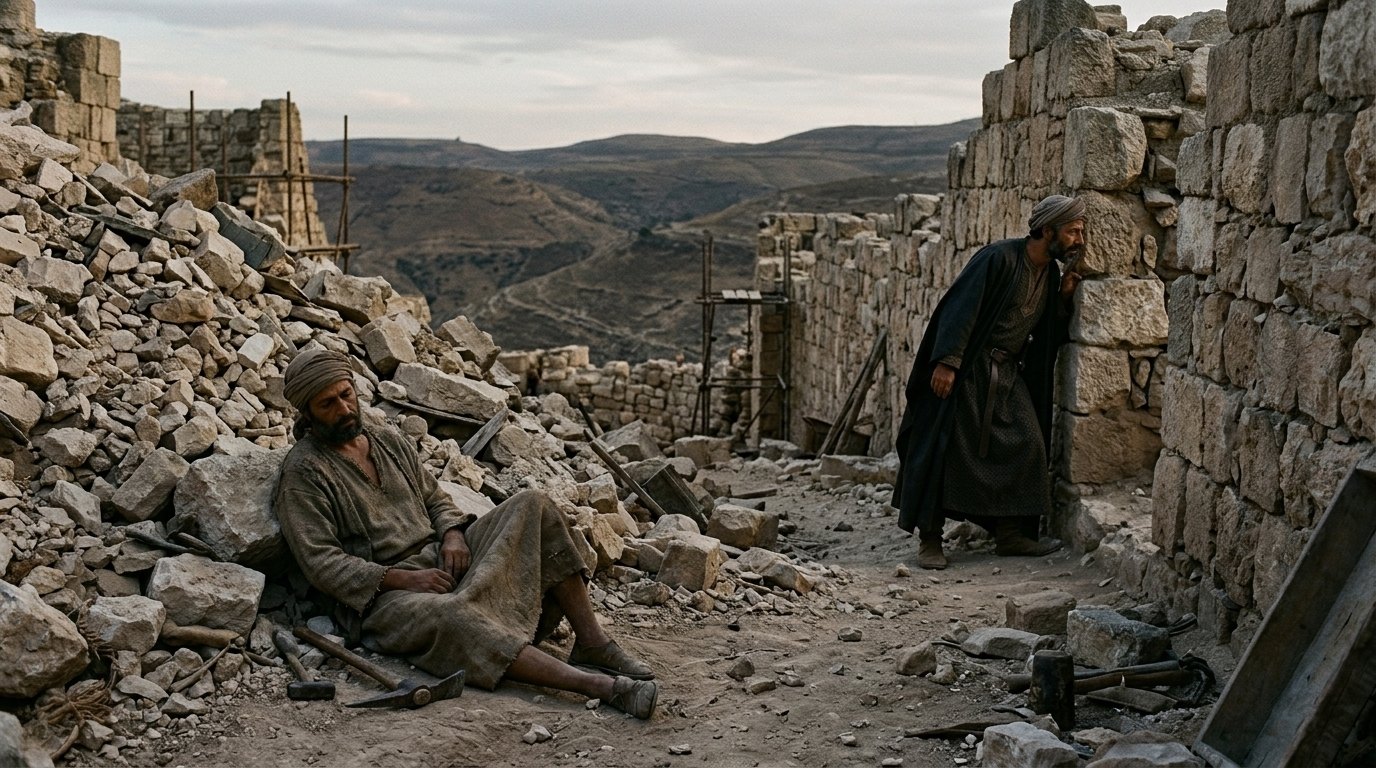
But we prayed to our God and posted a guard day and night to meet this threat.
Nehemiah 4:9 (NIV)
The people unite humble prayer to God with the practical duty of setting a watch day and night.
The heartbeat of biblical vigilance shines in Nehemiah 4:9: "Nevertheless we made our prayer unto our God, and set a watch against them day and night, because of them." Spiritual reliance and practical diligence are not rivals in the life of faith; they are inseparable duties.
Hostility rapidly escalates from ridicule into a coordinated military conspiracy. In Nehemiah 4:7-8, Sanballat, Tobiah, the Arabians, the Ammonites, and the Ashdodites band together in intense fury to launch a surprise attack against Jerusalem and stir up panic. While the community turns to God in prayer and posts sentinels, internal exhaustion threatens to accomplish what external enemies could not. According to Nehemiah 4:10, the men of Judah voice profound discouragement, lamenting that the carriers' strength is failing under vast mounds of suffocating debris, groaning that they are unable to build the wall.
Compounding this inner fatigue, the adversaries boast in Nehemiah 4:11 that they will infiltrate the city unawares and slaughter the workers. Outlying Jews repeatedly enter the city in Nehemiah 4:12, warning ten times that an ambush is imminent from every direction. The text shows that severe external threats often trigger internal despair and weariness, pressing God's people to anchor their watchfulness entirely upon His sustaining sovereignty.
| Passage | What it says |
|---|---|
| Nehemiah 4:7-8 | Surrounding regional enemies conspire together to march against Jerusalem and bring chaos to the work. |
| Nehemiah 4:9 | The community prays to God and stations a guard day and night against the brewing threat. |
| Nehemiah 4:10 | Judah reports failing strength and an overwhelming mountain of rubble that halts their building progress. |
| Nehemiah 4:11-12 | Enemies plan ambush killings while outlying Jews report ten times that an assault is coming. |
Courage and Preparation
Remembering the Lord and Defending the House
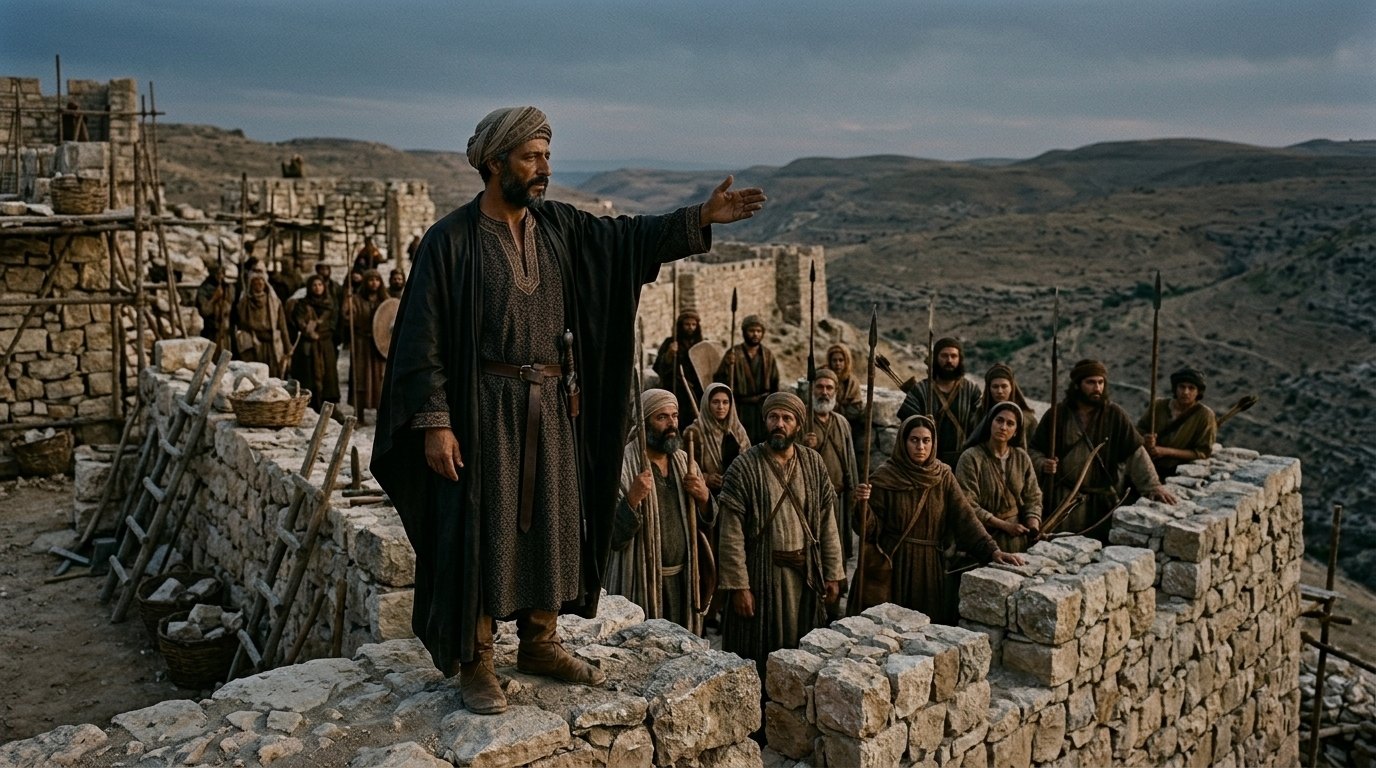
After I looked things over, I stood up and said to the nobles, the officials and the rest of the people, “Don’t be afraid of them. Remember the Lord, who is great and awesome, and fight for your families, your sons and your daughters, your wives and your homes.”
Nehemiah 4:14 (NIV)
Nehemiah centers their courage on the great and awesome Lord to drive out paralyzing fear.
Confronting widespread panic, Nehemiah delivers an electrifying charge in Nehemiah 4:14: "Be not ye afraid of them: remember the Lord, which is great and terrible, and fight for your brethren, your sons, and your daughters, your wives, and your houses." Courage does not stem from human optimism; it flows from setting the awesome majesty of God above every intimidating threat.
Nehemiah responds to the threat of ambush with clear-eyed military organization. In Nehemiah 4:13, he places the people family by family behind the lowest and most exposed points of the perimeter, arming them with swords, spears, and bows. He recognizes that men fight with desperate tenacity when defending their own kin and sacred heritage. By confronting their dread with the reality of the living God in Nehemiah 4:14, he reorients their hearts from human peril to divine power.
The enemy's plot collapses without a spear being thrown. As Nehemiah 4:15 states, once the surrounding nations realize their secret plan has been discovered, "God had brought their counsel to nought, and we returned all of us to the wall, every one unto his work." The passage teaches that God vindicates the faith of those who stand boldly on His promises, scattering the plots of darkness so His kingdom work can advance.
| Passage | What it says |
|---|---|
| Nehemiah 4:13 | Nehemiah stations families with swords, spears, and bows behind the lowest and most exposed wall openings. |
| Nehemiah 4:14 | Nehemiah commands the leaders and people not to fear, but to remember God and fight for their families. |
| Nehemiah 4:15 | God frustrates the enemies' secret ambush, permitting all the people to return safely to the wall. |
Vigilant Perseverance
Building with One Hand and Bearing Arms with the Other
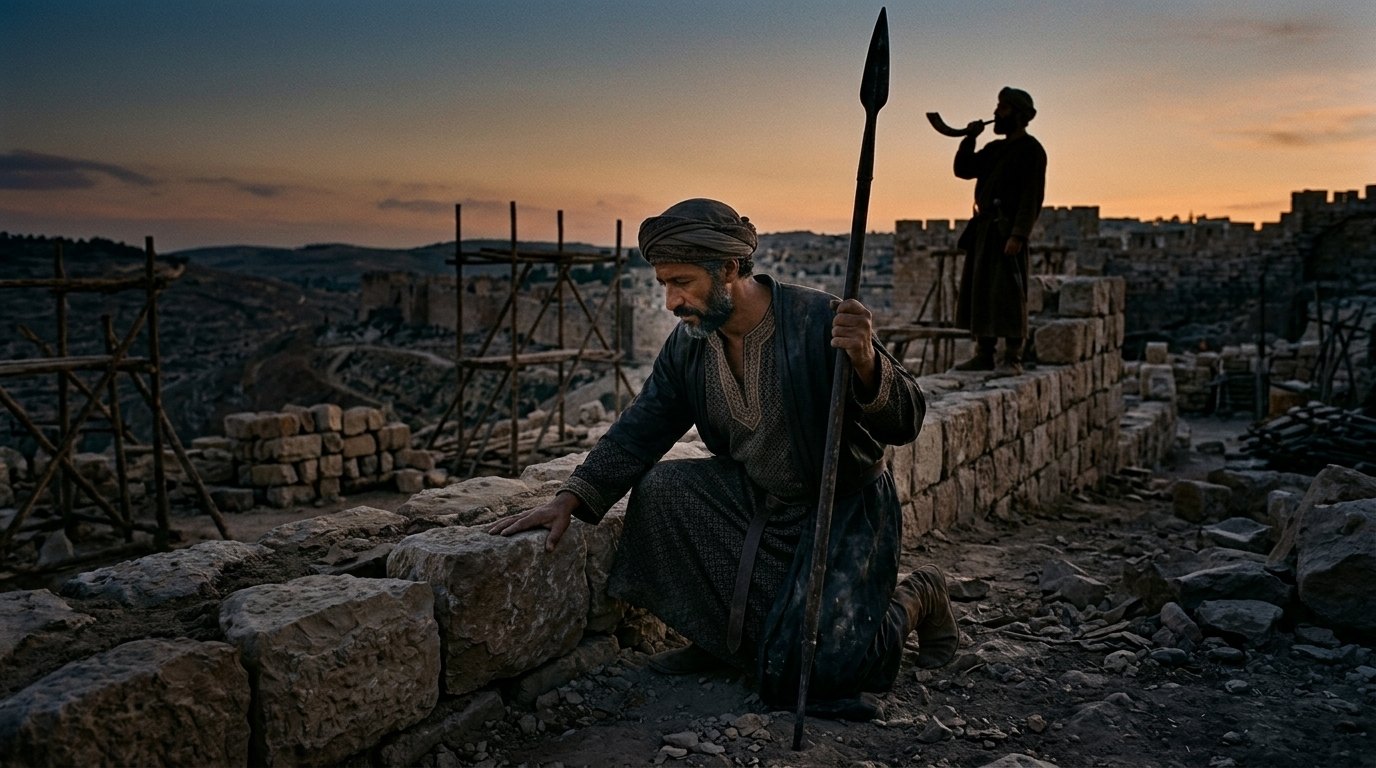
Wherever you hear the sound of the trumpet, join us there. Our God will fight for us!”
Nehemiah 4:20 (NIV)
Nehemiah anchors their defensive unity in the unshakable certainty that God will fight on their behalf.
Amid ongoing peril, Nehemiah proclaims the theological bedrock of their defense in Nehemiah 4:20: "In what place therefore ye hear the sound of the trumpet, resort ye thither unto us: our God shall fight for us." True assurance never bred carelessness in Jerusalem; it inspired an astonishing posture of armed readiness.
From that day forward, the work continues under intense mobilization. In Nehemiah 4:16-18, half of Nehemiah's personal retinue stands guard with armor, spears, and bows, while the laborers on the wall toil with one hand on their work and the other gripping a weapon. Every builder wears a sword strapped to his side as he lays stone. Because the wall is extensive and the workforce scattered, Nehemiah 4:19-20 establishes a trumpet alarm system: wherever the horn sounds, the workers must rally, confident that God Himself fights their battles.
This relentless vigilance defines their daily existence. According to Nehemiah 4:21-23, they labor unceasingly from the break of dawn until the stars appear, remaining inside the city at night for mutual protection. Neither Nehemiah, his brethren, his servants, nor the guards ever strip off their garments, keeping their weapons at their right hand even when drawing water. The chapter reveals that faithful service in a hostile world demands enduring sacrifice, continual alertness, and total dependence upon God.
| Passage | What it says |
|---|---|
| Nehemiah 4:16-18 | Half the servants hold spears while builders work with one hand and grasp a weapon with the other. |
| Nehemiah 4:19-20 | A trumpeter stands near Nehemiah to rally the scattered builders, trusting God to fight for them. |
| Nehemiah 4:21-23 | The laborers work from dawn till the stars appear, sleeping in Jerusalem in their clothes with weapons ready. |
Where in the Bible
| Book | Passages |
|---|---|
| Nehemiah | 13 · Nehemiah 4:1-3, Nehemiah 4:4-5, Nehemiah 4:6, Nehemiah 4:7-8, Nehemiah 4:9, Nehemiah 4:10, Nehemiah 4:11-12, Nehemiah 4:13, Nehemiah 4:14, Nehemiah 4:15, Nehemiah 4:16-18, Nehemiah 4:19-20, Nehemiah 4:21-23 |
The story in order
- Mockery of the builders (c. 445 BC) · Nehemiah 4:1-3 · Enemies ridicule the rebuilding effort, underestimating God's people.
- Prayer against reproach (c. 445 BC) · Nehemiah 4:4-5 · Nehemiah turns opposition into prayer, asking God to judge.
- Rebuilding to half height (c. 445 BC) · Nehemiah 4:6 · The people's commitment to work despite mockery.
- Enemies conspire to attack (c. 445 BC) · Nehemiah 4:7-8 · Regional enemies plot to disrupt and destroy Jerusalem.
- Prayer and guard against threat (c. 445 BC) · Nehemiah 4:9 · The community seeks God's help and sets up defenses.
- Report of failing strength (c. 445 BC) · Nehemiah 4:10 · Discouragement arises from the scale of rubble and exhaustion.
- Enemy ambush plans (c. 445 BC) · Nehemiah 4:11-12 · Intelligence reveals plots to kill and halt the work.
- Preparation for defense (c. 445 BC) · Nehemiah 4:13 · Families are armed and positioned at vulnerable wall sections.
- Remember God and fight (c. 445 BC) · Nehemiah 4:14 · Nehemiah rallies the people with faith and courage.
- God frustrates enemy plans (c. 445 BC) · Nehemiah 4:15 · Divine intervention protects the builders from ambush.
- Building with one hand (c. 445 BC) · Nehemiah 4:16-18 · Laborers work while armed, ready to defend.
- Trumpeter for rallying (c. 445 BC) · Nehemiah 4:19-20 · A signal system is in place to unite the defense.
- Constant labor and vigilance (c. 445 BC) · Nehemiah 4:21-23 · The people work tirelessly, sleeping armed and ready.
Prayer and Action
| Prayer | Action | Outcome | Passage |
|---|---|---|---|
| Nehemiah 4:4-5 | Nehemiah 4:6 | Wall rebuilt to half height | Nehemiah 4:4-6 |
| Nehemiah 4:9 | Nehemiah 4:9 (guard) | Threat is countered | Nehemiah 4:9 |
| Nehemiah 4:14 | Nehemiah 4:13, 16-18 | Enemies frustrated, work continues |
Opposition and Perseverance
| Opposition | Response | Result | Passage |
|---|---|---|---|
| Mockery (Nehemiah 4:1-3) | Prayer and determined work (Nehemiah 4:4-6) | Work progresses (Nehemiah 4:6) | Nehemiah 4:1-6 |
| Conspiracy and threat of violence (Nehemiah 4:7-8, 11-12) | Prayer, guard, and preparation (Nehemiah 4:9, 13-14) | Enemies frustrated, safety (Nehemiah 4:15) | Nehemiah 4:7-15 |
| Discouragement and exhaustion (Nehemiah 4:10) | Vigilant labor and trust in God (Nehemiah 4:16-23) | Work continues day and night (Nehemiah 4:21-23) | Nehemiah 4:10-23 |
Key words
- Mockery (לָעַג (la'ag))
- Ridicule and scorn directed at the builders and their work. · Nehemiah 4:1
- Reproach (חֶרְפָּה (ḥerpâ))
- Shame, disgrace, or insult; the malice of enemies. · Nehemiah 4:4
- Rubble (חֹרֶב (ḥōreb))
- Broken stones and debris from destruction, hindering progress. · Nehemiah 4:10
- Fear (פַּחַד (paḥad))
- Anxiety or dread in the face of danger. · Nehemiah 4:14
- Vigilance (שָׁמַר (shamar))
- Watchfulness and readiness to defend against threats.
Nehemiah 4 teaches that opposition to God's building will inevitably come, but it need never stop the work. When believers fix their eyes on the Lord who fights for them, prayer and faithful vigilance go hand in hand until the task is complete.
13 passages, each cited once.
Scripture cited
- Nehemiah 4