When will Jesus come back?

Matthew 24:36-44
36 “But about that day or hour no one knows, not even the angels in heaven, nor the Son, but only the Father.
37 As it was in the days of Noah, so it will be at the coming of the Son of Man.
38 For in the days before the flood, people were eating and drinking, marrying and giving in marriage, up to the day Noah entered the ark;
39 and they knew nothing about what would happen until the flood came and took them all away. That is how it will be at the coming of the Son of Man.
40 Two men will be in the field; one will be taken and the other left.
41 Two women will be grinding with a hand mill; one will be taken and the other left.
42 “Therefore keep watch, because you do not know on what day your Lord will come.
43 But understand this: If the owner of the house had known at what time of night the thief was coming, he would have kept watch and would not have let his house be broken into.
44 So you also must be ready, because the Son of Man will come at an hour when you do not expect him.
New International Version (NIV)
The answer
No one knows when Jesus will return; only God the Father knows the day and hour. Jesus said, “But no one knows of that day and hour, not even the angels of heaven, but my Father only” (Matthew 24:36). After His resurrection, He also taught that the times and seasons belong to the Father’s authority, not to human calculation (Acts 1:7).
His coming is certain, but it will be unexpected. In Noah’s day, ordinary life continued until the flood came and took people away (Matthew 24:37-39). The day of the Lord is also described as coming “as a thief in the night” (2 Peter 3:10; 1 Thessalonians 5:2). These warnings rule out confident predictions of a particular date.
The right response is watchfulness and readiness, not speculation. Jesus commands, “Watch therefore, for you don’t know in what hour your Lord comes” (Matthew 24:42), and again, “Therefore also be ready, for in an hour that you don’t expect, the Son of Man will come” (Matthew 24:44). Rather than searching for a hidden timetable, His followers are to live faithfully, ready to meet Him when He comes.
Answered from Scripture · reviewed November 11, 2026
Scripture gives an unmistakable and definitive answer regarding the date of Christ's return: no human being or angel knows the timing, for the Father alone has reserved that knowledge to Himself. Rather than offering a timeline to calculate, God calls believers to perpetual readiness, holy living, and faithful service in light of a sudden and unexpected return.
The Hidden Hour
Only the Father knows the appointed day

“But about that day or hour no one knows, not even the angels in heaven, nor the Son, but only the Father.
Matthew 24:36 (NIV)
Jesus explicitly declares that knowledge of the day and hour belongs exclusively to the Father and remains hidden from all creatures.
In Matthew 24:36, Jesus settles the timeline of His return with unmatched clarity: the precise date belongs exclusively to the sovereign knowledge of the Father. Neither the celestial angels who stand in the immediate presence of God nor any human intellect possesses this secret. Mark 13:32 underscores this profound mystery by stating that within the limitations of His earthly incarnation and humble servant status, even the Son voluntarily submitted this knowledge to the Father alone. When the disciples sought geopolitical timelines following His resurrection, the Lord gently but firmly redirected their ambitions in Acts 1:7, affirming that the Father has fixed all seasons and epochs by His own unilateral authority.
Because the calendar remains hidden by divine design, speculative prediction is entirely ruled out. Mark 13:34 illustrates this reality through the parable of a homeowner who departs on a journey, assigning specific work to each servant while charging the doorkeeper to remain on vigilant guard. The master deliberately withholds the time of his return, ensuring that fidelity is motivated by continuous honor rather than last-minute preparation. Mark 13:36 issues the sobering consequence: the master may arrive suddenly and discover his household sleeping in spiritual apathy. Divine silence regarding the hour is not an oversight, but a deliberate sanctifying boundary designed to produce unbroken faithfulness.
| Passage | What it says |
|---|---|
| Matthew 24:36 | Jesus affirms that neither the angels in heaven nor any man knows the exact day or hour, but the Father alone. |
| Mark 13:32 | Jesus states that neither angels nor the Son in His earthly incarnation know that day or hour, but only the Father. |
| Acts 1:7 | The risen Lord informs His disciples that it is not for them to know the times or seasons set by the Father's authority. |
| Mark 13:34 | A master puts servants in charge, commanding the doorkeeper to watch without giving the return time. |
| Mark 13:36 | Jesus warns the master must not find his servants sleeping upon his sudden return. |
Ordinary Life Interrupted
His coming brings sudden and decisive separation

As it was in the days of Noah, so it will be at the coming of the Son of Man.
Matthew 24:37 (NIV)
Jesus compares His future coming to the historical days of Noah, emphasizing unexpected judgment arriving amidst mundane human activity.
Opening His solemn warning in Matthew 24:37, Jesus compares His second coming to the historical days of Noah: divine judgment will break into the routine flow of ordinary human existence without preliminary fanfare. Matthew 24:38 recounts how the pre-flood world operated in total normalcy—eating, drinking, marrying, and conducting everyday family affairs—right until the moment Noah stepped through the ark's door. As Matthew 24:39 records, their sin lay not simply in daily chores, but in an oblivious disregard for God's warnings until the catastrophic flood swept them all away. Luke 17:26 reinforces that the arrival of the Son of Man will mirror this sudden shock, catching a distracted world off balance.
The same tragic pattern unfolded in Sodom. Luke 17:28 describes citizens buying, selling, planting, and building, fully consumed by temporal enterprise, until Luke 17:29 tells of the morning Lot departed and fire fell without warning. Luke 17:27 and Luke 17:30 emphasize that the apocalypse unfolds precisely when men expect business as usual. In that sudden moment, eternal separation takes place instantly across mundane settings. Matthew 24:40 and Luke 17:34 describe two men side by side in a field or sharing a bed, where one is taken and the other left behind. Matthew 24:41 and Luke 17:35 depict two women grinding grain at the household millstone, where ordinary labor is severed forever by divine separation.
| Passage | What it says |
|---|---|
| Matthew 24:37 | The coming of the Son of Man will mirror the conditions of Noah's era. |
| Matthew 24:38 | People carried on ordinary routines of eating, drinking, and marrying right until Noah boarded the ark. |
| Matthew 24:39 | The unheeding world remained oblivious until the flood arrived and swept them all away. |
| Matthew 24:40 | Two men will be working in the field; one will be taken and the other left behind. |
| Matthew 24:41 | Two women will be grinding grain at the mill; one will be taken and the other left behind. |
| Luke 17:26 | Jesus warns that the days of the Son of Man will repeat the pattern seen in Noah's time. |
| Luke 17:28 | Lot's generation also ate, drank, bought, sold, planted, and built without heed until judgment fell. |
| Luke 17:27 | People ate, drank, and married until the flood caught them unprepared. |
| Luke 17:29 | Fire and sulfur rained from heaven the day Lot exited Sodom. |
| Luke 17:30 | The Son of Man is revealed unexpectedly amid ordinary earthly living. |
| Luke 17:34 | Two people will be in one bed; one is taken and the other left. |
| Luke 17:35 | Two women will be grinding grain together; one is taken and the other left. |
The Night Thief
Christ arrives at an unexpected hour
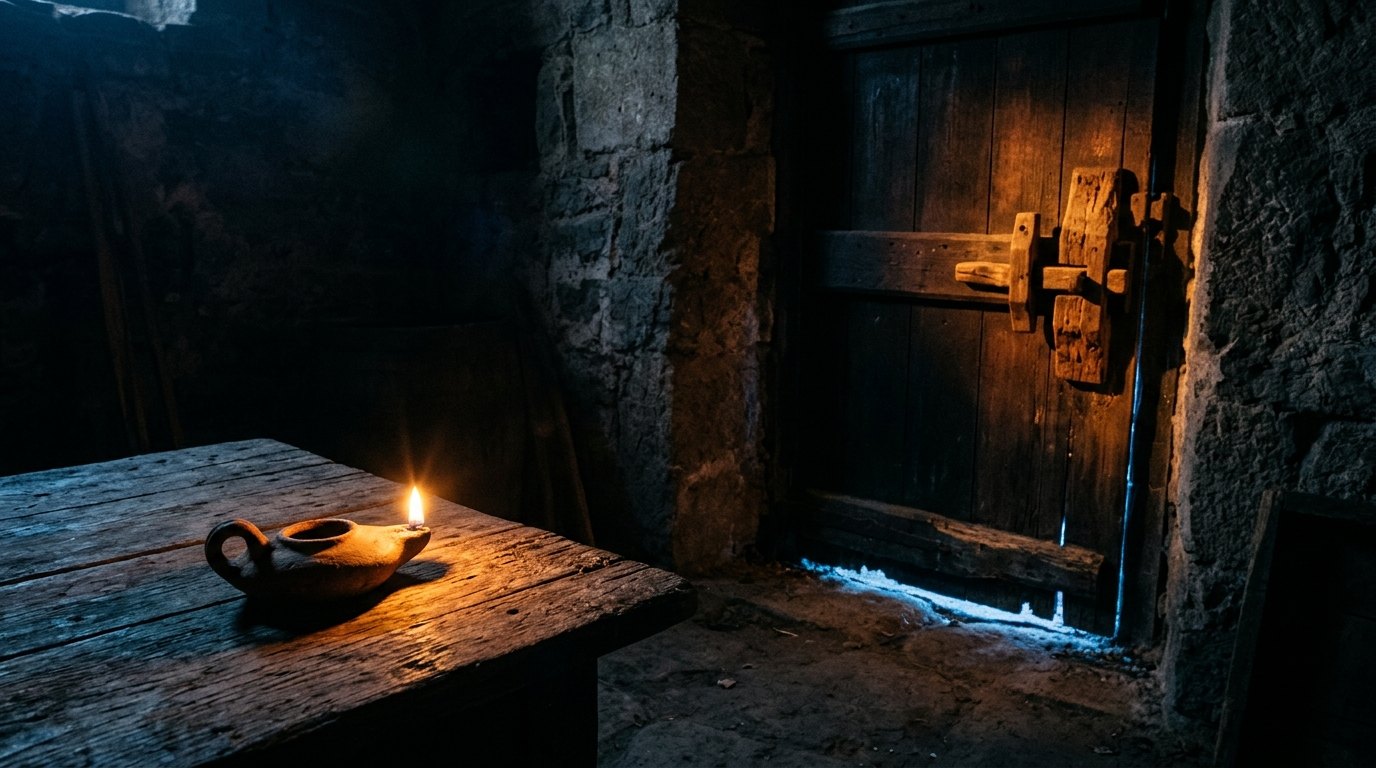
So you also must be ready, because the Son of Man will come at an hour when you do not expect him.
Matthew 24:44 (NIV)
Jesus commands ongoing preparation because His arrival will occur precisely when men do not expect Him.
Matthew 24:44 issues the definitive directive for every generation: the Son of Man returns precisely at an hour when human wisdom does not anticipate Him. Jesus establishes this necessity in Matthew 24:42, commanding unending vigilance because believers simply cannot deduce the day their Lord arrives. In Matthew 24:43 and Luke 12:39, He introduces the vivid metaphor of a homeowner guarding his residence; had the homeowner known which hour of the night the burglar intended to breach the perimeter, he would have remained vigilant and preserved his goods. Because the arrival of a thief is inherently unannounced, only persistent wakefulness prevents sudden ruin.
This apostolic metaphor echoes throughout the New Testament epistles to instruct the church on holy living. Paul writes in 1 Thessalonians 5:2 that the day of the Lord arrives like a thief in the night, bringing sudden destruction upon those crying peace and safety. Yet 1 Thessalonians 5:4 offers profound comfort: believers, walking in the light of God's Word, need not be caught unprepared like victims in the dark. Peter uses the same imagery in 2 Peter 3:10, declaring that the day of the Lord will break in like a thief, culminating in the fiery renewal of the cosmos. The exalted Christ repeats this urgent warning in Revelation 3:3 to the slumbering church in Sardis and reaffirms it in Revelation 16:15, pronouncing a rich blessing upon the faithful servant who stays awake, keeping his garments clean and ready for his Lord's unexpected appearance.
| Passage | What it says |
|---|---|
| Matthew 24:42 | Believers are charged to stay alert because they do not know what hour their Lord arrives. |
| Matthew 24:43 | A homeowner would prevent a break-in if he knew which watch the thief intended to strike. |
| Matthew 24:44 | Christ directs His hearers to be ready, for the Son of Man comes at an unanticipated hour. |
| 1 Thessalonians 5:2 | Paul reminds believers that the day of the Lord comes silently and suddenly like a thief in the night. |
| 2 Peter 3:10 | Peter states the day of the Lord will arrive like a thief, ushering in the dissolution of the heavens. |
| Revelation 16:15 | The Lord declares He comes like a thief, blessing the servant who remains awake and clothed. |
| Luke 12:39 | A homeowner who knows the thief's hour remains awake to guard his house. |
| 1 Thessalonians 5:4 | Believers are not in darkness for that day to surprise them like a thief. |
| Revelation 3:3 | Christ warns Sardis he will come like a thief if they do not wake. |
Constant Watchfulness
Readiness and faithful stewardship are commanded

Be on guard! Be alert! You do not know when that time will come.
Mark 13:33 (NIV)
The Lord commands vigilant attention and prayer because the precise time of His return remains entirely unknown.
In Mark 13:33, the Lord translates prophetic ignorance into moral urgency: take heed, watch and pray, for you do not know when the appointed time is. Mark 13:35 catalogs the Roman night watches—evening, midnight, rooster-crowing, and dawn—reminding believers that their Master could return during any watch of the night. Mark 13:37 broadens this mandate from the twelve apostles to the entire universal church throughout every age: 'What I say to you, I say to all: Watch!' Matthew 25:13 grounds the parable of the ten virgins upon this exact truth, while Luke 12:40 repeats that readiness must be continuous because Christ's arrival will confound human timetables.
Readiness is expressed through faithful stewardship rather than passive idleness. In Matthew 24:45 and Matthew 24:46, Jesus pronounces a blessing on the servant diligently feeding and caring for the household when his master appears. Luke 12:35 commands believers to keep their loins girded and their lamps burning, ready like wedding attendants in Luke 12:36 to open the door the moment their Lord knocks. Luke 12:37 and Luke 12:38 declare the blessedness of servants found wide awake whether at the second or third watch. In Luke 21:34 and Luke 21:36, Jesus warns against hearts weighed down by drunkenness, dissipation, and the anxieties of this life, commanding constant prayer to stand blameless before Him. Paul echoes this in 1 Thessalonians 5:6, urging believers to remain sober and watchful. Titus 2:13 defines this posture as looking for that blessed hope, while Hebrews 9:28 promises that Christ will appear to save those eagerly awaiting Him. James 5:8 and 1 Peter 4:7 therefore urge patience, prayer, and steady hearts, because the Judge stands at the door.
| Passage | What it says |
|---|---|
| Mark 13:33 | Jesus commands vigilance and prayer since the exact time remains hidden from men. |
| Mark 13:35 | The master could return at evening, midnight, rooster-crowing, or morning, demanding uninterrupted alert. |
| Mark 13:37 | The charge to stay awake is given plainly not just to the disciples, but to all believers. |
| Matthew 25:13 | Jesus concludes the parable of the virgins by commanding watchfulness regarding the unknown day and hour. |
| Luke 12:40 | Disciples must be ready because the Son of Man will come at an unexpected hour. |
| Matthew 24:45 | A faithful servant provides food to household members at the appointed season. |
| Matthew 24:46 | Blessed is the servant found faithfully working when the master returns. |
| Luke 12:35 | Believers are instructed to stay dressed for service and keep lamps burning. |
| Luke 12:36 | Servants await their master returning from a wedding banquet to open immediately. |
| Luke 12:37 | Blessed are those servants whom the master finds watchful upon his arrival. |
| Luke 12:38 | Blessed are those awake even if the master arrives at the second or third watch. |
| Luke 21:34 | Jesus warns not to let hearts become weighed down by dissipation and worldly worries. |
| Luke 21:36 | Watch and pray constantly to escape coming trials and stand before the Son. |
| 1 Thessalonians 5:6 | Believers are commanded to stay awake and sober rather than sleeping like others. |
| Titus 2:13 | Believers actively await the blessed hope of the appearing of Jesus Christ. |
| Hebrews 9:28 | Christ will appear a second time to save those eagerly waiting for him. |
| James 5:8 | Believers must establish their hearts patiently because the Lord's coming is near. |
| 1 Peter 4:7 | The end of all things is near, requiring self-control and sober prayer. |
Necessary Antecedents
Prior events must unfold before the end arrives

Don’t let anyone deceive you in any way, for that day will not come until the rebellion occurs and the man of lawlessness is revealed, the man doomed to destruction.
2 Thessalonians 2:3 (NIV)
Paul explicitly states that the rebellion and the revelation of the man of lawlessness precede Christ's return.
Paul confronts premature panic by declaring that the day of the Lord will not come until the rebellion occurs and the man of lawlessness is revealed, establishing clear historical precursors in 2 Thessalonians 2:3. In 2 Thessalonians 2:1-2, the apostle calms the church at Thessalonica, instructing believers not to be quickly shaken or alarmed by forged letters or prophetic claims alleging that Christ's return had already transpired. There is a divine order to redemptive history that prevents the final day from overtaking an uninformed world unannounced. Before that culmination arrives, global proclamation must also proceed; Jesus teaches in Matthew 24:14 that the gospel of the kingdom will be preached throughout the whole inhabited earth as a testimony to all nations, an absolute necessity affirmed again in Mark 13:10. The rise of final opposition will culminate in the revelation of the lawless one, yet his terror remains fleeting. Paul assures the saints in 2 Thessalonians 2:8 that the Lord Jesus will destroy that very rebel with the breath of His mouth and wipe him out by the splendor of His appearing. The sovereign orchestrator of history ensures that every word of prophecy unfolds precisely as decreed before the skies part.
| Passage | What it says |
|---|---|
| Matthew 24:14 | The gospel of the kingdom will be proclaimed to all nations before the end. |
| Mark 13:10 | The gospel must first be preached to all nations before the consummation. |
| 2 Thessalonians 2:1 | Paul addresses concerning the coming of the Lord and our gathering to him. |
| 2 Thessalonians 2:2 | Believers are told not to be easily shaken thinking the day had arrived. |
| 2 Thessalonians 2:3 | The day will not come until the rebellion occurs and lawlessness is revealed. |
| 2 Thessalonians 2:8 | The lawless one will be overthrown by the breath of the Lord's mouth. |
Divine Patience
Apparent delay reflects God's saving patience toward sinners

The Lord is not slow in keeping his promise, as some understand slowness. Instead he is patient with you, not wanting anyone to perish, but everyone to come to repentance.
2 Peter 3:9 (NIV)
The Lord's timetable is governed by His mercy, giving space for all to come to repentance.
The apostle Peter reminds believers that the Lord is not slow in keeping his promise, but is patient toward you, not wanting anyone to perish but everyone to come to repentance, grounding the calendar of heaven in divine mercy in 2 Peter 3:9. Skeptics misinterpret God's forbearance as divine impotence or indifference; 2 Peter 3:3-4 warns that cynical scoffers will emerge in the last days, driven by their own lusts and mocking the promise of Christ's arrival by claiming that all things continue unaltered since the beginning of creation. Such mockers forget that the Lord's perception of duration transcends creaturely boundaries, for 2 Peter 3:8 reveals that with the Lord a single day is like a thousand years, and a thousand years like a single day. God does not measure time through the narrow lens of mortal impatience. What human eyes perceive as postponement is actually an era of divine restraint that preserves the world for redemption. Therefore, Peter commands believers in 2 Peter 3:15 to count the patience of our Lord as salvation, celebrating every passing day as a generous gift from God to gather His elect into eternal life.
| Passage | What it says |
|---|---|
| 2 Peter 3:3 | Scoffers will arise in the last days following their own sinful desires. |
| 2 Peter 3:4 | Scoffers ask where the promised coming is since creation remains unchanged. |
| 2 Peter 3:8 | With the Lord a single day is like a thousand years. |
| 2 Peter 3:9 | God does not delay as some count slowness, but exercises patient mercy toward repentance. |
| 2 Peter 3:15 | Count the patience of our Lord as salvation for mankind. |
The Imminent Return
The sure promise that Christ comes quickly and visibly

He who testifies to these things says, “Yes, I am coming soon.” Amen. Come, Lord Jesus.
Revelation 22:20 (NIV)
Scripture concludes with Jesus' personal pledge of an imminent return and the church's longing prayer.
The closing verses of the canon ring out with the King's definitive vow: 'Yes, I am coming soon,' answered by the church's eager cry, 'Amen. Come, Lord Jesus', sealed forever in Revelation 22:20. Scripture refuses to leave the return of Christ as an abstract concept or an indefinite mystery; rather, Revelation 1:7 proclaims that He is coming with the clouds, and every eye will see Him, even those who pierced Him, bringing universal recognition to the exalted Lamb. His return remains impending and sudden, demanding an earnest response of faithful obedience. In Revelation 22:7, the Lord repeats His solemn pledge, 'Look, I am coming soon,' pronouncing a blessing upon everyone who keeps the words of the prophecy written in this book. He brings full justice with Him; as Revelation 22:12 affirms, His reward is with Him to repay each person according to what they have done. For the believer, this impending advent is not a source of dread, but the ultimate consummation of hope, prompting the church throughout every generation to live in watchful expectancy and joyful adoration.
| Passage | What it says |
|---|---|
| Revelation 1:7 | He is coming with clouds, and every eye will see him. |
| Revelation 22:7 | Jesus declares he is coming soon, blessing those keeping the prophecy. |
| Revelation 22:12 | Christ comes soon to repay each according to what they have done. |
| Revelation 22:20 | He who testifies confirms he is coming soon, met by the church's amen. |
Where in the Bible
| Book | Passages |
|---|---|
| Matthew | 13 · Matthew 24:36, Matthew 24:37, Matthew 24:38, Matthew 24:39, Matthew 24:40, Matthew 24:41, Matthew 24:42, Matthew 24:43, Matthew 24:44, Matthew 25:13, Matthew 24:45, Matthew 24:46, Matthew 24:14 |
| Mark | 7 · Mark 13:32, Mark 13:34, Mark 13:36, Mark 13:33, Mark 13:35, Mark 13:37, Mark 13:10 |
| Luke | 15 · Luke 17:26, Luke 17:28, Luke 17:27, Luke 17:29, Luke 17:30, Luke 17:34, Luke 17:35, Luke 12:39, Luke 12:40, Luke 12:35, Luke 12:36, Luke 12:37, Luke 12:38, Luke 21:34, Luke 21:36 |
| Acts | 1 · Acts 1:7 |
| 1 Thessalonians | 3 · 1 Thessalonians 5:2, 1 Thessalonians 5:4, 1 Thessalonians 5:6 |
| 2 Thessalonians | 4 · 2 Thessalonians 2:1, 2 Thessalonians 2:2, 2 Thessalonians 2:3, 2 Thessalonians 2:8 |
| Titus | 1 · Titus 2:13 |
| Hebrews | 1 · Hebrews 9:28 |
| James | 1 · James 5:8 |
| 1 Peter | 1 · 1 Peter 4:7 |
| 2 Peter | 6 · 2 Peter 3:10, 2 Peter 3:3, 2 Peter 3:4, 2 Peter 3:8, 2 Peter 3:9, 2 Peter 3:15 |
| Revelation | 6 · Revelation 16:15, Revelation 3:3, Revelation 1:7, Revelation 22:7, Revelation 22:12, Revelation 22:20 |
The story in order
- Creation and Fall (c. 4000 BC) · Genesis 1:1 · God's perfect beginning, marred by sin.
- The Flood (c. 2350 BC) · Matthew 24:37 · Judgment came unexpectedly during ordinary life.
- Sodom and Gomorrah (c. 2070 BC) · Luke 17:28 · Judgment fell on unheeding cities.
- Abrahamic Covenant (c. 2000 BC) · Genesis 12:1-3 · God's promise of blessing through a chosen line.
- Exodus from Egypt (c. 1450 BC) · Exodus 12:1-14 · God's deliverance of His people.
- Giving of the Law (c. 1450 BC) · Exodus 20:1-17 · God's standard for His people.
- Davidic Kingdom (c. 1000 BC) · 2 Samuel 7:11-16 · Promise of an eternal king.
- Prophetic Warnings (c. 740 BC) · Isaiah 1:16-17 · Call to repentance before judgment.
- Babylonian Exile (586 BC) · Jeremiah 25:11-12 · Consequence of disobedience.
- Return from Exile (538 BC) · Ezra 1:1-4 · God's faithfulness to His promises.
- The Gospel Preached (AD 30) · Matthew 24:14 · The gospel goes to all nations.
- Christ's Ascension (AD 30) · Acts 1:9 · Promise of His return.
- The Day of the Lord (Future) · 1 Thessalonians 5:2 · Christ returns suddenly and unexpectedly.
Key words
- times or seasons (καιροὺς ἢ τὰς ὥρας (kairous ē tas hōras))
- Specific periods or appointed times set by God's authority. · Acts 1:7
- watch (γρηγορέω (grēgoreō))
- To remain alert and vigilant, especially in anticipation of a sudden event. · Mark 13:33
- ready (ἑτοίμως ἔχοντες (hetoimōs echontes))
- Prepared and equipped for the master's unexpected return. · Luke 12:40
- thief in the night (κλέπτης τῇ νυκτί (kleptēs tē nykti))
- Describes the sudden, unexpected, and stealthy manner of the Lord's return. · 1 Thessalonians 5:2
- taken (παραλαμβάνεται (paralambanetai))
- Removed for judgment. · Matthew 24:40
- left (ἀφίεται (aphietai))
- Remaining behind, spared from immediate judgment. · Matthew 24:41
- day of the Lord (ἡμέρα κυρίου (hēmera kuriou))
- A future time of divine judgment and intervention. · 2 Peter 3:10
- coming soon (ἔρχομαι ταχύ (erchomai tachy))
- Emphasizes the certainty and imminence of Christ's visible return. · Revelation 22:7
Believers are not left in the dark about how to live, even though the exact hour remains unrevealed. The certainty of Christ's return calls every disciple away from speculative dates and into daily faithfulness, watchful prayer, and steady hope in the promise of God.
59 passages, each cited once.
Scripture cited
- Acts 1:7
- Matthew 24:44
- 2 Peter 3:10
- 1 Thessalonians 5:2
- Matthew 24:42