Did dinosaurs exist, and does the Bible mention them?

Job 40:15-24
15 “Look at Behemoth, which I made along with you and which feeds on grass like an ox.
16 What strength it has in its loins, what power in the muscles of its belly!
17 Its tail sways like a cedar; the sinews of its thighs are close-knit.
18 Its bones are tubes of bronze, its limbs like rods of iron.
19 It ranks first among the works of God, yet its Maker can approach it with his sword.
20 The hills bring it their produce, and all the wild animals play nearby.
21 Under the lotus plants it lies, hidden among the reeds in the marsh.
22 The lotuses conceal it in their shadow; the poplars by the stream surround it.
23 A raging river does not alarm it; it is secure, though the Jordan should surge against its mouth.
24 Can anyone capture it by the eyes, or trap it and pierce its nose?
New International Version (NIV)
The answer
Yes, dinosaurs existed; the Bible does not use the modern word “dinosaur,” and no passage identifies a particular dinosaur with certainty. Fossil bones are the remains of real animals, and their existence agrees with Genesis: God created all animal life. Behemoth may possibly describe a dinosaur, but that identification is not certain.
What Genesis establishes
On the sixth day, God made “the animals of the earth after their kind,” and on that same day He created mankind (Genesis 1:24-31). Dinosaurs therefore belong to the world God created alongside humanity, not to a history independent of Him. Genesis identifies the Creator and the created kinds; it does not catalogue every species.
The absence of the word dinosaur proves nothing: it is a modern scientific label, while Genesis was written in ancient Hebrew. Nor does extinction contradict Scripture. God never promised that every modern species would survive until the present day.
Could Behemoth be a dinosaur?
Job 40:15-24 describes a real, grass-eating animal of immense strength, with bones like bronze and iron, resting among reeds and marshes and remaining undisturbed by a flooding river. God says that He made Behemoth “as well as you” (Job 40:15).
The main proposed identifications are a hippopotamus, an elephant, or a large extinct reptile such as a sauropod. A sauropod fits especially well the statement, “He moves his tail like a cedar” (Job 40:17); the Hebrew word there is the ordinary word for a tail. Nevertheless, Job does not name the species. Calling Behemoth certainly a dinosaur would go beyond what is written, even though it remains a reasonable suggestion.
Leviathan in Job 41:1-11 is likewise described as a real, untamable water creature, but that passage does not establish it as a dinosaur either.
God's purpose in describing these creatures
God is not giving Job a zoology lesson merely to satisfy curiosity. He confronts Job with creatures man cannot master, then declares, “Everything under the heavens is mine” (Job 41:11). Even the mightiest animal is only a creature; God alone is its Maker and sovereign Lord.
Answered from Scripture · reviewed November 11, 2026
Scripture declares that the Lord formed every living creature by His sovereign power on the sixth day of creation, bringing forth land animals alongside mankind. In Job 40, God summons Job to behold Behemoth, a magnificent land beast whose physical majesty, massive strength, and unmatched stature point directly to the unmatched greatness of the Creator.
The Sixth Day
God Formed Every Beast of the Earth

And God said, “Let the land produce living creatures according to their kinds: the livestock, the creatures that move along the ground, and the wild animals, each according to its kind.” And it was so.
Genesis 1:24 (NIV)
God commands the earth to bring forth every living creature and land beast on the very same day He created mankind.
In Genesis 1:24, God commands the earth to bring forth living creatures according to their kinds: cattle, creeping things, and beasts of the earth. This authoritative decree establishes that every variety of terrestrial animal came into existence through divine fiat on the sixth day of creation. Scripture leaves no ambiguity regarding the origin of land-dwelling fauna; they did not emerge through unguided natural processes over millions of years, but were summoned into being by the spoken Word of God.
Continuing in Genesis 1:25, the record confirms that God meticulously made every beast of the earth, livestock, and crawling creature according to its kind, pronouncing the completed work good. Immediately following this, in Genesis 1:26, God resolved to create man in His own image and likeness, placing humanity in benevolent dominion over every living thing upon the land. Because mankind and every land animal were brought forth on this identical day, all land creatures originally coexisted with man within an unfallen paradise. Later reflections such as Psalms 104:14 celebrate how the Lord faithfully causes grass to grow for livestock and vegetation for man's service, demonstrating His enduring providential care over all earthly life from the dawn of creation.
| Passage | What it says |
|---|---|
| Genesis 1:24 | God commands the earth to bring forth living creatures according to their kinds: cattle, creeping things, and beasts of the earth. |
| Genesis 1:25 | God makes the beasts of the earth, cattle, and creeping things according to their kinds, seeing that it is good. |
| Genesis 1:26 | God determines to make man in His own image and grants him dominion over all the beasts and creeping things. |
| Psalms 104:14 | The Lord causes grass to grow for livestock and vegetation for man's cultivation, providing sustaining nourishment for all living earthly creatures. |
Behemoth's Might
A Creature of Astonishing Strength and Frame
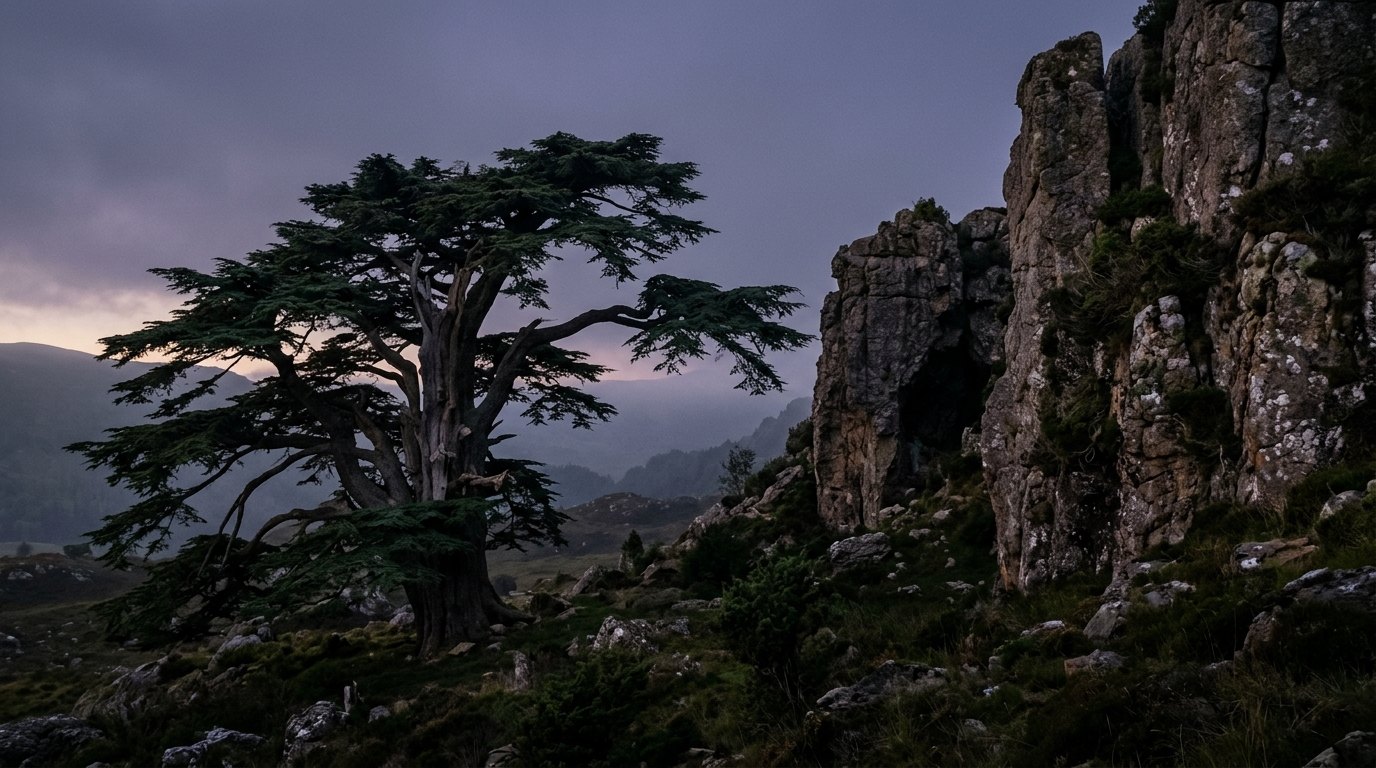
Its tail sways like a cedar; the sinews of its thighs are close-knit.
Job 40:17 (NIV)
The creature sways its massive tail like a cedar while the sinews of its muscular thighs are tightly knit together.
When God responds to Job out of the whirlwind, He directs Job's gaze to a creature whose physical magnitude evokes sheer awe. In Job 40:17, the text specifies that it moves its tail like a cedar, while the sinews of its thighs are tightly knit together. This graphic description rules out smaller pachyderms like the elephant or hippopotamus, whose slender, rope-like tails bear no resemblance to the massive, sweeping bough of a majestic cedar tree. Instead, this portrait aligns naturally with the gargantuan sauropods known from the fossil record.
The description opens in Job 40:15, where God bids Job to look upon Behemoth, explicitly noting that He made this creature along with man, and that it feeds upon grass like an ox. In Job 40:16, the Lord details its physiology: tremendous strength resides in its loins, and immense raw power is centered within the muscular sinews of its belly. The skeletal structure of the animal is equally astonishing; according to Job 40:18, its bones are like tubes of bronze and its limbs like heavy bars of forged iron. Consequently, God declares in Job 40:19 that Behemoth stands as the chief of His creative ways, an unrivaled monument of design that only its Maker can confront with a sword.
| Passage | What it says |
|---|---|
| Job 40:15 | God directs Job to observe Behemoth, whom He made along with man, noting that it feeds upon grass like an ox. |
| Job 40:16 | The creature's immense strength resides in its loins, and its formidable force is anchored in the muscular bands of its belly. |
| Job 40:17 | It moves its tail like a cedar tree, and the muscular sinews of its thighs are woven firmly together. |
| Job 40:18 | Its bones are described as robust tubes of bronze, and its heavy limbs resemble rigid bars of structural iron. |
| Job 40:19 | God designates this creature the chief of His creative ways, declaring that only its Maker can approach it with a sword. |
Habitat and Untamed Nature
Unmoved by Raging Rivers and Unconquered by Man
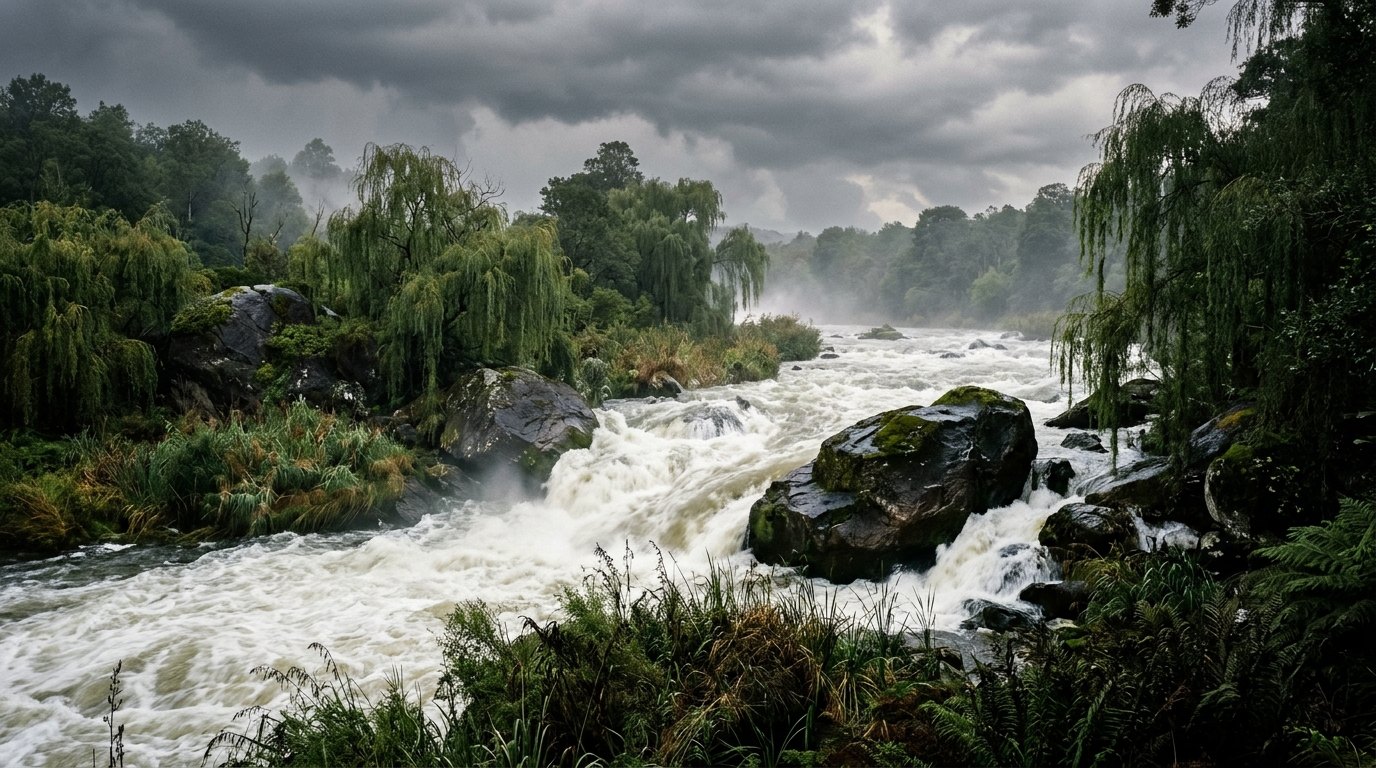
A raging river does not alarm it; it is secure, though the Jordan should surge against its mouth.
Job 40:23 (NIV)
Behemoth stands calm and undisturbed even when a torrential river surges against its very mouth.
The staggering physical stature of Behemoth is matched by its tranquil, unassailable presence within its native habitat. In Job 40:23, God highlights its absolute fearlessness: though a river swells into a violent torrent, Behemoth remains confident and unmoved, even when the waters of the Jordan burst against its mouth. A surge of raging floodwaters that would sweep away ordinary livestock fails even to stir apprehension in this immense creature, whose massive bulk anchors it firmly against the rushing current.
This peaceable giant sustains its vast frame on extensive foraging. Just as wild beasts range over hills in search of greenery as described in Job 39:8, Job 40:20 states that the high places bring forth abundant fodder for Behemoth, while the smaller beasts of the field play unharmed in its vicinity. When the heat of the day arrives, Job 40:21 records that the animal rests calmly beneath shady lotus plants, sheltered by the dense marsh reeds and protective fens. Surrounded by the willows of the brook (Job 40:22), it enjoys an unmolested existence. Man possesses no weapon capable of domesticating or subduing it; as Job 40:24 emphasizes, no human hunter can capture Behemoth openly or pierce its nose with snares.
| Passage | What it says |
|---|---|
| Job 39:8 | The wild creature ranges through mountain pasturelands, searching out every green plant for its sustenance. |
| Job 40:20 | The mountains yield ample food for Behemoth, where the other beasts of the open field play peacefully nearby. |
| Job 40:21 | The massive beast reclines beneath the shading lotus plants, hidden securely within the marsh reeds and thick fens. |
| Job 40:22 | The shady lotus trees provide protective canopy over him, while the willows of the brook encircle his marshy resting place. |
| Job 40:23 | Even if a river swells into a raging torrent, the beast remains confident and unmoved though the Jordan bursts against its mouth. |
| Job 40:24 | No hunter can capture Behemoth while on watch or successfully pierce its nose with an ordinary snare. |
Sea Monsters and Leviathan
God Created the Mighty Creatures of the Deep

So God created the great creatures of the sea and every living thing with which the water teems and that moves about in it, according to their kinds, and every winged bird according to its kind. And God saw that it was good.
Genesis 1:21 (NIV)
It shows God's sovereign creation of the massive marine creatures (tanninim) alongside all life of the sea on Day Five.
The terrestrial grandeur of Behemoth is mirrored in the aquatic realm by the formidable creatures of the deep. In Genesis 1:21, the historical record reveals that God created the great sea monsters (tanninim) and every living creature that moves in the waters on the fifth day. These massive marine reptiles and ocean beasts were not products of evolutionary accidents, but deliberate handiworks of divine majesty designed to inhabit the world's oceans.
The vastness and sovereignty of God over these aquatic giants form a recurring theme throughout biblical poetry. In Psalms 74:13, the psalmist praises the Lord who divided the Red Sea by His power and crushed the heads of the great sea monsters in the waters. Psalms 104:25 contemplates the sheer scale of the ocean, teeming with innumerable creatures both small and great, while Psalms 104:26 notes that beside the ocean-going ships, God formed Leviathan specifically to sport and frolic in the deep. Finally, Isaiah 27:1 employs Leviathan the gliding serpent and the dragon of the sea as a solemn emblem of rebellious worldly powers, promising that the Lord's great and mighty sword will ultimately execute final judgment over every chaos and spiritual adversary.
| Passage | What it says |
|---|---|
| Genesis 1:21 | God created the great sea creatures (tanninim) and every living creature moving in the waters on the fifth day. |
| Psalms 74:13 | God divided the sea by His strength and broke the heads of the sea monsters in the waters. |
| Psalms 104:25 | The vast sea contains creeping things innumerable, living creatures both small and great. |
| Psalms 104:26 | Ships go upon the sea, and Leviathan was formed by God to play in its deep waters. |
| Isaiah 27:1 | The Lord with His great and strong sword will punish Leviathan the gliding serpent and slay the dragon in the sea. |
The Anatomy of Leviathan
The Armored Leviathan Defies Human Power
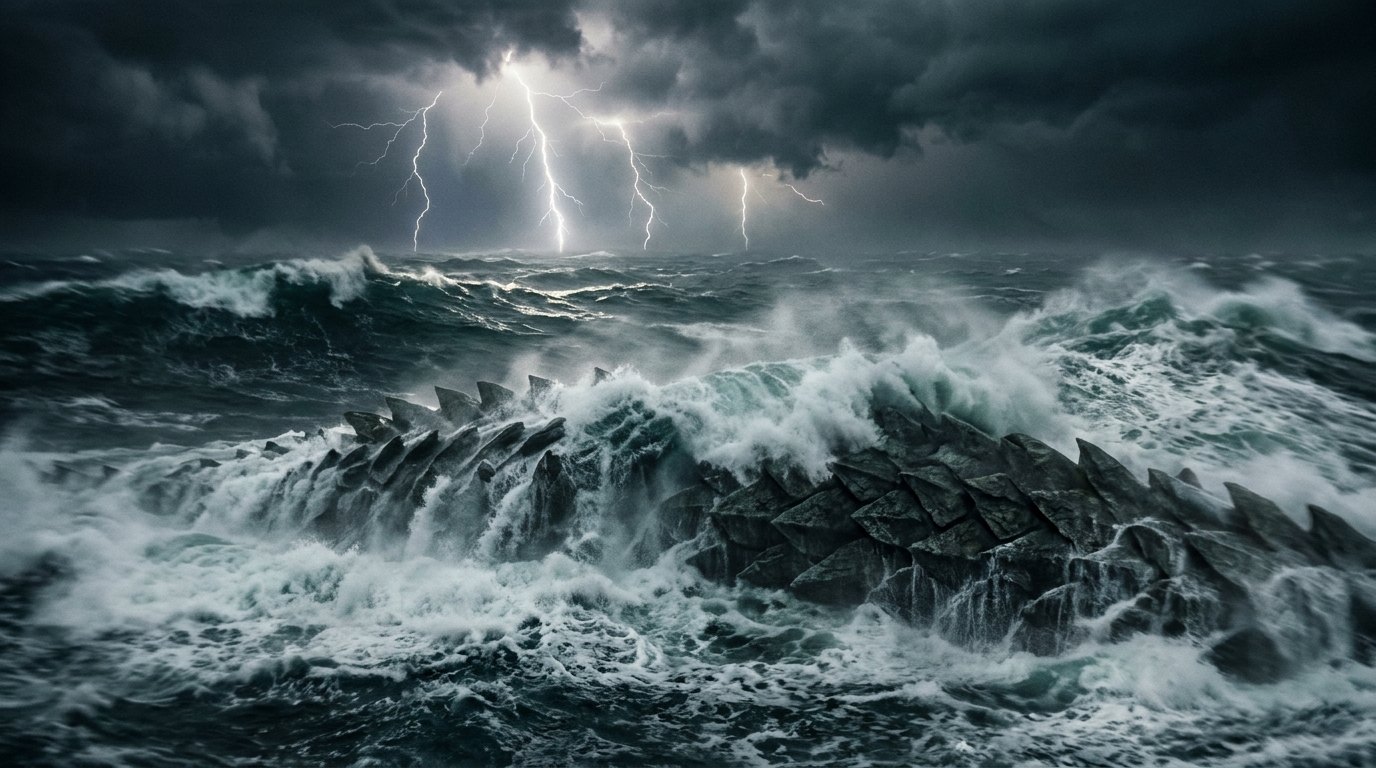
Nothing on earth is its equal— a creature without fear.
Job 41:33 (NIV)
It establishes that this immense, armored aquatic creature is peerless on earth and entirely fearless before man.
In the climax of God's interrogation of Job, the Lord presents a marine terror that humbles every human pretense. Job 41:33 declares that on earth there is nothing like him, a creature made without fear, setting Leviathan entirely apart from common aquatic predators. God opens His challenge in Job 41:1–2 by asking Job whether he can draw out Leviathan with a common fishhook, press down his tongue with a cord, or pierce his jaw with a hook. Human weapons are entirely futile against this armored monarch; Job 41:7 asks if his skin can be filled with iron harpoons, while Job 41:8 warns that to lay a hand upon him stirs a contest a man will never repeat. In Job 41:12, God explicitly commands attention toward the beast's limbs, immense power, and orderly frame.
The anatomical description that follows depicts impenetrable defensive armor. Job 41:15–17 reveals that his back consists of rows of shields shut up tightly together as with a seal, so closely fitted that no air can pass between them and no blade can sever them. The imagery rises to a fiery intensity in Job 41:18–21, where his snorting flashes light, sparks leap from his mouth, and breath pours forth like smoke from a boiling caldron, kindling coals with flame. Job 41:22 and Job 41:25 describe how strength resides in his neck, dismay dances before his path, and the mightiest men retreat when he raises himself up. Neither sword, spear, dart, nor javelin can pierce his plates (Job 41:26). He churns the ocean abyss until it froths like a boiling cauldron of ointment (Job 41:31). In the final estimation of Job 41:34, this formidable creature looks down on everything that is high, reigning as king over all the children of pride.
| Passage | What it says |
|---|---|
| Job 41:1 | God challenges Job regarding whether he can draw out Leviathan with a fishhook or press down his tongue with a cord. |
| Job 41:2 | Man cannot put a rope in Leviathan's nose or pierce his jaw with a hook. |
| Job 41:7 | Leviathan's skin cannot be filled with harpoons, nor his head with fishing spears. |
| Job 41:8 | Laying a hand upon him stirs a battle that man will never forget. |
| Job 41:12 | The Lord declares He will not keep silence concerning Leviathan's limbs, power, or graceful proportion. |
| Job 41:15 | Leviathan's back has rows of shields tightly sealed together as with a stone seal. |
| Job 41:16 | His scales are so close to one another that no air can come between them. |
| Job 41:17 | They are joined one to another and clasp together so they cannot be separated. |
| Job 41:18 | His snorting flashes forth light, and his eyes are like the eyelids of the morning. |
| Job 41:19 | Out of his mouth go flaming torches, and sparks of fire leap forth. |
| Job 41:20 | Smoke goes out of his nostrils as from a boiling pot and burning rushes. |
| Job 41:21 | His breath kindles coals, and a flame goes forth from his mouth. |
| Job 41:22 | Strength resides in his neck, and dismay dances before his presence. |
| Job 41:25 | When Leviathan raises himself up, the mighty are afraid and withdraw before his crashing. |
| Job 41:26 | The sword reaching him cannot prevail, nor does the spear, the dart, or the javelin. |
| Job 41:31 | He makes the deep boil like a cauldron and stirs the sea like a pot of ointment. |
| Job 41:33 | On earth there is nothing like him, a creature made without fear. |
| Job 41:34 | He beholds everything that is high and is king over all the children of pride. |
The Ark and the Deluge
Preserved Through the Flood and Released into the Earth
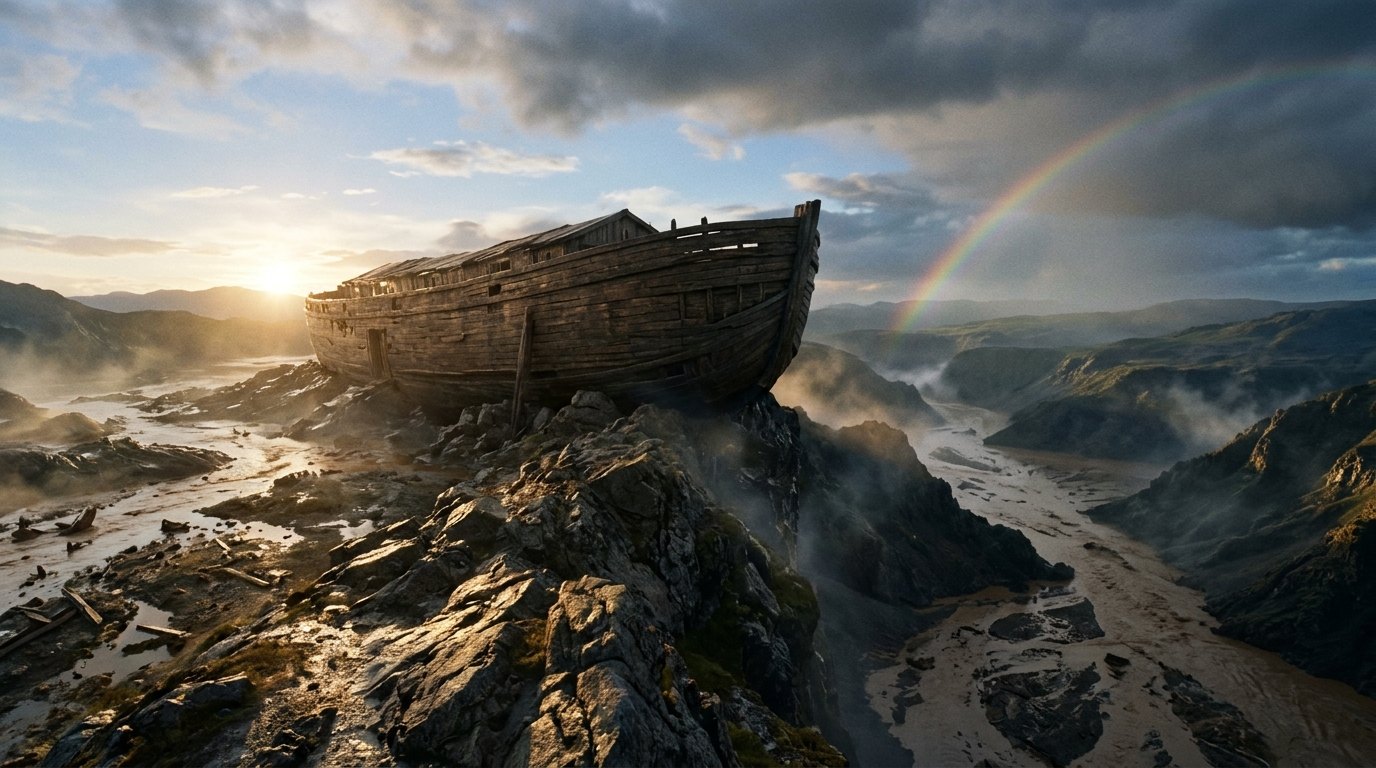
They had with them every wild animal according to its kind, all livestock according to their kinds, every creature that moves along the ground according to its kind and every bird according to its kind, everything with wings.
Genesis 7:14 (NIV)
It demonstrates that every category of air-breathing terrestrial animal was represented aboard Noah's ark.
The historical reality of the global Deluge explains both the preservation and subsequent decline of giant terrestrial beasts. Genesis 7:14 records that every beast according to its kind, all livestock, every creeping thing, and every bird went into the ark, confirming that no category of air-breathing terrestrial animal was excluded from God's covenant of preservation. Earlier, in Genesis 6:19–20, the Lord commanded Noah to bring two of every sort into the vessel to keep them alive through the judgment, specifying that birds, cattle, and ground-dwelling creatures would come to him according to their kinds. Noah followed this mandate precisely, bringing seven pairs of clean animals and a pair of every unclean creature into the safety of the gopherwood vessel, as detailed in Genesis 7:2.
The catastrophe that followed extinguished all terrestrial life outside that vessel. In Genesis 7:21–22, Scripture records that all flesh moving upon the face of the earth perished—all birds, livestock, wild beasts, and swarming things—so that everything on dry land in whose nostrils was the breath of the spirit of life died. Extinction on a staggering scale occurred in the waters of the Flood, creating immense fossil beds across every continent. Yet God remembered Noah and the animals inside the ark. When the mountain peaks emerged and the waters subsided, Genesis 8:17 recounts God commanding Noah to release every living creature so that they might breed abundantly and multiply upon the dry land. In Genesis 8:19, every beast, creeping thing, and bird departed family by family into a radically altered post-Flood biosphere, where dramatic climatic shifts, ecological hardship, and human hunting would eventually drive the largest reptiles toward total extinction.
| Passage | What it says |
|---|---|
| Genesis 6:19 | God commanded Noah to bring two of every sort of living creature into the ark to keep them alive. |
| Genesis 6:20 | Birds, cattle, and creeping things of the ground entered Noah's ark by pairs according to their kinds. |
| Genesis 7:2 | Noah took seven pairs of clean animals and a pair of every animal that is not clean. |
| Genesis 7:14 | Every beast, livestock, creeping thing, and winged creature entered the ark with Noah's family. |
| Genesis 7:21 | All flesh moving on the earth perished during the Flood, including all beasts, birds, and swarmers. |
| Genesis 7:22 | Everything on dry land in whose nostrils was the breath of the spirit of life died in the waters. |
| Genesis 8:17 | Noah released every living creature from the ark to breed abundantly and multiply on the earth. |
| Genesis 8:19 | Every beast, creeping thing, and bird departed from the ark family by family onto the renewed dry land. |
The Tannin in Scripture
Great Monsters and Serpents in Hebrew Thought
Praise the LORD from the earth, you great sea creatures and all ocean depths,
Psalms 148:7 (NIV)
It summons the earth's greatest creatures, the tanninim, to give glory and praise to their Creator.
Throughout the Old Testament, the Hebrew term tannin appears frequently to denote powerful, fearsome serpents, sea monsters, and colossal reptilian creatures. Psalms 148:7 calls the earth to praise the Lord from its deepest recesses, specifically commanding the tanninim and all ocean deeps to magnify their Creator, demonstrating that these formidable beasts were not mythological phantoms but actual works of divine power summoned to honor God. Scripture consistently treats them as tangible, terrifying realities of the animal world, exhibiting dangerous strength and lethal potential.
Moses utilizes this creature in Deuteronomy 32:33 when describing the corrupt nature of Israel's enemies, comparing their deeds to the fierce venom of serpents and the deadly poison of tanninim. In the historical account of the rebuilding of Jerusalem, Nehemiah 2:13 records that Nehemiah went out by night through the Valley Gate toward the Serpent Spring—traditionally rendered the Dragon Well—and on to the Dung Gate to inspect the broken walls, demonstrating that the term was entrenched in local topography and memory. The word also conveys acute physical danger in Psalms 91:13, where the Lord promises supernatural protection to the faithful, declaring they will tread upon the lion and the cobra and trample the young lion and the tannin beneath their feet. When Jeremiah mourned the brutal conquest of Jerusalem, he employed this imagery in Jeremiah 51:34, lamenting that King Nebuchadnezzar of Babylon had swallowed the nation whole like a voracious tannin, devouring its delicacies and casting it out. Across narrative, poetry, and prophecy, the biblical authors employed the tannin as an unmistakable emblem of terrifying physical power.
| Passage | What it says |
|---|---|
| Deuteronomy 32:33 | Moses describes venom of serpents and the deadly poison of dragons (tanninim). |
| Nehemiah 2:13 | Nehemiah inspected Jerusalem's walls by the Dragon Spring (Jackal Well) and the Dung Gate. |
| Psalms 91:13 | The faithful shall tread upon the lion and cobra, trampling the young lion and the serpent (tannin). |
| Psalms 148:7 | The psalmist calls the earth to praise the Lord, including great sea creatures (tanninim) and all deeps. |
| Jeremiah 51:34 | Nebuchadnezzar is portrayed as having swallowed Judah like a monster or dragon (tannin). |
Where in the Bible
| Book | Passages |
|---|---|
| Genesis | 12 · Genesis 1:24, Genesis 1:25, Genesis 1:26, Genesis 1:21, Genesis 6:19, Genesis 6:20, Genesis 7:2, Genesis 7:14, Genesis 7:21, Genesis 7:22, Genesis 8:17, Genesis 8:19 |
| Deuteronomy | 1 · Deuteronomy 32:33 |
| Nehemiah | 1 · Nehemiah 2:13 |
| Job | 29 · Job 40:15, Job 40:16, Job 40:17, Job 40:18, Job 40:19, Job 39:8, Job 40:20, Job 40:21, Job 40:22, Job 40:23, Job 40:24, Job 41:1, Job 41:2, Job 41:7, Job 41:8, Job 41:12, Job 41:15, Job 41:16, Job 41:17, Job 41:18, Job 41:19, Job 41:20, Job 41:21, Job 41:22, Job 41:25, Job 41:26, Job 41:31, Job 41:33, Job 41:34 |
| Psalms | 6 · Psalms 104:14, Psalms 74:13, Psalms 104:25, Psalms 104:26, Psalms 91:13, Psalms 148:7 |
| Isaiah | 1 · Isaiah 27:1 |
| Jeremiah | 1 · Jeremiah 51:34 |
The story in order
- Creation of Beasts (c. 4000 BC) · Genesis 1:25 · God made beasts of the earth, cattle, and creeping things.
- Noah's Ark and the Flood (c. 2348 BC) · Genesis 7:14 · All living creatures entered the ark to survive the deluge.
- Release from the Ark (c. 2347 BC) · Genesis 8:19 · Creatures multiplied on the earth after the Flood.
- Job's Encounter with Behemoth (c. 2000 BC) · Job 40:15 · God presents Behemoth, a powerful land creature, to Job.
- Job's Encounter with Leviathan (c. 2000 BC) · Job 41:1 · God challenges Job regarding the mighty sea creature, Leviathan.
- Psalmist Praises God's Creation (c. 1000 BC) · Psalms 104:25 · The vast sea teems with great and small creatures.
- Prophet Warns of Serpent's Venom (c. 1400 BC) · Deuteronomy 32:33 · Serpents and dragons possess deadly poison.
- Isaiah Foretells Leviathan's Punishment (c. 700 BC) · Isaiah 27:1 · The Lord will punish the sea dragon, Leviathan.
- Jeremiah Describes Tannin (c. 590 BC) · Jeremiah 51:34 · Nebuchadnezzar is like a dragon that swallowed Judah.
Key words
- Behemoth (בְּהֵמוֹת (bə·hê·mō·wṯ))
- A powerful land creature described in Job, possibly representing a hippopotamus or a mythical beast, showcasing God's creative might. · Job 40:15
- Leviathan (לִוְיָתָן (liw·yā·ṯān))
- A formidable sea creature, often depicted as a dragon or serpent, symbolizing chaos or immense power that only God can control. · Job 41:1
- Tannin (תַּנִּין (tān·nîn))
- A Hebrew word used for various large creatures, including sea monsters, dragons, and serpents, often associated with chaos or powerful enemies. · Genesis 1:21
Whether Behemoth is understood as the largest of known beasts or a mighty creature now lost to the ages, God's address to Job accomplishes its sovereign purpose. Beholding such astonishing works of God's hands humbles human pride and draws the believer into reverent awe before the Almighty.
51 passages, each cited once.
Scripture cited
- Job 40:15-24
- Genesis 1:20-31
- Job 41:1-11