Did Jesus ever get angry?

Mark 3:1-6
1 Another time Jesus went into the synagogue, and a man with a shriveled hand was there.
2 Some of them were looking for a reason to accuse Jesus, so they watched him closely to see if he would heal him on the Sabbath.
3 Jesus said to the man with the shriveled hand, “Stand up in front of everyone.”
4 Then Jesus asked them, “Which is lawful on the Sabbath: to do good or to do evil, to save life or to kill?” But they remained silent.
5 He looked around at them in anger and, deeply distressed at their stubborn hearts, said to the man, “Stretch out your hand.” He stretched it out, and his hand was completely restored.
6 Then the Pharisees went out and began to plot with the Herodians how they might kill Jesus.
New International Version (NIV)
The answer
Yes. Jesus became angry, and his anger was righteous, not sinful. Mark 3:5 says that he “looked around at them with anger, being grieved at the hardening of their hearts.”
The occasion matters. The Pharisees were watching Jesus in the synagogue, hoping to accuse him for healing a man on the Sabbath (Mark 3:2). Jesus asked whether the Sabbath was for doing good or harm, saving life or killing, but they refused to answer (Mark 3:4). His anger was directed at their hardened hearts, and it was joined with grief. He then restored the man’s withered hand—doing good rather than seeking personal revenge (Mark 3:5). By contrast, the Pharisees went out and plotted to destroy him (Mark 3:6).
Anger itself is therefore not automatically sin. Hebrews 4:15 says Jesus was tempted in every way as we are, “yet without sin.” Ephesians 4:26 likewise says, “Be angry, and don’t sin.” Jesus’ example is not permission for resentment, rage, or retaliation. His anger responded to hardness toward God and indifference to a suffering person, and it resulted in compassionate action.
Answered from Scripture · reviewed November 11, 2026
Scripture explicitly records that Jesus experienced anger, yet He did so entirely without sin. His anger was never personal malice, fragile pride, or loss of self-control; rather, it was the holy, grief-filled reaction of divine love confronting hard-heartedness, hypocrisy, and the desecration of His Father's house. Examining how and why the Lord expressed anger clarifies what truly offends God and shows believers how righteous indignation must always be tethered to mercy and truth.
The Synagogue in Galilee
Grief and Anger Over Hardened Hearts
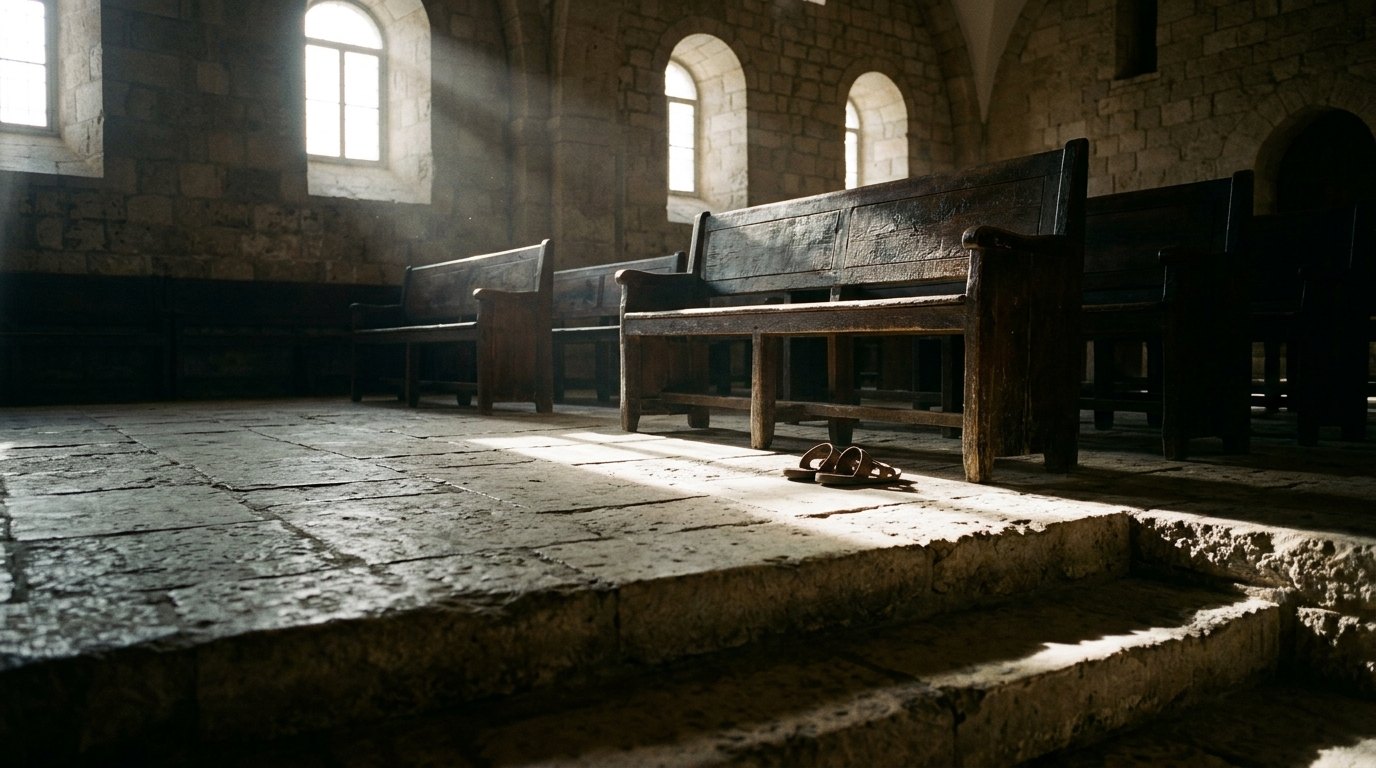
He looked around at them in anger and, deeply distressed at their stubborn hearts, said to the man, “Stretch out your hand.” He stretched it out, and his hand was completely restored.
Mark 3:5 (NIV)
Mark explicitly names Christ's emotion as anger, linking it directly to inner grief over religious hardness of heart.
The clearest explicit statement that the Son of God experienced anger occurs in Mark 3:5, where Jesus looks around at the religious watchers in the synagogue "with anger, being grieved at the hardness of their hearts." His anger was not petulant resentment, but holy abhorrence at callous men who used God's Sabbath to choke out God's mercy. Mark 3:1 records that Jesus entered the synagogue and encountered a man with a withered hand. The scribes and Pharisees in Mark 3:2 stood watching closely, hoping to manufacture grounds to accuse Him (Matthew 12:9-10; Luke 6:6-8). Knowing their covert malice, the Lord called the afflicted man forward to stand in the center (Mark 3:3).
Then Christ pierced their hypocrisy by asking whether Sabbath law commands saving life or destroying it (Mark 3:4; Luke 6:9). Matthew 12:11-12 notes His stinging challenge: any of them would eagerly rescue a sheep fallen into a pit on the Sabbath, yet they begrudged healing an image-bearer of God. Their stony, calculating silence provoked Christ's righteous indignation. Looking around the room with holy sorrow, He commanded the man to stretch out his hand, restoring it immediately to full wholeness (Mark 3:5). Unable to celebrate the rescue of a brother, the Pharisees left immediately to plot His execution alongside their bitter political rivals, the Herodians (Mark 3:6; Luke 6:11). Christ's anger was the exact moral reflection of divine compassion confronting obstinate cruelty.
| Passage | What it says |
|---|---|
| Mark 3:1 | Jesus enters the synagogue on the Sabbath, finding a man with a withered hand awaiting mercy. |
| Mark 3:2 | Pharisees watch Jesus closely to see if He will heal on the Sabbath, seeking grounds to accuse Him. |
| Mark 3:3 | Jesus calls the afflicted man to stand forward openly before the watchful assembly. |
| Mark 3:4 | Jesus asks whether Sabbath law permits doing good or evil, saving life or killing, meeting stony silence. |
| Mark 3:5 | Looking around in anger and grief over their hardened hearts, Jesus heals the man's withered hand completely. |
| Mark 3:6 | The Pharisees immediately depart and conspire with the Herodians to plot Christ's destruction. |
| Matthew 12:11-12 | Jesus points out that any of them would rescue a sheep fallen into a pit on the Sabbath. |
| Luke 6:9-11 | Luke observes that the religious leaders were filled with rage after Jesus restored the man's hand. |
| Matthew 12:9-10 | Jesus enters their synagogue where opponents watch whether He will heal on the Sabbath to accuse Him. |
| Luke 6:6-8 | Jesus knows their hostile thoughts as the scribes and Pharisees watch Him closely on the Sabbath. |
The Temple Cleansing
Holy Zeal Consumes the Temple Courts
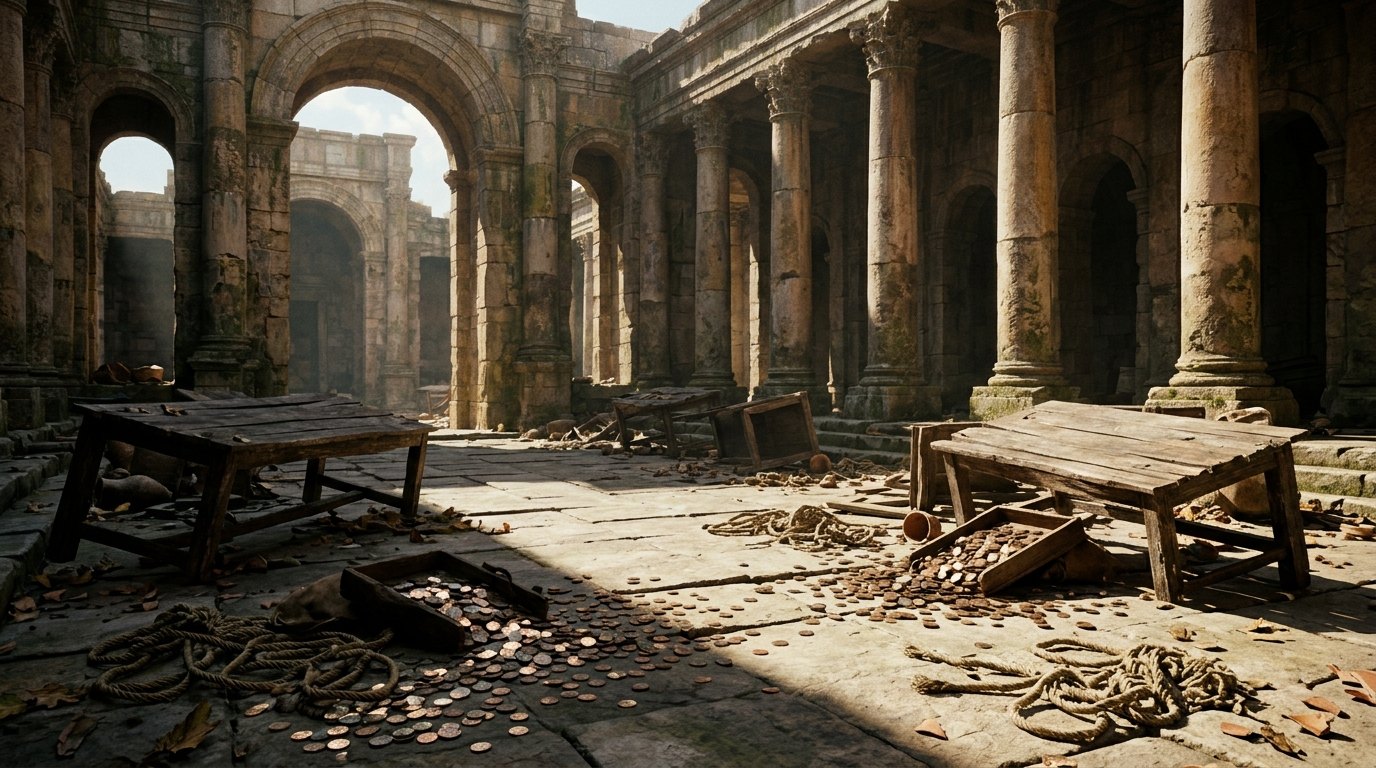
His disciples remembered that it is written: “Zeal for your house will consume me.”
John 2:17 (NIV)
The disciples recognize Jesus' forceful actions in clearing the temple as the direct fulfillment of zeal for God's house.
Nowhere is Christ's active, righteous indignation more visible than in the purification of the temple. John 2:17 records that as Jesus overturned the merchants' booths, His disciples remembered the inspired prophecy: "Zeal for Your house has eaten Me up." Entering the outer court of the temple at Passover (John 2:13-14), Jesus observed an extortionate marketplace operating where foreign seekers were supposed to worship. Making a whip of cords, Christ forcefully drove the sheep and oxen out, poured out the money changers' coins, and overturned their heavy tables (John 2:15). He commanded them plainly: do not turn My Father's house into a den of merchandise (John 2:16).
This dramatic intervention was repeated during His final Passion week. Approaching the sacred precincts, Jesus once again drove out those buying and selling, overturning tables and refusing to allow merchants to use the courts as a commercial shortcut (Matthew 21:12-13; Mark 11:15-17; Luke 19:45-46). He cited Isaiah and Jeremiah to demonstrate that His Father's dwelling was designed as a house of prayer for all nations, not an exploitative den of thieves. This was no impulsive temper, but the blazing purity predicted of the Messiah in Psalm 69:9 and Malachi 3:1-3, where the Lord suddenly visits His temple like a refiner's fire to cleanse true worship from religious greed.
| Passage | What it says |
|---|---|
| John 2:13-14 | At Passover, Jesus enters the Jerusalem temple and finds merchants and money changers conducting trade. |
| John 2:15 | Jesus braids a whip of cords, drives out the animals, scatters the money changers' coins, and overturns tables. |
| John 2:16 | Jesus commands sellers to remove their goods, forbidding them from turning His Father's house into a market. |
| John 2:17 | The disciples remember the Scripture prophesying that zeal for God's house would consume Him. |
| Matthew 21:12-13 | During His final week, Jesus again overturns temple tables, declaring God's house a den of robbers. |
| Mark 11:15-17 | Jesus forbids carrying merchandise through the courts, citing that His house must be a house of prayer for nations. |
| Luke 19:45-46 | Luke records Jesus cleansing the sacred precinct to restore the true worship of God. |
| Psalms 69:9 | David prophesies that zeal for God's house consumes the righteous sufferer, fulfilled in Christ's cleansing of the temple. |
| Malachi 3:1-3 | The Lord suddenly comes to His temple as a refiner's fire to purify the sons of Levi. |
Indignation for the Vulnerable
Defending Children and Denouncing Stumbling Blocks

When Jesus saw this, he was indignant. He said to them, “Let the little children come to me, and do not hinder them, for the kingdom of God belongs to such as these.
Mark 10:14 (NIV)
Jesus is shown to be visibly indignant when the disciples hinder little children from approaching Him.
Christ's capacity for intense moral reaction repeatedly defended the vulnerable against cold religious protocol. When parents brought infants and small children for Him to lay His hands on them and pray, the disciples sternly rebuked them (Mark 10:13; Matthew 19:13; Luke 18:15). Mark 10:14 records that "when Jesus saw it, He was greatly displeased"—an intense Greek term denoting visible, indignant displeasure. He rebuked the disciples, ordered them to let the children come unhindered, and took the little ones into His arms to bless them (Mark 10:15-16; Matthew 19:14-15; Luke 18:16-17).
This fierce protectiveness for the defenseless framed His solemn warnings against spiritual abuse. In Matthew 18:6, Mark 9:42, and Luke 17:1-2, the Lord delivered a dread warning: whoever causes one of these believing little ones to stumble would be better off cast into the ocean depths with a heavy donkey's millstone hung about his neck. The same deep internal turbulence appears in Christ's confrontation with disease and mortality. When confronting a leper's defilement, Jesus was moved with intense compassion and sternly charged him (Mark 1:41, 43). Standing at the sepulcher of Lazarus, John 11:33 and 11:38 reveal that Jesus groaned deeply in His spirit and was profoundly troubled before death itself. Divine indignation consistently arose to shield the weak from neglect, corruption, and the ravages of the fall.
| Passage | What it says |
|---|---|
| Mark 10:13 | People bring young children to Jesus to be blessed, but the disciples rebuke those who bring them. |
| Mark 10:14 | Seeing this, Jesus becomes indignant, commanding that children be permitted to come to Him freely. |
| Matthew 18:6 | Jesus warns that whoever causes a child who believes in Him to stumble deserves severe drowning. |
| Mark 1:41 | Moved with deep feeling facing the ruin of leprosy, Jesus reaches out to touch and cleanse the outcast. |
| John 11:33 | Beholding Mary weeping at Lazarus' tomb, Jesus is deeply moved in spirit and troubled over death's sorrow. |
| John 11:38 | Deeply groaning within Himself once more, Jesus approaches the tomb to confront death directly. |
| Mark 9:42 | Jesus warns that drowning with a millstone is better than causing one believing child to stumble. |
| Luke 17:1-2 | Jesus states offenses will come but pronounces woe upon anyone who causes a little one to stumble. |
| Mark 10:15-16 | Jesus blesses the children in contrast to the rebuke of the disciples. |
| Matthew 19:13-15 | Jesus insists little children be brought to Him and lays His hands on them in blessing. |
| Luke 18:15-17 | Jesus welcomes infants and asserts that the kingdom of God belongs to such as these. |
| Mark 1:43 | Jesus sternly charges the cleansed leper before sending him immediately away. |
Righteous Prophetic Rebuke
Uncompromising Woes Against Religious Hypocrisy
“You snakes! You brood of vipers! How will you escape being condemned to hell?
Matthew 23:33 (NIV)
Jesus delivers a blistering, prophetic judgment against religious rulers who shut the kingdom of heaven against men.
Jesus spoke with uncompromising, severe rebukes whenever institutional religion blinded men to the truth of God. In His final public address to the scribes and Pharisees, Jesus unveiled eight blistering prophetic woes, culminating in Matthew 23:33: "Serpents, brood of vipers! How can you escape the condemnation of hell?" He exposed leaders who bound crushing moral burdens on others without lifting a finger to help (Matthew 23:1-4; Luke 11:45-46), while locking people out of the kingdom of God (Matthew 23:13) and multiplying corruption across land and sea (Matthew 23:15).
Christ reserved His sharpest condemnation for hypocrisy that substituted outward trivialities for genuine godliness. He condemned those who scrupulously tithed backyard herbs while discarding justice, mercy, and faithfulness (Matthew 23:23; Luke 11:42), branding them as whitewashed tombs glistening outside while decaying with rot inside (Matthew 23:27-28; Luke 11:44). He exposed blind guides swearing deceitful oaths (Matthew 23:16-22) and denounced those who built memorials to ancient prophets while plotting the murder of living messengers (Matthew 23:29-32, 37-39; Luke 11:47-52). Even among His closest companions, Christ did not hesitate to offer sharp rebuke when human sentiment opposed God's redemptive will, telling Peter plainly, "Get behind Me, Satan!" (Matthew 16:21-23; Mark 8:31-33), and rebuking the persistent faithlessness of a perverse generation (Matthew 17:17; Mark 9:19; Luke 9:41). In every instance, Christ's fiery speech stood as the righteous judgment of the true King.
| Passage | What it says |
|---|---|
| Matthew 23:13 | Jesus pronounces woe on scribes and Pharisees for locking people out of the kingdom of heaven. |
| Matthew 23:15 | Jesus rebukes religious hypocrites who cross land and sea to make converts twice as fit for hell. |
| Matthew 23:23 | Jesus condemns tithing spices while omitting the weightier matters of the law: justice, mercy, and faithfulness. |
| Matthew 23:27-28 | Jesus likens hypocrites to whitewashed tombs, beautiful outward but full of dead men's bones and uncleanness. |
| Matthew 23:33 | Jesus calls corrupt leaders serpents and a brood of vipers, asking how they will escape the judgment of hell. |
| Luke 11:42-44 | Jesus pronounces woe upon leaders who neglect love and justice while coveting prominent seats. |
| Matthew 16:21-23 | Jesus sternly rebukes Peter, commanding Satan behind Him for setting his mind on human things. |
| Mark 8:31-33 | Jesus turns, looks at His disciples, and rebukes Peter for opposing God's redemptive purpose. |
| Matthew 17:17 | Jesus expresses exasperation over an unbelieving and perverse generation failing in faith. |
| Mark 9:19 | Jesus laments how long He must put up with a faithless generation. |
| Luke 9:41 | Jesus rebukes the faithless and perverse generation unable to deliver the afflicted boy. |
| Matthew 23:1-4 | Jesus exposes the religious leaders who bind heavy burdens on men's shoulders but lift not a finger. |
| Matthew 23:16-22 | Jesus calls the scribes blind guides and fools who swear falsely by the temple gold. |
| Matthew 23:29-32 | Jesus condemns the hypocrites building prophets' tombs while filling up the measure of their fathers' guilt. |
| Matthew 23:37-39 | Jesus laments over Jerusalem for killing prophets and declares their house left desolate. |
| Luke 11:45-52 | Jesus denounces lawyers for loading burdens, hiding the key of knowledge, and opposing truth. |
Anger Without Sin
The Holy Distinction Between Righteous and Sinful Wrath

For we do not have a high priest who is unable to empathize with our weaknesses, but we have one who has been tempted in every way, just as we are—yet he did not sin.
Hebrews 4:15 (NIV)
The author affirms that Christ endured every human temptation and emotion yet remained entirely free from sin.
The bedrock of understanding Christ's emotional life is found in Hebrews 4:15, which declares that our High Priest is able to sympathize with our weaknesses, having been tempted in every respect as we are, yet without sin. Human anger is almost invariably infected by wounded pride, malice, or a desire for retaliation. By contrast, Jesus exhibited holy indignation entirely divorced from personal vindictiveness. As Peter records in 1 Peter 2:22-23, when He was reviled, He did not revile in return; when He suffered, He made no threats, but instead entrusted Himself to the One who judges justly. He could challenge His fiercest critics with the question, "Which one of you convicts me of sin?" (John 8:46), for He was the spotless sacrifice who knew no sin (2 Corinthians 5:21; 1 John 3:5).
Scripture acknowledges that anger itself is not inherently sinful, but it warns how swiftly fallen hearts corrupt it. Paul writes, "Be angry and do not sin; do not let the sun go down on your anger" (Ephesians 4:26-27), echoing the wisdom of Psalms 4:4 to tremble and refrain from transgression. Because fallen anger so easily gives place to the devil, James reminds believers to be quick to hear, slow to speak, and slow to anger, "for the anger of man does not produce the righteousness of God" (James 1:19-20). Jesus Himself condemned unrighteous, contemptuous anger against a brother as a violation of the sixth commandment, placing a man in danger of hell fire (Matthew 5:22). Believers are therefore commanded to put away all wrath, malice, and slander (Colossians 3:8), relinquishing vengeance entirely to the sovereign judgment of God (Romans 12:19). Christ's anger was the perfect manifestation of holy zeal and grief over sin, proving that true righteousness hates evil while remaining perfectly pure.
| Passage | What it says |
|---|---|
| Hebrews 4:15 | Jesus sympathizes with human weaknesses, having been tempted in all points just as we are, yet without sin. |
| 1 Peter 2:22-23 | When reviled, Jesus did not revile in return; when suffering, He uttered no threats, entrusting Himself to God. |
| Ephesians 4:26-27 | Paul instructs believers to be angry without sinning, warning not to let the sun go down on wrath. |
| James 1:19-20 | James cautions believers to be slow to anger, because human anger does not produce the righteousness of God. |
| Psalms 4:4 | David counsels standing in awe and not sinning, meditating within the heart while resting quietly. |
| Matthew 5:22 | Jesus warns that unrighteous, murderous anger against a brother puts one in danger of fiery judgment. |
| 2 Corinthians 5:21 | God made Him who knew no sin to be sin for us, demonstrating Christ's sinless perfection. |
| 1 John 3:5 | Christ appeared to take away sins, and in Him there is no sin. |
| John 8:46 | Jesus challenges His accusers to convict Him of any sin. |
| Romans 12:19 | Believers are commanded never to avenge themselves but leave room for God's wrath. |
| Colossians 3:8 | Believers are instructed to put away sinful anger, wrath, malice, slander, and obscene talk. |
The Wrath of the Lamb
The Glorified Christ Executes Final Divine Wrath

They called to the mountains and the rocks, “Fall on us and hide us from the face of him who sits on the throne and from the wrath of the Lamb!
Revelation 6:16 (NIV)
It shows that divine, holy wrath is fundamentally attributed to the Lamb Himself upon the unrepentant.
While Christ walked the earth in humility, Scripture warns that His holy opposition to evil will culminate in the terrifying reality of final judgment. In Revelation 6:16, the kings of the earth, the generals, and the mighty cry out to the mountains and rocks, "Fall on us and hide us from the face of him who is seated on the throne, and from the wrath of the Lamb." This striking phrase—the wrath of the Lamb—shatters any false sentimentalism that imagines Christ as indifferent to unrepentant wicked rebellion. Revelation reveals that the great day of Their wrath has come, and no one can stand before it (Revelation 6:15-17).
This apocalyptic judgment fulfills the ancient warning of the Psalms, where the rulers of the earth are commanded to kiss the Son lest He be angry and they perish in the way (Psalms 2:10-12). When Christ returns, He comes not as a meek servant bearing the reproach of sinners, but as the conquering King of kings and Lord of lords riding a white horse in righteousness to judge and make war (Revelation 19:11-13). His robe is dipped in blood, and from His mouth comes a sharp sword with which to strike down the nations, as He treads the winepress of the fury of the wrath of God the Almighty (Revelation 19:14-16). Paul testifies that the Lord Jesus will be revealed from heaven in flaming fire, inflicting vengeance on those who do not know God and do not obey the gospel (2 Thessalonians 1:7-9). Those who persist in rebellion drink the unmixed wine of divine indignation in the presence of the holy angels and the Lamb (Revelation 14:9-10). The anger of Jesus is not an anomaly; it is the righteous, cosmic vindication of God's holiness over all that corrupts and destroys His creation.
| Passage | What it says |
|---|---|
| Revelation 6:15-17 | Kings and mighty men hide in caves from the face of God and the wrath of the Lamb. |
| Revelation 19:11-13 | The exalted Christ rides a white horse in righteousness to judge and wage war. |
| Revelation 19:14-16 | Christ treads the winepress of the furious wrath of God the Almighty as King of kings. |
| Revelation 14:9-10 | Those worshipping the beast drink the unmixed wine of God's wrath in the presence of the Lamb. |
| Psalms 2:10-12 | Kings are commanded to kiss the Son lest He be angry and they perish in the way. |
| 2 Thessalonians 1:7-9 | The Lord Jesus is revealed from heaven in flaming fire inflicting vengeance on those who disobey the gospel. |
Where in the Bible
| Book | Passages |
|---|---|
| Psalms | 3 · Psalms 69:9, Psalms 4:4, Psalms 2:10-12 |
| Malachi | 1 · Malachi 3:1-3 |
| Matthew | 17 · Matthew 12:11-12, Matthew 12:9-10, Matthew 21:12-13, Matthew 18:6, Matthew 19:13-15, Matthew 23:13, Matthew 23:15, Matthew 23:23, Matthew 23:27-28, Matthew 23:33, Matthew 16:21-23, Matthew 17:17, Matthew 23:1-4, Matthew 23:16-22, Matthew 23:29-32, Matthew 23:37-39, Matthew 5:22 |
| Mark | 15 · Mark 3:1, Mark 3:2, Mark 3:3, Mark 3:4, Mark 3:5, Mark 3:6, Mark 11:15-17, Mark 10:13, Mark 10:14, Mark 1:41, Mark 9:42, Mark 10:15-16, Mark 1:43, Mark 8:31-33, Mark 9:19 |
| Luke | 8 · Luke 6:9-11, Luke 6:6-8, Luke 19:45-46, Luke 17:1-2, Luke 18:15-17, Luke 11:42-44, Luke 9:41, Luke 11:45-52 |
| John | 7 · John 2:13-14, John 2:15, John 2:16, John 2:17, John 11:33, John 11:38, John 8:46 |
| Romans | 1 · Romans 12:19 |
| 2 Corinthians | 1 · 2 Corinthians 5:21 |
| Ephesians | 1 · Ephesians 4:26-27 |
| Colossians | 1 · Colossians 3:8 |
| 2 Thessalonians | 1 · 2 Thessalonians 1:7-9 |
| Hebrews | 1 · Hebrews 4:15 |
| James | 1 · James 1:19-20 |
| 1 Peter | 1 · 1 Peter 2:22-23 |
| 1 John | 1 · 1 John 3:5 |
| Revelation | 4 · Revelation 6:15-17, Revelation 19:11-13, Revelation 19:14-16, Revelation 14:9-10 |
The story in order
- Jesus heals on the Sabbath (c. AD 30) · Mark 3:5 · Jesus expressed anger and grief over hardened hearts when healing.
- Jesus cleanses the temple (c. AD 30) · John 2:15 · Zeal for God's house consumed Jesus as He drove out traders.
- Jesus rebukes the disciples (c. AD 30) · Mark 10:14 · Jesus became indignant when disciples rebuked children.
- Jesus denounces religious hypocrisy (c. AD 30) · Matthew 23:13 · Jesus pronounced woes on scribes and Pharisees for hypocrisy.
- Jesus rebukes Peter (c. AD 30) · Mark 8:33 · Jesus sternly rebuked Peter for opposing God's purpose.
- Jesus laments over Jerusalem (c. AD 30) · Matthew 23:37 · Jesus lamented over Jerusalem's rejection of God's messengers.
- Jesus is tempted and without sin (c. AD 60) · Hebrews 4:15 · Jesus experienced all human weaknesses yet remained sinless.
- Paul instructs on anger (c. AD 60) · Ephesians 4:26 · Believers are told to be angry but not to sin.
- James cautions against anger (c. AD 45) · James 1:20 · Human anger does not produce God's righteousness.
- The Lamb's wrath revealed (c. AD 95) · Revelation 6:16 · The mighty hide from the wrath of the Lamb.
Key words
- Anger (ὀργή (orgē))
- A strong feeling of annoyance, displeasure, or hostility. · Ephesians 4:26
- Grief (λύπη (lypē))
- Deep sorrow, especially that caused by someone's death or loss. · Mark 3:5
- Indignation (ἀγανακτέω (aganakteō))
- Anger or annoyance provoked by what is perceived as unfair treatment. · Mark 10:14
- Zeal (ζῆλος (zēlos))
- Great energy or enthusiasm in pursuit of a cause or objective. · John 2:17
- Wrath (θυμός (thymos))
- Extreme anger. · Colossians 3:8
Jesus demonstrates that anger itself is not inherently sinful, but rather an emotion that must be governed by holy zeal, love for God, and sorrow over evil. When believers feel anger, Christ calls them to examine their motives, ensure grief outstrips self-interest, and seek God's righteousness rather than fleshly vengeance.
64 passages, each cited once.
Scripture cited
- Ephesians 4:26-27
- Hebrews 4:15