Did Jesus have brothers and sisters?

Mark 6:3
3 Isn’t this the carpenter? Isn’t this Mary’s son and the brother of James, Joseph, Judas and Simon? Aren’t his sisters here with us?” And they took offense at him.
New International Version (NIV)
The answer
Yes. The Gospels explicitly speak of Jesus’ brothers and sisters; the most natural reading is that they were his younger half-siblings, children of Joseph and Mary after Jesus’ virgin birth. Mark 6:3 names four brothers—James, Joses, Judah, and Simon—and also refers to “his sisters.” The plural indicates at least two sisters, although their names are not given there. Matthew 13:55-57 gives the same family description, and Matthew 12:46 records Jesus’ mother and brothers wanting to speak with him.
This does not contradict the virgin birth. Matthew 1:18-20 explains that Mary conceived Jesus by the Holy Spirit before she and Joseph came together. Joseph was therefore not Jesus’ biological father. Matthew 1:25 adds that Joseph “didn’t know her sexually until she had given birth to her firstborn son,” language that most naturally indicates normal marital relations afterward. Later, Galatians 1:19 calls James “the Lord’s brother,” and Jude 1:1 identifies Jude as the brother of James.
The precise relationship has nevertheless been understood differently:
- Many Protestants: They were Mary and Joseph’s later children and therefore Jesus’ younger half-siblings.
- A common Eastern Orthodox reading: They were Joseph’s children from an earlier marriage and therefore Jesus’ step-siblings; Mary remained ever-virgin.
- A common Roman Catholic reading: They were other close relatives rather than children of Mary.
The Greek word for brother, adelphos, can describe either a physical brother or a broader relative. In Mark 6:3, however, the brothers and sisters are mentioned directly alongside Jesus’ mother, which is why the immediate-family reading is the natural one. What is beyond dispute is that Scripture places Jesus within a real human family while also affirming his unique conception by the Holy Spirit.
Answered from Scripture · reviewed November 11, 2026
Scripture explicitly records that Jesus had named brothers and unnamed sisters who shared His household in Nazareth. Across the Gospels, the Epistles, and the book of Acts, the New Testament repeatedly documents these familial relationships, their initial skepticism, and their eventual devotion in the early church.
The Nazareth Household
The Gospels Name Jesus' Brothers and Sisters
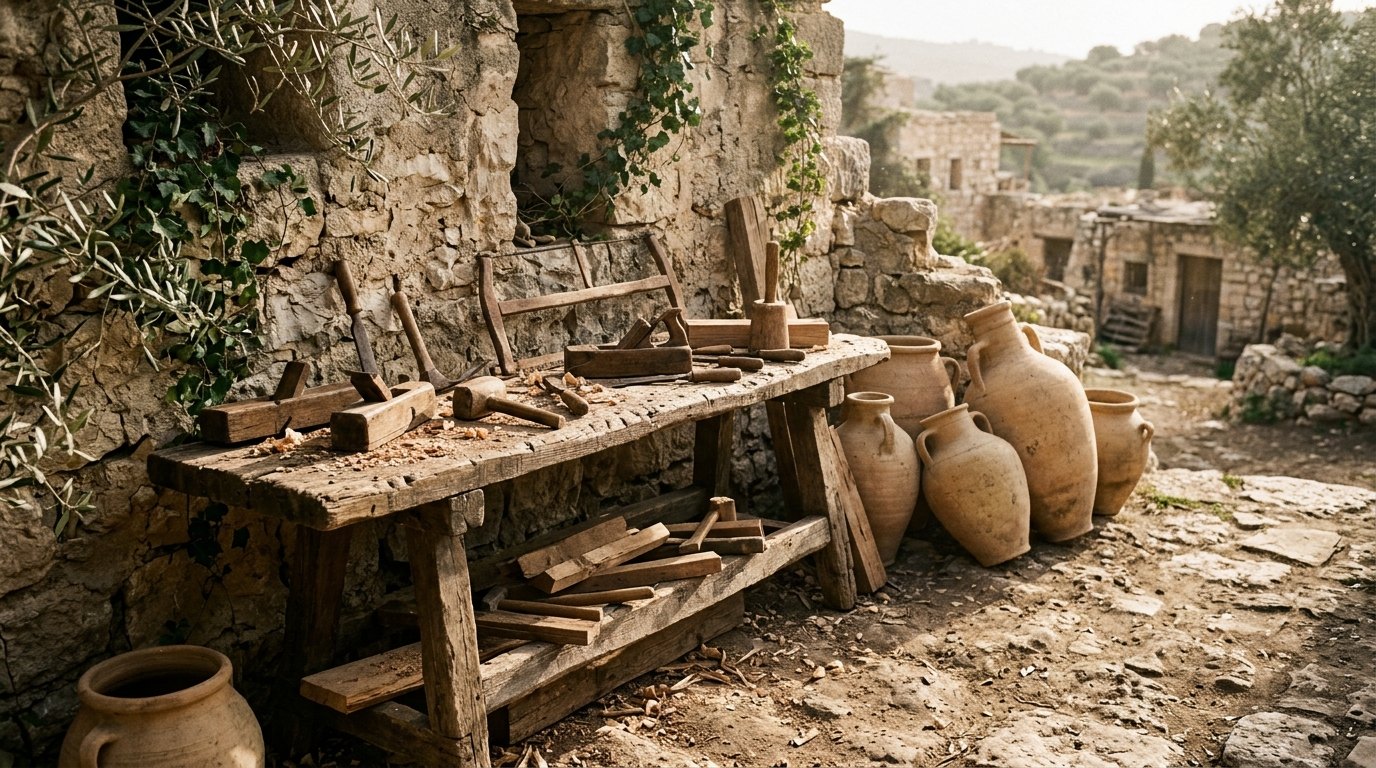
Isn’t this the carpenter? Isn’t this Mary’s son and the brother of James, Joseph, Judas and Simon? Aren’t his sisters here with us?” And they took offense at him.
Mark 6:3 (NIV)
The people of Nazareth identify Jesus by naming His four brothers and noting that His sisters reside among them.
In Mark 6:3, the people of His hometown question His supernatural wisdom and miracles by appealing directly to His ordinary domestic upbringing: "Is not this the carpenter, the son of Mary and brother of James and Joses and Judas and Simon? And are not his sisters here with us?" The citizens of Nazareth knew the family intimately and recognized Jesus as the eldest child of that familiar household. Matthew 13:55-56 presents the parallel account, explicitly identifying the four named brothers alongside unnamed sisters who lived among them in Galilee. The historical foundation for these later siblings is laid in the nativity narratives themselves. Matthew 1:25 notes that Joseph took Mary as his wife but knew her not until she had given birth to a son, while Luke 2:7 records that she gave birth to her firstborn son, natural phrasing denoting the beginning of a larger family rather than an only child. In historic Christian debate, traditions have differed over whether these siblings were subsequent children of Joseph and Mary, children of Joseph by a prior marriage, or cousins; yet Scripture plainly presents them as members of His immediate home. This domestic estrangement was foreshadowed centuries earlier in Psalm 69:8, where the Messiah laments becoming a stranger to his brothers and an alien to his mother's children, a prophetic shadow fulfilled when His kin struggled to perceive His true divine identity in John 7:5.
| Passage | What it says |
|---|---|
| Matthew 13:55-56 | Townspeople identify Jesus as the carpenter's son, naming His brothers James, Joseph, Simon, and Judas alongside His sisters. |
| Mark 6:3 | Nazareth residents question Jesus' authority by explicitly naming His brothers James, Joses, Judas, and Simon, and referencing His sisters. |
| Matthew 1:25 | Matthew records that Joseph kept Mary a virgin until she gave birth to Jesus, her firstborn son. |
| Luke 2:7 | Mary brings forth her firstborn son in Bethlehem, wrapping Him in swaddling clothes and laying Him in a manger. |
| Psalms 69:8 | Messianic prophecy foreshadowing Christ being an alien to his mother's children. |
Family During Ministry
Jesus' Kin Arrive During His Public Teaching
While Jesus was still talking to the crowd, his mother and brothers stood outside, wanting to speak to him. Someone told him, “Your mother and brothers are standing outside, wanting to speak to you.” He replied to him, “Who is my mother, and who are my brothers?” Pointing to his disciples, he said, “Here are my mother and my brothers. For whoever does the will of my Father in heaven is my brother and sister and mother.”
Matthew 12:46-50 (NIV)
Jesus' biological mother and brothers seek an audience with Him, prompting His teaching on spiritual kinship.
In Matthew 12:46-50, Jesus uses the physical arrival of His kin to articulate the priority of the kingdom of God over earthly relations: "Whoever does the will of my Father in heaven is my brother and sister and mother." While He was teaching inside a crowded house, Word arrived that His mother and brothers were waiting outside, demanding His attention. Mark 3:31-35 and Luke 8:19-21 document the same encounter, noting how the dense throngs prevented His family from reaching Him directly. Rather than capitulating to family pressure or dismissing His lineage, the Lord leveraged the moment to reveal that spiritual regeneration establishes an eternal family that transcends blood ties. Scripture portrays these siblings as active companions throughout His life, not distant acquaintances. Immediately after His first sign at the wedding in Cana, John 2:12 records that Jesus traveled down to Capernaum accompanied by His mother, His brothers, and His disciples, residing together for several days before the Passover. Their shared travel and collective presence across the Gospels demonstrate an integrated domestic life during the early phases of His public work, establishing their witness to His ministry from its inception.
| Passage | What it says |
|---|---|
| Matthew 12:46-50 | Jesus' mother and brothers stand outside desiring to speak with Him while He instructs the gathered crowds. |
| Mark 3:31-35 | Jesus' mother and brothers arrive calling Him, leading Jesus to declare those who do God's will His family. |
| Luke 8:19-21 | Luke records Jesus' mother and brothers unable to approach Him due to the pressing throng. |
| John 2:12 | After the wedding in Cana, Jesus travels down to Capernaum with His mother, His brothers, and His disciples. |
Doubt and Unbelief
His Brothers Question His Claims and Motives
For even his own brothers did not believe in him.
John 7:5 (NIV)
The Gospel of John plainly states that before the resurrection, Jesus' own brothers did not believe in Him.
The Gospel of John reveals the profound sorrow of familial skepticism in John 7:5, observing with sobering clarity: "For not even his brothers believed in him." Leading up to the Feast of Booths, His brothers challenged Him in John 7:3-5 to abandon Galilee and perform miracles publicly in Judea if He truly wished to be known, mistaking His messianic calling for personal ambition. Jesus refused their worldly advice, choosing to go up to the feast privately in John 7:10 according to the Father's appointed timing. This domestic tension had flared earlier in Mark 3:21, when His relatives sought to seize Him forcibly, concluding among themselves that He had lost His mind. Growing up beside perfect holiness did not automatically produce saving faith; it required supernatural regeneration. This persistent domestic unbelief explains why, as Jesus hung dying upon the cross in John 19:26-27, He committed the earthly care of His mother Mary to the beloved disciple John rather than to His biological brothers, who remained outside the circle of faith until after the resurrection.
| Passage | What it says |
|---|---|
| John 7:3-5 | Jesus' brothers urge Him to display His works openly in Judea, because even they did not believe in Him. |
| Mark 3:21 | Jesus' family sets out to seize Him, declaring among themselves that He is out of His mind. |
| John 19:26-27 | From the cross, Jesus entrusts the care of His mother Mary to the beloved disciple John. |
| John 7:10 | Records Jesus going up to the Feast in secret after his brothers departed. |
Faith in the Early Church
From Skeptics to Pillars of the Church

They all joined together constantly in prayer, along with the women and Mary the mother of Jesus, and with his brothers.
Acts 1:14 (NIV)
Following the ascension, the Lord's brothers are gathered in prayer alongside Mary and the eleven apostles.
Following the triumph of the resurrection, the skepticism of the Lord's brothers dissolved into steadfast worship. In Acts 1:14, the New Testament captures this transformative shift: "All these with one accord were devoting themselves to prayer, together with the women and Mary the mother of Jesus, and his brothers." The pivotal catalyst for this conversion is disclosed in 1 Corinthians 15:7, where Paul records that the risen Lord appeared specifically to James. Transformed by this encounter, James emerged as an unshakeable leader in the nascent church. When Peter was delivered from prison in Acts 12:17, he immediately directed news to James, whom Paul later visited in Acts 21:18. Writing to the Galatians, Paul identified James explicitly as the Lord's brother in Galatians 1:19 and named him alongside Cephas and John as one of the pillars of the church in Galatians 2:9. James presided over the Jerusalem Council in Acts 15:13-21, issuing the definitive judgment welcoming Gentiles without legalistic burdens. Paul also confirmed in 1 Corinthians 9:5 that the Lord's brothers traveled in apostolic labor alongside their wives. The canonical epistles crown this witness: James 1:1 and Jude 1:1 open not with boastful appeals to their physical kinship with Jesus, but with reverent submission, joyfully designating themselves as servants of Jesus Christ.
| Passage | What it says |
|---|---|
| Acts 1:14 | Jesus' brothers join the apostles and women in continuous prayer in the upper room awaiting Pentecost. |
| 1 Corinthians 15:7 | Paul records a distinct post-resurrection appearance of the risen Christ specifically to James. |
| Galatians 1:19 | Paul identifies James explicitly as the Lord's brother during his visit to Jerusalem. |
| Galatians 2:9 | James, the Lord's brother, is recognized as a pillar of the Jerusalem church alongside Cephas and John. |
| Acts 15:13-21 | James leads the Jerusalem Council, delivering the decisive pastoral judgment concerning Gentile converts. |
| 1 Corinthians 9:5 | Paul references the brothers of the Lord as traveling with their wives in ministry like other apostles. |
| James 1:1 | James introduces himself as a servant of God and of the Lord Jesus Christ to the dispersed tribes. |
| Jude 1:1 | Jude opens his epistle identifying himself as the servant of Jesus Christ and brother of James. |
| Acts 12:17 | Peter directs the believers to report his miraculous prison release to James. |
| Acts 21:18 | Paul visits James and all the elders upon arriving in Jerusalem. |
Where in the Bible
| Book | Passages |
|---|---|
| Psalms | 1 · Psalms 69:8 |
| Matthew | 3 · Matthew 13:55-56, Matthew 1:25, Matthew 12:46-50 |
| Mark | 3 · Mark 6:3, Mark 3:31-35, Mark 3:21 |
| Luke | 2 · Luke 2:7, Luke 8:19-21 |
| John | 4 · John 2:12, John 7:3-5, John 19:26-27, John 7:10 |
| Acts | 4 · Acts 1:14, Acts 15:13-21, Acts 12:17, Acts 21:18 |
| 1 Corinthians | 2 · 1 Corinthians 15:7, 1 Corinthians 9:5 |
| Galatians | 2 · Galatians 1:19, Galatians 2:9 |
| James | 1 · James 1:1 |
| Jude | 1 · Jude 1:1 |
The story in order
- Jesus' birth and early life (c. 4 BC) · Matthew 1:25 · Mary remained a virgin until Jesus' birth.
- Messianic prophecy of kinship (c. 1000 BC) · Psalms 69:8 · Foreshadows Christ being an alien to His mother's children.
- Jesus' family seeks Him (c. AD 28) · Mark 3:31-35 · His mother and brothers arrive while He teaches.
- Brothers' initial disbelief (c. AD 30) · John 7:5 · His brothers did not believe in Him.
- Jesus entrusts Mary to John (AD 30) · John 19:26-27 · Jesus cares for His mother from the cross.
- Brothers await Pentecost (AD 30) · Acts 1:14 · Jesus' brothers join the disciples in prayer.
- Post-resurrection appearance to James (AD 30) · 1 Corinthians 15:7 · The risen Christ appeared specifically to James.
- James recognized as a pillar (c. AD 49) · Galatians 2:9 · James, the Lord's brother, leads the Jerusalem church.
- James leads Jerusalem Council (c. AD 49) · Acts 15:13-21 · James delivers pastoral judgment on Gentile converts.
- Paul visits James (c. AD 57) · Acts 21:18 · Paul meets with James and the elders in Jerusalem.
- James writes his epistle (c. AD 50s) · James 1:1 · James identifies himself as servant and brother of Jesus.
- Jude writes his epistle (c. AD 60s) · Jude 1:1 · Jude identifies himself as servant and brother of James.
Jesus' True Family
| Jesus' Statement | Physical Kin | Spiritual Family | Passage |
|---|---|---|---|
| Who is my mother and my brothers? | His mother and brothers stood outside | Those who do the will of God | Mark 3:33-35 |
| My brothers are those who hear the word of God and do it. | His mother and brothers were there | Those who hear and do | Luke 8:21 |
Key words
- brothers (adelphoi, ἀδελφοί)
- Male siblings, sons of Mary and Joseph. · Matthew 13:55
- sisters (adelphai, ἀδελφαί)
- Female siblings, daughters of Mary and Joseph. · Mark 6:3
- firstborn (prōtotokos, πρωτότοκος)
- The first male child born to a mother. · Luke 2:7
- believe (pisteuō, πιστεύω)
- To trust in, rely on, have faith in. · John 7:5
- servant (doulos, δοῦλος)
- One who serves God or the Lord Jesus Christ. · James 1:1
- pillar (stylos, στῦλος)
- A key leader and supporter of the church. · Galatians 2:9
The biblical witness leaves no doubt that Jesus lived within a real human household with brothers and sisters who knew Him intimately. Their journey from hometown familiarity and early skepticism to bold apostolic witness offers enduring comfort to every believer praying for family.
23 passages, each cited once.
How the major Christian traditions read this
All Christians confess that Jesus was conceived by the Holy Spirit and born of the Virgin Mary, and that Scripture repeatedly mentions His "brothers and sisters" who were part of His earthly household (Mark 6:3; Matthew 13:55-56).
Catholic
We hold that Mary remained ever-virgin (semper virgo), both before and after the birth of Christ. Scripture frequently uses the terms "brother" and "sister" (adelphos) to mean close relatives, cousins, or kinsmen, as when Abraham calls his nephew Lot "brother" (Genesis 14:14-16). In Mark 6:3, James and Joses are called Jesus' brothers, yet Matthew 27:56 identifies them as sons of another Mary at the cross. Furthermore, Jesus entrusts His mother to the Apostle John from the cross (John 19:26-27), an act that would have been unthinkable under Jewish family law if Mary had other biological sons living.
Scripture: Genesis 14:14-16, Mark 6:3, Matthew 27:56, John 19:26-27
Orthodox
We confess the Ever-Virginity of the Theotokos, holding the ancient church tradition that the "brethren of the Lord" were Joseph's children from a prior marriage before he was betrothed to Mary. Joseph, an elderly widower, was appointed as Mary's guardian and protector. Thus, James, Jude, and the others were step-siblings to Jesus within Joseph's legal household (Mark 6:3). This explains why the older brothers often act with elder authority toward Jesus (Mark 3:21; John 7:3-5), and why Christ commended His mother into the care of the Apostle John at the crucifixion rather than to biological sons (John 19:26-27).
Scripture: Mark 3:21, Mark 6:3, John 7:3-5, John 19:26-27
Lutheran
Martin Luther and the historic Lutheran confessions upheld Mary as semper virgo, understanding the "brothers and sisters" in Mark 6:3 either as cousins according to Semitic idiom or as Joseph's children from an earlier marriage. Scripture states that Joseph "knew her not till she had brought forth her firstborn son" (Matthew 1:25), which affirms Christ's virginal conception without demanding subsequent marital relations. While modern Lutherans view this primarily as a question of historical exegesis rather than a core article of salvation, our historic heritage affirms that Mary bore no other children and that Christ's "brethren" were close kinsmen.
Scripture: Matthew 1:25, Mark 6:3, Galatians 1:19
Reformed & Presbyterian
Classical Reformers such as John Calvin defended Mary's perpetual virginity, noting that Hebrew and Aramaic idiom uses "brother" for distant relatives (Genesis 29:12; Mark 6:3). However, modern Reformed readers generally take the plain sense of the New Testament text: Matthew 1:25 notes that Joseph kept Mary a virgin "until" she gave birth, implying a normal marital relationship followed, and Luke 2:7 names Christ her "firstborn." While we reject any elevation of Mary that diminishes Christ's unique mediation, whether one reads these siblings as literal younger children of Mary and Joseph or as close cousins, Scripture presents them as true members of His earthly family.
Scripture: Genesis 29:12, Matthew 1:25, Mark 6:3, Luke 2:7
Anglican & Episcopal
Our tradition encompasses both historic and modern readings. Historic Anglican divines generally affirmed Mary's perpetual virginity, interpreting the "brothers" in Mark 6:3 and Galatians 1:19 as cousins or Joseph's children, consistent with the ancient ecumenical consensus and Christ entrusting Mary to John (John 19:26-27). Many contemporary Anglicans, however, read Mark 6:3 alongside Matthew 1:25 as indicating that Mary and Joseph went on to have children together in a blessed, holy marriage. Scripture does not make the exact biological nature of these siblings a condition of faith, and both views are held with mutual charity within our communion.
Scripture: Matthew 1:25, Mark 6:3, John 19:26-27, Galatians 1:19
Baptist
We look to the plain, grammatical meaning of the inspired text. Scripture repeatedly refers to Jesus' brothers and sisters alongside His mother Mary (Mark 6:3; Matthew 13:55-56). Matthew 1:25 clearly states that Joseph did not know Mary "until" she gave birth to Jesus, which naturally means they enjoyed a normal, God-honoring marital union afterward. Christ was Mary's "firstborn" (Luke 2:7), and James, Joses, Judas, and Simon were His younger half-brothers, born of Mary and Joseph. Honoring marriage and childbearing reflects God's design, and accepting Jesus' biological younger siblings in no way compromises the miraculous virgin birth.
Scripture: Matthew 1:25, Matthew 13:55-56, Mark 6:3, Luke 2:7
Methodist & Wesleyan
John Wesley maintained an appreciation for early church tradition, including Mary's perpetual virginity, yet Methodist doctrine anchors itself firmly in the authority of Scripture. The Gospel writers speak naturally and without qualification of Jesus' "brothers and sisters" (Mark 6:3). Most Wesleyans conclude that Mary and Joseph shared a faithful, ordinary family life after the miraculous birth of the Savior, raising younger children together (Matthew 1:25). James and Jude, later prominent in the early church, were Jesus' younger half-brothers (Galatians 1:19; Jude 1:1). Either way, God chose a real, bustling family household in which to nurture the incarnate Lord.
Scripture: Matthew 1:25, Mark 6:3, Galatians 1:19, Jude 1:1
Pentecostal & Charismatic
We take the New Testament accounts at face value. When the hometown crowd asks, "Is not this the carpenter, the son of Mary and brother of James, Joses, Judah, and Simon?" (Mark 6:3), they are describing Jesus' actual domestic family. Matthew 1:25 confirms that Joseph and Mary consummated their marriage after Jesus' birth. His brothers initially doubted Him (John 7:5), but after His resurrection, they were filled with the Holy Spirit in the Upper Room alongside Mary (Acts 1:14). Recognizing Jesus' younger half-brothers and sisters magnifies God's grace in transforming His own earthly household into bold Spirit-filled leaders.
Scripture: Matthew 1:25, Mark 6:3, John 7:5, Acts 1:14
Non-denominational & Evangelical
We believe the simplest and most natural reading of God's Word is the right one. Matthew 1:25 says Joseph did not have marital relations with Mary until she gave birth, plainly indicating that they had children together afterward. Mark 6:3 and Matthew 13:55-56 name Jesus' brothers and mention His sisters living in Nazareth. These were His younger half-siblings, born to Mary and Joseph. While Jesus was uniquely conceived of the Holy Spirit without an earthly father, Mary and Joseph's subsequent children were part of a regular, godly home, fulfilling the normal biblical calling of marriage.
Scripture: Matthew 1:25, Matthew 13:55-56, Mark 6:3
Where they differ
The biological identity of the siblings
- Catholic
- Cousins or close kinsmen of Jesus, not children of Mary.
- Orthodox
- Step-siblings, children of Joseph from a prior marriage before Mary.
- Lutheran
- Historically viewed as cousins or step-siblings; modern views vary widely.
- Reformed & Presbyterian
- Historically seen as kinsmen; modern reading views them as younger half-siblings.
- Anglican & Episcopal
- Both the cousin/step-sibling view and the younger half-sibling view are held.
- Baptist
- Younger biological half-siblings, born to Mary and Joseph after Jesus.
- Methodist & Wesleyan
- Generally understood as younger half-siblings born to Mary and Joseph.
- Pentecostal & Charismatic
- Literal younger half-brothers and half-sisters born to Mary and Joseph.
- Non-denominational & Evangelical
- Younger half-siblings born to Mary and Joseph following Jesus' birth.
Scripture: Matthew 13:55-56, Mark 6:3, Matthew 27:56
The perpetual virginity of Mary
- Catholic
- Mary remained a virgin throughout her entire life as dogma.
- Orthodox
- Mary is ever-virgin (*Aeiparthenos*), having borne only Jesus Christ.
- Lutheran
- Affirmed in historic confessions, though treated flexibly among modern believers.
- Reformed & Presbyterian
- Affirmed by early Reformers, but modern readers reject it as unbiblical.
- Anglican & Episcopal
- Held by Anglo-Catholics and historic divines; optional for modern members.
- Baptist
- Rejected; Mary and Joseph had a normal marital relationship afterward.
- Methodist & Wesleyan
- Largely rejected in practice, though Wesley respected the ancient belief.
- Pentecostal & Charismatic
- Rejected as lacking Scriptural warrant; Mary bore subsequent children.
- Non-denominational & Evangelical
- Rejected; Scripture shows Mary and Joseph had subsequent children naturally.
Scripture: Matthew 1:25, Luke 2:7, John 19:26-27
Your pastor can tell you where your church stands.
Scripture cited
- Mark 6:3
- Matthew 12:46
- Matthew 13:55-57
- Jude 1:1
- Galatians 1:19
- Matthew 1:18-25