Does the Bible mention the Big Bang?
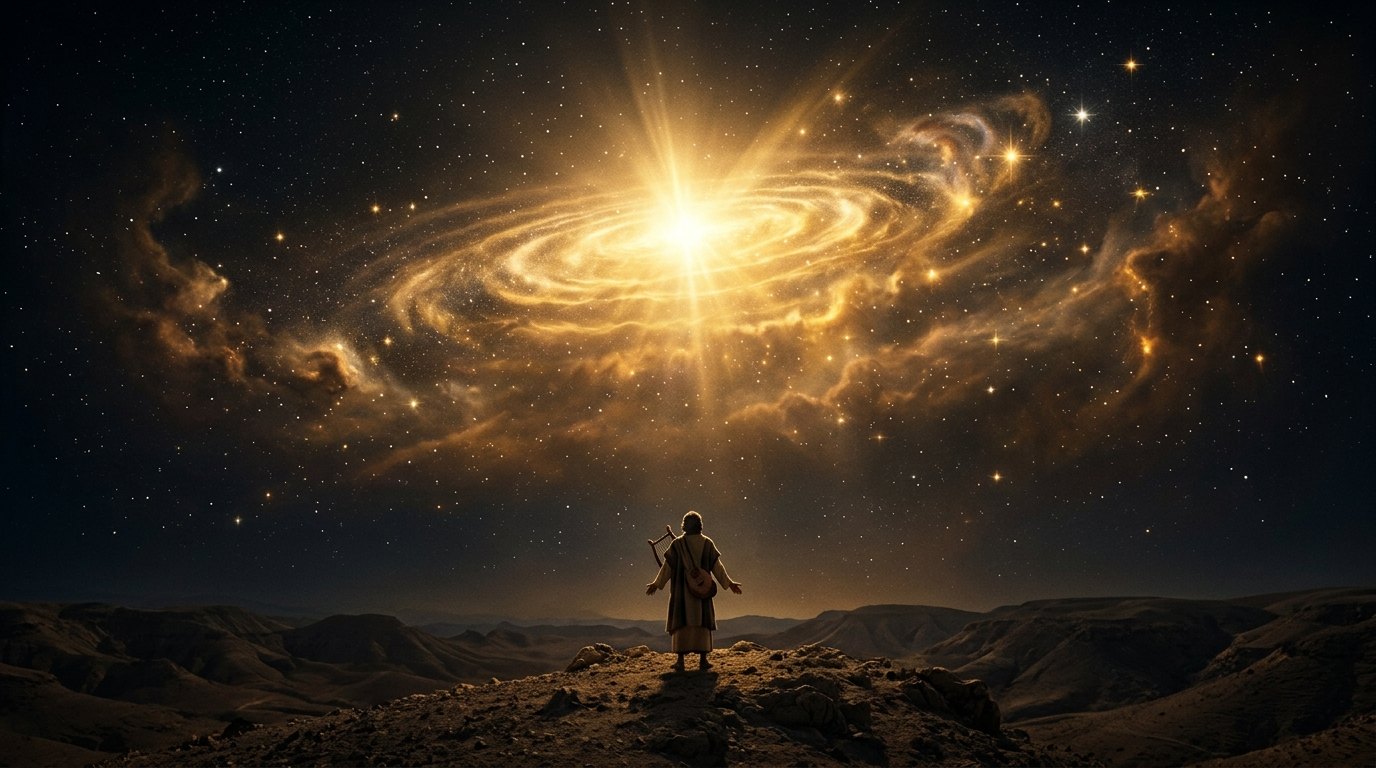
Psalms 33:6-9
6 By the word of the LORD the heavens were made, their starry host by the breath of his mouth.
7 He gathers the waters of the sea into jars; he puts the deep into storehouses.
8 Let all the earth fear the LORD; let all the people of the world revere him.
9 For he spoke, and it came to be; he commanded, and it stood firm.
New International Version (NIV)
The answer
No—the Bible does not mention the Big Bang by name or describe a modern scientific theory of cosmology. It does teach that the universe is not eternal or self-created: God brought it into existence by His word.
Genesis 1:1 begins, “In the beginning, God created the heavens and the earth.” Psalms 33:6 says, “By Yahweh’s word, the heavens were made: all their army by the breath of his mouth,” and Psalms 33:9 adds, “For he spoke, and it was done. He commanded, and it stood firm.” Hebrews 11:3 likewise teaches that “the universe has been framed by the word of God, so that what is seen has not been made out of things which are visible.”
The Big Bang is a scientific model concerning the universe’s early history. If the term is being used only to say that the cosmos had a beginning, that broad idea is compatible with Genesis 1:1. If it is being used to claim that everything arose without God, Scripture rejects that conclusion. The detailed physics belongs to scientific investigation; Scripture plainly identifies the Creator and declares that His word brought creation into being.
Answered from Scripture · reviewed November 12, 2026
Scripture does not mention the Big Bang by name or present a modern astrophysical model, but it foundational establishes that the universe had an absolute beginning brought about solely by the sovereign command of God. While human cosmology explores the physical mechanisms of the cosmos, the Bible reveals the personal Creator whose spoken word summoned all visible reality out of nothing.
Absolute Beginning
God Spoke the Visible Cosmos into Existence from Nothing
By faith we understand that the universe was formed at God’s command, so that what is seen was not made out of what was visible.
Hebrews 11:3 (NIV)
This verse directly states that visible reality was not fashioned from preexisting matter, establishing the biblical doctrine of creation ex nihilo.
In Hebrews 11:3, Scripture defines the foundational boundary of all cosmology: through faith we understand that the worlds were framed by the word of God, so that things which are seen were not made of things which do appear. The universe did not emerge from a chaotic stew of preexisting materials, nor from an eternal cycle of cosmic recycling. Instead, the living God summoned all physical reality out of absolute nothingness (creatio ex nihilo).
This truth anchors the opening line of Scripture in Genesis 1:1, which states simply that in the beginning God created the heaven and the earth. Before this moment, there was neither time, nor space, nor matter—only the eternal Triune God. Romans 4:17 underlines this sovereign prerogative, describing the God who calls those things which be not as though they were. Unlike idols or mythical cosmic architects who merely reshape primal substance, the Lord is the sole source of being itself.
Psalms 90:2 exalts this contrast: before the mountains were brought forth or the earth was formed, from everlasting to everlasting, He is God. In Proverbs 8:22-26, divine wisdom is depicted as existing before the depths, before the springs of water, and before the dust of the world were established. Creation had a definite starting line, established entirely by the sovereign will of the Maker.
Because God alone holds this absolute supremacy, Nehemiah 9:6 proclaims that He made heaven, the heaven of heavens, with all their host, and preserves them continually. Paul echoed this truth to the philosophers in Acts 17:24-25, preaching that God made the world and all things therein, giving to all life, breath, and all things. Finally, the heavenly chorus in Revelation 4:11 declares the grand purpose of this absolute beginning: for thou hast created all things, and for thy pleasure they are and were created.
| Passage | What it says |
|---|---|
| Genesis 1:1 | Declares that in the beginning God created the heavens and the earth, marking the absolute origin of time, space, and matter. |
| Hebrews 11:3 | Affirms by faith that the universe was framed by God's word, so that what is seen came from things invisible. |
| Romans 4:17 | Describes God as the One who calls into existence the things that do not exist. |
| Psalms 90:2 | Contrasts God's eternal existence from everlasting to everlasting with the brought-forth birth of the mountains and the earth. |
| Proverbs 8:22-26 | Wisdom was established before the earth, before the depths and mountains were brought forth, showing a universe with an absolute beginning. |
| Nehemiah 9:6 | The Lord alone made heaven, the heaven of heavens, with all their host, the earth and all on it, preserving them all. |
| Acts 17:24-25 | God made the world and everything in it, giving to all mankind life, breath, and everything. |
| Revelation 4:11 | The Lord created all things, and by His sovereign will they existed and were created. |
The Creative Word
Creation Stood Firm by the Direct Command of God
For he spoke, and it came to be; he commanded, and it stood firm.
Psalms 33:9 (NIV)
It captures the immediacy and absolute authority of God's creative power, where divine speech instantly establishes cosmic reality.
The direct agency behind the universe is divine speech, summarized forcefully in Psalms 33:9: for he spake, and it was done; he commanded, and it stood fast. Creation was not an accidental byproduct or an unguided eruption; it was the instantaneous, sovereign realization of the Almighty's decree. When God speaks, physical reality instantly obeys and establishes itself.
Psalms 33:6 reveals that by the word of the Lord were the heavens made, and all the host of them by the breath of His mouth. This unmediated power is witnessed on the first day of creation in Genesis 1:3, where the Lord said, 'Let there be light,' and there was light. No physical tools, prior forces, or intermediate ages were required for the command to take effect. The simple utterance of God produces instant, structured reality where darkness once reigned.
In 2 Peter 3:5, the Apostle warns that skeptics willingly ignore that by the word of God the heavens were of old, and the earth standing out of the water and in the water. The universe does not hold together by sheer blind luck or inherent naturalistic necessity. The spoken command of Yahweh is the singular cause that called the cosmos into being, governing its emergence and fixing its physical boundaries.
| Passage | What it says |
|---|---|
| Psalms 33:6 | Reveals that the heavens and all their starry host were made by Yahweh's word and the breath of His mouth. |
| Psalms 33:9 | Affirms that God spoke and it came to be, commanding reality to stand firm without delay. |
| Genesis 1:3 | Records the initial divine command, 'Let there be light,' and its instantaneous fulfillment. |
| 2 Peter 3:5 | Points out that by God's word the heavens existed long ago and the earth was formed out of water. |
Christ the Creator
The Living Word Conceived and Sustains All Things
Through him all things were made; without him nothing was made that has been made.
John 1:3 (NIV)
It affirms that nothing in all of created reality originated apart from Jesus Christ, the eternal Word.
The New Testament reveals that the creative word spoken at the beginning is a Divine Person. John 1:3 provides an absolute, all-encompassing declaration: all things were made by him; and without him was not any thing made that was made. Jesus Christ, the eternal Word (Logos), was not a bystander in creation, nor a created instrument, but the very Author through whom every particle, galaxy, and law of physics came into existence.
John 1:1-2 declares that this Word was in the beginning with God, and was God. Paul broadens this staggering reality in Colossians 1:16-17, testifying that by Him were all things created, that are in heaven, and that are in earth, visible and invisible. Furthermore, He is before all things, and by Him all things consist. Christ is not only the origin of creation but the cohesive glue that continually preserves the universe from unraveling into nothingness.
Hebrews 1:2-3 similarly confesses that God made the worlds through His Son, who sits as the appointed heir of all things and upholds all things by the word of His power. In 1 Corinthians 8:6, believers affirm that there is but one God the Father, of whom are all things, and one Lord Jesus Christ, by whom are all things, and we by Him. Any true biblical view of the cosmos must center on the glory of Christ, whose sovereign power conceived the cosmos and preserves it toward His intended end.
| Passage | What it says |
|---|---|
| John 1:1-3 | Identifies Jesus as the Word who was with God in the beginning, through whom all things were made. |
| Colossians 1:16-17 | Proclaims that all things were created by, through, and for Christ, who is before all and holds all together. |
| Hebrews 1:2-3 | Declares that God made the universe through His Son, who continually upholds all things by His powerful word. |
| 1 Corinthians 8:6 | Testifies that there is one God the Father from whom are all things, and one Lord Jesus Christ through whom all things exist. |
Stretching the Heavens
The Lord Continually Stretches Out the Vast Heavens
He sits enthroned above the circle of the earth, and its people are like grasshoppers. He stretches out the heavens like a canopy, and spreads them out like a tent to live in.
Isaiah 40:22 (NIV)
It uses the poetic and sovereign image of God spreading out the heavens like a tent to dwell in, demonstrating His transcendent power.
A recurring portrait across the prophetic Scriptures is the Lord stretching out the cosmos, captured vividly in Isaiah 40:22: it is he that sitteth upon the circle of the earth, and the inhabitants thereof are as grasshoppers; that stretcheth out the heavens as a curtain, and spreadeth them out as a tent to dwell in. God displays His immense transcendence by unfolding the vast celestial expanse with effortless mastery, making space a dwelling place beneath His gaze.
In Isaiah 42:5, Yahweh is identified as He that created the heavens and stretched them out, who spread forth the earth and that which cometh out of it, giving breath unto the people upon it. Jeremiah 10:12 and Jeremiah 51:15 pair this majestic work with divine wisdom: He hath made the earth by His power, He hath established the world by His wisdom, and hath stretched out the heavens by His discretion. The universe is not an erratic, chaotic explosion; its expansion reflects exquisite, purposeful design.
Zechariah 12:1 links the stretching forth of the heavens directly to the forming of the spirit of man within him, proving that cosmic power is tied to God's covenantal care for mankind. In Job 9:8, Job marvels that God alone spreadeth out the heavens and treadeth upon the waves of the sea. Psalms 104:2 depicts the Lord covering Himself with light as with a garment, stretching out the heavens like a curtain. Isaiah 44:24 emphasizes that He did this without rival: 'I am the Lord that maketh all things; that stretcheth forth the heavens alone.' In Isaiah 45:12 and Isaiah 51:13, God reminds His people that His own hands laid the foundations of the earth and marshaled the starry host, demanding our reverent worship of the One who commands the stars.
| Passage | What it says |
|---|---|
| Isaiah 40:22 | Speaks of God stretching out the heavens like a curtain and spreading them like a tent to dwell in. |
| Isaiah 42:5 | Identifies Yahweh as the Creator who created the heavens and stretched them out, giving breath to people on earth. |
| Jeremiah 10:12 | Affirms that God established the world by His wisdom and stretched out the heavens by His understanding. |
| Zechariah 12:1 | Attributes the stretching forth of the heavens and the forming of the human spirit to the Lord. |
| Job 9:8 | Declares that God alone stretches out the heavens and treads upon the waves of the sea. |
| Psalms 104:2 | The Lord covers Himself with light as with a garment, stretching out the heavens like a tent curtain. |
| Isaiah 44:24 | The Lord made all things, stretching out the heavens alone and spreading out the earth by Himself. |
| Isaiah 45:12 | God made the earth and created man on it; His hands stretched out the heavens and marshaled their starry host. |
| Isaiah 51:13 | The Lord stretched out the heavens and laid the foundations of the earth. |
| Jeremiah 51:15 | God made the earth by His power, established the world by His wisdom, and by His understanding stretched out the heavens. |
Cosmic Consummation
The Created Heavens Have a Finite End as Well as a Beginning
But the day of the Lord will come like a thief. The heavens will disappear with a roar; the elements will be destroyed by fire, and the earth and everything done in it will be laid bare.
2 Peter 3:10 (NIV)
It declares that the material cosmos, which began at God's command, will end by divine judgment with a sudden dissolution.
In 2 Peter 3:10, Scripture presents a sobering reality that sets biblical truth apart from any secular theory of eternal matter: the day of the Lord will come like a thief, and then the heavens will pass away with a roar. The same God who commanded the universe into being from nothing holds its destiny entirely in His sovereign hands. The material heavens are not self-sustaining or permanent; they are appointed for a final, purifying transformation.
Long before modern observers theorized about the heat death or cosmic decay of the universe, the psalmist recognized the finite nature of creation under the eternal rule of God. In Psalm 102:25-26, the Scripture contrasts the timeless nature of the Creator with His works: of old He laid the foundation of the earth, yet they will perish, but You will remain; they will all wear out like a garment. Creation is subject to transience, but the Word that formed it endures forever.
Jesus Christ confirmed this reality with divine authority in Matthew 24:35, declaring, "Heaven and earth will pass away, but my words will not pass away." The visible universe, with all its vast galaxies and cosmic structures, remains subordinate to the unshakeable truth of Christ. Finally, Revelation 21:1 brings the biblical story of the cosmos to its glorious climax: the first heaven and the first earth pass away, making way for a new heaven and a new earth where righteousness dwells eternally.
| Passage | What it says |
|---|---|
| 2 Peter 3:10 | The heavens will pass away with a roar, and the heavenly bodies will be burned up and dissolved. |
| Psalms 102:25-26 | Of old God laid the foundation of the earth, and the heavens will perish and wear out like a garment. |
| Matthew 24:35 | Heaven and earth will pass away, but Christ's words will never pass away. |
| Revelation 21:1 | The first heaven and the first earth passed away, making way for a new heaven and a new earth. |
Where in the Bible
| Book | Passages |
|---|---|
| Genesis | 2 · Genesis 1:1, Genesis 1:3 |
| Nehemiah | 1 · Nehemiah 9:6 |
| Job | 1 · Job 9:8 |
| Psalms | 5 · Psalms 90:2, Psalms 33:6, Psalms 33:9, Psalms 104:2, Psalms 102:25-26 |
| Proverbs | 1 · Proverbs 8:22-26 |
| Isaiah | 5 · Isaiah 40:22, Isaiah 42:5, Isaiah 44:24, Isaiah 45:12, Isaiah 51:13 |
| Jeremiah | 2 · Jeremiah 10:12, Jeremiah 51:15 |
| Zechariah | 1 · Zechariah 12:1 |
| Matthew | 1 · Matthew 24:35 |
| John | 1 · John 1:1-3 |
| Acts | 1 · Acts 17:24-25 |
| Romans | 1 · Romans 4:17 |
| 1 Corinthians | 1 · 1 Corinthians 8:6 |
| Colossians | 1 · Colossians 1:16-17 |
| Hebrews | 2 · Hebrews 11:3, Hebrews 1:2-3 |
| 2 Peter | 2 · 2 Peter 3:5, 2 Peter 3:10 |
| Revelation | 2 · Revelation 4:11, Revelation 21:1 |
The story in order
- God spoke the universe into existence (c. 4000 BC) · Genesis 1:1 · Establishes the absolute beginning of all things by divine command.
- Wisdom present at creation (c. 950 BC) · Proverbs 8:22-26 · Shows the universe had a beginning with divine wisdom involved.
- God's word creates and sustains (c. 1000 BC) · Psalms 33:6 · Highlights the power of God's spoken word in creation.
- Jesus the Word, through whom all was made (AD 30) · John 1:1-3 · Identifies Christ as the agent of all creation.
- Christ holds all things together (AD 60) · Colossians 1:16-17 · Affirms Christ's ongoing role in sustaining the cosmos.
- God stretches out the heavens (c. 700 BC) · Isaiah 40:22 · Describes God's active, ongoing work in creating the vast heavens.
- The heavens will pass away (c. 1000 BC) · Psalms 102:25-26 · Indicates the created heavens are not eternal and will wear out.
- The first heaven and earth pass away (AD 95) · Revelation 21:1 · Marks the end of the current creation to make way for the new.
Key words
- Created (bara, בָּרָא)
- Brought into existence by God's sovereign act. · Genesis 1:1
- Word (dabar, דָּבָר)
- God's spoken command that brings reality into being. · Psalms 33:6
- Logos (logos, λόγος)
- The divine Word, identified as Jesus Christ, through whom all things were made. · John 1:1-3
- Stretched out (natah, נָטָה)
- The act of expanding and forming the vastness of the heavens. · Isaiah 40:22
- Pass away (parerchomai, παρέρχομαι)
- To cease to exist; indicating the temporary nature of the current heavens. · 2 Peter 3:10
Rather than seeking modern scientific terminology in ancient revelation, the believer finds in Scripture the ultimate reality behind the cosmos: an eternal, personal God who commands light out of darkness. The origin of the universe is not an impersonal accident of unguided matter, but the purposeful work of Christ, calling every creature to worship the One who spoke and made it stand firm.
30 passages, each cited once.
Scripture cited
- Hebrews 11:3
- Psalms 33:9
- Genesis 1:1-3