How do I choose a church?

Acts 2:42-47
42 They devoted themselves to the apostles’ teaching and to fellowship, to the breaking of bread and to prayer.
43 Everyone was filled with awe at the many wonders and signs performed by the apostles.
44 All the believers were together and had everything in common.
45 They sold property and possessions to give to anyone who had need.
46 Every day they continued to meet together in the temple courts. They broke bread in their homes and ate together with glad and sincere hearts,
47 praising God and enjoying the favor of all the people. And the Lord added to their number daily those who were being saved.
New International Version (NIV)
The answer
A church in the New Testament is a community gathered around the apostles' teaching, fellowship, breaking of bread, and prayer (Acts 2:42). Choose one that faithfully holds these four things and where you can commit to be a real member, not a consumer in the pews.
Step 1: Listen to the preaching
- Make doctrine the first test: Acts 2:42 puts "the apostles' teaching" before everything else, because doctrine shapes everything else.
- Hear Scripture opened plainly, as the text, not as decoration for the speaker's opinion.
- Look for Christ exalted: 1 John 1:3 ties fellowship to "the Father and his Son Jesus Christ." A pulpit that loses Christ has lost the gospel.
- Sit under it more than once: one sermon is a sample, several is a diet. Visit a month before judging.
Step 2: Watch how they live together
- Real fellowship, not just programmes: Greek koinonia in Acts 2:42 means shared life, not shared schedules.
- Walk in the light: 1 John 1:7 — fellowship means honest repentance, not polite distance.
- People known, not just counted: does anyone notice if a member stops coming?
- Generosity flowing across differences: Acts 2:44-45 sold possessions for those in need; that flow of giving is a sign of life.
Step 3: Test the Lord's table
- The breaking of bread is named as a mark, not an optional extra (Acts 2:42).
- It was the centre of Sunday gathering in Acts 20:7: "upon the first day of the week, when the disciples came together to break bread."
- Look for gladness and singleness of heart at the table (Acts 2:46), not routine performance.
- The bread and cup are for remembering Christ crucified — a church that treats the Supper as central usually treats Christ as central.
Step 4: Test the prayer life
- Prayer is the fourth pillar of Acts 2:42 and the first thing the apostles themselves prioritized (Acts 1:14).
- Corporate prayer together, not only private devotion.
- Intercession for the lost, the weak, the sick, and one another.
- A church that prays together will not drift into performance.
Step 5: Commit, don't drift
- Hebrews 10:25 commands gathering: "not forsaking the assembling of ourselves together, as the manner of some is."
- Look for a body you can be a member of, not a stage you can watch.
- Be willing to be known, corrected, and held accountable — that is the "one accord" of Acts 2:46.
Step 6: Look for gospel fruit
- Gladness and singleness of heart — a Spirit-given joy, not performed cheer (Acts 2:46).
- Favour with all the people alongside favour with God (Acts 2:47) — the church's reputation in your town.
- The Lord adding to them those who were being saved (Acts 2:47) — the surest sign that Christ is building.
The most common mistake
Treating a church like a restaurant — keep walking until the menu suits you — instead of treating it like a family. Hebrews 10:25 warns that some have "the manner" of forsaking the gathering; the antidote is commitment, not endless comparison. A faithful small church is better than a polished large one you will leave in a year.
A verse to carry
Hebrews 10:25 — "not forsaking the assembling of ourselves together, but exhorting one another." The church you join is the church you exhort, and the church that exhorts you.
Answered from Scripture · reviewed November 7, 2026
Scripture does not leave the definition of a healthy church to modern preference or consumer taste. In Acts 2:42, the Holy Spirit establishes four enduring pillars that mark a true assembly of Christ: the apostles' teaching, biblical fellowship, the breaking of bread, and corporate prayer. Choosing a church means testing prospective congregations against this apostolic blueprint so that you may plant your life where Christ is faithfully worshipped and proclaimed.
Sound Doctrine
Listen First to What Is Taught
They devoted themselves to the apostles’ teaching and to fellowship, to the breaking of bread and to prayer.
Acts 2:42 (NIV)
The Jerusalem church placed the apostles' doctrine first because sound biblical teaching governs all genuine worship and practice.
In Acts 2:42, the earliest Christians began their corporate life by devoting themselves steadfastly to the apostles' teaching. Sound biblical doctrine is not one option among many for a congregation; it is the essential bedrock that governs every aspect of its worship, life, and mission. As John affirms in 1 John 1:3, apostolic preaching has a singular aim: to draw believers into genuine, life-giving communion with the Father and His Son, Jesus Christ. When choosing a congregation, your first inquiry must never be the quality of the musical production or the scale of the facility, but rather what is proclaimed from the pulpit.
The Apostle Paul understood that fidelity to the Word would always face cultural resistance. In 2 Timothy 4:1-4, he solemnly charges Timothy to preach the word in season and out of season, warning that congregations will naturally drift toward teachers who flatter their itching ears and validate their private passions. A faithful church resists this consumerist pull. According to Titus 1:9, qualified elders must cling tenaciously to the trustworthy word as taught, equipping them both to nourish the flock with sound instruction and to boldly refute those who contradict it.
The stakes could not be higher. In Galatians 1:8-9, Paul pronounces a severe anathema upon anyone—even an angel from heaven—who dares to preach a gospel contrary to the message originally delivered by the apostles. A church that compromises on the gospel ceases to be a church of Jesus Christ. As Paul reminds us in 1 Timothy 3:15, the local assembly of the living God is designed to stand in the world as the pillar and buttress of the truth. Seek a church where the whole counsel of God is unashamedly expounded, guarded, and obeyed.
| Passage | What it says |
|---|---|
| Acts 2:42 | The believers devoted themselves continually to the apostles' teaching, setting sound doctrine as the foundation of assembly life. |
| 1 John 1:3 | Apostolic testimony proclaims Christ so that believers share fellowship rooted directly in the Father and the Son. |
| 2 Timothy 4:1-4 | Paul charges Timothy to preach the word faithfully when people gather teachers who suit their own passions. |
| Titus 1:9 | Elders must hold firmly to the trustworthy message as taught, so they can encourage sound doctrine and refute error. |
| Galatians 1:8-9 | Any gospel contrary to the apostolic gospel brings a curse, establishing the purity of the message as paramount. |
| 1 Timothy 3:15 | The household of God, the church of the living God, is the pillar and buttress of the truth. |
Shared Life
Observe How Believers Walk Together

But if we walk in the light, as he is in the light, we have fellowship with one another, and the blood of Jesus, his Son, purifies us from all sin.
1 John 1:7 (NIV)
Authentic Christian fellowship requires transparent living in God's light, where sins are confessed and cleansed together.
In 1 John 1:7, Scripture sets down the true nature of Christian community: walking in the light of God produces authentic fellowship with one another while the blood of Jesus continuously cleanses us from all sin. Biblical fellowship is never mere social camaraderie or casual politeness over coffee; it is a shared supernatural life marked by honesty, mutual confession, and Christ-centred accountability. Where the Spirit of God is genuinely at work, believers do not hide behind superficial masks but pursue holiness together.
The Jerusalem church embodied this sacrificial reality with astonishing generosity. In Acts 2:44, the believers lived in profound unity, holding their possessions with an open hand, and in Acts 2:45, they willingly liquidated properties to relieve any brother or sister experiencing poverty or distress. This level of care reflects the direct command of our Lord in John 13:34-35, where Jesus declared that genuine love between disciples serves as the definitive public badge that proves to the watching world whose followers they truly are.
When evaluating a church, observe how its members treat the vulnerable and the fallen. As Paul instructs in Galatians 6:1-2, spiritual believers must gently restore those caught in transgression while deliberately bearing one another's heavy burdens, thereby fulfilling the law of Christ. In Romans 12:9-13, this shared life is detailed as genuine brotherly affection, outdoing one another in showing honour, persistent hospitality to strangers, and joyful generosity toward the needs of the saints. Look for an assembly where real lives intertwine in sacrificial service rather than one of detached Sunday attendance.
| Passage | What it says |
|---|---|
| 1 John 1:7 | Walking in divine light produces genuine fellowship among believers while Christ's blood cleanses them from every sin. |
| Acts 2:44 | All who believed remained together, holding their material possessions in common for the good of the body. |
| Acts 2:45 | Believers sold their property and possessions to distribute resources freely to any brother or sister in need. |
| John 13:34-35 | Jesus commands his disciples to love one another, marking genuine discipleship by sacrificial mutual love. |
| Galatians 6:1-2 | Believers are to restore those caught in sin gently and bear one another's burdens to fulfil the law of Christ. |
| Romans 12:9-13 | A healthy body displays genuine affection, honours others above self, shows hospitality, and contributes to the saints' needs. |
The Table
Test the Centre of Worship
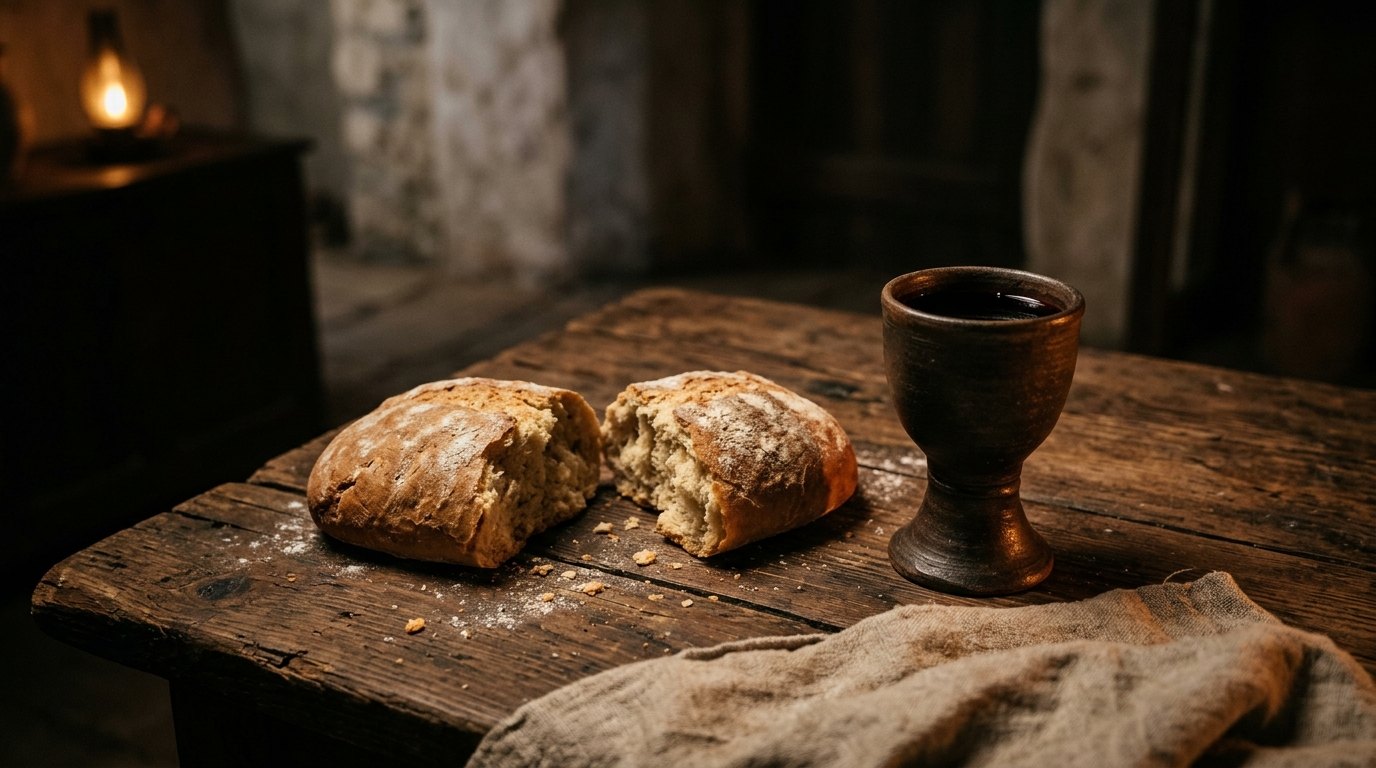
On the first day of the week we came together to break bread. Paul spoke to the people and, because he intended to leave the next day, kept on talking until midnight.
Acts 20:7 (NIV)
The regular gathering of the apostolic church on the first day of the week centred on the celebration of the Lord's Supper.
According to Acts 20:7, the apostolic church established the rhythm of meeting on the first day of the week specifically to break bread and sit under the exposition of the Scriptures. The ordinances given by Jesus Christ—baptism and the Lord's Supper—are not optional add-ons or dramatic interludes; they are visible words, sovereignly ordained means of grace that keep the substitutionary death and bodily resurrection of Christ perpetually at the beating heart of the gathered church.
This pattern defined the daily existence of the earliest converts. In Acts 2:46, the believers moved between the public courts of the temple and the private intimacy of home tables, partaking of food with glad and sincere hearts, magnifying God in the common and sacred alike. The breaking of bread was both a shared communal meal and a deliberate commemoration of the sacrifice that bound them into one single body across every former social divide.
The Apostle Paul unpacks the theological weight of this sacrament in 1 Corinthians 11:23-26. Quoting the Lord's institution at the Last Supper, Paul explains that as often as the church eats the bread and drinks the cup, it publicly proclaims the Lord's death until He returns in glory. The Lord's Table anchors the congregation squarely at the foot of the cross, demanding sober self-examination, reverent unity, and joyful anticipation. Paired with this is the commission of Matthew 28:19-20, which commands the church to initiate new converts through water baptism into the name of the Father, Son, and Holy Spirit. Choose a church that guards these holy ordinances with reverence, celebrating them faithfully as Christ commanded.
| Passage | What it says |
|---|---|
| Acts 20:7 | Disciples gathered together on Sunday specifically to break bread while Paul proclaimed the Word among them. |
| Acts 2:46 | Early Christians continued daily in the temple and broke bread at home, eating together with glad and sincere hearts. |
| 1 Corinthians 11:23-26 | The Lord's Supper proclaims the Lord's death until he comes, anchoring corporate worship in the cross. |
| Matthew 28:19-20 | The Great Commission mandates baptising disciples in the triune name and teaching them to obey Christ's commands. |
Corporate Prayer
Weigh the Church's Dependence on God
They all joined together constantly in prayer, along with the women and Mary the mother of Jesus, and with his brothers.
Acts 1:14 (NIV)
Before ministry began, the apostles and disciples demonstrated that unified, steadfast prayer must undergird the congregation's entire life.
Before the church preached a single sermon or appointed a single deacon, Acts 1:14 records that the disciples, the women, and the family of Jesus devoted themselves with one accord to continuous corporate prayer. A gathering of believers that relies on human charisma, managerial skill, or cultural relevance will achieve only what man can produce. A church that prays together openly confesses its total weakness and casts itself wholly upon the power of Almighty God.
This posture of helpless dependence invited God's manifest presence. In Acts 2:43, divine awe rested upon every soul as God worked mightily through the apostles in response to their unceasing supplication. When severe persecution threatened to silence their proclamation, the believers did not strategize politically; in Acts 4:24-31, they lifted their voices together to the Sovereign Lord of creation, pleading for supernatural boldness to speak His truth, and the very place where they gathered was shaken by the Spirit.
Corporate intercession must be the ongoing breath of the assembly. Paul directs in 1 Timothy 2:1-4 that petitions, prayers, and thanksgivings be made by the church for all people, including civic rulers, so that believers may lead tranquil, godly lives pleasing to God who desires all to be saved. Furthermore, in Acts 12:5, when the Apostle Peter was imprisoned beneath heavy chains, the church did not despair; earnest, unceasing prayer was made to God on his behalf until deliverance came. When searching for a spiritual home, evaluate its prayer gatherings. A healthy church is unmistakably a praying church.
| Passage | What it says |
|---|---|
| Acts 1:14 | The early disciples, along with the women and Jesus' family, continued steadfastly with one mind in corporate supplication. |
| Acts 2:43 | Reverence and awe settled upon every soul as signs and wonders authenticated the apostles' prayerful ministry. |
| Acts 4:24-31 | The early believers pray together for boldness under threat, demonstrating desperate corporate reliance upon sovereign God. |
| 1 Timothy 2:1-4 | Supplications, prayers, intercessions, and thanksgivings are to be made corporately for all people and those in authority. |
| Acts 12:5 | Earnest corporate prayer is made by the gathered church to God when Peter is imprisoned. |
Faithful Commitment
Anchor Your Life in Membership

not giving up meeting together, as some are in the habit of doing, but encouraging one another—and all the more as you see the Day approaching.
Hebrews 10:25 (NIV)
Believers are explicitly commanded never to abandon regular corporate assembly, especially as the day of Christ's return draws near.
The author of Hebrews commands believers with absolute clarity: do not neglect to meet together, as is the habit of some, but encourage one another, and all the more as you see the Day drawing near (Hebrews 10:25). Biblical Christianity knows nothing of unattached, solitary believers. When looking for a local church, one must seek an assembly that takes covenant commitment seriously. From the earliest days in Jerusalem, the body was an identifiable assembly where the Lord added daily those who were being saved (Acts 2:47).
Scripture presupposes that every Christian belongs to an identifiable local flock under specific spiritual oversight. In Hebrews 13:17, believers are instructed to obey and submit to their leaders, who keep watch over their souls as those who must give an account. One cannot submit to pastors, nor can elders shepherd a flock, without clear local commitment. This boundary between those inside and those outside is essential for loving accountability and church discipline, as Paul makes clear when distinguishing those within the assembly from those outside (1 Corinthians 5:12-13). As Paul illustrates in 1 Corinthians 12:12-27, each believer is an individual organ of one living body, placed by God to supply care, support, and spiritual service to the whole. Look for a church where membership is meaningful, mutual, and anchored in lifelong dedication to the household of God.
| Passage | What it says |
|---|---|
| Hebrews 10:25 | Scripture forbids neglecting church gatherings, commanding Christians instead to meet continually to encourage one another. |
| Acts 2:47 | The church praised God and held public favour, while the Lord daily added to their number those being saved. |
| Hebrews 13:17 | Believers are told to obey their leaders and submit to them, as they keep watch over their souls. |
| 1 Corinthians 5:12-13 | The local church exercises discipline over those inside the body, presupposing identifiable membership. |
| 1 Corinthians 12:12-27 | Believers are individual members of one body, each placed deliberately to function together in vital unity. |
Qualified Leadership
Examine the Integrity and Calling of Leaders

Now the overseer is to be above reproach, faithful to his wife, temperate, self-controlled, respectable, hospitable, able to teach,
1 Timothy 3:2 (NIV)
Biblical church selection requires evaluating whether those who lead are above reproach in character and able to teach.
In 1 Timothy 3:2, the Holy Spirit establishes that an overseer must be above reproach, faithful in marriage, temperate, self-controlled, respectable, hospitable, and able to teach. The spiritual health of any local church rises and falls with the character of its shepherds. When evaluating a congregation, scrutinize not the charisma or entrepreneurial skill of the preachers, but their moral integrity, family faithfulness, and theological fidelity as prescribed in 1 Timothy 3:1-7. A shepherd who fails in his home or lacks personal self-control cannot guide the flock of God.
Titus 1:5-9 reinforces this standard, charging church leadership to hold firmly to the trustworthy word as taught, so that an elder may be able both to give instruction in sound doctrine and to rebuke those who contradict it. False teaching always threatens the household of faith; therefore, overseers must be courageous defenders of orthodoxy. Furthermore, Peter exhorts elders not to rule domineeringly or for shameful financial gain, but to shepherd the flock of God eagerly as humble examples, awaiting the crown of glory from the Chief Shepherd (1 Peter 5:1-4). A healthy church is guided by plural, godly elders who mirror Christ's selfless sacrifice rather than worldly corporate ambition.
| Passage | What it says |
|---|---|
| 1 Timothy 3:1-7 | Paul outlines the character qualifications required of overseers, emphasizing blameless character, teaching ability, and family order. |
| Titus 1:5-9 | Titus is appointed to establish qualified elders who hold fast to sound doctrine in every town. |
| 1 Peter 5:1-4 | Elders are exhorted to shepherd the flock eagerly and as examples, under the Chief Shepherd. |
Evangelism and Mission
Verify Passion for Reaching the Lost

Therefore go and make disciples of all nations, baptizing them in the name of the Father and of the Son and of the Holy Spirit,
Matthew 28:19 (NIV)
A faithful church exists not for its own comfort but to proclaim Christ and make disciples among all peoples.
Before ascending to heaven, Jesus Christ charged his people with a global mandate: go therefore and make disciples of all nations, baptizing them in the name of the Father and of the Son and of the Holy Spirit (Matthew 28:19). A genuine church of Jesus Christ is defined by its unswerving devotion to the Great Commission. In Matthew 28:18-20, our Lord claims absolute authority in heaven and on earth, promising his perpetual presence as his disciples proclaim the gospel and instruct converts in all his commandments. A healthy church never turns inward as a private social club; its gaze is fixed on the glory of Christ and the salvation of the lost.
This outward mission is powered by the Holy Spirit, who equips the congregation to be Christ's bold witnesses locally, regionally, and to the uttermost ends of the earth (Acts 1:8). Whether across the street or across the oceans, a faithful assembly gives, prays, and goes. Paul rejoiced over the Philippian believers because of their active partnership in the gospel from the first day until now (Philippians 1:3-5). Seek a congregation that shares this apostolic burden—one that faithfully proclaims Christ from the pulpit, equips every member for personal evangelism, and sacrificialy sends workers into global harvest fields.
| Passage | What it says |
|---|---|
| Matthew 28:18-20 | Christ sends the church to make disciples of all nations, baptising and teaching all he commanded. |
| Acts 1:8 | The Spirit empowers believers to be Christ's witnesses locally, cross-culturally, and to the ends of the earth. |
| Philippians 1:3-5 | Paul thanks the Philippians for their active corporate partnership in the gospel from the first day until now. |
Where in the Bible
| Book | Passages |
|---|---|
| Matthew | 2 · Matthew 28:19-20, Matthew 28:18-20 |
| John | 1 · John 13:34-35 |
| Acts | 11 · Acts 2:42, Acts 2:44, Acts 2:45, Acts 20:7, Acts 2:46, Acts 1:14, Acts 2:43, Acts 4:24-31, Acts 12:5, Acts 2:47, Acts 1:8 |
| Romans | 1 · Romans 12:9-13 |
| 1 Corinthians | 3 · 1 Corinthians 11:23-26, 1 Corinthians 5:12-13, 1 Corinthians 12:12-27 |
| Galatians | 2 · Galatians 1:8-9, Galatians 6:1-2 |
| Philippians | 1 · Philippians 1:3-5 |
| 1 Timothy | 3 · 1 Timothy 3:15, 1 Timothy 2:1-4, 1 Timothy 3:1-7 |
| 2 Timothy | 1 · 2 Timothy 4:1-4 |
| Titus | 2 · Titus 1:9, Titus 1:5-9 |
| Hebrews | 2 · Hebrews 10:25, Hebrews 13:17 |
| 1 Peter | 1 · 1 Peter 5:1-4 |
| 1 John | 2 · 1 John 1:3, 1 John 1:7 |
The story in order
- The early church's foundation (AD 30) · Acts 2:42 · The Spirit establishes four pillars for a true assembly: teaching, fellowship, breaking bread, and prayer.
- Sharing life and resources (AD 30) · Acts 2:44-45 · Believers lived together and shared possessions for the common good.
- Love as the mark of discipleship (c. AD 30) · John 13:34-35 · Jesus commands mutual love, which identifies his followers.
- Worship and teaching on the Lord's Day (c. AD 55) · Acts 20:7 · Disciples gathered on Sunday to break bread and hear Paul preach.
- The Lord's Supper proclaims Christ's death (c. AD 55) · 1 Corinthians 11:23-26 · The Supper is a memorial of Christ's sacrifice until his return.
- Corporate prayer for boldness (c. AD 30) · Acts 4:24-31 · Believers prayed together for courage when facing opposition.
- The church as the pillar of truth (c. AD 65) · 1 Timothy 3:15 · The church's role is to uphold and display God's truth.
- Instructions for church leaders (c. AD 65) · Titus 1:5-9 · Elders must be qualified in character and sound doctrine.
- Partnership in the gospel (c. AD 61) · Philippians 1:3-5 · The church actively partners in spreading the gospel.
- The church's mission to make disciples (c. AD 30) · Matthew 28:18-20 · Christ commissions the church to disciple all nations.
Key words
- Apostles' Teaching
- The foundational instruction and doctrine passed down from the apostles, rooted in Christ. · Acts 2:42
- Fellowship
- Genuine community and shared life among believers, rooted in Christ and the Father. · 1 John 1:7
- Breaking of Bread
- A practice including communal meals and the Lord's Supper, central to worship and remembrance. · Acts 2:46
- Corporate Prayer
- Unified and steadfast prayer offered by the gathered church. · Acts 4:24
- Sound Doctrine
- Truthful and orthodox teaching that upholds the apostolic gospel. · Titus 1:9
Finding a biblical church is not an exercise in consumer shopping, but a search for a spiritual family under the lordship of Christ. Commit to a body that preaches the Word, walks in sacrificial love, honours the sacraments, and calls upon God in prayer. When you find such an assembly, settle in, submit to its care, and give yourself wholeheartedly to its mission until Christ returns.
32 passages, each cited once.
How the major Christian traditions read this
All faithful Christians agree that believers must not forsake gathering together (Hebrews 10:25), but must commit to a local communion marked by the apostles' doctrine, fellowship, the breaking of bread, and prayer (Acts 2:42).
Catholic
To choose a church is to seek the visible, historic body Christ founded upon the apostles, with Saint Peter as its head (Matthew 16:18). A seeker should look for the fullness of the means of salvation: the valid celebration of all seven sacraments, particularly the true Sacrifice of the Mass where Christ is substantially present (John 6:53-56), and communion with the bishop of Rome. The Church is not a human association one invents or selects by consumer preference, but the one, holy, catholic, and apostolic body guided by the Holy Spirit (1 Timothy 3:15). One enters not merely a congregation, but the universal family of faith.
Scripture: Matthew 16:18, John 6:53-56, 1 Timothy 3:15
Orthodox
A seeker should look for the undivided Church of the apostles, unchanged in faith, liturgy, and holy tradition from Pentecost. We test a local parish by whether it guards the apostolic succession and the unaltered faith delivered once for all to the saints (Jude 1:3). The Church is where the Holy Spirit illuminates believers through the holy fathers, bishops, and the divine mysteries, especially the true Body and Blood of Christ in the Eucharist (Acts 2:42; 1 Corinthians 10:16-17). Finding a church means entering this continuous stream of liturgical worship, ascetic repentance, and conciliar unity under the guidance of canonical shepherds.
Scripture: Acts 2:42, 1 Corinthians 10:16-17, Jude 1:3
Lutheran
In our tradition, the Augsburg Confession teaches that the Church is the assembly of all believers among whom the Gospel is preached in its purity and the holy Sacraments are administered according to the Gospel (Augsburg Confession VII). When choosing a church, one must examine whether the pulpit proclaims Christ's full righteousness received through faith alone without human merit (Romans 3:28). Look for where Holy Baptism truly works regeneration (Titus 3:5) and the Lord's Supper offers Christ's true body and blood for the forgiveness of sins (Matthew 26:26-28). Where these Means of Grace are purely maintained, God's true Church is present.
Scripture: Romans 3:28, Matthew 26:26-28, Titus 3:5
Reformed & Presbyterian
We look for the three historic marks of a true church: the faithful preaching of God's Word, the pure administration of the sacraments (Baptism and the Lord's Supper), and the faithful exercise of church discipline (Matthew 18:15-18; 1 Corinthians 11:23-26). One should seek a congregation governed by biblical presbyters or elders who rightly handle Scripture and shepherd the flock (1 Peter 5:1-3; 2 Timothy 4:2). Above all, a church must proclaim the absolute sovereignty of God in salvation, covenant faithfulness in families, and reverent, Scripture-regulated worship that exalts the triune God alone.
Scripture: Matthew 18:15-18, 1 Corinthians 11:23-26, 1 Peter 5:1-3, 2 Timothy 4:2
Anglican & Episcopal
When discerning a parish home, we seek the balance of Scripture, apostolic tradition, and godly reason, expressed through liturgical worship and episcopal oversight. A true church maintains the catholic creeds, faithful preaching of the pure Word of God, and the two gospel sacraments of Baptism and Holy Communion ministered with Christ's words of institution (Acts 2:42; 1 Corinthians 14:40). One should look for a community rooted in the historic Book of Common Prayer, where corporate worship continually shapes the soul, and where the ministry of bishops, priests, and deacons preserves apostolic order and pastoral care.
Scripture: Acts 2:42, 1 Corinthians 14:40
Baptist
A believer choosing a church must seek a local, autonomous body of regenerated, baptized believers covenanted together under the lordship of Christ (Acts 2:41-42). We test whether the Bible is upheld as the sole, sufficient, and inerrant authority for all faith and practice (2 Timothy 3:16-17). Look for a congregation that practices believer's baptism by immersion (Matthew 28:19), protects congregational governance under the guidance of biblically qualified pastors and deacons (1 Timothy 3:1-13), and zealously commits to global evangelism and personal holiness.
Scripture: Acts 2:41-42, Matthew 28:19, 1 Timothy 3:1-13, 2 Timothy 3:16-17
Methodist & Wesleyan
When choosing a church, one should look for a fellowship where the free, transforming grace of God is proclaimed for all people (Titus 2:11) and where believers are spurred toward entire sanctification and practical holiness (Hebrews 12:14). We seek a body that pairs robust biblical preaching and the sacraments with intentional small-group accountability, such as class meetings, to stir up love and good works. A faithful congregation demonstrates vital piety, heartfelt worship, and active compassion toward the poor and marginalized, fulfilling the royal law of love (James 2:8; 1 John 3:18).
Scripture: Titus 2:11, Hebrews 12:14, James 2:8, 1 John 3:18
Pentecostal & Charismatic
In choosing a church, one should look for a Spirit-filled community where the supernatural power and gifts of the Holy Spirit are actively welcome and exercised according to biblical order (1 Corinthians 12:7-11; 1 Corinthians 14:40). Seek a body that believes in the baptism in the Holy Spirit with signs following (Acts 2:4), passionate, expectant praise, and fervent prayer for miraculous healing and deliverance (James 5:14-15). A faithful church will not merely teach sound doctrine historically, but demonstrate the living presence and power of the risen Lord through urgent evangelism.
Scripture: Acts 2:4, 1 Corinthians 12:7-11, 1 Corinthians 14:40, James 5:14-15
Non-denominational & Evangelical
We look for a Bible-believing, Christ-centered fellowship where Scripture is taught expositionally without human denominational traditions superseding God's Word (Colossians 2:8; 2 Timothy 4:2). A seeker should evaluate whether the gospel of salvation by grace through faith is clearly proclaimed (Ephesians 2:8-9), whether genuine Christian community flourishes, and whether believers are actively equipped for discipleship and missional service. Denominational pedigree matters far less than an authentic love for Jesus, fervent prayer, vibrant contemporary worship, and a clear dedication to making disciples.
Scripture: Ephesians 2:8-9, Colossians 2:8, 2 Timothy 4:2
Where they differ
Essential marks of a true church
- Catholic
- Communion with Rome, apostolic succession, and the fullness of seven valid sacraments.
- Orthodox
- Historical apostolic succession, unchanged ancient holy tradition, and valid Eucharistic communion.
- Lutheran
- Pure preaching of the gospel and right administration of both sacraments.
- Reformed & Presbyterian
- Faithful preaching of the Word, right sacraments, and church discipline.
- Anglican & Episcopal
- Apostolic episcopal succession, pure Word, and sacraments of the Gospel.
- Baptist
- Regenerate membership, believer's immersion, biblical discipline, and congregational autonomy.
- Methodist & Wesleyan
- Pure Word, sacraments, and connectional pursuit of personal and social holiness.
- Pentecostal & Charismatic
- Gospel preaching, active spiritual gifts, and manifestation of the Holy Spirit.
- Non-denominational & Evangelical
- Biblical fidelity, evangelism, Christ-centered worship, and authentic discipleship community.
Scripture: Matthew 16:18, Matthew 18:15-18, 1 Timothy 3:15
The nature of church governance
- Catholic
- Hierarchical authority under the Roman Pontiff and bishops in communion.
- Orthodox
- Conciliar governance by bishops maintaining historic apostolic succession.
- Lutheran
- Pastors called to administer Word and sacraments under varied oversight orders.
- Reformed & Presbyterian
- Government by representative courts of ordained presbyters and elders.
- Anglican & Episcopal
- Episcopal oversight through historic orders of bishops, priests, and deacons.
- Baptist
- Local church autonomy governed congregationally under pastors and deacons.
- Methodist & Wesleyan
- Connectional governance through conferences, bishops, and pastoral appointments.
- Pentecostal & Charismatic
- Pastoral leadership guided by the Holy Spirit, often within loose fellowships.
- Non-denominational & Evangelical
- Autonomous local elder leadership free from outside ecclesiastical control.
Scripture: Acts 15:2-6, 1 Timothy 3:1-13, Titus 1:5-9
Your pastor can tell you where your church stands.
Scripture cited
- Hebrews 10:25
- Acts 1:14
- 1 John 1:3
- Acts 2:46
- 1 John 1:7
- Acts 20:7