What does the Bible say about poverty and the poor?

Proverbs 19:17
17 Whoever is kind to the poor lends to the LORD, and he will reward them for what they have done.
New International Version (NIV)
The answer
The Bible calls for active compassion toward the poor and warns against deliberate indifference. God sees help given to them, treats it as service to himself, and promises to remember it. Proverbs 19:17 says: "He who has pity on the poor lends to Yahweh; he will reward him."
God notices and rewards mercy
To "lend to Yahweh" does not mean that God lacks anything. It means that he accepts kindness shown to the poor as something given to him and pledges to repay it. Poverty therefore does not place a person beyond God's notice or concern.
Hebrews 6:10 gives the same assurance about practical love: "For God is not unrighteous to forget your work and labour of love, which ye have shewed toward his name, in that ye have ministered to the saints, and do minister." God remembers continuing service, not merely good intentions.
Jesus also identifies himself closely with needy believers: "Inasmuch as ye have done it unto one of the least of these my brethren, ye have done it unto me" (Matthew 25:40). Care for them is therefore part of serving Christ himself.
Deliberately ignoring need is condemned
Proverbs 28:27 draws a sharp contrast: "He that giveth unto the poor shall not lack: but he that hideth his eyes shall have many a curse." The choice is between giving and hiding one's eyes—between responding to need and deliberately refusing to acknowledge it.
This does not mean that one person can relieve every instance of poverty. It does mean that indifference is not presented as morally neutral. When help is possible, Scripture commends openhanded mercy rather than looking away.
Generosity should be openhanded and patient
Jesus uses the picture of an overflowing measure in Luke 6:38: "Give, and it shall be given unto you; good measure, pressed down, and shaken together, and running over, shall men give into your bosom. For with the same measure that ye mete withal it shall be measured to you again." The emphasis falls on the generosity of the measure used, not on giving the smallest possible amount.
Paul similarly compares giving to sowing: "He which soweth sparingly shall reap also sparingly; and he which soweth bountifully shall reap also bountifully" (2 Corinthians 9:6). A restricted sowing and an abundant sowing produce different harvests.
Yet the return is not necessarily immediate. Ecclesiastes 11:1 says: "Cast thy bread upon the waters: for thou shalt find it after many days." Generosity may require patience before its fruit becomes visible.
These promises should not turn poor people into a means of self-enrichment. The commanded action is giving out of pity and love, while God remains the one who determines and supplies the reward.
The practical response
- Refuse cultivated blindness: do not hide your eyes from need that you can help relieve (Proverbs 28:27).
- Give practical assistance: pity is expressed through giving and ministering, not through words alone (Proverbs 19:17; Hebrews 6:10).
- Give generously rather than grudgingly: the images of an overflowing measure and bountiful sowing set the pattern (Luke 6:38; 2 Corinthians 9:6).
- Serve Christ in the person helped: Matthew 25:40 gives care for needy believers a direct connection to him.
- Leave the outcome with God: he remembers the labour of love, and its fruit may appear only "after many days" (Hebrews 6:10; Ecclesiastes 11:1).
Answered from Scripture · reviewed November 11, 2026
From the earliest statutes of the Mosaic Law to the teachings of Christ and His apostles, Scripture consistently reveals that God guards the cause of the poor and holds His people accountable for their care. To ignore or oppress the impoverished is to dishonor their Creator, while open-handed generosity reflects the very mercy of God. The Bible charts a comprehensive vision where material stewardship, structural justice, and sacrificial compassion meet.
Divine Defense
God executes justice and maintains the cause of the needy.

I know that the LORD secures justice for the poor and upholds the cause of the needy.
Psalms 140:12 (NIV)
David anchors human relief in divine character, declaring that the Lord Himself secures justice for the afflicted.
King David testifies directly to the personal advocacy of the Almighty in Psalms 140:12, declaring, "I know that the Lord will maintain the cause of the afflicted, and justice for the poor." Throughout the Psalter and the wisdom literature, God reveals Himself not as an indifferent onlooker, but as an active defender of those who possess no earthly clout or protection. Because the poor are constantly preyed upon by rapacious systems and violent men, God establishes His own sovereignty as their sanctuary. In Psalms 12:5, the Lord announces, "Because the poor are plundered, because the needy groan, I will now arise... I will place him in the safety for which he longs." The psalmist in Psalms 35:10 praises God as the One who delivers the poor from those who are far too strong for them, while Psalms 109:31 pictures God standing faithfully at the right hand of the needy to save their life from condemnation.
This divine championship culminates in the reign of God's Messiah. Psalms 72:4 and Psalms 72:12-14 prophesy that the righteous King will judge the poor with equity, crush the oppressor, deliver the needy who cry out, and redeem their life from violence. Divine elevation reverses earthly humiliation; Hannah sings in 1 Samuel 2:8 that God raises the poor from the dust and lifts the beggar from the ash heap to make them sit with princes, an oracle echoed verbatim in Psalms 113:7-8. The destitute man's cry is never lost in heaven: Psalms 34:6 recounts that this poor man cried, and the Lord delivered him out of all his troubles, while Psalms 9:18 guarantees that the expectation of the poor will not perish forever. Even earthly magistrates are strictly commanded in Psalms 82:3-4 to defend the fatherless and rescue the needy, because as Eliphaz and Elihu remind us in Job 5:15-16 and Job 34:28, God hears their affliction and shatters every sword that seeks to devour them.
| Passage | What it says |
|---|---|
| Psalms 140:12 | Affirms that Yahweh will actively maintain the cause of the afflicted and bring justice to the needy. |
| Psalms 12:5 | God promises to arise and protect the poor from those who malign and oppress them. |
| Psalms 72:4 | Prophesies that God's righteous King will judge the poor with equity and crush their oppressors. |
| Psalms 72:12-14 | Declares the King delivers the needy when they call, redeeming their life from violence. |
| Psalms 113:7-8 | Praises God for raising the poor out of the dust to seat them with princes. |
| 1 Samuel 2:8 | Hannah's song celebrates God lifting the beggar from the ash heap to inherit a throne. |
| Psalms 9:18 | God promises the needy will not always be forgotten nor the expectation of the poor perish. |
| Psalms 34:6 | A poor man cried out, and the Lord heard and saved him out of all troubles. |
| Psalms 35:10 | The Lord delivers the poor from those too strong and rescues the afflicted and needy. |
| Psalms 82:3-4 | Judges are commanded to defend the poor and fatherless and deliver the afflicted. |
| Psalms 109:31 | God stands at the right hand of the needy to save their life from accusers. |
| Job 5:15-16 | God saves the needy from the sword of the mighty, giving hope to the poor. |
| Job 34:28 | God hears the cry of the poor and attends to the affliction of the needy. |
Mosaic Protections
The Law embedded structural mercies to shield the impoverished.

If anyone is poor among your fellow Israelites in any of the towns of the land the LORD your God is giving you, do not be hardhearted or tightfisted toward them. Rather, be openhanded and freely lend them whatever they need. Be careful not to harbor this wicked thought: “The seventh year, the year for canceling debts, is near,” so that you do not show ill will toward the needy among your fellow Israelites and give them nothing. They may then appeal to the LORD against you, and you will be found guilty of sin. Give generously to them and do so without a grudging heart; then because of this the LORD your God will bless you in all your work and in everything you put your hand to. There will…
Deuteronomy 15:7-11 (NIV)
Moses commands God's people not to harden their hearts or shut their hands against their poor brother.
In Deuteronomy 15:7-11, Moses lays down the heartbeat of covenantal community: "You shall not harden your heart or shut your hand against your poor brother, but you shall open your hand wide to him." Israel's statutory code was unique among ancient Near Eastern law collections because it systematically legislated structural mercies for the economically vulnerable. God insisted that material hardship must never harden into perpetual servitude. Under Deuteronomy 15:1-11, all debts were dissolved every seven years, while Leviticus 25:35-38 and Exodus 22:25-27 outlawed charging interest to impoverished brethren and demanded the immediate return of a pledged outer cloak before sunset so the debtor would not sleep cold, a law restated in Deuteronomy 24:10-13. The day laborer's sustenance was protected in Deuteronomy 24:14-15, mandating his wages be paid before sundown lest he cry to the Lord in distress.
God embedded agrarian provisions to ensure dignified self-sufficiency rather than degrading dependence. Fields were not to be stripped clean; Leviticus 19:9-10, Leviticus 23:22, and Deuteronomy 24:19-22 mandated that harvesters leave unharvested corners, dropped ears, and forgotten olives or grapes for the alien, the fatherless, and the widow. Every seventh year, the land rested entirely so the poor could gather whatever grew naturally (Exodus 23:10-11), and every third year a communal tithe was gathered for their sustenance (Deuteronomy 26:12-13). In the sacrificial realm, God adapted liturgical requirements: those unable to bring a lamb could offer inexpensive turtledoves (Leviticus 5:7; Leviticus 14:21), yet in the census atonement, rich and poor contributed the exact same half-shekel (Exodus 30:15), establishing absolute equality before God. Ancestral land lost to poverty was protected by redemptive rights (Leviticus 25:25-28), and destitute brothers could never be treated as chattel slaves (Leviticus 25:39-43), grounding all mercy in Israel's own redemption from Egypt.
| Passage | What it says |
|---|---|
| Exodus 22:25-27 | Prohibits charging interest to poor Israelites and commands returning a neighbor's pledged cloak before sundown. |
| Exodus 23:10-11 | Commands leaving the land fallow during the seventh year so the poor may freely eat. |
| Exodus 30:15 | Mandates that rich and poor pay the exact same half-shekel atonement price for their souls. |
| Leviticus 19:9-10 | Forbids harvesting fields to their edges so that gleanings remain for the poor and stranger. |
| Leviticus 25:35-38 | Commands sustaining an impoverished countryman without charging him usury or interest. |
| Deuteronomy 15:1-11 | Orders the cancellation of debts every seven years and open-handed lending to those in need. |
| Deuteronomy 24:14-15 | Requires paying an impoverished laborer his daily wages before the sun sets. |
| Leviticus 5:7 | Allows those unable to afford a lamb to bring two turtledoves for a sin offering. |
| Leviticus 14:21 | The Law provides reduced cleansing sacrifice offerings for any cleansed person who is poor. |
| Leviticus 23:22 | Harvesters must leave the corners of fields and gleanings for the poor and stranger. |
| Leviticus 25:25-28 | A kinsman redeemer must buy back land sold by an impoverished brother. |
| Leviticus 25:39-43 | Impoverished Israelites sold into service must be treated as hired workers, not slaves. |
| Deuteronomy 24:10-13 | Lenders must return a poor borrower's outer cloak before sunset for sleeping. |
| Deuteronomy 24:19-22 | Forgotten sheaves, olives, and grapes must be left for the sojourner, fatherless, and widow. |
| Deuteronomy 26:12-13 | The third-year tithe is set aside for Levites, foreigners, orphans, and widows to eat. |
Wisdom and Honor
Treating the poor reflects a person's reverence for God.

Whoever is kind to the poor lends to the LORD, and he will reward them for what they have done.
Proverbs 19:17 (NIV)
This proverb reveals that showing pity to the poor is counted as lending to the Lord Himself.
The wisdom literature cuts through all superficial piety by tethering human generosity directly to the character of God. In Proverbs 19:17, the sage discloses a stunning spiritual reality: "Whoever is generous to the poor lends to the Lord, and he will repay him for his deed." To neglect or despise the impoverished is therefore an affront against God Himself, while mercy honors Him. Proverbs 14:31 warns that he who oppresses a poor man insults his Maker, and Proverbs 17:5 states plainly that mocking the poor brings inevitable ruin. Human social divisions dissolve under the gaze of heaven, for as Proverbs 22:2 observes, the rich and the poor share one fundamental truth: the Lord is the maker of them all. Generosity carries divine reward, as Proverbs 22:9 and Proverbs 28:27 promise that the bountiful eye will be blessed and giving prevents lack, whereas hiding one's eyes brings curses.
The sages also prize moral integrity over worldly wealth. Proverbs 19:1 and Proverbs 28:6 insist that a poor man walking in integrity is infinitely better than a crooked man of wealth. Godly wisdom warns against callous indifference; Proverbs 21:13 cautions that whoever closes his ear to the cry of the poor will himself cry out and not be heard. While Proverbs 13:23 laments that injustice often sweeps away the yield of the poor, Proverbs 29:7 marks the righteous as those who diligently consider the legal cause of the needy. Kings are exhorted in Proverbs 31:8-9 to open their mouths and plead the rights of the destitute, just as the virtuous woman in Proverbs 31:20 reaches out her hands to the needy. Agur prays in Proverbs 30:8-9 to be kept from poverty lest he steal and profane God's name, while Ecclesiastes reminds us not to marvel when earthly rulers crush the poor (Ecclesiastes 5:8), not to forget the poor man whose forgotten wisdom once saved a city (Ecclesiastes 9:15-16), and to cast our bread upon the waters in relentless charity (Ecclesiastes 11:1).
| Passage | What it says |
|---|---|
| Proverbs 14:31 | Oppressing the poor insults their Maker, but showing mercy to the needy honors God. |
| Proverbs 17:5 | Mocks directed at the poor reproaches their Creator, bringing inevitable punishment. |
| Proverbs 19:17 | He who has pity on the poor lends to Yahweh, who will repay his deed. |
| Proverbs 22:2 | Observes that rich and poor share the fundamental commonality of being made by the Lord. |
| Proverbs 22:9 | Promises a blessing to the generous man who shares his bread with the poor. |
| Proverbs 28:27 | Giving to the poor prevents lack, whereas hiding one's eyes brings many curses. |
| Proverbs 29:7 | The righteous considers the cause of the poor, but the wicked regards it not. |
| Ecclesiastes 11:1 | Encourages open-handed investment and charity, casting bread upon the waters to find it later. |
| Proverbs 13:23 | An uncultivated field of the poor produces food, yet injustice sweeps it away. |
| Proverbs 19:1 | Better is a poor man walking in integrity than one perverse in speech. |
| Proverbs 21:13 | Whoever closes his ear to the cry of the poor will also cry out unanswered. |
| Proverbs 28:6 | Better is a poor person who walks in integrity than a crooked rich person. |
| Proverbs 30:8-9 | Agur prays for neither poverty nor riches, lest poverty lead him to steal God's name. |
| Proverbs 31:8-9 | Kings are commanded to speak up for the mute and defend the rights of the poor. |
| Proverbs 31:20 | The noble woman opens her hands to the poor and reaches out to the needy. |
| Ecclesiastes 5:8 | Oppression of the poor and denial of justice under high officials should not cause shock. |
| Ecclesiastes 9:15-16 | A poor wise man delivered a besieged city, yet his wisdom was soon forgotten. |
Prophetic Indictment
God rebukes religious ritual that ignores the afflicted.

“Is not this the kind of fasting I have chosen: to loose the chains of injustice and untie the cords of the yoke, to set the oppressed free and break every yoke? Is it not to share your food with the hungry and to provide the poor wanderer with shelter— when you see the naked, to clothe them, and not to turn away from your own flesh and blood?
Isaiah 58:6-7 (NIV)
God defines the true fast not as external rites, but as sharing bread and housing the homeless.
When religious performance masks societal neglect, God unleashes scathing prophetic thunder. Through Isaiah, the Lord rejects empty fasting and hollow worship, commanding in Isaiah 58:6-7 the true fast He has chosen: "Is it not to share your bread with the hungry and bring the homeless poor into your house; when you see the naked, to cover him?" In Isaiah 1:16-17, Yahweh bids Israel to cease doing evil and correct oppression by defending the fatherless and pleading for the widow. To build a lavish temple while grinding the poor into the dirt is an abomination. God accuses the elders in Isaiah 3:14-15 of devouring His vineyard and crushing His people: "What do you mean by crushing my people, by grinding the face of the poor?" When corrupt leaders enshrine exploitative statutes, Isaiah 10:1-2 thunders, "Woe to those who decree iniquitous decrees... to turn aside the needy from justice and to rob the poor of my people of their right." The Branch of Jesse will arrive specifically to judge the poor with equity (Isaiah 11:4), acting as a stronghold to the poor in distress (Isaiah 25:4).
Jeremiah delivers a piercing indictment against King Jehoiakim in Jeremiah 22:16, declaring that his father Josiah "judged the cause of the poor and needy; then it was well. Is not this to know me? declares the Lord." Knowing God is inseparable from loving justice; those who refuse it are indicted in Jeremiah 5:28 for growing fat while failing to defend the needy. Ezekiel identifies the foundational sin of Sodom not merely as sensual wickedness, but that she had "pride, excess of food, and prosperous ease, but did not aid the poor and needy" (Ezekiel 16:49). Amos pours relentless wrath on Israel's opulent elite who "sell the righteous for silver and the needy for a pair of sandals" (Amos 2:6-7; Amos 8:4-6), who trample the weak (Amos 5:11-12), and who act like pampered cows of Bashan crushing the poor (Amos 4:1). Micah pronounces woe on those who covet fields and seize houses (Micah 2:1-2), and Zechariah commands genuine compassion (Zechariah 7:9-10). Ultimately, the prophetic voice culminates in the proclamation of Isaiah 61:1, where the Spirit of the Lord anoints the Messiah specifically to bring good news to the poor.
| Passage | What it says |
|---|---|
| Isaiah 1:16-17 | Exhorts Israel to cease evil, learn to do well, and defend the fatherless and widow. |
| Isaiah 10:1-2 | Pronounces woe upon lawmakers who enact unrighteous decrees to rob the poor of justice. |
| Isaiah 58:6-7 | Declares acceptable fasting entails undoing heavy burdens, feeding the hungry, and clothing the naked. |
| Jeremiah 22:16 | Affirms that defending the cause of the poor and needy is what it means to know God. |
| Ezekiel 16:49 | Names pride, abundance of food, and neglect of the poor as the foundational sin of Sodom. |
| Amos 2:6-7 | Indicts Israel for selling the righteous for silver and the needy for a pair of sandals. |
| Amos 5:11-12 | Condemns the rich for trampling upon the poor and taking exactions of wheat from them. |
| Zechariah 7:9-10 | Commands true justice, steadfast love, and mercy, forbidding oppression of the widow, orphan, or poor. |
| Isaiah 3:14-15 | The Lord judges leaders who crush His people and grind the faces of the poor. |
| Isaiah 11:4 | The Branch of Jesse will judge the poor with righteousness and decide with equity. |
| Isaiah 25:4 | God is a stronghold to the poor and a refuge to the needy in distress. |
| Isaiah 61:1 | The Spirit of the Sovereign Lord anoints the Servant to preach good news to the poor. |
| Jeremiah 5:28 | The wicked grow fat and plead not the cause of the fatherless or needy. |
| Amos 4:1 | The cows of Bashan on Mount Samaria oppress the poor and crush the needy. |
| Amos 8:4-6 | Dishonest merchants trample the needy and buy the poor for a pair of sandals. |
| Micah 2:1-2 | Woe to those who covet fields and seize houses, defrauding a man of his heritage. |
Christ's Kingdom
Jesus proclaimed good news and received service through the least.
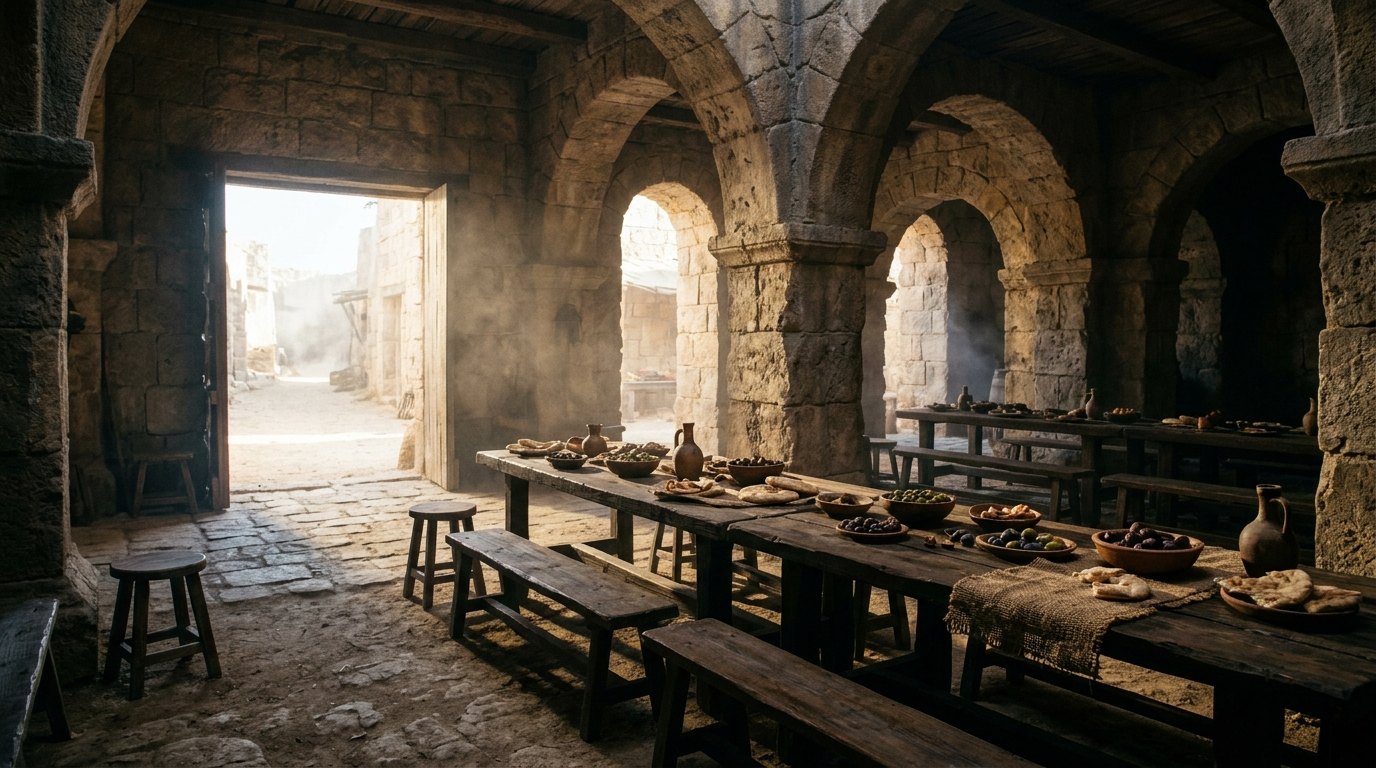
“The King will reply, ‘Truly I tell you, whatever you did for one of the least of these brothers and sisters of mine, you did for me.’
Matthew 25:40 (NIV)
Jesus explicitly equates acts of mercy shown to the hungry, sick, and poor with service to Himself.
In Matthew 25:40, the King unveils the standard of the final judgment: whatever was done for the least of these brothers was done unto Christ Himself. The Incarnation brings God's ancient defense of the afflicted into sharp, flesh-and-blood clarity. In the opening notes of the Gospel, Mary’s Magnificat praises God because He has filled the hungry with good things and sent the rich away empty (Luke 1:52-53). Announcing His public ministry at the synagogue in Nazareth, Jesus unfurls the scroll of Isaiah to proclaim that He was anointed precisely to preach good news to the poor (Luke 4:18-19). When the imprisoned John the Baptist sent disciples to confirm His identity, Jesus pointed directly to this divine priority alongside physical miracles: the poor have good news preached to them (Matthew 11:5; Luke 7:22).
Christ's kingdom completely inverts worldly prestige and economic comfort. In His foundational sermons, He pronounces blessings on the poor in spirit and the destitute, declaring that the kingdom of God belongs to them (Matthew 5:3; Luke 6:20-21). Following Jesus requires unseating the idol of wealth. He challenged the rich young ruler to sell everything, distribute it to the poor, and acquire eternal treasure (Matthew 19:21), a principle He delivered broadly to His disciples when urging them to sell possessions and give alms (Luke 12:33-34). Generosity under His reign is lavish and uncalculating; Jesus promised that the measure you give will be measured back, running over (Luke 6:38). True fellowship looks past social leverage: Jesus commands hosts to invite the poor, lame, and blind who cannot repay, promising a reward at the resurrection of the just (Luke 14:12-14).
When salvation transforms a heart, purse strings immediately loosen, as seen when Zacchaeus pledged half his wealth to the poor (Luke 19:8). Conversely, Jesus warned of eternal disaster for the indifferent rich, recounting how the neglected beggar Lazarus was carried to Abraham's bosom while the unyielding wealthy man suffered torment (Luke 16:19-25). True value before God is never determined by monetary size: the poor widow offering two copper coins gave more than all the wealthy donors because she sacrificed her entire livelihood (Luke 21:1-4). While Christ recognized that broken systems mean the poor will always be present (Matthew 26:11), Matthew 25:34-40 reveals that the Son of Man remains intimately identified with the hungry, thirsty, and naked.
| Passage | What it says |
|---|---|
| Matthew 5:3 | Pronounces the poor in spirit blessed, promising them the kingdom of heaven. |
| Matthew 19:21 | Tells the rich young ruler to sell possessions, give to the poor, and follow Him. |
| Matthew 25:34-40 | Identifies kindness rendered to the hungry, thirsty, and imprisoned as rendered directly to the King. |
| Luke 4:18-19 | Jesus reads Isaiah 61 in Nazareth, declaring His anointing to proclaim good news to the poor. |
| Luke 6:20-21 | Blesses the poor and the hungry, declaring the kingdom of God belongs to them. |
| Luke 6:38 | Promises that bountiful giving will be returned in good measure, pressed down and overflowing. |
| Luke 12:33-34 | Instructs disciples to sell possessions and give alms, storing treasure in heaven. |
| Luke 14:12-14 | Advises hosting the poor, maimed, and lame who cannot repay, promising reward at the resurrection. |
| Luke 19:8 | Zacchaeus demonstrates repentance by pledging half of his goods to the poor. |
| Luke 21:1-4 | Jesus commends the poor widow who gave her entire livelihood over the abundance of the rich. |
| Matthew 11:5 | Jesus points John's disciples to the good news preached to the poor. |
| Matthew 26:11 | Jesus tells the disciples they will always have the poor with them. |
| Luke 1:52-53 | Mary magnifies God for exalting the humble and filling the hungry with good things. |
| Luke 7:22 | Jesus sends word that the blind see, the lame walk, and the poor hear good news. |
| Luke 16:19-25 | The poor beggar Lazarus dies and is carried to Abraham's side while the rich man suffers. |
Apostolic Practice
The early church practiced radical equality and generous relief.

My brothers and sisters, believers in our glorious Lord Jesus Christ must not show favoritism. Suppose a man comes into your meeting wearing a gold ring and fine clothes, and a poor man in filthy old clothes also comes in. If you show special attention to the man wearing fine clothes and say, “Here’s a good seat for you,” but say to the poor man, “You stand there” or “Sit on the floor by my feet,” have you not discriminated among yourselves and become judges with evil thoughts? Listen, my dear brothers and sisters: Has not God chosen those who are poor in the eyes of the world to be rich in faith and to inherit the kingdom he promised those who love him? But you have dishonored the poor. Is…
James 2:1-9 (NIV)
James forbids seating the wealthy over the poor, naming favoritism as sin and contrary to God's election.
In James 2:1-9, Scripture delivers an uncompromising rebuke to the church: favoritism toward the wealthy over the poorly clothed is sin and an insult to God. God deliberately chose those who are poor in the world's eyes to be rich in faith and heirs of His kingdom. From Pentecost onward, the early believers lived out this reality through sacrificial communal care. In Jerusalem, the community held all things in common, selling properties and belongings to distribute proceeds to anyone in need (Acts 2:44-45), resulting in a community where not a single person remained needy (Acts 4:34-35). When practical distribution to Greek-speaking widows threatened to falter, the apostles ordained seven spirit-filled men to secure daily equity (Acts 6:1-3).
Every corner of the apostolic church echoed this imperative. Disciples like Dorcas in Joppa were remembered for good works and charity (Acts 9:36), while the Roman centurion Cornelius had his alms remembered before God (Acts 10:2). In response to widespread famine, the church in Antioch gathered relief to send to Judean believers (Acts 11:28-30), fulfilling what the apostles in Jerusalem urged Paul to never forget: the ongoing care of the poor (Galatians 2:10). Paul repeatedly mobilized cross-provincial relief, instructing Corinth and Galatia to set aside money weekly (1 Corinthians 16:1-3) and praising the impoverished Macedonian churches who begged for the privilege of sharing in this ministry (2 Corinthians 8:1-4; Romans 15:25-27).
This radical generosity is grounded entirely in the gospel: Christ became poor so that through His poverty we might become rich (2 Corinthians 8:9). True giving aims for an equitable balance where abundance meets scarcity (2 Corinthians 8:13-15), given cheerfully and without compulsion (2 Corinthians 9:6-8; Romans 12:13). Yet outward sacrifice is useless if devoid of genuine love (1 Corinthians 13:3), which 1 John 3:17-18 proves by showing that God's love cannot abide in someone who shuts their heart against a destitute brother. Local assemblies were commanded to honor and support destitute widows (1 Timothy 5:3-10), while wealthy members were charged to be rich in good works and ready to share (1 Timothy 6:17-19). Pure religion before God the Father demands visiting orphans and widows in distress (James 1:27), whereas unrighteous employers who exploit laborers face the wrath of the Lord of Hosts (James 5:1-6). In every act of practical charity toward the saints, God takes note and promises not to forget their labor of love (Hebrews 6:10).
| Passage | What it says |
|---|---|
| Acts 2:44-45 | Believers held all things in common, selling goods to distribute to anyone as they had need. |
| Acts 4:34-35 | Records that there was not a needy person among them because proceeds from property were distributed. |
| Acts 6:1-3 | Seven men are appointed to ensure widows receive fair daily distribution of food. |
| Acts 11:28-30 | Antioch believers send relief aid to Judean brothers facing a widespread famine. |
| Galatians 2:10 | Paul notes the Jerusalem leaders asked only that they remember the poor, which he was eager to do. |
| 2 Corinthians 8:9 | Points to Christ becoming poor for our sakes so that through His poverty we might become rich. |
| 2 Corinthians 9:6-8 | Exhorts cheerful, bountiful sowing, trusting God to make all grace abound for every good work. |
| 1 Timothy 6:17-19 | Charges the rich to be generous and ready to share, laying up a firm foundation for the future. |
| Hebrews 6:10 | Affirms God is not unjust to forget loving work done in ministering to the saints. |
| James 1:27 | Defines pure religion as visiting orphans and widows in their affliction and keeping unspotted from the world. |
| James 2:1-9 | Denounces favoritism toward the rich over the poor, reminding them God chose the poor to be rich in faith. |
| 1 John 3:17-18 | Asks how God's love can abide in someone who closes his heart against a brother in need. |
| Acts 9:36 | Dorcas in Joppa was full of good works and acts of charity toward the needy. |
| Acts 10:2 | Cornelius gave generously to the poor and prayed continuously to God. |
| Romans 12:13 | Paul instructs believers to contribute to the needs of the saints and show hospitality. |
| Romans 15:25-27 | Macedonia and Achaia contributed eagerly for the relief of the poor saints in Jerusalem. |
| 1 Corinthians 13:3 | Giving away all possessions to feed the poor profits nothing without love. |
| 1 Corinthians 16:1-3 | Churches are instructed to set aside a weekly collection for the relief of the saints. |
| 2 Corinthians 8:1-4 | Macedonian believers in severe poverty pleaded for the privilege of sharing in relief. |
| 2 Corinthians 8:13-15 | Abundance supplies need so there may be fair balance and mutual sustenance. |
| 1 Timothy 5:3-10 | The church must honor and support widows who are truly destitute and without family. |
| James 5:1-6 | James warns rich oppressors whose withheld wages cry out to the Lord of Hosts. |
Where in the Bible
| Book | Passages |
|---|---|
| Exodus | 3 · Exodus 22:25-27, Exodus 23:10-11, Exodus 30:15 |
| Leviticus | 7 · Leviticus 19:9-10, Leviticus 25:35-38, Leviticus 5:7, Leviticus 14:21, Leviticus 23:22, Leviticus 25:25-28, Leviticus 25:39-43 |
| Deuteronomy | 5 · Deuteronomy 15:1-11, Deuteronomy 24:14-15, Deuteronomy 24:10-13, Deuteronomy 24:19-22, Deuteronomy 26:12-13 |
| 1 Samuel | 1 · 1 Samuel 2:8 |
| Job | 2 · Job 5:15-16, Job 34:28 |
| Psalms | 10 · Psalms 140:12, Psalms 12:5, Psalms 72:4, Psalms 72:12-14, Psalms 113:7-8, Psalms 9:18, Psalms 34:6, Psalms 35:10, Psalms 82:3-4, Psalms 109:31 |
| Proverbs | 14 · Proverbs 14:31, Proverbs 17:5, Proverbs 19:17, Proverbs 22:2, Proverbs 22:9, Proverbs 28:27, Proverbs 29:7, Proverbs 13:23, Proverbs 19:1, Proverbs 21:13, Proverbs 28:6, Proverbs 30:8-9, Proverbs 31:8-9, Proverbs 31:20 |
| Ecclesiastes | 3 · Ecclesiastes 11:1, Ecclesiastes 5:8, Ecclesiastes 9:15-16 |
| Isaiah | 7 · Isaiah 1:16-17, Isaiah 10:1-2, Isaiah 58:6-7, Isaiah 3:14-15, Isaiah 11:4, Isaiah 25:4, Isaiah 61:1 |
| Jeremiah | 2 · Jeremiah 22:16, Jeremiah 5:28 |
| Ezekiel | 1 · Ezekiel 16:49 |
| Amos | 4 · Amos 2:6-7, Amos 5:11-12, Amos 4:1, Amos 8:4-6 |
| Micah | 1 · Micah 2:1-2 |
| Zechariah | 1 · Zechariah 7:9-10 |
| Matthew | 5 · Matthew 5:3, Matthew 19:21, Matthew 25:34-40, Matthew 11:5, Matthew 26:11 |
| Luke | 10 · Luke 4:18-19, Luke 6:20-21, Luke 6:38, Luke 12:33-34, Luke 14:12-14, Luke 19:8, Luke 21:1-4, Luke 1:52-53, Luke 7:22, Luke 16:19-25 |
| Acts | 6 · Acts 2:44-45, Acts 4:34-35, Acts 6:1-3, Acts 11:28-30, Acts 9:36, Acts 10:2 |
| Romans | 2 · Romans 12:13, Romans 15:25-27 |
| 1 Corinthians | 2 · 1 Corinthians 13:3, 1 Corinthians 16:1-3 |
| 2 Corinthians | 4 · 2 Corinthians 8:9, 2 Corinthians 9:6-8, 2 Corinthians 8:1-4, 2 Corinthians 8:13-15 |
| Galatians | 1 · Galatians 2:10 |
| 1 Timothy | 2 · 1 Timothy 6:17-19, 1 Timothy 5:3-10 |
| Hebrews | 1 · Hebrews 6:10 |
| James | 3 · James 1:27, James 2:1-9, James 5:1-6 |
| 1 John | 1 · 1 John 3:17-18 |
The story in order
- God hears the cry of the poor (c. 1000 BC) · Psalms 34:6 · Early affirmation of God's attentiveness to the needy.
- Mosaic Law protects the poor (c. 1450 BC) · Exodus 22:25-27 · Statutes embedded structural mercies for the impoverished.
- Wisdom honors God by caring for poor (c. 950 BC) · Proverbs 14:31 · Wise conduct shows reverence for God's creation.
- Prophets indict injustice to the poor (c. 740 BC) · Isaiah 10:1-2 · God rebukes leaders for unrighteous decrees against the poor.
- Jesus proclaims good news to the poor (AD 30) · Luke 4:18-19 · Jesus declares His mission to bring hope to the impoverished.
- Jesus identifies with the least (AD 30) · Matthew 25:34-40 · Service to the needy is seen as service to Christ.
- Early church shares possessions (AD 33) · Acts 2:44-45 · Radical equality and mutual support among believers.
- Apostles ensure fair distribution (AD 34) · Acts 6:1-3 · Practical steps taken to care for widows.
- Paul collects relief for Jerusalem (AD 57) · Romans 15:25-27 · Inter-church generosity for famine relief.
- James condemns favoritism to rich (AD 45) · James 2:1-9 · Warning against partiality based on wealth.
- John calls for practical love (AD 90) · 1 John 3:17-18 · Love for God demonstrated by caring for the needy.
God's Care for the Poor
| God's Action | Biblical Basis | Passage |
|---|---|---|
| Maintains the cause of the afflicted | Psalms 140:12 | Psalms 140:12 |
| Protects the poor from oppressors | Psalms 12:5 | Psalms 12:5 |
| Lifts the beggar to a place of honor | 1 Samuel 2:8 | 1 Samuel 2:8 |
| Hears the cry of the poor | Psalms 34:6 | Psalms 34:6 |
| Saves the needy from violence | Psalms 72:12-14 | Psalms 72:12-14 |
| Judges the poor with equity | Psalms 72:4 | Psalms 72:4 |
Mosaic Law Provisions for the Poor
| Provision | Purpose | Reference | Passage |
|---|---|---|---|
| No interest on loans to poor Israelites | Preventing further debt | Exodus 22:25-27 | Exodus 22:25-27 |
| Leave fields fallow in 7th year | Allowing gleaning for the poor | Exodus 23:10-11 | Exodus 23:10-11 |
| Same atonement price for rich and poor | Ensuring equal spiritual value | Exodus 30:15 | Exodus 30:15 |
| Leave gleanings for poor and stranger | Providing sustenance | Leviticus 19:9-10 | Leviticus 19:9-10 |
| Cancel debts every seven years | Offering fresh start | Deuteronomy 15:1-11 | Deuteronomy 15:1-11 |
| Pay daily wages before sunset | Preventing hardship for laborers | Deuteronomy 24:14-15 | Deuteronomy 24:14-15 |
| Leave forgotten sheaves for needy | Ensuring access to food | Deuteronomy 24:19-22 | Deuteronomy 24:19-22 |
Christ's Identification with the Poor
| Jesus' Teaching | Context | Reference | Passage |
|---|---|---|---|
| Blessed are the poor in spirit | Kingdom of Heaven promised | Matthew 5:3 | Matthew 5:3 |
| Sell possessions and give to the poor | Following Jesus | Matthew 19:21 | Matthew 19:21 |
| Kindness to the hungry is kindness to Him | Judgment criteria | Matthew 25:34-40 | Matthew 25:34-40 |
| Proclaiming good news to the poor | Jesus' mission statement | Luke 4:18-19 | Luke 4:18-19 |
| Kingdom of God belongs to the poor | Blessings for the needy | Luke 6:20-21 | Luke 6:20-21 |
| Hosting the poor brings reward | Generosity rewarded | Luke 14:12-14 | Luke 14:12-14 |
| Zacchaeus gives half his goods to the poor | Demonstration of repentance | Luke 19:8 | Luke 19:8 |
Key words
- Needy (Hebrew: dal (דַּל))
- Those lacking basic necessities, vulnerable and dependent. · Psalms 140:12
- Poor (Hebrew: 'ebyown (אֶבְיוֹן))
- Lacking sufficient resources, often in a state of destitution. · Psalms 12:5
- Afflicted (Hebrew: 'anî (עָנִי))
- Suffering hardship, oppression, or distress. · Psalms 72:12
- Justice (Hebrew: mišpāṭ (מִשְׁפָּט))
- Fairness, righteousness, and the upholding of rights. · Psalms 72:4
- Mercy (Hebrew: ḥesed (חֶסֶד))
- Compassion and kindness shown to those in need. · Proverbs 14:31
- Generosity (Greek: philanthrōpía (φιλανθρωπία))
- Willingness to give freely and abundantly. · 1 Timothy 6:17
- Stewardship (Greek: oikonomia (οἰκονομία))
- Responsible management of resources entrusted by God. · Luke 12:33-34
Believers are summoned not merely to pity those in need, but to act with open hands, impartiality, and cheerful generosity as stewards of God's abundant grace. Because Christ entered human poverty to make us rich in salvation, caring for the needy remains an indispensable mark of living faith. What we offer to the vulnerable in His name is never lost; God Himself receives it and remembers every labor of love.
98 passages, each cited once.
Scripture cited
- Proverbs 19:17
- Proverbs 28:27
- Hebrews 6:10
- Luke 6:38
- Matthew 25:40
- Ecclesiastes 11:1