What happened at Pentecost?
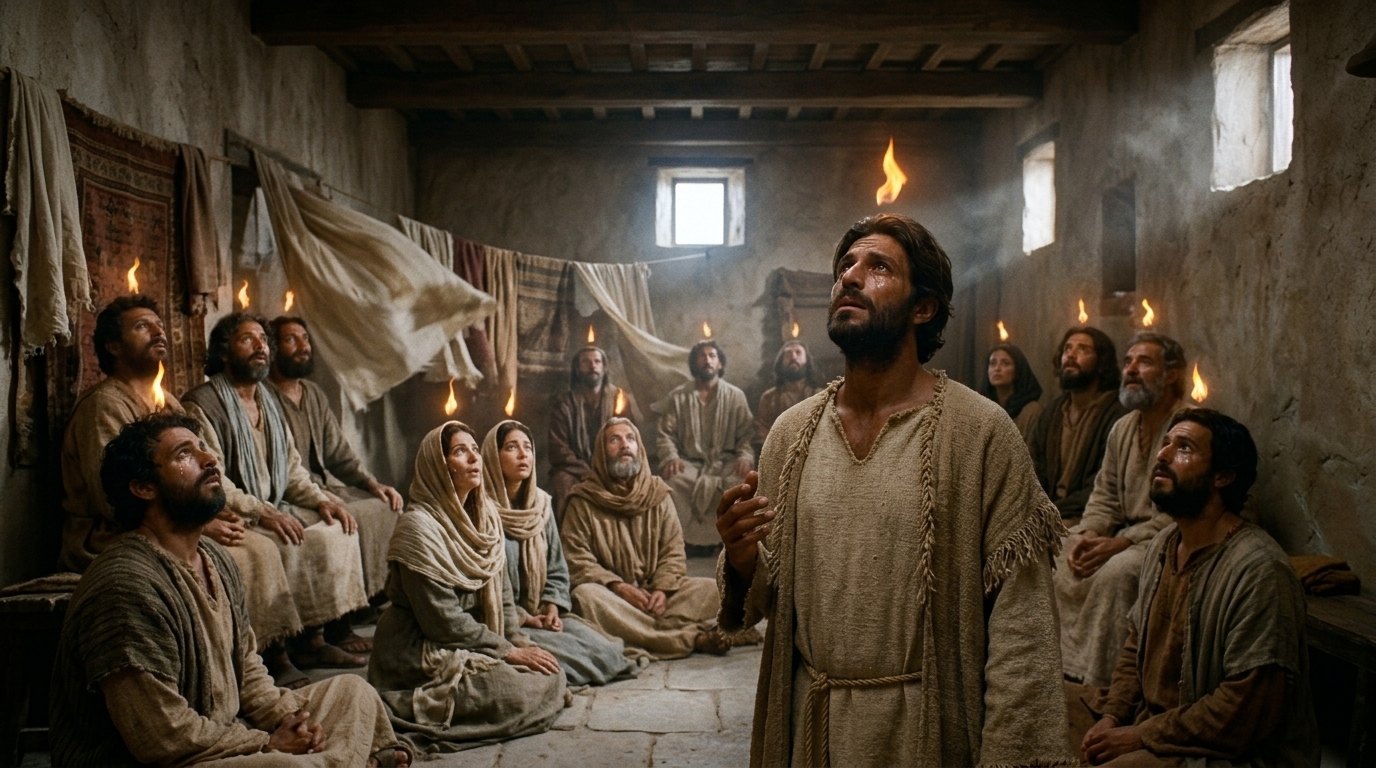
Acts 2:1-13
1 When the day of Pentecost came, they were all together in one place.
2 Suddenly a sound like the blowing of a violent wind came from heaven and filled the whole house where they were sitting.
3 They saw what seemed to be tongues of fire that separated and came to rest on each of them.
4 All of them were filled with the Holy Spirit and began to speak in other tongues as the Spirit enabled them.
5 Now there were staying in Jerusalem God-fearing Jews from every nation under heaven.
6 When they heard this sound, a crowd came together in bewilderment, because each one heard their own language being spoken.
7 Utterly amazed, they asked: “Aren’t all these who are speaking Galileans?
8 Then how is it that each of us hears them in our native language?
9 Parthians, Medes and Elamites; residents of Mesopotamia, Judea and Cappadocia, Pontus and Asia,
10 Phrygia and Pamphylia, Egypt and the parts of Libya near Cyrene; visitors from Rome
11 (both Jews and converts to Judaism); Cretans and Arabs—we hear them declaring the wonders of God in our own tongues!”
12 Amazed and perplexed, they asked one another, “What does this mean?”
13 Some, however, made fun of them and said, “They have had too much wine.”
New International Version (NIV)
The answer
At Pentecost, God poured out the Holy Spirit on Jesus’ disciples, just as Jesus had promised. They spoke in other languages by the Spirit’s power, Peter proclaimed the crucified and risen Jesus as Lord and Christ, and about three thousand people repented and were baptized.
Before His ascension, Jesus had told the disciples to wait in Jerusalem for the Father’s promise. They would be baptized in the Holy Spirit and receive power to witness for Him in Jerusalem and ultimately to the ends of the earth (Acts 1:4-8).
The Holy Spirit came with visible and audible signs
- A sound like a mighty wind: As the disciples were gathered together, the sound suddenly filled the house. Tongues like fire appeared and rested on each of them (Acts 2:1-3).
- They spoke in other languages: They were all filled with the Holy Spirit and spoke as the Spirit enabled them. Jews from many nations heard God’s mighty works declared in their own native languages—these were recognizable human languages, not merely unintelligible sounds (Acts 2:4-11).
- The crowd was divided: Some were amazed and asked what it meant; others mocked the disciples as drunk (Acts 2:12-13).
Peter explained the miracle and preached Christ
Peter declared that this was the outpouring of the Spirit prophesied by Joel. He also announced that whoever calls on the name of the Lord will be saved (Acts 2:14-21).
He then proclaimed that Jesus had been crucified through lawless men according to God’s determined counsel and foreknowledge, but God raised Him from death. The exalted Jesus had poured out the Holy Spirit, and God had made Him both Lord and Christ (Acts 2:22-36).
Thousands responded, and the church grew
The listeners were cut to the heart and asked what they should do. Peter called them to repent and be baptized in Jesus Christ’s name for the forgiveness of sins, promising the gift of the Holy Spirit to them, their children, and all whom God would call (Acts 2:37-39).
About three thousand received the word and were baptized that day. The new believers devoted themselves to the apostles’ teaching, fellowship, breaking bread, and prayer. They cared for one another’s needs, and the Lord continued adding those who were being saved (Acts 2:41-47).
Answered from Scripture · reviewed November 11, 2026
On the Jewish feast of Pentecost, God poured out the Holy Spirit upon the gathered disciples in Jerusalem, fulfilling ancient prophecy and the direct promise of Jesus. Accompanied by the roar of a rushing wind and tongues of fire, the believers declared God's mighty acts in native languages to pilgrims from across the known world, prompting Peter to preach the crucified and risen Christ and bringing about three thousand souls into the newly born church in a single day.
The Waiting Disciples
Gathered in Jerusalem for the Promise
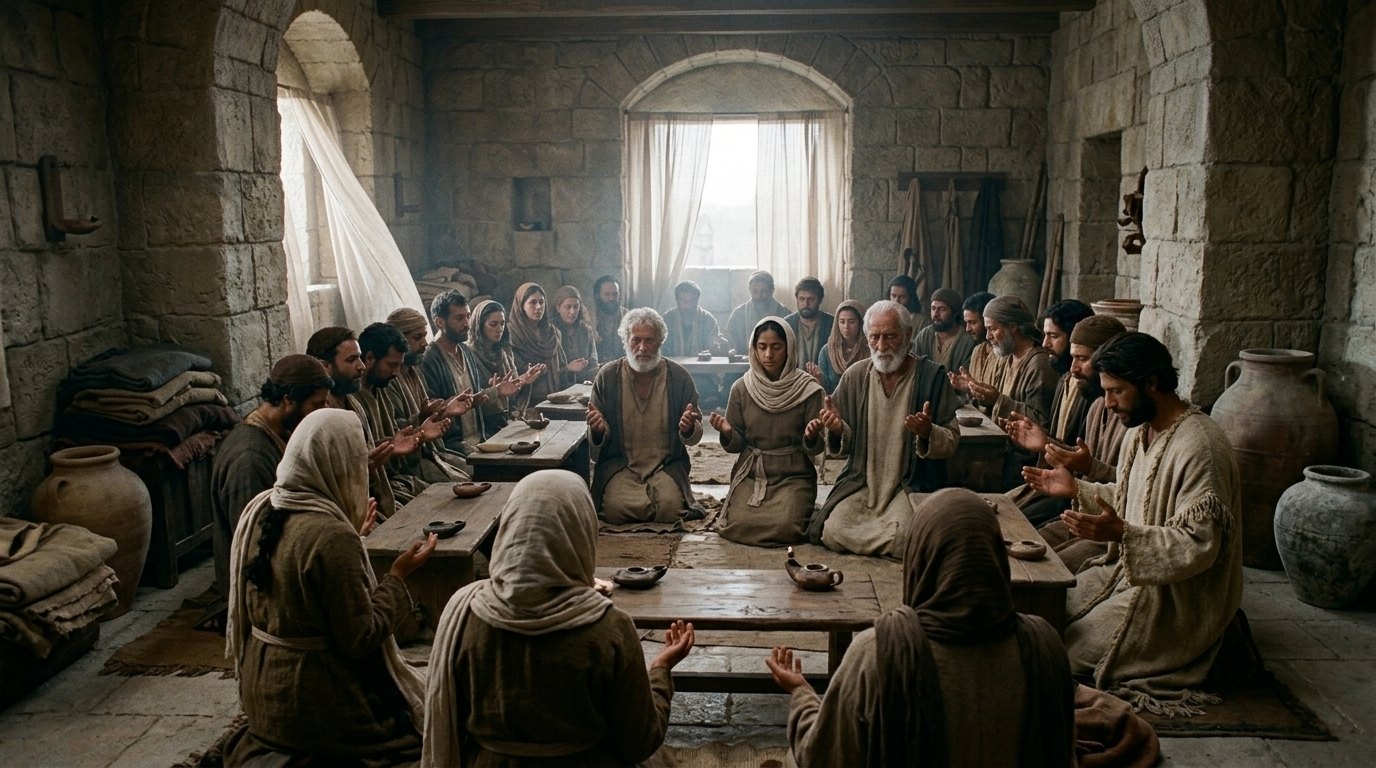
But you will receive power when the Holy Spirit comes on you; and you will be my witnesses in Jerusalem, and in all Judea and Samaria, and to the ends of the earth.”
Acts 1:8 (NIV)
Jesus defines the entire purpose of the Spirit's arrival: giving supernatural power to His followers to be His witnesses to the ends of the earth.
Before ascending into heaven, Jesus established the supreme purpose of Pentecost in Acts 1:8, declaring, "You will receive power when the Holy Spirit has come upon you, and you will be my witnesses in Jerusalem and in all Judea and Samaria, and to the end of the earth." The descent of the Spirit was neither an accident nor an afterthought, but the divine climax foretold throughout redemption history. Centuries earlier, Leviticus 23:15-21 prescribed the Feast of Weeks, commanding Israel to present the firstfruits of the wheat harvest fifty days after Passover. This agricultural festival was appointed by God to foreshadow the spiritual harvest of souls, which found its fulfillment in Acts 2:1. Centuries later, Joel 2:28-32 promised that in the last days God would pour out His Spirit upon all flesh, an oracle directly fulfilled in Acts 2:16-21.
During His earthly ministry, Christ repeatedly pointed to this appointed moment. In Luke 24:49, He commanded His followers to tarry in the city of Jerusalem until they were clothed with power from on high (fulfilled in Acts 2:1-4). Acts 1:4-5 reiterates this charge, contrasting water baptism with the coming baptism of the Holy Spirit (fulfilled in Acts 2:4). Jesus had comforted His grief-stricken disciples in John 14:16-17 by promising another Helper—the Spirit of truth—who would dwell with them and abide in them forever. In John 16:7, the Lord insisted that His departure was for their advantage, because only upon His ascension would the Helper come. Matthew 3:11 documents John the Baptist's prophetic warning that the Messiah would baptize not merely with water, but with the Holy Spirit and fire. Submitting completely to their Lord's instruction, the eleven apostles, along with Mary, Jesus' brothers, and the women, gathered in an upper room in Acts 1:13-14, continuing steadfastly with one accord in prayer until the promised hour arrived.
| Passage | What it says | Fulfilled |
|---|---|---|
| Leviticus 23:15-21 | Establishes the Feast of Weeks fifty days after Passover, celebrating the harvest with wave loaves. | Acts 2:1 |
| Joel 2:28-32 | Prophesies that God will pour out His Spirit on all flesh in the last days. | Acts 2:16-21 |
| Luke 24:49 | Jesus instructs the disciples to tarry in Jerusalem until clothed with power from on high. | Acts 2:1-4 |
| Acts 1:4-5 | Jesus commands His followers to wait for the baptism of the Holy Spirit promised by the Father. | Acts 2:4 |
| Acts 1:8 | Jesus promises power through the Holy Spirit to witness in Jerusalem, Judea, Samaria, and all the earth. | Acts 2:4-14 |
| Acts 1:13-14 | The apostles, women, Mary, and Jesus' brothers gather continuously in one accord in prayer. | Acts 2:1 |
| John 14:16-17 | Jesus promises the Father will give another Helper, the Spirit of truth, to dwell with them. | |
| John 16:7 | Jesus tells the disciples His departure is necessary so the Helper can come unto them. | |
| Matthew 3:11 | John the Baptist announces that the Messiah will baptize with the Holy Spirit and with fire. |
Wind and Fire
The Holy Spirit Descends in Power
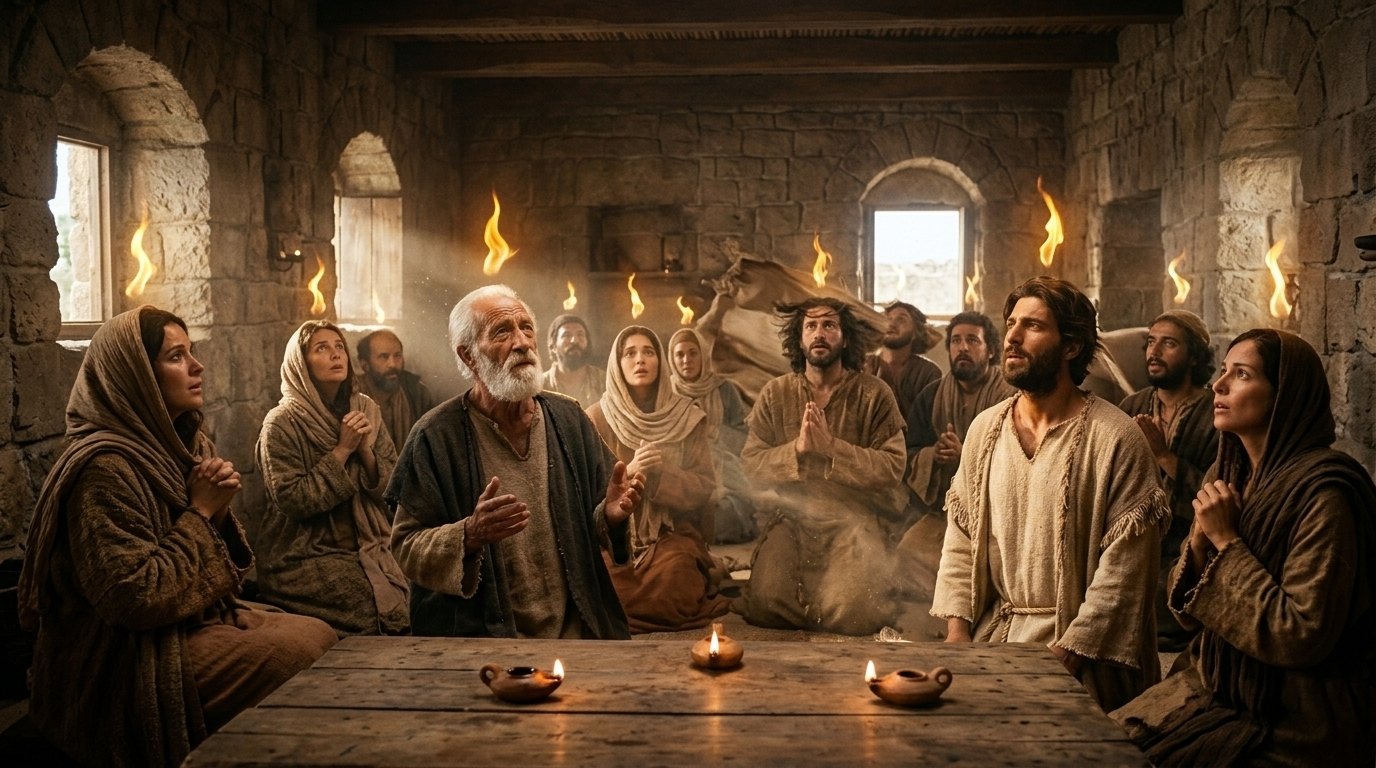
Suddenly a sound like the blowing of a violent wind came from heaven and filled the whole house where they were sitting. They saw what seemed to be tongues of fire that separated and came to rest on each of them.
Acts 2:2-3 (NIV)
God visibly and audibly signals the divine arrival with heaven's rushing wind and individual resting flames.
When the day of Pentecost had fully arrived, God openly shattered heaven's silence. According to Acts 2:2-3, a sound like a rushing mighty wind suddenly filled the whole house, and divided tongues as of fire appeared and rested upon each one of them. This was no gentle whisper; it was an unmistakable, sensible demonstration of heaven invading earth. The Lord announced the advent of the Holy Spirit with emblems long associated with His manifest presence throughout redemptive history: wind that speaks of His sovereign, invisible life-giving breath, and fire that marks His consuming holiness and refining glory.
The narrative opens in Acts 2:1 with approximately one hundred and twenty believers gathered together in one place, preserved in unified expectation. Acts 2:2 notes the suddenness of the sound from heaven, which echoed not merely through the upper room but throughout the entire surrounding dwelling. Then, in Acts 2:3, the supernatural flame partitioned itself, not consuming them as at Sinai, but resting upon each individual head. Every single believer—apostle, disciple, man, and woman alike—was consecrated as a living temple for God's indwelling presence.
Immediately following these visual and auditory wonders, Acts 2:4 records the inward transformation: they were all filled with the Holy Spirit and began to speak with other tongues, as the Spirit gave them utterance. This filling was an immediate empowerment, moving the believers from silent prayer into public declaration. God did not keep the fire hidden within four walls; the supernatural breath that filled their lungs instantly propelled them outside to declare the wonders of God.
| Passage | What it says |
|---|---|
| Acts 2:1 | The disciples are all together with one accord in one place when Pentecost fully arrives. |
| Acts 2:2 | A sound from heaven like a rushing mighty wind suddenly fills the entire house where they sit. |
| Acts 2:3 | Divided tongues like fire appear and sit upon each of the gathered believers. |
| Acts 2:4 | All present are filled with the Holy Spirit and speak in other languages as given utterance. |
The Miracle of Tongues
Nations Hear the Mighty Works of God
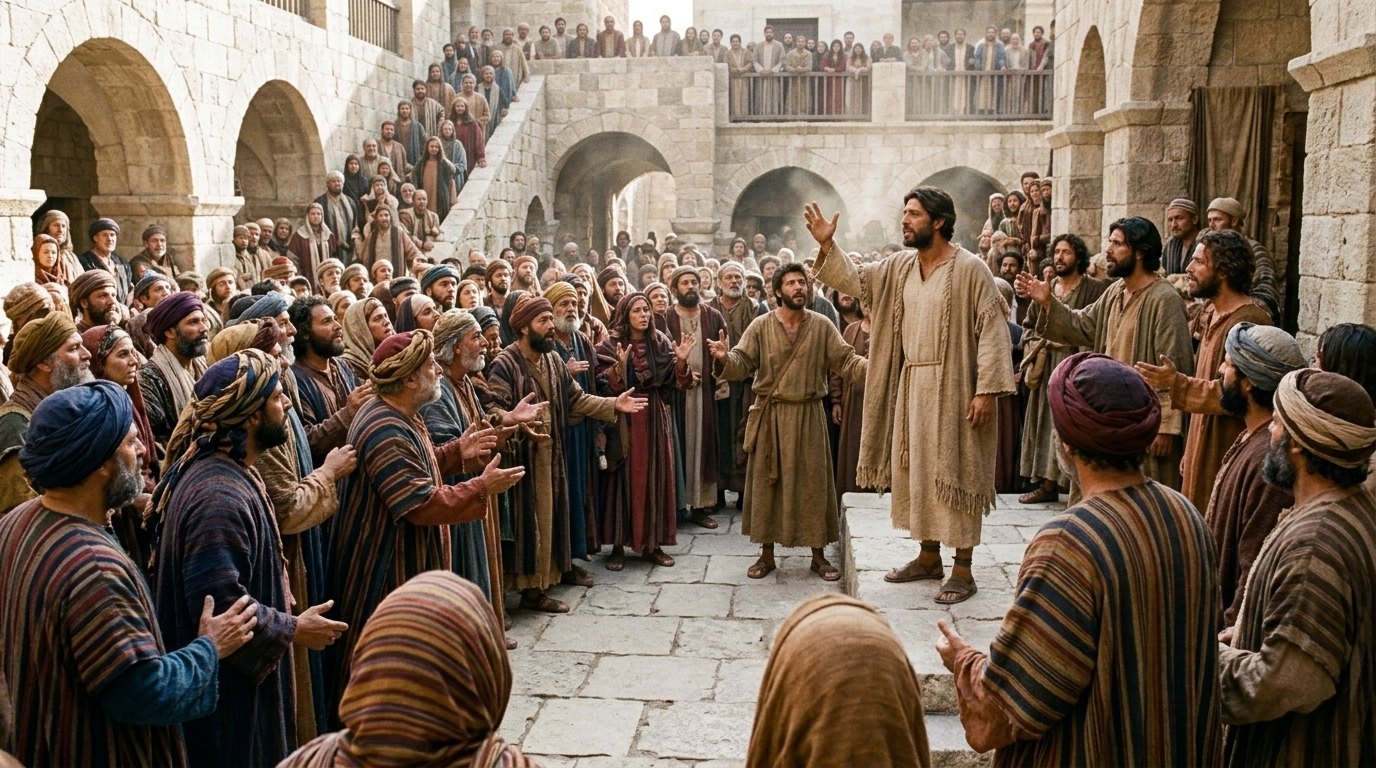
(both Jews and converts to Judaism); Cretans and Arabs—we hear them declaring the wonders of God in our own tongues!”
Acts 2:11 (NIV)
Devout international pilgrims hear uneducated Galileans proclaiming the magnificent works of God in their own native dialects.
The auditory miracle at Pentecost directly confronted the ancient fracture of human communication. In Acts 2:11, the gathered crowds expressed sheer astonishment, crying out, "We hear them telling in our own tongues the mighty works of God!" This supernatural utterance overturned the curse of Babel recorded in Genesis 11:7-9, where God confounded human language to scatter rebellious humanity across the earth; at Pentecost (fulfilled in Acts 2:6-11), the Spirit utilized diverse human languages not to scatter, but to unite all nations under the banner of Christ.
According to Acts 2:5-6, devout Jewish pilgrims residing or worshiping in Jerusalem from every nation under heaven were drawn by the thunderous roar. The multitude came together and was utterly bewildered, because every man heard these believers speaking in his own local dialect. The shock deepened in Acts 2:7-8 as the onlookers recognized that the speakers were unlettered Galileans, a regional group whose northern dialect was commonly despised and entirely devoid of formal linguistic training. How could provincial fishermen fluently articulate the idioms of distant empires?
Acts 2:9-11 catalogues fifteen distinct regions—stretching from Parthia, Media, and Elam in the east, through Mesopotamia, Judea, Cappadocia, Pontus, Asia, Phrygia, and Pamphylia, down into Egypt and Libya near Cyrene, reaching visitors from Rome, and including Cretans and Arabians. Every listener heard the unadulterated praises of Yahweh in his native mother tongue. As Acts 2:12-13 records, while the crowd was amazed and perplexed, skeptics mocked, asserting that the disciples were merely full of new wine. Unbelief sought to reduce the Holy Spirit's divine architecture to common drunkenness.
| Passage | What it says | Fulfilled |
|---|---|---|
| Genesis 11:7-9 | God confounds human speech at Babel, scattering nations across the face of the earth. | Acts 2:6-11 |
| Acts 2:5-6 | Devout Jews dwelling in Jerusalem from every nation gather in bewilderment hearing their own languages spoken. | |
| Acts 2:7-8 | The crowd marvels that Galilean speakers are understood distinctly in everyone's native tongue. | |
| Acts 2:9-11 | Pilgrims from fifteen named regions hear the mighty works of God declared in their native tongues. | |
| Acts 2:12-13 | While many are amazed and inquire what this means, others mock and accuse them of drunkenness. |
Peter's Proclamation
Declaring Jesus as Lord and Christ
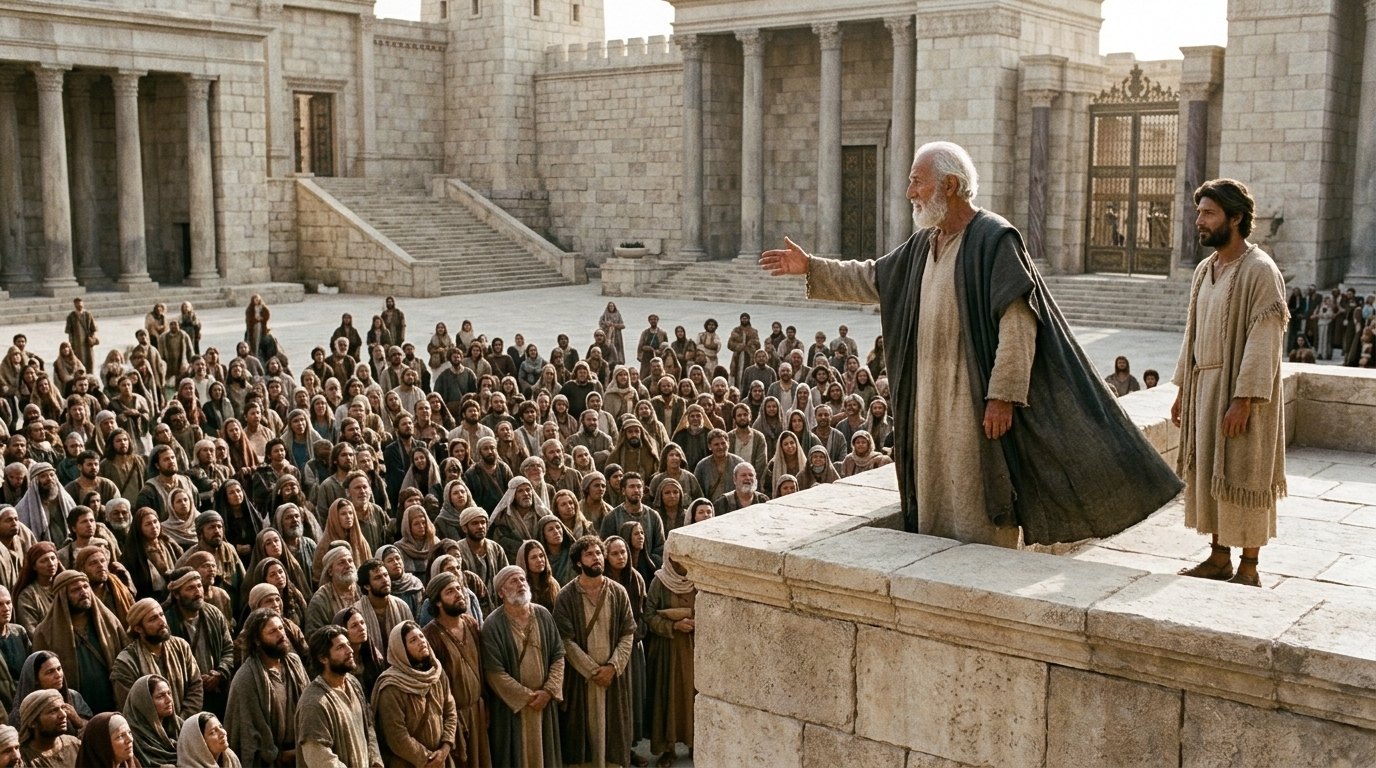
“Therefore let all Israel be assured of this: God has made this Jesus, whom you crucified, both Lord and Messiah.”
Acts 2:36 (NIV)
Peter culminates his sermon by declaring that God has made the crucified Jesus both Lord and Christ.
Standing before the murmuring multitude, the apostle Peter delivered the definitive interpretation of the morning's events, culminating in Acts 2:36 with the majestic verdict: "Let all the house of Israel therefore know for certain that God has made him both Lord and Christ, this Jesus whom you crucified." Peter did not entertain academic speculation; he grounded everything in fulfilled Scripture, bold proclamation of the cross, and the reality of the resurrection.
In Acts 2:14-21, Peter stood with the eleven, refuting charges of drunkenness by noting it was only the third hour of the day (nine in the morning). He declared that the crowd was witnessing the exact fulfillment of Joel 2:28-32, wherein God promised to pour out His Spirit upon all flesh before the great day of the Lord, assuring that whoever calls upon the name of the Lord shall be saved. In Acts 2:22-24, Peter traced the earthly life of Jesus of Nazareth, attested by God with signs and wonders, delivered over by God's determined counsel, crucified by lawless hands, and raised by God because death could not hold Him.
To prove Christ's resurrection, Peter cited Psalm 16:8-11 in Acts 2:25-28, where David rejoiced that God would not abandon His soul to Hades nor let His Holy One see corruption. In Acts 2:29-31, Peter pointed out that the tomb of the patriarch David remained visible in Jerusalem, meaning David was not speaking of himself, but prophesied the resurrection of the Christ. Peter added in Acts 2:32-35 that the risen Jesus, exalted to the right hand of God, received the promised Holy Spirit and poured forth what they saw and heard, fulfilling Psalm 110:1: "The Lord said to my Lord, 'Sit at My right hand.'" Exalted on high, Jesus reigns as the sovereign dispenser of the Spirit.
| Passage | What it says | Fulfilled |
|---|---|---|
| Psalms 16:8-11 | David prophesies that God's Holy One will not see corruption or be abandoned to Sheol. | Acts 2:25-31 |
| Psalms 110:1 | The Lord says to David's Lord to sit at His right hand until enemies become His footstool. | Acts 2:34-35 |
| Acts 2:14-21 | Peter refutes intoxication and identifies the outpouring as the fulfillment of Joel's prophecy for salvation. | |
| Acts 2:22-24 | Peter testifies that Jesus was attested by miracles, crucified by lawless men under God's counsel, and raised. | |
| Acts 2:32-35 | Exalted to the right hand of God, Jesus received the promise of the Spirit and poured it forth. | |
| Acts 2:36 | Israel is summoned to know assuredly that God made this crucified Jesus both Lord and Christ. | |
| Acts 2:25-28 | Peter cites David's prophecy of Christ's resurrection without seeing corruption. | |
| Acts 2:29-31 | Peter explains David spoke of the resurrection of the Christ, not himself. |
Repentance and Harvest
Three Thousand Baptized and the Church Formed
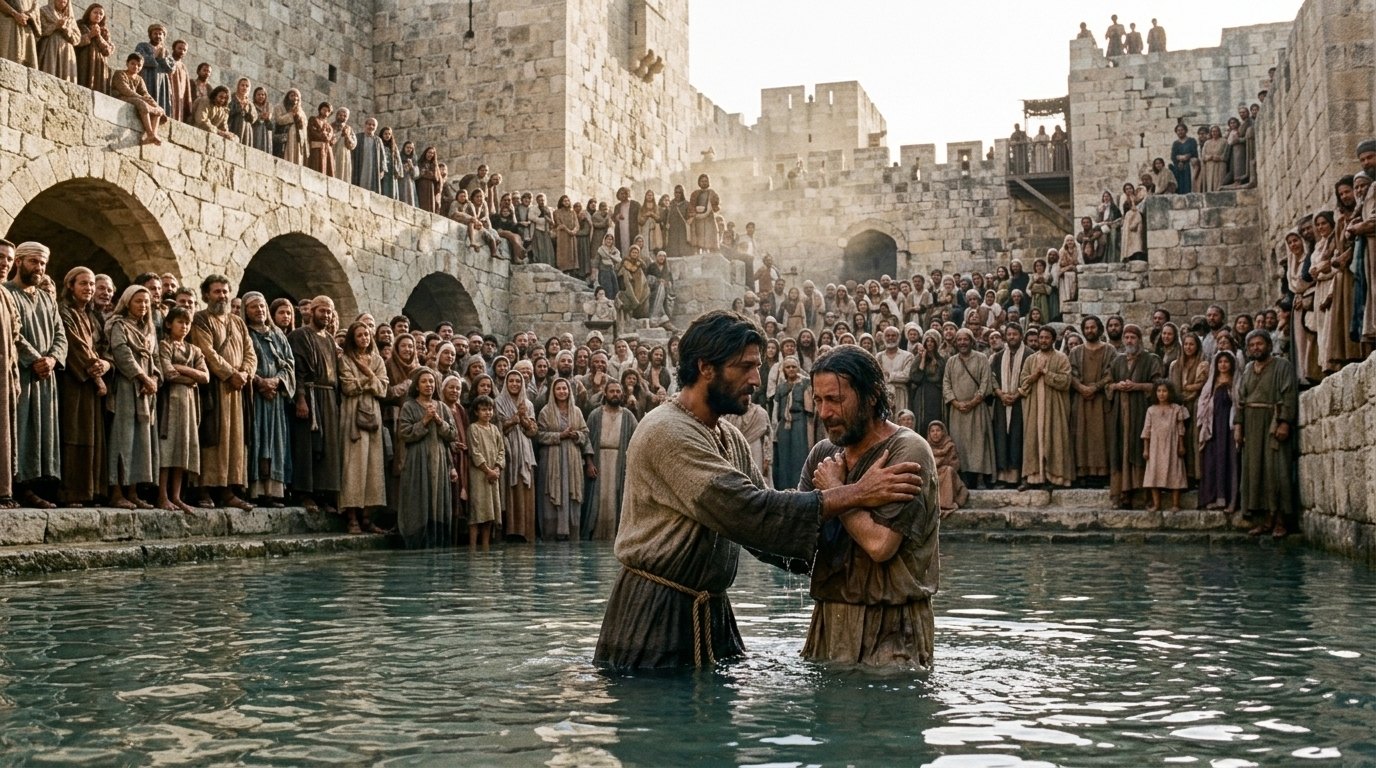
Peter replied, “Repent and be baptized, every one of you, in the name of Jesus Christ for the forgiveness of your sins. And you will receive the gift of the Holy Spirit.
Acts 2:38 (NIV)
Peter provides the definitive apostolic call to repentance, baptism in Jesus' name, and receipt of the Spirit's gift.
In Acts 2:38, the Apostle Peter delivers the definitive apostolic summons that answers the crisis of convicted sinners: 'Repent, and let every one of you be baptized in the name of Jesus Christ for the remission of sins; and you shall receive the gift of the Holy Spirit.' Having heard the declaration of Christ's resurrection and lordship, the crowd is cut to the heart, crying out to Peter and the rest of the apostles, 'Men and brethren, what shall we do?' (Acts 2:37). Their question is met with an immediate, unwavering command to turn from their unbelief and identify publicly with the crucified Messiah through water baptism, receiving the full forgiveness of sins and the indwelling seal of God's Spirit.
Peter immediately extends this promise beyond the immediate courtyard of Jerusalem, declaring in Acts 2:39 that this grace belongs 'to you and to your children, and to all who are afar off, as many as the Lord our God will call.' With many other solemn words, he urges them to be saved from that corrupt generation (Acts 2:40). The response is miraculous and sudden: those who receive his word with gladness are baptized, and that day about three thousand souls are added to the fledgling congregation (Acts 2:41).
This great harvest marks the formal birth and ordering of the New Testament church. Rather than dispersing back into their ordinary routines, these newly converted believers begin walking in daily, devoted communion with God and one another (Acts 2:42-47). They persevere steadfastly in the apostles' doctrine, fellowship, the breaking of bread, and prayers, sharing their resources with joy and generous hearts. As wonders and signs testify to God's hand among the apostles, the Lord faithfully adds to their number day by day those who are being saved.
| Passage | What it says |
|---|---|
| Acts 2:37 | The listeners are pierced to the heart and ask Peter and the apostles what they must do. |
| Acts 2:38-39 | Peter commands repentance and baptism for remission of sins, promising the Holy Spirit to all called. |
| Acts 2:40-41 | Those who gladly receive his word are baptized, adding about three thousand souls that day. |
| Acts 2:42-47 | Believers devote themselves to apostolic teaching, fellowship, breaking bread, and prayer as the Lord adds daily. |
Where in the Bible
| Book | Passages |
|---|---|
| Genesis | 1 · Genesis 11:7-9 |
| Leviticus | 1 · Leviticus 23:15-21 |
| Psalms | 2 · Psalms 16:8-11, Psalms 110:1 |
| Joel | 1 · Joel 2:28-32 |
| Matthew | 1 · Matthew 3:11 |
| Luke | 1 · Luke 24:49 |
| John | 2 · John 14:16-17, John 16:7 |
| Acts | 21 · Acts 1:4-5, Acts 1:8, Acts 1:13-14, Acts 2:1, Acts 2:2, Acts 2:3, Acts 2:4, Acts 2:5-6, Acts 2:7-8, Acts 2:9-11, Acts 2:12-13, Acts 2:14-21, Acts 2:22-24, Acts 2:32-35, Acts 2:36, Acts 2:25-28, Acts 2:29-31, Acts 2:37, Acts 2:38-39, Acts 2:40-41, Acts 2:42-47 |
The story in order
- God pours out His Spirit (c. 800 BC) · Joel 2:28-32 · Prophesies the outpouring of the Spirit on all flesh.
- Jesus promises the Helper (c. AD 30) · John 14:16-17 · Jesus promises the Spirit will dwell with believers.
- Disciples wait in Jerusalem (AD 30) · Acts 1:4-5 · Jesus commands waiting for the baptism of the Spirit.
- Pentecost arrives (AD 30) · Acts 2:1 · The disciples are gathered together when Pentecost fully arrives.
- Wind and fire descend (AD 30) · Acts 2:2-3 · A sound of wind and tongues of fire appear.
- Spirit fills believers (AD 30) · Acts 2:4 · All are filled with the Holy Spirit and speak in tongues.
- Nations hear God's works (AD 30) · Acts 2:5-11 · Devout Jews hear the mighty works of God in their own languages.
- Peter preaches Christ (AD 30) · Acts 2:14-36 · Peter explains the outpouring as Joel's prophecy fulfilled in Jesus.
- Three thousand repent (AD 30) · Acts 2:37-41 · Listeners are convicted and about three thousand are added.
- Church is formed (AD 30) · Acts 2:42-47 · Believers devote themselves to teaching, fellowship, and prayer.
Key words
- Pentecost (pentākostē, πεντηκοστῆ)
- Feast of Weeks, celebrated fifty days after Passover, also known as the harvest festival. · Leviticus 23:15-21
- Holy Spirit (pneuma, πνεῦμα)
- The third person of the Trinity, God's presence and power active in the world and in believers. · Joel 2:28-32
- Tongues (glōssai, γλωσσαι)
- Languages, spoken by the disciples as enabled by the Holy Spirit. · Acts 2:4
- Repentance (metanoia, μετανοια)
- A change of mind and heart leading to a turning away from sin and towards God. · Acts 2:38
- Baptism (baptisma, βαπτισμα)
- Immersion or washing, signifying cleansing from sin and identification with Christ's death and resurrection. · Acts 2:38
Pentecost demonstrates that the exalted Christ has poured out His Spirit to empower His people as bold witnesses to every tongue and nation. The same promise of repentance, remission of sins, and the Holy Spirit remains open to all whom the Lord God calls.
30 passages, each cited once.
Scripture cited
- Acts 2:14-47
- Acts 1:4-8