What is communion, the Lord's Supper?
1 Corinthians 11:23-26
23 For I received from the Lord what I also passed on to you: The Lord Jesus, on the night he was betrayed, took bread,
24 and when he had given thanks, he broke it and said, “This is my body, which is for you; do this in remembrance of me.”
25 In the same way, after supper he took the cup, saying, “This cup is the new covenant in my blood; do this, whenever you drink it, in remembrance of me.”
26 For whenever you eat this bread and drink this cup, you proclaim the Lord’s death until he comes.
New International Version (NIV)
The answer
Communion, or the Lord’s Supper, is the act of worship Jesus gave His church: believers eat bread and drink from the cup to remember His death, share in Him, and proclaim His death until He returns.
Paul explains that Jesus instituted it on the night He was betrayed. He gave thanks, broke the bread, and then gave the cup after supper (1 Corinthians 11:23-25). The bread points to His body broken for His people, and the cup is “the new covenant in my blood” (1 Corinthians 11:25).
Scripture gives the Supper several connected meanings:
- Remembrance: Jesus commanded, “Do this in memory of me” (1 Corinthians 11:24). Communion deliberately remembers Jesus and what He accomplished through His death.
- Proclamation: “For as often as you eat this bread and drink this cup, you proclaim the Lord’s death until he comes” (1 Corinthians 11:26). It looks back to the cross and forward to Christ’s return.
- Sharing in Christ: The cup and bread are called a sharing in Christ’s blood and body (1 Corinthians 10:16).
- Unity among believers: Because all partake of one loaf, the many are one body (1 Corinthians 10:17). Communion therefore expresses the fellowship of Christ’s people, not merely private devotion.
It is also to be received with reverence. Paul instructs participants to examine themselves, not eat or drink “in an unworthy way,” and discern the Lord’s body (1 Corinthians 11:27-29).
Answered from Scripture · reviewed November 11, 2026
The Lord's Supper is the sacred meal instituted by Jesus Christ on the night of His betrayal, given to His church as an enduring remembrance of His death and a proclamation of His gospel. Through the bread and the cup, believers participate in the fellowship of Christ's body and blood, ratifying their union with Him and with one another until He returns in glory. Scripture provides an unbroken witness to this ordinance, tracing its roots from the Old Testament covenants to the Upper Room and the life of the early church.
The Night Betrayed
Jesus Institutes the Memorial Meal

and when he had given thanks, he broke it and said, “This is my body, which is for you; do this in remembrance of me.”
1 Corinthians 11:24 (NIV)
Jesus establishes the broken bread as the abiding memorial of His sacrificial body given on behalf of His people.
In 1 Corinthians 11:24, the apostle Paul records the defining words of the Savior: "This is my body, which is for you; do this in remembrance of me." On the solemn night before His crucifixion, Jesus gathered His disciples to celebrate the ancient Passover, transforming that historic feast into the inaugural meal of the New Covenant. As recorded in Matthew 26:26-28, the Lord took bread, spoke a blessing, and broke it, giving it to His disciples as His own body offered on their behalf, before handing them the cup of wine as His covenant blood poured out for the remission of sins.
Mark 14:22-24 confirms this sacred transfer, portraying Jesus identifying the fruit of the vine directly with the blood of the new covenant that seals redemption. In Luke 22:19-20, Christ establishes the perpetual command for His followers to partake of the bread and the cup in deliberate memorial of His substitutionary death. When Paul later received the direct revelation of the ordinance in 1 Corinthians 11:23-25, he underscored that this rite originated with the Lord Himself on the very night He was handed over to death.
Before initiating this permanent feast, Jesus gave voice to the eternal weight of the moment. In Luke 22:14-18, He confessed His deep longing to eat this Passover before He suffered, looking past the cross to the ultimate consummation when the kingdom of God shall come in fullness. The Lord's Supper stands as the living testimony that Christ surrendered Himself willingly as an atoning sacrifice, calling His church across every generation to remember and rejoice.
| Passage | What it says |
|---|---|
| Matthew 26:26-28 | Jesus blesses and breaks bread as His body, offering the cup of the covenant for the remission of sins. |
| Mark 14:22-24 | During the Passover meal, Jesus distributes bread and wine as His body and blood of the new covenant. |
| Luke 22:19-20 | Jesus commands His disciples to break bread and drink the cup in remembrance of Him. |
| 1 Corinthians 11:23-25 | Paul recounts receiving directly from the Lord the tradition of the institution of the Supper. |
| Luke 22:14-18 | Jesus expresses fervent desire to eat the Passover before His suffering, anticipating the kingdom of God. |
Shadow to Substance
Covenant Promises and the Paschal Lamb
This is how you are to eat it: with your cloak tucked into your belt, your sandals on your feet and your staff in your hand. Eat it in haste; it is the LORD’s Passover. “On that same night I will pass through Egypt and strike down every firstborn of both people and animals, and I will bring judgment on all the gods of Egypt. I am the LORD. The blood will be a sign for you on the houses where you are, and when I see the blood, I will pass over you. No destructive plague will touch you when I strike Egypt. “This is a day you are to commemorate; for the generations to come you shall celebrate it as a festival to the LORD—a lasting ordinance.
Exodus 12:11-14 (NIV)
The Passover lamb's blood shields God's people from judgment, prefiguring the true Lamb who institutes the Supper.
The ordinance of communion does not arise in isolation, for in Exodus 12:11-14 the Lord ordained the Passover as an everlasting statute, where the blood of the unblemished lamb stood as a shield against wrath. In Exodus 12:1-14, God commanded every household of Israel to slaughter a male yearling and smear its blood on their doorposts, a deliverance that found its ultimate reality when Christ, the true Lamb of God, was slain for the sins of the world, fulfilling this type in John 1:29 and 1 Corinthians 5:7.
Centuries prior to Sinai, Genesis 14:18 recorded Melchizedek bringing forth bread and wine to bless Abraham, prefiguring the royal and eternal priesthood of Jesus documented in Hebrews 7:1-3. When God forged His covenant with the nation at Sinai in Exodus 24:8, Moses sprinkled the blood of the sacrifice upon the people, directly anticipating Christ's blood of the covenant that purchases eternal redemption in Matthew 26:28 and Hebrews 9:18-22. In Jeremiah 31:31-34, the prophet promised a new covenant of internal transformation and absolute pardon, which Jesus instituted in the cup according to Luke 22:20 and Hebrews 8:8-12.
The historical deliverance recorded in Exodus 12:21-27 demanded that the blood mark every home to stay the destroyer, fulfilled in 1 Corinthians 5:7-8 where the church is summoned to purge the leaven of malice and feast upon Christ in sincerity and truth. As Hebrews 9:18-22 and Hebrews 10:19-22 clarify, the first covenant required blood, but now believers possess boldness to enter the Holiest of all through the torn veil of Christ's flesh.
| Passage | What it says | Fulfilled |
|---|---|---|
| Exodus 12:1-14 | The institution of the Passover lamb whose shed blood delivers Israel from the angel of death. | 1 Corinthians 5:7, John 1:29 |
| Exodus 24:8 | Moses sprinkles the blood of the covenant upon the people to seal God's sacred bond with them. | Matthew 26:28, Hebrews 9:18-22 |
| Jeremiah 31:31-34 | God promises a new covenant of internal transformation and complete forgiveness of sins. | Luke 22:20, Hebrews 8:8-12 |
| Exodus 12:21-27 | The blood of the slaughtered Passover lamb applied to lintels saves Israel from death. | 1 Corinthians 5:7-8 |
| 1 Corinthians 5:7-8 | Christ our Passover lamb is sacrificed, so believers must keep the feast with sincerity and truth. | |
| Hebrews 9:18-22 | The first covenant was dedicated with blood, foreshadowing remission of sins through Christ's blood. | |
| Hebrews 10:19-22 | Believers enter the Holiest by the blood of Jesus through the veil of His flesh. | |
| Genesis 14:18 | Melchizedek king of Salem brings forth bread and wine as priest of God Most High. | Hebrews 7:1-3 |
Fellowship and Proclamation
Communion in the Body and Blood
Is not the cup of thanksgiving for which we give thanks a participation in the blood of Christ? And is not the bread that we break a participation in the body of Christ?
1 Corinthians 10:16 (NIV)
Paul defines the cup and bread as genuine participation and fellowship in Christ's blood and body.
In 1 Corinthians 10:16, the apostle sets forth the nature of the communion table: "The cup of blessing that we bless, is it not a participation in the blood of Christ? The bread that we break, is it not a participation in the body of Christ?" Believers do not simply remember a historical event; they share real spiritual fellowship with Christ and with each other. In 1 Corinthians 10:17, Paul explains that because there is one loaf, all who partake are knit together as one corporate body. This sacred meal requires undivided allegiance, as 1 Corinthians 10:21 warns that one cannot drink the Lord's cup and the cup of demons without provoking the Lord to jealousy. In 1 Corinthians 11:26, the apostle declares that eating this bread and drinking this cup actively proclaims Christ's sacrificial death until His triumphant return.
From its earliest days, the church centered its life around this meal. Acts 2:42 records that the converts in Jerusalem devoted themselves steadfastly to the apostles' doctrine, fellowship, prayer, and the breaking of bread. Acts 2:46 notes how this continued daily with gladness and singleness of heart from home to home. By the time of the missionary journeys, Acts 20:7 demonstrates that the disciples at Troas gathered regularly on the first day of the week for this explicit purpose. Even amidst peril at sea in Acts 27:35, Paul took bread, gave thanks to God publicly, broke it, and ate.
Yet this holy feast was fiercely guarded from perversion. In 1 Corinthians 11:17-22, Paul sternly rebuked the Corinthian believers for turning the holy meal into an occasion of social division and self-indulgence. The epistles of Jude 1:12 and 2 Peter 2:13 warned the church against ungodly men and false teachers who intruded as hidden reefs and blemishes in their communal love feasts, carousing without the fear of God.
| Passage | What it says |
|---|---|
| 1 Corinthians 10:16-17 | Believers partake of one bread and cup, signifying their spiritual union as one body in Christ. |
| 1 Corinthians 10:21 | Believers cannot share both the Lord's table and the table of demons without spiritual compromise. |
| 1 Corinthians 11:26 | Partaking of the bread and cup actively proclaims the Lord's death until His future return. |
| Acts 2:42 | The early church devoted itself steadily to apostolic doctrine, fellowship, prayer, and breaking bread. |
| Acts 20:7 | The disciples at Troas gathered specifically on the first day of the week to break bread. |
| Acts 2:46 | The early disciples continue daily with one accord and break bread from house to house. |
| Acts 27:35 | Paul takes bread, gives thanks to God before all, breaks it, and begins to eat. |
| 1 Corinthians 11:17-22 | Paul rebukes divisions and selfish conduct when the church comes together to eat the Lord's Supper. |
| Jude 1:12 | False teachers are described as hidden reefs in the church's love feasts, feasting without fear. |
| 2 Peter 2:13 | Ungodly men are stains and blemishes, reveling in their deceptions while feasting with the church. |
Reverence and Self-Examination
Approaching the Table with Discernment
Everyone ought to examine themselves before they eat of the bread and drink from the cup.
1 Corinthians 11:28 (NIV)
Scripture commands every believer to examine their heart before eating the bread and drinking the cup.
Because the table represents the sacred sacrifice of the Son of God, 1 Corinthians 11:28 delivers an unbending apostolic command: "Let a person examine himself, then, and so eat of the bread and drink of the cup." The Lord's Supper is neither a casual snack nor a careless ceremony; it demands honest self-scrutiny and genuine repentance before God. In 1 Corinthians 11:27, Paul warns that anyone who eats the bread or drinks the cup of the Lord in an unworthy manner—treating holy things with flippancy, unresolved bitterness, or unrepented sin—becomes guilty of desecrating the body and blood of the Lord Himself.
This solemn gravity is reinforced in 1 Corinthians 11:29, which explains that whoever eats and drinks without discerning the Lord's body eats and drinks judgment upon himself. The Corinthian congregation learned this truth through painful reality. In 1 Corinthians 11:30-32, Paul reveals that because they dishonored the table, many among them were weak and sickly, and a number had fallen asleep in physical death. God's disciplinary hand fell upon His own household so that they would be chastened by the Lord and not finally condemned along with the world.
To restore order and holiness, Paul concluded his instruction in 1 Corinthians 11:33-34 with pastoral clarity. He charged the brethren to wait patiently for one another when gathering to eat, setting aside all selfish appetites and personal pride. The Lord's Supper must always be celebrated with reverent hearts, deep humility, and unbroken love for the brethren.
| Passage | What it says |
|---|---|
| 1 Corinthians 11:27 | Eating or drinking in an unworthy manner brings guilt concerning the body and blood of the Lord. |
| 1 Corinthians 11:28-29 | Believers must examine themselves, discerning the Lord's body to avoid eating and drinking judgment upon themselves. |
| 1 Corinthians 11:30-32 | Disregard for the sanctity of the table resulted in divine chastening of weakness, sickness, and death. |
| 1 Corinthians 11:33-34 | Paul instructs believers to wait for one another and eliminate selfish excess when gathering to eat. |
Eschatological Hope
The Table and the Kingdom Feast
I tell you, I will not drink from this fruit of the vine from now on until that day when I drink it new with you in my Father’s kingdom.”
Matthew 26:29 (NIV)
Jesus points forward to the day He drinks the fruit of the vine anew with His redeemed.
In Matthew 26:29, the Lord lifts the cup not merely as an ending, but as an unbreakable pledge: He points His people forward to the day He drinks the fruit of the vine anew with His redeemed in the Father's kingdom. The Lord's Supper is fundamentally an eschatological meal, anchored in a past sacrifice but straining toward an impending dawn. When Christ established this table, He deliberately placed an expiration date on His absence.
Both Mark 14:25 and Luke 22:16-18 capture this same solemn vow. Christ abstained from the earthly cup from that moment onward, declaring that the Passover shadow would remain unfinished until it reaches its ultimate consummation in the inaugurated reign of God. Every observance of the Supper by the church is an act of expectant waiting. Paul echoes this forward posture when he writes that we proclaim the Lord's death until He comes. The table we spread today is not the end of the story, but the vestibule of the wedding hall. Revelation 19:9 discloses the destination toward which every broken loaf and poured cup has always pointed: the marriage supper of the Lamb, where the bride is gathered, the Bridegroom presides, and the redemption purchased at Calvary is celebrated in unending fellowship. Whenever believers take communion, they confess that the present age is passing and that the true banquet is yet to begin.
| Passage | What it says |
|---|---|
| Matthew 26:29 | Jesus vows not to drink of the vine again until the day He drinks it new in His Father's kingdom. |
| Mark 14:25 | Christ affirms His abstention from the fruit of the vine until the kingdom of God arrives. |
| Luke 22:16-18 | Jesus declares He will not eat the Passover again until it reaches fulfilment in God's kingdom. |
| Revelation 19:9 | An angel pronounces a blessing on those invited to the future marriage supper of the Lamb. |
The Bread of Life
Feeding on Christ the Living Bread

I am the living bread that came down from heaven. Whoever eats this bread will live forever. This bread is my flesh, which I will give for the life of the world.”
John 6:51 (NIV)
Jesus links His sacrificial offering of flesh with life-giving spiritual nourishment for the world.
In John 6:51, the Savior makes a revelation that confounded His listeners: Jesus links His sacrificial offering of flesh with life-giving spiritual nourishment for the whole world. While this discourse in Capernaum preceded the Last Supper, it unveils the theological reality that the sacrament outward signs signify. Man does not live by bread alone, nor could the wilderness manna preserve the wilderness generation from physical death, as Jesus explains in John 6:32-35. He alone is the true Bread descending from heaven, satisfying the soul's deepest famine forever.
To eat His flesh and drink His blood, as Jesus commands in John 6:48-51 and John 6:53-58, is to receive Him by faith, taking His atonement into our innermost being. It is an act of union, wherein Christ abides in the believer and the believer in Christ. This spiritual feeding grants eternal life and the certain promise of the resurrection on the last day. Yet Christ guards against gross carnal misunderstanding in John 6:63, insisting that it is the Spirit who gives life, while the flesh profits nothing; His words are spirit and life. When believers approach the Table, they do not perform an empty ceremony or a physical magic trick. By the Holy Spirit, they truly feast upon Christ, receiving from His fullness the grace, strength, and life that flow from His broken body and shed blood.
| Passage | What it says |
|---|---|
| John 6:32-35 | Jesus declares Himself the true Bread from heaven who gives life to the world. |
| John 6:48-51 | Jesus identifies His flesh as the living bread given for the life of the world. |
| John 6:53-58 | Jesus teaches that feeding on His flesh and drinking His blood yields eternal life and mutual abidance. |
| John 6:63 | Jesus explains that the Spirit gives life while the flesh profits nothing; His words are spirit and life. |
The Resurrected Banquet
The Table of Kingdom Fulfillment
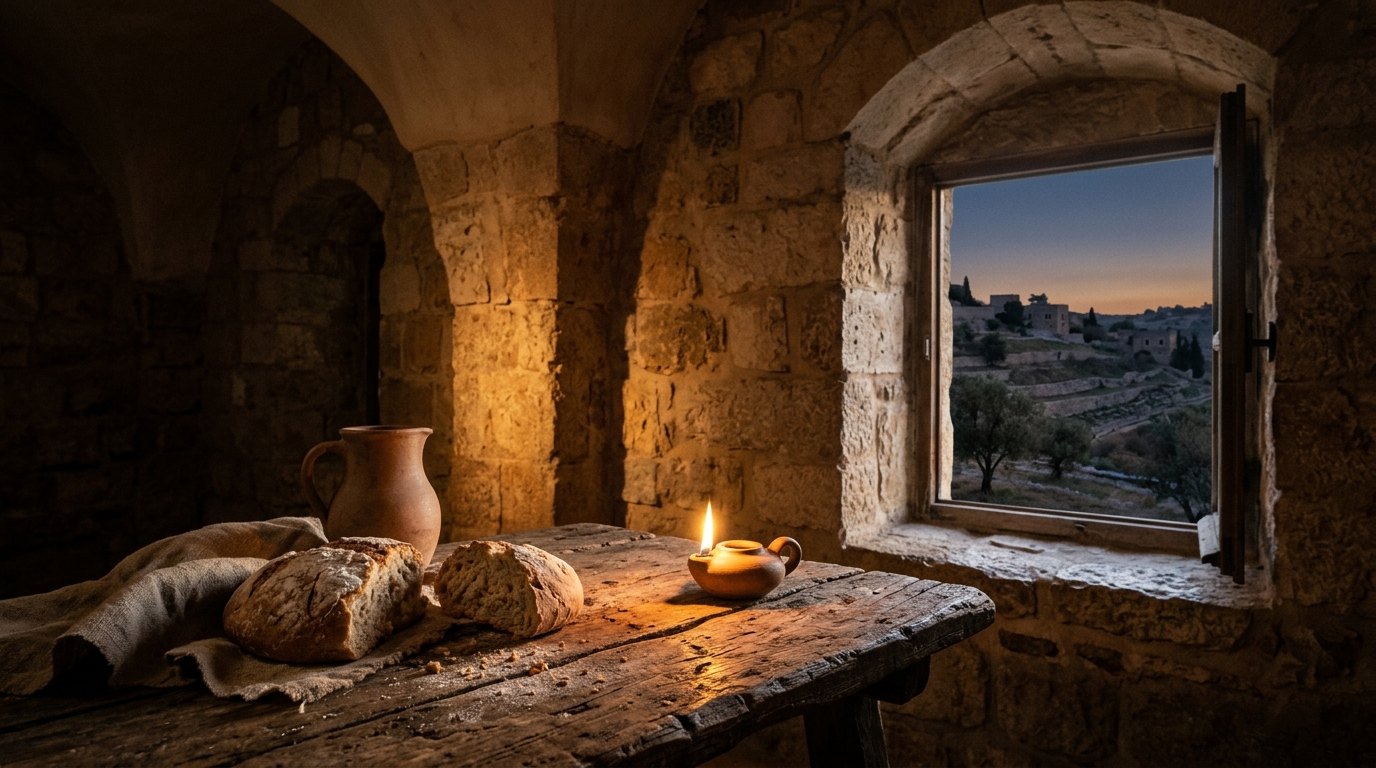
When he was at the table with them, he took bread, gave thanks, broke it and began to give it to them. Then their eyes were opened and they recognized him, and he disappeared from their sight.
Luke 24:30-31 (NIV)
The resurrected Lord is immediately recognized by His disciples through the familiar action of blessing and breaking bread.
At an ordinary table in Emmaus, Luke 24:30-31 records an extraordinary moment of grace: the resurrected Lord is immediately recognized by His disciples through the familiar, deliberate action of blessing and breaking bread. Their eyes, previously blinded by grief and unbelief, were opened the instant the nail-pierced hands tore the loaf. This Emmaus meal revealed that the risen Christ continues to meet His people at the table, transforming their sorrow into worship and commissioning them to bear witness to His victory.
This meal was the foretaste of an ancient promise. In Isaiah 25:6-8, the Lord of hosts promised to prepare on His mountain a feast of rich food and aged wines, swallowing up death forever and wiping away every tear—a prophecy fulfilled in Christ's resurrection and destined for final glory in 1 Corinthians 15:54 and Revelation 19:9. Throughout His earthly ministry, Jesus anticipated this hospitality. In Luke 12:37, He promised that the Master would gird Himself to serve His watchful servants, and in Luke 14:15-24, He pictured the kingdom as an abundant banquet where the poor and crippled are warmly welcomed. The story of Luke 24:30-35 proves that the cross did not abolish table fellowship; it perfected it. Even now, as Revelation 3:20 promises, Christ stands at the door, desiring to dine with anyone who hears His voice. At the Lord's Table, the church communes with a living King.
| Passage | What it says |
|---|---|
| Isaiah 25:6-8 | The Lord of hosts prepares a feast of rich food and wine, swallowing up death forever. |
| Luke 12:37 | The Master girds Himself and serves watchful servants at table upon His arrival. |
| Luke 14:15-24 | The parable of the great banquet illustrates the open feast of the kingdom offered to all. |
| Luke 24:30-35 | The resurrected Jesus breaks bread at Emmaus, and the disciples recognize Him in the breaking. |
| Revelation 3:20 | Christ stands at the door and knocks, promising to dine with whoever opens to Him. |
Where in the Bible
| Book | Passages |
|---|---|
| Genesis | 1 · Genesis 14:18 |
| Exodus | 3 · Exodus 12:1-14, Exodus 24:8, Exodus 12:21-27 |
| Isaiah | 1 · Isaiah 25:6-8 |
| Jeremiah | 1 · Jeremiah 31:31-34 |
| Matthew | 2 · Matthew 26:26-28, Matthew 26:29 |
| Mark | 2 · Mark 14:22-24, Mark 14:25 |
| Luke | 6 · Luke 22:19-20, Luke 22:14-18, Luke 22:16-18, Luke 12:37, Luke 14:15-24, Luke 24:30-35 |
| John | 4 · John 6:32-35, John 6:48-51, John 6:53-58, John 6:63 |
| Acts | 4 · Acts 2:42, Acts 20:7, Acts 2:46, Acts 27:35 |
| 1 Corinthians | 10 · 1 Corinthians 11:23-25, 1 Corinthians 5:7-8, 1 Corinthians 10:16-17, 1 Corinthians 10:21, 1 Corinthians 11:26, 1 Corinthians 11:17-22, 1 Corinthians 11:27, 1 Corinthians 11:28-29, 1 Corinthians 11:30-32, 1 Corinthians 11:33-34 |
| Hebrews | 2 · Hebrews 9:18-22, Hebrews 10:19-22 |
| 2 Peter | 1 · 2 Peter 2:13 |
| Jude | 1 · Jude 1:12 |
| Revelation | 2 · Revelation 19:9, Revelation 3:20 |
The story in order
- Covenant sealed with blood (c. 1446 BC) · Exodus 24:8 · Moses sprinkles blood, sealing God's sacred bond with Israel.
- Passover lamb instituted (c. 1446 BC) · Exodus 12:1-14 · Shed blood of the lamb delivers Israel from death.
- Melchizedek offers bread and wine (c. 2000 BC) · Genesis 14:18 · Priest of God Most High blesses Abraham with bread and wine.
- New covenant promised (c. 600 BC) · Jeremiah 31:31-34 · God promises internal transformation and forgiveness of sins.
- Jesus institutes the Supper (AD 30) · Matthew 26:26-28 · Jesus breaks bread and offers the cup of the new covenant.
- Jesus shares Passover meal (AD 30) · Luke 22:14-18 · Jesus anticipates the kingdom of God before His suffering.
- Paul receives Supper tradition (c. AD 55) · 1 Corinthians 11:23-25 · Paul recounts the Lord's direct instruction on the Supper.
- Early church breaks bread (c. AD 30) · Acts 2:42 · The early church devoted itself to fellowship and breaking bread.
- Jesus is the Bread of Life (c. AD 30) · John 6:32-35 · Jesus declares Himself the true Bread from heaven.
- Resurrected Jesus breaks bread (AD 30) · Luke 24:30-35 · Disciples recognize the resurrected Jesus in the breaking of bread.
- Marriage supper of the Lamb (c. AD 95) · Revelation 19:9 · Blessing pronounced on those invited to the future supper.
Key words
- Covenant (berit (Hebrew))
- A solemn agreement or bond, often sealed by a ritual or sacrifice. · Exodus 24:8
- Remission of sins (aphesis hamartion (Greek))
- The forgiveness or cancellation of sins. · Matthew 26:28
- Remembrance (anamnesis (Greek))
- Recalling something to mind, especially with solemnity and devotion. · Luke 22:19
- Fellowship (koinonia (Greek))
- Communion or partnership, sharing in common. · 1 Corinthians 10:16
- Discern (diakrino (Greek))
- To distinguish, recognize, or judge properly. · 1 Corinthians 11:29
Approaching the Lord's Table calls every believer to reverent self-examination, gratitude, and expectant faith. In the bread and the cup, Christ gives His people tangible signs of His redeeming love and a foretaste of the marriage supper of the Lamb. When the church partakes together in unity and truth, she proclaims the Lord's death until He comes.
40 passages, each cited once.
How the major Christian traditions read this
All Christian traditions confess that the Lord Jesus instituted the Lord's Supper on the night He was betrayed, commanding His followers to eat the bread and drink the cup in remembrance of His sacrificial death until He comes again (1 Corinthians 11:23-26).
Catholic
We believe the Holy Eucharist is the source and summit of the Christian life, instituted by Christ at the Last Supper (Matthew 26:26-28). When the priest consecrates the bread and wine, their entire substance is transformed into the actual body, blood, soul, and divinity of Jesus Christ—a change known as transubstantiation—while the outward appearances remain. The Mass is a true, unbloody representation of the one sacrifice of Calvary, applying its fruits to our souls. Through this sacrament, believers are intimately united to Christ and His Church, receiving sanctifying grace, remission of venial sins, and spiritual nourishment for eternal life, provided one receives worthily (1 Corinthians 10:16; 1 Corinthians 11:27-29).
Scripture: Matthew 26:26-28, 1 Corinthians 10:16, 1 Corinthians 11:27-29
Orthodox
In the Orthodox Church, the Holy Eucharist is the supreme Divine Mystery of the Church, instituted by Christ (Luke 22:19-20). We hold firmly that after the invocation of the Holy Spirit, the bread and wine truly, really, and substantially become the genuine Body and Blood of our Lord Jesus Christ. Rather than attempting to explain the exact mechanics through human philosophy, we revere it as an ineffable holy mystery. Communion unites the faithful mystically with Christ's deified humanity and with one another in the fullness of His resurrected life (1 Corinthians 10:16-17). It is given to baptized and chrismated Orthodox Christians, from infants to adults, for the remission of sins and life eternal.
Scripture: Luke 22:19-20, 1 Corinthians 10:16-17
Lutheran
We teach that in the Sacrament of the Altar, the true body and blood of Christ are really present in, with, and under the bread and wine, distributed to and received by all who eat and drink (Matthew 26:26-28; 1 Corinthians 10:16). We take Christ's words literally: "This is my body." This bodily presence is not a philosophical transformation of substance nor a mere symbol, but a sacramental union instituted by Christ's own word. The Supper is a means of grace wherein God offers and imparts the forgiveness of sins, life, and salvation to believers. Even the unworthy receive Christ's body and blood, though to their judgment if lacking faith (1 Corinthians 11:27-29).
Scripture: Matthew 26:26-28, 1 Corinthians 10:16, 1 Corinthians 11:27-29
Reformed & Presbyterian
We confess that the Lord's Supper is a sacrament instituted by Christ to nourish believers spiritually and seal the promises of the gospel (1 Corinthians 11:23-26). The bread and wine remain physically unchanged, and Christ’s physical body remains locally in heaven. Yet this is not an empty memorial: by the power of the Holy Spirit, believers who receive the outward elements in faith truly, spiritually feed upon the crucified Christ and receive all the benefits of His death (1 Corinthians 10:16). The Supper confirms our union with Christ, assures our pardon, and knits the congregation together into one spiritual body, while the unbelieving receive only the outward signs to their condemnation.
Scripture: 1 Corinthians 10:16, 1 Corinthians 11:23-26
Anglican & Episcopal
We receive the Supper of the Lord as a sacrament of our redemption by Christ's death (1 Corinthians 11:23-26). As our historic formularies state, to those who rightly, worthily, and with faith receive it, the bread broken is a partaking of the body of Christ, and the cup of blessing is a partaking of His blood (1 Corinthians 10:16). The body of Christ is given, taken, and eaten in the Supper only after a heavenly and spiritual manner, through faith. We reject transubstantiation as unscriptural, yet we uphold Christ's real spiritual presence given to the faithful. The sacrament strengthens our souls by Christ's grace and visibly binds us together as His church.
Scripture: 1 Corinthians 10:16, 1 Corinthians 11:23-26
Baptist
We observe the Lord's Supper as an ordinance given by Jesus to His local churches until He returns (1 Corinthians 11:23-26). The elements of bread and the fruit of the vine are sacred symbols pointing to the broken body and shed blood of our Redeemer (Luke 22:19-20). While some among us emphasize the spiritual nourishment experienced through communion, our primary focus is memorial and proclamation: we obey Christ's command, "Do this in remembrance of me," publicly declaring His finished sacrifice on the cross. Communion belongs to baptized believers who examine their hearts before God, celebrating our common salvation, unity in Christ, and hope of His glorious return.
Scripture: Luke 22:19-20, 1 Corinthians 11:23-26
Methodist & Wesleyan
We hold that the Lord's Supper is not merely a badge of Christian fellowship, but a true sacrament and efficacious means of grace ordained by Christ (Luke 22:19-20; 1 Corinthians 11:23-26). In communion, God conveys transforming grace, strengthening and confirming our faith as we remember Christ's death and await His kingdom. Christ is truly present in a spiritual manner, imparting Himself to the believer through the Holy Spirit (1 Corinthians 10:16). Historically in our Wesleyan heritage, the table is open to all who sincerely repent of their sin, desire peace with God, and seek His forgiving love, serving not only to sustain believers but even to bring the seeking soul to salvation.
Scripture: Luke 22:19-20, 1 Corinthians 10:16, 1 Corinthians 11:23-26
Pentecostal & Charismatic
We celebrate the Lord's Supper as a holy ordinance instituted by Christ for His church (1 Corinthians 11:23-26). The bread and cup are symbolic elements representing the body and blood of Jesus Christ, calling us to remember His sufferings and proclaim His atoning death until His return. As we partake in the fellowship of the Holy Spirit, we share in the benefits of Christ's redemption, which provides forgiveness, spiritual renewal, and physical healing by His stripes (Isaiah 53:5). Partaking demands self-examination and reverence, uniting believers in expectant worship as we anticipate the marriage supper of the Lamb (1 Corinthians 11:28-29; Revelation 19:9).
Scripture: Isaiah 53:5, 1 Corinthians 11:23-26, 1 Corinthians 11:28-29, Revelation 19:9
Non-denominational & Evangelical
We practice communion in direct obedience to Christ's command in Scripture, gathering as the church to remember His death and celebrate the new covenant established in His blood (Luke 22:19-20; 1 Corinthians 11:24-25). The bread and the cup serve as symbolic reminders of Christ's physical sacrifice for our sins. Participating in the Lord’s Supper allows us to reflect personally on God's grace, confess our sins, examine our hearts, and express fellowship with all believers in Christ (1 Corinthians 10:17; 1 Corinthians 11:28). It is an act of humble proclamation, looking back to the cross and forward with great joy to the Lord's second coming.
Scripture: Luke 22:19-20, 1 Corinthians 10:17, 1 Corinthians 11:24-25, 1 Corinthians 11:28
Where they differ
The nature of Christ's presence
- Catholic
- Substances literally become Christ's body and blood through transubstantiation.
- Orthodox
- Truly Christ's body and blood by an ineffable divine mystery.
- Lutheran
- Christ's body and blood are present in, with, and under elements.
- Reformed & Presbyterian
- Christ is spiritually present, received by faith through the Holy Spirit.
- Anglican & Episcopal
- Christ is spiritually received by faith; physical substance remains bread and wine.
- Baptist
- The elements remain bread and cup, functioning as memorial symbols.
- Methodist & Wesleyan
- Christ is spiritually present, imparting sanctifying grace to the faithful receiver.
- Pentecostal & Charismatic
- Elements are symbolic representations of Christ's body and atoning blood.
- Non-denominational & Evangelical
- The elements are purely symbolic visual reminders of Christ's sacrifice.
Scripture: Matthew 26:26-28, 1 Corinthians 10:16
Sacramental grace versus memorial ordinance
- Catholic
- A true sacrifice and sacrament conferring grace directly to the recipient.
- Orthodox
- A life-giving mystery imparting deification and remission of sins.
- Lutheran
- A means of grace that imparts the forgiveness of sins.
- Reformed & Presbyterian
- A sacramental seal nourishing faith through the Holy Spirit.
- Anglican & Episcopal
- An effectual sign of grace strengthening our union with Christ.
- Baptist
- An ordinance of obedient remembrance, not a channel of salvific grace.
- Methodist & Wesleyan
- A means of grace that conveys converting and sanctifying divine power.
- Pentecostal & Charismatic
- An obedient memorial ordinance reminding believers of atoning provision.
- Non-denominational & Evangelical
- An act of memorial obedience and worship honoring Jesus' command.
Scripture: Luke 22:19-20, 1 Corinthians 11:24-26
Your pastor can tell you where your church stands.
Scripture cited
- 1 Corinthians 11:23-26
- 1 Corinthians 11:23-25
- 1 Corinthians 10:16-17
- 1 Corinthians 11:27-29