What is the book of Esther about?
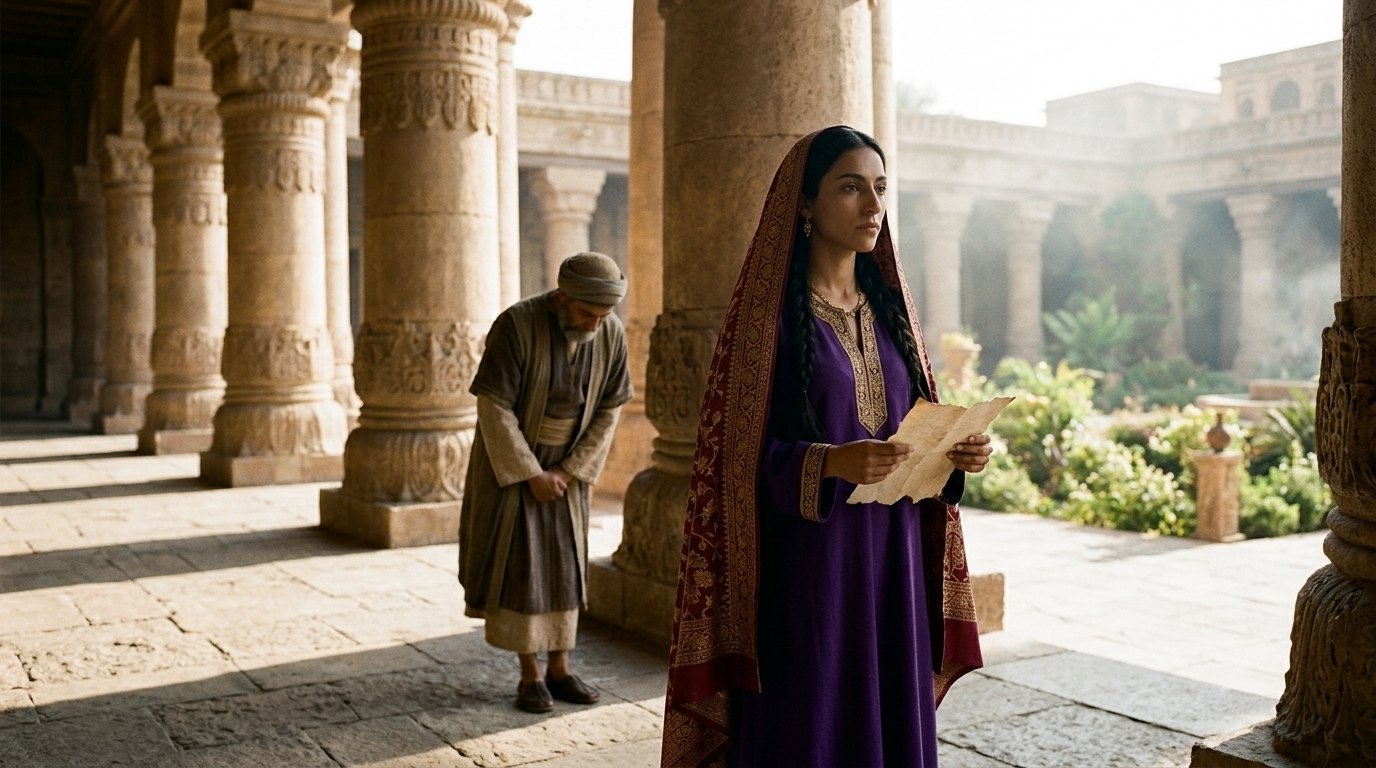
Esther 4:12-14
12 When Esther’s words were reported to Mordecai,
13 he sent back this answer: “Do not think that because you are in the king’s house you alone of all the Jews will escape.
14 For if you remain silent at this time, relief and deliverance for the Jews will arise from another place, but you and your father’s family will perish. And who knows but that you have come to your royal position for such a time as this?”
New International Version (NIV)
The answer
The book of Esther is about how God preserves His people through danger and uses one person's courage at the right moment.
The story unfolds in Persia. Esther, a Jewish woman raised by her cousin Mordecai, becomes queen without knowing her royal identity. Meanwhile, Haman—the king's favorite—plots to destroy the Jews. Mordecai urges Esther to go to the king, asking, “Who knows if you have not come to the kingdom for such a time as this?” (Esther 4:14). Esther fasts and prays, then courageously confronts the king and Haman. The king discovers that Haman has ordered the destruction of the Jews, so he reverses the decree. The Jews are delivered, Haman is executed, and Mordecai is honored. The book closes with the establishment of Purim (Esther 9:20-32).
What the book emphasizes
- God's unseen providence: Although God is not mentioned directly in the book, His presence is evident in the sequence of events that brings Esther to the throne, gives Mordecai the king's attention, and saves the Jews.
- God's faithfulness to His people: The threatened destruction does not succeed. The deliverance shows that God remains faithful even when His people seem abandoned.
- Courage at the appointed moment: Esther acts when no human guarantee of success exists. Her willingness to risk her life for her people is central to the story.
- The reversal of evil: The plans of Haman are reversed, and the people who had been set for destruction are preserved.
The central question is not merely, “Will the Jews survive?” but, “Will Esther act when God has placed her in a position of influence?” The book answers that God brings His people to the moments where they must trust Him and act. Although Esther never explicitly names God before the king, the outcome makes God's sovereign work unmistakable (Esther 4:14-16; 5:1-2; 7:1-10; 9:20-32).
Answered from Scripture · reviewed November 10, 2026
The book of Esther is the dramatic account of how God sovereignly preserves His covenant people from total extermination through hidden providence and obedient human courage. Though the name of God is never explicitly mentioned in its ten chapters, His sovereign hand governs every royal decree, sleepless night, and banquet exchange. It tells the story of an exiled Jewish orphan who became queen of Persia and risked her life to intercede when an ancient enemy sought to destroy her people.
The Hidden Crown
An Orphan Raised in Exile Becomes Queen
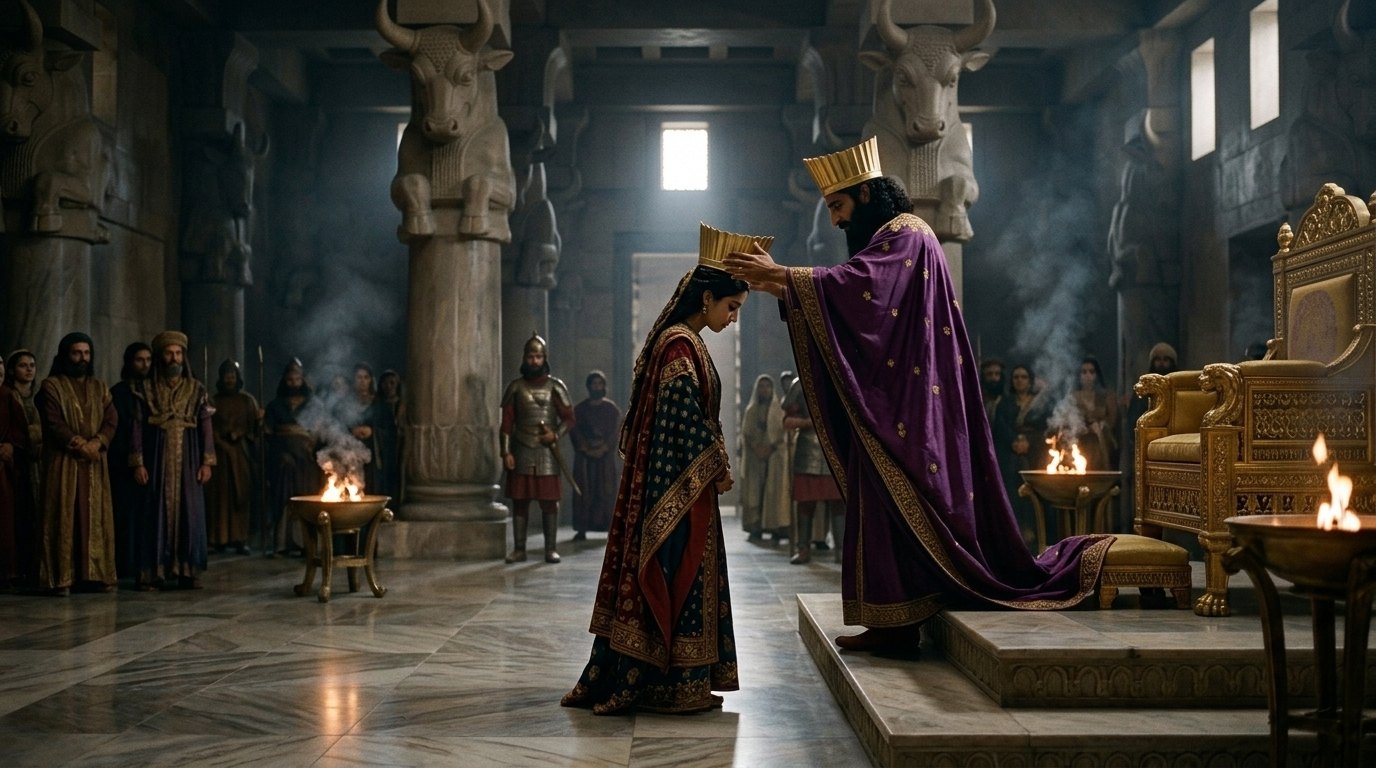
Now the king was attracted to Esther more than to any of the other women, and she won his favor and approval more than any of the other virgins. So he set a royal crown on her head and made her queen instead of Vashti.
Esther 2:17 (NIV)
It marks the providential elevation of an orphaned Jewish exile to the throne of Persia, setting the stage for national deliverance.
In Esther 2:17, the imperial crown of Persia is placed upon the head of an orphaned Jewish exile, marking the quiet beginning of a deliverance that only God could orchestrate. The Persian monarch Ahasuerus ruled over a sprawling empire of one hundred and twenty-seven provinces from his winter palace in Susa. Yet worldly power is notoriously fickle. When Queen Vashti defied the king's summons during a drunken six-month banquet of imperial splendor, she was summarily deposed (Esther 1:1-22), leaving the royal chambers empty and prompting an empire-wide search for a successor.
Into this volatile court stepped Hadassah, known as Esther. Bereft of her father and mother, she had been adopted and raised by her devout cousin Mordecai from the tribe of Benjamin (Esther 2:1-11). Taken into the royal harem under the custody of Hegai, she concealed her covenant lineage under Mordecai's counsel, winning favor not through lavish adornment but through quiet grace. When presented before Ahasuerus, the king loved Esther above all the women, setting the royal diadem upon her head (Esther 2:12-18).
God's invisible hand moved swiftly to position another piece on the board. While sitting at the king's gate, Mordecai uncovered an assassination conspiracy hatched by Bigthan and Teresh, two royal eunuchs (Esther 2:19-23). Mordecai relayed the intelligence through Esther, the plot was foiled, and the deed was recorded in the official royal chronicles. No immediate reward or promotion was given to Mordecai, but the forgotten entry was preserved in the scrolls for the exact night when the fate of God's people would hang in the balance.
| Passage | What it says |
|---|---|
| Esther 1:1-22 | King Ahasuerus deposes Queen Vashti after a lavish banquet, creating a royal vacancy across the Persian Empire. |
| Esther 2:1-11 | Esther, raised by her cousin Mordecai in Susa, is gathered into the royal harem while concealing her Jewish heritage. |
| Esther 2:12-18 | Esther wins the favor of the king and is crowned queen of Persia in Vashti's place. |
| Esther 2:19-23 | Mordecai discovers an assassination plot against the king, saves his life, and the deed is recorded in the royal chronicles. |
The Genocidal Edict
An Ancient Enemy Plots Extermination
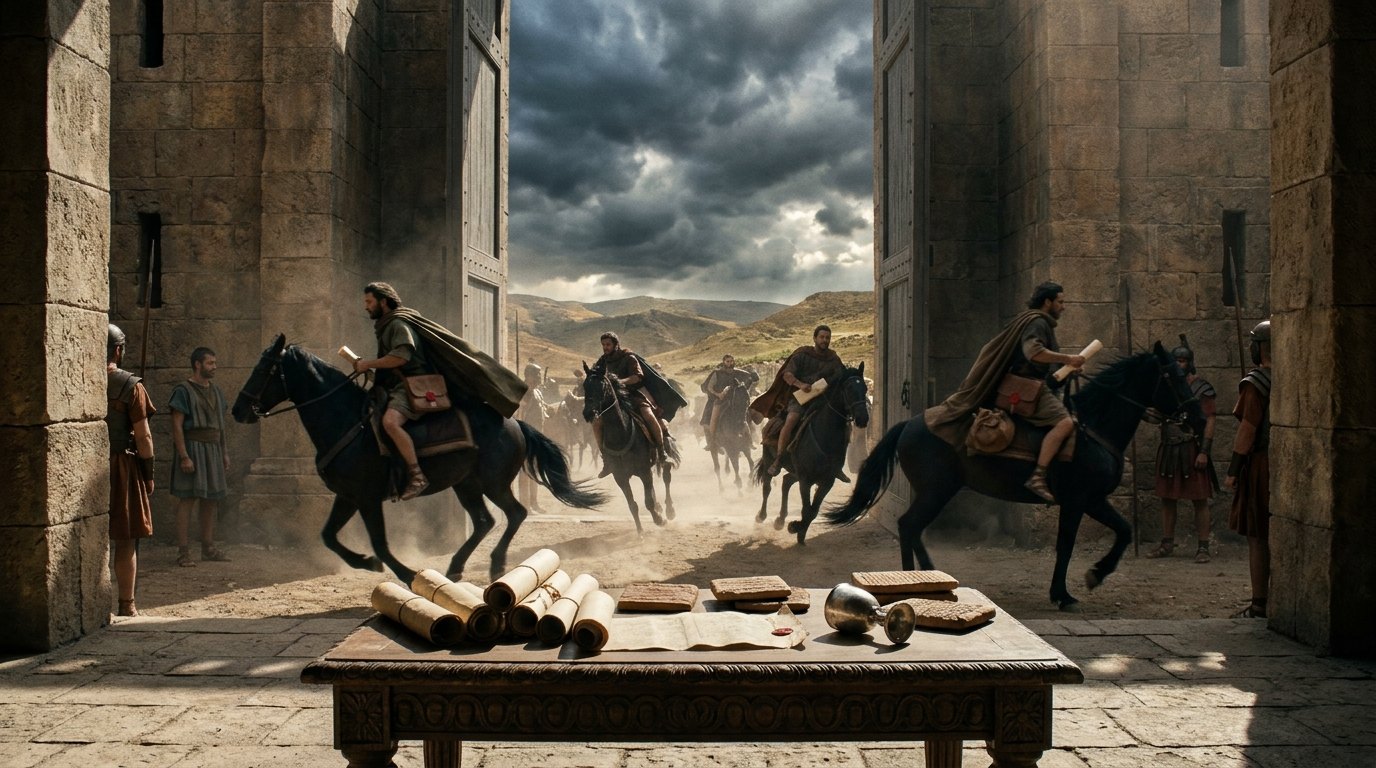
Dispatches were sent by couriers to all the king’s provinces with the order to destroy, kill and annihilate all the Jews—young and old, women and children—on a single day, the thirteenth day of the twelfth month, the month of Adar, and to plunder their goods.
Esther 3:13 (NIV)
It records the horrific empire-wide decree that sentenced every Jewish man, woman, and child to total destruction.
The dreadful crisis of the book crystallizes in Esther 3:13, when couriers were dispatched throughout the empire with sealed orders to destroy, to kill, and to annihilate all Jews, young and old, women and children, in one day. This catastrophic decree was the poisonous fruit of an ancient enmity. King Ahasuerus had promoted Haman the Agagite—a descendant of Agag, the Amalekite king whom Saul had spared centuries earlier in direct violation of God's command—above all the princes of Persia (Esther 3:1-6). While the entire court bowed in subservience to Haman, Mordecai refused to kneel before an Amalekite enemy of God.
Consuming rage blinded Haman to individual vengeance; he determined to eradicate Mordecai's entire race. In the first month of the twelfth year of King Ahasuerus, Haman cast the pur—the lot—to select an auspicious day for the slaughter (Esther 3:7-11). The lot fell on the thirteenth day of the twelfth month, Adar, nearly a year away, giving God ample time to unfold His counter-strategy. Haman offered ten thousand talents of silver to the royal treasury to secure royal permission, falsely slandering the Jews as a lawless, dispersed people whose customs differed from the empire's.
The king slipped his signet ring onto Haman's hand, authorizing the slaughter. Scribes drafted the bloodthirsty edict in every language, and royal runners hastened out to the farthest reaches of the realm (Esther 3:12-15). As the king and Haman sat down callously to drink, the entire city of Susa was thrown into bewilderment and dread.
| Passage | What it says |
|---|---|
| Esther 3:1-6 | Haman the Agagite is promoted by the king, but becomes enraged when Mordecai refuses to bow to him. |
| Esther 3:7-11 | Haman casts lots (pur) to choose a date and bribes the king to authorize the destruction of all Jews. |
| Esther 3:12-15 | Couriers carry an unalterable royal decree to every province ordering the slaughter and plundering of the Jewish people. |
Such a Time
Courage Confronts Peril in the Royal Court
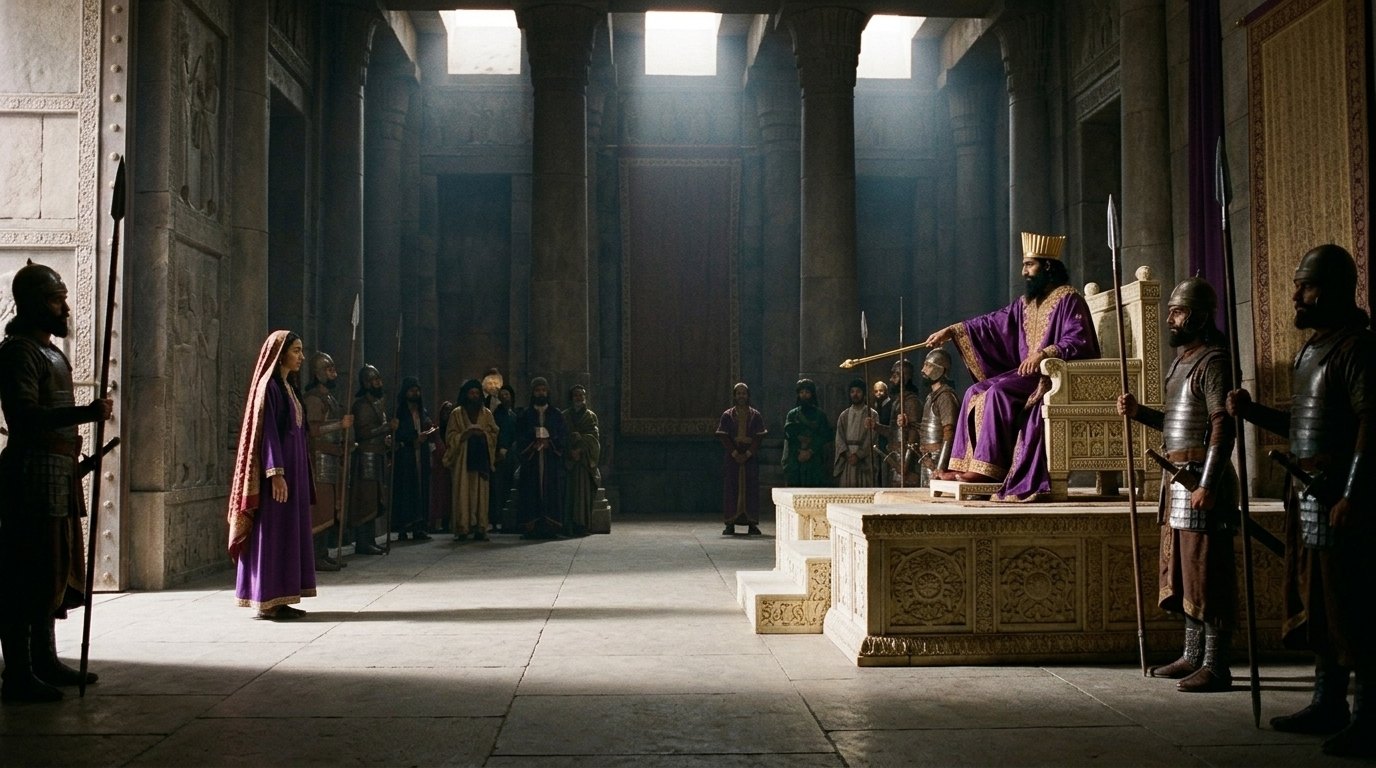
For if you remain silent at this time, relief and deliverance for the Jews will arise from another place, but you and your father’s family will perish. And who knows but that you have come to your royal position for such a time as this?”
Esther 4:14 (NIV)
It articulates the core theological heartbeat of the book: God's deliverance is certain, but human obedience is called to meet the crisis.
In the depths of despair, Esther 4:14 pierces the darkness with the theological summit of the book: "Who knows whether you have not come to the kingdom for such a time as this?" Mordecai tore his clothes, donned coarse sackcloth, and wailed openly at the palace gate (Esther 4:1-9). When Esther sent garments to clothe him and sent Hathach to inquire what had happened, Mordecai forwarded the text of Haman's genocidal decree. He commanded the young queen to go before Ahasuerus and plead for the life of her people.
Esther initially hesitated, reminding Mordecai of the imperial law: anyone who entered the inner court unsummoned faced instant execution unless the king held out the golden scepter (Esther 4:10-14). Mordecai's reply remains immortal: God's covenant promise would not fail; relief and deliverance would arise from another place if she remained silent, but she and her father's house would perish.
Her hesitation gave way to steely resolve. Esther called for a strict three-day fast among all the Jews in Susa, declaring, "If I perish, I perish" (Esther 4:15-17). On the third day, she donned her royal apparel and stepped into the inner court (Esther 5:1-8). Seeing her, Ahasuerus extended his golden scepter. Esther approached, touched the tip, and cautiously invited the king and Haman to an intimate banquet of wine, where she invited them yet again to a second banquet on the following day. Haman departed proud and intoxicated, but the sight of Mordecai at the gate soured his joy, prompting him to erect a seventy-five-foot gallows to hang Mordecai the very next morning (Esther 5:9-14).
| Passage | What it says |
|---|---|
| Esther 4:1-9 | Mordecai and the Jews weep in sackcloth, prompting Esther to send clothes and inquire into the cause of mourning. |
| Esther 4:10-14 | Mordecai warns Esther that silence will not save her and asks if she became queen for such a time as this. |
| Esther 4:15-17 | Esther calls all Jews in Susa to fast for three days, declaring that she will approach the king even if she perishes. |
| Esther 5:1-8 | Esther risks death by entering the inner court unbidden, receives the golden scepter, and invites the king and Haman to two banquets. |
| Esther 5:9-14 | Haman leaves elated but builds a seventy-five-foot gallows to hang Mordecai before attending the next day's banquet. |
The Great Reversal
Sovereign Irony Turns the Enemy's Scheme
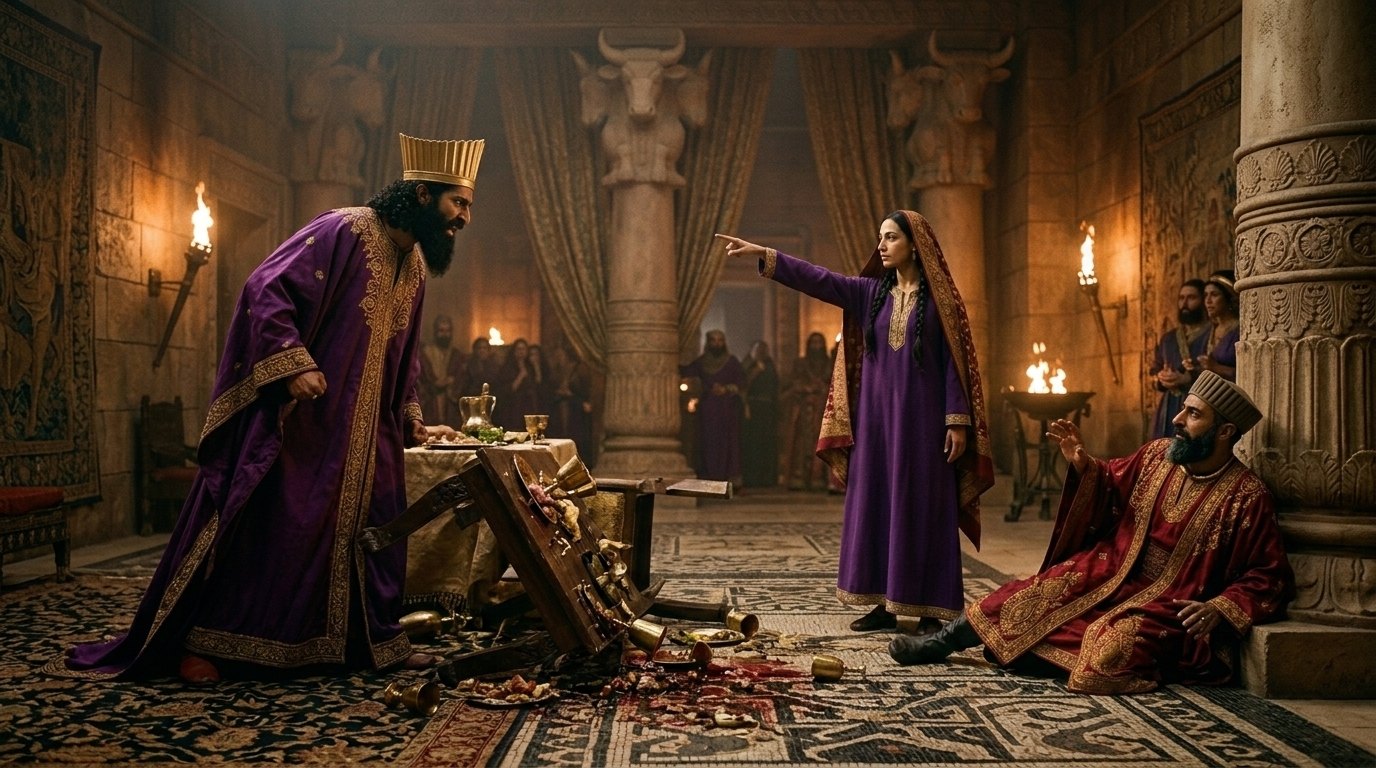
So they impaled Haman on the pole he had set up for Mordecai. Then the king’s fury subsided.
Esther 7:10 (NIV)
It records the climax of divine poetic justice as the adversary is hanged on the gallows he built for Mordecai.
The dramatic climax of divine retribution unfolds in Esther 7:10: "So they hanged Haman on the gallows that he had prepared for Mordecai." That very night, God orchestrated royal insomnia (Esther 6:1-3). Unable to sleep, Ahasuerus demanded the royal chronicles be read aloud. The reading happened to land upon Mordecai's forgotten foiling of the assassination plot. Realizing Mordecai had never been rewarded, the king sought advice from the courtyard, where Haman had just arrived at dawn to request Mordecai's execution (Esther 6:4-11).
When the king asked what should be done for the man the king delights to honor, Haman's vanity assumed the king meant him. He prescribed royal robes, the king's horse, a royal crown, and a public parade led by a noble prince. Stunned, Haman was ordered by the monarch to bestow those exact honors upon Mordecai the Jew immediately. Humiliated and covering his head in mourning, Haman hurried home, where his wife and counselors grimly prophesied his total ruin (Esther 6:12-14).
Immediately whisked to Esther's second banquet, Haman's doom was sealed (Esther 7:1-6). When the king asked Esther for her petition, she unmasked her Jewish heritage and begged for her life and the lives of her people, pointing at her guest: "The adversary and enemy is this wicked Haman!" Terrified, Haman fell upon Esther's couch to plead for mercy as the enraged king re-entered from the garden. Harbona, an attendant eunuch, pointed out the towering gallows Haman had constructed for Mordecai, and the king ordered Haman hanged upon it at once (Esther 7:7-10).
| Passage | What it says |
|---|---|
| Esther 6:1-3 | The king suffers sleeplessness and orders the royal chronicles read, discovering Mordecai was never rewarded for saving him. |
| Esther 6:4-11 | Haman enters seeking Mordecai's death but is compelled instead to lead Mordecai through the city in royal honors. |
| Esther 6:12-14 | Haman returns home humiliated, his advisers warn him of coming ruin, and he is rushed to Esther's banquet. |
| Esther 7:1-6 | At the second banquet, Esther reveals her identity, pleads for her people's lives, and names Haman as the adversary. |
| Esther 7:7-10 | The king discovers Haman pleading at Esther's couch, becomes furious, and commands that Haman be hanged on his own gallows. |
Deliverance and Purim
Joyful Triumph and an Enduring Feast
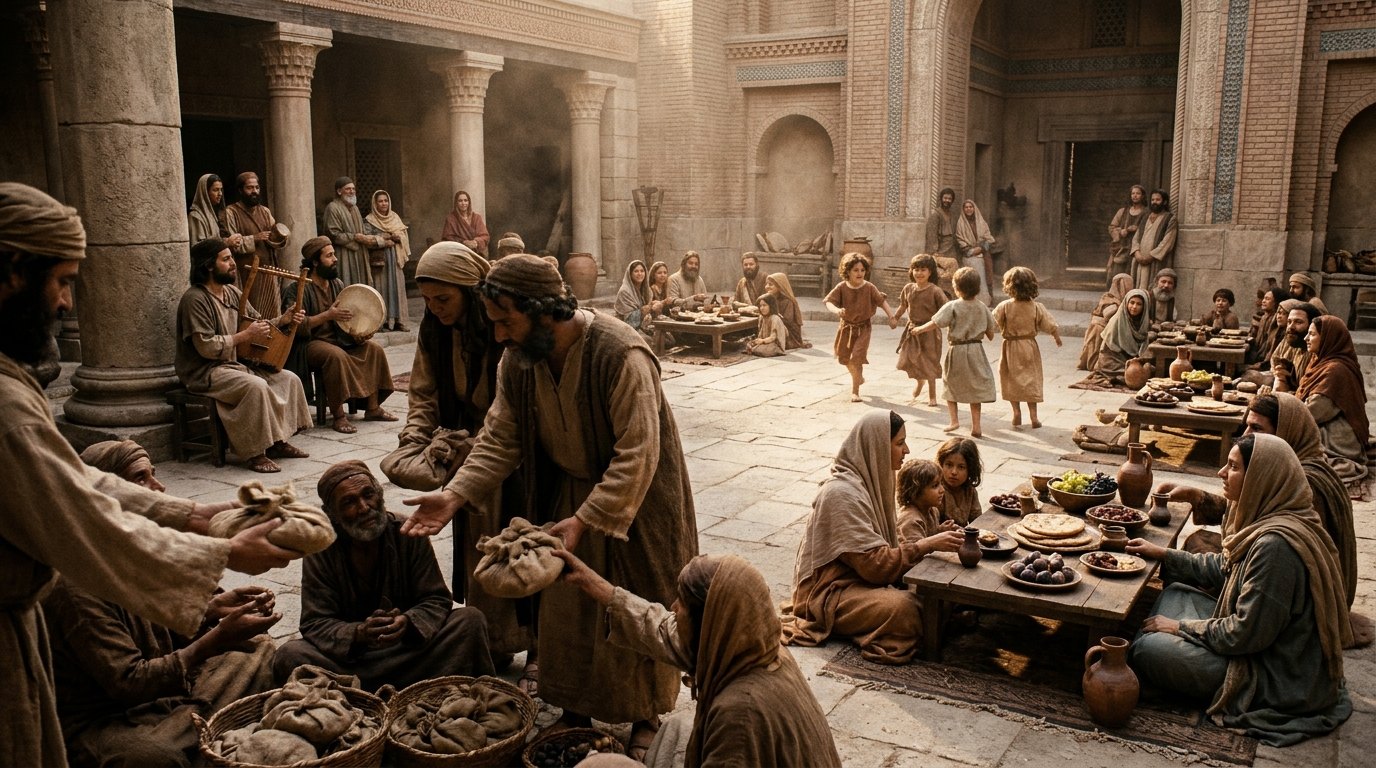
as the time when the Jews got relief from their enemies, and as the month when their sorrow was turned into joy and their mourning into a day of celebration. He wrote them to observe the days as days of feasting and joy and giving presents of food to one another and gifts to the poor.
Esther 9:22 (NIV)
It defines the meaning of Purim as the days when sorrow was turned into joy and mourning into a holiday.
The feast of Purim stands as an everlasting witness that God turns sorrow into gladness and mourning into a holiday when His people face destruction, just as Esther 9:22 commemorates. The turnaround begins immediately after Haman's fall, when King Ahasuerus awards Haman's entire estate to Esther and grants Mordecai the royal signet ring in Esther 8:1-8. Because an irreversible Persian law had already decreed the extermination of the Jews, the king authorizes a counter-decree written under Mordecai's direction. In Esther 8:9-17, couriers race across the empire's one hundred and twenty-seven provinces on royal steeds, granting the Jewish people full authority to gather, defend their lives, and destroy any armed force that attacks them. Light, gladness, joy, and honor fill the Jewish communities, leading many among the Persian people to embrace faith in God. When the thirteenth of Adar arrives in Esther 9:1-19, the Jews gather in their cities and prevail over those who sought their ruin; Haman's ten sons are slain and impaled on gallows, and on the fourteenth day the people rest and celebrate in immense triumph. In Esther 9:20-32, Mordecai and Queen Esther establish the annual celebration of Purim with two days of feasting, rejoicing, sending portions of food to one another, and giving gifts to the poor, binding all future generations never to let the memory of this deliverance perish. The book concludes in Esther 10:1-3 with Mordecai standing second in dignity only to King Ahasuerus, using his vast authority to seek the good of his people and speak peace to all his descendants.
| Passage | What it says |
|---|---|
| Esther 8:1-8 | The king gives Haman's estate to Esther, promotes Mordecai, and authorizes a new decree counteracting the first. |
| Esther 8:9-17 | A decree is dispatched permitting Jews throughout the empire to assemble, defend themselves, and destroy their attackers. |
| Esther 9:1-19 | On the appointed day, the Jews overpower their enemies across the empire, slay Haman's ten sons, and rest in victory. |
| Esther 9:20-32 | Mordecai and Queen Esther establish the annual feast of Purim to commemorate God's deliverance of His people forever. |
| Esther 10:1-3 | Mordecai the Jew rules as second in authority to King Ahasuerus, seeking the welfare and peace of his people. |
Where in the Bible
| Book | Passages |
|---|---|
| Esther | 22 · Esther 1:1-22, Esther 2:1-11, Esther 2:12-18, Esther 2:19-23, Esther 3:1-6, Esther 3:7-11, Esther 3:12-15, Esther 4:1-9, Esther 4:10-14, Esther 4:15-17, Esther 5:1-8, Esther 5:9-14, Esther 6:1-3, Esther 6:4-11, Esther 6:12-14, Esther 7:1-6, Esther 7:7-10, Esther 8:1-8, Esther 8:9-17, Esther 9:1-19, Esther 9:20-32, Esther 10:1-3 |
The story in order
- King deposes Queen Vashti (c. 483 BC) · Esther 1:1-22 · A royal vacancy is created, setting the stage for Esther.
- Esther raised and hidden (c. 479 BC) · Esther 2:1-11 · Esther is brought into the harem, concealing her Jewish identity.
- Esther crowned queen (c. 478 BC) · Esther 2:12-18 · Esther gains favor and becomes queen of Persia.
- Mordecai foils assassination plot (c. 478 BC) · Esther 2:19-23 · Mordecai's loyalty is recorded, foreshadowing future events.
- Haman plots Jewish extermination (c. 474 BC) · Esther 3:7-11 · A decree is issued for the destruction of all Jews.
- Esther risks her life (c. 474 BC) · Esther 4:15-17 · Esther resolves to approach the king for her people.
- Haman honored, then condemned (c. 474 BC) · Esther 6:4-11 · Irony strikes as Haman honors Mordecai.
- Esther reveals Haman's plot (c. 474 BC) · Esther 7:1-6 · Esther exposes Haman's treachery to the king.
- Haman is executed (c. 474 BC) · Esther 7:7-10 · Haman is hanged on the gallows he built for Mordecai.
- New decree issued (c. 474 BC) · Esther 8:9-17 · Jews are permitted to defend themselves.
- Jews defeat enemies (c. 474 BC) · Esther 9:1-19 · The Jewish people triumph over their adversaries.
- Purim established (c. 474 BC) · Esther 9:20-32 · The feast of Purim is instituted to remember God's deliverance.
- Mordecai's high position (c. 470 BC) · Esther 10:1-3 · Mordecai serves the king, seeking his people's welfare.
Esther's Courage and Obedience
| Situation | Mordecai's Challenge | Esther's Response | Passage |
|---|---|---|---|
| Mordecai and Jews mourn after edict | Esther is unaware of the cause | Esther sends inquiry | Esther 4:1-9 |
| Esther is queen, but must not approach king unbidden | Will silence save her? Was she queen for 'such a time as this'? | Esther calls for fasting and prayer, then resolves to go | Esther 4:10-14 |
| Esther must approach the king unbidden, risking death | She invites the king and Haman to banquets | She reveals her identity and Haman's plot at the second banquet |
Key words
- Pur (pûr, פۈר)
- The lots cast by Haman to determine the date for the destruction of the Jews. · Esther 3:7
- Sackcloth (śaq, שַׂק)
- A garment made of coarse material worn as a sign of mourning or penitence. · Esther 4:1
- Purim (Pûrîm, פּוּרִים)
- The annual feast commemorating the deliverance of the Jews from Haman's plot. · Esther 9:26
Esther reassures believers that even when God seems hidden behind geopolitical chaos and personal crisis, He is actively directing every circumstance to protect His people and accomplish His purposes. It calls every reader to recognize that God places His children in distinct positions of influence for such a time as this, summoning them to courageous obedience rather than comfortable silence. Ultimately, the book stands as an enduring monument to God's unfailing covenant fidelity across generations.
22 passages, each cited once.
Scripture cited
- Esther 4:12-14