Who goes to heaven?

John 3:16-18
16 For God so loved the world that he gave his one and only Son, that whoever believes in him shall not perish but have eternal life.
17 For God did not send his Son into the world to condemn the world, but to save the world through him.
18 Whoever believes in him is not condemned, but whoever does not believe stands condemned already because they have not believed in the name of God’s one and only Son.
New International Version (NIV)
The answer
Those who believe in Jesus Christ, the Son of God.
That is the verdict of the passage before us. John 3:16 says it straight: "whoever believes in him should not perish, but have eternal life." And John 3:18 draws the dividing line: "He who believes in him is not judged. He who doesn't believe has been judged already, because he has not believed in the name of the only born Son of God." Heaven is where that "eternal life" is lived out — God's own dwelling place, as the Old Testament pictures it (Psalm 11:4; Isaiah 63:15). And Christ is the door into it.
The rest of Scripture says the same thing in the same voice:
- John 11:25-26 – "I am the resurrection, and the life: he that believeth in me, though he were dead, yet shall he live."
- John 6:40 – "every one which seeth the Son, and believeth on him, may have everlasting life."
- Romans 5:8 – "while we were yet sinners, Christ died for us."
- 1 John 4:9-10 – "God sent his only begotten Son into the world, that we might live through him."
Heaven is not earned by good behavior, background, or effort. It is the gift God gives through His Son, and belief is the hand that receives it. The warning of John 3:18 is just as real as the promise of verse 16: to refuse the Son is to remain under judgment — not because the Father is harsh, but because He sent the Son "that the world should be saved through him" (John 3:17), and the world has turned aside.
If you want to settle this for yourself, the next step is not more data — it is trusting the One John 3:16 names as the Son.
Answered from Scripture · reviewed November 7, 2026
Scripture speaks with unmistakable clarity on who will dwell forever in the presence of God: those who place their trust in Jesus Christ, the Son of God. Heaven is not attained by ancestry, human merit, or self-effort, but is received as a gift of grace through faith in the Savior. To examine this question across God's Word is to see the narrow and sovereign door He has opened for sinners to enter His eternal home.
The Exclusive Savior
Eternal Life Is Given Only Through the Son

For God so loved the world that he gave his one and only Son, that whoever believes in him shall not perish but have eternal life.
John 3:16 (NIV)
This verse presents the supreme manifestation of God's love and the sole condition for escaping destruction: believing in His only begotten Son.
The definitive promise of the gospel is concentrated in John 3:16, where the Lord Jesus declares that God so loved the world that He gave His only begotten Son, so that everyone who believes in Him should not perish but have everlasting life. Eternal dwelling with God is not a universal inheritance or an automatic human birthright; it is grounded squarely in the person and sacrifice of Christ. As Jesus explained in John 3:15, belief in Him is the sole remedy against destruction, mirroring the serpent lifted up in the wilderness. The Father sent His Son into the world not to bring arbitrary condemnation, but that through Him the world might be rescued (John 3:17). Yet this mercy establishes an absolute line of demarcation: whoever believes in Him is not condemned, but whoever refuses to believe stands condemned already for rejecting the only begotten Son (John 3:18).
Scripture leaves no room for pluralistic roads to paradise. In John 14:6, Jesus speaks with uncompromising exclusivity: He is the way, the truth, and the life, and no one comes to the Father except through Him. The apostles proclaimed this precise truth without dilution to the rulers of Jerusalem, announcing in Acts 4:12 that salvation exists in no other name under heaven given among men. In John 3:36, John the Baptist confirms that the one believing in the Son possesses eternal life right now, while the one disobeying the Son shall not see life, but remains under God's abiding wrath. The apostle John summarizes this divine testimony in 1 John 5:11-12, stating that God has granted us eternal life in His Son; whoever has the Son possesses that life, and whoever lacks the Son lacks life entirely. Because God is holy and humanity is fallen, 1 Timothy 2:5 settles the matter for all time: there is exactly one God and one mediator between God and men, the man Christ Jesus.
| Passage | What it says |
|---|---|
| John 3:15 | Whoever believes in the Son will not perish but possess eternal life. |
| John 3:16 | God gave His only Son so that anyone believing in Him receives everlasting life. |
| John 3:17 | The Father sent the Son into the world not for condemnation, but for salvation. |
| John 3:18 | Believers escape condemnation, while those refusing to believe stand judged already. |
| John 14:6 | Jesus declares Himself the only way, truth, and life to reach the Father. |
| Acts 4:12 | No other name under heaven is given among men by which salvation is found. |
| John 3:36 | Whoever believes in the Son has eternal life, but whoever rejects the Son will not see life. |
| 1 John 5:11-12 | God gave eternal life in His Son; whoever has the Son has life, and whoever lacks Him does not. |
| 1 Timothy 2:5 | There is one mediator between God and men, the man Christ Jesus. |
Grace, Not Works
Entrance to Heaven Is a Gift Received by Faith

But God demonstrates his own love for us in this: While we were still sinners, Christ died for us.
Romans 5:8 (NIV)
It demonstrates that God provides salvation entirely on the merit of Christ's sacrifice while men were still helpless sinners.
The foundation of our acceptance before God is revealed in Romans 5:8, which demonstrates God's personal love toward us in that while we were still sinners, Christ died for us. Entrance into heaven cannot be bought, earned, or negotiated by fallen mankind. As Paul lays out in Romans 3:23-24, every human being has sinned and fallen entirely short of the divine glory; justified status is conferred solely as a free gift through the redemption accomplished in Christ Jesus. Human pride seeks to establish its own merit, but Ephesians 2:8-9 dismantling all self-reliance by showing that salvation is by grace through faith—a gift of God rather than a product of works, leaving no room for boasting. In Titus 3:5, Scripture reiterates that God saved us not on the basis of righteous deeds we performed, but entirely according to His washing mercy and regeneration.
This exchange is rooted in the sovereign generosity of God, who did not spare His own Son but gave Him up on our behalf, ensuring He will freely grant all promises to those in Christ (Romans 8:32). The true nature of divine love appears in 1 John 4:9-10: we did not love God first, but He loved us and sent His Son as the wrath-bearing propitiation for our guilt. Therefore, while the earned wage of human rebellion is spiritual and eternal death, the unearned gift of God is everlasting life in Christ Jesus (Romans 6:23). Entering that life requires heartfelt submission: Romans 10:9-10 promises that if you confess Jesus as Lord and believe God raised Him from the grave, you will be saved. As Galatians 2:16 cements, no sinner is ever justified by deeds of the law, but solely through resting faith in the Savior.
| Passage | What it says |
|---|---|
| Romans 5:8 | Christ died for the ungodly while they were still helpless sinners. |
| Ephesians 2:8-9 | Salvation comes by grace through faith, entirely apart from works, preventing boasting. |
| Titus 3:5 | God saves believers according to His mercy, not deeds done in righteousness. |
| Romans 8:32 | Having delivered up His own Son, God will freely give believers all things. |
| 1 John 4:9-10 | God sent His Son as the propitiation for our sins so that we might live. |
| Romans 3:23-24 | All have sinned and fall short of God's glory, being justified freely by His grace through redemption in Christ. |
| Romans 6:23 | The wages of sin is death, but the free gift of God is eternal life in Christ Jesus our Lord. |
| Romans 10:9-10 | Confessing Jesus as Lord and believing God raised Him from the dead results in salvation. |
| Galatians 2:16 | A person is justified not by the works of the law but through faith in Jesus Christ. |
The Resurrection Hope
Christ Guarantees Bodily Resurrection and Unending Life
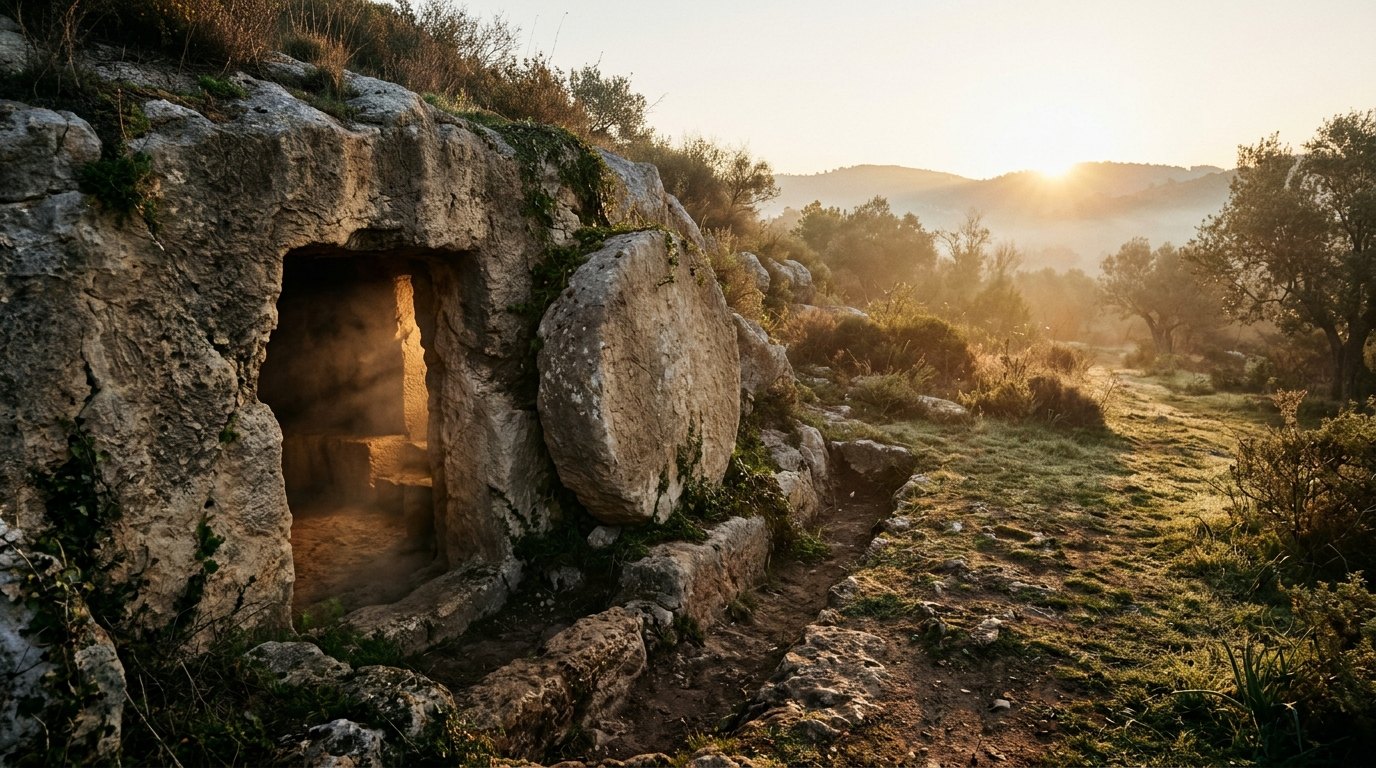
Jesus said to her, “I am the resurrection and the life. The one who believes in me will live, even though they die; and whoever lives by believing in me will never die. Do you believe this?”
John 11:25-26 (NIV)
Jesus identifies Himself as the resurrection and the life, guaranteeing that physical death cannot prevent believers from living forever.
The Christian hope of entering heaven is not an abstract spiritual survival, but a guaranteed bodily resurrection anchored in John 11:25-26, where Jesus announces: I am the resurrection and the life. He who believes in the Son will live even if he dies, and everyone who lives and believes in Him will never taste ultimate death. This eternal security was promised during Christ's earthly ministry; in John 6:40, the Lord declared that the Father's sovereign will is that everyone who looks upon the Son and believes should have everlasting life, guaranteed to be raised up on the last day. Because Jesus conquered the grave physically, 1 Corinthians 15:20-22 establishes that His resurrection is the firstfruits of the harvest: just as physical death swept through the race united to Adam, all who are united to Christ will be made bodily alive.
Death has thus lost its terror for the believer. In 1 Thessalonians 4:14, the church is comforted by the truth that since Jesus died and rose again, God will certainly bring with Him all who have fallen asleep in Him. This transformation is absolute: 1 Corinthians 15:50-54 teaches that corruptible flesh and blood cannot inherit an incorruptible kingdom, meaning this perishable body must put on immortality, swallowing up death in complete victory. For this reason, Paul explains in 2 Corinthians 5:1-8 that we possess a permanent building from God in the heavens, walking by faith and confident that to be absent from this mortal body is to be at home with the Lord. As Peter rejoices in 1 Peter 1:3-5, God's great mercy has born us again into an imperishable, undefiled inheritance kept securely in heaven for all who are shielded by His power.
| Passage | What it says |
|---|---|
| John 6:40 | Everyone looking upon the Son and believing will be raised at the last day. |
| John 11:25-26 | Jesus affirms that whoever lives and believes in Him will never die spiritually. |
| 1 Corinthians 15:20-22 | As all in Adam die, even so all united to Christ are made alive. |
| 1 Thessalonians 4:14 | God will bring with Jesus those who have fallen asleep believing in Him. |
| 1 Corinthians 15:50-54 | Flesh and blood cannot inherit God's kingdom; the perishable must put on imperishable immortality. |
| 2 Corinthians 5:1-8 | Believers possess an eternal heavenly building from God, preferring to be away from the body and at home with the Lord. |
| 1 Peter 1:3-5 | God caused believers to be born again to a living hope and an imperishable inheritance kept in heaven. |
The Heavenly Register
Those Written in the Lamb's Book of Life

Nothing impure will ever enter it, nor will anyone who does what is shameful or deceitful, but only those whose names are written in the Lamb’s book of life.
Revelation 21:27 (NIV)
This verse marks the definitive boundary of heaven, establishing that only those recorded in the Lamb's Book enter the eternal city.
The boundary of the heavenly realm is fixed by divine decree, defined definitively in Revelation 21:27: nothing unclean or practicing abominations will ever step into the New Jerusalem, only those whose names are written in the Lamb's Book of Life. Heaven is not an undisciplined crowd of self-styled pilgrims, but the registered dwelling place of God's redeemed people. Jesus underscored this eternal priority to His disciples in Luke 10:20, directing them not to marvel merely over spiritual victories on earth, but to rejoice that their names stand recorded in heaven. Because our actual citizenship belongs in the heavenly sanctuary (Philippians 3:20), believers live as expectant exiles, waiting eagerly for the Savior who will transform our humble bodies to match His glorious body.
The terrifying counterpart to this blessing is set out in Revelation 20:15, where anyone whose name is missing from the Book of Life is cast into the lake of fire. By contrast, Revelation 22:14 pronounces a blessing on those who wash their robes in the blood of Christ, granting them the legal right to the tree of life and entrance through the city gates. The writer of Hebrews 12:22-24 reminds the faithful that we have already drawn near to Mount Zion, the heavenly Jerusalem, and the festive assembly of the firstborn who are enrolled in heaven. John witnesses the glorious outcome of this redemption in Revelation 7:9-10, looking upon a countless multitude from every tribe, nation, and tongue standing before the throne in spotless robes. As Revelation 13:8 affirms, these saints belong to the Lamb who was slain from the foundation of the world, kept secure by His sovereign mercy forever.
| Passage | What it says |
|---|---|
| Luke 10:20 | Disciples are commanded to rejoice that their names are written in heaven. |
| Philippians 3:20 | The citizenship of the redeemed resides in heaven, awaiting the Savior's return. |
| Revelation 20:15 | Anyone whose name is not found in the Book of Life is cast out. |
| Revelation 21:27 | Nothing unclean enters the New Jerusalem, only those in the Lamb's Book of Life. |
| Revelation 22:14 | Blessed are those who wash their robes, gaining entrance through the city's gates. |
| Hebrews 12:22-24 | Believers have come to Mount Zion, heavenly Jerusalem, and the assembly of the firstborn enrolled in heaven. |
| Revelation 7:9-10 | A great multitude from every nation stands before the throne and the Lamb, clothed in white robes. |
| Revelation 13:8 | Those who belong to God have their names recorded in the Book of Life of the slain Lamb. |
The Transformed Life
Only the Born Again and Sanctified Enter In

Jesus replied, “Very truly I tell you, no one can see the kingdom of God unless they are born again.”
John 3:3 (NIV)
Jesus lays down the foundational spiritual necessity: entrance into God's kingdom requires supernatural new birth from above.
In John 3:3, Jesus lays bare the non-negotiable threshold of eternity: unless one is born again, he cannot see the kingdom of God. Entry into heaven is neither hereditary nor the fruit of sheer moral determination; it demands a radical, supernatural transformation from above. In John 3:3-5, Christ emphasizes that this new birth of water and the Spirit completely renovates the human heart, awakening a dead soul to divine life. Outward religious activity and lip-service cannot substitute for this inner reality. As Jesus warns in Matthew 7:21-23, not everyone who says to me, 'Lord, Lord,' will enter the kingdom of heaven, but only the one who does the will of the Father. Those who claim His name while remaining unrepentant workers of lawlessness will be turned away.
Because genuine faith yields real spiritual fruit, entrance into God's presence is indivisibly linked to personal holiness. Hebrews 12:14 calls believers to strive for the holiness without which no one will see the Lord. This does not imply sinless perfection earned by works, but the unmistakable fruit of the Spirit at work in every true child of God. The sobering catalogue of persistent, unrepentant wickedness in 1 Corinthians 6:9-11 demonstrates that the unrighteous will not inherit the kingdom of God; yet Paul immediately points to grace, declaring, and such were some of you. But you were washed, you were sanctified, you were justified. Ultimately, Revelation 21:7-8 contrasts the faithful conqueror who inherits God's everlasting city with the cowardly, faithless, and unrepentant whose end is the lake of fire. Heaven belongs only to those who have been redeemed, cleansed, and remade by the grace of Christ.
| Passage | What it says |
|---|---|
| Matthew 7:21-23 | Not everyone saying 'Lord, Lord' will enter heaven, but only those who do the will of the Father. |
| John 3:3-5 | Unless one is born again of water and the Spirit, he cannot see or enter the kingdom of God. |
| Hebrews 12:14 | Believers are exhorted to pursue holiness, without which no one will see the Lord. |
| 1 Corinthians 6:9-11 | The unrighteous will not inherit God's kingdom, but believers are washed, sanctified, and justified in Christ. |
| Revelation 21:7-8 | The conqueror will inherit these things, while the cowardly, faithless, and unrepentant face the second death. |
Immediate Presence
The Believer's Spirit Goes Immediately to Christ

Jesus answered him, “Truly I tell you, today you will be with me in paradise.”
Luke 23:43 (NIV)
Christ assures the dying repentant criminal of instantaneous fellowship in Paradise upon death, demonstrating salvation by grace alone.
In Luke 23:43, the dying Savior speaks words of matchless assurance: 'Truly, I say to you, today you will be with me in paradise.' Hanging beside Christ on the cross, the penitent thief had no opportunity to undergo baptism, perform good works, or attend religious ceremonies; he cast himself entirely upon the mercy of the King. Christ's immediate answer reveals that the believer passes into conscious, joyous fellowship with the Lord the very moment earthly life ends. There is no lingering in unconscious slumber, nor any purgatorial cleansing needed to satisfy divine justice. The blood of Christ cleanses fully and instantly, securing paradise for the repentant sinner on the very day of death.
This immediate transition into Christ's presence anchored the hope of the early church through persecution and martyrdom. In Philippians 1:21-23, the apostle Paul weighs earthly ministry against eternity, writing that to depart and be with Christ is far better. For the believer, death is not an abyss or an indeterminate waiting room, but an entrance into the immediate presence of the Savior. Similarly, as the first Christian martyr faced death in Acts 7:55-59, Stephen gazed into an opened heaven and saw Jesus standing at the right hand of God. Crying out, 'Lord Jesus, receive my spirit,' he died with total certainty that his departing soul was instantly gathered into the welcoming hands of Christ.
| Passage | What it says |
|---|---|
| Luke 23:42-43 | Jesus promises the repentant thief on the cross that he will be with Him that day in Paradise. |
| Philippians 1:21-23 | Paul explains that to depart this earthly life is to be immediately with Christ, which is far better. |
| Acts 7:55-59 | Stephen, full of the Holy Spirit, sees Jesus standing at God's right hand and asks the Lord Jesus to receive his spirit. |
Where in the Bible
| Book | Passages |
|---|---|
| Matthew | 1 · Matthew 7:21-23 |
| Luke | 2 · Luke 10:20, Luke 23:42-43 |
| John | 9 · John 3:15, John 3:16, John 3:17, John 3:18, John 14:6, John 3:36, John 6:40, John 11:25-26, John 3:3-5 |
| Acts | 2 · Acts 4:12, Acts 7:55-59 |
| Romans | 5 · Romans 5:8, Romans 8:32, Romans 3:23-24, Romans 6:23, Romans 10:9-10 |
| 1 Corinthians | 3 · 1 Corinthians 15:20-22, 1 Corinthians 15:50-54, 1 Corinthians 6:9-11 |
| 2 Corinthians | 1 · 2 Corinthians 5:1-8 |
| Galatians | 1 · Galatians 2:16 |
| Ephesians | 1 · Ephesians 2:8-9 |
| Philippians | 2 · Philippians 3:20, Philippians 1:21-23 |
| 1 Thessalonians | 1 · 1 Thessalonians 4:14 |
| 1 Timothy | 1 · 1 Timothy 2:5 |
| Titus | 1 · Titus 3:5 |
| Hebrews | 2 · Hebrews 12:22-24, Hebrews 12:14 |
| 1 Peter | 1 · 1 Peter 1:3-5 |
| 1 John | 2 · 1 John 5:11-12, 1 John 4:9-10 |
| Revelation | 6 · Revelation 20:15, Revelation 21:27, Revelation 22:14, Revelation 7:9-10, Revelation 13:8, Revelation 21:7-8 |
The story in order
- Adam sins, bringing death (c. 4000 BC) · 1 Corinthians 15:20-22 · Introduces death as the consequence of sin.
- God promises a Savior (c. 1450 BC) · John 3:16 · God's plan for salvation through His Son.
- Law reveals sin (c. 1450 BC) · Romans 3:23-24 · All fall short of God's glory.
- Jesus' earthly ministry (c. AD 30) · John 14:6 · Jesus declares Himself the only way to the Father.
- Jesus' atoning death (c. AD 30) · Romans 5:8 · Christ died for the ungodly.
- Early church proclaims salvation (c. AD 30-60) · Acts 4:12 · Salvation is found only in Jesus' name.
- Paul writes about grace and faith (c. AD 60) · Ephesians 2:8-9 · Salvation is a gift by grace through faith.
- John writes about eternal life (c. AD 90) · 1 John 5:11-12 · Eternal life is in God's Son.
- John sees the New Jerusalem (c. AD 95) · Revelation 21:27 · Only the redeemed enter the heavenly city.
Key words
- Eternal Life (zōē aiōnios (ζωὴ αἰώνιος))
- Life with God, given through faith in Jesus Christ. · John 3:15
- Faith (pistis (πίστις))
- Trust and belief in God and His promises, especially in Jesus Christ. · Ephesians 2:8-9
- Grace (charis (χάρις))
- God's unmerited favor and kindness extended to sinners. · Ephesians 2:8-9
- Born Again (gennēthē anōthen (γεννηθῇ ἄνωθεν))
- A spiritual transformation by the Holy Spirit, enabling entrance into God's kingdom. · John 3:3-5
- Holiness (hagiasmos (ἁγιασμός))
- Moral and spiritual purity, essential for seeing the Lord. · Hebrews 12:14
- Book of Life (biblion tēs zōēs (βιβλίον τῆς ζωῆς))
- Heavenly register containing the names of those chosen by God. · Revelation 20:15
The question of who enters heaven is ultimately personal and urgent: the dividing line is not human goodness, but faith in the Son of God. Trusting Christ settles one's eternal dwelling place forever, moving a believer from condemnation into eternal life. Take God at His Word today, receive His Son, and walk in the assurance of an everlasting home prepared by Him.
41 passages, each cited once.
Scripture cited
- Romans 5:8
- 1 John 4:9-10
- John 11:25-26
- John 6:40