Who was Gideon?
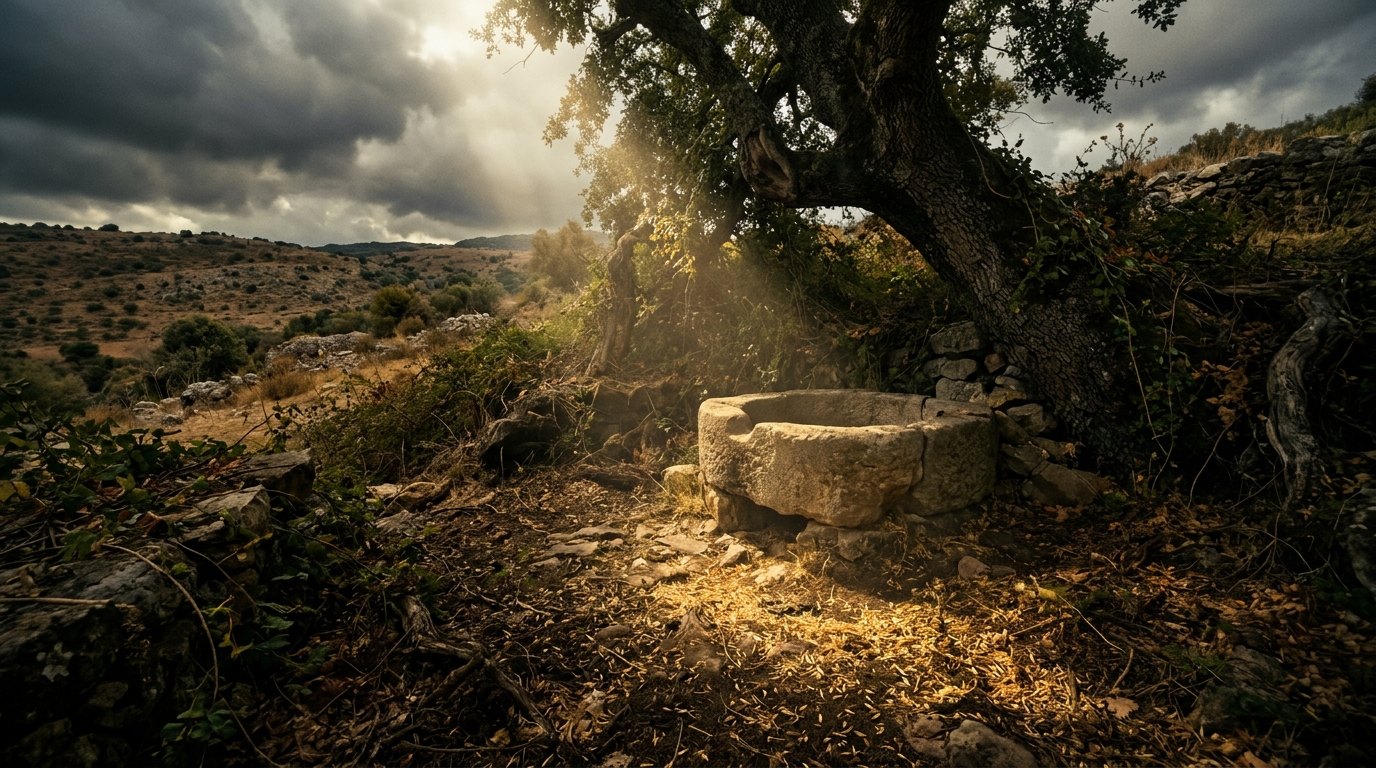
Judges 6:11-16
11 The angel of the LORD came and sat down under the oak in Ophrah that belonged to Joash the Abiezrite, where his son Gideon was threshing wheat in a winepress to keep it from the Midianites.
12 When the angel of the LORD appeared to Gideon, he said, “The LORD is with you, mighty warrior.”
13 “Pardon me, my lord,” Gideon replied, “but if the LORD is with us, why has all this happened to us? Where are all his wonders that our ancestors told us about when they said, ‘Did not the LORD bring us up out of Egypt?’ But now the LORD has abandoned us and given us into the hand of Midian.”
14 The LORD turned to him and said, “Go in the strength you have and save Israel out of Midian’s hand. Am I not sending you?”
15 “Pardon me, my lord,” Gideon replied, “but how can I save Israel? My clan is the weakest in Manasseh, and I am the least in my family.”
16 The LORD answered, “I will be with you, and you will strike down all the Midianites, leaving none alive.”
New International Version (NIV)
The answer
Gideon was a judge and deliverer of Israel whom God used to rescue His people from Midianite oppression. He was the son of Joash, from the Abiezrite clan of Manasseh, and lived in Ophrah. His story occupies Judges 6–8, and he was also called Jerubbaal after he tore down Baal’s altar (Judges 6:11, Judges 6:25-32).
His calling
Israel had done evil in Yahweh’s sight and suffered under Midian for seven years. When Yahweh’s angel found Gideon, he was threshing wheat in a winepress to hide it from the Midianites. The angel greeted him, “Yahweh is with you, you mighty man of valor!” Gideon protested that his family was poor and that he was the least in his father’s house, but God promised His presence and sent him to save Israel (Judges 6:1, Judges 6:11-16).
Gideon obeyed God by destroying his father’s altar to Baal, though he initially acted at night because he was afraid. He also asked God for reassurance through the two signs involving a fleece, which God graciously provided (Judges 6:25-40).
His victory over Midian
God reduced Gideon’s army from 32,000 men to 300, explicitly so Israel could not boast that its own strength had brought salvation. Armed with trumpets, empty pitchers and torches, the 300 surrounded the Midianite camp. When they blew the trumpets and broke the pitchers, Yahweh threw the enemy into confusion and put them to flight (Judges 7:2-7, Judges 7:16-22).
His legacy
Gideon refused Israel’s request that he and his descendants rule over them, declaring that Yahweh should rule. The land then had rest for forty years. Nevertheless, Gideon later made a golden ephod that became an occasion of idolatry and “a snare to Gideon and to his house” (Judges 8:22-28).
Hebrews therefore remembers Gideon not as a flawless hero, but as a man of faith, naming him among those who subdued kingdoms and “from weakness were made strong” (Hebrews 11:32-34). His life displays God’s power to save through a hesitant, weak servant, while his later failure warns that even a greatly used leader remains capable of serious sin.
Answered from Scripture · reviewed November 11, 2026
Gideon was an unlikely deliverer called by God from the winepress of Ophrah to break the seven-year stranglehold of Midian over Israel. His life shows how the Lord's presence transforms fearful inadequacy into victorious faith, stripping away human boasting so that God alone receives the glory.
Identity and Setting
An obscure son of Manasseh under severe oppression
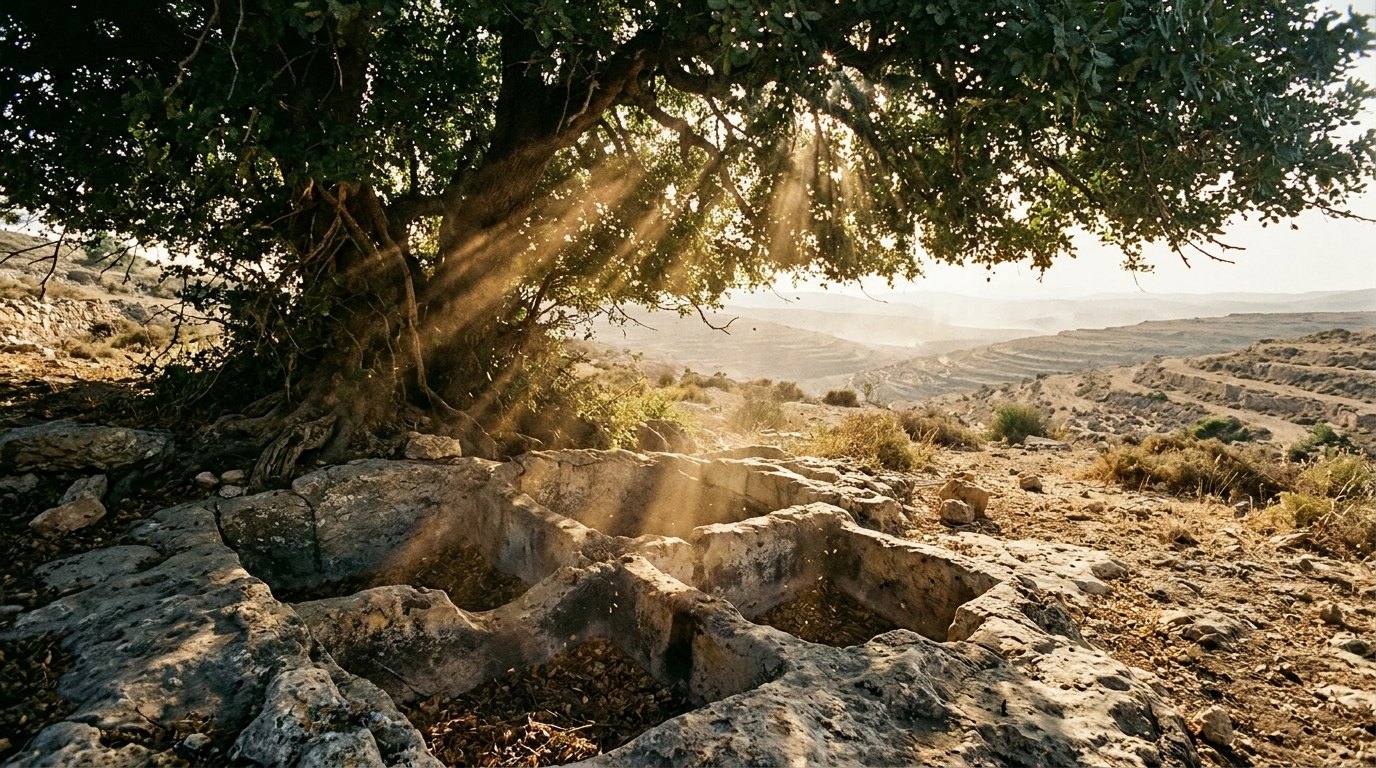
The angel of the LORD came and sat down under the oak in Ophrah that belonged to Joash the Abiezrite, where his son Gideon was threshing wheat in a winepress to keep it from the Midianites.
Judges 6:11 (NIV)
It introduces Gideon threshing grain in secret inside a winepress out of sheer terror of the Midianite raiders.
Judges 6:11 introduces Gideon at his lowest point, secretly beating out wheat inside a sunken winepress to conceal the grain from ruthless nomadic raiders. The historical allotment in Joshua 17:2 had settled the Abiezrite clan within the tribal boundaries of Manasseh, but centuries later that inheritance was practically lost to terror. Judges 6:1 explains the spiritual root: Israel did evil in the eyes of the Lord, prompting God to deliver them into the hands of Midian for seven punishing years. The severity of this subjugation forced the covenant people into mountain clefts, caves, and fortified strongholds (Judges 6:2). Whenever crops were sown, an overwhelming confederation of Midianites, Amalekites, and eastern desert tribes marched across the land (Judges 6:3). They pitched tents throughout the countryside, systematically devouring harvest yields all the way to Gaza and leaving Israel stripped of livestock and sustenance (Judges 6:4). Like an inescapable swarm of locusts, the raiders arrived with innumerable camels and tents, completely laying waste the land (Judges 6:5). Brought to sheer poverty and utter helplessness, Israel finally cried out to the Lord for deliverance (Judges 6:6-7). Before sending a military deliverer, God sent an unnamed prophet to convict the people, recalling how the Lord redeemed them from Egyptian bondage (Judges 6:8), delivered them from every oppressor, and settled them safely in Canaan (Judges 6:9). The prophet indicted Israel because they had defied God's direct command by worshipping Amorite deities (Judges 6:10). It was precisely into this dark climate of spiritual treachery and national starvation that the Angel of the Lord came and sat beneath the oak tree at Ophrah, observing an anxious young farmer striving merely to keep his family alive (Judges 6:11).
| Passage | What it says |
|---|---|
| Joshua 17:2 | Lists the clan of Abiezer among the families of the tribe of Manasseh who received an allotment in the land. |
| Judges 6:1 | Israel did evil in the eyes of the Lord, who handed them over to Midian for seven years. |
| Judges 6:2 | The Midianite oppression forced the Israelites to seek refuge in dens, caves, and mountain strongholds. |
| Judges 6:3 | Whenever Israel sowed seeds, the Midianites, Amalekites, and eastern peoples invaded the land. |
| Judges 6:4 | The invaders camped on the land and destroyed crops as far as Gaza, leaving no sustenance for Israel. |
| Judges 6:5 | The raiders swarmed in like locusts with their livestock and camels to lay waste the countryside. |
| Judges 6:6 | Brought low by Midian, the Israelites cried out to the Lord for deliverance. |
| Judges 6:7 | When the people of Israel cried out to the Lord because of Midian, God responded. |
| Judges 6:8 | The Lord sent an unnamed prophet reminding Israel of the Exodus from Egypt and house of bondage. |
| Judges 6:9 | The prophet recalled how God drove out oppressors before Israel and gave them their land. |
| Judges 6:10 | The prophet indicted Israel for disobeying God's command not to fear the Amorite gods. |
| Judges 6:11 | The Angel of the Lord appeared under an oak in Ophrah while Gideon secretly threshed wheat. |
The Divine Call
Called a mighty warrior while hiding in fear
The LORD turned to him and said, “Go in the strength you have and save Israel out of Midian’s hand. Am I not sending you?”
Judges 6:14 (NIV)
The Lord commands Gideon to go in the strength of His divine sending, turning Gideon's complaint into a commission.
Judges 6:14 marks the dramatic turning point where the Lord looks directly at Gideon and commissions him: 'Go in this might of yours and save Israel from the hand of Midian; have not I sent you?' The encounter had opened startlingly in Judges 6:12 when the Angel of the Lord appeared, hailing the terrified farmer as a 'mighty man of valor' and declaring that the Lord was with him. Gideon pushed back with honest anguish in Judges 6:13, asking why disaster had crushed their nation if the Lord was truly present, lamenting that the legendary wonders of the Exodus seemed long gone. Even after receiving the royal command in Judges 6:14, Gideon protested his total inadequacy, objecting in Judges 6:15 that his clan was the weakest in all of Manasseh and he was the least in his father's house. God countered every objection not with flattery, but with the sufficiency of His sovereign presence, promising in Judges 6:16 that Gideon would strike down the Midianite hordes as easily as one man. Seeking assurance, Gideon requested a confirming sign from the divine visitor (Judges 6:17) and begged Him to remain while an offering was prepared (Judges 6:18). Gideon went indoors and brought back a boiled young goat, unleavened cakes of flour, and broth (Judges 6:19). The Angel directed him to lay the meat and bread upon a flat rock and pour out the broth as a libation (Judges 6:20). Fire flared instantly from the stone when the tip of the Angel's staff touched the food, consuming the sacrifice entirely as the Angel vanished from sight (Judges 6:21). Overwhelmed with dread, Gideon cried out that he had seen the Angel of the Lord face to face (Judges 6:22). God spoke immediate peace to his trembling heart (Judges 6:23), leading Gideon to build an altar called Yahweh-Shalom, confessing the Lord as peace (Judges 6:24).
| Passage | What it says |
|---|---|
| Judges 6:12 | The Angel of the Lord greeted Gideon, declaring that the Lord was with him, calling him a mighty warrior. |
| Judges 6:13 | Gideon questioned why disaster struck if the Lord was with them, noting the absence of past wonders. |
| Judges 6:14 | The Lord looked at Gideon and commissioned him to save Israel from Midian by His authority. |
| Judges 6:15 | Gideon protested his unfitness, stating his clan was the weakest in Manasseh and he the least in his family. |
| Judges 6:16 | The Lord promised His personal presence, assuring Gideon he would defeat the Midianites as one man. |
| Judges 6:17 | Gideon requested a confirming sign from the visitor to prove He was truly speaking to him. |
| Judges 6:18 | Gideon asked the visitor to wait until he brought an offering, and the Lord agreed to stay. |
| Judges 6:19 | Gideon prepared a young goat and unleavened bread, bringing meat in a basket and broth in a pot. |
| Judges 6:20 | The Angel instructed him to place the meat and bread upon a rock and pour out the broth. |
| Judges 6:21 | Fire sprang from the rock when the Angel touched the offering, and the Angel disappeared. |
| Judges 6:22 | Gideon realized he had seen the Angel of the Lord face to face and feared for his life. |
| Judges 6:23 | The Lord reassured Gideon, saying, 'Peace to you; do not fear, you shall not die.' |
| Judges 6:24 | Gideon built an altar there to the Lord and named it Yahweh-Shalom, which remains in Ophrah. |
Confronting Idolatry
Tearing down Baal's altar to earn a new name
So because Gideon broke down Baal’s altar, they gave him the name Jerub-Baal that day, saying, “Let Baal contend with him.”
Judges 6:32 (NIV)
Joash renames his son Jerubbaal, establishing that a false god cannot defend himself against Gideon's obedience.
In Judges 6:32, Gideon's father confers a brand-new title upon his son: Jerubbaal, meaning 'let Baal contend against him,' because the false god proved completely powerless to defend his own shattered shrine. Deliverance for Israel could never begin on the foreign battlefield while idolatry flourished inside the family compound. That very night, God issued a direct summons commanding Gideon to tear down his father's altar to Baal, chop down the wooden Asherah pole standing beside it (Judges 6:25), build a proper stone altar to the Lord on top of the stronghold, and sacrifice a seven-year-old fattened bull using the wood of the pagan idol for kindling (Judges 6:26). Bound by human fear of his household and the local townsmen, yet determined to obey, Gideon enlisted ten trusted servants and performed the dangerous deed in the dead of night (Judges 6:27). When dawn broke over Ophrah, the morning light revealed a staggering sight: Baal's altar lay in ruins, the Asherah lay cleaved in pieces, and the second bull smoldered atop the newly built altar of the Lord (Judges 6:28). An angry investigation quickly traced the wreckage back to Gideon son of Joash (Judges 6:29). Bloodthirsty citizens stormed the homestead, demanding that Joash surrender his son to be executed for sacrilege (Judges 6:30). Joash decisively silenced the mob by exposing Baal's utter impotence, reasoning in Judges 6:31 that if Baal were genuinely a living deity, he ought to plead his own case against the man who dismantled his sanctuary. By surviving the wrath of both the pagan god and the idolatrous town, Gideon carried the name Jerubbaal as a permanent public monument to Baal's utter vanity (Judges 6:32).
| Passage | What it says |
|---|---|
| Judges 6:25 | God commanded Gideon to pull down his father's altar to Baal and cut down the Asherah pole. |
| Judges 6:26 | Gideon was instructed to build a proper altar to the Lord and sacrifice a bull using the Asherah wood. |
| Judges 6:27 | Fearing his family and the townspeople by day, Gideon took ten servants and executed the task by night. |
| Judges 6:28 | The townspeople woke to find Baal's altar demolished, the Asherah cut down, and the bull sacrificed. |
| Judges 6:29 | After investigating, the men of the town identified Gideon son of Joash as the one responsible. |
| Judges 6:30 | The men demanded Joash bring out his son so that Gideon might be put to death. |
| Judges 6:31 | Joash defied the crowd, asserting that if Baal were truly a god, he could contend for himself. |
| Judges 6:32 | Joash named him Jerubbaal, declaring, 'Let Baal plead against him, because he broke down his altar.' |
The Signs of the Fleece
The Spirit clothes Gideon and confirms His promise
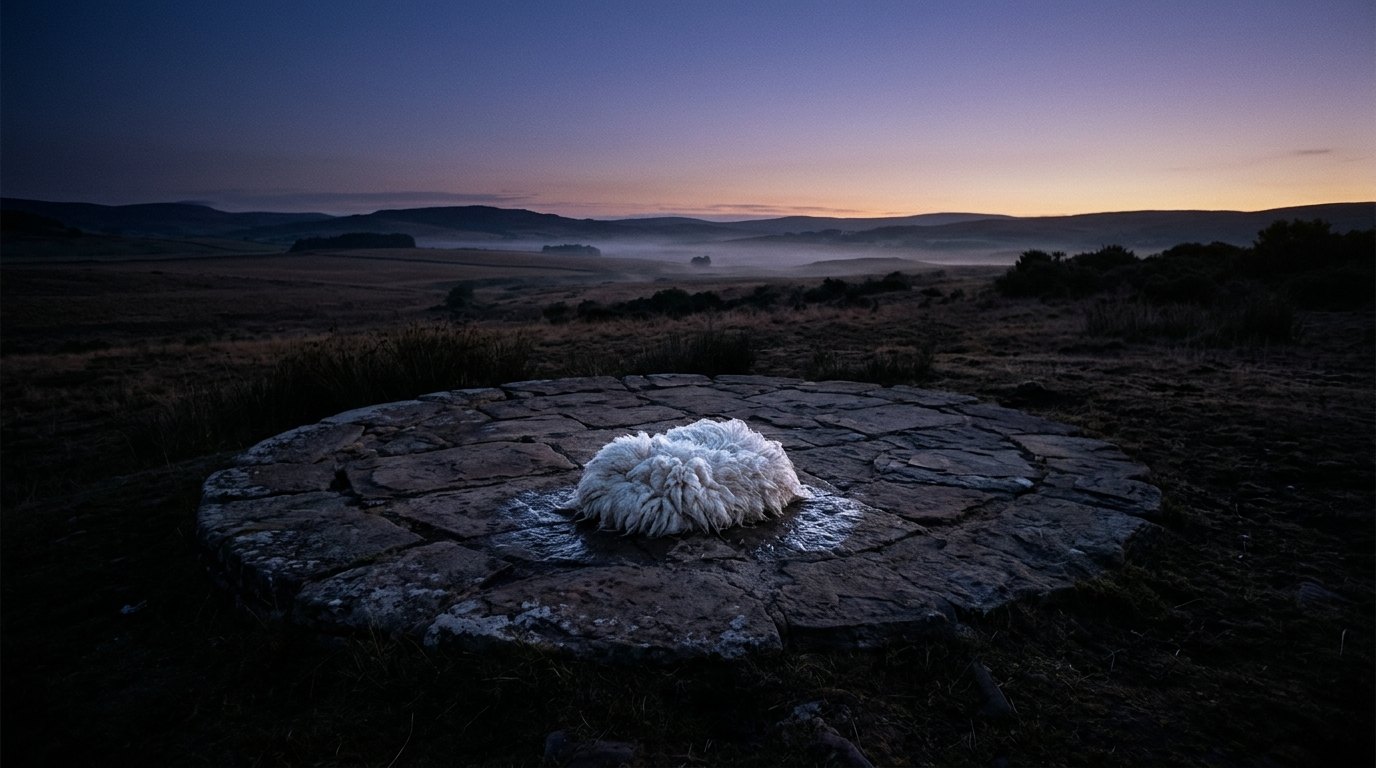
Then the Spirit of the LORD came on Gideon, and he blew a trumpet, summoning the Abiezrites to follow him.
Judges 6:34 (NIV)
The Spirit of the Lord clothes Gideon, transforming an insecure farmer into an empowered leader who summons tribes to war.
Judges 6:34 records the pivotal spiritual clothing of the deliverer: 'The Spirit of the Lord clothed Gideon, and he blew the trumpet, and the Abiezrites were called out to follow him.' The crisis intensified rapidly in Judges 6:33 as the armies of Midian, Amalek, and the peoples of the East crossed the Jordan River and established an enormous military camp across the fertile Valley of Jezreel. Empowered from on high, the once-timid farmer blew the ram's horn and dispatched couriers throughout Manasseh, Asher, Zebulun, and Naphtali, mobilizing thousands of northern warriors ready for battle (Judges 6:35). Yet despite this extraordinary army and the Spirit's inward rush, Gideon wrestled with lingering human doubt and sought further confirmation that God would indeed deliver Israel through his weak hands (Judges 6:36). Setting a wool fleece upon the outdoor threshing floor, he asked the Lord for a miracle: that morning dew would settle exclusively upon the fleece while the surrounding earth remained bone-dry (Judges 6:37). God met his trembling servant with astonishing gentleness; rising early the next morning, Gideon picked up the fleece and wrung out an entire bowl full of water, while the soil around it was parched (Judges 6:38). Still wrestling with the gravity of the mission, Gideon reverently petitioned God not to let His anger burn while asking for the reverse sign (Judges 6:39). God patiently confirmed His Word once more, keeping the fleece entirely dry throughout the night while heavy dew saturated the surrounding ground (Judges 6:40), sealing Gideon's assurance for the impossible battle ahead.
| Passage | What it says |
|---|---|
| Judges 6:33 | Midianites, Amalekites, and eastern allies crossed the Jordan and camped in the Valley of Jezreel. |
| Judges 6:34 | The Spirit of the Lord clothed Gideon, who blew a trumpet and rallied the Abiezrites behind him. |
| Judges 6:35 | Gideon sent messengers calling men from Manasseh, Asher, Zebulun, and Naphtali to join him. |
| Judges 6:36 | Gideon spoke to God, seeking confirmation that He would save Israel through his hand as promised. |
| Judges 6:37 | He asked for dew only on a wool fleece on the threshing floor while the ground remained dry. |
| Judges 6:38 | God granted the sign; Gideon wrung a full bowl of water from the fleece the next morning. |
| Judges 6:39 | Gideon respectfully petitioned God for one more test: the fleece dry and the ground wet with dew. |
| Judges 6:40 | God complied that night, leaving only the fleece dry while dew covered all the surrounding ground. |
The Sifting of the Army
From thirty-two thousand down to three hundred
The LORD said to Gideon, “You have too many men. I cannot deliver Midian into their hands, or Israel would boast against me, ‘My own strength has saved me.’
Judges 7:2 (NIV)
God explicitly limits the army so Israel cannot boast in its own power rather than the Lord's salvation.
In Judges 7:2, the Lord cuts straight to the root of human pride: God will not give Midian into Israel's hands while the army is large, lest Israel boast that her own strength has delivered her. The military assembly at the Spring of Harod (Judges 7:1) seemed modest compared to the sea of nomadic raiders camped beneath the hill of Moreh, yet to heaven it was dangerously oversized. True deliverance required stripping away every pretext for self-reliance. Under Deuteronomy's war ordinance, Gideon first proclaimed that anyone trembling in fear could return home; twenty-two thousand soldiers promptly turned back, leaving only ten thousand men (Judges 7:3).
Even that reduced force proved too capable in human terms. The Lord declared the army still too numerous and directed Gideon to bring the soldiers down to the stream for a final sorting (Judges 7:4). There, Gideon observed how the men drank from the flowing water (Judges 7:5). The vast majority dropped to their knees, bowing their faces directly to the surface, while a tiny remnant of three hundred men scooped water with their hands and lapped it from their palms like dogs (Judges 7:6).
By this simple test, the Lord separated the instrument He had chosen from the multitude. He promised Gideon that through these three hundred men alone He would deliver the nation, directing the remaining thousands to return to their tents (Judges 7:7). Retaining only the provisions and trumpets of the dismissed host, Gideon stood beside three hundred unarmed commoners against an imperial host (Judges 7:8). The reduction of the force was an intentional act of holy grace, ensuring that when victory arrived, every voice in Israel would be compelled to confess that salvation belongs exclusively to God.
| Passage | What it says |
|---|---|
| Judges 7:1 | Jerubbaal and his forces camped by the Spring of Harod, with the Midianites northward by the hill of Moreh. |
| Judges 7:2 | The Lord told Gideon his army was too large, lest Israel boast that her own strength saved her. |
| Judges 7:3 | Gideon sent home anyone fearful; twenty-two thousand left, leaving ten thousand men. |
| Judges 7:4 | The Lord declared the army was still too large and instructed Gideon to bring them to the water. |
| Judges 7:5 | Gideon separated those who lapped water with their tongues like dogs from those who knelt to drink. |
| Judges 7:6 | Three hundred men lapped water with hands to their mouths, while all the rest knelt down to drink. |
| Judges 7:7 | The Lord promised to deliver Israel through the three hundred lappers and send the others home. |
| Judges 7:8 | Gideon retained the three hundred men, took the provisions and trumpets, and dismissed the rest. |
The Barley Loaf and the Routing
Trumpets, broken jars, and torches in the night
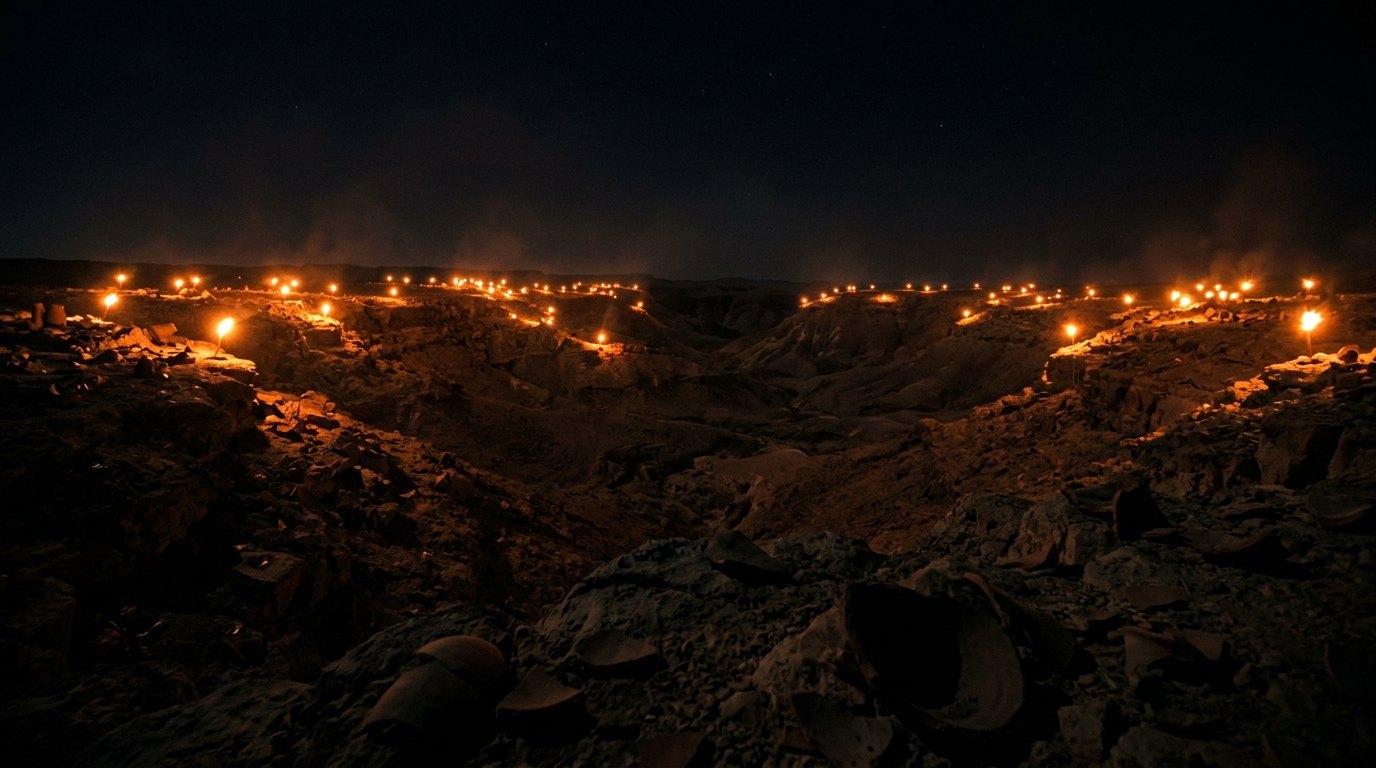
The three companies blew the trumpets and smashed the jars. Grasping the torches in their left hands and holding in their right hands the trumpets they were to blow, they shouted, “A sword for the LORD and for Gideon!”
Judges 7:20 (NIV)
The three hundred unleash chaos upon the vast camp with nothing more than torches, broken jars, and a cry of faith.
In Judges 7:20, the silent midnight air explodes with sound and blinding light: holding burning torches high in their left hands and blowing ram's horns in their right, the three hundred shout, 'A sword for the Lord and for Gideon!' Hours earlier, God had commanded Gideon to arise and fall upon the camp, graciously offering him a final sign if lingering doubts remained (Judges 7:9–10). Creeping down to the outposts with his servant Purah, Gideon beheld the invaders lying thick across the valley like swarming locusts, their camels beyond counting (Judges 7:11–12). In the darkness, he overheard a Midianite soldier recounting a dream of a rolling loaf of barley bread—the food of the poorest peasants—tumbling into camp and flattening a royal tent (Judges 7:13). When the soldier's comrade correctly interpreted the rolling loaf as the sword of Gideon into whose hand God had surrendered Midian, Gideon bowed in silent worship right outside their lines (Judges 7:14–15).
Strengthened by this sovereign assurance, Gideon mobilized his three companies, arming them not with swords or spears, but with horns, earthenware jars, and hidden torches (Judges 7:16). He commanded them to surround the sprawling valley encampment and mirror his precise actions when the middle watch began (Judges 7:17–19). When the three hundred shattered their pottery vessels and blew their trumpets, they stood entirely still in their positions around the rim of the camp (Judges 7:21). The sudden cacophony and fiery circle induced blinding panic throughout the ranks: the Lord turned every man's sword against his fellow, and the vast army fractured in desperate flight (Judges 7:22). Gideon instantly summoned the tribes of Naphtali, Asher, Manasseh, and Ephraim to seize the Jordan crossings, cutting off the routed host and capturing princes Oreb and Zeeb (Judges 7:23–25).
| Passage | What it says |
|---|---|
| Judges 7:9 | The Lord commanded Gideon that night to arise and attack the camp, having given it into his hand. |
| Judges 7:10 | The Lord invited Gideon to go down to the camp with his servant Purah if he was still afraid. |
| Judges 7:11 | Gideon and Purah sneaked down to the outposts of the armed camp and listened to the soldiers. |
| Judges 7:12 | Midianites and allies lay thick as locusts in the valley, their camels as numerous as sand on the seashore. |
| Judges 7:13 | A soldier recounted a dream of a tumbling barley loaf striking a Midianite tent and collapsing it. |
| Judges 7:14 | His companion interpreted the dream as the sword of Gideon, to whom God gave Midian's camp. |
| Judges 7:15 | Gideon worshiped God upon hearing the dream, then returned and rallied Israel for battle. |
| Judges 7:16 | He divided the three hundred into three companies, giving every man a trumpet, an empty jar, and a torch. |
| Judges 7:17 | Gideon instructed them to watch him and do exactly as he did when reaching the edge of the camp. |
| Judges 7:18 | He ordered them to blow their trumpets and shout, 'For the Lord and for Gideon!' |
| Judges 7:19 | Gideon's company reached the camp around midnight, right after the guard had been changed. |
| Judges 7:20 | All three companies blew trumpets, smashed jars, held torches aloft, and shouted their battle cry. |
| Judges 7:21 | Every man held his ground around the camp, and the entire Midianite army ran, cried out, and fled. |
| Judges 7:22 | When the trumpets blew, the Lord set every man's sword against his fellow throughout the camp. |
| Judges 7:23 | Men of Naphtali, Asher, and all Manasseh were called out to pursue the fleeing Midianites. |
| Judges 7:24 | Gideon summoned Ephraimites to seize the Jordan waters as far as Beth-barah against the fugitives. |
| Judges 7:25 | Ephraim captured and executed Midianite princes Oreb and Zeeb, bringing their heads to Gideon. |
Diplomacy and Pursuit
Pacifying Ephraim and pursuing kings across the Jordan
But he answered them, “What have I accomplished compared to you? Aren’t the gleanings of Ephraim’s grapes better than the full grape harvest of Abiezer?
Judges 8:2 (NIV)
Gideon deflects Ephraim's hostile jealousy with gracious humility, showing wisdom in resolving tribal strife.
In Judges 8:2, Gideon exhibits rare pastoral gentleness in the midst of triumph: he defuses Ephraim's fiery grievance by asking what his own house has achieved compared to the rich gleanings of Ephraim's vintage. The haughty northern tribe had confronted Gideon angrily for failing to summon them before the initial clash (Judges 8:1), but his humble reminder that God had handed over princes Oreb and Zeeb to Ephraim instantly pacified their wounded pride (Judges 8:3). Leaving Ephraim satisfied, Gideon crossed the Jordan with his three hundred companions, physically exhausted yet pressing the pursuit of Midian's surviving kings, Zebah and Zalmunna (Judges 8:4).
Tragically, Israelite cities east of the river refused to aid their own brethren. The elders of Succoth and Penuel sneered at the ragged band, refusing to give even bread to the starving men until the enemy kings were securely in hand (Judges 8:5–6, 8). Gideon warned both towns of the severe retribution they would face when he returned in peace (Judges 8:7, 9). Bypassing traditional routes, Gideon struck the fifteen thousand remaining Midianite troops at Karkor through the nomadic caravan trails, routing the unsuspecting force and capturing both kings (Judges 8:10–12).
Returning by the ascent of Heres, Gideon exacted righteous judgment upon the faithless leaders of Succoth and dismantled Penuel's defensive tower (Judges 8:13–17). When Zebah and Zalmunna admitted to slaughtering Gideon's own brothers at Mount Tabor, Gideon executed the captive kings himself after his young son Jether hesitated in fear (Judges 8:18–21). Gideon’s relentless pursuit revealed the unyielding determination of faith, overcoming not only external enemies but the callous treachery of compromise within God's own covenant borders.
| Passage | What it says |
|---|---|
| Judges 8:1 | The men of Ephraim sharply criticized Gideon for not calling them when he first went to fight Midian. |
| Judges 8:2 | Gideon asked what he had done compared to them, praising Ephraim's gleanings over Abiezer's vintage. |
| Judges 8:3 | He highlighted that God delivered Midian's leaders into Ephraim's hand, diffusing their anger. |
| Judges 8:4 | Gideon and his three hundred men crossed the Jordan River, exhausted yet still pursuing the enemy. |
| Judges 8:5 | Gideon asked the men of Succoth for bread to feed his weary men pursuing Zebah and Zalmunna. |
| Judges 8:6 | The leaders of Succoth sneered, refusing bread until Zebah and Zalmunna were captured. |
| Judges 8:7 | Gideon vowed to tear their flesh with wilderness thorns and briers when the Lord gave him victory. |
| Judges 8:8 | He went to Penuel with the same request, and the men of Penuel answered him identically. |
| Judges 8:9 | Gideon warned Penuel that when he returned in peace, he would break down their defensive tower. |
| Judges 8:10 | Zebah and Zalmunna were at Karkor with fifteen thousand surviving soldiers out of an initial army of 135,000. |
| Judges 8:11 | Gideon traveled by caravan route east of Nobah and Jogbehah and surprised the unsuspecting army. |
| Judges 8:12 | When Zebah and Zalmunna fled, Gideon pursued them, routed the army, and captured both Midianite kings. |
| Judges 8:13 | Gideon son of Joash returned from the battle by the ascent of Heres. |
| Judges 8:14 | He captured a young man of Succoth, who wrote down seventy-seven officials and elders of the town. |
| Judges 8:15 | Gideon confronted Succoth with the captive kings whom they had mocked him over. |
| Judges 8:16 | He took wilderness thorns and briers and punished the elders of Succoth with them. |
| Judges 8:17 | He tore down the tower of Penuel and killed the men of the city for their treasonous defiance. |
| Judges 8:18 | Gideon asked the captured kings about the men they had killed at Mount Tabor, who resembled him. |
| Judges 8:19 | Identifying the slain as his brothers, Gideon swore as the Lord lives he would have spared the kings had they spared them. |
| Judges 8:20 | Gideon commanded his firstborn Jether to execute them, but the youth drew no sword because he was afraid. |
| Judges 8:21 | The kings challenged Gideon to slay them himself; Gideon executed them and took ornaments from their camels. |
Later Years and Legacy
Refusing monarchy, crafting a snare, and resting forty years
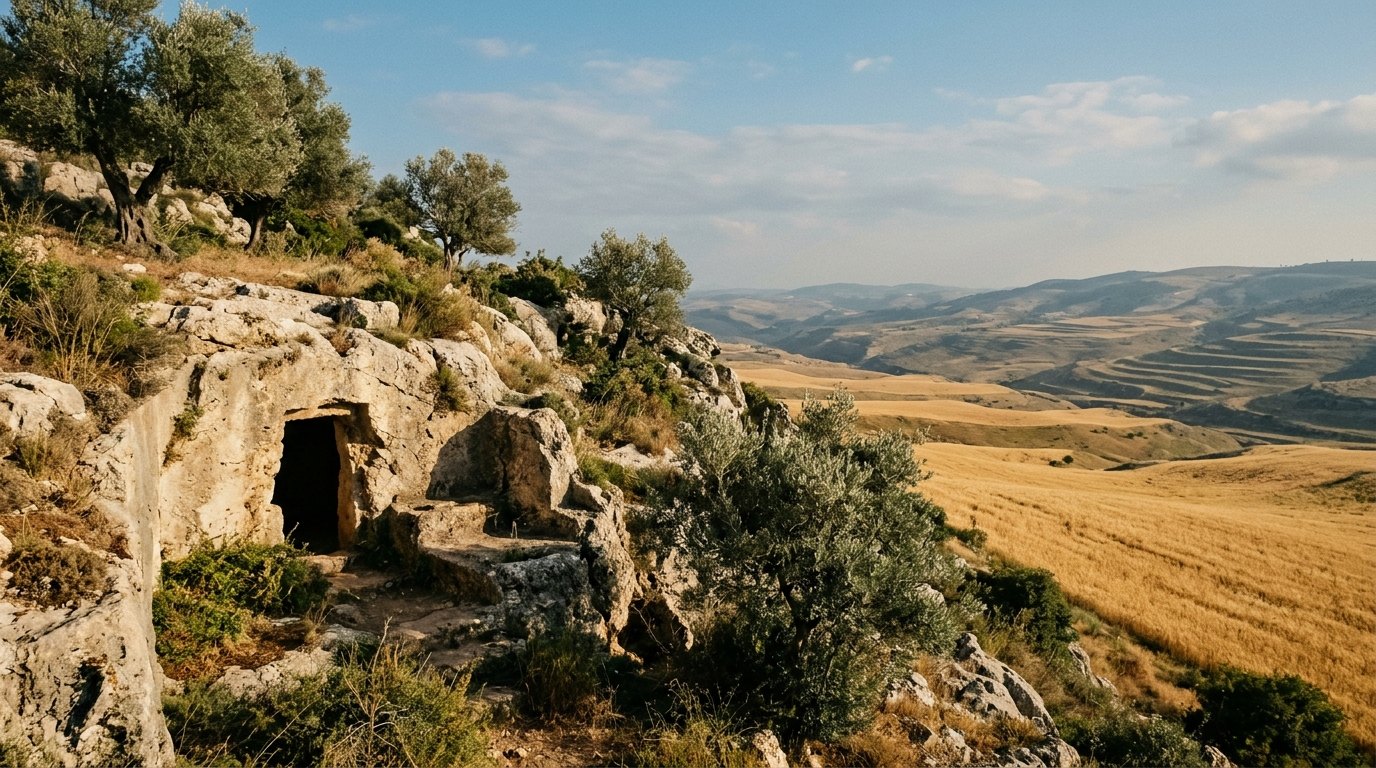
But Gideon told them, “I will not rule over you, nor will my son rule over you. The LORD will rule over you.”
Judges 8:23 (NIV)
Gideon upholds theocratic rule by refusing royal title over Israel, pointing to Yahweh as their true King.
In Judges 8:23, Gideon delivers one of the great declarations of Old Testament faith: he refuses Israel's clamor for a hereditary dynasty, insisting that 'I will not rule over you, nor will my son rule over you; the Lord will rule over you.' After Midian's crushing defeat, the people sought human monarchy (Judges 8:22), but Gideon firmly pointed them back to Yahweh's sovereign kingship. Yet even this faithful champion remained a fallible sinner. Requesting the gold earrings gathered from the Ishmaelite plunder, Gideon accumulated over seventeen hundred shekels of precious metal alongside royal purple fabrics and camel ornaments (Judges 8:24–26). With this wealth, he fashioned an ornate ephod and set it up in his hometown of Ophrah, which swiftly became a snare that seduced all Israel into idolatry (Judges 8:27).
Under Gideon's tenure, Midian remained subdued and the land enjoyed rest for forty full years (Judges 8:28–29). Yet his domestic choices planted bitter seeds: fathering seventy sons through many wives, his concubine in Shechem bore him a son named Abimelech, whose name would later spell ruin for the household (Judges 8:30–31). When Gideon died at a good old age and was laid in his father's tomb, Israel immediately reverted to worshiping Baal-berith, forgetting both their divine Savior and the household of Jerubbaal (Judges 8:32–35).
Despite his human frailties, Scripture honors Gideon's enduring legacy of trust. Samuel cited Jerubbaal as a proof of God's redemptive faithfulness (1 Samuel 12:11), Asaph invoked Midian's defeat as the pattern for divine rescue (Psalms 83:9, 11), and Isaiah heralded the coming Messiah by promising to smash the oppressor's rod 'as in the day of Midian' (Isaiah 9:4; 10:26; see also 2 Samuel 11:21). Above all, Hebrews 11:32 enshrines Gideon among the champions of faith who through genuine reliance upon God conquered kingdoms, turning human weakness into triumphant strength.
| Passage | What it says |
|---|---|
| Judges 8:22 | The men of Israel asked Gideon, his son, and grandson to rule over them as a dynastic king. |
| Judges 8:23 | Gideon refused to rule over them, declaring that the Lord alone would be their ruler. |
| Judges 8:24 | Gideon requested instead that every man give him golden earrings taken from the Ishmaelite plunder. |
| Judges 8:25 | The men willingly spread out a garment, and every man threw plunder onto it. |
| Judges 8:26 | The gold earrings weighed 1,700 shekels, besides crescents, pendants, purple garments, and camel chains. |
| Judges 8:27 | Gideon fashioned an ephod and placed it in Ophrah; all Israel prostituted themselves to it, ensnaring his family. |
| Judges 8:28 | Midian was subdued before Israel, and the land enjoyed quiet and peace for forty years during Gideon's lifetime. |
| Judges 8:29 | Jerubbaal son of Joash went and lived quietly in his own home. |
| Judges 8:30 | Gideon fathered seventy sons of his own body, having many wives. |
| Judges 8:31 | His concubine in Shechem also bore him a son, whom he named Abimelech. |
| Judges 8:32 | Gideon died at a good old age and was buried in the tomb of his father Joash at Ophrah. |
| Judges 8:33 | As soon as Gideon died, Israel turned back to the Baals and made Baal-berith their god. |
| Judges 8:34 | The Israelites failed to remember the Lord their God who had rescued them from all surrounding enemies. |
| Judges 8:35 | They showed no kindness to the family of Jerubbaal (Gideon) in return for all the good he did for Israel. |
| Hebrews 11:32 | The New Testament canonizes Gideon among the champions of faith who through trust in God conquered kingdoms. |
| 1 Samuel 12:11 | Samuel lists Jerubbaal alongside Barak, Jephthah, and Samuel as deliverers sent by the Lord to rescue Israel from surrounding enemies. |
| 2 Samuel 11:21 | Joab recalls Abimelech as the son of Jerubbesheth, an alternate name for Jerubbaal used in Israel's historical memory. |
| Psalms 83:9 | Asaph prays that God would defeat Israel's present enemies just as He defeated Midian, Sisera, and Jabin at Kishon. |
| Psalms 83:11 | The psalmist asks God to make the nobles like Oreb and Zeeb and all their princes like Zebah and Zalmunna. |
| Isaiah 9:4 | Isaiah prophesies the breaking of the yoke and rod of the oppressor as in the day of Midian's defeat. |
| Isaiah 10:26 | The Lord of hosts promises to stir up a scourge against Assyria as at the slaughter of Midian at Oreb's rock. |
Where in the Bible
| Book | Passages |
|---|---|
| Joshua | 1 · Joshua 17:2 |
| Judges | 100 · Judges 6:1, Judges 6:2, Judges 6:3, Judges 6:4, Judges 6:5, Judges 6:6, Judges 6:7, Judges 6:8, Judges 6:9, Judges 6:10, Judges 6:11, Judges 6:12, Judges 6:13, Judges 6:14, Judges 6:15, Judges 6:16, Judges 6:17, Judges 6:18, Judges 6:19, Judges 6:20, Judges 6:21, Judges 6:22, Judges 6:23, Judges 6:24, Judges 6:25, Judges 6:26, Judges 6:27, Judges 6:28, Judges 6:29, Judges 6:30, Judges 6:31, Judges 6:32, Judges 6:33, Judges 6:34, Judges 6:35, Judges 6:36, Judges 6:37, Judges 6:38, Judges 6:39, Judges 6:40, Judges 7:1, Judges 7:2, Judges 7:3, Judges 7:4, Judges 7:5, Judges 7:6, Judges 7:7, Judges 7:8, Judges 7:9, Judges 7:10, Judges 7:11, Judges 7:12, Judges 7:13, Judges 7:14, Judges 7:15, Judges 7:16, Judges 7:17, Judges 7:18, Judges 7:19, Judges 7:20, Judges 7:21, Judges 7:22, Judges 7:23, Judges 7:24, Judges 7:25, Judges 8:1, Judges 8:2, Judges 8:3, Judges 8:4, Judges 8:5, Judges 8:6, Judges 8:7, Judges 8:8, Judges 8:9, Judges 8:10, Judges 8:11, Judges 8:12, Judges 8:13, Judges 8:14, Judges 8:15, Judges 8:16, Judges 8:17, Judges 8:18, Judges 8:19, Judges 8:20, Judges 8:21, Judges 8:22, Judges 8:23, Judges 8:24, Judges 8:25, Judges 8:26, Judges 8:27, Judges 8:28, Judges 8:29, Judges 8:30, Judges 8:31, Judges 8:32, Judges 8:33, Judges 8:34, Judges 8:35 |
| 1 Samuel | 1 · 1 Samuel 12:11 |
| 2 Samuel | 1 · 2 Samuel 11:21 |
| Psalms | 2 · Psalms 83:9, Psalms 83:11 |
| Isaiah | 2 · Isaiah 9:4, Isaiah 10:26 |
| Hebrews | 1 · Hebrews 11:32 |
The story in order
- Israel oppressed by Midian (c. 1100 BC) · Judges 6:1 · God hands Israel over to Midian for seven years due to their sin.
- Gideon called by the Angel of the Lord (c. 1100 BC) · Judges 6:12 · The Lord calls a fearful Gideon a mighty warrior.
- Gideon confirms God's call (c. 1100 BC) · Judges 6:37 · Two signs with a fleece confirm God's promise to save Israel through Gideon.
- The Spirit clothes Gideon (c. 1100 BC) · Judges 6:34 · The Spirit empowers Gideon to rally Israel against Midian.
- Army reduced to 300 (c. 1100 BC) · Judges 7:7 · God reduces Gideon's army to 300 to ensure Israel boasts in Him alone.
- Gideon attacks the Midianite camp (c. 1100 BC) · Judges 7:19 · Gideon's 300 men rout the vast Midianite army with trumpets, jars, and torches.
- Midianite kings captured (c. 1100 BC) · Judges 8:12 · Gideon pursues and captures the fleeing Midianite kings, Zebah and Zalmunna.
- Gideon refuses kingship (c. 1100 BC) · Judges 8:23 · Gideon declares that the Lord alone is Israel's ruler.
- Gideon crafts an ephod (c. 1100 BC) · Judges 8:27 · Gideon makes an idol that ensnares Israel and his family.
- Forty years of peace (c. 1100 BC) · Judges 8:28 · The land has peace for forty years during Gideon's lifetime.
- Gideon remembered in faith (AD 1st Century) · Hebrews 11:32 · Gideon is listed among the faithful heroes of Israel.
Gideon's Faith Journey
| Doubt and Fear | God's Assurance and Power | Faithful Action | Passage |
|---|---|---|---|
| Hiding from Midianites while threshing wheat | Angel of the Lord declares 'The Lord is with you' | Gideon builds an altar to Yahweh-Shalom | Judges 6:11-24 |
| Questioning God's presence due to oppression | God promises His presence and victory | Gideon tears down Baal's altar | |
| Seeking signs for confirmation | The Spirit clothes Gideon; signs with the fleece granted | Gideon rallies Israel and attacks the camp | |
| Fearful of Ephraim's anger | Gideon appeases Ephraim by highlighting God's deliverance | Gideon pursues and captures the kings | Judges 8:1-21 |
| Refusing kingship | Declaring the Lord as Israel's sole ruler | Gideon leads Israel for forty years of peace | Judges 8:22-32 |
God's Sovereignty vs. Human Boasting
| Human Weakness/Fear | God's Intervention/Power | Result: God Glorified | Passage |
|---|---|---|---|
| Gideon is the least in his family and clan | The Lord promises 'I will be with you' | Gideon saves Israel from Midian | Judges 6:15-16 |
| Gideon's army of 32,000 is too large | The Lord reduces the army to 300 men | Israel cannot boast that their own strength saved them | Judges 7:2-7 |
| Gideon's fear of the Midianite camp | God gives Gideon the victory through a dream and a plan | The Midianite army is routed by God's power | Judges 7:9-22 |
Key words
- Angel of the Lord (mal'ak YHWH, מַלְאַךְ יְהוָה)
- A divine messenger, often identified with God Himself, appearing in human form. · Judges 6:11
- Mighty Warrior (gibbor ḥayil, גִּבּוֹר חַיִל)
- A term of encouragement and designation for Gideon, despite his current fear. · Judges 6:12
- Yahweh-Shalom (YHWH-Shalom, יְהוָה שָׁלוֹם)
- The name Gideon gave to the altar he built, meaning 'The Lord is Peace'. · Judges 6:24
- Jerubbaal (Yerubba'al, יְרֻבַּעַל)
- The name given to Gideon by his father, meaning 'Let Baal contend against him'. · Judges 6:32
- Spirit of the Lord (ruach YHWH, רוּחַ יְהוָה)
- The divine power and presence of God that equipped Gideon for leadership. · Judges 6:34
- Ephod (ʼēphōdh, אֵפֹד)
- A priestly garment, but here Gideon fashioned one as an idol, leading Israel astray. · Judges 8:27
Gideon's journey from threshing wheat in secret to delivering an entire nation reminds us that God does not call the equipped, but equips the called. When the Lord promises His presence, our weakness becomes the very canvas upon which His almighty power is displayed.
108 passages, each cited once.
Scripture cited
- Judges 6:11-16
- Judges 6
- Judges 7
- Judges 8
- Hebrews 11:32-34