Who was the apostle John?

John 21:20-24
20 Peter turned and saw that the disciple whom Jesus loved was following them. (This was the one who had leaned back against Jesus at the supper and had said, “Lord, who is going to betray you?”)
21 When Peter saw him, he asked, “Lord, what about him?”
22 Jesus answered, “If I want him to remain alive until I return, what is that to you? You must follow me.”
23 Because of this, the rumor spread among the believers that this disciple would not die. But Jesus did not say that he would not die; he only said, “If I want him to remain alive until I return, what is that to you?”
24 This is the disciple who testifies to these things and who wrote them down. We know that his testimony is true.
New International Version (NIV)
The answer
The apostle John was John the son of Zebedee, a fisherman called by Jesus to be one of the Twelve, an eyewitness of Jesus’ ministry, death and resurrection, and the writer of the Gospel of John, the three letters of John, and Revelation. He was the brother of James and is distinct from John the Baptist.
His life with Jesus
- His calling: Matthew 4:21-22 records Jesus calling James and John while they were mending nets with their father. They immediately left the boat and followed Him. Matthew 10:2 lists John among the twelve apostles.
- His character and closeness to Jesus: Mark 3:17 says Jesus named the brothers Boanerges, meaning “Sons of Thunder.” Matthew 17:1-2 places John with Peter and James when Jesus was transfigured before them.
- The beloved disciple: John 21:20 and John 21:24 identify the disciple whom Jesus loved, who had leaned on Jesus at the supper, as the disciple who testified and wrote these things. At the cross, Jesus entrusted His mother to this disciple’s care, as John 19:26-27 records. On resurrection morning, John 20:2-8 says that he ran to the tomb with Peter, entered, saw and believed.
His ministry and writings
After Jesus’ ascension, John continued bearing witness with Peter. Acts 4:13 says the council saw their boldness and recognized that they had been with Jesus. When commanded to stop speaking and teaching in Jesus’ name, Peter and John answered that they had to obey God and could not stop telling what they had seen and heard, according to Acts 4:19-20. Galatians 2:9 names John alongside James and Cephas as one of those reputed to be pillars.
John 21:24 affirms that his witness is true. John 20:31 gives the Gospel’s purpose: that readers may believe Jesus is the Christ, the Son of God, and have life in His name. In 1 John 1:1-3, John testifies to what he and the other apostles heard, saw and touched concerning the Word of life. Revelation 1:9-11 identifies John on Patmos because of God’s Word and the testimony of Jesus Christ, where he was commanded to write what he saw and send it to the seven churches.
Answered from Scripture · reviewed November 11, 2026
The apostle John stands among the most intimate companions of Jesus Christ, called from mending fishing nets on the Sea of Galilee to become a pillar of the early church and an eyewitness to the glory of the incarnate Son. Known within his own Gospel as 'the disciple whom Jesus loved,' John bore faithful testimony across five books of the New Testament to what he had seen, heard, and touched. Tracing his life through the Scriptures reveals not only the fiery son of thunder transformed by grace, but an apostle whose entire witness directs the church to eternal life in Christ.
The Call by the Sea
Called from the fishing nets to follow Christ

Going on from there, he saw two other brothers, James son of Zebedee and his brother John. They were in a boat with their father Zebedee, preparing their nets. Jesus called them, and immediately they left the boat and their father and followed him.
Matthew 4:21-22 (NIV)
John immediately abandons his trade and familial obligations when Jesus calls him to discipleship.
In Matthew 4:21-22, the Lord Jesus walks along the shores of Galilee and calls two brothers mending nets with their father: John immediately leaves the boat and his family behind to follow the Messiah. Mark 1:19-20 underscores the radical cost of that moment, noting that the brothers left behind Zebedee and the hired servants, forsaking an established family business. In Luke 5:10, Luke reveals that James and John were partners with Simon Peter, brought to sheer astonishment by a miraculous catch of fish before Christ summons them to become fishers of men. When the Lord formalizes His inner leadership, John is numbered prominently among the twelve in Matthew 10:2 and Luke 6:14, always paired closely with his brother James and with Peter. In Mark 3:17, Jesus gives James and John the distinctive Aramaic surname Boanerges, meaning 'Sons of Thunder.' This title was not merely decorative; it testified to their fierce temperament, fiery zeal, and passionate nature. Yet that very energy, initially raw and unbridled, was placed at the feet of Jesus. John's calling proves that God takes ordinary men from the manual labor of everyday life and shapes them through sustained fellowship with His Son.
| Passage | What it says |
|---|---|
| Matthew 4:21-22 | Jesus calls James and John, sons of Zebedee, who leave their boat and father immediately. |
| Mark 1:19-20 | John leaves the hired servants in the boat with his father Zebedee to follow Jesus. |
| Luke 5:10 | James and John, partners with Simon, witness the miraculous catch of fish and follow Jesus. |
| Matthew 10:2 | John is listed among the twelve apostles chosen by Jesus, paired with his brother James. |
| Mark 3:17 | Jesus names James and John 'Boanerges', which means 'Sons of Thunder.' |
| Luke 6:14 | Luke includes John immediately alongside Peter, Andrew, and James among the apostles. |
The Inner Circle
An eyewitness to the deepest revelations of Christ's power

After six days Jesus took with him Peter, James and John the brother of James, and led them up a high mountain by themselves. There he was transfigured before them. His face shone like the sun, and his clothes became as white as the light.
Matthew 17:1-2 (NIV)
John is chosen to behold Christ's divine glory unveiled on the holy mount.
On the high summit described in Matthew 17:1-2, John beholds the unveiled glory of Jesus Christ as His face shines like the sun and His clothes turn dazzling white. Along with Peter and James, John formed an intimate circle of three disciples whom the Lord admitted into the deepest sanctums of His earthly ministry. In Mark 5:37 and Luke 8:51, when Jairus' daughter lies dead, Jesus excludes the clamoring crowd and permits only this trio to witness the miracle of resurrection as life returns to the maiden. Months later, Mark 9:2 and Luke 9:28 recount John scaling the mountain of transfiguration, hearing the voice of the Father out of the luminous cloud confirm Jesus as His beloved Son. Later, as Christ foretells the coming destruction of the temple, Mark 13:3 records John sitting privately with Jesus on the Mount of Olives to inquire into the consummation of the age. Yet this intimacy brought John not only to scenes of majestic power but into the depths of Christ's sorrow. In Matthew 26:37 and Mark 14:33, Jesus leads John and his two companions into the shadowed olive trees of Gethsemane, bidding them watch while He agonizes in soul before the Father.
| Passage | What it says |
|---|---|
| Mark 5:37 | Jesus permits only Peter, James, and John to enter and see the raising of Jairus' daughter. |
| Luke 8:51 | John enters the house with Jesus as an eyewitness to the resurrection of the young girl. |
| Matthew 17:1-2 | Jesus leads Peter, James, and John up a high mountain and is transfigured before them. |
| Mark 9:2 | Mark records John witnessing Jesus' clothes become radiant white on the mount of transfiguration. |
| Luke 9:28 | Luke notes that Jesus took Peter, John, and James up the mountain to pray. |
| Mark 13:3 | Peter, James, John, and Andrew question Jesus privately on the Mount of Olives regarding the end times. |
| Matthew 26:37 | Jesus takes Peter and the two sons of Zebedee into Gethsemane during His agony. |
| Mark 14:33 | Jesus brings Peter, James, and John into the garden as He begins to be deeply distressed. |
The Son of Thunder Rebuked
Chastened zeal matured into Christlike humility
When the disciples James and John saw this, they asked, “Lord, do you want us to call fire down from heaven to destroy them?” But Jesus turned and rebuked them.
Luke 9:54-55 (NIV)
Jesus rebukes John for seeking destructive judgment against a Samaritan village that rejected them.
When a Samaritan village refuses hospitality to Jesus, Luke 9:54-55 reveals the unrestrained fury of the sons of Zebedee: Jesus turns and rebukes John for seeking to call down consuming fire from heaven upon their opponents. The fiery zeal that earned John the title Boanerges was still tainted by worldly ambition and sectarian pride. In Mark 9:38 and Luke 9:49-50, John openly confesses to rebuking an outsider who was casting out demons in Christ's name simply because he did not belong to their specific company; Jesus gently corrects him, declaring that whoever is not against them is for them. Ambition surfaced again on the road to Jerusalem. Matthew 20:20-23 depicts their mother petitioning for the prime thrones, while Mark 10:35-40 shows James and John personally asking for the places of ultimate prestige at Christ's right and left hand in His kingdom. Jesus confronts their ignorance of what true glory demands, asking if they can drink the bitter cup of suffering He must drink. Through these painful reproofs, the Savior steadily dismantled John's self-seeking impulses, burning away the dross of pride to forge an apostle of steadfast tenderness and sacrificial love.
| Passage | What it says |
|---|---|
| Mark 9:38 | John reports forbidding someone casting out demons in Jesus' name because he did not follow with them. |
| Luke 9:49-50 | Jesus instructs John not to forbid others working in His name, for whoever is not against them is for them. |
| Luke 9:54-55 | James and John ask to call fire down on Samaria, and Jesus rebukes their spirit. |
| Matthew 20:20-23 | The mother of Zebedee's sons requests chief places for them; Jesus asks if they can drink His cup. |
| Mark 10:35-40 | James and John directly ask Jesus for places of glory at His right and left hand. |
The Beloved Disciple
Leaning on Jesus' breast and standing at the cross

When Jesus saw his mother there, and the disciple whom he loved standing nearby, he said to her, “Woman, here is your son,” and to the disciple, “Here is your mother.” From that time on, this disciple took her into his home.
John 19:26-27 (NIV)
From the cross, Jesus entrusts the care of His earthly mother to the beloved disciple.
Standing at the foot of Golgotha in John 19:26-27, the disciple whom Jesus loved receives the sacred commission from the dying Savior to take Mary into his own home as his mother. Throughout the passion narrative, John's unique closeness to the Lord shines with solemn beauty. In Luke 22:8, Jesus entrusts Peter and John alone with the sensitive duty of preparing the final Passover meal. Hours later, at the table, John 13:23-26 shows John reclining next to the Lord's chest, leaning back at Peter's motion to ask who would betray Him. When the Shepherd is struck, John does not flee completely; John 18:15-16 records that he followed Jesus into the high priest's palace, securing entry into the courtyard. At the cross, when other men hid in fear, John stood near the suffering Lamb of God. In John 19:35, he records the soldier piercing the Savior's side and the immediate effusion of water and blood, anchoring his testimony in absolute historical truth so that the church may believe. In this beloved disciple, we see how the transforming love of Christ casts out fear and anchors the believer in unwavering fidelity.
| Passage | What it says |
|---|---|
| Luke 22:8 | Jesus sends Peter and John to prepare the Passover meal for the disciples. |
| John 13:23-26 | The disciple whom Jesus loved reclines next to Him and asks who will betray Him. |
| John 18:15-16 | Another disciple known to the high priest enters the courtyard and brings Peter inside. |
| John 19:26-27 | Jesus commands Mary to behold her son and tells the beloved disciple to take her home. |
| John 19:35 | The eyewitness testifies to the water and blood from Jesus' pierced side so readers may believe. |
Witness of the Resurrection
First to believe at the tomb and at the sea
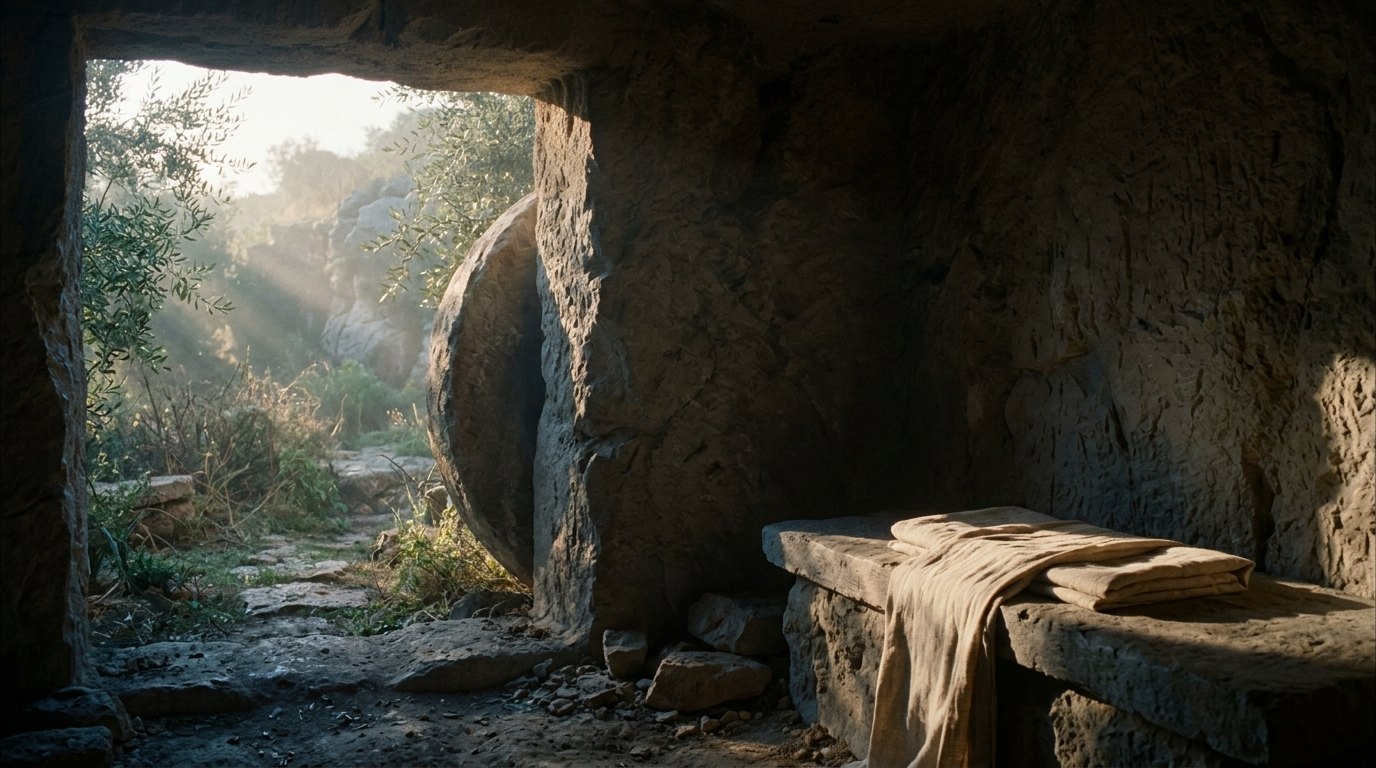
Finally the other disciple, who had reached the tomb first, also went inside. He saw and believed.
John 20:8 (NIV)
Entering the empty tomb, John sees the linen cloths and believes without having yet seen the risen Lord.
When John stooped to peer into the sepulchre, he saw the empty burial clothes and believed, grasping the reality of Christ's resurrection before any other disciple (John 20:8). The dramatic morning had begun when Mary Magdalene brought word that the stone was rolled away, prompting a race between Peter and John toward the garden vault (John 20:2-4). John's swifter pace brought him first to the threshold, but his entrance proved to be a decisive moment of quiet faith, apprehending that the neatly folded grave clothes signified victory rather than grave robbery. That same spiritual clarity marked his perception weeks later along the Galilean shore. When a mysterious voice called from the morning mist directing their nets to a miraculous harvest of fish, the beloved disciple immediately discerned the Master's presence, whispering to Peter, 'It is the Lord!' (John 21:7). Beside that shore, as Peter questioned the future destiny of his fellow apostle, Jesus redirected him from speculative curiosity by affirming His absolute sovereign authority over John's lifespan and calling (John 21:20-23). The chapter concludes by explicitly tying the entire written narrative to John's direct eyewitness fidelity (John 21:24). The one who had reclined upon Jesus' chest remained to the end a foundational herald of the risen King.
| Passage | What it says |
|---|---|
| John 20:2-4 | Mary Magdalene runs to Peter and the beloved disciple, who outruns Peter to the tomb. |
| John 20:8 | The other disciple enters the tomb, sees the linen wrappings, and believes. |
| John 21:7 | Recognizing the miraculous haul of fish, the beloved disciple tells Peter, 'It is the Lord!' |
| John 21:20-23 | Jesus responds to Peter's inquiry about John by commanding Peter simply to follow Him. |
| John 21:24 | The author confirms that this beloved disciple is the one testifying and writing these truths. |
Pillar of the Early Church
Bold herald and defender of the apostolic faith
When they saw the courage of Peter and John and realized that they were unschooled, ordinary men, they were astonished and they took note that these men had been with Jesus.
Acts 4:13 (NIV)
The Jewish council is astonished by the uneducated boldness of Peter and John, recognizing they had been with Jesus.
The Sanhedrin stood utterly amazed when the uneducated fishermen spoke with sovereign authority, recognizing that the courage of Peter and John came from having walked with Jesus (Acts 4:13). Following the ascension of their Lord, John had joined the faithful remnant in the upper room, constant in unified prayer as the church waited for the promised Spirit (Acts 1:13). When power fell at Pentecost, the former 'son of thunder' became a steadfast instrument of healing and apostolic boldness. Outside the temple gate Beautiful, John accompanied Peter as an incurable lameness yielded instantly to the name of Jesus Christ the Nazarene (Acts 3:1-11). Arrested and threatened by the rulers who had orchestrated the crucifixion, the apostles flatly refused to be silenced, declaring that no earthly council could override their holy obligation to proclaim what they had seen and heard (Acts 4:19-20). This ministry extended beyond Jerusalem when Peter and John journeyed north into Samaria, laying hands upon newly converted believers that they might receive the Holy Spirit (Acts 8:14-17). Decades later, the apostle Paul would confirm John's enduring stature, enumerating him alongside Peter and James as the undisputed pillars of the Jerusalem assembly (Galatians 2:9).
| Passage | What it says |
|---|---|
| Acts 1:13 | John joins the other apostles in the upper room devoted to prayer after the ascension. |
| Acts 3:1-11 | Peter and John heal a man lame from birth at the temple gate Beautiful. |
| Acts 4:13 | The Sanhedrin observes the boldness of Peter and John, recognizing they had been with Jesus. |
| Acts 4:19-20 | Peter and John declare they cannot stop speaking what they have seen and heard. |
| Acts 8:14-17 | Peter and John travel to Samaria to pray that new believers might receive the Holy Spirit. |
| Galatians 2:9 | Paul identifies James, Cephas, and John as recognized pillars of the church in Jerusalem. |
Apostolic Author and Seer
Proclaiming the Word of life and the final victory

That which was from the beginning, which we have heard, which we have seen with our eyes, which we have looked at and our hands have touched—this we proclaim concerning the Word of life. The life appeared; we have seen it and testify to it, and we proclaim to you the eternal life, which was with the Father and has appeared to us. We proclaim to you what we have seen and heard, so that you also may have fellowship with us. And our fellowship is with the Father and with his Son, Jesus Christ.
1 John 1:1-3 (NIV)
John bases his authority on what his hands have handled concerning the Word of life manifested in the flesh.
Against every early heresy that denied the true humanity of Jesus, John anchored Christian certainty in tangible historical encounter, writing of the eternal Word whom his own eyes had seen and his hands had handled (1 John 1:1-3). This unwavering testimony opened his Gospel, where he celebrated the incarnation of the divine Logos who tabernacled among men in grace and truth (John 1:14). His stated design in recording these miraculous signs was entirely pastoral and evangelistic, written so that generations yet unborn might believe that Jesus is the Christ and possess eternal life in His name (John 20:30-31). In his shorter epistles, the aging elder passionately urged the church toward steadfast love and truth, charging believers to guard against deceivers who refused to confess Christ's coming in the flesh (2 John 1:1; 3 John 1:1). Banished in his final years to the rugged penal island of Patmos on account of the word of God, John received the culminating revelation of Jesus Christ (Revelation 1:1-2, 9). He bore faithful witness to the apocalyptic triumph of the Lamb, closing the canon of Scripture with an earnest declaration of the visions he had received (Revelation 22:8) and the steadfast promise of the Lord's return.
| Passage | What it says |
|---|---|
| John 1:14 | John declares that the Word became flesh and that they beheld His glory, full of grace and truth. |
| John 20:30-31 | John explains his purpose: that readers may believe Jesus is the Christ and have life in His name. |
| 1 John 1:1-3 | John proclaims what he has heard, seen with his eyes, and touched with his hands concerning the Word. |
| 2 John 1:1 | The elder writes to the elect lady and her children in truth and love. |
| 3 John 1:1 | The elder writes to his beloved Gaius, rejoicing that believers walk in the truth. |
| Revelation 1:1-2 | God sends His angel to His servant John, who bore witness to the word of God and Jesus Christ. |
| Revelation 1:9 | John writes from exile on the island of Patmos on account of the word of God and the testimony of Jesus. |
| Revelation 22:8 | John identifies himself as the one who heard and saw the prophetic visions of the Apocalypse. |
Where in the Bible
| Book | Passages |
|---|---|
| Matthew | 5 · Matthew 4:21-22, Matthew 10:2, Matthew 17:1-2, Matthew 26:37, Matthew 20:20-23 |
| Mark | 8 · Mark 1:19-20, Mark 3:17, Mark 5:37, Mark 9:2, Mark 13:3, Mark 14:33, Mark 9:38, Mark 10:35-40 |
| Luke | 7 · Luke 5:10, Luke 6:14, Luke 8:51, Luke 9:28, Luke 9:49-50, Luke 9:54-55, Luke 22:8 |
| John | 11 · John 13:23-26, John 18:15-16, John 19:26-27, John 19:35, John 20:2-4, John 20:8, John 21:7, John 21:20-23, John 21:24, John 1:14, John 20:30-31 |
| Acts | 5 · Acts 1:13, Acts 3:1-11, Acts 4:13, Acts 4:19-20, Acts 8:14-17 |
| Galatians | 1 · Galatians 2:9 |
| 1 John | 1 · 1 John 1:1-3 |
| 2 John | 1 · 2 John 1:1 |
| 3 John | 1 · 3 John 1:1 |
| Revelation | 3 · Revelation 1:1-2, Revelation 1:9, Revelation 22:8 |
The story in order
- Jesus calls John and James (c. AD 28) · Matthew 4:21-22 · Called from fishing nets to follow Christ.
- Named 'Sons of Thunder' (c. AD 28) · Mark 3:17 · Indicates a zealous, perhaps impetuous, nature.
- Witnesses transfiguration (c. AD 29) · Matthew 17:1-2 · Part of Jesus' inner circle for key revelations.
- Zeal rebuked (c. AD 29) · Luke 9:54-55 · His zeal tempered by Jesus' humility.
- Prepares Passover (AD 30) · Luke 22:8 · Entrusted with important tasks by Jesus.
- Leans on Jesus' breast (AD 30) · John 13:23-26 · Demonstrates intimacy and closeness to Jesus.
- At the cross (AD 30) · John 19:26-27 · Entrusted with Jesus' mother.
- Believes at the tomb (AD 30) · John 20:8 · First to believe upon seeing the empty tomb.
- Recognizes Jesus at the sea (AD 30) · John 21:7 · Recognizes the resurrected Lord by His power.
- In the upper room (AD 30) · Acts 1:13 · Continues in prayer with other apostles.
- Heals lame man with Peter (c. AD 30) · Acts 3:1-11 · Boldly proclaims Christ's power.
- Recognized as a pillar (c. AD 48) · Galatians 2:9 · A leader in the early church.
- Writes Revelation (c. AD 95) · Revelation 1:9 · Exiled to Patmos for the Word of God.
Key words
- Beloved Disciple (ὁ μαθητὴς ὃν ἐφίλει ὁ Ἰησοῦς (ho mathētēs hon ephilei ho…)
- The special title John uses for himself, highlighting his intimacy with Jesus. · John 13:23
- Sons of Thunder (Βοανηργές (Boanerges))
- A name Jesus gave to James and John, possibly indicating their zealous nature. · Mark 3:17
- Word of Life (ὁ λόγος τῆς ζωῆς (ho logos tēs zōēs))
- Refers to Jesus Christ, the eternal Word who became flesh and offers life. · 1 John 1:1
- Eyewitness (ἑώρακαμεν (heōrakamen))
- One who personally saw and experienced events, lending credibility to testimony. · 1 John 1:1
John's life reveals how Christ's transformative love can turn hot-headed zeal into steadfast pastoral devotion and deep spiritual insight. For the believer today, John remains an enduring guide: calling us to behold the Word made flesh, walk in the light of His truth, and love one another as He has loved us.
43 passages, each cited once.
Scripture cited
- John 21:24
- Matthew 4:18-22
- Matthew 10:2-4
- John 19:25-27
- Acts 4:13-20
- Galatians 2:9
- Revelation 1:9-11
- Mark 3:17
- Matthew 17:1-2
- John 20:2-8
- John 20:30-31