Why did Judas betray Jesus?

John 13:21-30
21 After he had said this, Jesus was troubled in spirit and testified, “Very truly I tell you, one of you is going to betray me.”
22 His disciples stared at one another, at a loss to know which of them he meant.
23 One of them, the disciple whom Jesus loved, was reclining next to him.
24 Simon Peter motioned to this disciple and said, “Ask him which one he means.”
25 Leaning back against Jesus, he asked him, “Lord, who is it?”
26 Jesus answered, “It is the one to whom I will give this piece of bread when I have dipped it in the dish.” Then, dipping the piece of bread, he gave it to Judas, the son of Simon Iscariot.
27 As soon as Judas took the bread, Satan entered into him. So Jesus told him, “What you are about to do, do quickly.”
28 But no one at the meal understood why Jesus said this to him.
29 Since Judas had charge of the money, some thought Jesus was telling him to buy what was needed for the festival, or to give something to the poor.
30 As soon as Judas had taken the bread, he went out. And it was night.
New International Version (NIV)
The answer
Judas betrayed Jesus out of an unbelieving, greedy heart, for money, and under Satan’s influence. Yet God used that evil act within his purpose for Jesus’ crucifixion without taking away Judas’s guilt.
An unbelieving and greedy heart
Judas was already stealing from the money entrusted to him. John 12:6 says that his supposed concern for the poor was false: he was “a thief” who “used to steal what was put into it.” Jesus had also known from the beginning who did not believe and who would betray him (John 6:64).
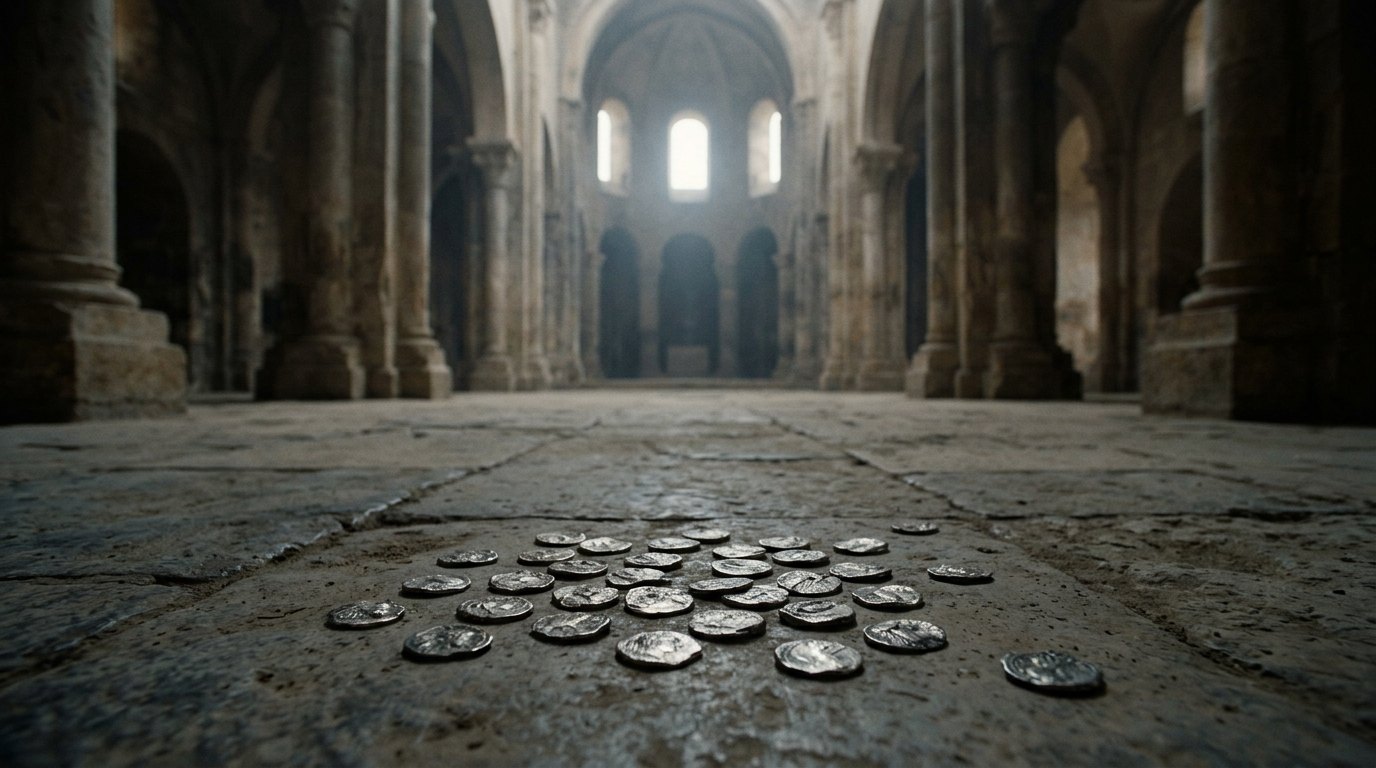
When Judas approached the chief priests, he asked, “What are you willing to give me if I deliver him to you?” They paid him thirty pieces of silver, and “from that time he sought opportunity to betray him” (Matthew 26:14-16). Money was an immediate motive, rooted in the covetousness already present in his life.
Satan entered him
The betrayal was also satanic. Luke 22:3 says, “Satan entered into Judas,” before Judas arranged Jesus’ arrest with the chief priests. At the supper, Jesus identified Judas by giving him the dipped bread; then, John 13:27 says, “After the piece of bread, then Satan entered into him.”
This was therefore not merely a financial transaction. An evil spiritual power was at work in Judas’s willing treachery. Satan’s involvement did not make Judas innocent: Judas sought the payment, consented to the arrangement, and looked for an opportunity to hand Jesus over.
God’s purpose did not excuse Judas
Jesus held God’s purpose and Judas’s responsibility together: “The Son of Man indeed goes as it has been determined, but woe to that man through whom he is betrayed!” (Luke 22:22). Likewise, Acts 2:23 says Jesus was delivered up by “the determined counsel and foreknowledge of God,” yet lawless men crucified and killed him.
Judas was not excused because his betrayal fulfilled God’s purpose. He remained accountable for his sin. Even so, his treachery did not defeat Jesus: Acts 2:24 declares that God raised him from the dead.
Judas is a solemn warning that someone can be close to Jesus outwardly, occupy a trusted position, and still cherish sin inwardly. The response Scripture calls for is confession and turning from sin: “If we confess our sins, he is faithful and righteous to forgive us the sins and to cleanse us from all unrighteousness” (1 John 1:9).
Answered from Scripture · reviewed November 11, 2026
Scripture reveals that Judas betrayed Jesus through a deadly convergence of personal greed, satanic possession, and a hardened heart that never truly believed. Far from an accidental tragedy or an innocent misunderstanding, this dark deed took place under the absolute sovereignty of God, fulfilling ancient prophecy to the letter.
The Greed of Judas
A Heart Captive to the Love of Money

He did not say this because he cared about the poor but because he was a thief; as keeper of the money bag, he used to help himself to what was put into it.
John 12:6 (NIV)
John exposes Judas's true character as an unrepentant thief who managed the disciples' funds while pretending compassion for the poor.
In John 12:6, the Holy Spirit strips away any lingering pretense regarding the motive of Judas Iscariot, laying bare a heart thoroughly enslaved to the love of money. When Mary of Bethany poured out her costly nard upon the feet of Jesus, Judas indignantly objected in John 12:4-6, feigning a tender regard for the poor. Yet the inspired text pulls back the veil: he cared nothing for the destitute, but was a habitual thief who regularly embezzled from the common money box entrusted to his keeping. This private covetousness soon metastasized into outright treason. In Matthew 26:14-15, Judas initiated the dreadful transaction himself, going directly to the chief priests to demand, "What will you give me if I deliver him over to you?" He struck a covenant with the religious rulers for thirty pieces of silver—the ancient price of a common slave. Both Mark 14:10-11 and Luke 22:5-6 emphasize that the priests rejoiced at his offer, while Judas actively sought an opportune moment to hand Jesus over in the absence of the crowds. The Apostle Paul later provided the solemn postscript to such spiritual ruin in 1 Timothy 6:10, warning that the love of money is a root of all kinds of evil, plunging men into destruction and causing them to wander away from the faith.
| Passage | What it says |
|---|---|
| John 12:4-6 | Judas objects to Mary anointing Jesus with costly ointment, masking his habitual theft from the money box under a feigned concern for the poor. |
| Matthew 26:14-15 | Judas approaches the chief priests asking what they will pay him to deliver Jesus, agreeing to thirty pieces of silver. |
| Mark 14:10-11 | The chief priests rejoice at Judas's offer to betray Jesus and promise him money, while he seeks an opportunity to deliver Him. |
| Luke 22:5-6 | Judas covenants with the religious rulers for money and promises to betray Jesus away from the multitude. |
| 1 Timothy 6:10 | Paul warns that the love of money is a root of all kinds of evil, leading some to wander from the faith. |
Satanic Influence
The Enemy Enters a Willing Vessel

Then Satan entered Judas, called Iscariot, one of the Twelve.
Luke 22:3 (NIV)
Luke explicitly identifies Satan's direct entry into Judas before he conspired with the religious leaders.
Luke 22:3 records the harrowing moment when human corruption intersected with supernatural malice: Satan entered into Judas called Iscariot, transforming a thieving disciple into a ready vessel for the powers of darkness. Judas did not fall in an instant; he had steadily yielded ground to the adversary through hidden sin. By the time the Passover arrived, John 13:2 notes that the devil had already placed the treacherous intention into Judas's heart. Then, in John 13:27, as Jesus offered him a morsel of bread at the Last Supper—a final gesture of intimate fellowship and unmistakable exposure—Satan entered him definitively. Jesus dismissed him with the chilling words, "What you are going to do, do quickly." John 13:30 starkly observes that immediately after receiving the morsel, Judas went out into the night, stepping into absolute moral and spiritual darkness. The terrifying descent of Judas illustrates the sober apostolic admonition of Ephesians 4:27 to give no place to the devil. Because Judas nurtured unrepentant sin within his heart, he opened the door wide to the enemy, becoming an instrument of the serpent's ancient enmity against the Seed of the woman.
| Passage | What it says |
|---|---|
| Luke 22:3-4 | Satan enters into Judas called Iscariot, who then goes and confers with the chief priests how to betray Jesus. |
| John 13:2 | During supper, the devil puts the thought into the heart of Judas Iscariot to betray Jesus. |
| John 13:27 | After receiving the dipped morsel, Satan enters Judas, and Jesus commands him to do quickly what he is doing. |
| John 13:30 | Having taken the piece of bread, Judas goes immediately out into the night to execute his betrayal. |
| Ephesians 4:27 | Warns believers not to give the devil an opportunity, reflecting how Judas's persistent sin opened the door to Satan. |
Unbelief and Apostasy
An Apostle Who Never Truly Believed

Then Jesus replied, “Have I not chosen you, the Twelve? Yet one of you is a devil!” (He meant Judas, the son of Simon Iscariot, who, though one of the Twelve, was later to betray him.)
John 6:70-71 (NIV)
Jesus reveals early in His ministry that Judas was not a genuine believer but possessed a devilish nature.
Jesus was never deceived by Judas's public posture; as John 6:70-71 declares, Judas walked in persistent unbelief and apostasy from the beginning. Long before the conspiracy unfolded, the Lord announced in John 6:64 that there were some among His followers who did not believe, knowing from the outset who would fail to trust Him and who would betray Him. To the astonishment of the Twelve, Jesus bluntly stated in John 6:70, "Did I not choose you, the twelve? And yet one of you is a devil," explicitly designating Judas. When washing the disciples' feet, Jesus affirmed in John 13:10-11 that the Eleven were clean, but pointedly excluded Judas, revealing that he had never received the spiritual cleansing of regeneration. In His high priestly prayer in John 17:12, the Savior named him the "son of perdition," acknowledging his settled state of spiritual ruination. Both Matthew 26:24-25 and Mark 14:18-21 record the Lord's dreadful pronouncement of woe over the one sharing His bread: it would have been far better for that man had he never been born. Luke 22:21-22 underscores that while the Son of Man went as it had been determined in the divine counsel, full personal guilt remained upon the traitor.
| Passage | What it says |
|---|---|
| John 6:64 | Jesus notes that some among His followers do not believe, knowing from the beginning who would betray Him. |
| John 6:70-71 | Jesus declares that one of the Twelve is a devil, speaking specifically of Judas Iscariot. |
| John 17:12 | In His high priestly prayer, Jesus calls Judas the son of perdition who was lost so Scripture might be fulfilled. |
| Matthew 26:24-25 | Jesus pronounces woe upon His betrayer, stating it would be better for him had he never been born. |
| John 13:10-11 | Jesus declares that the disciples are clean except for one, identifying Judas as unregenerate and spiritually uncleansed. |
| Mark 14:18-21 | Jesus pronounces woe upon the man by whom the Son of Man is betrayed, declaring it better had he never been born. |
| Luke 22:21-22 | Jesus identifies the betrayer at the table and notes the tragedy of sovereign decree coupled with personal accountability. |
Sovereignty and Prophecy
Fulfilling the Ancient Word of God
Even my close friend, someone I trusted, one who shared my bread, has turned against me.
Psalms 41:9 (NIV)
David foretells that a close, trusted companion sharing his table would turn treacherous and lift his heel against him.
The betrayal of Christ stands under the sovereign purpose of Almighty God, fulfilling what David foretold in Psalm 41:9: a close friend sharing table fellowship lifted his heel against the righteous King. Jesus directly cited Psalm 41:9 in John 13:18 and Mark 14:18 to demonstrate that the treachery of His companion was no surprise to Scripture. Likewise, Psalm 55:12-14 mourned the bitter sting of betrayal by an equal companion with whom the psalmist walked in sweet counsel, a type fulfilled when Judas greeted Jesus with a deceitful kiss in the Garden of Gethsemane, recorded in Matthew 26:47-50 and Luke 22:47-48. Zechariah 11:12-13 anticipated the exact price of the Good Shepherd, foretelling that thirty pieces of silver would be weighed out and cast into the potter's field in the house of the Lord—fulfilled with meticulous precision in Matthew 26:15 and Matthew 27:3-10 when Judas threw down the silver before the priests. Finally, Psalm 69:25 and Psalm 109:8 prophesied the utter desolation of the betrayer's habitation and the transfer of his office to another. As Peter declared in Acts 1:16-26, these ancient words found their exact, terrible fulfilment when the apostolic band gathered to replace the fallen son of perdition.
| Passage | What it says | Fulfilled |
|---|---|---|
| Psalms 41:9 | A familiar friend who shared bread lifts his heel in treacherous rebellion against the righteous sufferer. | John 13:18, Mark 14:18 |
| Psalms 55:12-14 | The psalmist laments betrayal by an equal companion with whom he took sweet counsel in the house of God. | Matthew 26:47-50, Luke 22:47-48 |
| Zechariah 11:12-13 | The shepherd's wages are weighed out at thirty pieces of silver and cast to the potter in the house of the Lord. | Matthew 26:15, Matthew 27:3-10 |
| Psalms 69:25 | David imprecates judgment upon enemies, praying that their habitation be desolate with none to dwell within. | Acts 1:16-20 |
| Psalms 109:8 | The psalm petitions that the wicked man's days be few and another take his office. | Acts 1:20-26 |
| John 13:18 | Jesus explicitly quotes Psalm 41:9 as finding its fulfilment in Judas eating His bread yet lifting up his heel. | |
| Acts 1:20 | Peter quotes Psalm 69:25 and Psalm 109:8 regarding Judas's desolate habitation and the reassignment of his apostolic office. |
The Tragic End
Remorse Without Repentance and Ruin

When Judas, who had betrayed him, saw that Jesus was condemned, he was seized with remorse and returned the thirty pieces of silver to the chief priests and the elders. “I have sinned,” he said, “for I have betrayed innocent blood.” “What is that to us?” they replied. “That’s your responsibility.” So Judas threw the money into the temple and left. Then he went away and hanged himself.
Matthew 27:3-5 (NIV)
Judas recognizes his sin of betraying innocent blood, but his worldly grief yields despair rather than saving repentance.
In Matthew 27:3-5, Judas discovers the agonizing emptiness of his bargain, learning too late that worldly remorse produces only death rather than saving life. Upon realizing that Jesus was condemned, Judas was seized with bitter regret and returned the thirty pieces of silver to the chief priests, crying out that he had betrayed innocent blood. Yet instead of seeking the mercy of the Savior he had wronged, he flung the silver onto the temple floor, departed in utter despair, and hanged himself. As Matthew 27:6-10 records, the priests took the tainted silver, calling it blood money, and purchased the potter's field as a cemetery for foreigners, unwittingly fulfilling the prophetic Scriptures spoken through Jeremiah and Zechariah. The terrible physical aftermath of his suicide is recorded in Acts 1:16-19, where Peter recounts to the early church that Judas fell headlong in the very field acquired by his iniquity, bursting open so that all in Jerusalem came to know the site as Akeldama, the Field of Blood. Acts 1:25 somberly observes that Judas turned aside from his apostolic office to go to 'his own place,' the eternal ruin merited by his betrayal.
This catastrophic culmination was set in motion in Gethsemane, where Judas weaponized his close intimacy with Christ to orchestrate His arrest. John 18:2-5 notes that Judas knew the olive grove well, having often gathered there with Jesus and the disciples; he used that sacred familiarity to guide a cohort of Roman soldiers and temple officers straight to the Master. In Matthew 26:47-50, Judas approaches the Lord in the darkness accompanied by an armed multitude, delivering Him over with a prearranged sign: a hypocritical greeting and an intimate embrace. Luke 22:47-48 highlights the piercing grief of Christ's response: 'Judas, would you betray the Son of Man with a kiss?' Judas experienced anguish over the temporal ruin his crime had wrought, but he lacked faith in the forgiving grace of God. His tragic downfall stands as the ultimate illustration of 2 Corinthians 7:10, demonstrating that while godly grief produces repentance that leads to salvation, the sorrow of the world works only death.
| Passage | What it says |
|---|---|
| Matthew 27:3-5 | Judas repents himself, casts down the thirty pieces of silver in the temple, and departs to hang himself. |
| Matthew 27:6-10 | The priests use the blood money to purchase the potter's field to bury strangers, fulfilling ancient prophecy. |
| Acts 1:16-19 | Peter recounts that Judas fell headlong in his acquired field, bursting open in the midst as a sign to Jerusalem. |
| Acts 1:25 | The disciples cast lots to replace Judas in the apostolic ministry from which he turned aside to go to his own place. |
| Matthew 26:47-50 | Judas leads the armed crowd into Gethsemane and betrays the Son of Man with an intimate kiss of feigned devotion. |
| Luke 22:47-48 | Jesus confronts Judas directly in Gethsemane over betraying the Son of Man with the intimate gesture of a kiss. |
| John 18:2-5 | Judas uses his intimate knowledge of Jesus's prayer retreat in Gethsemane to guide the cohort to arrest Him. |
| 2 Corinthians 7:10 | Contrasts godly sorrow leading to salvation with worldly grief that leads to death, capturing Judas's despairing remorse. |
Where in the Bible
| Book | Passages |
|---|---|
| Psalms | 4 · Psalms 41:9, Psalms 55:12-14, Psalms 69:25, Psalms 109:8 |
| Zechariah | 1 · Zechariah 11:12-13 |
| Matthew | 5 · Matthew 26:14-15, Matthew 26:24-25, Matthew 27:3-5, Matthew 27:6-10, Matthew 26:47-50 |
| Mark | 2 · Mark 14:10-11, Mark 14:18-21 |
| Luke | 4 · Luke 22:5-6, Luke 22:3-4, Luke 22:21-22, Luke 22:47-48 |
| John | 10 · John 12:4-6, John 13:2, John 13:27, John 13:30, John 6:64, John 6:70-71, John 17:12, John 13:10-11, John 13:18, John 18:2-5 |
| Acts | 3 · Acts 1:20, Acts 1:16-19, Acts 1:25 |
| 2 Corinthians | 1 · 2 Corinthians 7:10 |
| Ephesians | 1 · Ephesians 4:27 |
| 1 Timothy | 1 · 1 Timothy 6:10 |
The story in order
- God's Word foretells betrayal (c. 1000 BC) · Psalms 41:9 · Foreshadows a close companion's treachery against the righteous.
- Prophecy of betrayal for silver (c. 700 BC) · Zechariah 11:12-13 · Predicts a shepherd's wages of thirty pieces of silver.
- Jesus knows His betrayer (AD 30) · John 6:64 · Jesus knew from the beginning who would betray Him.
- Judas agrees to betray Jesus (AD 30) · Matthew 26:14-15 · Judas covenants with priests for thirty pieces of silver.
- Satan enters Judas (AD 30) · Luke 22:3-4 · Satan influences Judas to betray Jesus.
- The Last Supper (AD 30) · John 13:2 · The devil puts the thought to betray Jesus into Judas's heart.
- Jesus identifies the betrayer (AD 30) · Luke 22:21-22 · Jesus speaks of the betrayer and sovereign decree.
- Judas betrays Jesus with a kiss (AD 30) · Matthew 26:47-50 · Judas leads the crowd and betrays Jesus.
- Judas's remorse and death (AD 30) · Matthew 27:3-5 · Judas repents, returns silver, and hangs himself.
- The potter's field purchased (AD 30) · Matthew 27:6-10 · Priests buy the field with blood money, fulfilling prophecy.
- Judas's end described (c. AD 33) · Acts 1:16-19 · Judas fell and burst open; his field was bought.
- Judas's office reassigned (c. AD 33) · Acts 1:25 · The disciples choose another to replace Judas.
Judas's Betrayal: A Shadow of Treachery
| Old Testament Shadow | New Testament Fulfilment | Passage |
|---|---|---|
| A close companion betrays the righteous sufferer. | Judas, one of the Twelve, betrays Jesus. | Psalms 41:9 |
| Betrayal by a friend with whom counsel was shared. | Judas, who walked with Jesus, betrays Him. | Psalms 55:12-14 |
| Betrayal for thirty pieces of silver. | Judas agrees to betray Jesus for this amount. | Zechariah 11:12-13 |
| The betrayer's office is taken by another. | Matthias is chosen to replace Judas. | Psalms 109:8 |
Greed's Destructive Path
| The Warning | Judas's Actions | Consequence | Passage |
|---|---|---|---|
| The love of money is a root of all kinds of evil. | Judas objects to Mary's costly anointing of Jesus. | He habitually stole from the money box. | 1 Timothy 6:10 |
| The love of money leads some to wander from the faith. | Judas asks the chief priests what they will pay him. | He agrees to deliver Jesus for thirty pieces of silver. | Matthew 26:14-15 |
| The love of money can lead to betrayal. | Judas covenants with the rulers for money. | He seeks an opportunity to betray Jesus. | Luke 22:5-6 |
| Greed can mask itself as concern for the poor. | Judas feigns concern for the poor regarding the ointment. | His true motive is personal gain. | John 12:4-6 |
Sorrow: Godly vs. Worldly
| Godly Sorrow | Worldly Grief (Judas) | Passage |
|---|---|---|
| Leads to repentance and salvation. | Leads to remorse and death. | 2 Corinthians 7:10 |
| Focuses on sin against God. | Focuses on the consequences of sin. | Matthew 27:3-5 |
| Results in lasting change. | Results in despair and suicide. | Matthew 27:3-5 |
Key words
- Betrayal
- To deliver someone into the hands of an enemy; treachery. · Matthew 26:14-15
- Love of Money (philargyria, φιλαργυρία)
- A strong desire for wealth, which can lead to evil. · 1 Timothy 6:10
- Satan (Satanas, Σατανᾶς)
- The chief evil spirit, the adversary of God and man. · Luke 22:3
- Unbelief (apistia, ἀπιστία)
- Lack of faith or trust in God and His promises. · John 6:64
- Son of Perdition (huios tēs apōleias, υἱὸς τῆς ἀπωλείας)
- One destined for destruction or ruin, often referring to a betrayer. · John 17:12
- Repentance (metanoia, μετάνοια)
- A change of mind and heart leading to a change of action. · Matthew 27:3
- Sovereignty
- God's supreme and absolute authority and control over all things. · Luke 22:22
Judas stands as a sobering warning that one can walk alongside Christ, hear His preaching, and witness His wonders, yet remain entirely unchanged in heart. In the very act that exposed the depth of human treachery, God accomplished His eternal plan of redemption through the cross.
32 passages, each cited once.
Scripture cited
- John 12:1-8
- Matthew 26:14-16
- Luke 22:1-6
- John 6:63-71
- Luke 22:21-23
- Acts 2:22-24
- 1 John 1:9