Did the disciples steal the body of Jesus?
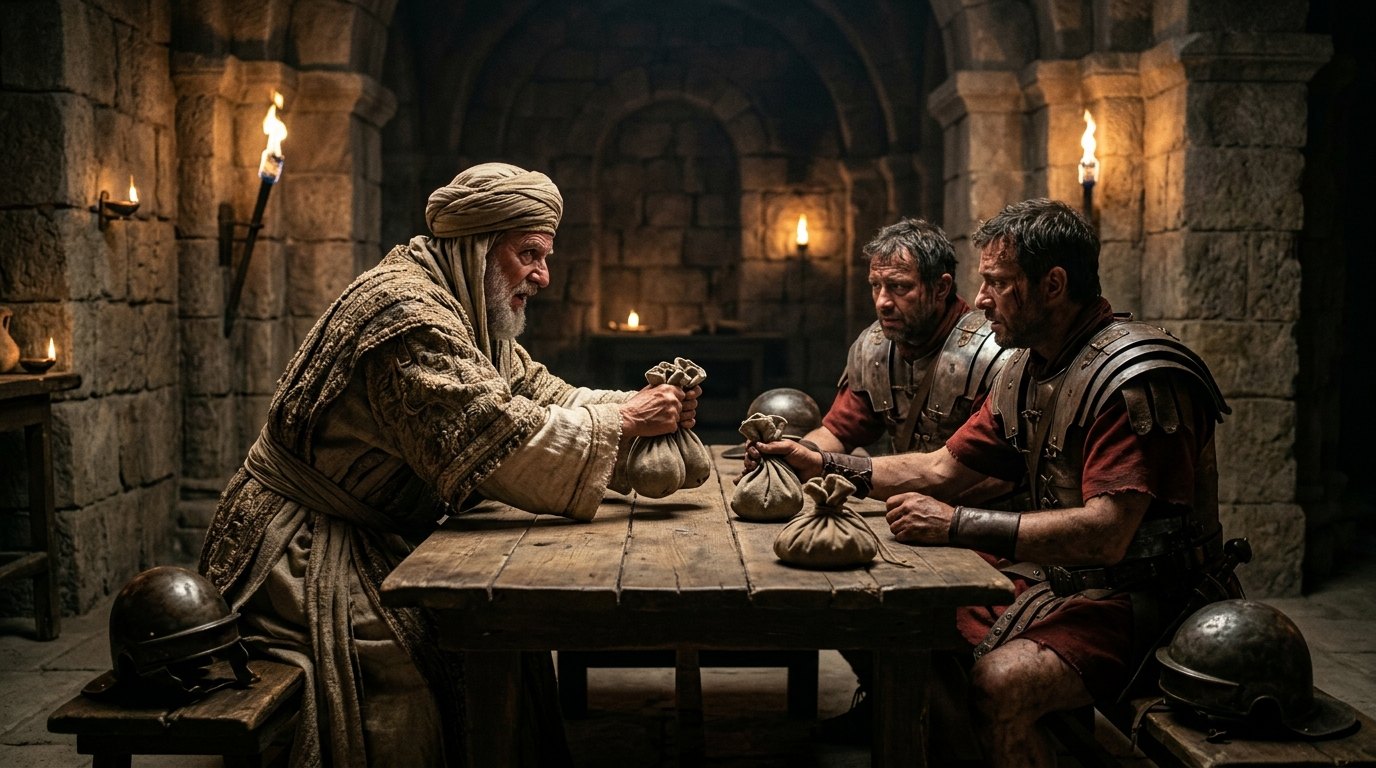
Matthew 28:11-15
11 While the women were on their way, some of the guards went into the city and reported to the chief priests everything that had happened.
12 When the chief priests had met with the elders and devised a plan, they gave the soldiers a large sum of money,
13 telling them, “You are to say, ‘His disciples came during the night and stole him away while we were asleep.’
14 If this report gets to the governor, we will satisfy him and keep you out of trouble.”
15 So the soldiers took the money and did as they were instructed. And this story has been widely circulated among the Jews to this very day.
New International Version (NIV)
The answer
No. The disciples did not steal Jesus’ body; Jesus rose bodily from the dead. Scripture identifies the theft story as a false account that the chief priests and elders paid the guards to spread.
- The tomb was guarded against this very accusation. Before the resurrection, the chief priests and Pharisees asked Pilate to secure the tomb because they feared someone might claim Jesus had risen. Pilate provided a guard, and they sealed the stone (Matthew 27:62-66).
- The empty tomb was accompanied by Jesus’ resurrection and appearance. The angel told the women, “He is not here, for he has risen, just like he said.” Jesus then met the women, and “they came and took hold of his feet, and worshiped him” (Matthew 28:1-10). This was a bodily resurrection, not merely an empty tomb or a spiritual vision.
- The theft account was manufactured through bribery. Matthew 28:11-15 says the guards reported what had happened to the chief priests. After consulting the elders, the priests gave the soldiers “a large amount of silver” and instructed them: “Say that his disciples came by night and stole him away while we slept.” Their story also undermines itself: if they were asleep, they could not have known who removed the body.
Matthew 28:15 explains that this purchased story became widespread: “This saying was spread abroad among the Jews, and continues until today.” Its circulation explains the accusation’s origin; it does not establish its truth. The guards had been stationed to prevent theft, yet the authorities responded to their report not by producing Jesus’ body, but by paying them to change their account.
Answered from Scripture · reviewed November 12, 2026
The claim that the disciples stole Jesus' body is a fabricated cover-up recorded and refuted directly within Scripture. God's Word shows that the tomb was heavily secured to prevent theft, that the guards were bribed by religious authorities to tell a self-defeating lie, and that the risen Christ appeared physically to hundreds of eyewitnesses.
The Secure Tomb
The Authorities Guarded Against Any Possible Deception
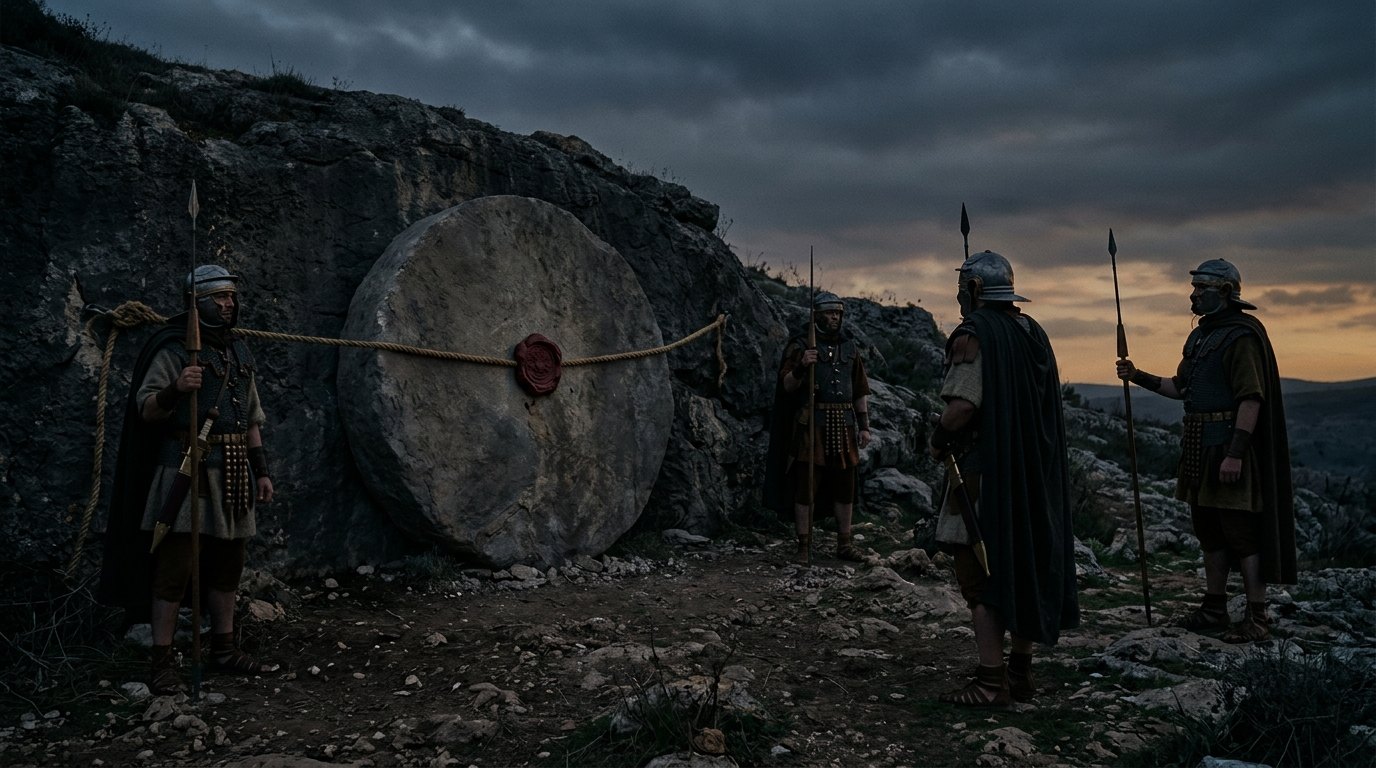
So they went and made the tomb secure by putting a seal on the stone and posting the guard.
Matthew 27:66 (NIV)
It shows that the Roman seal and imperial guard directly guaranteed the tomb could not be quietly tampered with.
In Matthew 27:66, the Scripture records that the Jewish leaders went, and made the sepulchre sure, sealing the stone, and setting a watch, providing absolute imperial security against any human intervention. The historical record demonstrates that the religious rulers remembered Christ's prophecies far better than His scattered followers did. Following His crucifixion, Joseph of Arimathea wrapped the Lord's body in clean linen and placed Him inside a brand new rock-hewn sepulchre, rolling a massive boulder against the doorway, as detailed in Matthew 27:59-60. The chief priests and Pharisees immediately approached the Roman governor the next day to alert him to Jesus' promise of rising after three days (Matthew 27:62-64). They explicitly warned Pilate that the disciples might come by night to steal the corpse and deceive the populace with a claim of resurrection. To forestall any possibility of theft, Pilate authorized an armed detachment, instructing them to make the tomb as secure as they knew how (Matthew 27:65-66). The official Roman seal was attached directly across the rock face, carrying the full judicial weight and fatal penalty of the empire for anyone daring to tamper with it. A unit of disciplined Roman soldiers stood vigil before the entrance, making an unnoticed approach by terrified disciples physically impossible.
| Passage | What it says |
|---|---|
| Matthew 27:62-64 | The chief priests and Pharisees remind Pilate of Jesus' predicted resurrection and ask for a guard to prevent body theft. |
| Matthew 27:65-66 | Pilate grants a Roman guard, and the religious leaders seal the great stone over the sepulchre. |
| Matthew 27:59-60 | Joseph of Arimathea wraps Jesus in clean linen and lays Him in a new tomb, rolling a great stone across the door. |
The Fabricated Lie
The Rumour Was Invented with Bribed Guards
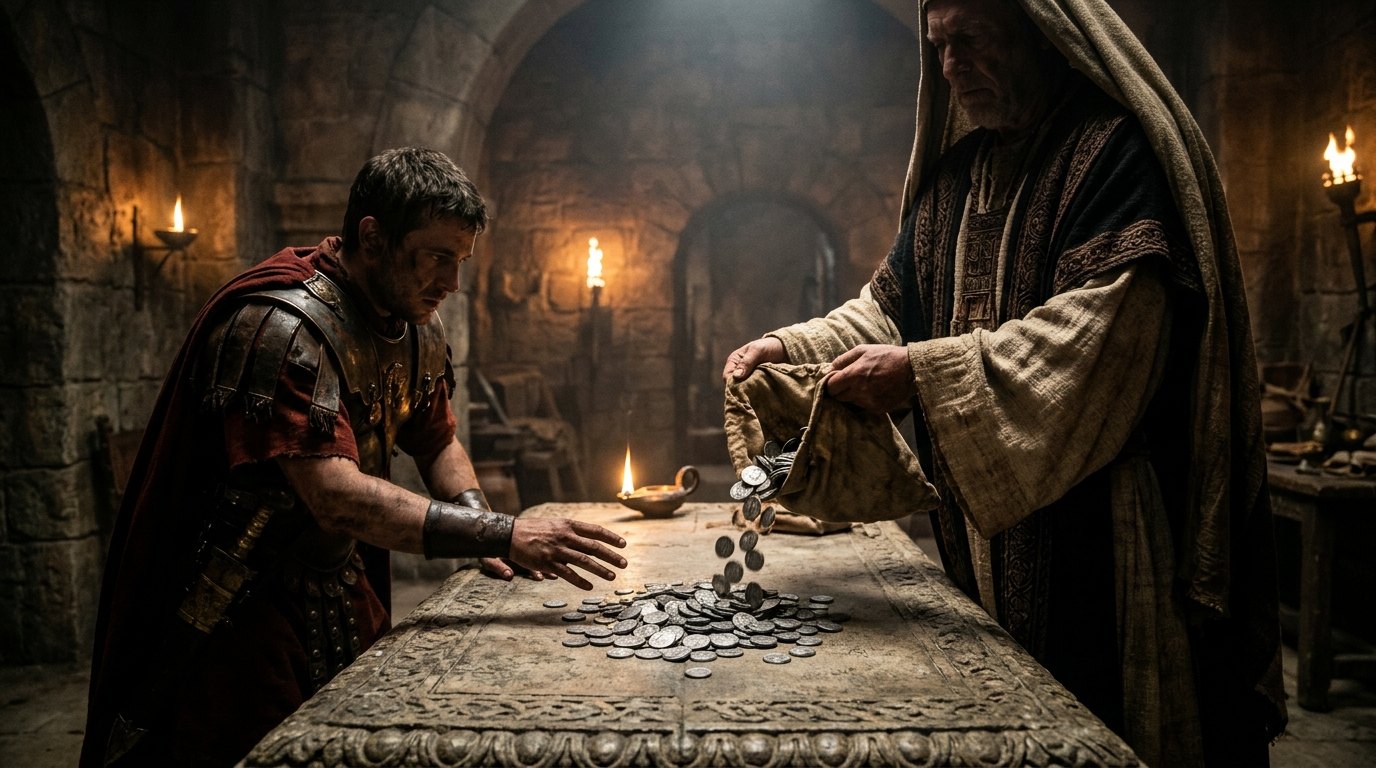
telling them, “You are to say, ‘His disciples came during the night and stole him away while we were asleep.’
Matthew 28:13 (NIV)
The authorities commanded the soldiers to claim a theft occurred while they were asleep, exposing the tale's contradictory nature.
The entire theft hypothesis originates from a deliberate fabrication recorded in Matthew 28:13, where the religious council bribed the guards to say, "His disciples came by night, and stole him away while we slept." This explanation collapses under its own internal contradiction, for if a soldier is genuinely asleep, he cannot legally or factually testify to who removed a body. The genuine event had terrified the soldiers beyond measure; Matthew 28:2-4 recounts that an angel of the Lord descended amid a great earthquake, rolled back the enormous stone, and sat upon it, striking the Roman guards with such trembling dread that they became like dead men. Once they recovered, some of the watch fled into the city to report everything that had occurred directly to the chief priests, as recorded in Matthew 28:11-12. Instead of repenting before the obvious display of divine power, the council assembled elders, gathered a large sum of silver money, and paid off the guards to circulate the story of theft. Matthew 28:13-14 reveals that the priests guaranteed political immunity to the soldiers should the news reach the governor's ears. The soldiers took the bribe and obeyed, propagating a lie that persisted widely (Matthew 28:15).
| Passage | What it says |
|---|---|
| Matthew 28:2-4 | An angel rolls back the stone in an earthquake, causing the armed guards to tremble and become like dead men. |
| Matthew 28:11-12 | The shaken guards report the real events to the chief priests, who pay them a large sum of silver. |
| Matthew 28:13-14 | The soldiers are told to claim the disciples stole the body while they slept, with protection promised against Pilate. |
| Matthew 28:15 | The soldiers take the bribe, spreading a false account that circulated widely among the Jews. |
The Physical Reality
Orderly Linens and Physical Touch Refute Theft
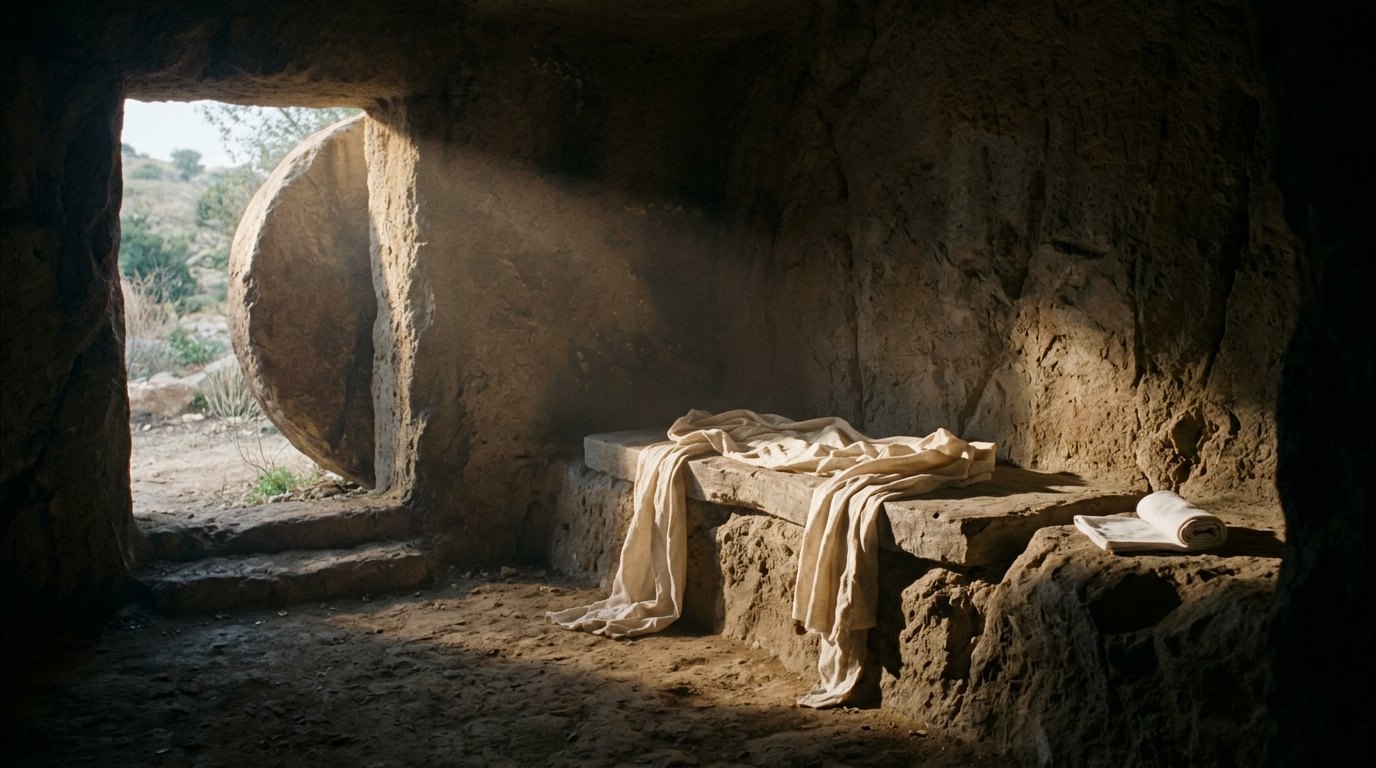
as well as the cloth that had been wrapped around Jesus’ head. The cloth was still lying in its place, separate from the linen.
John 20:7 (NIV)
The carefully folded face napkin demonstrates an unhurried, miraculous departure rather than a hasty grave robbery.
The physical condition of the empty tomb thoroughly refutes the chaotic scramble of grave robbery, centered on John 20:7, where the cloth that wrapped Christ's head was not lying with the linen clothes, but wrapped together in a place by itself. Grave robbers seizing a corpse under imminent threat of discovery do not meticulously unwrap seventy-five pounds of spices and linen, fold the face cloth, and set it apart neatly. Early on the first day of the week, the women arrived to find the heavy stone rolled away and the body entirely gone (Luke 24:1-3). Peter and John entered the burial chamber and observed the burial wrappings lying completely intact, undisturbed as an empty chrysalis (John 20:5-7). The sight caused John to believe immediately in the miraculous departure of his Lord (John 20:8-9). Furthermore, Christ did not present Himself as a disembodied apparition or an empty grave alone. He met the women on the road, where they grabbed His physical feet and worshipped Him (Matthew 28:9-10). When the disciples doubted, Jesus invited them to touch His flesh and bones, eating a piece of broiled fish in front of them to demonstrate tangible bodily life (Luke 24:38-43). Thomas was later called to place his fingers directly into the spear wound and nail prints (John 20:26-28), proving Christ was alive in bodily perfection.
| Passage | What it says |
|---|---|
| Luke 24:1-3 | The women find the stone rolled away and do not find the body of the Lord Jesus inside. |
| John 20:5-7 | Peter and John see the linen wrappings lying intact and the face cloth rolled up neatly by itself. |
| Matthew 28:9-10 | Jesus physically meets the women on the road, and they take hold of His feet and worship Him. |
| Luke 24:38-43 | Jesus invites the disciples to handle His flesh and bones and eats broiled fish in their presence. |
| John 20:8-9 | The beloved disciple sees the undisturbed linen cloths and believes, having previously not understood Scripture that Christ must rise. |
| John 20:26-28 | Jesus presents His wounds to Thomas, proving bodily resurrection rather than stolen remains or hallucination. |
Eyewitness Boldness
Frightened Disciples Died for What They Personally Saw
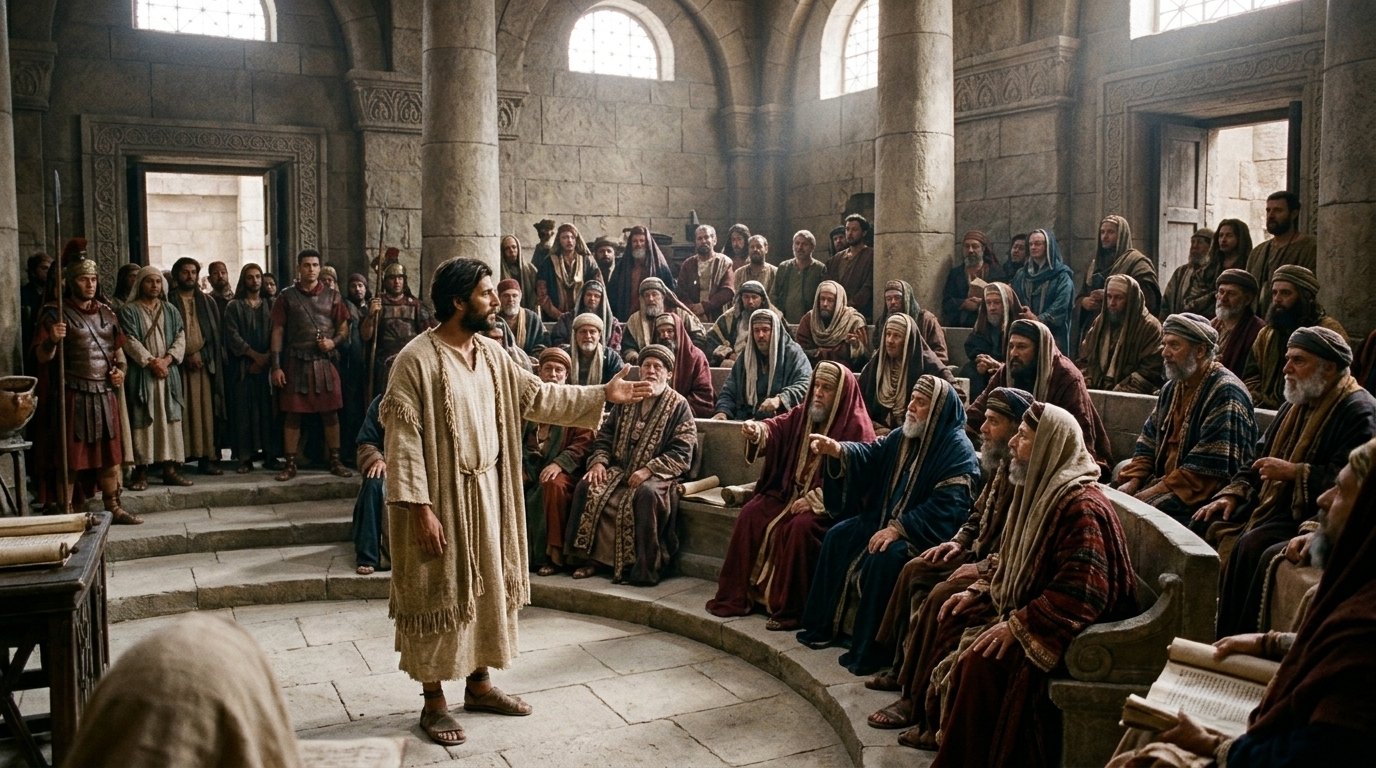
As for us, we cannot help speaking about what we have seen and heard.”
Acts 4:20 (NIV)
The apostles openly proclaimed before hostile rulers that they could not stop speaking of what they personally witnessed.
The rapid transformation of the apostles from terrified fugitives into unshakeable heralds provides definitive proof that they stole nothing, captured in Acts 4:20: "For we cannot but speak the things which we have seen and heard." Men do not knowingly conspire to fabricate a lie only to die agonizing deaths in defense of a corpse they buried in secret. When Jesus was arrested in Gethsemane, every single disciple abandoned Him and fled into the dark to save their lives (Mark 14:50). Following His death, they cowered behind locked doors in sheer terror of the ruling authorities (John 20:19). Yet within weeks, Peter stood openly in the heart of Jerusalem before the very men who orchestrated the crucifixion, proclaiming that God loosed the pangs of death and raised Jesus up (Acts 2:23-24). Dragged before the high council and commanded under severe threat never to speak the name of Jesus, Peter and John flatly refused to obey human authority over God (Acts 4:18-20; Acts 5:29-32). Paul catalogs that the risen Christ appeared not in secret, but to Peter, the twelve, and more than five hundred brethren simultaneously, most of whom were still alive to be questioned (1 Corinthians 15:3-8). As Peter affirmed, they did not follow cleverly concocted fables, but were genuine eyewitnesses of His majesty (2 Peter 1:16).
| Passage | What it says |
|---|---|
| Mark 14:50 | At Jesus' arrest, all the disciples abandoned Him and fled in fear. |
| John 20:19 | The disciples hid behind locked doors out of direct terror of the Jewish leaders. |
| Acts 2:23-24 | Peter publicly proclaims in Jerusalem that God raised Jesus, overcoming the agony of death. |
| Acts 4:18-20 | Threatened by the Sanhedrin, Peter and John refuse to be silenced regarding the risen Christ. |
| 1 Corinthians 15:3-8 | Paul catalogs Jesus' bodily appearances to Peter, the twelve, more than five hundred brethren, and himself. |
| Acts 5:29-32 | Peter and the apostles testify boldly before the high priest that God raised Jesus, defying threats of death. |
| 2 Peter 1:16 | Peter affirms the apostles did not follow cleverly devised myths but were eyewitnesses of His majesty. |
Where in the Bible
| Book | Passages |
|---|---|
| Matthew | 8 · Matthew 27:62-64, Matthew 27:65-66, Matthew 27:59-60, Matthew 28:2-4, Matthew 28:11-12, Matthew 28:13-14, Matthew 28:15, Matthew 28:9-10 |
| Mark | 1 · Mark 14:50 |
| Luke | 2 · Luke 24:1-3, Luke 24:38-43 |
| John | 4 · John 20:5-7, John 20:8-9, John 20:26-28, John 20:19 |
| Acts | 3 · Acts 2:23-24, Acts 4:18-20, Acts 5:29-32 |
| 1 Corinthians | 1 · 1 Corinthians 15:3-8 |
| 2 Peter | 1 · 2 Peter 1:16 |
The story in order
- Jesus is buried in a new tomb (c. AD 30) · Matthew 27:59-60 · Joseph of Arimathea places Jesus' body in a tomb and seals it with a stone.
- Tomb is secured by guards (c. AD 30) · Matthew 27:62-66 · Religious leaders request and receive a Roman guard to prevent body theft.
- Angel rolls stone, guards flee (c. AD 30) · Matthew 28:2-4 · An earthquake and angelic intervention cause the guards to tremble and flee.
- Guards report to priests (c. AD 30) · Matthew 28:11-12 · The guards inform the chief priests of the events at the tomb.
- Priests bribe guards to lie (c. AD 30) · Matthew 28:13-15 · The guards are paid to spread the false story of the disciples stealing the body.
- Women find tomb empty (c. AD 30) · Luke 24:1-3 · The women discover the stone rolled away and Jesus' body missing.
- Disciples see undisturbed linens (c. AD 30) · John 20:5-7 · Peter and John observe the orderly arrangement of the grave clothes.
- Jesus appears to women (c. AD 30) · Matthew 28:9-10 · The women physically encounter the risen Jesus.
- Jesus shows His physical body (c. AD 30) · Luke 24:38-43 · Jesus allows disciples to touch Him and eats fish to prove His bodily resurrection.
- Thomas touches Jesus' wounds (c. AD 30) · John 20:26-28 · Jesus presents His wounds to Thomas, confirming His physical resurrection.
- Disciples preach resurrection boldly (AD 30) · Acts 2:23-24 · Peter proclaims Jesus' resurrection in Jerusalem, despite the danger.
- Paul lists eyewitnesses (c. AD 55) · 1 Corinthians 15:3-8 · Paul recounts numerous physical appearances of the risen Christ to hundreds.
Key words
- stole
- To take another's property without permission or legal right and without intending to return it. · Matthew 28:13
- lie
- An intentionally false statement. · Matthew 28:15
- bribed
- To give or offer money or something of value to influence the actions of someone in a position of trust. · Matthew 28:12
- eyewitness
- A person who personally saw an event happen. · 2 Peter 1:16
- resurrection
- The act of rising from the dead. · Matthew 27:63
The stolen body theory collapses under the weight of Scripture's historical witness, internal consistency, and the transformed lives of the apostles. Christ did not remain in the tomb through human deceit, but rose triumphantly over death, offering forgiveness, bodily hope, and eternal life to all who believe.
20 passages, each cited once.
Scripture cited
- Matthew 28:11-15
- Matthew 27:65-66
- Matthew 28:4
- Matthew 28:1-10
- Matthew 27:62-66