How do we know the resurrection really happened?
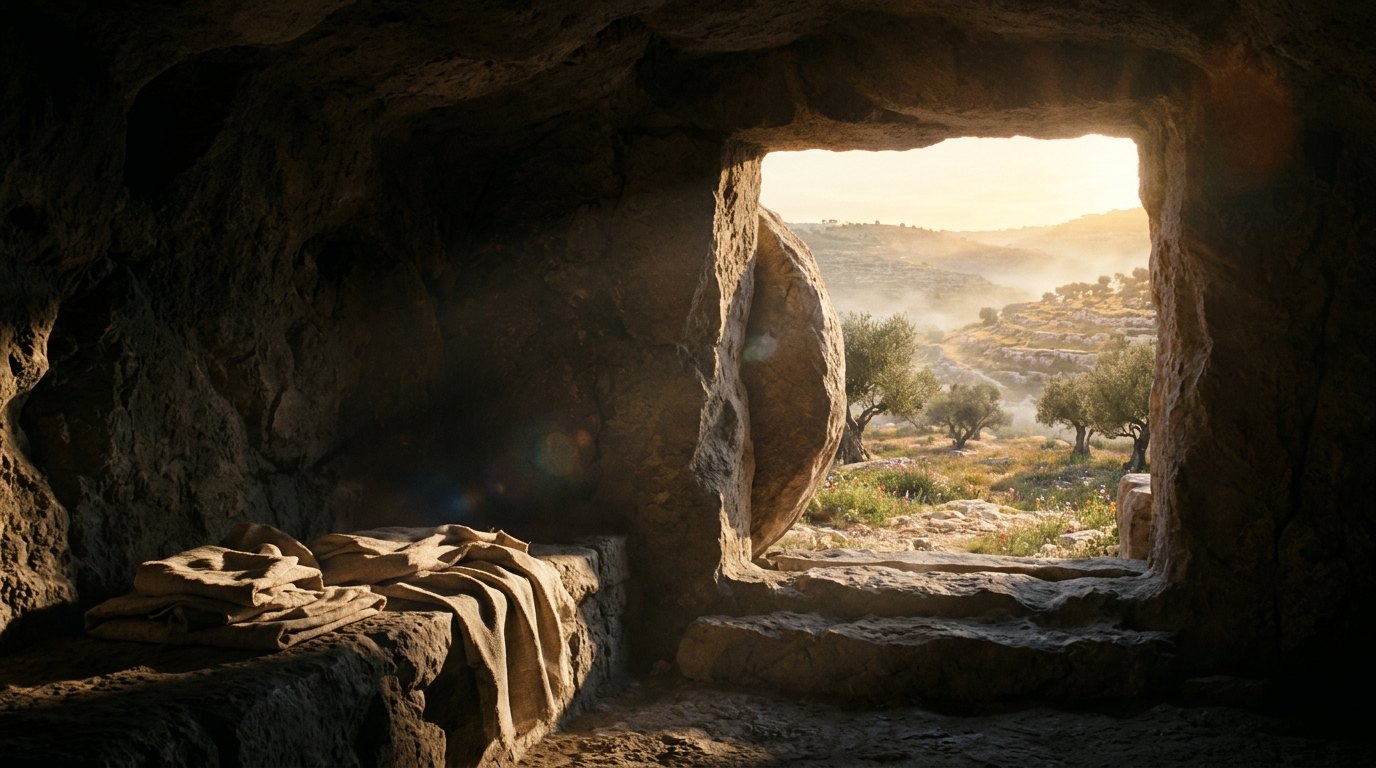
1 Corinthians 15:3-8
3 For what I received I passed on to you as of first importance: that Christ died for our sins according to the Scriptures,
4 that he was buried, that he was raised on the third day according to the Scriptures,
5 and that he appeared to Cephas, and then to the Twelve.
6 After that, he appeared to more than five hundred of the brothers and sisters at the same time, most of whom are still living, though some have fallen asleep.
7 Then he appeared to James, then to all the apostles,
8 and last of all he appeared to me also, as to one abnormally born.
New International Version (NIV)
The answer
Jesus really rose from the dead, bodily and in real history. God has given converging historical testimony: an empty tomb, physical appearances of the risen Jesus, numerous witnesses on different occasions, and apostles who maintained their eyewitness testimony under pressure. John explains why this evidence was written: “these are written that you may believe that Jesus is the Christ, the Son of God” (John 20:31).
Historical events cannot be repeated like laboratory experiments; they are known through reliable testimony. Scripture is God’s true testimony, and its concrete details allow the resurrection claim to be examined rather than reduced to a vague religious feeling.
The tomb was empty
The women who came to Jesus’ tomb found the stone rolled away and His body absent. They heard the announcement, “He isn’t here, but is risen.” Peter subsequently found the linen strips lying by themselves. The apostles were not portrayed as gullible: the women’s report initially seemed like “nonsense” to them (Luke 24:1-12).
Matthew also records that the guards were bribed to say that the disciples had stolen Jesus’ body. That competing explanation already had to account for a missing body; it did not claim that Jesus remained in the tomb (Matthew 28:11-15).
The appearances were bodily
The risen Jesus was not merely a spirit or an inward experience. He showed His hands and feet, invited the disciples to touch Him, and said that a spirit did not have flesh and bones as He had. He then ate in front of them (Luke 24:36-43). Thomas refused to believe the other disciples’ report without seeing Jesus’ wounds; Jesus subsequently appeared and invited him to examine those wounds (John 20:24-29).
After His suffering, Jesus showed Himself alive “by many proofs,” appearing to His apostles over forty days and speaking about God’s kingdom (Acts 1:3).
There were many witnesses
Paul records that Jesus appeared to Cephas, the twelve, more than five hundred brothers at once, James, all the apostles, and finally Paul himself. Most of the five hundred were still alive when Paul wrote. This was testimony from individuals and groups on multiple occasions, not one person’s private experience (1 Corinthians 15:5-8).
Paul’s inclusion is especially significant: he had persecuted the church before the risen Jesus confronted him on the road to Damascus (1 Corinthians 15:9; Acts 9:1-9).
The witnesses testified publicly under pressure
Peter proclaimed in Jerusalem, where Jesus had been crucified, “This Jesus God raised up, to which we all are witnesses” (Acts 2:22-32). When the authorities later commanded Peter and John to stop speaking about Jesus, they answered, “we can’t help telling the things which we saw and heard” (Acts 4:18-20).
Courage alone would not establish an event, but their persistence shows that they maintained their claim to be eyewitnesses under pressure. They were not merely repeating an inspiring idea; they insisted that they had seen and heard the risen Lord.
The resurrection fulfilled God’s purpose and demands a response
The resurrection cannot be separated from the cross: Christ died for sins, was buried, and was raised on the third day “according to the Scriptures.” Jesus Himself explained that His suffering and resurrection fulfilled what was written in Moses, the prophets, and the psalms (1 Corinthians 15:3-4; Luke 24:44-47).
Paul states the stakes plainly: without Christ’s resurrection, faith is vain and sinners remain in their sins; “But now Christ has been raised from the dead” (1 Corinthians 15:17-20). God has given assurance of coming judgment by raising Jesus, commands everyone everywhere to repent, and provides salvation in no one else (Acts 17:30-31; Acts 4:12).
Answered from Scripture · reviewed November 11, 2026
Scripture grounds our confidence in the bodily resurrection of Jesus Christ on the public testimony of named eyewitnesses, a physical body that could be touched and fed, and the exact fulfilment of ancient prophecy. Far from a late-developing legend, the resurrection was proclaimed from the very earliest weeks of the church by men and women who staked their lives and deaths upon what they saw.
The Early Creed
Eyewitnesses named and checkable while still alive
After that, he appeared to more than five hundred of the brothers and sisters at the same time, most of whom are still living, though some have fallen asleep.
1 Corinthians 15:6 (NIV)
Paul appeals directly to over five hundred eyewitnesses, noting most were still alive to be questioned by any skeptic.
In 1 Corinthians 15:6, the apostle Paul presents an open public challenge, declaring that the risen Christ appeared to more than five hundred brothers at one time, the greater part of whom remain unto the present day. This was an immediate invitation to check the facts: hundreds of living men and women were readily available for cross-examination throughout the Mediterranean world when these words were penned. Paul does not invent a myth decades later; rather, in 1 Corinthians 15:3 and 1 Corinthians 15:4, he delivers an ancient creed received within only a few years of the crucifixion, confessing that Christ died for our sins according to the Scriptures, that He was buried, and that He rose again on the third day. The historical sequence continues with specific, named encounters. According to 1 Corinthians 15:5, Christ appeared first to Cephas—Simon Peter—and subsequently to the gathered Twelve. After visiting the five hundred, He appeared personally to James, the Lord's skeptical earthly brother, and then to all the apostles together (1 Corinthians 15:7). Finally, as 1 Corinthians 15:8 records, the exalted Lord appeared to Paul himself, instantly overturning the life of a sworn enemy and persecutor of the church. In Galatians 1:18-19, Paul confirms that just three years after his Damascus road encounter, he stayed fifteen days with Peter in Jerusalem and conferred with James, verifying the unified, earliest apostolic testimony.
| Passage | What it says |
|---|---|
| 1 Corinthians 15:3 | Paul delivers the early creed received by the church, testifying that Christ died for our sins according to the Scriptures. |
| 1 Corinthians 15:4 | The foundational creed records that Christ was buried and that He was raised on the third day according to the Scriptures. |
| 1 Corinthians 15:5 | The risen Christ appeared specifically to Cephas (Peter) and subsequently to the Twelve disciples. |
| 1 Corinthians 15:6 | He appeared to more than five hundred brethren simultaneously, the majority of whom were still living when Paul wrote. |
| 1 Corinthians 15:7 | He appeared to James, the Lord's brother, and afterward to all the apostles together. |
| 1 Corinthians 15:8 | Last of all, Christ appeared personally to Paul, transforming a persecutor into an apostle. |
| Galatians 1:18-19 | Paul visits Jerusalem three years after conversion to meet Peter and James, anchoring early apostolic testimony. |
Physical Reality
A real and touchable body of flesh

Look at my hands and my feet. It is I myself! Touch me and see; a ghost does not have flesh and bones, as you see I have.”
Luke 24:39 (NIV)
Jesus explicitly commands His terrified disciples to touch His flesh and bones, proving He is not an immaterial ghost or vision.
The resurrection was never a disembodied ghost story or an ecstatic group hallucination, as Luke 24:39 decisively proves when Jesus says, handle Me and see, for a spirit has not flesh and bones as you see Me have. Terrified disciples sitting behind locked doors thought they were viewing a phantom when the Lord suddenly stood among them offering peace (Luke 24:36-38). To eradicate all doubt, the Lord displayed His wounded hands and feet, and in Luke 24:40-43, He took a piece of broiled fish and honeycomb and ate it directly before their eyes. When Thomas struggled to believe reports from the other disciples, Jesus invited him in John 20:26-28 to reach out his finger, place his hand into the pierced spear wound in His side, and behold the nail prints, eliciting the pure confession: 'My Lord and my God!' The apostle John similarly affirms in 1 John 1:1 that what they proclaimed was that which their ears had heard, their eyes had beheld, and their own hands had physically handled concerning the Word of life. Earlier, in Matthew 28:9, the women met the risen Lord on the road, fell before Him, and held Him firmly by the feet in true adoration. John 21:12-14 depicts Jesus preparing hot coals and roasted fish by the Sea of Galilee, eating breakfast alongside His disciples. Peter later summarizes this physical certainty in Acts 10:40-41, reminding Cornelius that God chose eyewitnesses who ate and drank with Jesus after He rose from the dead.
| Passage | What it says |
|---|---|
| Luke 24:36-38 | Jesus stands among His disciples offering peace, addressing their inward fear and troubled thoughts. |
| Luke 24:39 | Jesus presents His hands and feet, declaring a spirit lacks the flesh and bones they see Him possess. |
| Luke 24:40-43 | Jesus displays His wounded hands and feet, then eats a piece of broiled fish and honeycomb before them. |
| John 20:26-28 | Jesus invites Thomas to probe the nail marks and His pierced side, moving him to confess Christ as Lord and God. |
| 1 John 1:1 | John insists the apostles heard, saw with their eyes, looked upon, and touched the Word of life with their own hands. |
| Matthew 28:9 | The women hold Jesus by his feet and worship him, demonstrating a physical, tangible post-resurrection body. |
| John 21:12-14 | Jesus prepares breakfast and eats fish with the disciples by the Sea of Galilee. |
| Acts 10:40-41 | Peter affirms that chosen witnesses ate and drank with Jesus after he rose from the dead. |
Prophetic Fulfilment
Raised on the third day according to Scripture

because you will not abandon me to the realm of the dead, nor will you let your faithful one see decay.
Psalms 16:10 (NIV)
David foretold that the Holy One of God would not be left in Sheol or suffer physical decay, a prophecy realized only in Jesus.
Centuries before the Roman cross, God outlined the resurrection through the prophets, anchored centrally in Psalm 16:10: nor will You allow Your Holy One to see corruption. In Psalm 16:9-11, King David rejoiced in God's preservation, a promise fulfilled in Jesus whom God raised up, loosening the pains of death because decay could not touch Him (Acts 2:27; Acts 2:31-32; Acts 13:35-37). Isaiah 53:10-11 foresaw that when the Suffering Servant rendered His soul as an offering for guilt, He would prolong His days and see the light of life, fulfilled when Christ was delivered for our offenses and raised for our justification (Romans 4:25; 1 Corinthians 15:3-4). The third-day pattern revealed in Hosea 6:2—where God revives His people on the third day—finds its ultimate reality in Christ's third-day vindication (1 Corinthians 15:4). Furthermore, Jonah's three days and three nights in the belly of the sea creature (Jonah 1:17) served as the prophetic sign Jesus designated for His own entombment and subsequent rising (Matthew 12:40). Speaking before King Agrippa in Acts 26:22-23, Paul maintained that he preached nothing beyond what Moses and the prophets foretold: that the Christ would suffer and rise first from the dead. On Pentecost, Peter demonstrated how David's tomb remained sealed and decayed, meaning David's words in Psalm 16 looked ahead to the resurrection of the Messiah (Acts 2:25-31). In Antioch, Paul reaffirmed from the Psalms that while David died and saw corruption, the One God raised saw none (Acts 13:34-37).
| Passage | What it says | Fulfilled |
|---|---|---|
| Psalms 16:9-11 | David rejoices that God will not leave His soul in Sheol or allow His Holy One to see corruption. | Acts 2:27, Acts 2:31-32, Acts 13:35-37 |
| Isaiah 53:10-11 | The Suffering Servant, after making His soul an offering for sin, prolongs His days and sees the fruit of His travail. | Romans 4:25, 1 Corinthians 15:3-4 |
| Hosea 6:2 | The prophet declares that on the third day God will raise us up that we may live in His sight. | 1 Corinthians 15:4 |
| Jonah 1:17 | Jonah remains in the belly of the fish three days and three nights as a sign of the burial and resurrection. | Matthew 12:40 |
| Acts 26:22-23 | Paul testifies before Agrippa that he preaches only what Moses and the prophets said: that Christ would suffer and rise first. | |
| Matthew 12:40 | Jesus directly points to the sign of Jonah as prophetic foreshadowing of his three days in the earth. | |
| Acts 2:25-31 | Peter explains how David's Psalm 16 prophesied the bodily resurrection of the Christ. | |
| Acts 13:34-37 | Paul demonstrates from the Psalms that the Holy One would never see corruption, unlike King David. |
Apostolic Endurance
Unshakable conviction in the face of death

And if Christ has not been raised, our preaching is useless and so is your faith. More than that, we are then found to be false witnesses about God, for we have testified about God that he raised Christ from the dead. But he did not raise him if in fact the dead are not raised.
1 Corinthians 15:14-15 (NIV)
Paul stakes the integrity of the apostles on the historical reality of the resurrection, knowing false witnesses face divine condemnation.
The radical transformation of the apostles from frightened fugitives into bold heralds who faced torture and martyrdom rests entirely upon fact, as 1 Corinthians 15:14-15 warns: if Christ is not risen, then our preaching is empty and your faith is also empty; yes, and we are found false witnesses of God. The apostles understood that inventing a resurrection story would make them blasphemous perjurers before the Almighty. In Acts 2:32, Peter stood before thousands in Jerusalem, boldly testifying that God had raised this Jesus, of which they were all eyewitnesses. Commanded by the high council to speak no more in Christ's name, Peter and John answered in Acts 4:18-20 that they could not stop speaking what they had seen and heard. Paul reasons in 1 Corinthians 15:12-15 and 1 Corinthians 15:17-19 that if the dead do not rise, Christians remain trapped in guilt and are the most pitiable of men; yet Christ is truly risen. In 2 Peter 1:16, the apostle rejects any claim of mythology, insisting they did not follow cleverly crafted fables, but witnessed His majesty with their own eyes. Re-arrested in Acts 5:29-32, the disciples announced they must obey God rather than men, standing as Spirit-led witnesses to the living Lord. This unbending resolve compelled Paul to endure daily peril, beaten and hunted, convinced that He who raised the Lord Jesus would also raise believers with Him (2 Corinthians 4:13-14).
| Passage | What it says |
|---|---|
| Acts 2:32 | Peter openly proclaims to Jerusalem that God raised Jesus from the dead, affirming that all the disciples are witnesses. |
| Acts 4:18-20 | Peter and John refuse the Sanhedrin's silencing order, declaring they cannot stop speaking what they have seen and heard. |
| 1 Corinthians 15:12-15 | Paul insists that denying the resurrection makes the apostles false witnesses of God and leaves their faith in vain. |
| 1 Corinthians 15:17-19 | If Christ is not raised, believers remain in their sins and are of all people most pitiable. |
| 2 Peter 1:16 | Peter declares the apostles did not follow cleverly devised fables, but were eyewitnesses of His majesty. |
| Acts 5:29-32 | The apostles testify before the Sanhedrin that they must obey God rather than men as witnesses of Christ's resurrection. |
| 2 Corinthians 4:13-14 | Paul explains that enduring constant peril and suffering is grounded in the certain resurrection of Jesus. |
The Empty Tomb
The Empty Tomb and Left Grave Clothes
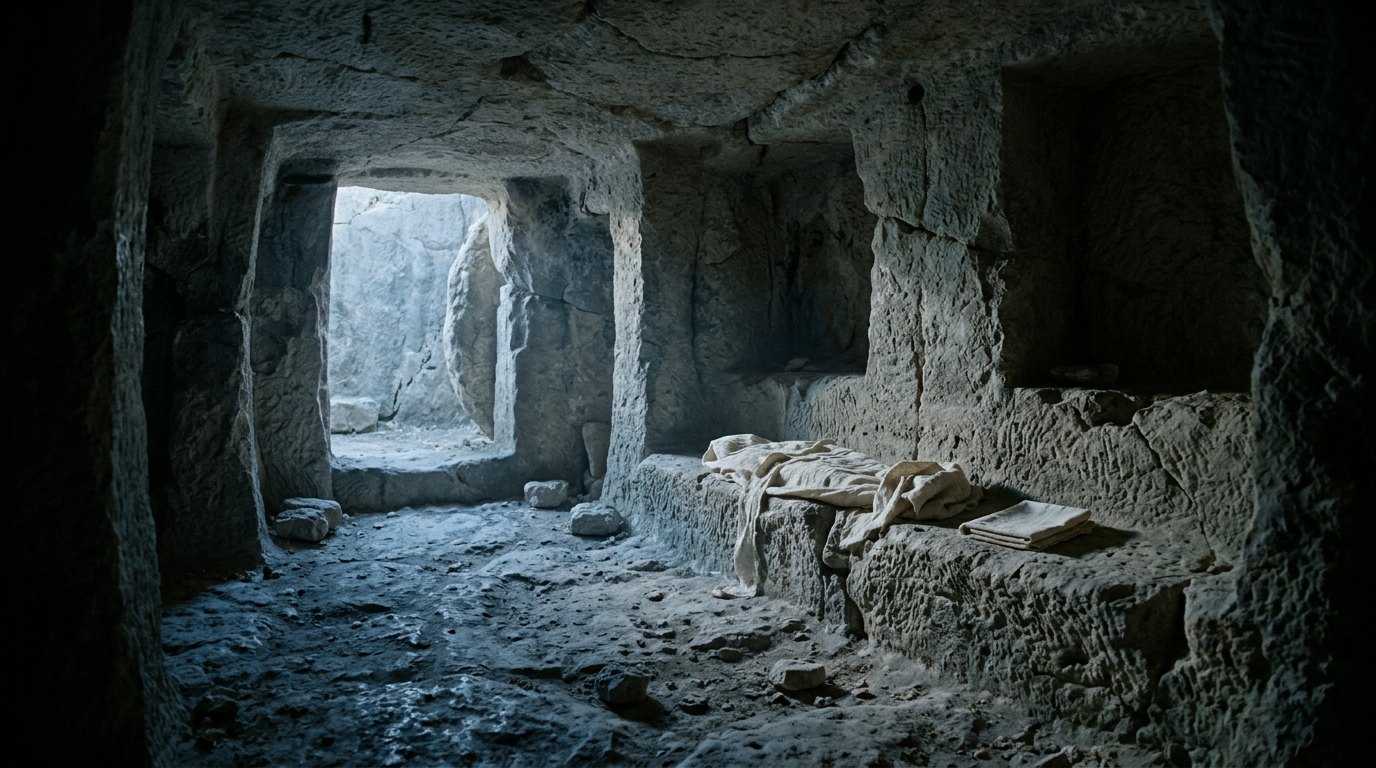
Then Simon Peter came along behind him and went straight into the tomb. He saw the strips of linen lying there, as well as the cloth that had been wrapped around Jesus’ head. The cloth was still lying in its place, separate from the linen.
John 20:6-7 (NIV)
The abandoned linen cloths and folded face cloth show that the body was neither stolen in haste nor decay.
When Simon Peter reached the rock-hewn sepulchre, the linen cloths lying folded by themselves dismantled any claim of grave robbery (John 20:6–7). Grave robbers strip valuables and leave corpses behind, while panicked conspirators do not pause to roll up the face cloth and lay it neatly in a separate place. The historical reality of the tomb's vacancy begins not with imaginative folklore, but with hostile precautions. Prior to dawn on the first day of the week, the chief priests and Pharisees had demanded that Pilate secure the site to prevent fraud, setting a Roman seal upon the stone and stationing an armed guard outside (Matthew 27:62–66). Yet when the dawn broke, an earthquake shook the garden, and an angel rolled back the massive stone, demonstrating that the Lord was already risen, just as He said (Matthew 28:1–6). When the distraught women entered the vault early that morning, they found the rock aperture open and the body of Jesus entirely gone (Luke 24:1–3). The immediate response of the religious authorities was not to produce the corpse, but to bribe the guards to spread the claim that the disciples had stolen the body while the soldiers slept (Matthew 28:11–15). That desperate counter-narrative, confirmed by Peter and John's inspection of the quiet, vacated shroud inside the chamber (John 20:1–8), silently concedes the fundamental fact of the case: the tomb of Jesus of Nazareth was empty.
| Passage | What it says |
|---|---|
| Matthew 27:62-66 | Roman authorities seal the tomb and post a military guard at the request of the chief priests. |
| Matthew 28:1-6 | The stone is rolled away, revealing to the women that Jesus is not there, just as he said. |
| Matthew 28:11-15 | Jewish leaders bribe the Roman guards to circulate the story that the disciples stole the body. |
| Luke 24:1-3 | Women discover the stone rolled away from the tomb and find that the body of Jesus is missing. |
| John 20:1-8 | Peter and John race to the tomb and observe the discarded burial linens left orderly inside. |
First Witnesses
Women as the First Commissioned Witnesses

Jesus said, “Do not hold on to me, for I have not yet ascended to the Father. Go instead to my brothers and tell them, ‘I am ascending to my Father and your Father, to my God and your God.’ ”
John 20:17 (NIV)
Entrusting the primary announcement of the risen Christ to women reflects historical authenticity rather than human fabrication.
In the garden beside the vacated tomb, Jesus commissioned Mary Magdalene as the first bearer of resurrection tidings, an assignment no first-century human author would fabricate (John 20:17). In ancient Jewish and Greco-Roman jurisprudence, the formal testimony of women was routinely dismissed as unreliable and inadmissible in legal court settings. Had the Gospel writers manufactured a heroic myth to persuade a skeptical Mediterranean world, they would have invented high-ranking male authorities or venerable religious leaders as their primary witnesses. Instead, God ordained that Mary Magdalene and the other women would be the first to behold the rolled-away stone and receive the angel's proclamation (Matthew 28:1–8). Mark emphasizes that the Lord appeared first to Mary Magdalene out of whom He had cast seven demons, sending her to weeping disciples who initially refused to believe her report (Mark 16:9–11). When these faithful women returned from the sepulchre and delivered the message to the eleven apostles, the men greeted their words as an idle, delirious tale (Luke 24:9–11). Only personal sight could dispel that raw shock. Mary's tearful recognition of her Master's voice when He called her by name (John 20:11–18) stands as an indelible mark of historical authenticity, where Scripture records events exactly as they unfolded, without smoothing over cultural stigmas.
| Passage | What it says |
|---|---|
| Matthew 28:1-8 | Mary Magdalene and the other Mary are the first to receive the angelic announcement of the resurrection. |
| Mark 16:9-11 | Jesus appears first to Mary Magdalene, who reports it to the mourning disciples who initially disbelieve. |
| Luke 24:9-11 | The women recount the empty tomb and angelic message to the eleven, who initially regard it as idle talk. |
| John 20:11-18 | Mary Magdalene meets the risen Lord in the garden and is commissioned as the first messenger to the apostles. |
Convincing Proofs
Extensive Appearances Across Forty Days

After his suffering, he presented himself to them and gave many convincing proofs that he was alive. He appeared to them over a period of forty days and spoke about the kingdom of God.
Acts 1:3 (NIV)
The resurrection is established not by an isolated glimpse, but through forty days of continuous, convincing proofs.
The apostolic faith rests upon forty days of continuous and convincing proofs, wherein Jesus repeatedly engaged the senses of those who knew Him best (Acts 1:3). The resurrection appearances were neither momentary hallucinations nor ghostly visions; they were protracted, physical encounters marked by shared meals, theological discourse, and bodily touch. On the afternoon of the resurrection, two despondent disciples walked seven miles along the road to Emmaus with a traveler who expounded the Law and the Prophets before revealing Himself in the familiar action of breaking bread (Luke 24:13–35). That same evening, the Lord entered a locked room where the terrified disciples had barricaded themselves, displaying His hands and feet, bidding them inspect the scars of crucifixion, and eating a piece of broiled fish before them to prove His tangible reality (John 20:19–20; Luke 24:39–43). Luke records that Christ deliberately lingered among them across six weeks, delivering instruction concerning the kingdom of God and preparing His followers for global mission (Acts 1:3). By revealing His physical body repeatedly across multiple locations, to solitary travelers, small gatherings, and large assemblies alike, Christ provided an empirical foundation so clear and compelling that no room was left for doubt.
| Passage | What it says |
|---|---|
| Luke 24:13-35 | Two disciples walk and converse with the risen Christ on the road to Emmaus, recognizing him in the breaking of bread. |
| John 20:19-20 | Jesus appears through locked doors to the gathered disciples, showing them his hands and side. |
| Acts 1:3 | Jesus presents himself alive over forty days by many convincing proofs, speaking concerning the kingdom of God. |
Transformed Skeptics
The Transformation of Skeptics and Hostile Enemies

He fell to the ground and heard a voice say to him, “Saul, Saul, why do you persecute me?” “Who are you, Lord?” Saul asked. “I am Jesus, whom you are persecuting,” he replied.
Acts 9:4-5 (NIV)
The abrupt turn of an ardent persecutor to a suffering apostle points directly to an objective encounter with the risen Lord.
No psychological theory can explain the blinding illumination of Saul of Tarsus on the road to Damascus, where an implacable enemy became a willing martyr (Acts 9:4–5). Skepticism regarding Jesus was not confined to strangers; even His own biological brothers, including James, refused to believe in Him during His public ministry and regarded His messianic claims with suspicion (John 7:5). Yet immediately following the resurrection and ascension, these same brothers are found praying in unified devotion alongside the apostles, with James ultimately serving as a pillars of the Jerusalem church and laying down his life for the faith (Acts 1:14). Even more striking was the total reversal of Saul, a zealous Pharisee committed to dragging Christians to prison and executing them for blasphemy (Acts 9:1–6). Confronted on the highway by the radiant glory of the ascended Christ, Saul's worldview was utterly shattered and rebuilt in an instant. Paul repeatedly pointed to that historic encounter, whether speaking before hostile mobs in Jerusalem (Acts 22:6–10) or writing to churches across Galatia (Galatians 1:13–16), declaring that nothing less than the living, reigning Son of God had intervened to transform a violent persecutor into the herald of the Gospel.
| Passage | What it says |
|---|---|
| John 7:5 | James and Jesus' brothers do not believe in him during his earthly ministry. |
| Acts 1:14 | Jesus' brothers are united in persistent prayer with the apostles immediately following the ascension. |
| Acts 9:1-6 | Saul the violent persecutor is transformed into an apostle upon meeting the risen Christ on the road to Damascus. |
| Acts 22:6-10 | Paul testifies before the Jerusalem crowd of his dramatic conversion through the living Lord. |
| Galatians 1:13-16 | Paul recounts how God revealed his Son to someone who previously tried to destroy the church of God. |
Where in the Bible
| Book | Passages |
|---|---|
| Psalms | 1 · Psalms 16:9-11 |
| Isaiah | 1 · Isaiah 53:10-11 |
| Hosea | 1 · Hosea 6:2 |
| Jonah | 1 · Jonah 1:17 |
| Matthew | 6 · Matthew 28:9, Matthew 12:40, Matthew 27:62-66, Matthew 28:1-6, Matthew 28:11-15, Matthew 28:1-8 |
| Mark | 1 · Mark 16:9-11 |
| Luke | 6 · Luke 24:36-38, Luke 24:39, Luke 24:40-43, Luke 24:1-3, Luke 24:9-11, Luke 24:13-35 |
| John | 6 · John 20:26-28, John 21:12-14, John 20:1-8, John 20:11-18, John 20:19-20, John 7:5 |
| Acts | 11 · Acts 10:40-41, Acts 26:22-23, Acts 2:25-31, Acts 13:34-37, Acts 2:32, Acts 4:18-20, Acts 5:29-32, Acts 1:3, Acts 1:14, Acts 9:1-6, Acts 22:6-10 |
| 1 Corinthians | 8 · 1 Corinthians 15:3, 1 Corinthians 15:4, 1 Corinthians 15:5, 1 Corinthians 15:6, 1 Corinthians 15:7, 1 Corinthians 15:8, 1 Corinthians 15:12-15, 1 Corinthians 15:17-19 |
| 2 Corinthians | 1 · 2 Corinthians 4:13-14 |
| Galatians | 2 · Galatians 1:18-19, Galatians 1:13-16 |
| 2 Peter | 1 · 2 Peter 1:16 |
| 1 John | 1 · 1 John 1:1 |
The story in order
- David prophesies resurrection (c. 1000 BC) · Psalms 16:9-11 · Foretells God's Holy One not seeing corruption.
- Hosea foretells resurrection on third day (c. 750 BC) · Hosea 6:2 · Predicts God raising people on the third day.
- Suffering Servant's sacrifice and long life (c. 700 BC) · Isaiah 53:10-11 · Prophesies the Servant seeing the fruit of His travail.
- Jonah as a sign (c. 750 BC) · Jonah 1:17 · Three days and nights in the fish foreshadows resurrection.
- Jesus predicts His resurrection (c. AD 28) · Matthew 12:40 · Jesus likens His burial to Jonah's sign.
- Jesus' resurrection and appearances (AD 30-33) · 1 Corinthians 15:3-8 · Eyewitness accounts of Christ's death and resurrection.
- Empty tomb discovered (AD 30) · Matthew 28:1-8 · Women find the tomb empty and hear angelic news.
- Jesus appears to disciples (AD 30) · Luke 24:13-35 · Two disciples recognize Jesus on the road to Emmaus.
- Jesus appears through locked doors (AD 30) · John 20:19-20 · Jesus shows His wounds to the disciples.
- Jesus appears to Thomas (AD 30) · John 20:26-28 · Thomas touches Jesus' wounds and confesses Him.
- Jesus appears to over 500 (AD 30-33) · 1 Corinthians 15:6 · Most witnesses were still alive when Paul wrote.
- Jesus ascends to heaven (AD 30) · Acts 1:3 · Jesus shows Himself alive over forty days.
- Peter preaches resurrection (AD 30) · Acts 2:32 · Peter proclaims Jesus raised by God, with witnesses.
- Paul's conversion (c. AD 33-36) · Acts 9:1-6 · Persecutor Paul transformed by meeting the risen Christ.
Prophetic Foreshadowing of the Resurrection
| Prophecy | Fulfillment | Significance | Passage |
|---|---|---|---|
| God will not leave His Holy One in Sheol or see corruption (Psalms 16:9-11) | His body did not decay in the grave (Acts 2:27, 31) | David prophesied Christ's resurrection. | Acts 2:25-31 |
| On the third day God will raise us up (Hosea 6:2) | Jesus was raised on the third day (1 Corinthians 15:4) | Hosea predicted the timing of the resurrection. | 1 Corinthians 15:4 |
| Jonah in the fish three days and nights (Jonah 1:17) | Jesus in the earth three days and nights (Matthew 12:40) | Jesus is the sign of Jonah. | Matthew 12:40 |
| The Suffering Servant prolongs His days after His soul's offering (Isaiah 53:10-11) | Christ lives after His atoning sacrifice (1 Corinthians 15:3-4) | The Servant's resurrection is the fruit of His suffering. | 1 Corinthians 15:3-4 |
Eyewitness Testimony to the Resurrection
| Witness | Testimony | Context | Passage |
|---|---|---|---|
| Peter | Saw the risen Christ (1 Corinthians 15:5) | First to see the risen Lord alone. | 1 Corinthians 15:5 |
| The Twelve | Saw the risen Christ (1 Corinthians 15:5) | Met as a group after the resurrection. | 1 Corinthians 15:5 |
| More than 500 brethren | Saw the risen Christ simultaneously (1 Corinthians 15:6) | Majority still alive when Paul wrote. | 1 Corinthians 15:6 |
| James (Lord's brother) | Saw the risen Christ (1 Corinthians 15:7) | Initially a skeptic, later an apostle. | 1 Corinthians 15:7 |
| Paul | Saw the risen Christ (1 Corinthians 15:8) | Transformed from persecutor to apostle. | 1 Corinthians 15:8 |
| Women (Mary Magdalene, etc.) | Saw the risen Christ and angels (Matthew 28:1-10) | First witnesses commissioned to tell the apostles. | John 20:11-18 |
| Disciples on Emmaus road | Walked and talked with the risen Christ (Luke 24:13-35) | Recognized Him in the breaking of bread. | Luke 24:13-35 |
Physicality of the Resurrected Body
| Action | Observation | Implication | Passage |
|---|---|---|---|
| Jesus shows His hands and feet | Disciples see flesh and bones (Luke 24:39) | A spirit does not have flesh and bones. | Luke 24:39 |
| Jesus invites Thomas to touch | Thomas probes nail marks and side (John 20:27) | Confirms the reality of Jesus' wounds and body. | John 20:27 |
| Jesus eats fish | Disciples see Him eat broiled fish (Luke 24:42-43) | Demonstrates a physical body capable of eating. | Luke 24:42-43 |
| Women hold Jesus' feet | They hold His feet and worship Him (Matthew 28:9) | Shows a tangible, physical body. | Matthew 28:9 |
| Disciples ate and drank with Jesus | Peter affirms they ate and drank with Him after resurrection (Acts 10:40-41) | Confirms the reality of His post-resurrection interactions. | Acts 10:40-41 |
Key words
- Resurrection (anastasis (ἀνάστασις))
- Christ's rising from the dead, a physical and bodily event. · 1 Corinthians 15:4
- Eyewitness (martys (μάρτυς))
- One who personally saw or experienced an event. · Acts 2:32
- Prophecy (propheteia (προφητεία))
- Divinely inspired foretelling of future events. · Acts 26:22-23
- Flesh and bones (sarx kai ostea (σάρξ καὶ ὀστέα))
- The physical substance of a living body. · Luke 24:39
- Testimony (martyria (μαρτυρία))
- A public declaration of what one has seen or heard. · Acts 2:32
- Empty tomb
- The grave where Jesus was buried, found vacant. · Matthew 28:6
Because Christ was truly raised on the third day, the Christian faith does not rest on wishful sentiment but on an immovable historical fact. His empty tomb and physical appearances guarantee the forgiveness of our sins, the truth of God's Word, and the sure hope that all who belong to Him will likewise be raised to everlasting life.
47 passages, each cited once.
Scripture cited
- Luke 24:1-12
- Luke 24:36-49
- Acts 1:1-5
- Acts 2:22-36
- 1 Corinthians 15:3-20
- Acts 17:30-31
- John 20:24-31
- Matthew 28:11-15
- Acts 4:8-20
- Acts 9:1-9