What did Jesus mean by 'It is finished'?

John 19:28-30
28 Later, knowing that everything had now been finished, and so that Scripture would be fulfilled, Jesus said, “I am thirsty.”
29 A jar of wine vinegar was there, so they soaked a sponge in it, put the sponge on a stalk of the hyssop plant, and lifted it to Jesus’ lips.
30 When he had received the drink, Jesus said, “It is finished.” With that, he bowed his head and gave up his spirit.
New International Version (NIV)
The answer
“It is finished!” means that Jesus had completed the saving work the Father gave Him. He was not merely saying that His suffering was ending, and He was certainly not admitting defeat. He had obeyed to the end, fulfilled the Scriptures, and offered Himself as the complete sacrifice for sin.
John 19:28 has already said that “all things were now finished,” immediately before Jesus speaks and dies in John 19:30. The Greek word translated “It is finished” is tetelestai, describing something brought to completion, with its accomplished result standing. In context, several things were completed:
- The work assigned by the Father. Earlier, Jesus prayed, “I have accomplished the work which you have given me to do” (John 17:4). At the cross, that work reached its intended completion in His obedient death.
- The Scriptures concerning His suffering. His thirst and the vinegar fulfilled what was written (John 19:28-29; Psalm 69:21). His death was not an accident or a plan gone wrong; it accomplished what God had spoken beforehand.
- The sacrifice that secures redemption. Christ entered God’s presence through His own blood, “having obtained eternal redemption” (Hebrews 9:12). Unlike the priests who repeatedly offered sacrifices that could never take away sins, Jesus “offered one sacrifice for sins forever” and sat down (Hebrews 10:11-14). No further sacrifice is needed to complete what His death accomplished.
- The removal of the record against sinners. Colossians 2:14 says that Christ wiped out what stood against His people, “nailing it to the cross.” Forgiveness rests on His completed work, not on a sinner’s ability to repay God.
This does not mean that God’s entire plan ended at the cross: Jesus was “delivered up for our trespasses, and was raised for our justification” (Romans 4:25). Nor does it mean everyone is saved automatically. Salvation is received through faith as God’s gift, “not of works, that no one would boast” (Ephesians 2:8-9), while John 3:18 warns, “He who doesn’t believe has been judged already.” The response is to trust in the crucified and risen Christ rather than trying to add saving merit through good works.
Answered from Scripture · reviewed November 11, 2026
When Jesus cried 'It is finished' from the cross, He uttered a single Greek word—tetelestai—that resounds as the supreme cry of victory in all of Scripture. Far from an admission of defeat or a mere gasp of exhaustion, this declaration announced that the eternal plan of redemption was completely fulfilled, the righteous demands of the Law were fully met, and the penalty for sin was paid in full. To understand what was finished is to understand the unshakeable foundation of the Christian's peace and assurance before God.
The Final Cry
A King's Cry of Complete Accomplishment
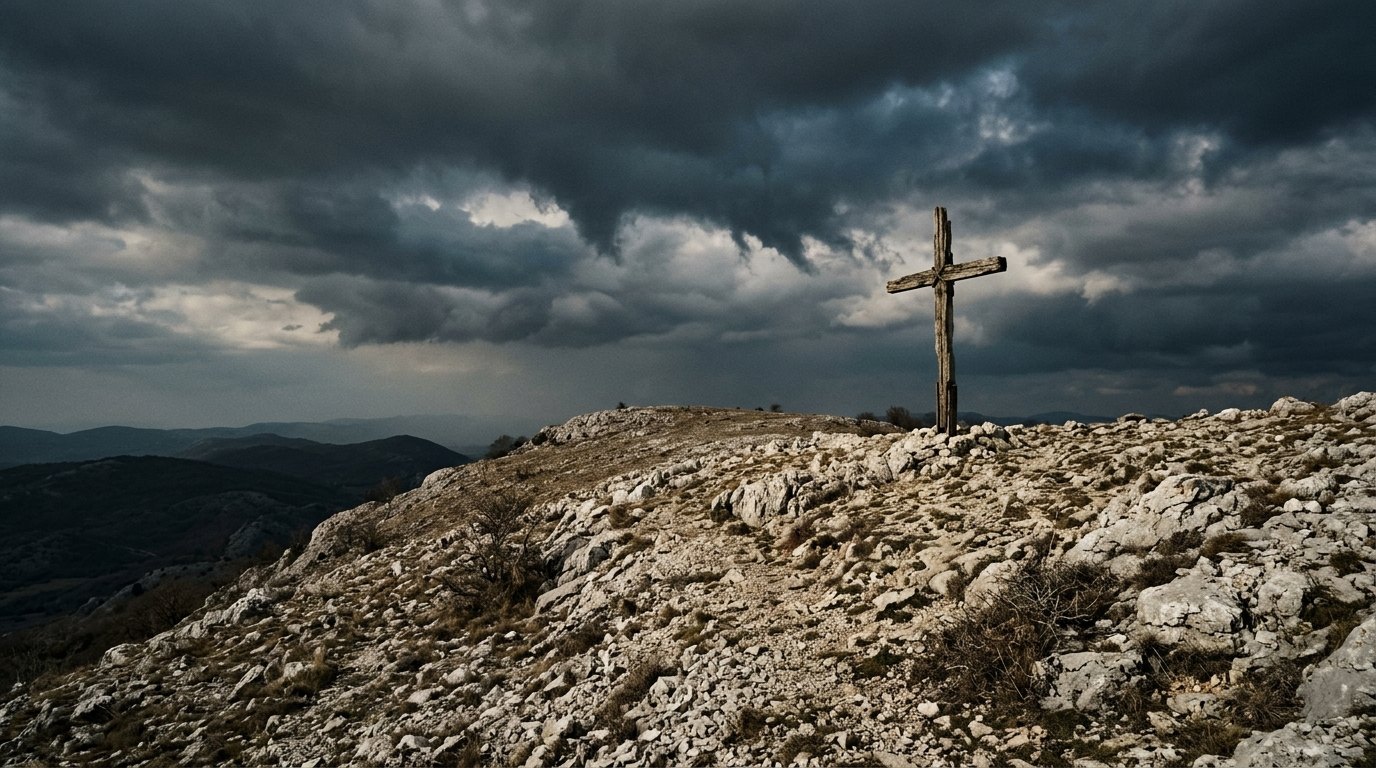
When he had received the drink, Jesus said, “It is finished.” With that, he bowed his head and gave up his spirit.
John 19:30 (NIV)
The single word tetelestai proclaims that the work the Father gave the Son to do stands finished for all time.
When the Lord Jesus uttered His last words in John 19:30, He cried tetelestai—a single Greek term that means "it has been accomplished and stands complete forever." Far from the feeble whisper of a dying victim, this was a sovereign shout of triumph. Just moments earlier, the apostle notes that "Jesus, knowing that all was now finished, said (to fulfill the Scripture), 'I thirst'" (John 19:28). Every detail of His passion unfolded under divine ordination. Even the sour wine raised on a stalk of hyssop (John 19:29) fulfilled the ancient psalmic pattern before Jesus received it and proclaimed that His work was done (John 19:30). He then bowed His head and gave up His spirit. The Synoptic Gospels underscore this remarkable authority. Luke records that Jesus called out with a loud voice, "Father, into your hands I commit my spirit!" (Luke 23:46). Matthew emphasizes that He "cried out again with a loud voice and yielded up his spirit" (Matthew 27:50), and Mark similarly records that He breathed His last following a loud cry (Mark 15:37). Crucifixion suffocated its victims, rendering loud cries physically impossible in ordinary circumstances. Jesus did not merely expire; He laid down His life of His own accord, shouting the victor's word before committing His spirit to the Father.
| Passage | What it says |
|---|---|
| John 19:28 | Jesus knew all things were now completed and spoke to fulfill the final prophetic Scripture before dying. |
| John 19:29 | A sponge filled with sour wine was lifted to Jesus on a hyssop branch as prophesied. |
| John 19:30 | Jesus received the sour wine, declared 'It is finished,' bowed His head, and yielded up His spirit. |
| Luke 23:46 | Jesus called out with a loud voice, committing His spirit into the Father's hands before breathing His last. |
| Matthew 27:50 | Jesus cried out again with a loud voice and voluntarily released His spirit in sovereign authority. |
| Mark 15:37 | Jesus utters a loud cry immediately before breathing His last, marking the triumphant end of His earthly suffering. |
The Appointed Mission
The Lifelong Purpose of the Son Completed

I have brought you glory on earth by finishing the work you gave me to do.
John 17:4 (NIV)
On the eve of His passion, Jesus looked ahead to the cross as the climax of glorifying the Father through His finished task.
The cry on Golgotha marked the culmination of an entire lifetime devoted to a single divine assignment, as Jesus prayed in John 17:4: "I glorified you on earth, having accomplished the work that you gave me to do." That holy obedience governed every step of His earthly ministry. Early in His service, He told His disciples, "My food is to do the will of him who sent me and to accomplish his work" (John 4:34). The signs He performed were not arbitrary displays of power, but the very works the Father gave Him to finish, testifying to His divine commission (John 5:36). He had descended from heaven not to execute His own will, but the sovereign purpose of the Father (John 6:38). Throughout His earthly journey, Christ lived under the holy weight of that coming cross, asking, "How great is my distress until it is accomplished!" (Luke 12:50). When the final hour approached, He refused to shrink back, asking, "Shall I say, 'Father, save me from this hour'? But for this purpose I have come to this hour" (John 12:27). He went to the tree with majestic intentionality, having made clear that no man possessed the power to take His life, but that He possessed authority to lay it down (John 10:18). On the cross, that lifelong obedience reached its perfect end.
| Passage | What it says |
|---|---|
| John 4:34 | Jesus declared that His nourishment was to do the will of Him who sent Him and to finish His work. |
| John 5:36 | The miraculous works that the Father assigned Jesus to finish testified that the Father had truly sent Him. |
| John 17:4 | Jesus stated that He glorified the Father on earth by completing the exact work assigned to Him. |
| Luke 12:50 | Jesus described the distress and constraint He felt until His coming baptism of suffering was accomplished. |
| John 10:18 | Jesus affirmed that no one took His life from Him, but that He laid it down of His own authority. |
| John 6:38 | Jesus declares He came down from heaven not to do His own will, but the will of the Father who sent Him. |
| John 12:27 | Jesus acknowledges that His very purpose was to arrive at this specific hour of sacrificial offering. |
Prophecy Fulfilled
The Entire Prophetic Witness Brought to its Goal
Jesus took the Twelve aside and told them, “We are going up to Jerusalem, and everything that is written by the prophets about the Son of Man will be fulfilled.
Luke 18:31 (NIV)
Christ explicitly bound the climax of His earthly journey to the full realization of everything written by the prophets.
Before He ascended to Jerusalem, Jesus pulled the Twelve aside with a solemn guarantee recorded in Luke 18:31: everything written by the prophets concerning the Son of Man would be accomplished. Centuries of redemptive prophecy found their focal point in His death. In the garden of Eden, God had promised that the seed of the woman would suffer a bruised heel while crushing the head of the ancient serpent (Genesis 3:15). In the Psalms, David had prophesied the excruciating physical torment of crucifixion, crying out that his strength was dried up like a potsherd and his tongue stuck to his jaws (Psalms 22:15), an agony fulfilled to the letter when Jesus declared His thirst (John 19:28). David had also foreseen that they would give the righteous sufferer poison for food and sour wine for his thirst (Psalms 69:21), exactly fulfilled at the cross (John 19:29). Jesus reminded His followers that the prophecy numbering Him with transgressors had to reach its appointed end (Luke 22:37), fulfilled as He hung between two thieves (Mark 15:27; John 19:30). Through His suffering, the decree given to Daniel to make an end of sin and bring in everlasting righteousness came to pass (Daniel 9:24; Romans 5:19; John 19:30). After His resurrection, Christ confirmed that every word written about Him in the Law of Moses, the Prophets, and the Psalms had to be fulfilled (Luke 24:44), and the early church preached that Israel's rulers had carried out all that was written of Him before placing Him in the tomb (Acts 13:29).
| Passage | What it says | Fulfilled |
|---|---|---|
| Psalms 22:15 | David foretold the Messiah's strength drying up like a potsherd and His tongue cleaving to His jaws in death. | John 19:28 |
| Psalms 69:21 | The psalmist prophesied that the afflicted righteous sufferer would be offered poison and sour wine for his thirst. | John 19:29 |
| Luke 18:31 | Jesus forewarned the Twelve that everything written by the prophets concerning the Son of Man would be accomplished in Jerusalem. | John 19:30 |
| Luke 22:37 | Jesus declared that the Scripture numbering Him with transgressors must be fulfilled, for His prophetic words reached their end. | Mark 15:27, John 19:30 |
| Daniel 9:24 | Daniel received the promise of seventy weeks to finish transgression, make an end of sins, and bring in everlasting righteousness. | Romans 5:19, John 19:30 |
| Genesis 3:15 | The seed of the woman is promised to crush the head of the serpent through His own bruising. | |
| Luke 24:44 | Jesus affirms that everything written about Him in the Law, Prophets, and Psalms had to be fulfilled. | |
| Acts 13:29 | The apostles testify that the rulers carried out everything written concerning the Messiah before laying Him in a tomb. |
The Law Satisfied
The Perfect End of the Law's Demands

Christ is the culmination of the law so that there may be righteousness for everyone who believes.
Romans 10:4 (NIV)
Paul shows that Christ is the culmination and termination of the Law's demand for righteousness for everyone who believes.
When Christ cried that all was finished, the legal debt of sinners before a holy God was cancelled forever, for as Paul writes, "Christ is the end of the law for righteousness to everyone who believes" (Romans 10:4). Jesus had stated in the Sermon on the Mount that He did not come to abolish the Law or the Prophets, but to fulfill them (Matthew 5:17), achieving that perfect righteousness which God then imputed to believers through the cross (Romans 8:3–4; Philippians 3:9). The moral law demanded absolute obedience and pronounced a curse upon every transgressor, yet "Christ redeemed us from the curse of the law by becoming a curse for us" (Galatians 3:13), bearing that curse fully when He yielded up His spirit (John 19:30). What human flesh was completely powerless to do under the Law, God accomplished by sending His own Son in the likeness of sinful flesh and condemning sin in the flesh (Romans 8:3; John 19:30). God publicly presented Jesus as a propitiation in His blood to satisfy divine wrath and vindicate His righteousness (Romans 3:25). For our sake, God "made him to be sin who knew no sin, so that in him we might become the righteousness of God" (2 Corinthians 5:21). Therefore, the handwriting of ordinances and legal demands standing against us was blotted out and completely removed, nailed decisively to the cross of Christ (Colossians 2:14; John 19:30).
| Passage | What it says | Fulfilled |
|---|---|---|
| Matthew 5:17 | Jesus taught that He came not to abolish the Law or the Prophets, but to fulfill them completely. | Romans 8:3, Romans 8:4 |
| Galatians 3:13 | Christ redeemed us from the curse of the Law by becoming a curse on the tree on our behalf. | John 19:30 |
| Romans 8:3 | God accomplished what the Law was powerless to do by condemning sin in the flesh through His own Son. | John 19:30 |
| Romans 10:4 | Paul confirms that Christ is the end and goal of the Law for righteousness to all who believe. | Philippians 3:9 |
| Colossians 2:14 | God canceled the record of debt and legal ordinances against us by nailing it to the cross of Christ. | John 19:30 |
| Romans 3:25 | God set forth Christ Jesus as a propitiation through faith in His blood, demonstrating God's righteousness. | |
| 2 Corinthians 5:21 | God made Him who knew no sin to be sin for us, securing righteousness for believers. |
Atonement Completed
One Sacrifice Offered Once for All Time

But when this priest had offered for all time one sacrifice for sins, he sat down at the right hand of God,
Hebrews 10:12 (NIV)
Unlike priests who stood repeatedly, Christ offered one sacrifice for sins forever and sat down because the work was done.
The decisive truth of redemption is crystallized in Hebrews 10:12: unlike earthly priests who stood day after day offering repeated sacrifices that could never take away sins, Christ offered one single sacrifice for sins for all time and sat down at the right hand of God. Under the Old Covenant, priests never sat down in the tabernacle because their work was never done; Christ sat down because the work of atonement was finished forever, fulfilling the prophetic vision of Ephesians 1:20. Centuries earlier, the prophet foresaw this divine satisfaction in Isaiah 53:11, declaring that the righteous Servant would see the agonizing travail of His soul and be fully satisfied, a prophecy brought to pass when Jesus gave up His spirit (John 19:30; Hebrews 12:2).
Because the cross accomplished a final expiation, Christ had no need to offer daily blood, for He did this once for all when He offered up Himself as the unblemished Lamb (Hebrews 7:27). As Hebrews 9:12 proclaims, He entered into the holy places not with the blood of goats and calves, but by His own blood, securing an eternal redemption that needs no supplementary work (John 19:30). At the end of the ages, He appeared once for all to put away sin by the sacrifice of Himself (Hebrews 9:26; John 19:30), bearing the guilt and penalty of many to cancel the eternal debt of transgression (Hebrews 9:28).
By this single offering, Christ has perfected for all time those who are being sanctified (Hebrews 10:14; John 19:30). The righteous died for the unrighteous, the sinless Shepherd in place of condemned sinners, bringing believers safely and permanently into fellowship with God (1 Peter 3:18).
| Passage | What it says | Fulfilled |
|---|---|---|
| Isaiah 53:11 | The prophet foresaw that the righteous Servant would see the fruitful result of His soul's anguish and be satisfied. | John 19:30, Hebrews 12:2 |
| Hebrews 9:12 | Christ entered into the holy places once for all by His own blood, securing an eternal redemption. | John 19:30 |
| Hebrews 9:26 | Christ appeared at the end of the ages to put away sin once for all by the sacrifice of Himself. | John 19:30 |
| Hebrews 10:12 | Having offered a single sacrifice for sins for all time, Christ sat down at the right hand of God. | Ephesians 1:20 |
| Hebrews 10:14 | By a single offering Christ has perfected for all time those who are being sanctified. | John 19:30 |
| Hebrews 7:27 | Jesus has no daily need to offer sacrifices, since He did this once for all when He offered up Himself. | |
| Hebrews 9:28 | Christ was offered once to bear the sins of many, settling the debt of transgression permanently. | |
| 1 Peter 3:18 | Christ suffered once for sins, the righteous for the unrighteous, to bring us safely to God. |
The Veil Torn
Unrestricted Access and the New Covenant
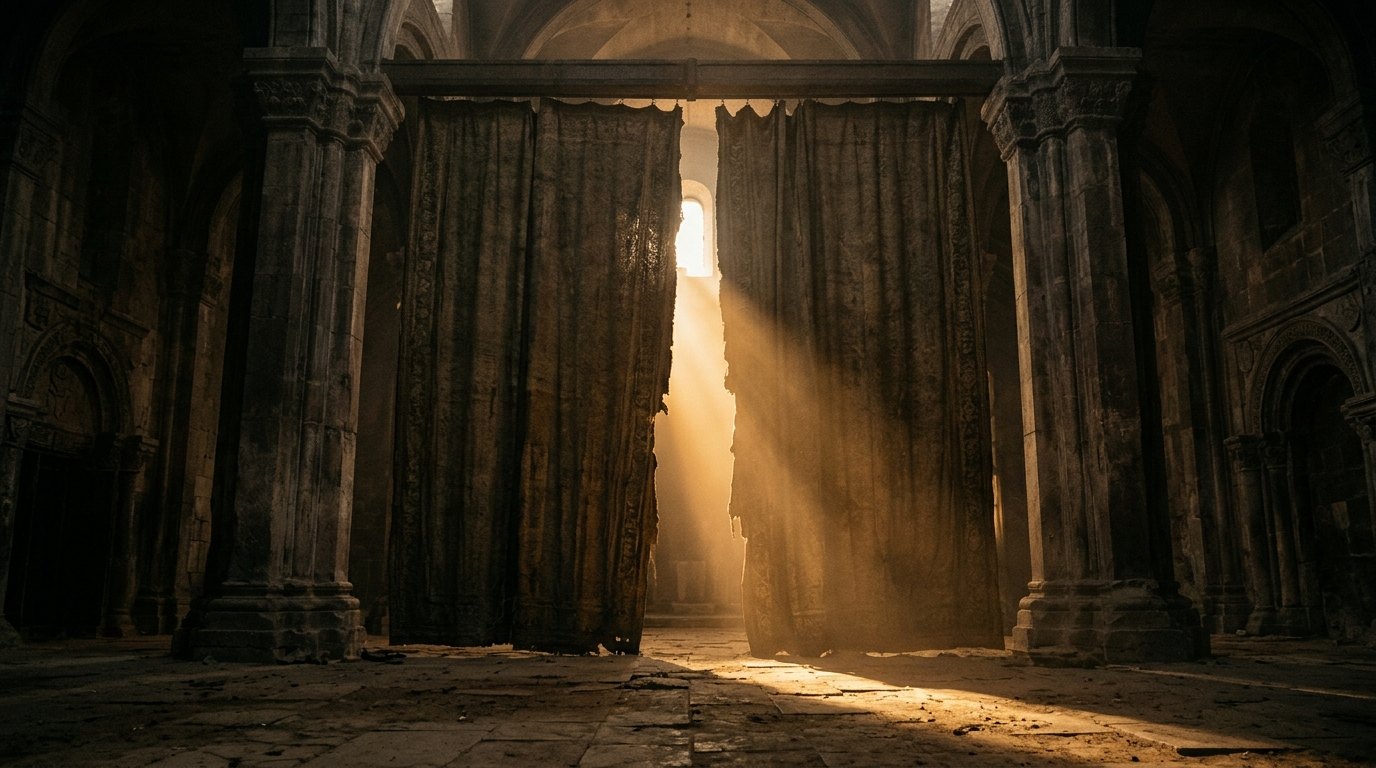
Therefore, brothers and sisters, since we have confidence to enter the Most Holy Place by the blood of Jesus,
Hebrews 10:19 (NIV)
The torn curtain and the blood of Jesus grant believers bold and confident access directly into the Holy of Holies.
The moment Jesus cried tetelestai, heaven provided an immediate, visible confirmation of what was accomplished: Hebrews 10:19 reminds us that believers now possess unshakable confidence to enter the Holy of Holies by the blood of Jesus. The physical curtain of the temple, woven thick and suspended between humanity and the manifest presence of God, was violently torn in two from top to bottom (Matthew 27:51; Mark 15:38; Hebrews 10:20). This sovereign tear came from above, proving that God Himself had abolished the separation and granted open access through the finished work of His Son.
Through the sacrifice of His physical body, Christ inaugurated a new and living way for His people (Hebrews 10:20; John 19:30). The ancient barrier of the ceremonial law and the alienation caused by human rebellion were definitively removed. As Ephesians 2:14 teaches, Christ broke down the dividing wall of hostility in His flesh, creating peace between Jew and Gentile and reconciling both into one body before God (John 19:30).
No longer do believers stand at a trembling distance behind barriers, altars, and earthly intermediaries. Because the curtain is permanently rent, Scripture summons every redeemed soul to draw near with freedom and holy boldness to the throne of grace, finding mercy and abundant help in every time of need (Hebrews 4:16).
| Passage | What it says | Fulfilled |
|---|---|---|
| Matthew 27:51 | The curtain of the temple was torn in two from top to bottom, signaling the opening of God's presence. | Hebrews 10:20 |
| Ephesians 2:14 | Christ broke down the dividing wall of hostility in His flesh, making peace between Jews and Gentiles. | John 19:30 |
| Hebrews 10:19 | Believers now possess boldness to enter the most holy place by the blood of Jesus. | Matthew 27:51 |
| Hebrews 10:20 | Jesus inaugurated a new and living way opened for us through the curtain of His torn flesh. | John 19:30 |
| Mark 15:38 | The veil of the temple is torn in two from top to bottom at Jesus' death. | |
| Hebrews 4:16 | Believers are summoned to draw near with confidence to the throne of grace through Christ's open way. |
The Believer's Rest
Living in the Reality of a Finished Salvation

fixing our eyes on Jesus, the pioneer and perfecter of faith. For the joy set before him he endured the cross, scorning its shame, and sat down at the right hand of the throne of God.
Hebrews 12:2 (NIV)
Jesus is not merely the one who starts our faith, but the triumphant finisher who endured the cross and sat down in glory.
Because Jesus finished the work of salvation, the Christian life is not a frantic effort to earn divine acceptance, but a life of resting in what has already been won. The posture of the believer is defined by Hebrews 12:2, which calls us to look steadfastly unto Jesus, the founder and perfecter of our faith, who for the joy set before Him endured the cross, despising the shame, and sat down at the right hand of the throne of God. He did not merely initiate our salvation and leave the completion to our frail strength; He is both its author and its triumphant finisher.
This finished work forms the unassailable ground of our justification. Sinners are justified freely by His grace as an outright gift through the redemption that is in Christ Jesus, without any contribution of self-righteous merit (Romans 3:24). Consequently, there is now no condemnation for those who are in Christ Jesus (Romans 8:1); the entire ledger of our guilt was pinned to the tree and canceled in full.
Believers can walk with unwavering assurance because He who began a good work in you will faithfully bring it to full completion at the day of Jesus Christ (Philippians 1:6). The cry of the cross echoes into eternity, culminating at the consummation of history when the Alpha and the Omega proclaims from the throne, 'It is done,' offering the spring of the water of life freely to all who thirst (Revelation 21:6).
| Passage | What it says |
|---|---|
| Romans 3:24 | Sinners are justified freely by God's grace through the redemption that is in Christ Jesus. |
| Romans 8:1 | There is now no condemnation for those who are in Christ Jesus because the penalty has been paid. |
| Philippians 1:6 | He who began a good work in believers will bring it to completion at the day of Jesus Christ. |
| Hebrews 12:2 | We look to Jesus, the founder and perfecter of our faith, who endured the cross and sat down at God's throne. |
| Revelation 21:6 | The Alpha and Omega declares from the throne, 'It is done,' offering the water of life freely. |
Powers Disarmed
The Decisive Defeat of Satan's Power

And having disarmed the powers and authorities, he made a public spectacle of them, triumphing over them by the cross.
Colossians 2:15 (NIV)
It shows that 'It is finished' signaled the public disarmament and overthrow of the demonic principalities.
The cry of tetelestai was not merely an announcement of human redemption; it was an earth-shattering verdict against the kingdom of darkness. In Colossians 2:15, Scripture reveals the hidden reality of Calvary: God disarmed the rulers and authorities, putting them to open shame by triumphing over them in Christ. What appeared to human eyes as the humiliating defeat of a prophet was in truth the cosmic undoing of Satan's dominion, stripping evil spirits of their ultimate weapon of legal accusation against God's elect.
During His earthly ministry, Jesus anticipated this hour of victory, declaring that through His impending cross, the prince of this world would be decisively cast out (John 12:31). Satan's stronghold had always rested on the power of sin, guilt, and condemnation; by paying sin's debt in full, Jesus dismantled the devil's legal claim over the souls of men.
By sharing in our flesh and blood, Christ died so that through death He might destroy the one who holds the power of death—that is, the devil—and deliver all those who through fear of death were subject to lifelong slavery (Hebrews 2:14). The Son of God appeared for this precise purpose, to destroy the works of the devil once and for all (1 John 3:8). The cross crushed the serpent's head, sealing Satan's doom forever.
| Passage | What it says |
|---|---|
| John 12:31 | Jesus announces that through His impending cross, the ruler of this fallen world will be cast out. |
| Colossians 2:15 | Christ disarmed the rulers and authorities, triumphing over them openly through His victorious sacrifice on the cross. |
| Hebrews 2:14 | Through His death, Jesus destroyed the one who holds the power of death, namely the devil. |
| 1 John 3:8 | The Son of God appeared for this explicit reason, to destroy the works of the devil forever. |
Where in the Bible
| Book | Passages |
|---|---|
| Genesis | 1 · Genesis 3:15 |
| Psalms | 2 · Psalms 22:15, Psalms 69:21 |
| Isaiah | 1 · Isaiah 53:11 |
| Daniel | 1 · Daniel 9:24 |
| Matthew | 3 · Matthew 27:50, Matthew 5:17, Matthew 27:51 |
| Mark | 2 · Mark 15:37, Mark 15:38 |
| Luke | 5 · Luke 23:46, Luke 12:50, Luke 18:31, Luke 22:37, Luke 24:44 |
| John | 10 · John 19:28, John 19:29, John 19:30, John 4:34, John 5:36, John 17:4, John 10:18, John 6:38, John 12:27, John 12:31 |
| Acts | 1 · Acts 13:29 |
| Romans | 5 · Romans 8:3, Romans 10:4, Romans 3:25, Romans 3:24, Romans 8:1 |
| 2 Corinthians | 1 · 2 Corinthians 5:21 |
| Galatians | 1 · Galatians 3:13 |
| Ephesians | 1 · Ephesians 2:14 |
| Philippians | 1 · Philippians 1:6 |
| Colossians | 2 · Colossians 2:14, Colossians 2:15 |
| Hebrews | 11 · Hebrews 9:12, Hebrews 9:26, Hebrews 10:12, Hebrews 10:14, Hebrews 7:27, Hebrews 9:28, Hebrews 10:19, Hebrews 10:20, Hebrews 4:16, Hebrews 12:2, Hebrews 2:14 |
| 1 Peter | 1 · 1 Peter 3:18 |
| 1 John | 1 · 1 John 3:8 |
| Revelation | 1 · Revelation 21:6 |
The story in order
- The Fall and the First Promise (c. 4000 BC) · Genesis 3:15 · God promises the seed of the woman will crush the serpent's head.
- Daniel's Prophecy of Seventy Weeks (c. 539 BC) · Daniel 9:24 · Promise of finishing transgression and bringing everlasting righteousness.
- Jesus' Ministry Begins (c. AD 27) · John 4:34 · Jesus declares His nourishment is to finish His work.
- Jesus Forewarns of His Suffering (c. AD 30) · Luke 18:31 · Jesus states all prophets' writings about Him must be fulfilled.
- Jesus Prays for Glorification (AD 30) · John 17:4 · Jesus states He completed the work the Father gave Him.
- Jesus' Last Supper and Betrayal (AD 30) · Luke 22:37 · Jesus declares Scripture numbering Him with transgressors must be fulfilled.
- Jesus' Crucifixion (AD 30) · Matthew 27:50 · Jesus cries out and releases His spirit.
- The Temple Veil is Torn (AD 30) · Matthew 27:51 · Signaling unrestricted access to God's presence.
- Christ's Sacrifice for All Time (AD 30) · Hebrews 10:12 · Christ offered one sacrifice for sins, then sat down.
- The Apostles Preach the Gospel (c. AD 47) · Acts 13:29 · The rulers fulfilled all that was written about the Messiah.
- Paul Explains Redemption (c. AD 55) · Romans 3:24 · Sinners are justified freely by grace through redemption.
- Paul Explains No Condemnation (c. AD 55) · Romans 8:1 · No condemnation for those in Christ Jesus.
Key words
- It is finished (tetelestai (τετέλεσται))
- The Greek word 'tetelestai' signifies completion, fulfillment, and payment in full. · John 19:30
- Redemption (apolutrosis (ἀπολύτρωσις))
- The act of being bought back or set free from sin and its consequences. · Romans 3:24
- Fulfillment (plēroō (πληρόω))
- The accomplishment of prophecies, promises, and the Law's requirements. · Matthew 5:17
- Propitiation (hilastērion (ἱλαστήριον))
- An atoning sacrifice that appeases God's wrath and turns away His anger. · Romans 3:25
- Atonement (katharismos (καθαρισμός))
- The reconciliation of God and humankind through the sacrificial death of Christ. · Hebrews 9:26
- Righteousness (dikaiosynē (δικαιοσύνη))
- The state of being just and in right standing with God. · Romans 10:4
Because Christ cried 'It is finished,' the believer rests in an accomplished salvation that requires no human addition and can never be undone. The debt of sin has been wiped clean, divine justice has been fully satisfied, and eternal life is secured forever. We do not work toward acceptance with God; we live and worship from the triumphant reality of a redemption that stands complete for all eternity.
51 passages, each cited once.
Scripture cited
- John 19:28-30
- Psalms 69:21
- John 19:30
- John 17:4
- Hebrews 9:11-14
- John 19:28
- John 17:1-5
- Hebrews 10:11-14
- Romans 4:23-25
- John 3:16-18
- Ephesians 2:8-9
- Colossians 2:13-14