What does 'iron sharpens iron' mean?
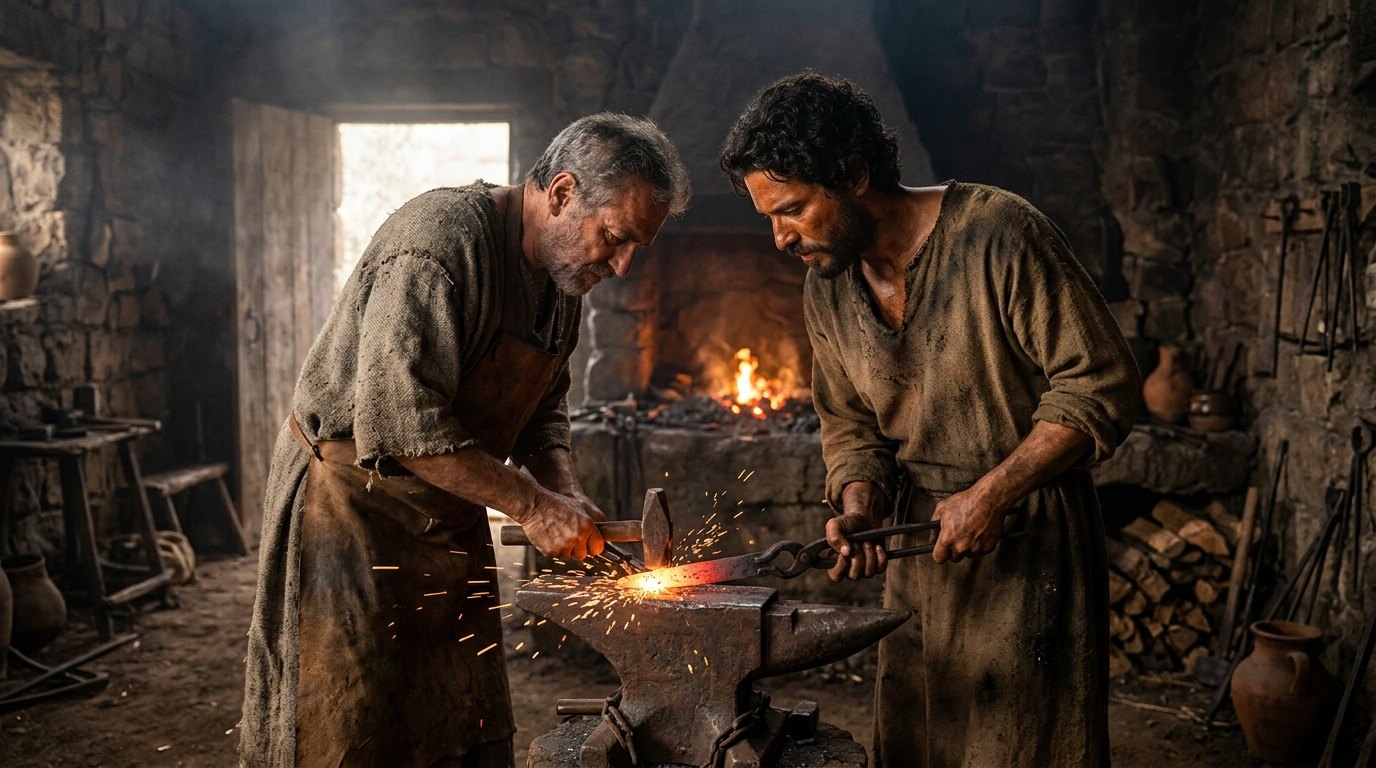
Proverbs 27:17
17 As iron sharpens iron, so one person sharpens another.
New International Version (NIV)
The answer
Iron sharpens iron: one person's faith and character are sharpened by the honest, strengthening contact of another. The point of the proverb is that no one improves alone — growth in a Christian life happens through another believer who speaks truthfully to you and lets you speak truthfully to them.
What the proverb is saying
The word is countenance: the face, the expression, the whole outward bearing of a person. When iron rubs against iron, it becomes sharper and smoother — the friction is the point. So "a man sharpens his friend's countenance" means a friend steadies and improves another friend by loving, candid counsel that calls out what needs correcting.
Notice the verse does not picture harshness. The parallel line in Proverbs 27:9 gives the tone: "the sweetness of a man's friend by hearty counsel." Sharpening here is the same process as a doctor using iron to cut, or a smith honing a blade — purposeful,beneficial, done by someone who knows what the metal is for.
Why it matters for faith
- Truth spoken in love does the sharpening. The friend here is not a flatterer and not a prosecutor; the verse pairs the file with the sweetness of counsel (Proverbs 27:9).
- It is mutual. Iron sharpens iron — the same action works both ways. Friends sharpen each other.
- It is a settled biblical pattern. "Strengthen the weak hands" appears in Job 4:3-4, Isaiah 35:3-4 and 1 Samuel 23:16, where Jonathan "strengthened his hand in God." The friendships that God blesses are the ones where people steady each other in faith.
- It ends in love and good works. Hebrews 10:24 is the same idea in the church: "let us consider one another to provoke unto love and to good works." Sharpening is not criticism for its own sake; it aims at the other person's holiness and their good.
What it looks like practically
- Give counsel that is hearty, not soft-edged. Proverbs 27:9 pairs the sweetness of a friend's counsel with the sharpening of iron — grace and truth together, not one without the other (Ephesians 4:15 says to speak truth in love).
- Receive it. The verse assumes a friend who accepts the rubbing rather than resenting it.
- Look for the steady hand. Choose friendships that strengthen hands toward God, like Jonathan's with David, rather than ones that only flatter.
The most common mistake
Reading "sharpens" as attacking rather than making sharp. Iron doesn't sharpen iron to hurt it; it sharpens it to make a clean edge and a strong blade. The friendships God uses do that to your character — and you are the iron for someone else too.
Answered from Scripture · reviewed November 10, 2026
Scripture declares in Proverbs 27:17 that just as iron sharpens iron, so one person sharpens the countenance of his friend. God never intended believers to walk in isolation, but designed godly friendship and mutual exhortation as the very means by which character is forged and faith is sustained.
The Ancient Metaphor
Friction Shapes the Countenance of a Friend
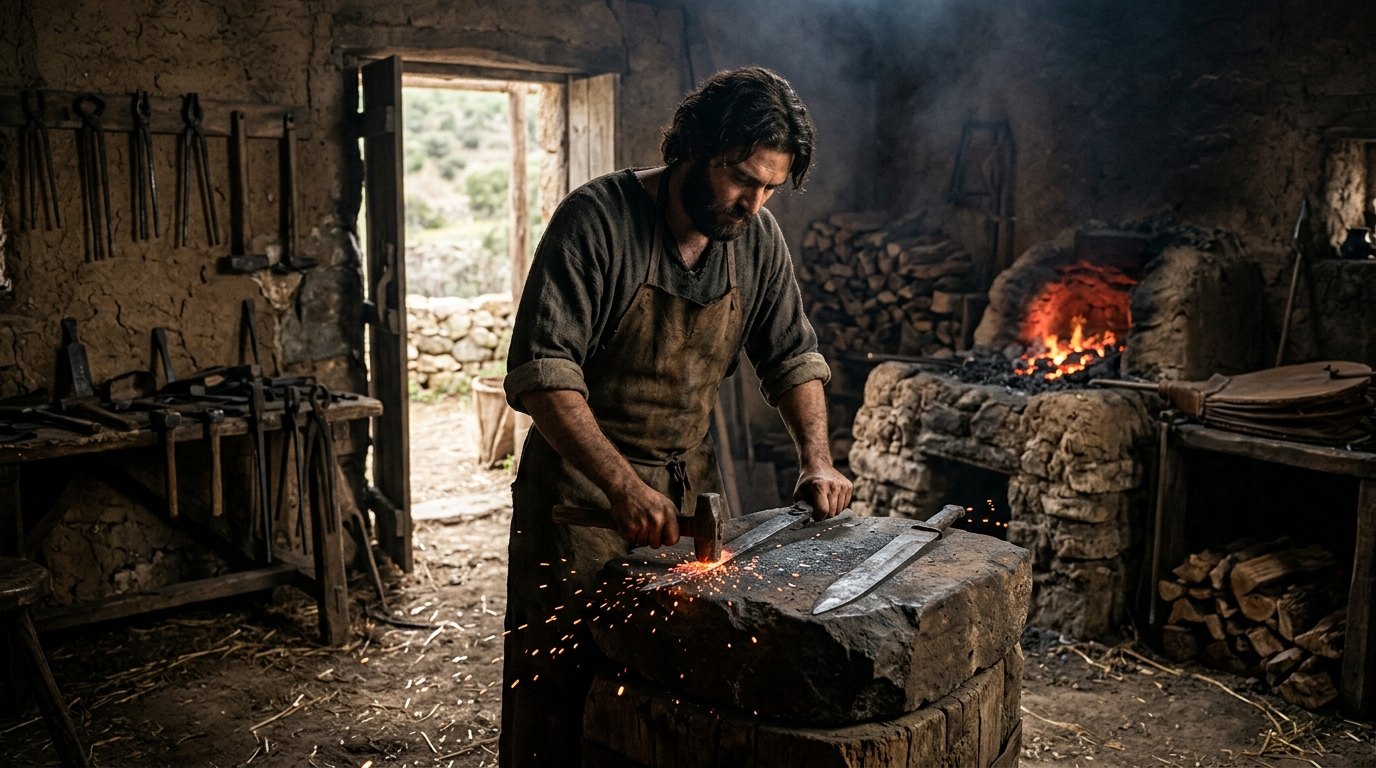
As iron sharpens iron, so one person sharpens another.
Proverbs 27:17 (NIV)
This proverb establishes that the deliberate, mutual contact between two blades is God's portrait of life-shaping friendship.
Iron sharpens iron, and one man sharpens the face of his friend (Proverbs 27:17). Solomon draws this proverb straight from the smith’s workshop. A metal blade cannot hone itself; it requires intentional, firm friction against an equally hard substance to remove burrs, reshape a dull edge, and restore its cutting power. In the exact same way, God ordains that human character, moral clarity, and spiritual alertness are sharpened through the rigorous, close-contact engagement of genuine companions. Isolation dulls a soul, but purposeful fellowship hones it.
This sharpening work is rarely painless. Solomon insists that open rebuke is better than hidden love (Proverbs 27:5). True affection refuses to remain silent while a brother wanders into foolishness or danger. Therefore, faithful are the wounds of a friend, whereas the kisses of an enemy are deceitful (Proverbs 27:6). The surface sting delivered by a faithful companion aims at healing and preservation, unlike the flattering, destructive kisses of an adversary. When received with humility, such honest counsel does not poison a relationship; it enriches it. As Proverbs 27:9 observes, ointment and perfume gladden the heart, and the sweetness of a friend comes from his earnest counsel.
The cost of refusing this mutual sharpening is severe. Ecclesiastes 10:10 warns that if the iron tool is blunt and one does not sharpen the edge, he must exert far more strength. A dull blade tires the laborer, ruins the work, and invites disaster. God gives us brothers and sisters so that we need not strike through life with a blunted edge.
| Passage | What it says |
|---|---|
| Proverbs 27:17 | Iron sharpens iron, showing that a man sharpens the countenance and character of his friend through purposeful interaction. |
| Proverbs 27:5 | Open rebuke is declared better than hidden love, proving that genuine love speaks plainly when correction is needed. |
| Proverbs 27:6 | Faithful are the wounds of a friend, while the kisses of an enemy are deceitful. |
| Proverbs 27:9 | Sweetness comes to a man's heart through the sincere, hearty counsel of his friend. |
| Ecclesiastes 10:10 | A blunt iron edge requires more strength, illustrating the need for deliberate sharpening and skill. |
Candid Counsel
Wise Friendship Chooses Truth Over Flattery

Whoever rebukes a person will in the end gain favor rather than one who has a flattering tongue.
Proverbs 28:23 (NIV)
It shows that honest rebukes produce greater enduring favor than the smooth, deceptive words of a flatterer.
He who rebukes a man will afterward find more favor than he who flatters with the tongue (Proverbs 28:23). Flattery appeals to vanity in the moment, but it leaves the recipient exposed to error and ruin. Candid reproof, though difficult to hear, delivers enduring life. A wise believer recognizes this and welcomes righteous correction. David prayed with remarkable humility, “Let a righteous man strike me—it is a kindness; let him rebuke me—it is oil for my head; let my head not refuse it” (Psalms 141:5). He viewed the corrective word of a fellow saint not as an assault, but as an anointing that guards against self-deception.
Such honest correction can only flourish within steadfast covenant commitment. A friend loves at all times, and a brother is born for adversity (Proverbs 17:17). Mutual sharpening is never an exercise in harsh criticism; it is the labor of enduring loyalty. Solomon captures the strength of this partnership in Ecclesiastes 4:9–10, declaring that two are better than one, because if they fall, one will lift up his fellow, whereas misery awaits the man who falls alone with no one to raise him up.
Who we walk with determines who we become. Proverbs 13:20 promises that whoever walks with the wise becomes wise, while the companion of fools suffers harm. For this sharpening to take effect, the ear must be willing to hear. Proverbs 15:31 notes that the ear that listens to life-giving reproof will dwell among the wise. When wise reproof meets a receptive heart, Solomon likens it to an earring of gold and an ornament of fine gold (Proverbs 25:12)—a costly, rare treasure that beautifies the listener.
| Passage | What it says |
|---|---|
| Proverbs 28:23 | He who rebukes a man will afterward find more favor than he who flatters with the tongue. |
| Psalms 141:5 | David welcomes the righteous striking and reproving him, counting it an excellent oil upon his head. |
| Proverbs 17:17 | A friend loves at all times, and a brother is born for adversity. |
| Ecclesiastes 4:9 | Two are better than one because they have a good reward for their labor. |
| Ecclesiastes 4:10 | If either falls, one will lift up his companion, but woe to him who is alone when he falls. |
| Proverbs 13:20 | Walking with the wise produces wisdom, showing the formative power of close companions. |
| Proverbs 15:31 | The ear that listens to life-giving reproof will dwell at home among the wise. |
| Proverbs 25:12 | A wise reprover to a listening ear is like an ornament of fine gold. |
Strengthening Hands
Covenant Companions Steady One Another in God
And Saul’s son Jonathan went to David at Horesh and helped him find strength in God.
1 Samuel 23:16 (NIV)
Jonathan's visit to David in the wilderness illustrates the exact spiritual sharpening that upholds a weary soul.
When David was hunted like an animal in the wilderness of Ziph, Jonathan went to David at Horesh and strengthened his hand in God (1 Samuel 23:16). Saul sought David every day to kill him, yet Jonathan slipped through the thickets, not merely to offer sympathy or military tactics, but to anchor David’s confidence in the unwavering promise of Yahweh. This is iron sharpening iron at its highest: stepping into the desolate wilderness of a brother’s life and fastening his trembling grip back onto the living God.
This sacred duty has always defined the godly. In Job 4:3–4, Eliphaz recalls Job’s historic ministry: “Behold, you have instructed many, and you have strengthened the weak hands. Your words have upheld him who was stumbling, and you have made firm the feeble knees.” When exhaustion sets in, our words must bear the weight of another’s flagging courage. Isaiah takes up this exact command, calling God's covenant people to strengthen the weak hands, and make firm the feeble knees, speaking directly to anxious hearts: “Be strong; fear not! Behold, your God will come” (Isaiah 35:3–4).
Such ministry requires a profound, selfless bond. Scripture records that the soul of Jonathan was knit to the soul of David, loving him as his own soul (1 Samuel 18:1). Even in their painful farewell, their covenant remained unshakable because the Lord was witness between them forever (1 Samuel 20:42). We see this same mutual upholding when Israel fought Amalek at Rephidim. When Moses’ hands grew heavy, Aaron and Hur held up his hands, one on one side, and the other on the other side, so his hands were steady until the going down of the sun (Exodus 17:12). Victory required companions who refused to let their leader’s hands fall.
| Passage | What it says |
|---|---|
| 1 Samuel 23:16 | Jonathan went to David in the woods and strengthened his hand in God amidst pursuit. |
| Job 4:3 | Job is remembered as one who instructed many and strengthened weak hands in distress. |
| Job 4:4 | Job's words upheld those who were stumbling and confirmed the feeble knees. |
| Isaiah 35:3 | The prophet commands the strengthening of weak hands and the firming of feeble knees. |
| Isaiah 35:4 | Believers are told to say to those with fearful hearts to be strong and not fear. |
| 1 Samuel 18:1 | The soul of Jonathan was knit to David, establishing a selfless covenant bond. |
| 1 Samuel 20:42 | David and Jonathan part in peace, bound by their mutual oath in the Lord. |
| Exodus 17:12 | Aaron and Hur hold up Moses' weary hands, ensuring victory through shared labor. |
Spurring Love
Mutual Exhortation within the Body of Christ
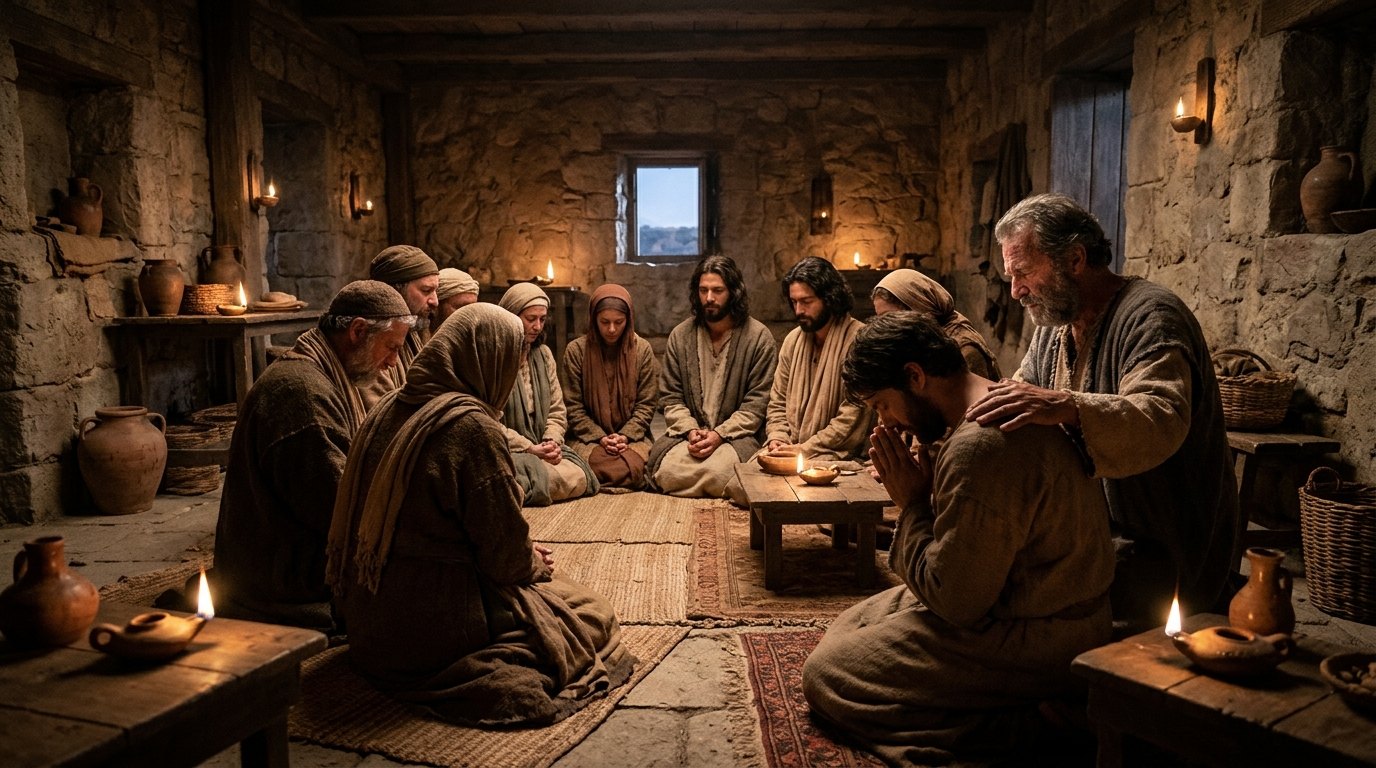
And let us consider how we may spur one another on toward love and good deeds,
Hebrews 10:24 (NIV)
The author calls believers to deliberate consideration of one another for the direct purpose of provoking love and good deeds.
The author of Hebrews commands the church: “Let us consider how to stir up one another to love and good works” (Hebrews 10:24). The Greek word translated “stir up” (paroxysmos) describes a sharp prodding or intentional incitement. Believers are called to study one another carefully so they might know how to provoke holy zeal and active obedience. This intentional sharpening cannot happen from a distance, which is why the text immediately forbids neglecting to meet together, commanding believers instead to encourage one another, all the more as the Day draws near (Hebrews 10:25).
Daily sharpening protects against spiritual apostasy. Hebrews 3:13 charges us to exhort one another every day, lest any be hardened by the deceitfulness of sin. Sin naturally blinds and insulates; the loving voice of a brother pierces that numbness. Paul shows how this works in the body of Christ: by speaking the truth in love, we grow up in every way into Christ the head (Ephesians 4:15). When a brother is overtaken in a transgression, those who are spiritual must restore him in a spirit of gentleness, keeping watch on themselves lest they also be tempted (Galatians 6:1), and thereby bear one another's burdens, and so fulfill the law of Christ (Galatians 6:2).
We share in this spiritual warfare together as good soldiers of Christ Jesus (2 Timothy 2:3). We are summoned to let the word of Christ dwell in us richly, teaching and admonishing one another in all wisdom (Colossians 3:16), encouraging one another and building one another up (1 Thessalonians 5:11). This pastoral care requires discernment: admonish the idle, encourage the fainthearted, help the weak, be patient with them all (1 Thessalonians 5:14). Paul was convinced that mature saints are full of goodness and competent to instruct one another (Romans 15:14). Therefore, James 5:16 concludes with this practical sharpening: confess your sins to one another and pray for one another, that you may be healed.
| Passage | What it says |
|---|---|
| Hebrews 10:24 | Believers must consider one another to provoke and stir up love and good works. |
| Hebrews 10:25 | The church must not forsake gathering together, but exhort one another as the Day approaches. |
| Hebrews 3:13 | Christians are commanded to exhort one another daily to prevent hearts from hardening through sin's deceitfulness. |
| Ephesians 4:15 | Speaking the truth in love causes the body of Christ to grow up into Him in all things. |
| Galatians 6:1 | Those who are spiritual must restore a brother caught in any transgression with a spirit of gentleness. |
| Galatians 6:2 | Believers bear one another's burdens and in doing so fulfill the law of Christ. |
| 2 Timothy 2:3 | Timothy is charged to endure hardship alongside other believers as a good soldier of Jesus Christ. |
| Colossians 3:16 | Believers teach and admonish one another with all wisdom through psalms and spiritual songs. |
| 1 Thessalonians 5:11 | Paul commands believers to encourage one another and build each other up. |
| 1 Thessalonians 5:14 | Admonishing the idle, encouraging the fainthearted, and helping the weak with patience. |
| Romans 15:14 | Believers are full of goodness and knowledge, competent to instruct and counsel one another. |
| James 5:16 | Confessing sins to one another and praying together brings spiritual healing. |
Where in the Bible
| Book | Passages |
|---|---|
| Exodus | 1 · Exodus 17:12 |
| 1 Samuel | 3 · 1 Samuel 23:16, 1 Samuel 18:1, 1 Samuel 20:42 |
| Job | 2 · Job 4:3, Job 4:4 |
| Psalms | 1 · Psalms 141:5 |
| Proverbs | 9 · Proverbs 27:17, Proverbs 27:5, Proverbs 27:6, Proverbs 27:9, Proverbs 28:23, Proverbs 17:17, Proverbs 13:20, Proverbs 15:31, Proverbs 25:12 |
| Ecclesiastes | 3 · Ecclesiastes 10:10, Ecclesiastes 4:9, Ecclesiastes 4:10 |
| Isaiah | 2 · Isaiah 35:3, Isaiah 35:4 |
| Romans | 1 · Romans 15:14 |
| Galatians | 2 · Galatians 6:1, Galatians 6:2 |
| Ephesians | 1 · Ephesians 4:15 |
| Colossians | 1 · Colossians 3:16 |
| 1 Thessalonians | 2 · 1 Thessalonians 5:11, 1 Thessalonians 5:14 |
| 2 Timothy | 1 · 2 Timothy 2:3 |
| Hebrews | 3 · Hebrews 10:24, Hebrews 10:25, Hebrews 3:13 |
| James | 1 · James 5:16 |
The story in order
- Creation of Man (c. 4000 BC) · Genesis 1:27 · God created man in His own image, implying inherent social design.
- The Fall of Man (c. 4000 BC) · Genesis 3:6 · Sin introduced brokenness and isolation, affecting human relationships.
- Moses' Hands Held Up (c. 1450 BC) · Exodus 17:12 · Communal support is vital for God's work and victory.
- Jonathan Strengthens David (c. 1000 BC) · 1 Samuel 23:16 · Friendship in God sustains believers during trials.
- David Welcomes Rebuke (c. 1000 BC) · Psalms 141:5 · Righteous counsel, though difficult, is valuable.
- Job Instructs and Upholds (c. 2000 BC) · Job 4:3-4 · Wise words strengthen and confirm those who stumble.
- Proverbial Wisdom (c. 950 BC) · Proverbs 27:17 · Purposeful interaction sharpens character like iron on iron.
- Two Are Better Than One (c. 950 BC) · Ecclesiastes 4:9-10 · Companionship provides mutual support and reward.
- Isaiah's Command (c. 700 BC) · Isaiah 35:3-4 · Encouragement strengthens the weak and fearful.
- Jesus' Ministry (AD 30) · Luke 10:1 · Jesus sent disciples out in pairs for mutual support.
- Early Church Exhortation (c. AD 65) · Hebrews 10:24-25 · Believers are called to gather and stir up love and good works.
- Apostolic Instruction (c. AD 60) · Ephesians 4:15 · Speaking truth in love fosters growth in Christ.
- Paul's Charge to Timothy (c. AD 67) · 2 Timothy 2:3 · Enduring hardship together is part of Christian service.
Friendship's Support in Adversity
| Friendship's Action | Biblical Example | Outcome | Passage |
|---|---|---|---|
| Strengthening hands in God | Jonathan and David | David's hand strengthened in God. | 1 Samuel 23:16 |
| Holding up weary hands | Aaron and Hur | Victory in battle assured. | Exodus 17:12 |
| Upholding and confirming the stumbling | Job's words | Those stumbling were upheld. | Job 4:3-4 |
| Lifting up a companion | Two are better than one | Protection from falling alone. | Ecclesiastes 4:9-10 |
| Restoring a fallen brother | Spiritual believers | Restoration in gentleness. | Galatians 6:1 |
The Value of Reproof
| Action | Description | Result | Passage |
|---|---|---|---|
| Open Rebuke | Better than hidden love | Genuine love speaks plainly. | Proverbs 27:5 |
| Faithful Wounds | Wounds of a friend | Contrast with deceitful kisses of an enemy. | Proverbs 27:6 |
| Rebuking a Man | Leads to more favor | Than flattering the tongue. | Proverbs 28:23 |
| Righteous Striking/Reproving | Welcome as excellent oil | Upon the head. | Psalms 141:5 |
| Life-giving Reproof | Listened to | Dwells among the wise. | Proverbs 15:31 |
| Wise Reprover | Like fine gold | To a listening ear. | Proverbs 25:12 |
The Progression of Mutual Exhortation
| Command | Purpose | Context | Passage |
|---|---|---|---|
| Consider one another | To provoke love and good works | Within the body of Christ. | Hebrews 10:24 |
| Exhort one another daily | Prevent hardening of hearts | As the Day approaches. | Hebrews 3:13 |
| Speak truth in love | Cause the body to grow up | Into Christ. | Ephesians 4:15 |
| Restore a brother | In a spirit of gentleness | If caught in transgression. | Galatians 6:1 |
| Bear one another's burdens | Fulfill the law of Christ | Together. | Galatians 6:2 |
| Teach and admonish one another | With all wisdom | Through psalms and spiritual songs. | Colossians 3:16 |
| Encourage one another | Build each other up | As the Day approaches. | 1 Thessalonians 5:11 |
| Admonish the idle, encourage the fainthearted | Help the weak with patience | In community. | 1 Thessalonians 5:14 |
Key words
- Sharpen (Hebrew: צָרַף (tsaraph))
- To make sharp or keen; to refine or improve through interaction. · Proverbs 27:17
- Countenance (Hebrew: פָּנִים (panim))
- The face or appearance of a person; one's character or disposition. · Proverbs 27:17
- Rebuke (Hebrew: הוֹכֵחַ (hokhiah))
- To express sharp disapproval or criticism; to correct or chastise. · Proverbs 27:5
- Strengthen (Hebrew: חָזַק (khazak))
- To make stronger; to give support or encouragement. · 1 Samuel 23:16
- Exhort (Greek: παραινέω (paraineō))
- To strongly encourage or urge someone to do something. · Hebrews 10:24
- Admonish (Greek: νουθετέω (noutheteō))
- To warn or reprimand someone firmly; to advise or urge earnestly. · Colossians 3:16
To live out this biblical proverb is to invite trusted believers into your life who love Christ enough to tell you the truth. As you receive their steadying counsel and offer your own in return, God uses that sacred friction to hone your character for His glory.
33 passages, each cited once.
Scripture cited
- Proverbs 27:17
- Hebrews 10:24
- Proverbs 27:9
- Job 4:3-4
- 1 Samuel 23:16
- Isaiah 35:3-4