What does the Bible say about judging others?

Matthew 7:1-5
1 “Do not judge, or you too will be judged.
2 For in the same way you judge others, you will be judged, and with the measure you use, it will be measured to you.
3 “Why do you look at the speck of sawdust in your brother’s eye and pay no attention to the plank in your own eye?
4 How can you say to your brother, ‘Let me take the speck out of your eye,’ when all the time there is a plank in your own eye?
5 You hypocrite, first take the plank out of your own eye, and then you will see clearly to remove the speck from your brother’s eye.
New International Version (NIV)
The answer
The Bible forbids hypocritical, self-righteous, superficial, and condemning judgment, but it does not forbid recognizing sin or lovingly correcting another person. Jesus says, “Don’t judge, so that you won’t be judged” (Matthew 7:1), yet the same teaching concludes, “First remove the beam out of your own eye, and then you can see clearly to remove the speck out of your brother’s eye” (Matthew 7:5). The purpose is therefore humble, clear-sighted help, not indifference toward evil.
Judgment that Scripture condemns
- Hypocrisy: Romans 2:1 warns that people who condemn others while doing the same things condemn themselves. Jesus likewise warns that the measure used against others will be measured back (Matthew 7:2). Personal sin must be faced honestly rather than excused while someone else’s sin is denounced.
- Harsh condemnation and an unforgiving spirit: Luke 6:37 joins “Judge not” with “condemn not” and “forgive, and ye shall be forgiven.” This condemns the attitude that delights in another person’s failure or refuses mercy.
- Contempt toward another believer: Romans 14:10-13 asks why a brother is judged or despised, reminding every believer that all will stand before Christ’s judgment seat and give an account to God.
- Pronouncing God’s final verdict: First Corinthians 4:5 commands, “judge nothing before the time, until the Lord comes,” because the Lord will expose hidden things and reveal the counsels of the heart. Human beings can evaluate conduct, but they cannot know every motive or determine anyone’s eternal destiny.
Discernment that Scripture requires
- Righteous rather than superficial judgment: Jesus explicitly says in John 7:24, “Don’t judge according to appearance, but judge righteous judgment.” Truthful moral discernment is therefore required, but it must rest on God’s standard rather than prejudice, gossip, or outward impressions.
- Gentle restoration: Galatians 6:1-2 instructs spiritual believers to restore someone caught in a fault “in a spirit of gentleness,” while watching themselves against temptation and bearing one another’s burdens. Correction should seek recovery, not humiliation.
- Accountability within the church: First Corinthians 5:12-13 distinguishes those inside the church from those outside: the church has responsibility to address wickedness among its own members, while God judges those outside. “Do not judge” cannot mean that the church should excuse or ignore persistent evil.
Before correcting someone, the beam must be removed first: repent of personal sin, establish the facts, abandon contempt, and aim at restoration. Calling conduct sinful when God calls it sinful is not the judging Jesus forbade; hypocritically excusing the same sin, rushing to condemnation, or pretending to know another person’s heart is.
Answered from Scripture · reviewed November 11, 2026
Scripture forbids harsh, self-righteous, and censorious condemnation of other people, yet it consistently calls believers to exercise righteous moral discernment and loving restoration. Far from teaching universal moral silence, Jesus and His apostles distinguish between usurping God's exclusive role as judge and walking in the clarity of truth. Understanding what the Bible commands guards the church against both destructive hypocrisy and undiscerning compromise.
The Measure Returned
Christ Prohibits Hypocritical and Merciless Condemnation

“Do not judge, or you too will be judged. For in the same way you judge others, you will be judged, and with the measure you use, it will be measured to you.
Matthew 7:1-2 (NIV)
Jesus lays down the foundational warning that censorious standards rebound upon those who pronounce them.
When Jesus commands in Matthew 7:1-2, "Judge not, that you be not judged," He strikes directly at the proud, condemnatory temper that presumes to pass final sentence on a neighbour. His warning is not a prohibition of moral discernment, but an absolute warning about divine retribution: the measure you dispense will be the exact measure pressed down and poured back into your own lap. A censorious spirit invites the unvarnished severity of heaven upon itself.
Luke 6:37-38 sharpens this solemn principle into practical discipleship, pairing the ban on condemning with the urgent summons to pardon and give generously. When a believer refuses to write off an offender in vindictive bitterness, they align their heart with the lavish mercy of God. In contrast, James 2:12-13 issues an alarming verdict to the legalist: judgment is merciless to the one who has shown no mercy, yet sovereign mercy rejoices against judgment for those who walk under the royal law of liberty.
This balance anchors Old Testament wisdom as well. Proverbs 24:23-24 warns that partiality in rendering verdicts corrupts community life; declaring an ungodly man righteous brings a curse, proving that God despises skewed balances whether they lean toward harshness or false acquittal. True Christian conduct is governed by Matthew 7:12, where the Golden Rule sums up the Law and the Prophets: treat others with the patient equity and charitable interpretation you desire when your own weaknesses are weighed.
| Passage | What it says |
|---|---|
| Matthew 7:1-2 | Christ forbids censorious judging and warns that the exact standard used will measure back to the judge. |
| Luke 6:37-38 | Jesus commands believers not to judge or condemn, pairing the prohibition with generous pardon and abundant giving. |
| James 2:12-13 | James warns that judgment is without mercy to one who has shown no mercy, for mercy triumphs over judgment. |
| Proverbs 24:23-24 | Declares that partiality in judgment is wrong and that justifying the wicked brings a curse from the peoples. |
| Matthew 7:12 | Summarizes the Law and the Prophets: treat others as you wish to be treated, guarding against ungracious verdicts. |
The Beam and Speck
Self-Examination Must Precede Any Loving Correction

“Why do you look at the speck of sawdust in your brother’s eye and pay no attention to the plank in your own eye? How can you say to your brother, ‘Let me take the speck out of your eye,’ when all the time there is a plank in your own eye? You hypocrite, first take the plank out of your own eye, and then you will see clearly to remove the speck from your brother’s eye.
Matthew 7:3-5 (NIV)
Jesus exposes the gross spiritual blindness of confronting another's minor flaw while ignoring one's own glaring sin.
In Matthew 7:3-5, Christ exposes the grotesque folly of self-righteous correction, asking why one stares at a tiny mote in a brother's eye while ignoring the monstrous wooden log protruding from one's own. Jesus does not forbid helping the brother; rather, He commands genuine repentance first. Only when the hypocrite endures the agony of self-cleansing can he see clearly enough to minister restoration to anyone else.
Luke 6:41-42 repeats this searching metaphor to strip away religious pretense. A blind guide cannot steer another through the ditch of sin. Paul takes up the identical indictment in Romans 2:1-3, declaring that anyone who pronounces moral condemnation upon the pagan world while secretly cherishing the same lusts and deceits is wholly inexcusable before God. Spiritual blindness inevitably weaponizes God's law against others while granting amnesty to self.
Scripture supplies vivid portraits of this blindness shattered. In 2 Samuel 12:5-7, King David burned with righteous fury against a fictitious rich man who stole a pet lamb, completely insensible to his own crimes of adultery and murder until Nathan struck his conscience with the words: "You are the man!" Similarly, in John 8:7-9, Jesus dismantled an eager lynch mob by challenging the sinless to cast the first stone, driving them away conscience-stricken from eldest to youngest. Therefore, Galatians 6:1 commands that when a believer is overtaken in a trespass, those who are spiritual must restore him in a spirit of gentleness, continually guarding their own hearts against temptation. As Titus 3:2-3 reminds us, patience toward all men is rooted in the sobering memory of our own past foolishness and enslavement before grace appeared.
| Passage | What it says |
|---|---|
| Matthew 7:3-5 | Jesus commands clearing the beam from one's own eye before attempting to help remove a brother's speck. |
| Luke 6:41-42 | Luke's account reiterates the impossibility of proper spiritual assistance while unrepentant moral blindness remains. |
| Romans 2:1-3 | Paul declares that those who condemn others are inexcusable because they practice the very same transgressions. |
| Galatians 6:1 | Believers are instructed to restore the caught brother in a spirit of gentleness, watching themselves lest they be tempted. |
| 2 Samuel 12:5-7 | Nathan exposes David's blind hypocrisy in condemning a ruthless rich man while blind to his own adultery and murder. |
| John 8:7-9 | Jesus calls on those without sin to cast the first stone, compelling accusers to confront their own guilt. |
| Titus 3:2-3 | Exhorts believers to be gentle toward all, remembering their own past enslavement to foolishness and sin. |
Usurping the Lawgiver
God Alone Sits on the Sovereign Throne of Judgment

Brothers and sisters, do not slander one another. Anyone who speaks against a brother or sister or judges them speaks against the law and judges it. When you judge the law, you are not keeping it, but sitting in judgment on it. There is only one Lawgiver and Judge, the one who is able to save and destroy. But you—who are you to judge your neighbor?
James 4:11-12 (NIV)
James reveals that speaking evil of a brother elevates a creature into the seat of the one sovereign Lawgiver.
James 4:11-12 reveals the terrifying presumption behind a slanderous and critical spirit: whoever speaks evil of a brother and passes judgment upon him sits upon God's throne, making himself a judge of the law rather than a doer of it. James reminds the church that there is only one Lawgiver and Judge—the sovereign God who alone has the power to save and to destroy. Usurping that bench is cosmic treason.
This boundary is vital in the fellowship of the local church. Romans 14:4 confronts petty ecclesiastical fault-finding by asking: "Who are you to pass judgment on the servant of another? It is before his own master that he stands or falls." Paul broadens this in Romans 14:10-13, urging believers to abandon their mutual contempt over secondary matters and disputable practices, because every single redeemed saint must ultimately give an account of himself directly to God.
Human judgment is radically flawed because it cannot read human hearts. In 1 Corinthians 4:3-5, Paul confesses that he does not even pass final judgment on himself; he awaits the day when the Lord returns to bring to light the hidden things of darkness and disclose the secret motives of the heart. For this reason, vengeance belongs exclusively to the Lord, as Deuteronomy 32:35 and Romans 12:19 declare: believers must never avenge themselves, but leave wrath to God's perfect timing. We rest in 2 Corinthians 5:10, knowing that all humanity must appear before the judgment seat of Christ to receive what is due for deeds done in the body.
| Passage | What it says |
|---|---|
| James 4:11-12 | Speaking evil and judging a brother sets oneself over the divine law, defying the one Lawgiver and Judge. |
| Romans 14:10-13 | Paul commands believers to cease judging brothers in disputable matters since every person will give account to Christ. |
| 1 Corinthians 4:3-5 | Paul forbids judging before the time when the Lord brings hidden counsels and motives to light. |
| Deuteronomy 32:35 | Affirms that ultimate vengeance and retribution belong solely to God in His appointed time. |
| Romans 12:19 | Forbids personal revenge, commanding believers to leave room for the wrath and righteous judgment of God. |
| Romans 14:4 | Asks who has authority to judge another's servant, since each stands or falls before his own Master. |
| 2 Corinthians 5:10 | Reminds all believers that everyone must appear before the judgment seat of Christ to receive what is due. |
Righteous Discernment
Scripture Demands Testing Spirits and Moral Fruit

Stop judging by mere appearances, but instead judge correctly.”
John 7:24 (NIV)
Jesus explicitly commands people to judge, establishing righteous standard rather than superficial appearance as the rule.
In John 7:24, the Lord Jesus issues an unmistakable mandate: "Do not judge by appearances, but judge with right judgment." Far from endorsing a vague, undiscerning tolerance, Scripture repeatedly commands believers to exercise robust moral clarity. Right judgment does not invent arbitrary human traditions; it anchors itself strictly in the revealed standard of God's Word and applies it without fear or favor.
Jesus Himself warns in Matthew 7:15-20 that false prophets come disguised in sheep's clothing, ravenous wolves who can be identified only by examining their fruit. Moral inspection is an act of spiritual survival. Similarly, in Matthew 7:6, disciples are forbidden from throwing pearls before swine, a command that requires assessing character and spiritual openness before offering sacred things. The Apostle John reiterates this protective obligation in 1 John 4:1, charging the flock never to believe every spirit, but to test every spirit against apostolic truth.
Scriptural discernment requires active mental discipline. In Acts 17:11, the Bereans are commended as noble because they tested Paul's own apostolic preaching daily against the Old Testament Scriptures. Paul prays in Philippians 1:9-10 that our love may abound in knowledge and all discernment to approve what is truly excellent, while 1 Thessalonians 5:21-22 demands that we test all things and cling to what is good. Proverbs 31:9 directs godly rulers to judge righteously and defend the poor. As Hebrews 5:14 summarizes, mature believers are those who have their powers of discernment trained by constant practice to distinguish good from evil.
| Passage | What it says |
|---|---|
| John 7:24 | Jesus commands His hearers not to judge according to appearance, but to judge with righteous judgment. |
| Matthew 7:15-20 | Jesus instructs His disciples to evaluate teachers by their fruit to detect wolves dressed in sheep's clothing. |
| 1 John 4:1 | John directs the church not to believe every spirit, but to test spirits whether they are from God. |
| 1 Thessalonians 5:21-22 | Paul instructs believers to test all things carefully, hold fast what is good, and abstain from evil. |
| Proverbs 31:9 | Commands open speech, righteous judgment, and the active defense of the rights of the poor and needy. |
| Matthew 7:6 | Instructs disciples not to give what is holy to dogs, demanding discernment regarding spiritual receptivity. |
| Acts 17:11 | Commends the Bereans for critically examining Paul's preaching against the Scriptures daily to discern truth. |
| Philippians 1:9-10 | Prays for love to abound in knowledge and all discernment to approve what is truly excellent. |
| Hebrews 5:14 | States that mature believers have trained their powers of discernment through practice to distinguish good from evil. |
Discipline in the Assembly
The Church Is Accountable for Order and Purity

What business is it of mine to judge those outside the church? Are you not to judge those inside? God will judge those outside. “Expel the wicked person from among you.”
1 Corinthians 5:12-13 (NIV)
Paul distinguishes between the world outside which God judges and the inside assembly which must address unrepentant sin.
In 1 Corinthians 5:12-13, the apostle Paul draws a clear boundary line that silences the common misconception that Christians may never exercise moral judgment: "For what have I to do with judging outsiders? Is it not those inside the church whom you are to judge? God judges those outside. 'Purge the evil person from among you.'" Far from recommending blanket non-involvement, Scripture commands the covenant community to maintain holiness, order, and mutual accountability within its own ranks.
This communal responsibility begins on an individual level. In Leviticus 19:17, God commands His people to reason frankly with their neighbor rather than harboring silent bitterness or sharing in his guilt. Jesus reaffirms this duty in Luke 17:3, telling His disciples to rebuke an erring brother and grant immediate forgiveness upon repentance. In Matthew 18:15-17, the Lord provides the formal, four-step pattern for church discipline, moving from a private conversation to two or three witnesses, and ultimately to the assembly if the offender refuses to repent.
When a congregation neglects this sacred trust, moral collapse follows. In 1 Corinthians 5:1-5, Paul fiercely censures the Corinthian believers for tolerating flagrant incest with pride rather than mourning, ordering them to deliver the unrepentant man to Satan for the destruction of the flesh so his spirit might be saved. In 1 Corinthians 6:1-4, he shames them for airing civil grievances before secular magistrates when saints will one day judge the world and angels. When leadership falters, 1 Timothy 5:20 instructs that elders who persist in sin be rebuked before all to instill holy fear. Yet this judgment is never vindictive: 2 Thessalonians 3:14-15 urges the church to withhold fellowship from a defiant brother without treating him as an enemy, while Titus 3:10-11 directs rejecting a factious person only after a first and second warning.
| Passage | What it says |
|---|---|
| Matthew 18:15-17 | Jesus outlines the deliberate, four-stage process for addressing an offending brother within the covenant community. |
| 1 Corinthians 5:1-5 | Paul censures Corinth for tolerating blatant immorality, commanding them to hand the unrepentant offender over to Satan. |
| 1 Corinthians 5:12-13 | Paul states believers have no mandate to judge outsiders, but must judge members within and purge evil. |
| 1 Corinthians 6:1-4 | Paul rebukes taking civil disputes before worldly courts since the saints are destined to judge the world. |
| 2 Thessalonians 3:14-15 | Paul tells the church to note the disobedient brother yet admonish him as a brother, not an enemy. |
| Leviticus 19:17 | Commands rebuking a neighbor candidly rather than harboring hatred in one's heart, avoiding bearing sin because of him. |
| Luke 17:3 | Commands disciples to rebuke a sinning brother and to forgive him if he sincerely repents. |
| 1 Timothy 5:20 | Directs that elders who persist in sin be rebuked in the presence of all as a solemn warning. |
| Titus 3:10-11 | Commands warning a divisive person once or twice, and thereafter having nothing more to do with him. |
Civil and Legal Justice
God Commands Impartial Justice in Public and Civil Law
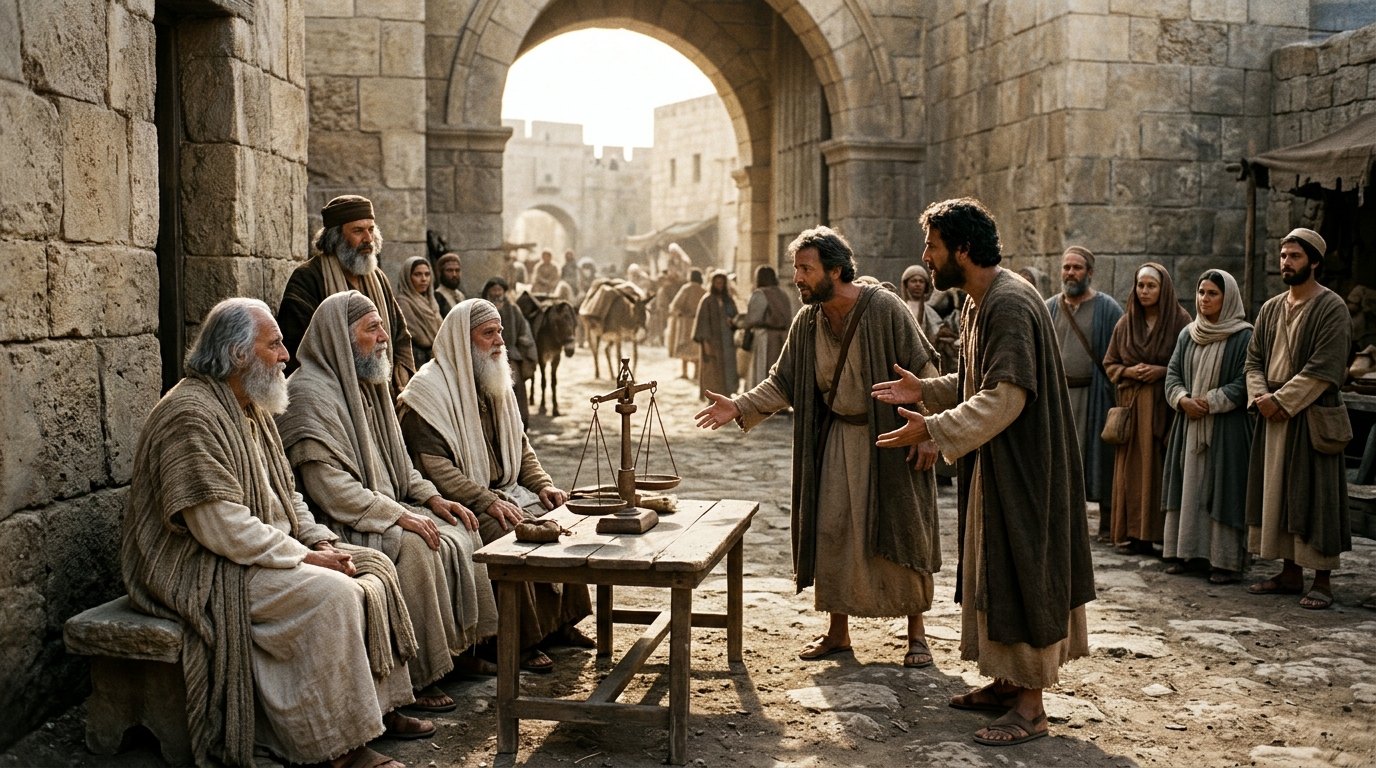
“ ‘Do not pervert justice; do not show partiality to the poor or favoritism to the great, but judge your neighbor fairly.
Leviticus 19:15 (NIV)
It defines God's absolute standard for external judgment: total impartiality without respect to wealth or status.
In Leviticus 19:15, God lays down the unbending standard for all civil and legal administration: "You shall do no injustice in court. You shall not be partial to the poor or defer to the great, but in righteousness shall you judge your neighbor." Civil justice is not an intrusion into God's sovereign domain, but an institution established and regulated by God Himself to preserve human society against anarchy and violence.
True justice demands strict impartiality that resists every corrupting influence. In Exodus 23:2-3, God forbids running with a mob to pervert testimony or tipping the scales toward a poor man merely out of sentimental sympathy. Deuteronomy 1:16-17 records Moses charging the judges of Israel to hear small and great alike without fear of human reprisal, declaring plainly that "the judgment is God's." Deuteronomy 16:18-20 commands the people to appoint righteous judges in every town who will never subvert justice, show favoritism, or accept a bribe, because bribes blind the eyes of the wise and twist the words of the righteous.
This legal duty carries directly into the New Testament. In Romans 13:1-4, Paul explains that civil government is appointed by God to curb evil and maintain public righteousness. The magistrate does not bear the sword in vain; he is God's servant, an avenger who carries out God's wrath on the wrongdoer. Far from forbidding legal verdicts, Scripture sanctifies impartial civil judgment as a vital earthly reflection of God's own perfect justice.
| Passage | What it says |
|---|---|
| Exodus 23:2-3 | Forbids following a crowd to do evil or perverting justice to favor a person in a lawsuit. |
| Leviticus 19:15 | Mandates judging one's neighbor with absolute justice, without deferring to the poor or favoring the great. |
| Deuteronomy 1:16-17 | Commands appointed judges to hear cases impartially without fear of man, because judgment belongs to God. |
| Deuteronomy 16:18-20 | Instructs Israel to appoint judges who administer justice without perversion, partiality, or taking bribes. |
| Romans 13:1-4 | Identifies civil magistrates as God's servants executing righteous wrath and judgment on those who do evil. |
Where in the Bible
| Book | Passages |
|---|---|
| Exodus | 1 · Exodus 23:2-3 |
| Leviticus | 2 · Leviticus 19:17, Leviticus 19:15 |
| Deuteronomy | 3 · Deuteronomy 32:35, Deuteronomy 1:16-17, Deuteronomy 16:18-20 |
| 2 Samuel | 1 · 2 Samuel 12:5-7 |
| Proverbs | 2 · Proverbs 24:23-24, Proverbs 31:9 |
| Matthew | 6 · Matthew 7:1-2, Matthew 7:12, Matthew 7:3-5, Matthew 7:15-20, Matthew 7:6, Matthew 18:15-17 |
| Luke | 3 · Luke 6:37-38, Luke 6:41-42, Luke 17:3 |
| John | 2 · John 8:7-9, John 7:24 |
| Acts | 1 · Acts 17:11 |
| Romans | 5 · Romans 2:1-3, Romans 14:10-13, Romans 12:19, Romans 14:4, Romans 13:1-4 |
| 1 Corinthians | 4 · 1 Corinthians 4:3-5, 1 Corinthians 5:1-5, 1 Corinthians 5:12-13, 1 Corinthians 6:1-4 |
| 2 Corinthians | 1 · 2 Corinthians 5:10 |
| Galatians | 1 · Galatians 6:1 |
| Philippians | 1 · Philippians 1:9-10 |
| 1 Thessalonians | 1 · 1 Thessalonians 5:21-22 |
| 2 Thessalonians | 1 · 2 Thessalonians 3:14-15 |
| 1 Timothy | 1 · 1 Timothy 5:20 |
| Titus | 2 · Titus 3:2-3, Titus 3:10-11 |
| Hebrews | 1 · Hebrews 5:14 |
| James | 2 · James 2:12-13, James 4:11-12 |
| 1 John | 1 · 1 John 4:1 |
The story in order
- The Law Given to Israel (c. 1450 BC) · Exodus 23:2-3 · Commands impartial justice in lawsuits, forbidding following crowds or perverting justice.
- Command for Impartial Judgment (c. 1450 BC) · Leviticus 19:15 · Mandates judging neighbors with absolute justice, regardless of status.
- Judges Appointed for Israel (c. 1400 BC) · Deuteronomy 1:16-17 · Judges must hear cases impartially, as judgment belongs to God.
- David's Adultery and Murder (c. 1000 BC) · 2 Samuel 12:5-7 · Nathan exposes David's hypocrisy in condemning another while blind to his own sin.
- Wisdom in Judgment (c. 900 BC) · Proverbs 24:23-24 · Declares partiality in judgment wrong and justifying the wicked brings a curse.
- Jesus Teaches on Judgment (c. AD 30) · Matthew 7:1-2 · Christ forbids censorious judging, warning that the standard used will measure back.
- Jesus Teaches Self-Examination (c. AD 30) · Matthew 7:3-5 · Jesus commands removing the beam from one's own eye before helping another.
- Jesus Commands Righteous Judgment (c. AD 30) · John 7:24 · Jesus commands not to judge by appearance, but with righteous judgment.
- Jesus Confronts Accusers (c. AD 30) · John 8:7-9 · Jesus compels accusers to confront their own guilt before casting stones.
- Paul on Judging Brothers (c. AD 55) · Romans 14:10-13 · Paul commands believers to cease judging brothers, as all will account to Christ.
- Paul on Church Discipline (c. AD 55) · 1 Corinthians 5:1-5 · Paul censures Corinth for tolerating immorality, commanding them to remove the offender.
- Paul on Judging Outsiders (c. AD 55) · 1 Corinthians 5:12-13 · Believers judge members within the church, not outsiders.
- Maturity in Discernment (c. AD 65) · Hebrews 5:14 · Mature believers train their discernment to distinguish good from evil.
- Church Discipline Process (c. AD 30) · Matthew 18:15-17 · Jesus outlines a process for addressing offending brothers within the community.
Hypocrisy vs. Righteous Judgment
| Hypocritical Judgment | Righteous Judgment | Passage |
|---|---|---|
| Condemning others while practicing the same sins. | Self-examination precedes correction. | Matthew 7:3-5 |
| Condemning others while being inexcusable oneself. | Testing spirits and discerning truth. | Romans 2:1-3 |
| Judging by appearance. | Judging with righteous judgment. | John 7:24 |
| Judging before the appointed time. | Letting God's judgment unfold. | 1 Corinthians 4:3-5 |
The Danger of Unmerciful Judgment
| Unmerciful Judgment | Merciful Outcome | Passage |
|---|---|---|
| The exact standard used will measure back to the judge. | Generous pardon and abundant giving are paired with non-condemnation. | Luke 6:37-38 |
| Judgment is without mercy to one who has shown no mercy. | Mercy triumphs over judgment. | James 2:12-13 |
| Justifying the wicked brings a curse. | Defending the rights of the poor and needy. | Proverbs 31:9 |
Key words
- Judge (krino, κρίνω)
- To discern, pass sentence, condemn, or exercise righteous judgment. · Matthew 7:1
- Mercy (eleos, ἔλεος)
- Compassion or kindness shown toward someone, especially when it is within one's power to punish or harm. · James 2:13
- Discernment (diakrisis, διάκρισις)
- The ability to judge well; keen insight and good judgment. · Hebrews 5:14
- Righteous Judgment (krisis dikaia, κρίσις δικαία)
- Judgment that is morally right and conforms to God's standards. · John 7:24
- Gentleness (prautes, πραΰτης)
- Mildness of disposition; tenderness, meekness, and forbearance. · Galatians 6:1
Believers are summoned to lay down censorious arrogance, examine their own lives with sobriety, and extend restorative love to their brethren. Because the Lord alone sees the human heart and will evaluate every soul at the final judgment, our speech and actions must reflect His holiness and His mercy. We judge ourselves strictly, evaluate truth carefully by God's Word, and entrust all ultimate condemnation to the righteous Judge of all the earth.
42 passages, each cited once.
Scripture cited
- Luke 6:37
- Romans 2:1-2
- Romans 14:10-13
- Matthew 7:5
- John 7:24
- Galatians 6:1-2
- 1 Corinthians 4:5
- 1 Corinthians 5:12-13