What does the Bible say about other gods?

Exodus 20:3
3 “You shall have no other gods before me.
New International Version (NIV)
The answer
The Bible's plain answer is that there is only one God, and that every other so-called god is nothing at all. The first word God ever spoke as a commandment is Exodus 20:3: "You shall have no other gods before me." The Hebrew carries "before my face" — not a ranking that puts other gods lower, but a total ban: in the presence of the one true God, no other may exist for you.
Why the ban is so absolute
Because the one God claims to be the only God. Isaiah 46:9 says, "I am God, and there is none else; I am God, and there is none like me." And Deuteronomy 10:17 names Him "God of gods and Lord of lords" — He is the God over every pretended deity, not one god among many. The Bible never treats the gods of Egypt, Canaan, Babylon, Greece or Rome as lesser rivals; it treats them as empty (Jeremiah 10:5; Psalm 96:5: "all the gods of the peoples are idols").
What Scripture counts as "other gods"
- Idols and statues — the golden calf at Sinai (Exodus 32), Baal and Ashtoreth in the Judges period (Judges 10:6), the household teraphim Rachel stole (Genesis 31:19).
- Sun, moon, and stars — explicitly forbidden as things to bow to (Deuteronomy 4:19).
- Human self-exaltation — Ezekiel 28:2: the prince of Tyre says "I am a god, I sit in the seat of God", and God answers, "yet you are man, and no god."
- Anything that displaces God — 1 John 5:21 warns the believer, "Little children, keep yourselves from idols."
Jesus says the same thing
Satan offered Jesus all the kingdoms of the world, and Matthew 4:10 records the answer: "Get behind me, Satan, for it is written, 'You shall worship the Lord your God, and him only shall you serve.'" This is not an old-covenant rule that Jesus softened; He enforced it at the sharpest moment of His life.
What this means for a believer today
The Bible's logic runs deep: because the Lord is the only true God, the calling on us is wholehearted — Deuteronomy 6:5, "You shall love the LORD your God with all your heart, and with all your soul, and with all your might." Anything you love more than Him, trust more than Him, or serve instead of Him is functionally an "other god." That is why the New Testament calls greed itself idolatry (Colossians 3:5), and why 2 Corinthians 6:16 asks, "What agreement does a temple of God have with idols?"
A short way to carry it
Exodus 20:3 is not the first step in a list of religious duties; it is the foundation of the whole list. If you keep only this one commandment perfectly — the Lord alone, with everything you are — every other command follows.
Where pastors help
Your pastor can walk through the immediate context of any people, place or idol named in Scripture (Baal, Molech, the Asherah poles at the high places, the teraphim) and show what faithfulness to the one true God looked like in that setting.
Answered from Scripture · reviewed November 7, 2026
Scripture speaks with one unwavering voice across both Testaments: the Lord alone is God, and every rival deity is a powerless counterfeit. The first commandment establishes this foundation not by arranging a hierarchy of gods, but by banning all others entirely from His presence.
The First Commandment
No other gods may stand before Him

“You shall have no other gods before me.
Exodus 20:3 (NIV)
This opening word of the Ten Commandments establishes that God tolerates no rival deities whatsoever in His presence.
When God spoke from Sinai, His very first stipulation established an absolute boundary: "You shall have no other gods before me" (Exodus 20:3). This command does not merely banish rivals from a localized temple precinct; the Hebrew idiom conveys that no supposed deity may stand before His face or enter His presence. Moses repeats this foundational covenant obligation in Deuteronomy 5:7 and reinforces it in Deuteronomy 6:14, commanding Israel never to go after the gods of surrounding peoples. In Exodus 23:13, the Lord demands such utter separation that the names of false gods are not even to pass the lips of His people. The psalmist sounds the identical warning in Psalm 81:9, declaring that no strange god shall dwell among the covenant community.
Yet Israel's history demonstrates how continually this command was tested. In Joshua 24:14, Joshua challenges the nation at Shechem to cast away the foreign gods their ancestors served beyond the Euphrates and in Egypt, and to cling to the Lord in sincerity. When Israel inevitably strayed into spiritual adultery, the Lord exposed the emptiness of their unfaithfulness, telling them in Judges 10:14 to go and cry out to the deities they had chosen to see if those gods could deliver them in their affliction. Second Kings 17:35 records the perpetual covenant that Israel broke, reminding them that they were commanded never to fear, bow to, serve, or sacrifice to other gods. Jeremiah 25:6 reiterates this enduring prophetic plea, warning the people not to chase after foreign deities to their own destruction and provoke the wrath of their Maker. Exclusive loyalty is God's non-negotiable claim on His people.
| Passage | What it says |
|---|---|
| Exodus 20:3 | Forbids having any other gods before the face of the Lord. |
| Deuteronomy 5:7 | Reiterates the covenant demand of exclusive devotion to God alone. |
| Deuteronomy 6:14 | Commands Israel not to pursue any gods of surrounding nations. |
| Psalms 81:9 | Warns God's people that no strange god may dwell among them. |
| Exodus 23:13 | Israel is instructed not to invoke or even let the names of other gods be heard on their lips. |
| Joshua 24:14 | Joshua commands the people to put away the foreign gods their fathers served and serve the Lord in sincerity. |
| Judges 10:14 | The Lord rebukes Israel to go cry out to the other gods they chose in times of distress. |
| 2 Kings 17:35 | The Lord covenants with Israel commanding them not to fear, bow to, serve, or sacrifice to other gods. |
| Jeremiah 25:6 | Jeremiah warns the people not to go after other gods to serve and worship them or provoke God to anger. |
The Living God
The Lord alone exists as true God

Remember the former things, those of long ago; I am God, and there is no other; I am God, and there is none like me.
Isaiah 46:9 (NIV)
The Lord declares His unmatched uniqueness, stating plainly that there is no other God beside Him.
The singular identity of the Lord leaves no room for any ontological rival. Isaiah 46:9 rings with supreme clarity: "Remember the former things of old; for I am God, and there is no other; I am God, and there is none like me." From the dawn of Israel's redemption, God manifested His mighty hand so that His people would know that the Lord is God in heaven above and on the earth beneath, and there is none else (Deuteronomy 4:35, 39). He declares through Moses, "See now that I, even I, am he, and there is no god beside me" (Deuteronomy 32:39), and reveals Himself as the supreme "God of gods and Lord of lords" (Deuteronomy 10:17).
David echoed this foundational truth in prayer, saying, "There is none like you, neither is there any God beside you" (2 Samuel 7:22), a reality Solomon prayed that all peoples of the earth might know (1 Kings 8:60). Through Isaiah, the Lord repeatedly demolishes the notion of competing deities: He is the first and the last, and besides Him there is no god (Isaiah 44:6); indeed, He searches the cosmos and knows not one other rock (Isaiah 44:8). Over and over He proclaims, "I am the Lord, and there is no other, besides me there is no God" (Isaiah 45:5), urging all the ends of the earth to turn to Him alone as the solitary righteous God and Savior (Isaiah 45:21-22). The New Testament carries this exact monotheism forward without dilution: the scribe affirms to Jesus that God is one and there is no other (Mark 12:32), while Paul insists that "an idol has no real existence" and "there is no God but one" (1 Corinthians 8:4). Although the pagan world imagines many so-called gods, for believers there is only one God the Father and one Lord Jesus Christ (1 Corinthians 8:5-6), and one mediator between God and men, the man Christ Jesus (1 Timothy 2:5).
| Passage | What it says |
|---|---|
| Deuteronomy 10:17 | Declares the Lord to be God of gods and Lord of lords. |
| Isaiah 45:5 | Affirms that beside the Lord there is simply no God at all. |
| Isaiah 46:9 | Commands remembrance of God's unmatched identity and singular sovereignty. |
| 1 Corinthians 8:4 | Affirms that an idol has no real existence and God is one. |
| Deuteronomy 4:35 | God showed wonders so Israel would know that the Lord is God and there is no other besides Him. |
| Deuteronomy 4:39 | Acknowledgment that the Lord is God in heaven above and on earth beneath with none else. |
| Deuteronomy 32:39 | The Lord declares that He alone is He, and there is no god beside Him. |
| 2 Samuel 7:22 | David praises God, affirming that none is like Him and there is no God beside Him. |
| 1 Kings 8:60 | Solomon prays that all peoples may know the Lord is God and that there is no other. |
| Isaiah 44:6 | The Lord, the King and Redeemer of Israel, states He is first and last, and beside Him there is no god. |
| Isaiah 44:8 | God asks if there is any God besides Him, declaring that He knows not one. |
| Isaiah 45:21-22 | The Lord declares He is the only righteous God and Savior, urging all the ends of the earth to look to Him. |
| Mark 12:32 | The scribe agrees with Jesus that God is one and there is no other besides Him. |
| 1 Corinthians 8:5-6 | Though there are so-called gods in heaven or on earth, for believers there is only one God the Father and one Lord Jesus Christ. |
| 1 Timothy 2:5 | Paul affirms there is one God and one mediator between God and men, the man Christ Jesus. |
The Emptiness of Idols
Manufactured deities are helpless and vain
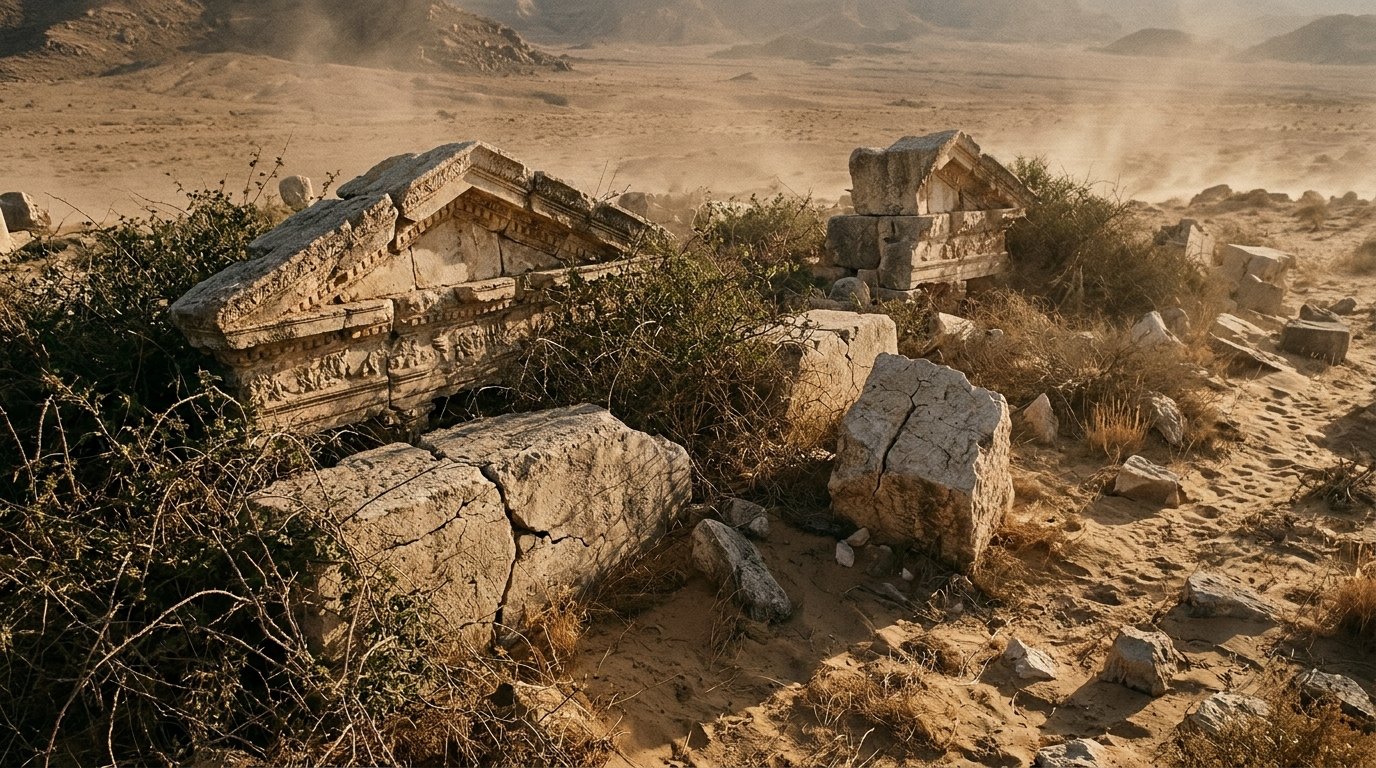
For all the gods of the nations are idols, but the LORD made the heavens.
Psalms 96:5 (NIV)
David exposes all pagan gods as mere lifeless idols in contrast to the Creator of the heavens.
Scripture confronts the manufactured deities of human imagination with unsparing irony: "For all the gods of the peoples are worthless idols, but the Lord made the heavens" (Psalm 96:5). The second commandment explicitly outlaws fashioning any physical likeness of created things to bow before them (Exodus 20:4-5), because no chunk of earth can represent the transcendent Creator. The Psalms expose the absolute absurdity of idolatry: idols are mere silver and gold, the work of human hands, possessing mouths that cannot speak, eyes that cannot see, and feet that cannot walk, and those who trust in them inevitably become just as lifeless and blind (Psalm 115:4-8; Psalm 135:15-18).
Jeremiah lampoons these handcrafted images as scarecrows in a cucumber field that must be carried because they cannot step forward (Jeremiah 10:3-5). Craftsmen cut a tree, fasten the wood with hammers, and overlay it with gold, yet the object remains a dead deception devoid of breath, destined to perish in judgment (Jeremiah 10:14-15; Habakkuk 2:18-19). Isaiah paints the devastating portrait of a man who cuts down a cedar, burns half of it to bake bread and warm his hands, and shapes the rest into a carved god, falling down to pray, "Deliver me, for you are my god!" (Isaiah 44:9-20; Isaiah 40:18-20). Men lavish gold from a bag, set an idol in place, and it stands frozen, unable to move or answer a cry of agony (Isaiah 46:6-7). The tragedy is immense: pagan nations never abandon their false gods, yet God's people foolishly exchanged their living Glory for that which cannot profit (Jeremiah 2:11). Centuries later on the Areopagus in Athens, Paul declared that the Divine Nature cannot be formed by human craft or stone (Acts 17:29), provoking silversmiths like Demetrius precisely because the gospel proved that gods made with hands are not gods at all (Acts 19:26).
| Passage | What it says |
|---|---|
| Psalms 96:5 | Declares the gods of the nations to be mere worthless idols. |
| Psalms 115:4-8 | Describes silver and gold idols as blind, deaf, and entirely helpless. |
| Jeremiah 10:5 | Compares handcrafted idols to scarecrows that cannot speak or walk. |
| Habakkuk 2:18-19 | Pronounces woe upon trusting mute wood and stone overlaid with gold. |
| Exodus 20:4-5 | The commandment forbids making carved images or likenesses of anything in heaven, earth, or sea to bow down to them. |
| Psalms 135:15-18 | The idols of nations are silver and gold, having mouths that do not speak, eyes that do not see, and those who trust them become like them. |
| Isaiah 40:18-20 | Isaiah shows the folly of likening God to an idol shaped by a craftsman or carved from wood that will not rot. |
| Isaiah 44:9-20 | A vivid description of a man using part of a tree for fuel and cooking, while carving the rest into a god to worship. |
| Isaiah 46:6-7 | Men lavish gold to make an idol, but when set in place it cannot move or answer cries of distress. |
| Jeremiah 2:11 | The Lord laments that while nations do not change their false gods, Israel exchanged their Glory for what cannot profit. |
| Jeremiah 10:3-4 | The customs of the peoples are vanity, cutting wood from the forest, decorating it with silver and gold, and fastening it with hammers. |
| Jeremiah 10:14-15 | Goldsmiths are put to shame by their idols, which are falsehoods without breath, destined to perish in the day of punishment. |
| Acts 17:29 | Paul preaches in Athens that the Divine Nature cannot be thought of as gold, silver, or stone formed by human art and design. |
| Acts 19:26 | Demetrius complains that Paul persuaded many by teaching that gods made with hands are not gods at all. |
The Dark Reality
Demonic deception behind pagan worship

No, but the sacrifices of pagans are offered to demons, not to God, and I do not want you to be participants with demons.
1 Corinthians 10:20 (NIV)
Paul reveals that what pagans sacrifice to idols is actually offered to demons, not to God.
While idols themselves are inert wood and metal, Scripture pulls back the veil to expose a dark spiritual power operating behind pagan worship: "No, I imply that what pagans sacrifice they offer to demons and not to God" (1 Corinthians 10:20). False religion is never merely harmless folklore; it is an avenue of demonic deception. Moses warned Israel that unfaithfulness meant sacrificing to goat demons and new gods that their fathers never feared, abandoning the Rock who bore them (Leviticus 17:7; Deuteronomy 32:17). The depths of this horror were realized when apostate Israel served Canaanite idols and sacrificed their own sons and daughters to demons, shedding innocent blood (Psalm 106:36-37).
This unseen spiritual warfare runs throughout redemptive history. In the Exodus, the Lord explicitly executed judgment against all the gods of Egypt, demonstrating His absolute supremacy over the demonic principalities they represented (Exodus 12:12; Numbers 33:4). In the divine council, God confronts the rebellious spiritual authorities, declaring that although they were called gods and sons of the Most High, they will die like mortal men and fall under His sovereign sentence (Psalm 82:1, 6-7). All worshippers of carved images are ultimately put to shame, and every celestial power is commanded to bow before Yahweh (Psalm 97:7). Paul therefore warns believers that they cannot partake of the table of the Lord and the table of demons, because participating in pagan rites communes with the dark forces behind them (1 Corinthians 10:19-21). Even in the final judgments depicted in Revelation 9:20, unrepentant humanity clings stubbornly to the worship of demons and blind idols of gold and stone, refusing to turn to the only living God who holds power over heaven and hell.
| Passage | What it says |
|---|---|
| Leviticus 17:7 | Prohibits offering sacrifices to goat demons instead of the Lord. |
| Deuteronomy 32:17 | Reveals that apostate sacrifices were made to demons, not God. |
| Psalms 106:36-37 | Records how serving Canaanite idols led to sacrificing children to demons. |
| 1 Corinthians 10:20 | Identifies the spiritual power behind pagan idol offerings as demonic deception. |
| Exodus 12:12 | The Lord executes judgment against all the gods of Egypt in the Passover. |
| Numbers 33:4 | Moses records that when Egypt buried their firstborn, the Lord had executed judgments on their gods. |
| Psalms 82:1 | God takes His place in the divine council and renders judgment among the rulers and gods. |
| Psalms 82:6-7 | Though called gods and sons of the Most High, they will die like men and fall like any prince under God's judgment. |
| Psalms 97:7 | All worshippers of carved images are put to shame, and all gods are commanded to worship the Lord. |
| 1 Corinthians 10:19-21 | Paul clarifies that an idol is nothing in itself, but sacrifices offered to it are offered to demons and not to God. |
| Revelation 9:20 | Unrepentant humanity continues to worship demons and idols of gold, silver, bronze, stone, and wood that cannot see, hear, or walk. |
Christ and the Gospel
Undivided worship through the Son of God

Jesus said to him, “Away from me, Satan! For it is written: ‘Worship the Lord your God, and serve him only.’”
Matthew 4:10 (NIV)
Jesus repels Satan's temptation by commanding worship and service to God alone.
When the adversary offered all the kingdoms of this world in exchange for worship, the Lord Jesus answered with absolute finality in Matthew 4:10, declaring that Scripture requires undivided worship and service to the Lord alone. This decisive rebuke grounded the New Testament revelation directly in the ancient command of Deuteronomy 6:5, which calls for love toward God with all one's heart, soul, and strength. Christ did not merely resist temptation; He defined the unalterable boundary of true worship. The apostolic church understood that redemption through Jesus Christ shatters every allegiance to false gods. In Romans 1:21-23, Paul traces the tragic root of fallen humanity's rebellion: knowing the creator, they suppressed the truth and exchanged His incorruptible glory for manufactured images of mortals, birds, beasts, and creeping things. Galatians 4:8 lays bare the sheer vacuity of these entities, reminding believers that prior to their conversion they lived in cruel bondage to things that by their very nature are not gods at all.
Because the Gospel delivers souls into the kingdom of light, genuine faith produces an unmistakable rupture with idolatry. Paul commends the believers in 1 Thessalonians 1:9 because they turned from dead idols to serve the living and true God. This conversion demands ongoing vigilance in both public practice and internal desire. The apostle sharpens this mandate in 2 Corinthians 6:16, warning that the living temple of God shares no common ground or compromise with carved idols. Idolatry, however, is not confined to physical shrines. Scripture unmasks the hidden attachments of the human heart, with Colossians 3:5 and Ephesians 5:5 exposing greed and covetousness as functional idolatry that enthrones temporal desires above God. The apostle John concludes his epistle with the urgent, affectionate warning of 1 John 5:21, bidding believers to keep themselves entirely from idols.
| Passage | What it says |
|---|---|
| Deuteronomy 6:5 | Commands wholehearted love and devotion to the Lord God. |
| Matthew 4:10 | Cites Scripture to require worship and service to God alone. |
| 2 Corinthians 6:16 | Asks what possible agreement the temple of God has with idols. |
| Colossians 3:5 | Exposes covetousness as modern idolatry that replaces devotion to God. |
| 1 John 5:21 | Instructs believers to guard themselves diligently from every form of idol. |
| 1 Thessalonians 1:9 | Believers turned to God from idols to serve the living and true God. |
| Romans 1:21-23 | Claiming wisdom, mankind exchanged the glory of the incorruptible God for images resembling mortal man, birds, animals, and reptiles. |
| Galatians 4:8 | Paul reminds the Galatians that before knowing God, they were enslaved to entities that by nature are not gods. |
| Ephesians 5:5 | Paul identifies covetousness as idolatry, barring any unrepentant covetous person from the kingdom of Christ and God. |
Where in the Bible
| Book | Passages |
|---|---|
| Exodus | 4 · Exodus 20:3, Exodus 23:13, Exodus 20:4-5, Exodus 12:12 |
| Leviticus | 1 · Leviticus 17:7 |
| Numbers | 1 · Numbers 33:4 |
| Deuteronomy | 8 · Deuteronomy 5:7, Deuteronomy 6:14, Deuteronomy 10:17, Deuteronomy 4:35, Deuteronomy 4:39, Deuteronomy 32:39, Deuteronomy 32:17, Deuteronomy 6:5 |
| Joshua | 1 · Joshua 24:14 |
| Judges | 1 · Judges 10:14 |
| 2 Samuel | 1 · 2 Samuel 7:22 |
| 1 Kings | 1 · 1 Kings 8:60 |
| 2 Kings | 1 · 2 Kings 17:35 |
| Psalms | 8 · Psalms 81:9, Psalms 96:5, Psalms 115:4-8, Psalms 135:15-18, Psalms 106:36-37, Psalms 82:1, Psalms 82:6-7, Psalms 97:7 |
| Isaiah | 8 · Isaiah 45:5, Isaiah 46:9, Isaiah 44:6, Isaiah 44:8, Isaiah 45:21-22, Isaiah 40:18-20, Isaiah 44:9-20, Isaiah 46:6-7 |
| Jeremiah | 5 · Jeremiah 25:6, Jeremiah 10:5, Jeremiah 2:11, Jeremiah 10:3-4, Jeremiah 10:14-15 |
| Habakkuk | 1 · Habakkuk 2:18-19 |
| Matthew | 1 · Matthew 4:10 |
| Mark | 1 · Mark 12:32 |
| Acts | 2 · Acts 17:29, Acts 19:26 |
| Romans | 1 · Romans 1:21-23 |
| 1 Corinthians | 4 · 1 Corinthians 8:4, 1 Corinthians 8:5-6, 1 Corinthians 10:20, 1 Corinthians 10:19-21 |
| 2 Corinthians | 1 · 2 Corinthians 6:16 |
| Galatians | 1 · Galatians 4:8 |
| Ephesians | 1 · Ephesians 5:5 |
| Colossians | 1 · Colossians 3:5 |
| 1 Thessalonians | 1 · 1 Thessalonians 1:9 |
| 1 Timothy | 1 · 1 Timothy 2:5 |
| 1 John | 1 · 1 John 5:21 |
| Revelation | 1 · Revelation 9:20 |
The story in order
- Creation and Fall (c. 4000 BC) · Genesis 1:1 · God establishes His unique existence and sovereignty from the beginning.
- The First Commandment Given (c. 1450 BC) · Exodus 20:3 · God demands exclusive devotion, forbidding any other gods.
- Wilderness Wanderings (c. 1400 BC) · Numbers 33:4 · God executes judgment on the gods of Egypt during the Exodus.
- Conquest of Canaan (c. 1400 BC) · Joshua 24:14 · Joshua commands Israel to put away foreign gods.
- Israel's Idolatry and Judgment (c. 1100 BC) · Judges 10:14 · Israel is rebuked for crying out to their chosen gods.
- David's Reign (c. 1000 BC) · 2 Samuel 7:22 · David praises God, affirming none is like Him.
- Solomon's Dedication Prayer (c. 960 BC) · 1 Kings 8:60 · Solomon prays for all peoples to know the Lord is God alone.
- Prophetic Warnings (c. 740 BC) · Isaiah 45:5 · Isaiah affirms that beside the Lord, there is no God.
- Exile and Return (c. 600 BC) · Jeremiah 25:6 · Jeremiah warns against going after other gods.
- Jesus' Ministry (AD 30) · Matthew 4:10 · Jesus cites Scripture to require worship of God alone.
- Apostolic Teaching (c. AD 55) · 1 Corinthians 8:4 · Paul affirms that an idol has no real existence and God is one.
- Paul's Sermon in Athens (c. AD 50) · Acts 17:29 · Paul preaches that the Divine Nature is not made by human hands.
- John's Final Exhortation (c. AD 90) · 1 John 5:21 · Believers are instructed to guard themselves from idols.
Key words
- God (elohim, אֱלֹהִים)
- The supreme being, creator and ruler of the universe. · Deuteronomy 10:17
- Lord (YHWH, יהוה)
- The covenant name of God, emphasizing His personal relationship with His people. · Exodus 20:3
- Idol (gilluwl, גִּלּוּל)
- A false god or an image representing a false god, worshipped as divine. · Psalms 96:5
- Serve (ʿāḇaḏ, עָבַד)
- To worship, obey, and be devoted to. · Joshua 24:14
- Demons (śāʿîr, שָׂעִיר)
- Fallen angelic beings who oppose God and deceive humanity. · Leviticus 17:7
Knowing that there is only one true God clarifies the entire Christian life: worship belongs to Him alone, without rival or compromise. Because idols are ultimately empty, the believer is freed to love and serve the living Creator with an undivided heart.
58 passages, each cited once.
Scripture cited
- Exodus 20:3
- Matthew 4:10
- Isaiah 46:9
- Deuteronomy 6:5
- Judges 10:6
- Deuteronomy 10:17
- Ezekiel 28:2
- 2 Corinthians 6:16