What is Golgotha, the place of the skull?
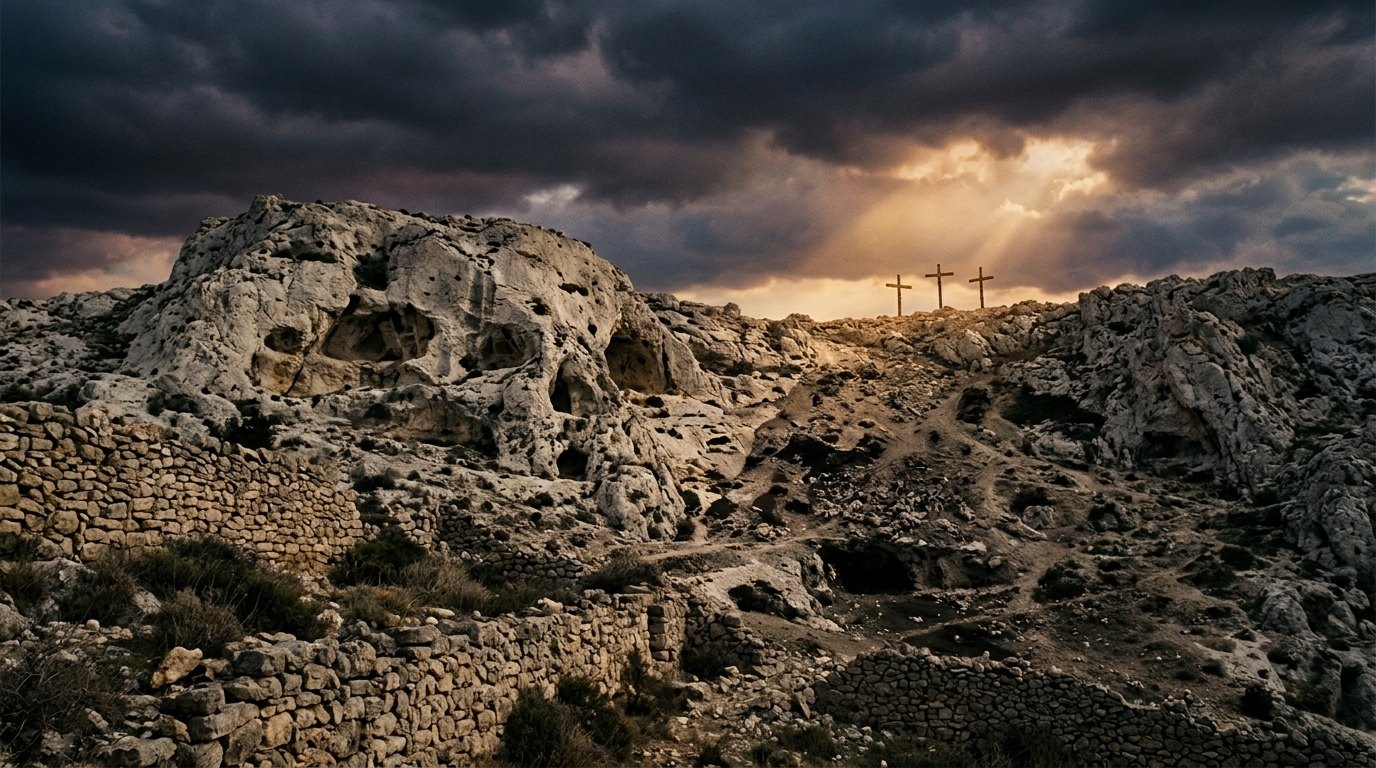
John 19:16-18
16 Finally Pilate handed him over to them to be crucified. So the soldiers took charge of Jesus.
17 Carrying his own cross, he went out to the place of the Skull (which in Aramaic is called Golgotha).
18 There they crucified him, and with him two others—one on each side and Jesus in the middle.
New International Version (NIV)
The answer
Golgotha is the place where Jesus was crucified, named in the Gospels as the "Place of a Skull." John 19:17 says Jesus "went out, bearing his cross, to the place called 'The Place of a Skull', which is called in Hebrew, 'Golgotha'." The same site is named in Matthew 27:33, Mark 15:22, and Luke 23:33, where Luke uses the Latin form "Calvary."
The name most likely refers to the shape of the rock formation — a bare, rounded hill that looked like a skull. The earliest Christian tradition, going back to the 4th century, places it just outside the walls of Jerusalem, near where the Church of the Holy Sepulchre now stands.
So Golgotha is not a person's name or a symbol — it is the location of the crucifixion, the hill outside Jerusalem where, as John 19:18 records, "they crucified him, and with him two others, on either side one, and Jesus in the middle."
Answered from Scripture · reviewed November 7, 2026
Golgotha is the actual physical hill outside the ancient walls of Jerusalem where Jesus Christ was crucified for the sins of the world. Known across the four Gospels as 'The Place of a Skull,' its identity anchors the redemption of humanity in historical, geographic reality.
The Fourfold Witness
All Four Evangelists Record the Place of the Crucifixion
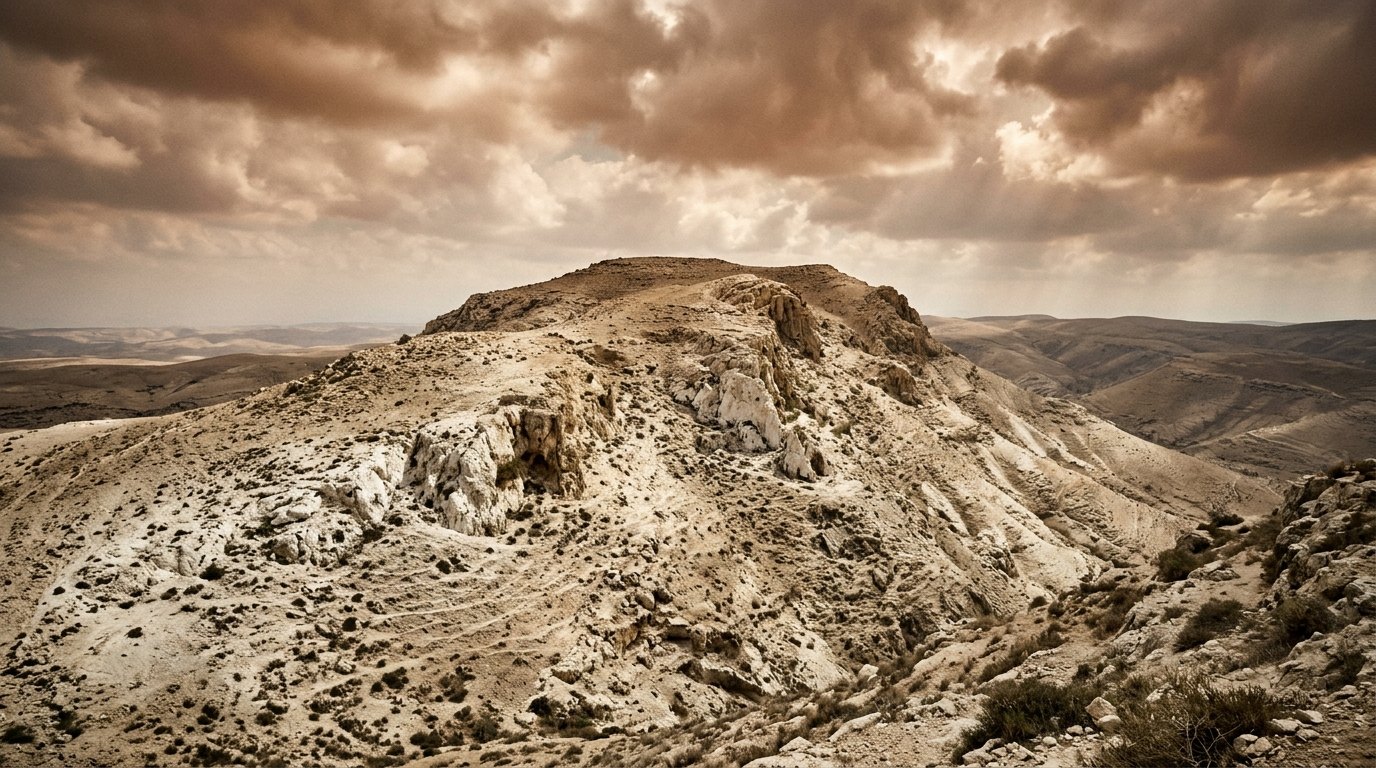
Carrying his own cross, he went out to the place of the Skull (which in Aramaic is called Golgotha).
John 19:17 (NIV)
John identifies the place by both its Greek translation and its Hebrew or Aramaic name as Jesus carries His cross toward execution.
In John 19:17, the Evangelist records with unmistakable precision that Jesus went out, bearing His own cross, to what was called the Place of a Skull, known in Aramaic as Golgotha. The Holy Spirit ensured that this specific geographical location was preserved by all four Gospel writers, establishing the crucifixion not as an allegorical myth, but as an objective event fixed in human history. Matthew similarly documents that the Roman cohort brought Him to a place called Golgotha, translating the term directly as "The Place of a Skull" (Matthew 27:33).
Mark affirms this same designation, noting that the execution squad brought Jesus to Golgotha and interpreting the Aramaic name for his wider audience (Mark 15:22). Luke employs the Greek equivalent Kranion, meaning simply "The Skull" (Luke 23:33), which the Latin Vulgate rendered as Calvaria, the source of the traditional English name Calvary. Whether derived from the physical contours of a rounded, craggy limestone mound that resembled a human cranium, or from its historic notoriety as an execution site, the Scriptures unite to anchor Christ's sacrifice to this unmistakable rocky elevation.
| Passage | What it says |
|---|---|
| Matthew 27:33 | Matthew records the soldiers leading Jesus to Golgotha, translating the name explicitly as 'The Place of a Skull.' |
| Mark 15:22 | Mark notes that they brought Jesus to Golgotha, providing the meaning 'Place of a Skull' for his readers. |
| Luke 23:33 | Luke designates the execution site simply as 'The Skull'—rendered 'Calvary' from the Latin translation 'Calvaria.' |
| John 19:17 | John documents that Jesus went out bearing His cross to the Place of a Skull, called in Aramaic Golgotha. |
Geography and Setting
A Prominent Hill Just Outside the City Gate
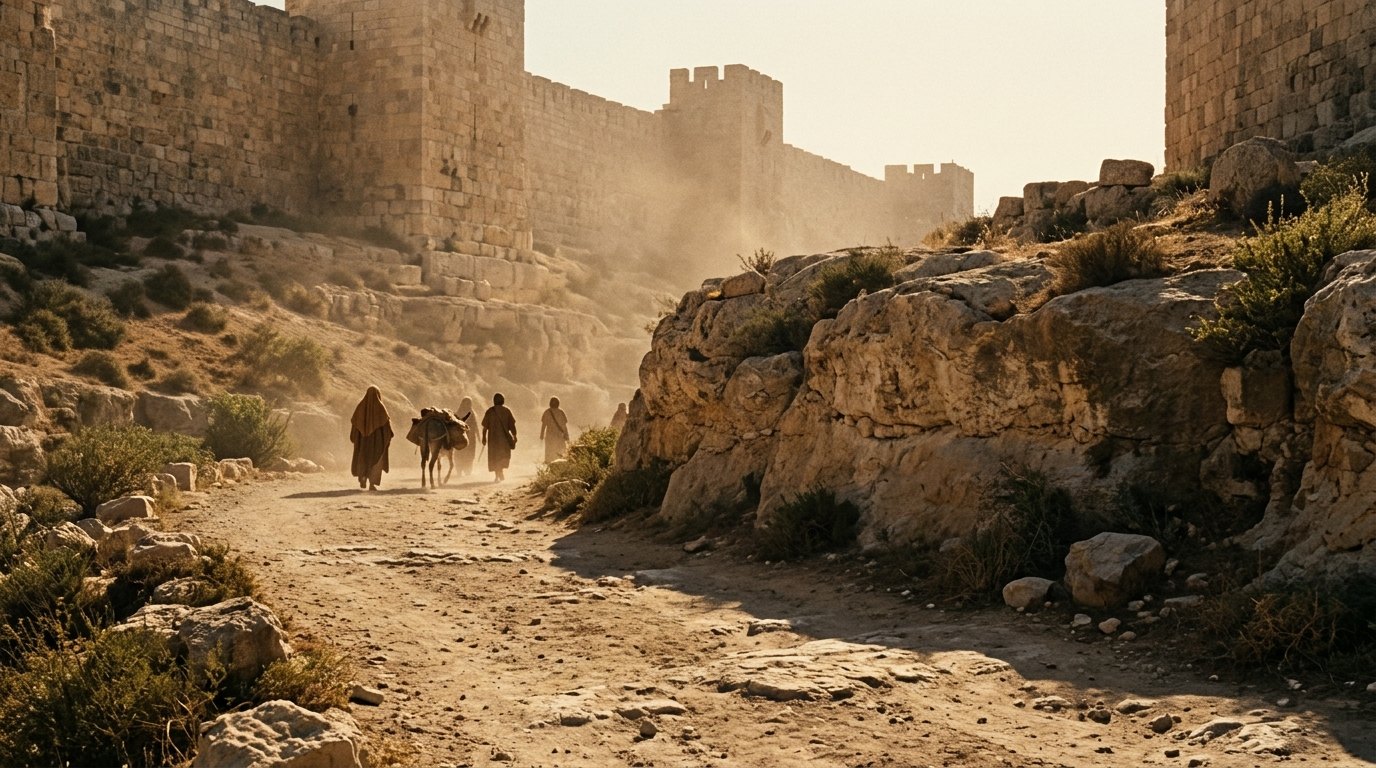
Many of the Jews read this sign, for the place where Jesus was crucified was near the city, and the sign was written in Aramaic, Latin and Greek.
John 19:20 (NIV)
John notes that the site was close to the city and passed by many, demonstrating its public prominence near a roadway.
According to John 19:20, the physical location of Golgotha was intimately connected to the daily life of first-century Jerusalem, lying close to the city walls where the trilingual inscription above the Lord could be read by many. The Romans deliberately chose prominent, elevated positions adjacent to heavy transit arteries to conduct public executions as a terrorizing deterrent. Matthew underscores this high traffic by noting that passersby hurled insults at Him, shaking their heads as they traveled the road skirting the elevation (Matthew 27:39).
Mark likewise records that those walking along the busy thoroughfare blasphemed the Lord on the cross, demonstrating that Golgotha was neither secluded nor hidden (Mark 15:29). Yet right alongside this place of public execution lay a private plot: John records that in the place where He was crucified there was a garden, and within that garden a new tomb cut into the bedrock wherein no man had yet been laid (John 19:41). Golgotha brought together the noise of human transit and the silent rock of burial, establishing the public reality of Christ's death alongside the immediate vicinity of His glorious resurrection.
| Passage | What it says |
|---|---|
| John 19:20 | John explains the sign above Jesus was read by many Jews because Golgotha was near the city. |
| Matthew 27:39 | Matthew observes that passersby along the road reviled Jesus, proving Golgotha lay near an active public thoroughfare. |
| Mark 15:29 | Mark confirms that travelers walking by shook their heads at Jesus on the cross at Golgotha. |
| John 19:41 | John records that adjacent to the crucifixion place at Golgotha was a garden containing an unused rock tomb. |
Redemptive Fulfillment
Suffering Outside the Gate as the Ultimate Sin Offering
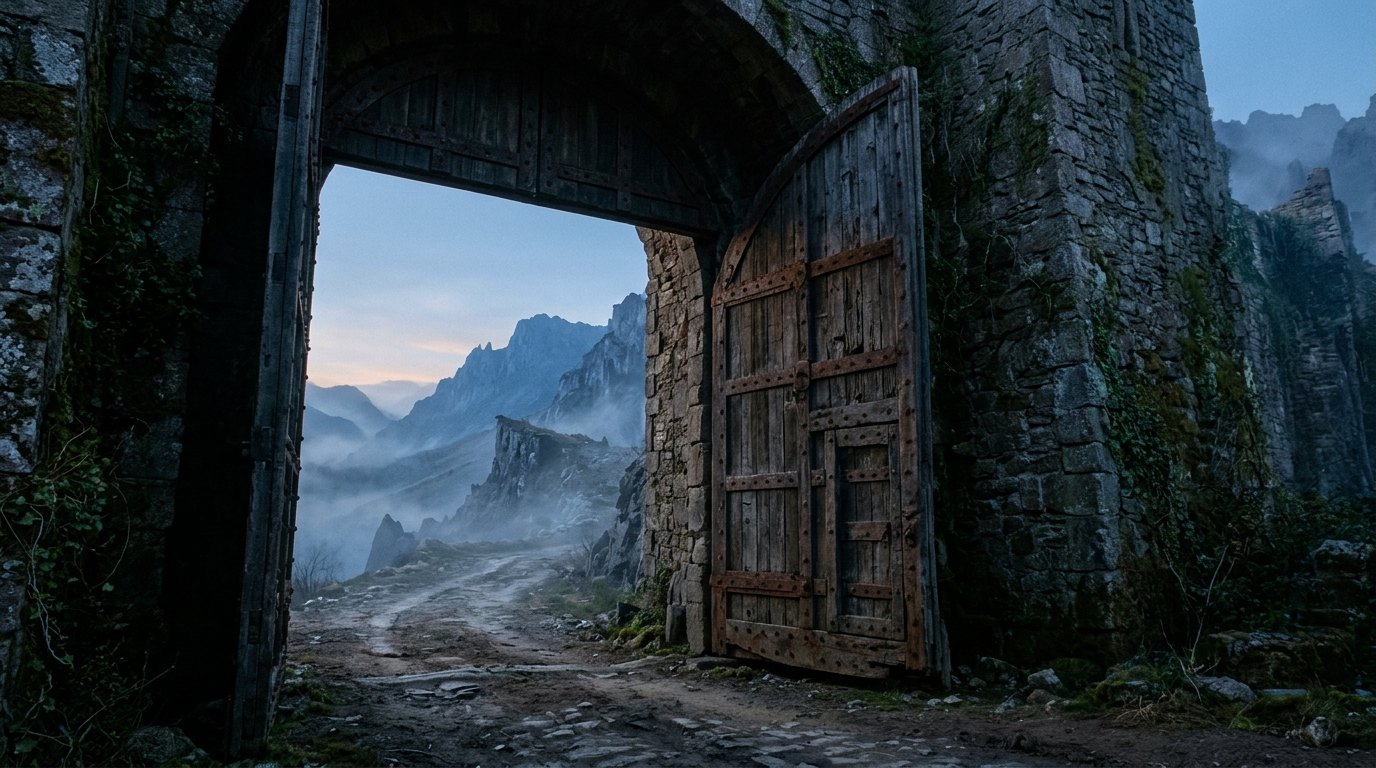
And so Jesus also suffered outside the city gate to make the people holy through his own blood.
Hebrews 13:12 (NIV)
Hebrews interprets the location of Golgotha outside Jerusalem as fulfilling the Day of Atonement sin offerings burned outside Israel's camp.
Hebrews 13:12 reveals the profound theological necessity of Golgotha's location, declaring that Jesus suffered outside the gate in order to sanctify the people through His own blood. This was no administrative accident of Roman civic policy, but the divine fulfillment of centuries of Levitical shadows. Under the Mosaic Law, the bodies of the sacrificial animals whose blood was brought into the Holy Place as an offering for sin were commanded to be carried entirely outside the camp and consumed with fire (Leviticus 4:11-12, fulfilled in Hebrews 13:11-12).
On the great Day of Atonement, the high priest similarly directed that the bull and the goat for the sin offering be carried beyond the perimeter of Israel's dwellings to be utterly burned (Leviticus 16:27, fulfilled in Hebrews 13:11-12). In the wilderness, judgment and capital execution were likewise conducted strictly beyond the camp's border (Numbers 15:35, fulfilled in Acts 7:58 and Hebrews 13:12). By bearing the cross outside Jerusalem to Golgotha, Christ bore the full curse and reproach of sin away from the sanctuary, exhausting the wrath of God on behalf of His people. Therefore, Scripture calls every disciple to go out to Him outside the camp, willingly sharing in His reproach (Hebrews 13:13).
| Passage | What it says | Fulfilled |
|---|---|---|
| Leviticus 4:11-12 | God commands that the body of the sacrificial sin offering bull be carried outside the camp to be burned completely. | Hebrews 13:11-12 |
| Leviticus 16:27 | The Law directs that the bull and goat of the Day of Atonement sin offerings be taken outside the camp. | Hebrews 13:11-12 |
| Numbers 15:35 | Capital punishment under the Mosaic law was executed outside the camp, establishing execution outside civil borders. | Acts 7:58, Hebrews 13:12 |
| Hebrews 13:12 | Scripture explicitly states Jesus suffered outside the city gate to sanctify the people through His own blood. | |
| Hebrews 13:13 | The Apostle exhorts believers to go out to Jesus outside the camp, bearing the reproach He endured on Golgotha. |
Where in the Bible
| Book | Passages |
|---|---|
| Leviticus | 2 · Leviticus 4:11-12, Leviticus 16:27 |
| Numbers | 1 · Numbers 15:35 |
| Matthew | 2 · Matthew 27:33, Matthew 27:39 |
| Mark | 2 · Mark 15:22, Mark 15:29 |
| Luke | 1 · Luke 23:33 |
| John | 3 · John 19:17, John 19:20, John 19:41 |
| Hebrews | 2 · Hebrews 13:12, Hebrews 13:13 |
The story in order
- Sin offering bull taken outside camp (c. 1450 BC) · Leviticus 4:11-12 · Establishes precedent for ritual impurity being removed outside the community.
- Day of Atonement sin offerings taken outside camp (c. 1450 BC) · Leviticus 16:27 · Reinforces the practice of sin-bearing sacrifices being removed from sacred space.
- Capital punishment executed outside the camp (c. 1450 BC) · Numbers 15:35 · Shows that transgressors were removed from the community for judgment.
- Jesus is led to Golgotha (AD 30) · Matthew 27:33 · Identifies the location as 'The Place of a Skull'.
- Jesus is brought to Golgotha (AD 30) · Mark 15:22 · Provides the meaning 'Place of a Skull'.
- Jesus is executed at 'The Skull' (AD 30) · Luke 23:33 · Names the site 'The Skull,' Latinized as 'Calvary'.
- Jesus bears His cross to Golgotha (AD 30) · John 19:17 · Specifies the Aramaic name 'Golgotha' meaning 'Place of a Skull'.
- Golgotha is near the city gate (AD 30) · John 19:20 · Explains why many Jews could read the sign above Jesus.
- Passersby revile Jesus at Golgotha (AD 30) · Matthew 27:39 · Indicates Golgotha was on a public thoroughfare.
- Travelers shake heads at Jesus (AD 30) · Mark 15:29 · Confirms Golgotha was visible and accessible to those passing by.
- Garden tomb adjacent to Golgotha (AD 30) · John 19:41 · Notes the proximity of a garden and tomb to the crucifixion site.
- Jesus suffered outside the city gate (c. AD 65) · Hebrews 13:12 · Connects Jesus' suffering outside the gate to sanctification.
- Go out to Jesus outside the camp (c. AD 65) · Hebrews 13:13 · Exhorts believers to identify with Jesus' reproach outside the city.
The Name and Meaning of Golgotha
| Gospel | Name Used | Meaning Provided | Passage |
|---|---|---|---|
| Matthew | Golgotha | The Place of a Skull | Matthew 27:33 |
| Mark | Golgotha | Place of Skull | Mark 15:22 |
| Luke | The Skull (Calvary) | The Skull | Luke 23:33 |
| John | Golgotha | Place of a Skull | John 19:17 |
Key words
- Golgotha (Golgotha, Γολγοθᾶ)
- The Aramaic name for the place of Jesus' crucifixion, meaning 'The Place of a Skull'. · John 19:17
- Calvary (Calvaria)
- The Latin translation of the Greek word for 'skull', referring to Golgotha. · Luke 23:33
- Place of a Skull (kranion, κρανίον)
- The explicit translation of Golgotha, indicating the site's name and possibly its appearance. · Matthew 27:33
- Outside the camp/gate (exō tēs poleōs, ἔξω τῆς πόλεως)
- A location removed from the Israelite camp or city, where impurity and judgment were taken. · Hebrews 13:12
Golgotha is not a theological metaphor or an allegorical landscape; it is the ground where the Son of God bought our pardon with His blood. Knowing where and why He suffered outside the gate calls every believer to leave worldly comfort and follow Him bearing His reproach.
13 passages, each cited once.
Scripture cited
- John 19:17
- John 19:18
- Matthew 27:33
- Mark 15:22
- Luke 23:33