What was the ark of the covenant?
Exodus 25:10-22
10 “Have them make an ark of acacia wood—two and a half cubits long, a cubit and a half wide, and a cubit and a half high.
11 Overlay it with pure gold, both inside and out, and make a gold molding around it.
12 Cast four gold rings for it and fasten them to its four feet, with two rings on one side and two rings on the other.
13 Then make poles of acacia wood and overlay them with gold.
14 Insert the poles into the rings on the sides of the ark to carry it.
15 The poles are to remain in the rings of this ark; they are not to be removed.
16 Then put in the ark the tablets of the covenant law, which I will give you.
17 “Make an atonement cover of pure gold—two and a half cubits long and a cubit and a half wide.
18 And make two cherubim out of hammered gold at the ends of the cover.
19 Make one cherub on one end and the second cherub on the other; make the cherubim of one piece with the cover, at the two ends.
20 The cherubim are to have their wings spread upward, overshadowing the cover with them. The cherubim are to face each other, looking toward the cover.
21 Place the cover on top of the ark and put in the ark the tablets of the covenant law that I will give you.
22 There, above the cover between the two cherubim that are over the ark of the covenant law, I will meet with you and give you all my commands for the Israelites.
New International Version (NIV)
The answer
The ark of the covenant was a rectangular chest of acacia wood, 2½ cubits long by 1½ wide and 1½ high, overlaid inside and out with pure gold, with a gold molding around its rim and four gold rings on its feet for poles by which the Levites carried it (Exodus 25:10-15). It was made to hold the covenant — the two stone tablets of the Ten Commandments that God gave Moses at Sinai (Exodus 25:16, 21; Deuteronomy 10:1-3).
On top of the ark sat the mercy seat, a slab of pure gold the same length and width as the ark, with two hammered-gold cherubim at its ends whose wings spread upward and whose faces turned toward the mercy seat (Exodus 25:17-20). God said: "There I will meet with you, and I will tell you from above the mercy seat, from between the two cherubim which are on the ark of the covenant, all that I command you for the children of Israel" (Exodus 25:22). So the ark was not just a box for a document — it was the throne-foot of God's meeting with His people, the place where blood was sprinkled once a year on the Day of Atonement to cover Israel's sin (Leviticus 16:14-15).
Hebrews 9:4 reminds the reader that the manna jar and Aaron's rod that budded were also kept with the ark as a witness. Its later travels — across the Jordan into Canaan, into David's tent, into Solomon's temple (2 Chronicles 8:11) — and its appearance again in the opened temple in heaven (Revelation 11:19) show how central this chest was to Israel's worship.
Answered from Scripture · reviewed November 7, 2026
The ark of the covenant was the sacred golden chest constructed at Mount Sinai to house the stone tablets of the Law and serve as the throne-foot of God's presence among Israel. Far more than an ornate box, it was the focal point of the tabernacle where atonement was made and God spoke with His people. Tracing its design, contents, and journey reveals the holiness of God and points directly to Christ, who is our true propitiation and eternal meeting place.
Design and Construction
A chest of acacia wood crowned with gold
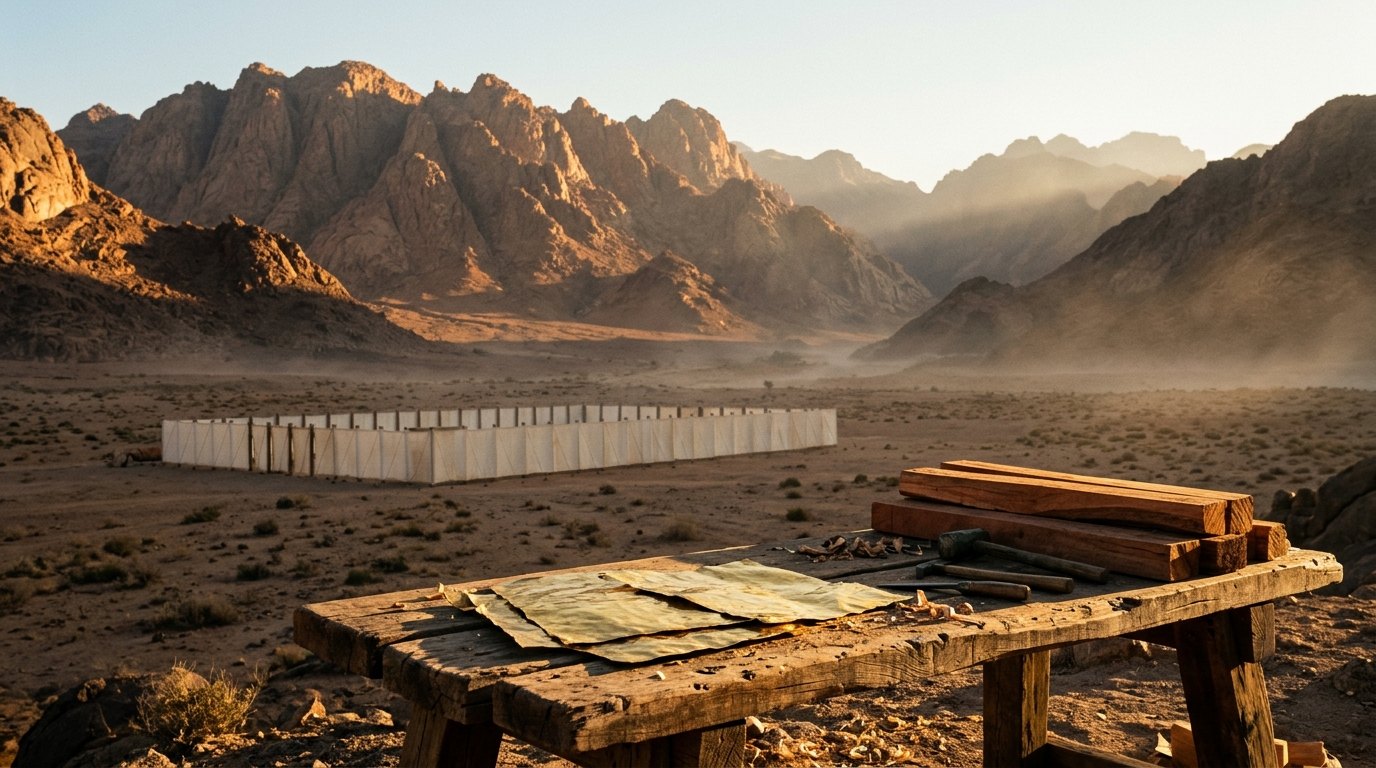
“Have them make an ark of acacia wood—two and a half cubits long, a cubit and a half wide, and a cubit and a half high.
Exodus 25:10 (NIV)
It gives the precise divine dimensions and raw material for building the chest that would hold the covenant.
The construction of the ark begins with a specific divine blueprint in Exodus 25:10, where God commands Moses to build an ark of acacia wood measuring two and a half cubits long, a cubit and a half wide, and a cubit and a half high. Every detail of this sacred chest was designed to reflect heavenly beauty and holiness while remaining portable for the wilderness journey. In Exodus 25:11, God directs that the wood be overlaid with pure gold both inside and out, crowned with an ornamental gold molding around its perimeter. To facilitate transport without human hands touching the sacred vessel, four gold rings were cast and fastened to its four feet (Exodus 25:12), through which gold-plated acacia poles were inserted (Exodus 25:13-14). Crucially, Exodus 25:15 states that these poles were never to be withdrawn, establishing an enduring readiness for pilgrimage.
The execution of this pattern was entrusted to Bezalel, whom God filled with the Spirit for craftsmanship. In Exodus 37:1-5, Bezalel faithfully fashions the chest of acacia wood, layers it completely in pure gold, casts its four rings, and crafts the carrying poles exactly according to the divine instructions. When the sanctuary was finally erected in the wilderness, Moses personally oversaw the final placement: Exodus 40:20 records that Moses placed the testimony inside the ark, attached its poles, and positioned the mercy seat upon it. He then brought the ark into the Holy of Holies and set up the veil of the screen to shield the sacred chest from sight (Exodus 40:21), establishing the Lord's royal footstool in Israel's midst.
| Passage | What it says |
|---|---|
| Exodus 25:10 | God commands an ark of acacia wood measuring two and a half cubits long, one and a half wide, and one and a half high. |
| Exodus 25:11 | The ark is overlaid inside and outside with pure gold, finished with an ornate gold molding around its perimeter. |
| Exodus 25:12 | Four gold rings are cast and fixed to its four feet, two rings on each side. |
| Exodus 25:13 | Poles of acacia wood are made and overlaid with pure gold for carrying the chest. |
| Exodus 25:14 | The gold-covered poles are inserted into the rings on the ark's sides to transport it. |
| Exodus 25:15 | God commands that the poles remain permanently inside the rings and never be removed. |
| Exodus 37:1 | Bezalel crafts the ark of acacia wood precisely to the dimensions revealed by the Lord. |
| Exodus 37:2 | Bezalel overlays the ark with pure gold inside and out and fashions the gold molding around it. |
| Exodus 37:3 | Bezalel casts four golden rings for its four feet to hold the carrying poles. |
| Exodus 37:4 | Bezalel makes poles of acacia wood overlaid with gold for carrying the ark. |
| Exodus 37:5 | The poles are placed into the rings on the ark's sides. |
| Exodus 40:20 | Moses places the testimony into the ark, sets the poles, and puts on the mercy seat. |
| Exodus 40:21 | Moses brings the ark into the tabernacle and hangs the veil to shield it. |
The Mercy Seat
The golden throne of God's meeting and mercy
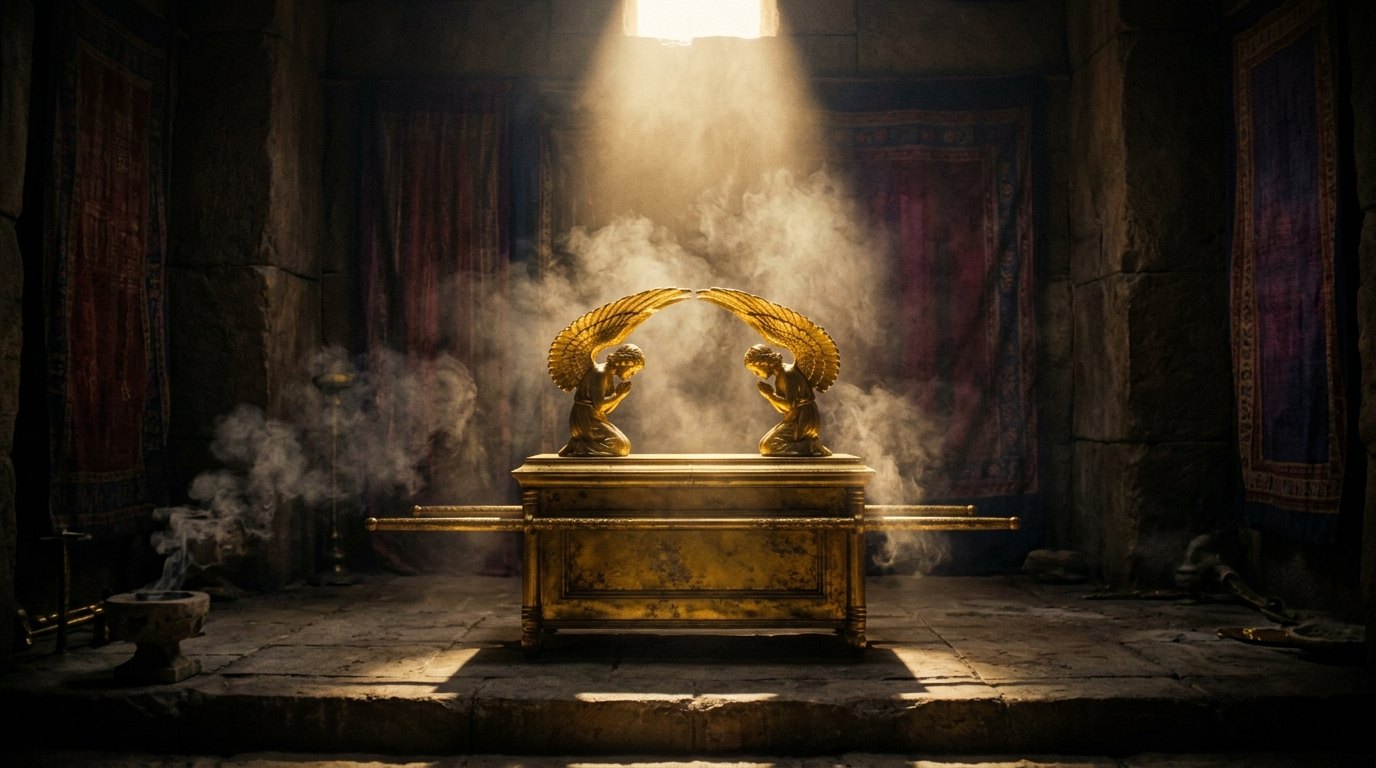
There, above the cover between the two cherubim that are over the ark of the covenant law, I will meet with you and give you all my commands for the Israelites.
Exodus 25:22 (NIV)
It declares the ark's supreme purpose: the place where the holy Lord meets and speaks with His covenant people.
The true center of the ark's ministry was its solid gold cover, where the Lord met His people, as revealed in Exodus 25:22: "There I will meet with you, and from above the mercy seat, from between the two cherubim that are on the ark of the testimony, I will speak with you." God commanded this lid, the kapporeth, to be crafted of pure gold matching the ark's dimensions (Exodus 25:17), crowned by two hammered golden cherubim facing inward with outstretched wings overshadowing the cover (Exodus 25:18-20). Placed atop the ark (Exodus 25:21), this cover was not merely an ornate lid but the footstool of God's earthly throne. Bezalel brought this vision to life with exquisite detail (Exodus 37:6-9), forging the cherubim and the lid out of a single piece of hammered gold.
Yet no sinner could casually approach this throne. In Leviticus 16:2, the Lord warned that the high priest could not enter the inner sanctuary behind the veil at will lest he die, for the Lord appeared in the cloud over the mercy seat. Only on the annual Day of Atonement, surrounded by a cloud of fragrant incense smoke to shield his eyes (Leviticus 16:13), did the priest enter with sacrificial blood. He sprinkled the blood of a bull (Leviticus 16:14) and the blood of a goat (Leviticus 16:15) directly upon and before the mercy seat to make atonement for the nation's transgressions.
This bloody ritual prefigured the ultimate work of Christ. The cherubim overshadowing the mercy seat (Hebrews 9:5) looked down upon blood that covered the broken law underneath. In the New Covenant, Romans 3:25 declares that God put forward Christ Jesus as our hilasterion—our true propitiation and mercy seat—through faith in His own shed blood. Because Jesus entered the heavenly sanctuary once for all with His own blood (Hebrews 9:11-12, 24-26), believers are now invited to draw near with confidence to the throne of grace to receive mercy (Hebrews 4:16).
| Passage | What it says | Fulfilled |
|---|---|---|
| Exodus 25:17 | A mercy seat of solid pure gold is made to the exact length and width of the ark. | Romans 3:25 |
| Exodus 25:18 | Two cherubim of hammered gold are fashioned at the two opposing ends of the mercy seat. | Hebrews 9:5 |
| Exodus 25:19 | The cherubim are crafted of one solid piece with the mercy seat on its ends. | |
| Exodus 25:20 | The cherubim face inward toward the mercy seat with their wings spreading upward, overshadowing the cover. | Hebrews 9:5 |
| Exodus 25:21 | The mercy seat is placed directly on top of the ark containing the testimony. | |
| Exodus 25:22 | The Lord promises to meet Moses and deliver His commands from between the cherubim above the mercy seat. | Hebrews 4:16 |
| Leviticus 16:14 | On the Day of Atonement, the high priest sprinkles sacrificial bull's blood on and before the mercy seat. | Hebrews 9:11-12 |
| Leviticus 16:15 | The blood of the goat for the sin offering is sprinkled upon and before the mercy seat to atone for Israel. | Hebrews 9:24-26 |
| Exodus 37:6 | Bezalel crafts the mercy seat of pure gold. | |
| Exodus 37:7 | Two cherubim of hammered gold are made for the ends of the mercy seat. | |
| Exodus 37:8 | The cherubim are crafted as one piece with the mercy seat at both ends. | |
| Exodus 37:9 | The cherubim spread their wings overshadowing the mercy seat, facing one another. | |
| Leviticus 16:2 | The high priest is warned not to enter the Holy of Holies anytime lest he die. | |
| Leviticus 16:13 | Incense smoke must cover the mercy seat over the testimony so the priest does not die. | |
| Romans 3:25 | God put forward Christ as a propitiation or mercy seat through faith in His blood. | Romans 3:25 |
The Sacred Contents
The testimonies of God's covenant and provision
I will write on the tablets the words that were on the first tablets, which you broke. Then you are to put them in the ark.”
Deuteronomy 10:2 (NIV)
It records God's direct command to place the Ten Commandments into the chest, giving the ark its foundational name and purpose.
The ark's foundational purpose was to preserve the sacred witnesses of God's covenant and care, highlighted in Deuteronomy 10:2 when God commanded Moses: "I will write on the tablets the words that were on the first tablets, which you broke, and you shall put them in the ark." From its inception, the chest was designated to hold the testimony that the Lord would reveal (Exodus 25:16). Following Israel's sin with the golden calf, the Lord instructed Moses to carve two new stone tablets and construct a wooden chest (Deuteronomy 10:1, 3). God wrote the Ten Commandments upon these replacement tablets (Deuteronomy 10:4), and Moses placed them into the ark, where they remained secure as the perpetual standard of God's holiness (Deuteronomy 10:5). The Book of the Law was likewise placed beside the ark as a formal witness against Israel's rebellion (Deuteronomy 31:26).
Alongside the covenant law, God preserved monuments of His miraculous provision and appointed leadership within the tabernacle precincts. In Exodus 16:33-34, Moses instructed Aaron to fill an omer with manna and place it before the testimony to be kept for generations. Later, after Korah's rebellion, the Lord commanded that Aaron's staff, which had supernaturally budded with blossoms and ripe almonds, be put back before the testimony as a sign to rebels (Numbers 17:10). The author of Hebrews confirms that in the wilderness sanctuary, the ark contained this golden jar of manna, Aaron's budded rod, and the stone tablets of the covenant (Hebrews 9:4). These items served as types of Jesus Christ, who is the true Bread from heaven (John 6:32-35) and our risen, eternal High Priest (Hebrews 7:24-25). Centuries later, when Solomon dedicated the temple, the historical transition was complete: 1 Kings 8:9 and 2 Chronicles 5:10 note that nothing remained inside the ark except the two stone tablets placed there at Mount Horeb.
| Passage | What it says | Fulfilled |
|---|---|---|
| Exodus 25:16 | Moses is commanded to place the covenant testimony that God will give him inside the ark. | |
| Deuteronomy 10:1 | God instructs Moses to cut two new stone tablets and construct a wooden ark before ascending Sinai. | |
| Deuteronomy 10:2 | God writes the words of the first broken tablets upon the new stones to be put in the ark. | |
| Deuteronomy 10:3 | Moses builds the chest of acacia wood, hews the stone tablets, and carries them up the mountain. | |
| Hebrews 9:4 | The New Testament identifies the ark as containing the golden pot of manna, Aaron's budded rod, and the covenant tablets. | John 6:32-35, Hebrews 7:24-25 |
| Exodus 16:33 | Moses commands Aaron to place a jar of manna before the Lord for future generations. | |
| Exodus 16:34 | Aaron places the jar of manna before the testimony to be kept. | |
| Numbers 17:10 | The Lord instructs that Aaron's blossomed staff be put back before the testimony as a sign. | |
| Deuteronomy 10:4 | The Lord writes the Ten Commandments on the replacement stone tablets. | |
| Deuteronomy 10:5 | Moses puts the tablets into the ark he made, where they remain as commanded. | |
| Deuteronomy 31:26 | The Book of the Law is placed beside the ark of the covenant as a witness. | |
| 1 Kings 8:9 | Nothing remained inside the ark except the two tablets of stone placed there at Horeb. | |
| 2 Chronicles 5:10 | At Solomon's temple dedication, only the two stone tablets are inside the ark. |
Travels and Heavenly Temple
From Israel's earthly sanctuary to the heavenly throne
Then God’s temple in heaven was opened, and within his temple was seen the ark of his covenant. And there came flashes of lightning, rumblings, peals of thunder, an earthquake and a severe hailstorm.
Revelation 11:19 (NIV)
It unveils the ultimate reality of the ark seen directly in God's heavenly temple amidst divine majesty.
The ark led Israel through the wilderness, into the Promised Land, and ultimately pointed toward the celestial sanctuary, reaching its glorious vision in Revelation 11:19: "Then God's temple in heaven was opened, and the ark of his covenant was seen within his temple." Whenever the camp moved in the desert, priests covered the ark in leather and cloth (Numbers 4:5-6), and the Kohathites carried it with reverent care (Numbers 4:15). It guided the nation three days ahead to find rest (Numbers 10:33), accompanied by Moses' prayer that God's enemies be scattered (Numbers 10:35-36). Presuming to battle without it meant disaster (Numbers 14:44). At the Jordan River, the priests carried the ark into the flooded waters, which miraculously parted and stood in a heap until all Israel crossed on dry ground (Joshua 3:3-17; 4:7-18). It marched around the walls of Jericho before their fall (Joshua 6:4-13), was sought in national repentance (Joshua 7:6; 8:33), and rested at Bethel and Shiloh (Judges 20:27-28; 1 Samuel 3:3).
When Israel treated the ark as a lucky charm in battle, the Philistines captured it, causing Eli's death and the tragic cry of Ichabod (1 Samuel 4:3-22). Yet in Philistia, the ark toppled the idol Dagon (1 Samuel 5:1-4) and brought plagues upon Ashdod, Gath, and Ekron (1 Samuel 5:7-10; 6:1), prompting its return on an unguided cart pulled by milk cows to Beth-shemesh and Kiriath-jearim (1 Samuel 6:2-21; 7:1-2; 14:18). David later brought the ark to Jerusalem, learning reverence through the tragic death of Uzzah before bringing it up with sacrifices, dancing, and joyful celebration (2 Samuel 6:2-17; 1 Chronicles 13:3-14; 15:1-29; 16:1-37). David lamented living in cedar while God's ark dwelt in curtains (2 Samuel 7:2; 11:11; 1 Chronicles 17:1), dreaming of the permanent resting place Solomon eventually built (1 Kings 6:19; 8:1-21; 2 Chronicles 5:2-9; 6:11-41; Psalm 132:8). Solomon brought it into the Most Holy Place under the giant cherubim's wings (1 Kings 8:6-8), recognizing its holiness (2 Chronicles 8:11; 35:3; 1 Kings 2:26; 3:15). Yet Jeremiah foretold a day when the earthly ark would no longer be remembered or missed (Jeremiah 3:16), for Christ has entered the true heavenly tabernacle (Hebrews 8:1-2), where the covenant ark stands forever secure in the presence of God.
| Passage | What it says | Fulfilled |
|---|---|---|
| 2 Chronicles 8:11 | Solomon moves Pharaoh's daughter from David's city because places sanctified by the ark's entrance are holy. | |
| Revelation 11:19 | The temple of God opens in heaven, revealing the ark of His covenant amid flashes of lightning, thunder, and earthquake. | Hebrews 8:1-2 |
| Numbers 4:5 | Aaron and sons take down the screening veil to cover the ark when packing camp. | |
| Numbers 4:6 | The ark is covered with fine leather, a blue cloth, and its poles inserted. | |
| Numbers 4:15 | The Kohathites carry the holy things but must not touch them lest they die. | |
| Numbers 10:33 | The ark travels ahead of Israel three days to seek out a resting place. | |
| Numbers 10:35 | Moses chants when the ark sets out, asking God to scatter His enemies. | |
| Numbers 10:36 | Moses chants when the ark rests, asking the Lord to return to Israel's thousands. | |
| Numbers 14:44 | Israel presumes to attack Canaan without Moses and the ark, suffering defeat. | |
| Joshua 3:3 | Israel is commanded to follow behind the Levitical priests carrying the ark. | |
| Joshua 3:6 | Joshua commands the priests to take up the ark and cross before the people. | |
| Joshua 3:11 | The ark of the Lord of all the earth crosses the Jordan before the nation. | |
| Joshua 3:13 | The waters of the Jordan part as the priests carrying the ark step in. | |
| Joshua 3:14 | The people break camp to cross Jordan with priests bearing the ark in front. | |
| Joshua 3:15 | The feet of the priests bearing the ark dip into the overflowing Jordan. | |
| Joshua 3:16 | The waters upstream heap up in a heap while the Jordan is cut off. | |
| Joshua 3:17 | The priests bearing the ark stand firm on dry ground in Jordan's midst until all cross. | |
| Joshua 4:7 | Twelve memorial stones commemorate Jordan's waters cutting off before the ark. | |
| Joshua 4:9 | Joshua sets twelve stones where the priests bearing the ark stood in the Jordan. | |
| Joshua 4:10 | The priests bearing the ark remain in Jordan until everything commanded is done. | |
| Joshua 4:11 | The ark of the Lord and the priests pass over before the eyes of the people. | |
| Joshua 4:16 | Joshua is commanded to tell the priests bearing the ark to come up from Jordan. | |
| Joshua 4:18 | When the priests bearing the ark step onto dry land, the Jordan floods again. | |
| Joshua 6:4 | Seven priests bearing ram's horns march before the ark around Jericho. | |
| Joshua 6:6 | Joshua instructs the priests to take up the ark of the covenant around Jericho. | |
| Joshua 6:7 | The armed men march before the ark of the Lord around Jericho. | |
| Joshua 6:8 | Seven priests blowing horns advance before the ark as they circle the city. | |
| Joshua 6:9 | The rearguard walks behind the ark while trumpets blow continuously. | |
| Joshua 6:11 | The ark of the Lord encircles Jericho once on the first day. | |
| Joshua 6:12 | Joshua rises early and the priests take up the ark for the second day. | |
| Joshua 6:13 | Priests blowing trumpets march continually before the ark of the Lord. | |
| Joshua 7:6 | Joshua tears his clothes and falls prostrate before the ark after defeat at Ai. | |
| Joshua 8:33 | Israel, elders, and judges stand on either side of the ark between Ebal and Gerizim. | |
| Judges 20:27 | Israel inquires of the Lord, for the ark of God was in Bethel in those days. | |
| Judges 20:28 | Phinehas son of Eleazar ministers before the ark during the civil inquiry. | |
| 1 Samuel 3:3 | Samuel lies down in the temple of the Lord, where the ark of God was. | |
| 1 Samuel 4:3 | Elders fetch the ark from Shiloh, hoping it will save them from the Philistines. | |
| 1 Samuel 4:4 | The ark of the Lord of hosts, enthroned on cherubim, is brought to the battle camp. | |
| 1 Samuel 4:5 | All Israel shouts so loudly that the ground shakes when the ark arrives. | |
| 1 Samuel 4:6 | Philistines hear the shouting and learn the ark of the Lord has arrived. | |
| 1 Samuel 4:7 | Philistines fear, believing God has entered the camp of Israel. | |
| 1 Samuel 4:11 | The Philistines capture the ark of God, and Eli's two sons die. | |
| 1 Samuel 4:13 | Eli waits trembling with fear for the ark of God when news arrives. | |
| 1 Samuel 4:17 | The messenger reports to Eli that his sons are dead and the ark is captured. | |
| 1 Samuel 4:18 | Eli falls backward, breaks his neck, and dies when the ark is mentioned. | |
| 1 Samuel 4:19 | Phinehas's wife goes into labor upon hearing the ark has been captured. | |
| 1 Samuel 4:21 | She names the boy Ichabod, declaring the glory has departed from Israel. | |
| 1 Samuel 4:22 | She repeats that the glory has departed from Israel because the ark is taken. | |
| 1 Samuel 5:1 | Philistines take the ark from Ebenezer and bring it to Ashdod. | |
| 1 Samuel 5:2 | The Philistines carry the ark into Dagon's temple and set it beside Dagon. | |
| 1 Samuel 5:3 | Ashdodites find Dagon fallen face down before the ark of the Lord. | |
| 1 Samuel 5:4 | Dagon is found again fallen before the ark, with head and hands severed. | |
| 1 Samuel 5:7 | Men of Ashdod declare the ark of Israel's God cannot remain with them. | |
| 1 Samuel 5:8 | Philistine lords decide to transfer the ark of God to Gath. | |
| 1 Samuel 5:9 | The Lord strikes Gath with plagues of tumors after the ark moves there. | |
| 1 Samuel 5:10 | The ark is sent to Ekron, causing panic among Ekronites. | |
| 1 Samuel 6:1 | The ark of the Lord remains in Philistine territory for seven months. | |
| 1 Samuel 6:2 | Philistines consult priests and diviners on how to return the ark properly. | |
| 1 Samuel 6:3 | Diviners advise sending the ark back with a guilt offering of gold. | |
| 1 Samuel 6:7 | A new cart and two milk cows that have never been yoked are prepared. | |
| 1 Samuel 6:8 | The ark and gold guilt offerings in a chest are placed on the cart. | |
| 1 Samuel 6:11 | The ark of the Lord and the chest with golden rats and tumors are loaded. | |
| 1 Samuel 6:12 | The cows head straight down the road toward Beth-shemesh, lowing as they go. | |
| 1 Samuel 6:13 | People of Beth-shemesh rejoice as they see the ark returning. | |
| 1 Samuel 6:14 | The cart stops by a large stone, and they offer the cows as a burnt offering. | |
| 1 Samuel 6:15 | Levites take down the ark and the chest of gold objects onto the large stone. | |
| 1 Samuel 6:18 | The large rock remains a witness to where they placed the ark. | |
| 1 Samuel 6:19 | God strikes men of Beth-shemesh because they looked into the ark. | |
| 1 Samuel 6:21 | Messengers ask Kiriath-jearim to come down and retrieve the ark. | |
| 1 Samuel 7:1 | Men of Kiriath-jearim bring the ark to Abinadab's house and consecrate Eleazar. | |
| 1 Samuel 7:2 | The ark remains at Kiriath-jearim twenty years while Israel laments after God. | |
| 1 Samuel 14:18 | Saul tells Ahijah to bring the ark of God, which was with Israel. | |
| 2 Samuel 6:2 | David sets out to bring up the ark called by the name of the Lord of hosts. | |
| 2 Samuel 6:3 | They place the ark on a new cart from Abinadab's house, guided by Uzzah and Ahio. | |
| 2 Samuel 6:4 | They bring the ark from the hill, with Ahio walking in front. | |
| 2 Samuel 6:5 | David and Israel celebrate before the Lord with instruments, harps, and songs. | |
| 2 Samuel 6:6 | Uzzah reaches out his hand to steady the ark when oxen stumble. | |
| 2 Samuel 6:7 | God's anger burns against Uzzah and He strikes him down dead beside the ark. | |
| 2 Samuel 6:9 | David fears the Lord and questions how the ark of the Lord can come to him. | |
| 2 Samuel 6:10 | David diverts the ark of the Lord to the house of Obed-edom the Gittite. | |
| 2 Samuel 6:11 | The ark stays in Obed-edom's home three months, and the Lord blesses his household. | |
| 2 Samuel 6:12 | David hears of the blessing and brings the ark up to Jerusalem with joy. | |
| 2 Samuel 6:13 | When the ark-bearers take six steps, David sacrifices an ox and a fattened calf. | |
| 2 Samuel 6:14 | David dances before the Lord with all his might, wearing a linen ephod. | |
| 2 Samuel 6:15 | David and all Israel bring up the ark with shouting and the sound of the horn. | |
| 2 Samuel 6:16 | Michal watches from a window and despises David leaping before the ark. | |
| 2 Samuel 6:17 | They set the ark inside the tent David pitched for it, offering burnt offerings. | |
| 2 Samuel 7:2 | David laments that he lives in a cedar house while God's ark dwells in a tent. | |
| 2 Samuel 11:11 | Uriah refuses to sleep at home while the ark and Israel dwell in tents. | |
| 2 Samuel 15:24 | Zadok and all the Levites carry the ark of the covenant during Absalom's rebellion. | |
| 2 Samuel 15:25 | David instructs Zadok to return the ark to Jerusalem. | |
| 2 Samuel 15:29 | Zadok and Abiathar carry the ark of God back to Jerusalem and remain there. | |
| 1 Kings 2:26 | Solomon spares Abiathar because he carried the ark of the Lord before David. | |
| 1 Kings 3:15 | Solomon comes to Jerusalem and stands before the ark of the covenant, offering sacrifices. | |
| 1 Kings 6:19 | Solomon prepares the inner sanctuary of the temple to place the ark of the covenant. | |
| 1 Kings 8:1 | Solomon assembles leaders to bring up the ark from Zion to the temple. | |
| 1 Kings 8:3 | All Israel's elders arrive, and the priests take up the ark. | |
| 1 Kings 8:4 | Priests and Levites bring up the ark, the tent of meeting, and holy vessels. | |
| 1 Kings 8:5 | Solomon and all Israel sacrifice countless sheep and oxen before the ark. | |
| 1 Kings 8:6 | Priests bring the ark to the Most Holy Place under the wings of the cherubim. | |
| 1 Kings 8:7 | The cherubim spread their wings over the place of the ark and its poles. | |
| 1 Kings 8:8 | The poles of the ark are long enough to be seen from the Holy Place. | |
| 1 Kings 8:21 | Solomon provides a place in the temple for the ark containing the Lord's covenant. | |
| 1 Chronicles 6:31 | David appoints men over the service of song in God's house after the ark rests. | |
| 1 Chronicles 13:3 | David urges bringing back the ark of God, neglected in the days of Saul. | |
| 1 Chronicles 13:5 | David gathers all Israel to bring the ark of God from Kiriath-jearim. | |
| 1 Chronicles 13:6 | David goes to bring up the ark of God the Lord, who sits between the cherubim. | |
| 1 Chronicles 13:7 | They carry the ark on a new cart from Abinadab's house with Uzzah and Ahio. | |
| 1 Chronicles 13:9 | Uzzah puts out his hand to hold the ark when the oxen stumble. | |
| 1 Chronicles 13:10 | The Lord strikes Uzzah down because he touched the ark, and he dies there. | |
| 1 Chronicles 13:12 | David fears God and wonders how he can bring the ark home to himself. | |
| 1 Chronicles 13:13 | David moves the ark aside to the house of Obed-edom the Gittite. | |
| 1 Chronicles 13:14 | The ark remains with Obed-edom's family three months, and God blesses his house. | |
| 1 Chronicles 15:1 | David prepares a place for the ark and pitches a tent for it in Jerusalem. | |
| 1 Chronicles 15:2 | David commands that only the Levites may carry the ark of God. | |
| 1 Chronicles 15:3 | David gathers all Israel to Jerusalem to bring up the ark to its place. | |
| 1 Chronicles 15:12 | David tells the Levites to consecrate themselves to bring up the ark. | |
| 1 Chronicles 15:13 | David notes God broke out because they did not seek Him properly at first. | |
| 1 Chronicles 15:14 | The priests and Levites consecrate themselves to bring up the ark of Israel's God. | |
| 1 Chronicles 15:15 | Levites carry the ark of God with poles on their shoulders as Moses commanded. | |
| 1 Chronicles 15:25 | David and elders go to bring up the ark of the covenant with rejoicing. | |
| 1 Chronicles 15:26 | Because God helped the Levites carrying the ark, they sacrifice seven bulls and rams. | |
| 1 Chronicles 15:28 | All Israel brings up the ark of the covenant with shouting, trumpets, and harps. | |
| 1 Chronicles 15:29 | Michal watches from a window and despises David dancing as the ark enters. | |
| 1 Chronicles 16:1 | They bring the ark and place it inside the tent David pitched, offering sacrifices. | |
| 1 Chronicles 16:4 | David appoints Levites to minister before the ark, invoking and praising God. | |
| 1 Chronicles 16:6 | Benaiah and Jahaziel blow trumpets regularly before the ark of the covenant of God. | |
| 1 Chronicles 16:37 | David leaves Asaph and his brothers before the ark to minister regularly as required. | |
| 1 Chronicles 17:1 | David reflects that he lives in cedar while the ark of God's covenant sits under tenting. | |
| 1 Chronicles 22:19 | David urges building the sanctuary to bring the ark of the Lord into the temple. | |
| 1 Chronicles 28:2 | David explains he had planned a resting place for the footstool and ark of God. | |
| 1 Chronicles 28:18 | David gives the plan for the golden chariot cherubim overshadowing the ark. | |
| 2 Chronicles 1:4 | David had brought the ark from Kiriath-jearim to the tent pitched in Jerusalem. | |
| 2 Chronicles 5:2 | Solomon assembles Israel's leaders to bring up the ark from Zion. | |
| 2 Chronicles 5:4 | All the elders of Israel arrive, and the Levites take up the ark. | |
| 2 Chronicles 5:5 | Priests and Levites bring up the ark, the tent of meeting, and holy vessels. | |
| 2 Chronicles 5:6 | Solomon and Israel sacrifice sheep and oxen before the ark in numbers beyond count. | |
| 2 Chronicles 5:7 | Priests bring the ark to the inner sanctuary beneath the cherubim's wings. | |
| 2 Chronicles 5:8 | The cherubim overshadow the ark and its carrying poles. | |
| 2 Chronicles 5:9 | The poles are long enough that their ends can be seen from the Holy Place. | |
| 2 Chronicles 6:11 | Solomon states he set the ark containing the Lord's covenant inside the temple. | |
| 2 Chronicles 6:41 | Solomon prays for God and the ark of His strength to arise to their resting place. | |
| 2 Chronicles 35:3 | Josiah commands the Levites to put the holy ark into Solomon's temple. | |
| Psalms 132:8 | The psalmist prays, Arise, O Lord, to Your resting place, You and Your mighty ark. | |
| Jeremiah 3:16 | Jeremiah prophesies days when the ark will no longer be remembered, visited, or remade. |
Where in the Bible
| Book | Passages |
|---|---|
| Exodus | 26 · Exodus 25:10, Exodus 25:11, Exodus 25:12, Exodus 25:13, Exodus 25:14, Exodus 25:15, Exodus 37:1, Exodus 37:2, Exodus 37:3, Exodus 37:4, Exodus 37:5, Exodus 40:20, Exodus 40:21, Exodus 25:17, Exodus 25:18, Exodus 25:19, Exodus 25:20, Exodus 25:21, Exodus 25:22, Exodus 37:6, Exodus 37:7, Exodus 37:8, Exodus 37:9, Exodus 25:16, Exodus 16:33, Exodus 16:34 |
| Leviticus | 4 · Leviticus 16:14, Leviticus 16:15, Leviticus 16:2, Leviticus 16:13 |
| Numbers | 8 · Numbers 17:10, Numbers 4:5, Numbers 4:6, Numbers 4:15, Numbers 10:33, Numbers 10:35, Numbers 10:36, Numbers 14:44 |
| Deuteronomy | 6 · Deuteronomy 10:1, Deuteronomy 10:2, Deuteronomy 10:3, Deuteronomy 10:4, Deuteronomy 10:5, Deuteronomy 31:26 |
| Joshua | 24 · Joshua 3:3, Joshua 3:6, Joshua 3:11, Joshua 3:13, Joshua 3:14, Joshua 3:15, Joshua 3:16, Joshua 3:17, Joshua 4:7, Joshua 4:9, Joshua 4:10, Joshua 4:11, Joshua 4:16, Joshua 4:18, Joshua 6:4, Joshua 6:6, Joshua 6:7, Joshua 6:8, Joshua 6:9, Joshua 6:11, Joshua 6:12, Joshua 6:13, Joshua 7:6, Joshua 8:33 |
| Judges | 2 · Judges 20:27, Judges 20:28 |
| 1 Samuel | 37 · 1 Samuel 3:3, 1 Samuel 4:3, 1 Samuel 4:4, 1 Samuel 4:5, 1 Samuel 4:6, 1 Samuel 4:7, 1 Samuel 4:11, 1 Samuel 4:13, 1 Samuel 4:17, 1 Samuel 4:18, 1 Samuel 4:19, 1 Samuel 4:21, 1 Samuel 4:22, 1 Samuel 5:1, 1 Samuel 5:2, 1 Samuel 5:3, 1 Samuel 5:4, 1 Samuel 5:7, 1 Samuel 5:8, 1 Samuel 5:9, 1 Samuel 5:10, 1 Samuel 6:1, 1 Samuel 6:2, 1 Samuel 6:3, 1 Samuel 6:7, 1 Samuel 6:8, 1 Samuel 6:11, 1 Samuel 6:12, 1 Samuel 6:13, 1 Samuel 6:14, 1 Samuel 6:15, 1 Samuel 6:18, 1 Samuel 6:19, 1 Samuel 6:21, 1 Samuel 7:1, 1 Samuel 7:2, 1 Samuel 14:18 |
| 2 Samuel | 20 · 2 Samuel 6:2, 2 Samuel 6:3, 2 Samuel 6:4, 2 Samuel 6:5, 2 Samuel 6:6, 2 Samuel 6:7, 2 Samuel 6:9, 2 Samuel 6:10, 2 Samuel 6:11, 2 Samuel 6:12, 2 Samuel 6:13, 2 Samuel 6:14, 2 Samuel 6:15, 2 Samuel 6:16, 2 Samuel 6:17, 2 Samuel 7:2, 2 Samuel 11:11, 2 Samuel 15:24, 2 Samuel 15:25, 2 Samuel 15:29 |
| 1 Kings | 12 · 1 Kings 8:9, 1 Kings 2:26, 1 Kings 3:15, 1 Kings 6:19, 1 Kings 8:1, 1 Kings 8:3, 1 Kings 8:4, 1 Kings 8:5, 1 Kings 8:6, 1 Kings 8:7, 1 Kings 8:8, 1 Kings 8:21 |
| 1 Chronicles | 29 · 1 Chronicles 6:31, 1 Chronicles 13:3, 1 Chronicles 13:5, 1 Chronicles 13:6, 1 Chronicles 13:7, 1 Chronicles 13:9, 1 Chronicles 13:10, 1 Chronicles 13:12, 1 Chronicles 13:13, 1 Chronicles 13:14, 1 Chronicles 15:1, 1 Chronicles 15:2, 1 Chronicles 15:3, 1 Chronicles 15:12, 1 Chronicles 15:13, 1 Chronicles 15:14, 1 Chronicles 15:15, 1 Chronicles 15:25, 1 Chronicles 15:26, 1 Chronicles 15:28, 1 Chronicles 15:29, 1 Chronicles 16:1, 1 Chronicles 16:4, 1 Chronicles 16:6, 1 Chronicles 16:37, 1 Chronicles 17:1, 1 Chronicles 22:19, 1 Chronicles 28:2, 1 Chronicles 28:18 |
| 2 Chronicles | 13 · 2 Chronicles 5:10, 2 Chronicles 8:11, 2 Chronicles 1:4, 2 Chronicles 5:2, 2 Chronicles 5:4, 2 Chronicles 5:5, 2 Chronicles 5:6, 2 Chronicles 5:7, 2 Chronicles 5:8, 2 Chronicles 5:9, 2 Chronicles 6:11, 2 Chronicles 6:41, 2 Chronicles 35:3 |
| Psalms | 1 · Psalms 132:8 |
| Jeremiah | 1 · Jeremiah 3:16 |
| Romans | 1 · Romans 3:25 |
| Hebrews | 1 · Hebrews 9:4 |
| Revelation | 1 · Revelation 11:19 |
The story in order
- Ark constructed at Sinai (c. 1445 BC) · Exodus 25:10 · God commands the construction of the ark of acacia wood overlaid with gold.
- Ark placed in Tabernacle (c. 1445 BC) · Exodus 40:20 · Moses places the testimony into the ark and sets it within the tabernacle.
- Ark travels with Israel (c. 1445 BC) · Numbers 10:33 · The ark leads Israel's journey, seeking a resting place.
- Ark crosses the Jordan (c. 1406 BC) · Joshua 3:11 · The ark precedes the people, causing the Jordan to part.
- Ark at Jericho (c. 1406 BC) · Joshua 6:6 · Priests carry the ark around Jericho, leading to its fall.
- Ark in Shiloh (c. 1170 BC) · 1 Samuel 3:3 · The ark of God is located in the temple at Shiloh.
- Ark captured by Philistines (c. 1160 BC) · 1 Samuel 4:11 · The Philistines defeat Israel and capture the ark.
- Ark returns to Israel (c. 1153 BC) · 1 Samuel 6:13 · The ark is returned to Beth-shemesh on a cart pulled by cows.
- Ark in Kiriath-jearim (c. 1153 BC) · 1 Samuel 7:1 · The ark is brought to Abinadab's house and stays for twenty years.
- Ark moved to Jerusalem (c. 1000 BC) · 2 Samuel 6:12 · David brings the ark to Jerusalem with great joy and celebration.
- Ark in Solomon's Temple (c. 966 BC) · 1 Kings 8:9 · Only the stone tablets are found inside the ark in the temple.
- Ark in heavenly temple (c. AD 95) · Revelation 11:19 · The ark is seen in God's temple in heaven.
The Ark's Contents: Testimony to God's Covenant and Provision
| Item | Description | Significance | Passage |
|---|---|---|---|
| Stone Tablets of the Law | God's commands written by His finger | The testimony of God's covenant and law | Exodus 25:16 |
| Jar of Manna | Food provided by God in the wilderness | God's faithfulness in providing sustenance | Exodus 16:33 |
| Aaron's Budded Rod | Symbol of God's chosen priesthood | God's authority and confirmation of His chosen leaders | Numbers 17:10 |
The Ark and God's Presence: From Earthly Sanctuary to Heavenly Throne
| Location/Event | Ark's Role | Outcome/Significance | Passage |
|---|---|---|---|
| Tabernacle | Center of God's dwelling and atonement | God meets His people and delivers commands | Exodus 25:22 |
| Wilderness Journeys | Leads the way, seeking a resting place | God's guidance and protection | Numbers 10:33 |
| Crossing the Jordan | Precedes the people, causing waters to part | God's power to bring His people into the promised land | Joshua 3:11 |
| Jericho | Marches around the city, leading to its fall | God's power to overcome fortified enemies | Joshua 6:6 |
| Philistine Captivity | Brought disaster to Dagon and Philistine cities | God's sovereignty and judgment on enemies | 1 Samuel 5:1-12 |
| Solomon's Temple | Housed in the Holy of Holies | Focal point of worship and God's presence in the temple | 1 Kings 8:9 |
| Heavenly Temple | Revealed in God's temple in heaven | Ultimate reality of God's covenant and presence | Revelation 11:19 |
The Mercy Seat: Atonement and God's Meeting Place
| Aspect | Description | Significance | Passage |
|---|---|---|---|
| Material and Design | Solid pure gold, with cherubim at each end | Represents divine presence and holiness | Exodus 25:17-19 |
| Location | Placed directly on top of the ark | The lid of the ark, covering the testimony | Exodus 25:21 |
| Divine Promise | God promises to meet Moses there | God's direct communication and presence with His people | Exodus 25:22 |
| Atonement Ritual | Blood sprinkled on and before it on Day of Atonement | The place where sin was atoned for through sacrifice | Leviticus 16:14-15 |
| New Testament Fulfillment | Christ as propitiation (mercy seat) | Jesus is the means of atonement and reconciliation with God | Romans 3:25 |
Key words
- Ark of the Covenant (ʾārôn hab·bə·rîṯ (אֲרוֹן הַבְּרִית))
- A sacred chest housing the stone tablets of the Law, symbolizing God's presence and covenant with Israel. · Exodus 25:10
- Mercy Seat (kappō·reṯ (כַּפֹּרֶת))
- The golden lid of the ark where God's presence was symbolized and atonement was made. · Exodus 25:17
- Cherubim (kər·wî·m (כְּרֻבִים))
- Angelic beings depicted on the mercy seat, guarding God's presence and facing the atonement cover. · Exodus 25:18
- Testimony (ʿē·ḏūṯ (עֵדוּת))
- Refers to the stone tablets of the Law placed inside the ark, representing God's covenant commands. · Exodus 25:16
- Propitiation (hilastērion (ἱλαστήριον))
- An atoning sacrifice that turns away God's wrath; identified with Christ on the mercy seat. · Romans 3:25
Understanding the ark of the covenant anchors our view of God's holiness and His unfailing desire to dwell with His people. Where Israel approached the blood-stained mercy seat with trembling once a year, believers now approach the throne of grace with boldness through Jesus Christ. The earthly shadow has yielded to the eternal substance, assuring us of God's unbreakable covenant and everlasting presence.
186 passages, each cited once.
Scripture cited
- Exodus 25:10-22
- Hebrews 9:4
- Deuteronomy 10:1-3
- Revelation 11:19
- 2 Chronicles 8:11
- Leviticus 16:14-15