Why did Jesus overturn the tables in the temple?
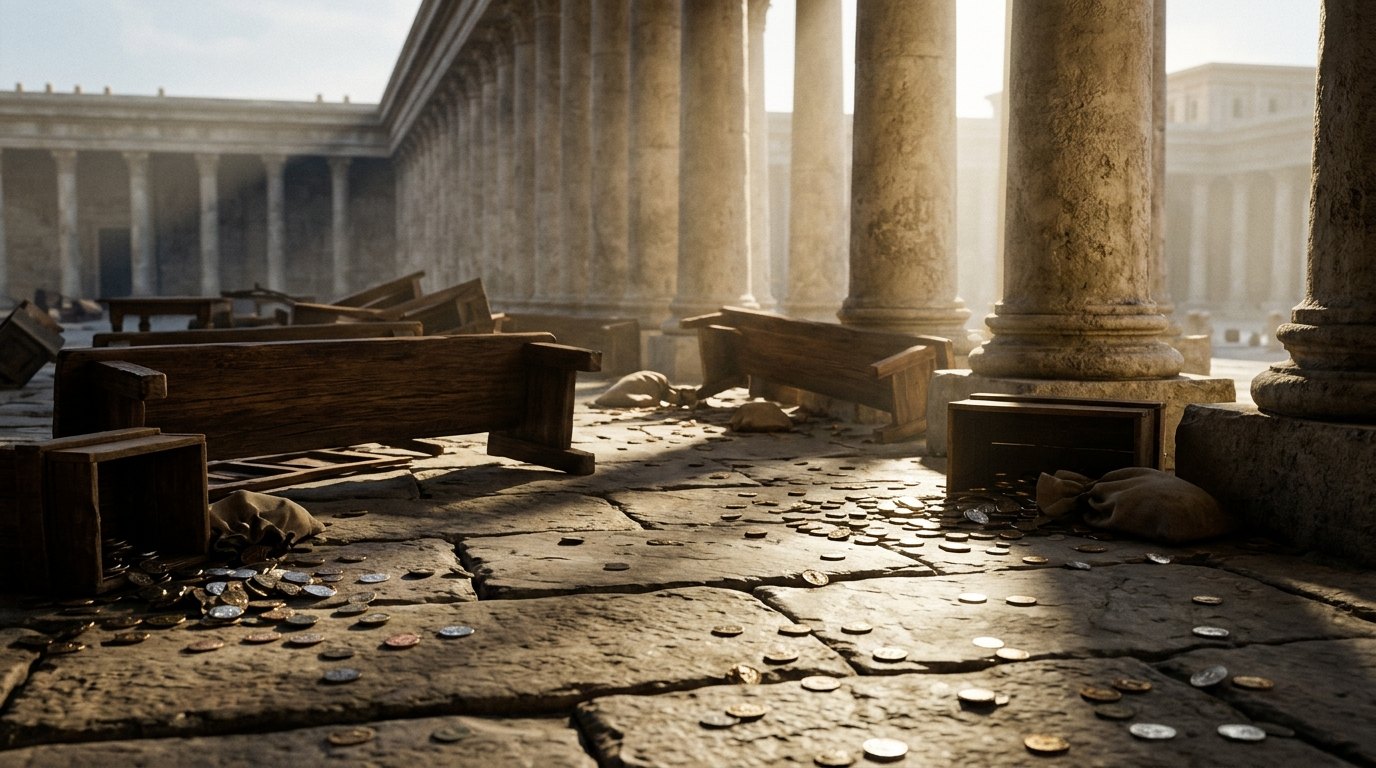
John 2:13-22
13 When it was almost time for the Jewish Passover, Jesus went up to Jerusalem.
14 In the temple courts he found people selling cattle, sheep and doves, and others sitting at tables exchanging money.
15 So he made a whip out of cords, and drove all from the temple courts, both sheep and cattle; he scattered the coins of the money changers and overturned their tables.
16 To those who sold doves he said, “Get these out of here! Stop turning my Father’s house into a market!”
17 His disciples remembered that it is written: “Zeal for your house will consume me.”
18 The Jews then responded to him, “What sign can you show us to prove your authority to do all this?”
19 Jesus answered them, “Destroy this temple, and I will raise it again in three days.”
20 They replied, “It has taken forty-six years to build this temple, and you are going to raise it in three days?”
21 But the temple he had spoken of was his body.
22 After he was raised from the dead, his disciples recalled what he had said. Then they believed the scripture and the words that Jesus had spoken.
New International Version (NIV)
The answer
Jesus overturned the tables because God’s house was being corrupted by commerce and exploitation instead of honoured as a place of worship. He declared, “Don’t make my Father’s house a marketplace!” (John 2:16). His actions were a deliberate expression of holy zeal and His authority as God’s Son.
Several truths explain what He did:
- The temple’s purpose was being dishonoured. Animals for sacrifice and money-changing could serve worshippers, but the temple was not to be treated as an ordinary trading centre. Jesus drove out the sellers and animals and overturned the money-changers’ tables because business was intruding upon the worship of God (John 2:14-16).
- Religious activity had become an occasion for injustice. When Jesus cleansed the temple during the final week of His ministry, He quoted Scripture: “My house shall be called a house of prayer,” but you have made it a “den of robbers!” (Matthew 21:13). The problem was therefore not merely buying and selling, but corruption and robbery carried on under a religious covering.
- Jesus was consumed with zeal for His Father’s honour. His disciples connected His actions with the words, “Zeal for your house will eat me up” (John 2:17), drawing from Psalm 69:9. This was righteous zeal, not an uncontrolled loss of temper. Calling the temple “my Father’s house” also displayed His unique relationship with the Father and His right to act there.
- The event pointed beyond the building to Christ Himself. When challenged to give a sign, Jesus answered, “Destroy this temple, and in three days I will raise it up” (John 2:19). John explains that He was speaking about “the temple of his body”; after His resurrection, the disciples remembered and believed (John 2:21-22). The cleansing of the earthly temple therefore stood alongside the greater revelation of Jesus as the One who would die and rise again.
Matthew also records that, after the cleansing, the lame and blind came to Jesus in the temple and He healed them (Matthew 21:14). That scene shows the difference sharply: corrupt religion used God’s house for gain, while Christ brought holiness, mercy and restoration.
Answered from Scripture · reviewed November 11, 2026
When Jesus overturned the tables in the temple courts, He was neither losing His temper nor staging a mere social protest. He acted with divine authority to purge His Father's house of commercial desecration, fulfill the ancient prophecy of holy zeal, and point forward to the true temple of His resurrected body.
The Defilement
Holy ground had been degraded into merchandise
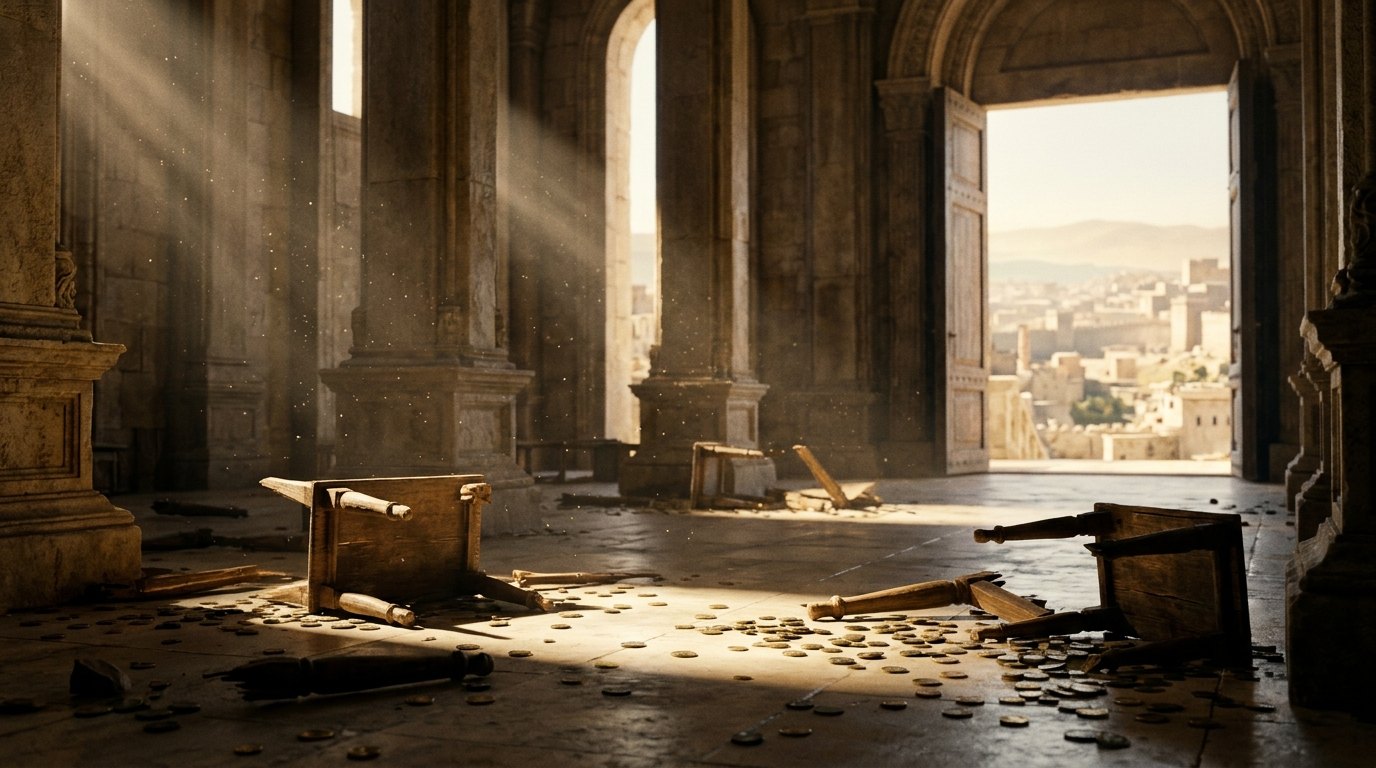
To those who sold doves he said, “Get these out of here! Stop turning my Father’s house into a market!”
John 2:16 (NIV)
Jesus explicitly names the offense by demanding that merchants cease turning His Father's sacred dwelling place into a worldly emporium.
In John 2:16, Jesus issues His unmistakable indictment: “Take these things away; do not make my Father’s house a house of trade.” The outrage was not the sacrificial system itself, which God had appointed, but the corrupt commercialization of sacred space. Under the Law of Moses, the celebration of Passover required an unblemished sacrificial lamb for every household, as commanded in Exodus 12:6. Because Deuteronomy 16:1 required all Israelite men to travel to the central sanctuary in Jerusalem to celebrate the feast, pilgrims came from great distances across the ancient world. Luke 2:41 records that Jesus' own family faithfully made this annual pilgrimage year after year. By the time John 2:13 records Jesus entering the holy city as Passover drew near, the temple complex had been overtaken by predatory convenience. Stepping into the Court of the Gentiles, John 2:14 notes that Jesus encountered dealers selling oxen, sheep, and doves, alongside tables of money changers who converted foreign currency into temple shekels at inflated rates. Confronted with this irreverent market within consecrated boundaries, Jesus responded with deliberate, majestic action. According to John 2:15, He made a whip of cords and drove out both the livestock and their sellers, poured out the coins of the money changers, and overturned their tables. By ordering the dove merchants to remove their cages in John 2:16, Jesus put an end to the desecration of His Father's house, vindicating the sanctity of divine worship over earthly profit.
| Passage | What it says |
|---|---|
| Exodus 12:6 | Passover required unblemished lambs for sacrifice, prompting an extensive local trade in sacrificial animals near the sacred courts. |
| Deuteronomy 16:1 | The law commanded all Israel to journey to Jerusalem to observe Passover before the Lord God. |
| Luke 2:41 | Jesus' family faithfully observed the annual pilgrimage to Jerusalem for the Feast of the Passover. |
| John 2:13 | Jesus went up to Jerusalem as the Passover of the Jews was at hand. |
| John 2:14 | Jesus found vendors selling oxen, sheep, and doves, with money changers seated inside the temple precinct. |
| John 2:15 | Jesus fashioned a whip of cords, drove out the beasts and sellers, poured out coins, and overturned tables. |
| John 2:16 | Jesus commanded dove-sellers to remove their goods and stop transforming His Father's house into a marketplace. |
Prophetic Zeal
Consumed by passionate devotion to the Father
His disciples remembered that it is written: “Zeal for your house will consume me.”
John 2:17 (NIV)
The disciples recognize Jesus' vigorous cleansing as the direct fulfillment of David's prophetic song of consuming zeal.
Observing the Lord's sweeping actions, the disciples witnessed a righteous anger that Scripture had long foretold. John 2:17 records their immediate recognition: “His disciples remembered that it was written, ‘Zeal for your house will consume me.’” This event was not an uncontrollable outburst of human frustration, but the fiery holiness of the promised Messiah contending for God’s honor. Centuries earlier, David had voiced this exact spiritual agony in Psalm 69:9, crying out under inspiration that zeal for God’s dwelling had eaten him up, while the reproaches aimed at the Almighty had fallen squarely upon him. When Jesus drove out the merchants and cast down the money tables, He took the shame of the temple’s dishonor onto Himself. The New Testament shows David’s prophetic lament fulfilled directly in John 2:17, demonstrating that the true Son of David could never look indifferently upon the corruption of holy ground. That consuming zeal drove Christ to cleanse the earthly courts at the threshold of His public ministry, and it would ultimately carry Him all the way to the cross, where the insults and sins of a rebellious world fell entirely upon Him.
| Passage | What it says | Fulfilled |
|---|---|---|
| Psalms 69:9 | David writes prophetically that zeal for God's house consumes him, and reproaches against God fall upon him. | John 2:17 |
| John 2:17 | The disciples remembered the scriptural promise that consuming zeal for God's house would mark the righteous sufferer. |
The True Temple
The temple of His body raised up
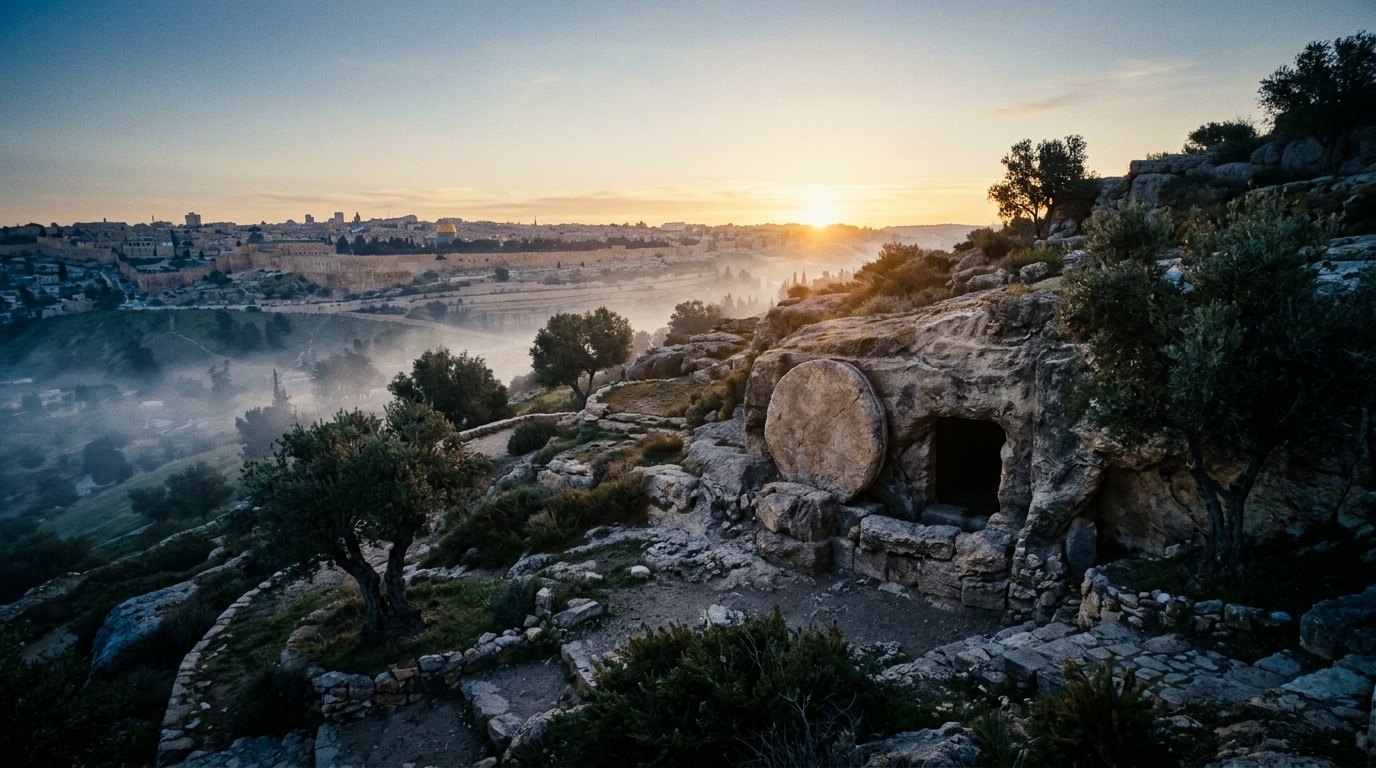
Jesus answered them, “Destroy this temple, and I will raise it again in three days.”
John 2:19 (NIV)
Jesus answers the demand for authority by linking the temple's ultimate purpose to His own physical death and resurrection.
When challenged for His actions, Jesus directed the attention of the religious rulers away from limestone walls toward His own person. In John 2:19, He issued a profound prophetic challenge: “Destroy this temple, and in three days I will raise it up.” The temple authorities had immediately approached Him in John 2:18, demanding an authoritative miraculous sign to justify His sweeping authority over the sanctuary courts. Blind to the deeper spiritual reality standing before them, the leaders objected in John 2:20 that Herod's elaborate renovation had already required forty-six years of painstaking labor, mocking the idea that it could be rebuilt in seventy-two hours. John 2:21 cuts through their confusion with apostolic clarity: Jesus was speaking about the temple of His own physical body. The stone building in Jerusalem was merely a shadow pointing toward the true meeting place between God and humanity—Jesus Christ Himself. When the rulers eventually nailed Him to a cross, they seemed to destroy that temple, yet in John 2:22, the disciples witnessed the glorious fulfillment of His words when He rose bodily from the dead on the third day, leading them to believe both the Scriptures and Christ's spoken promise. As John 2:23 records, this demonstration of divine power caused many in Jerusalem during the Passover feast to place their faith in His name.
| Passage | What it says | Fulfilled |
|---|---|---|
| John 2:18 | Jewish leaders questioned Jesus, demanding a miraculous sign to validate His authority to clear the courts. | |
| John 2:19 | Jesus replied that if they destroyed this temple, He would raise it up again in three days. | John 2:22 |
| John 2:20 | The leaders objected that Herod's temple took forty-six years to construct, questioning His three-day claim. | |
| John 2:21 | The apostle John clarifies that Jesus spoke specifically concerning the temple of His physical body. | |
| John 2:22 | After Christ rose from the dead, His disciples remembered His words and believed both Scripture and His declaration. | |
| John 2:23 | While Jesus remained in Jerusalem for the Passover feast, many believed in His name seeing His signs. |
House of Prayer
Restoring God's Sanctuary for the Nations
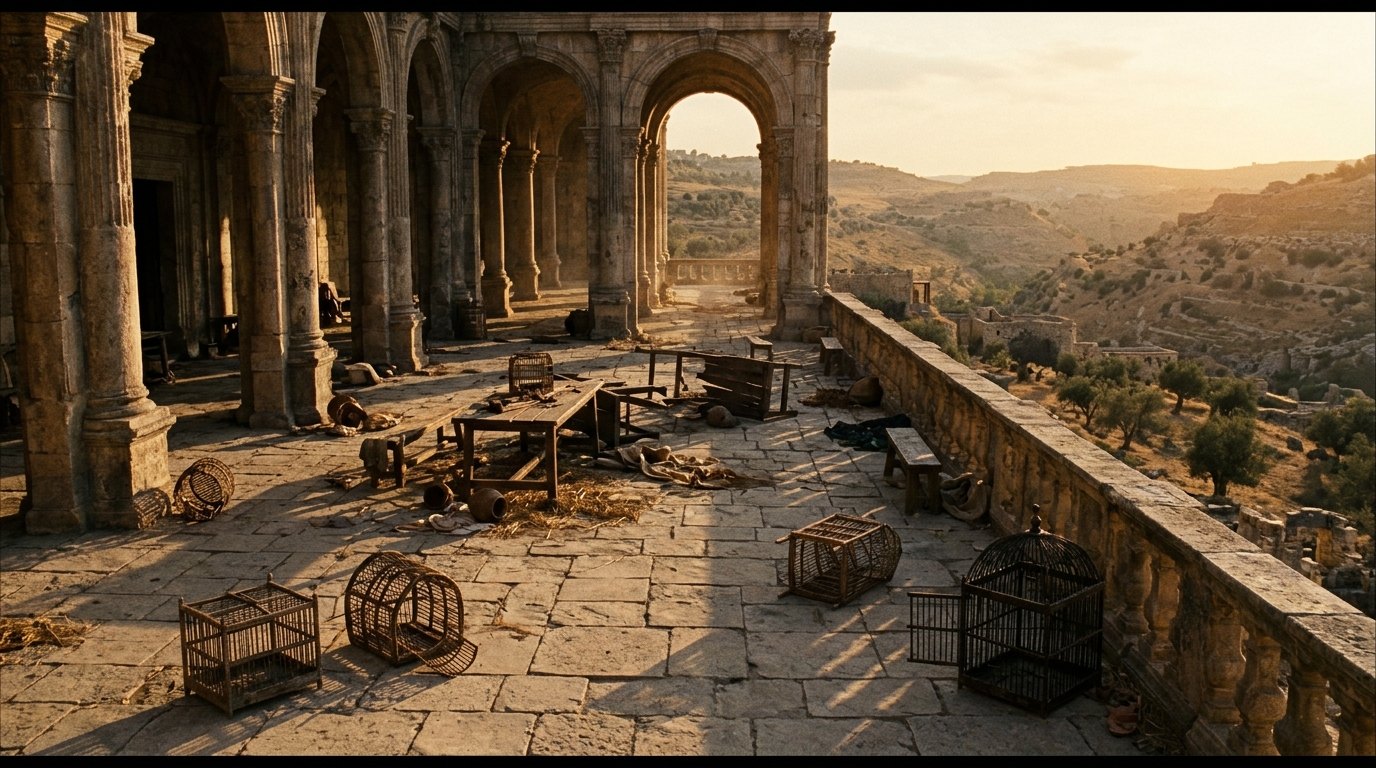
And as he taught them, he said, “Is it not written: ‘My house will be called a house of prayer for all nations’? But you have made it ‘a den of robbers.’”
Mark 11:17 (NIV)
It brings together Isaiah's universal scope of worship and Jeremiah's rebuke of corrupt, extortionate misuse.
Later during His final week before the cross, Jesus cleansed the temple once more, declaring its universal purpose. In Mark 11:17, He confronted the crowds with the words of the prophets: “Is it not written, ‘My house shall be called a house of prayer for all the nations’? But you have made it a den of robbers.” The Lord held up two foundational Old Testament scriptures to expose the priesthood’s corruption. In Isaiah 56:7, God had promised that His holy mountain would welcome foreigners and outcasts, making His dwelling a house of prayer for every nation. Yet by setting up a bustling market in the Court of the Gentiles—the only space non-Jews could enter to seek the Lord—the religious establishment had effectively shut out the nations. Furthermore, they mirrored the hypocrisy denounced in Jeremiah 7:11, where God condemned those who practiced extortion and injustice while treating His temple like a safe hideout for thieves. Synoptic accounts capture this confrontation with unflinching force: Matthew 21:12 notes that Jesus entered the temple, overturned the tables of the money changers, and drove out all buyers and sellers, while Matthew 21:13 records His stinging quotation of Isaiah and Jeremiah. Mark 11:15–16 adds that He overturned the seats of those selling doves and refused to let anyone carry commercial vessels through the sacred courts, fulfilling Mark 11:17. In Luke 19:45–46, Jesus likewise drove out the traders, confirming that God's sanctuary must remain a pure sanctuary of prayer rather than an enclave of deceit.
| Passage | What it says |
|---|---|
| Isaiah 56:7 | God promises His house will be called a house of prayer for all nations, welcoming foreign worshippers. |
| Jeremiah 7:11 | God condemns turning His house, bearing His name, into a den of robbers through dishonest and hypocritical living. |
| Matthew 21:12 | Jesus enters the temple, drives out all who buy and sell, and overturns the money changers' tables. |
| Matthew 21:13 | Jesus declares scripture: His house shall be called a house of prayer, but they made it a den of robbers. |
| Mark 11:15 | Entering Jerusalem, Jesus overturns the tables of money changers and seats of dove sellers in the temple courts. |
| Mark 11:16 | Jesus forbids anyone from carrying merchandise or trade vessels through the sacred courts of the temple. |
| Mark 11:17 | Jesus teaches that the temple was meant as a house of prayer for all nations, not a robbers' den. |
| Luke 19:45 | Jesus enters the temple precincts and begins driving out those selling sacrifices and exchanging coin. |
| Luke 19:46 | Jesus confronts the merchants, citing scripture that His house is for prayer rather than fraudulent gain. |
Messianic Purifier
The Lord Purifies His Sanctuary in Judgment
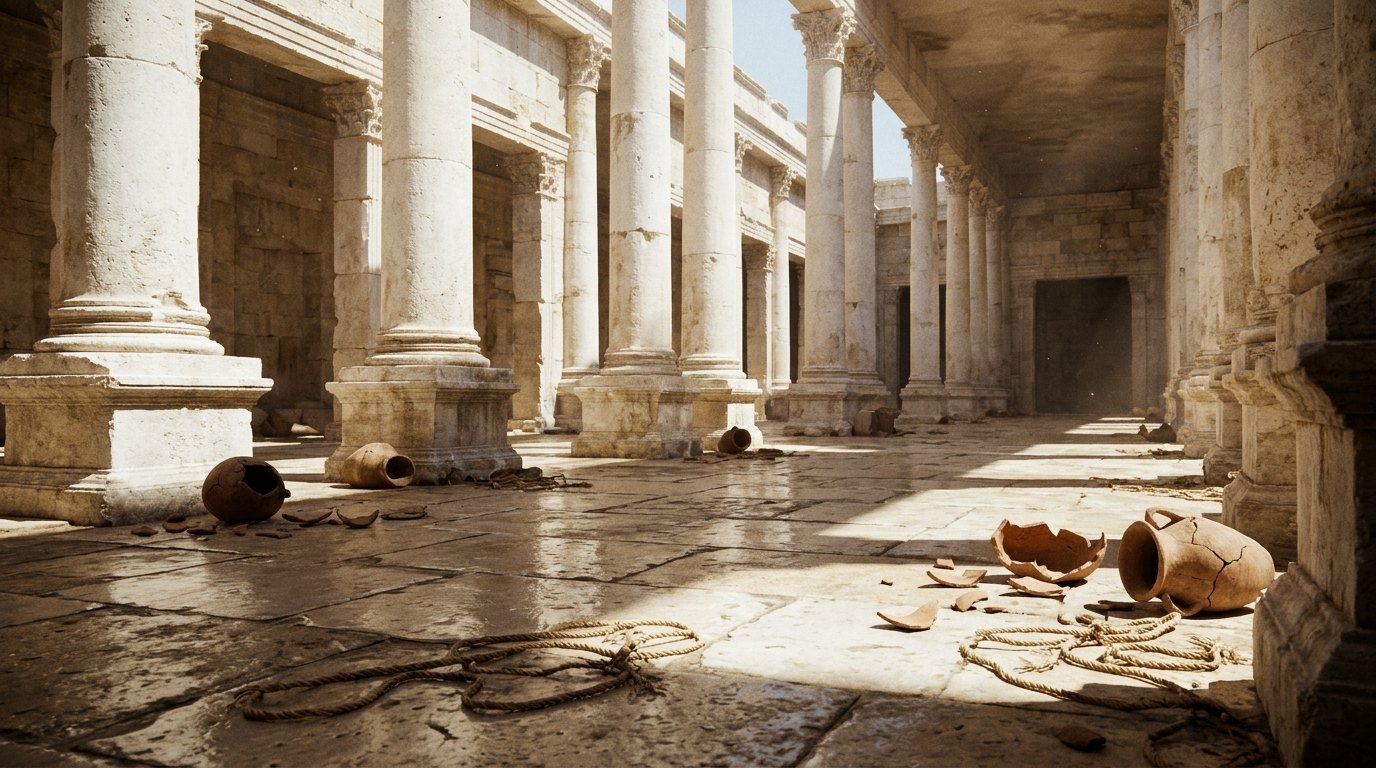
“I will send my messenger, who will prepare the way before me. Then suddenly the Lord you are seeking will come to his temple; the messenger of the covenant, whom you desire, will come,” says the LORD Almighty.
Malachi 3:1 (NIV)
It foretells the divine visitation where the Lord Himself arrives suddenly at the temple to inspect and purify.
In Malachi 3:1, the prophet announced the supreme moment toward which all Old Testament history strained: the Lord whom you seek will suddenly come to His temple. When Jesus strode into the temple courts, this long-awaited divine visitation ceased to be a remote anticipation and became history. He arrived not as a detached spectator or a pious pilgrim, but as the owner inspecting His own dwelling place. The prophet warned in Malachi 3:2 that no unfaithful shepherd could endure the day of His coming, because He is like a refiner's fire and like fuller's soap. The overturned tables and scattered coins were physical emblems of this consuming purification. According to Malachi 3:3, the Messiah's mission is to sit as a smelter and purifier of silver, specifically purging the sons of Levi so that their offerings may once again be presented in genuine righteousness. Zechariah 14:21 had likewise looked forward to this decisive day of holiness, declaring that in the day of the Lord, there shall no longer be a trader in the house of the Lord of hosts. By driving out those who commodified devotion, Christ executed this prophetic verdict against corrupt ritual, demonstrating that God's holiness tolerates no commercial exploitation within His sanctuary.
| Passage | What it says |
|---|---|
| Malachi 3:1 | The Lord suddenly comes to His temple as the messenger of the covenant whom God's people seek. |
| Malachi 3:2 | The day of His coming brings refining fire and launderer's soap to purify priesthood and worship. |
| Malachi 3:3 | He sits as a refiner of silver to purify the sons of Levi for righteous offerings. |
| Zechariah 14:21 | Prophecy that every pot in Jerusalem will be holy and no trader will remain in the Lord's house. |
Mercy and Conflict
Authority Confirmed by Miracles and Priestly Opposition
The blind and the lame came to him at the temple, and he healed them.
Matthew 21:14 (NIV)
Once extortion is cleared away, the temple immediately functions as a place of divine mercy, healing the marginalized.
The true purpose of the temple is restored the moment the extortioners are cast out, as Matthew 21:14 records that the blind and the lame came to Him in the temple, and He healed them. Those whom the prevailing religious establishment had marginalized and excluded from full access now found mercy, restoration, and life in the presence of the Messiah within the cleansed courts. Yet this manifestation of divine power provoked immediate hostility. In Matthew 21:15, the chief priests and scribes watched the wonderful works and heard young children crying out, 'Hosanna to the Son of David,' and they were filled with indignation. When challenged by their resentment, Jesus appealed to Psalm 8:2 in Matthew 21:16, reminding them that out of the mouth of infants and nursing babes God has perfected praise. The leaders were neither moved by mercy nor convicted by truth. As Mark 11:18 reveals, the scribes and chief priests immediately began searching for a way to destroy Him, because the whole crowd was astonished at His teaching. Throughout that final week, as Luke 19:47 notes, Jesus continued teaching daily in the temple precincts while the rulers plotted His death, confirming that His holy cleansing exposed the hardened rebellion of those who prized earthly control over the living God.
| Passage | What it says |
|---|---|
| Matthew 21:14 | The blind and the lame come to Jesus directly inside the cleansed temple, and He heals them. |
| Matthew 21:15 | Chief priests and scribes grow indignant when children cry out Hosanna to the Son of David. |
| Matthew 21:16 | Jesus answers their outrage by quoting Psalm 8:2, that God ordains praise from the lips of babes. |
| Mark 11:18 | The scribes and chief priests seek a way to destroy Him because the crowds were astonished at His teaching. |
| Luke 19:47 | Jesus teaches daily in the temple while the chief rulers and leaders seek to put Him to death. |
Where in the Bible
| Book | Passages |
|---|---|
| Exodus | 1 · Exodus 12:6 |
| Deuteronomy | 1 · Deuteronomy 16:1 |
| Psalms | 1 · Psalms 69:9 |
| Isaiah | 1 · Isaiah 56:7 |
| Jeremiah | 1 · Jeremiah 7:11 |
| Zechariah | 1 · Zechariah 14:21 |
| Malachi | 3 · Malachi 3:1, Malachi 3:2, Malachi 3:3 |
| Matthew | 5 · Matthew 21:12, Matthew 21:13, Matthew 21:14, Matthew 21:15, Matthew 21:16 |
| Mark | 4 · Mark 11:15, Mark 11:16, Mark 11:17, Mark 11:18 |
| Luke | 4 · Luke 2:41, Luke 19:45, Luke 19:46, Luke 19:47 |
| John | 11 · John 2:13, John 2:14, John 2:15, John 2:16, John 2:17, John 2:18, John 2:19, John 2:20, John 2:21, John 2:22, John 2:23 |
The story in order
- The Law commands Passover pilgrimage (c. 1400 BC) · Deuteronomy 16:1 · Established the annual requirement to go to Jerusalem for Passover.
- Prophecy of zeal for God's house (c. 1000 BC) · Psalms 69:9 · Foretold passionate devotion and suffering for God's house.
- Prophecy of the Lord coming to His temple (c. 450 BC) · Malachi 3:1 · Foretold the Lord's sudden arrival to purify His temple.
- Prophecy of a house of prayer for nations (c. 750 BC) · Isaiah 56:7 · Declared God's house intended for all nations' prayer.
- God condemns turning His house into a den of robbers (c. 600 BC) · Jeremiah 7:11 · Warned against corrupting the temple for dishonest gain.
- Jesus' family observes Passover (c. AD 12) · Luke 2:41 · Shows the custom of annual pilgrimage to Jerusalem.
- Jesus goes to Jerusalem for Passover (c. AD 27) · John 2:13 · Sets the scene for Jesus' cleansing of the temple.
- Jesus overturns tables in the temple (AD 27) · John 2:15 · Jesus acts with divine authority to cleanse the temple.
- Jesus declares His house is for prayer (AD 30) · Matthew 21:13 · Jesus quotes scripture to condemn the temple's misuse.
- Jesus predicts His resurrection (AD 27) · John 2:19 · Foreshadows the temple of His resurrected body.
- Jesus heals the blind and lame (AD 30) · Matthew 21:14 · Demonstrates His authority and compassion in the temple.
- Disciples remember Jesus' words after resurrection (AD 30) · John 2:22 · Confirms Jesus' prophetic statement about His body.
Key words
- Passover (Hebrew: פֶּסַח (pesach))
- Annual Jewish festival commemorating the Exodus from Egypt. · Exodus 12:6
- Temple (Greek: ἱερόν (hieron))
- The house of God in Jerusalem, a place of worship and sacrifice. · John 2:14
- Zeal (Greek: ζῆλος (zēlos))
- Passionate devotion and fervent enthusiasm for God and His house. · Psalms 69:9
- House of Prayer (Isaiah 56:7)
- The intended purpose of the temple as a place for communication with God. · Matthew 21:13
- Den of Robbers (Jeremiah 7:11)
- A place corrupted by greed and dishonest practices, contrary to God's will. · Matthew 21:13
The overturned tables in Jerusalem confront every worshiper with the pure holiness of God and the divine authority of Jesus Christ. He purges the false security of human compromise to establish true fellowship in Himself, the risen Lord who alone makes His people a holy temple.
33 passages, each cited once.
Scripture cited
- John 2:13-22
- Matthew 21:12-17
- Psalms 69:9