Why did Jesus turn water into wine?
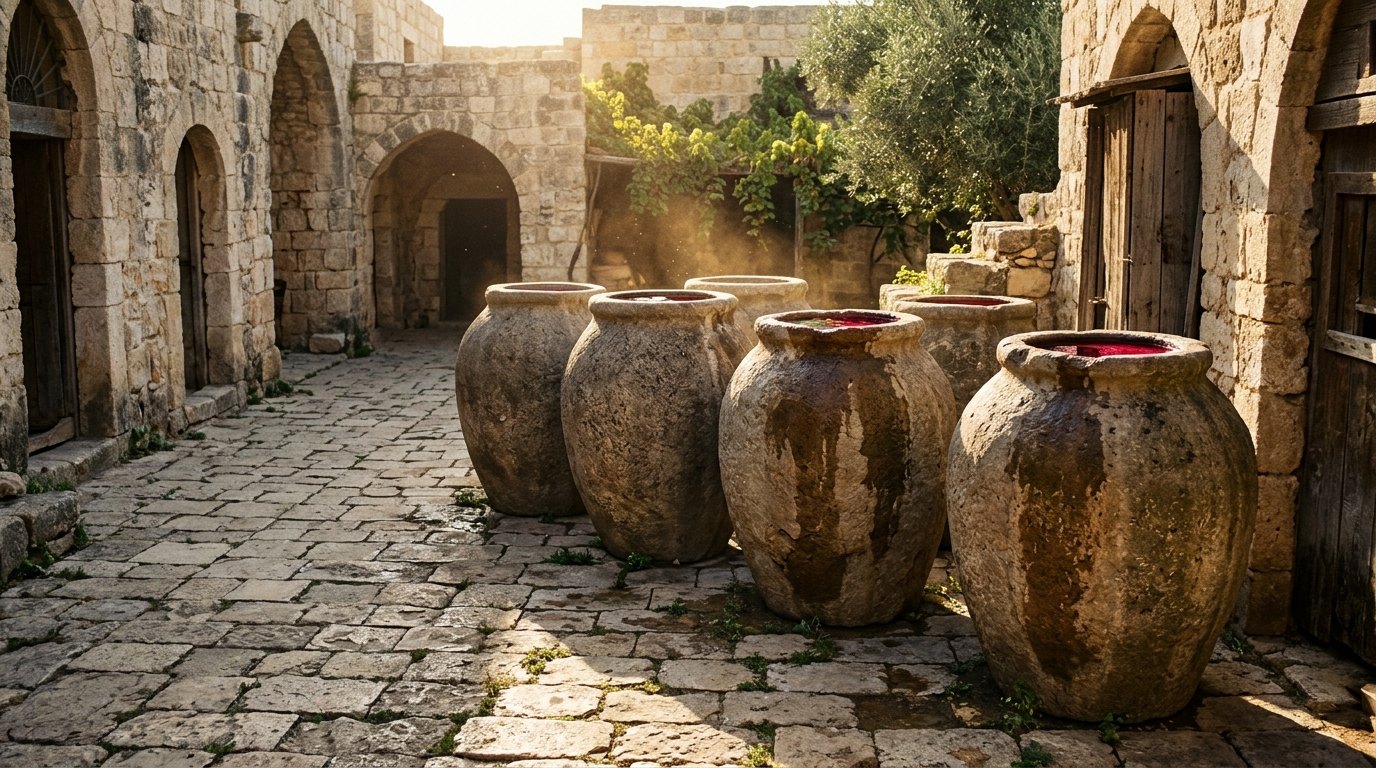
John 2:1-11
1 On the third day a wedding took place at Cana in Galilee. Jesus’ mother was there,
2 and Jesus and his disciples had also been invited to the wedding.
3 When the wine was gone, Jesus’ mother said to him, “They have no more wine.”
4 “Woman, why do you involve me?” Jesus replied. “My hour has not yet come.”
5 His mother said to the servants, “Do whatever he tells you.”
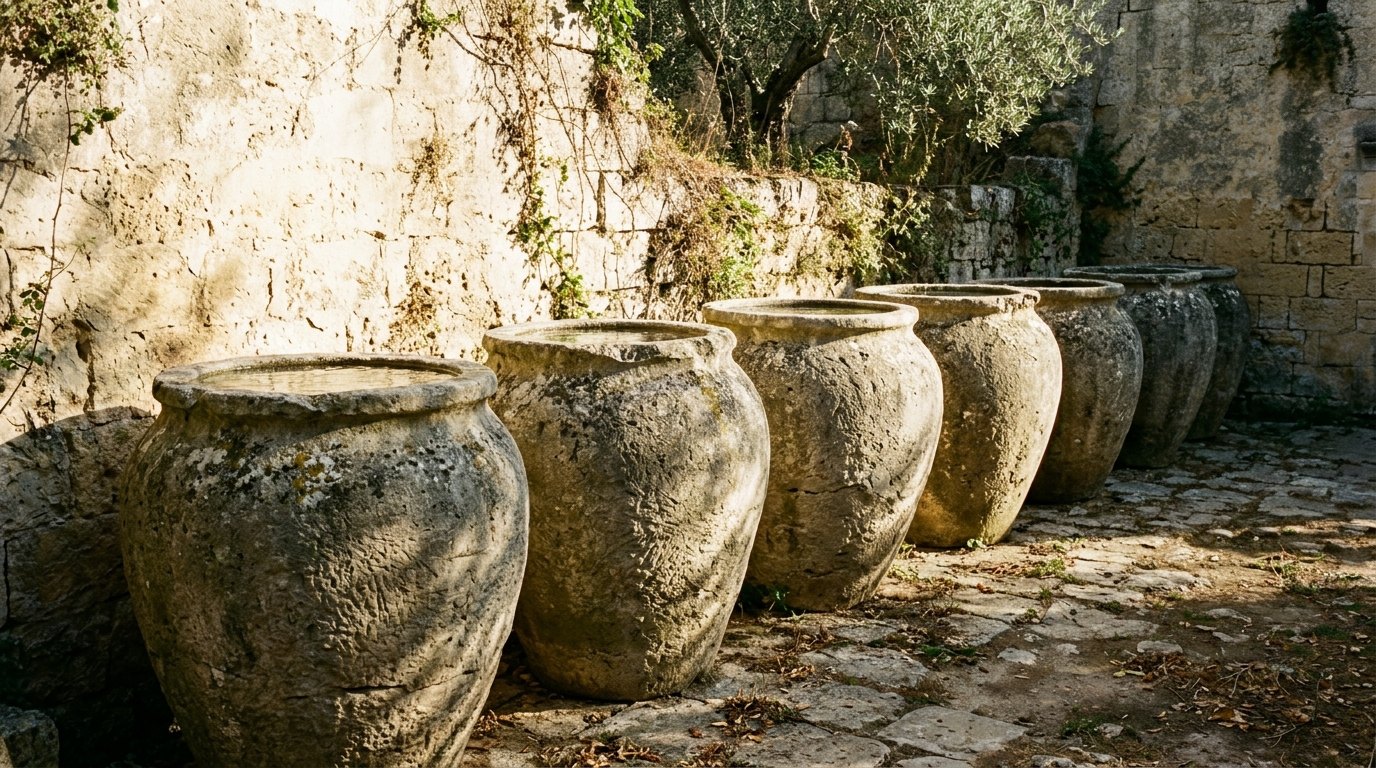
6 Nearby stood six stone water jars, the kind used by the Jews for ceremonial washing, each holding from twenty to thirty gallons.
7 Jesus said to the servants, “Fill the jars with water”; so they filled them to the brim.
8 Then he told them, “Now draw some out and take it to the master of the banquet.” They did so,
9 and the master of the banquet tasted the water that had been turned into wine. He did not realize where it had come from, though the servants who had drawn the water knew. Then he called the bridegroom aside
10 and said, “Everyone brings out the choice wine first and then the cheaper wine after the guests have had too much to drink; but you have saved the best till now.”
11 What Jesus did here in Cana of Galilee was the first of the signs through which he revealed his glory; and his disciples believed in him.
New International Version (NIV)
The answer
John 2:11 tells you the reason in one sentence: "This beginning of his signs Jesus did in Cana of Galilee, and revealed his glory; and his disciples believed in him." The miracle had two explicit purposes God’s Word names:
To reveal his glory. John calls it the beginning of his signs — his first public miracle, opening the works that display who he is. John 1:14 says of the same moment, "the Word became flesh and dwelt among us, and we have seen his glory, glory as of the only Son from the Father." Turning water into wine was not a party trick; it was a showing forth of the glory of God in the flesh.
To call forth faith. John 2:11 ends with the effect: "his disciples believed in him." Faith comes by what the eye sees God do (John 6:2, John 6:14). The Lord used this sign to root his disciples’ trust deeper from the start of his ministry.
A few things the text itself adds, which the commentators draw out:
- He honored marriage. By choosing a wedding as the setting of his first sign (Genesis 2:18-24; Matthew 19:5-6), he blessed the covenant he instituted, and showed he came to sanctify ordinary life, not to strip it of joy.
- He cared for a real need. The bridegroom’s household had run out of wine, and the Lord supplied it — abundantly: six stone jars, two or three metretes each (John 2:6), far more than was needed. He is the kind of Saviour who meets small, concrete needs.
- He kept the best for last. The ruler of the feast said, "You have kept the good wine until now" (John 2:10). The miracle itself pictures what the Lord does — he does not give us the leftovers of this world, but the wine of his kingdom.
So the short answer: to reveal his glory and to draw his people to trust him — and in doing so, to show that his kingdom touches even a wedding feast, and turns what runs empty into what runs over.
Answered from Scripture · reviewed November 8, 2026
Jesus turned water into wine at the wedding in Cana of Galilee to manifest His divine glory as the incarnate Son of God and to lead His disciples into saving faith. In performing this inaugural sign, the Lord also dignified holy matrimony, met an urgent human need with lavish grace, and pointed forward to the superior joy and fullness of the kingdom of God.
The Primary Purpose
Christ Revealed His Divine Glory to Awaken Faith
What Jesus did here in Cana of Galilee was the first of the signs through which he revealed his glory; and his disciples believed in him.
John 2:11 (NIV)
This verse explicitly states the dual divine purpose of the sign: unveiling Christ's glory and bringing His disciples to believe.
The decisive explanation for this inaugural miracle appears in John 2:11, where Scripture reveals that Jesus manifested His glory, and His disciples believed in Him. This miracle was never merely a rescue from an embarrassing social mishap; it was a cosmic self-revelation. The Apostle John frames his whole narrative around the reality that the eternal Word became flesh and tabernacled among us, displaying a glorious fullness seen by eye-witnesses, full of grace and truth (John 1:14). At Cana, the veil parted for the first time in Christ’s public ministry, showing that the Creator of heaven and earth was walking among men. Later in John 4:46, Cana is solemnly remembered as the place where the Lord displayed this creative sovereignty, establishing a pattern that confirms His messianic identity. John explicitly summarizes the purpose of recording such wonders at the climax of his book: these signs were written down so that readers might believe that Jesus is the Christ, the Son of God, and that by believing they may have life in His name (John 20:30-31). The miracle at Cana stood as the theological headline of His entire ministry, verifying His divine nature so that His followers would cast their whole trust upon Him.
| Passage | What it says |
|---|---|
| John 1:14 | Affirms that the Word became flesh and dwelt among us, displaying glory as of the Father's only Son. |
| John 2:11 | Records that this initial sign manifested Jesus' glory, causing His disciples to put their faith in Him. |
| John 4:46 | Recalls Cana as the specific place where Jesus demonstrated His authority by turning water into wine. |
| John 20:30-31 | John summarizes his entire Gospel by stating signs are written so readers believe Jesus is the Christ, the Son of God. |
Dignifying Marriage
The Lord Sanctified the Covenant of Holy Matrimony
On the third day a wedding took place at Cana in Galilee. Jesus’ mother was there, and Jesus and his disciples had also been invited to the wedding.
John 2:1-2 (NIV)
Shows the Son of God honoring human marriage by accepting an invitation to celebrate the covenant union.
By choosing a wedding for His first public miracle, Jesus sanctified the family and validated earthly joy. John 2:1-2 highlights that Jesus was also invited to the wedding with His disciples, demonstrating that the holy Son of God willingly entered the sacred, ordinary celebrations of human life. From the beginning, the Creator instituted marriage as the very foundation of human society, declaring that a man leaves father and mother to hold fast to his wife as one flesh (Genesis 2:18-24). In Proverbs 18:22, wisdom affirms that he who finds a wife finds a good thing and obtains favor from the Lord. Jesus reaffirmed this divine institution in Matthew 19:4-6, warning that what God has joined together, no man should separate. The Apostle Paul carries this truth further in Ephesians 5:31-32, explaining that the mystery of earthly marriage pictures the profound union between Christ and His bride, the church. Ultimately, redemptive history culminates in the marriage supper of the Lamb (Revelation 19:7-9). By inaugurating His miracles at a wedding feast, the Lord announced that He had arrived to betroth an unfaithful world to Himself through a new and everlasting covenant.
| Passage | What it says |
|---|---|
| Genesis 2:18-24 | Institutes the sacred marriage union between man and woman in creation as fundamentally good. |
| Proverbs 18:22 | Declares that finding a wife is finding a good thing and obtaining favor from the Lord. |
| John 2:1-2 | Documents that Jesus and His disciples accepted an invitation to the wedding celebration in Cana. |
| Matthew 19:4-6 | Affirms that God Himself joins husband and wife together in marital covenant. |
| Ephesians 5:31-32 | Paul explains that the marriage covenant instituted at creation profoundly pictures Christ and His church. |
| Revelation 19:7-9 | The climactic celebration of redemptive history is described as the marriage supper of the Lamb. |
Compassionate Intervention
Jesus Met a Concrete Human Need Through Obedience
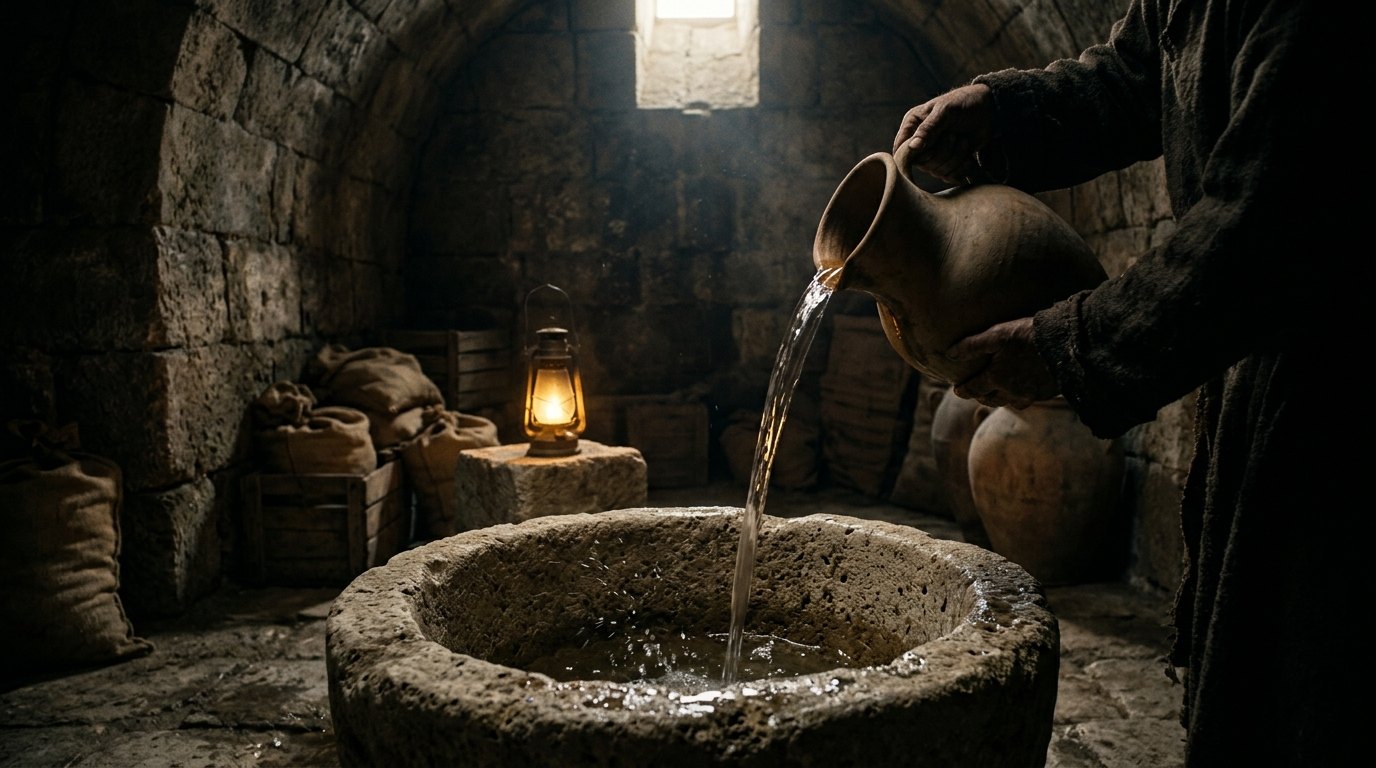
His mother said to the servants, “Do whatever he tells you.”
John 2:5 (NIV)
Mary's command models humble submission to Christ's absolute authority and direction.
When a humiliating shortage threatened the host family, Jesus responded with compassionate care through the humble cooperation of obedient servants. In John 2:5, Mary gave the definitive posture of Christian discipleship when she told the attendants, Do whatever He tells you. When the wine ran out, Mary carried the distress directly to her Son (John 2:3), knowing His character even before He had publicly manifested His power. Christ’s response in John 2:4 indicated that His life was not driven by human pressure, but anchored in the divine timetable of the Father. This submission to His predetermined hour echoes throughout His ministry, as seen when He declined to go up publicly to the feast because His time had not fully come (John 7:6-8), anticipating the supreme hour when the Son of Man would be lifted up on the cross (John 12:23-24). Yet in that very moment, Jesus honored His mother and showed mercy to the household. The servants listened to Mary, filled the six jars to the brim with water, and drew out wine (John 2:7-8). Their quiet, unquestioning obedience became the channel through which divine abundance flowed into an empty house.
| Passage | What it says |
|---|---|
| John 2:3 | Relates the social crisis when the wine failed and Mary brought the need directly to Jesus. |
| John 2:4 | Jesus notes His ultimate submission to the Father's timetable and heavenly hour. |
| John 2:5 | Mary directs the household servants to carry out whatever instruction Jesus gives them. |
| John 2:7-8 | The servants obediently fill the jars to the brim and draw out the newly created wine. |
| John 7:6-8 | Jesus emphasizes that His timing and public manifestations are strictly submitted to the Father's appointed hour. |
| John 12:23-24 | Jesus identifies His ultimate hour as the moment of His sacrificial death and glorification. |
Superabundant Grace
The Kingdom Replaces Ritual Scarcity with New Joy
and said, “Everyone brings out the choice wine first and then the cheaper wine after the guests have had too much to drink; but you have saved the best till now.”
John 2:10 (NIV)
The feast master's testimony highlights that Christ provides what is extraordinarily rich and superior.
The astonishing quality and volume of the wine proclaimed that the dawn of the new covenant had arrived. When the banquet master tasted the liquid, he cried out in amazement in John 2:10 that you have kept the good wine until now. The miracle occurred within six massive stone jars used for the Jewish rites of purification, each holding twenty to thirty gallons (John 2:6). As the master tasted the wine without knowing its source (John 2:9), between one hundred and twenty and one hundred and eighty gallons of the finest vintage stood ready. This was an unmistakable theological sermon in liquid form: the external rites of the old covenant were passing away, replaced by the lavish, superior grace of the Messiah. John had already announced that while the law was given through Moses, grace and truth came through Jesus Christ, giving us grace upon grace (John 1:16-17). The author of Hebrews reminds us that ritual washings were temporary ordinances imposed until the time of reformation (Hebrews 9:9-10), shadows that could never cleanse the conscience or take away sins (Hebrews 10:1-4). Christ poured out the vibrant, superior wine of His kingdom, ending spiritual lack with everlasting joy.
| Passage | What it says |
|---|---|
| John 2:6 | Identifies six stone jars used for ceremonial washing holding twenty to thirty gallons each. |
| John 2:9 | The master of the banquet tastes the water made wine without knowing its miraculous origin. |
| John 2:10 | The master remarks that while men serve cheap wine last, the best wine was kept until now. |
| John 1:16-17 | John declares that grace and truth came through Jesus Christ, offering grace upon grace beyond the law of Moses. |
| Hebrews 9:9-10 | The Old Covenant purifications were temporary regulations of the flesh until the time of the new reformation. |
| Hebrews 10:1-4 | Levitical rites could never take away sins, serving as shadows pointing forward to Christ's superior work. |
Messianic Feast
The Messiah Unleashed the Prophesied Banquet of the Kingdom
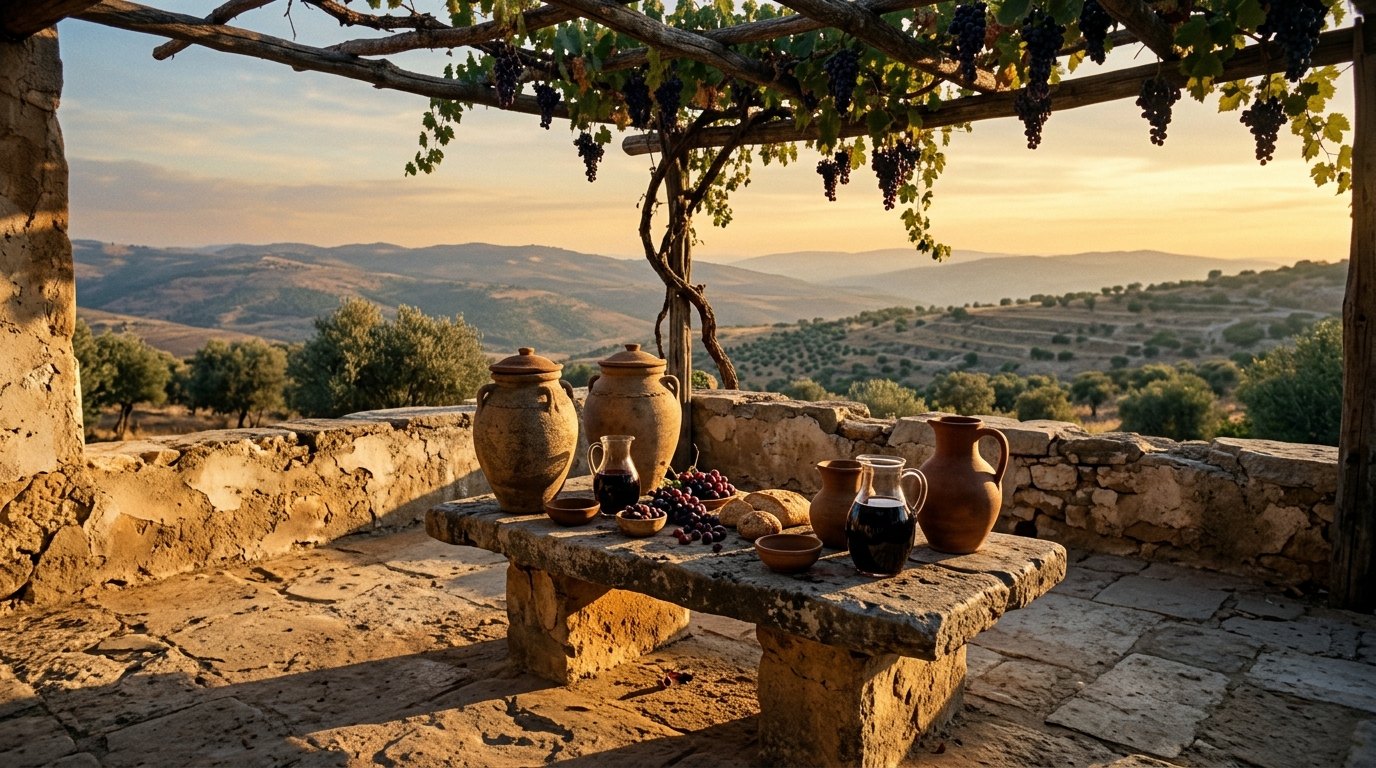
On this mountain the LORD Almighty will prepare a feast of rich food for all peoples, a banquet of aged wine— the best of meats and the finest of wines.
Isaiah 25:6 (NIV)
Isaiah foretold that Yahweh Himself would celebrate His salvation with a feast of refined, abundant vintage wine.
When Isaiah foresaw the sovereign day of redemption, he looked toward Zion and proclaimed that the Lord of hosts would prepare an extravagant banquet: a feast of rich food and well-aged wine (Isaiah 25:6). In that day, Yahweh would swallow up death forever and wipe away tears from every face (Isaiah 25:7-8; fulfilled in Matthew 26:29; John 2:10-11). When Jesus arrived at Cana of Galilee and supplied between one hundred twenty and one hundred eighty gallons of superior vintage, He was not simply solving a momentary social shortage; He was unveiling the prophesied feast of the kingdom. Ancient prophecy had long tied the arrival of the Messiah to overflowing vats of wine. Dying Jacob foretold that Shiloh would emerge from Judah to tether His donkey to choice vines and wash His garments in the blood of grapes amid supernatural bounty (Genesis 49:10-12; fulfilled in John 2:9-10). The prophets consistently portrayed the new covenant in the language of exuberant harvest and overflowing winepresses. Jeremiah promised that redeemed Israel would stream to the radiant goodness of the Lord for grain, new wine, and oil, their lives becoming like well-watered gardens (Jeremiah 31:12-14; fulfilled in John 2:9-11). Hosea depicted the fragrance and renown of restored Israel as the wine of Lebanon (Hosea 14:7; fulfilled in John 2:10-11). Joel declared that in the messianic era the mountains would drip with sweet wine and every dry riverbed would surge with life-giving water (Joel 3:18; fulfilled in John 2:9-11). Amos similarly announced that the plowman would overtake the reaper as the mountains flowed with wine when David's fallen booth was restored (Amos 9:13-14; fulfilled in Acts 15:16-17; John 2:9-11). Jesus confirmed that this eschatological joy could never be contained within old ceremonial structures: the new wine of His kingdom demands new wineskins (Mark 2:21-22; fulfilled in John 2:10). At Cana, Christ demonstrated that the long-promised messianic wedding feast had arrived in His own person.
| Passage | What it says | Fulfilled |
|---|---|---|
| Genesis 49:10-12 | Jacob prophesies of Judah that Shiloh will wash garments in wine and the blood of grapes amid royal abundance. | John 2:9-10 |
| Isaiah 25:6-8 | The Lord of hosts prepares a messianic feast of rich food and choice aged wines on His holy mountain. | John 2:10-11, Matthew 26:29 |
| Jeremiah 31:12-14 | In the new covenant restoration, God's people rejoice over goodness including grain, new wine, and oil. | John 2:9-11 |
| Hosea 14:7 | The redeemed people shall flourish like grain and blossom like the vine, famed as the wine of Lebanon. | John 2:10-11 |
| Joel 3:18 | In that messianic day the mountains will drip with sweet wine and the hills flow with milk. | John 2:9-11 |
| Amos 9:13-14 | The restoration of David's fallen tent brings mountains dripping sweet wine and flourishing repaired vineyards. | Acts 15:16-17, John 2:9-11 |
| Mark 2:21-22 | Jesus declares that the joy of the kingdom requires new wineskins for the new wine of His coming. | John 2:10 |
Where in the Bible
| Book | Passages |
|---|---|
| Genesis | 2 · Genesis 2:18-24, Genesis 49:10-12 |
| Proverbs | 1 · Proverbs 18:22 |
| Isaiah | 1 · Isaiah 25:6-8 |
| Jeremiah | 1 · Jeremiah 31:12-14 |
| Hosea | 1 · Hosea 14:7 |
| Joel | 1 · Joel 3:18 |
| Amos | 1 · Amos 9:13-14 |
| Matthew | 1 · Matthew 19:4-6 |
| Mark | 1 · Mark 2:21-22 |
| John | 15 · John 1:14, John 2:11, John 4:46, John 20:30-31, John 2:1-2, John 2:3, John 2:4, John 2:5, John 2:7-8, John 7:6-8, John 12:23-24, John 2:6, John 2:9, John 2:10, John 1:16-17 |
| Ephesians | 1 · Ephesians 5:31-32 |
| Hebrews | 2 · Hebrews 9:9-10, Hebrews 10:1-4 |
| Revelation | 1 · Revelation 19:7-9 |
The story in order
- Creation institutes marriage (c. 4000 BC) · Genesis 2:18-24 · God establishes marriage as a good and sacred union.
- Jacob prophesies of Shiloh (c. 1450 BC) · Genesis 49:10-12 · Foretells a ruler from Judah associated with wine and abundance.
- Isaiah prophesies messianic feast (c. 700 BC) · Isaiah 25:6-8 · Describes a future banquet with rich food and fine wine.
- Jeremiah prophesies new covenant (c. 600 BC) · Jeremiah 31:12-14 · Promises rejoicing with grain, new wine, and oil.
- Hosea describes flourishing people (c. 750 BC) · Hosea 14:7 · The redeemed will flourish like grain and blossom like the vine.
- Amos prophesies restoration (c. 750 BC) · Amos 9:13-14 · Restoration brings mountains dripping with sweet wine.
- Jesus attends wedding at Cana (c. AD 27) · John 2:1-2 · Jesus dignifies marriage by attending and participating.
- Jesus turns water into wine (c. AD 27) · John 2:7-8 · First sign reveals Jesus' glory and leads disciples to faith.
- Jesus teaches about new wine (c. AD 28) · Mark 2:21-22 · The kingdom requires new wineskins for new wine.
- Jesus' public ministry summary (c. AD 30) · John 20:30-31 · Signs written so readers believe Jesus is the Son of God.
- Paul on marriage and Christ (c. AD 60) · Ephesians 5:31-32 · Marriage pictures Christ and His church.
- Revelation describes marriage supper (c. AD 95) · Revelation 19:7-9 · The ultimate celebration is the marriage supper of the Lamb.
Ritual Scarcity vs. Kingdom Abundance
| Old Covenant Ritual | New Covenant Reality | Passage |
|---|---|---|
| Six stone jars for ceremonial washing. | Jesus provides abundant, superior wine. | |
| Levitical rites were temporary regulations. | Grace and truth came through Jesus Christ. | |
| Old covenant sacrifices could never take away sins. | Jesus' work is superior and brings forgiveness. | |
| The master of the banquet served cheap wine last. | Jesus kept the best wine until the end. | John 2:10 |
Key words
- Glory (doxa, δόξα)
- The visible manifestation of God's divine majesty and presence. · John 2:11
- Sign (semeion, σημεῖον)
- A miraculous act pointing to Jesus' divine identity and mission. · John 2:11
- Faith (pistis, πίστις)
- Trust and belief in Jesus Christ as the Son of God. · John 2:11
- Hour (hōra, ὥρα)
- The divinely appointed time for Jesus' suffering, death, and glorification. · John 2:4
- Grace (charis, χάρις)
- God's unmerited favor and divine assistance. · John 1:16
- Truth (alētheia, ἀλήθεια)
- The reality and faithfulness of God revealed in Christ. · John 1:17
The miracle at Cana assures believers that Christ cares intimately for the everyday details and failures of human life, transforming our scarcity into His abundance. Above all, it invites us to trust Him fully, resting in the glorious reality that the Savior reserves His best gifts for those who come to Him in faith.
29 passages, each cited once.
Scripture cited
- John 1:14
- John 6:2
- John 6:14