Why is Jesus called the Lamb of God?
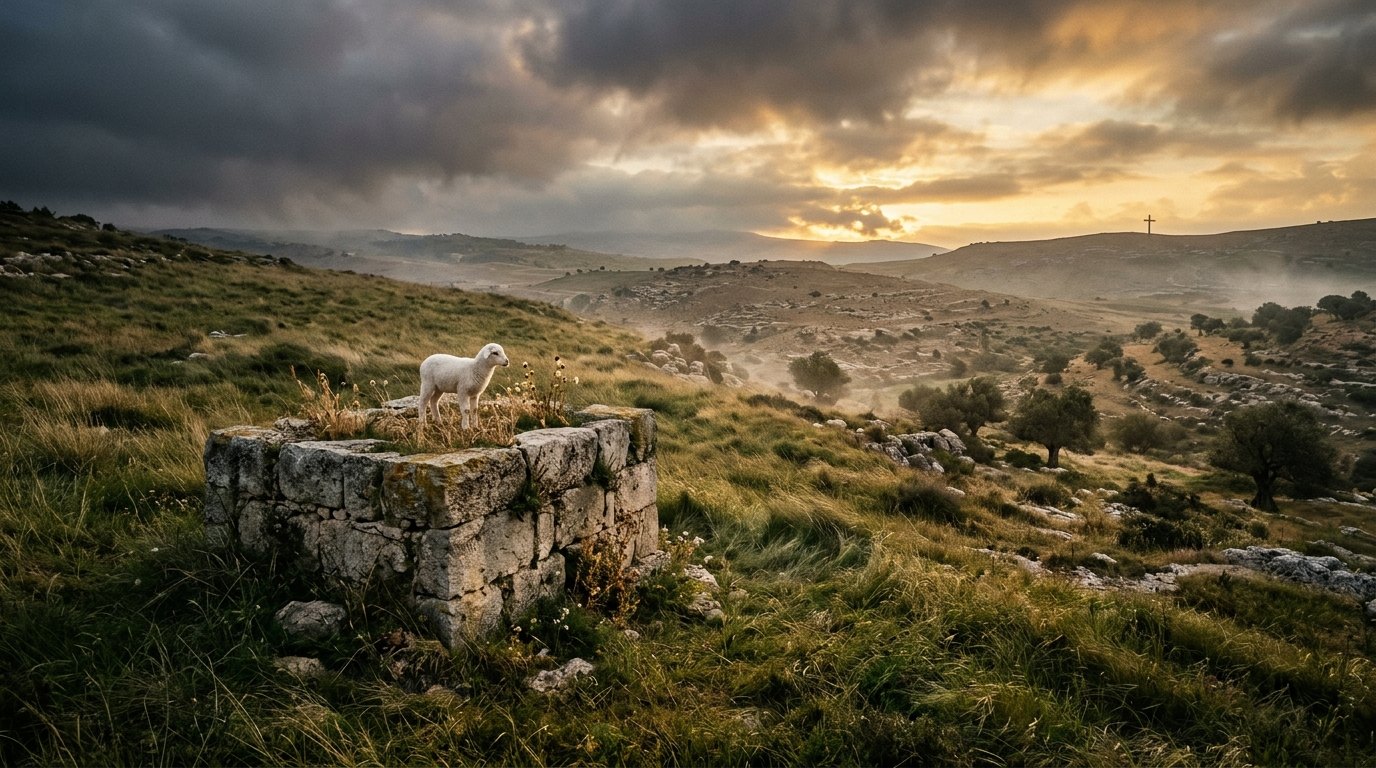
John 1:29
29 The next day John saw Jesus coming toward him and said, “Look, the Lamb of God, who takes away the sin of the world!
New International Version (NIV)
The answer
John the Baptist's title for Jesus — the Lamb of God — means Jesus is the sacrifice God himself provides to put away sin. John 1:29 ties the two ideas together: he is the Lamb, and he takes away the sin of the world.
He fulfills the Old Testament lamb sacrifices
Under the old covenant, lambs were the regular offering for sin. The ongoing sacrifice was a lamb (Exodus 29:38-41), and a lamb could be brought as a sin offering for the people (Leviticus 4:32; 5:6). All of these pointed forward to one final sacrifice that would actually deal with sin rather than merely cover it year after year.
He is without blemish or sin
A sacrifice for sin had to be clean. Scripture says Christ is exactly that. 1 Peter 1:19 calls him "a lamb without blemish and without spot," and 1 John 3:5 says "you know that he was manifested to take away our sins; and in him is no sin." A sinner cannot atone for sin — the offering has to be undefiled, and he is.
He dies as the substitute
He doesn't merely die; he carries the sins of others in his own body. 1 Peter 2:24: "he himself bore our sins in his own body on the tree." 2 Corinthians 5:21: "God made him who had no sin to be sin for us, so that in him we might become the righteousness of God." Isaiah 53:7 had pictured this long before: "he was led like a lamb to the slaughter."
His sacrifice reaches the whole world
The scope is universal, not just for Israel. 1 John 2:2: "he is the atoning sacrifice for our sins, and not only for ours but also for the sins of the whole world." John 1:29's phrase — "the sin of the world" — matches.
Putting it together: the Lamb of God is the sinless, God-provided substitute whose death actually takes away the world's sin, fulfilling every lamb sacrifice the Law had been pointing to all along.
Answered from Scripture · reviewed November 7, 2026
When John the Baptist saw Jesus approaching the Jordan, he announced him with a title that summarized the entire storyline of redemptive history: 'Behold, the Lamb of God, who takes away the sin of the world!' From the ram caught in Abraham's thicket to the daily tabernacle offerings and Isaiah's suffering servant, Scripture uniformly presents Christ as the spotless, God-provided substitute whose sacrificial death forever removes sin.
The Divine Provision
God provides the substitute on the mount of sacrifice.

Abraham answered, “God himself will provide the lamb for the burnt offering, my son.” And the two of them went on together.
Genesis 22:8 (NIV)
Abraham prophetically declares that God will provide Himself the lamb for the burnt offering, pointing to the ultimate sacrifice on Calvary.
On the heights of Moriah, Abraham spoke words that would resonate across two millennia of redemptive history: God will provide for himself the lamb for a burnt offering, my son (Genesis 22:8). Ascending the mountain with wood and fire, young Isaac asked the searching question that every fallen sinner must eventually ask: 'Behold, the fire and the wood, but where is the lamb for a burnt offering?' (Genesis 22:7). Abraham's reply was not merely a father's gentle reassurance; it was an inspired prophecy pointing directly to Calvary, where the Father would not spare His own Son (Romans 8:32; Hebrews 11:17-19).
When Abraham bound Isaac upon the altar and lifted the knife, divine justice intervened. A ram caught by its horns in a nearby thicket was substituted in Isaac's place (Genesis 22:13). Abraham sacrificed the ram, and the young man walked down the mountain alive and justified by a substitute. Abraham named the sacred summit Yahweh-Yireh—'The LORD Will Provide'—declaring that on the mount of the LORD it shall be provided (Genesis 22:14).
Yet the observant reader notices a crucial detail: Abraham had prophesied a lamb, but God provided a ram. The ultimate fulfillment remained suspended in promise until John the Baptist pointed across the Jordan River and announced Jesus as that long-awaited lamb (John 1:29). What Moriah foreshadowed in shadow, Golgotha accomplished in substance: the Father Himself provided the spotless Lamb whose substitutionary sacrifice delivers the condemned from death.
| Passage | What it says | Fulfilled |
|---|---|---|
| Genesis 22:7-8 | Isaac asks where the lamb is, and Abraham answers that God will provide Himself the lamb. | John 1:29, Hebrews 11:17-19 |
| Genesis 22:13-14 | A ram caught in a thicket is offered instead of Isaac, and Abraham names the place 'The LORD Will Provide.' | Romans 8:32 |
The Passover Shadow
The unblemished lamb shields the household from divine wrath.
The animals you choose must be year-old males without defect, and you may take them from the sheep or the goats.
Exodus 12:5 (NIV)
The Passover lamb was required to be an unblemished male, establishing the divine standard of purity for redemption.
The institution of the Passover established the enduring blueprint of redemption: salvation from wrath occurs solely under the cover of innocent blood. In Exodus 12:5, God commanded that your lamb shall be without blemish, a male a year old, setting a non-negotiable standard of moral and physical perfection that typified Christ's unspotted holiness (1 Peter 1:19). Every Hebrew household selected a lamb, slaughtered it at twilight, and applied its blood to the lintels and doorposts of their dwellings (Exodus 12:3-7).
The blood was not merely an emblem; it was an objective shield against holy judgment. As the Lord declared, when I see the blood, I will pass over you, and no plague will befall you to destroy you (Exodus 12:12-13). Deliverance did not depend upon the personal worthiness of those inside the house, but exclusively on the applied blood of the slain victim (Romans 5:9; Hebrews 9:14).
God further ordained that not one of its bones shall be broken (Exodus 12:46). Centuries later, when Roman soldiers broke the legs of the thieves crucified beside Jesus to expedite death, they found the Lord already deceased and left His legs unbroken (John 19:36). Paul confirms the exact antitype of this historical sign: Christ, our Passover lamb, has been sacrificed (1 Corinthians 5:7). By His death, the wrath of God passes over every believer shielded by His blood.
| Passage | What it says | Fulfilled |
|---|---|---|
| Exodus 12:3-7 | Each household takes an unblemished lamb, slaughters it, and strikes its blood on the lintel and doorposts. | 1 Corinthians 5:7, 1 Peter 1:19 |
| Exodus 12:12-13 | The Lord passes through Egypt in judgment, but passes over houses marked by the applied blood of the lamb. | Romans 5:9, Hebrews 9:14 |
| Exodus 12:46 | Not a single bone of the Passover lamb shall be broken during its sacrifice or preparation. | John 19:36 |
| 1 Corinthians 5:7 | Declares explicitly that Christ, our Passover lamb, has been sacrificed for us. | |
| John 19:36 | Notes that not one of Jesus' bones was broken, fulfilling Passover statute. |
The Levitical Offerings
Daily and personal sacrifices point to continuous substitutionary atonement.
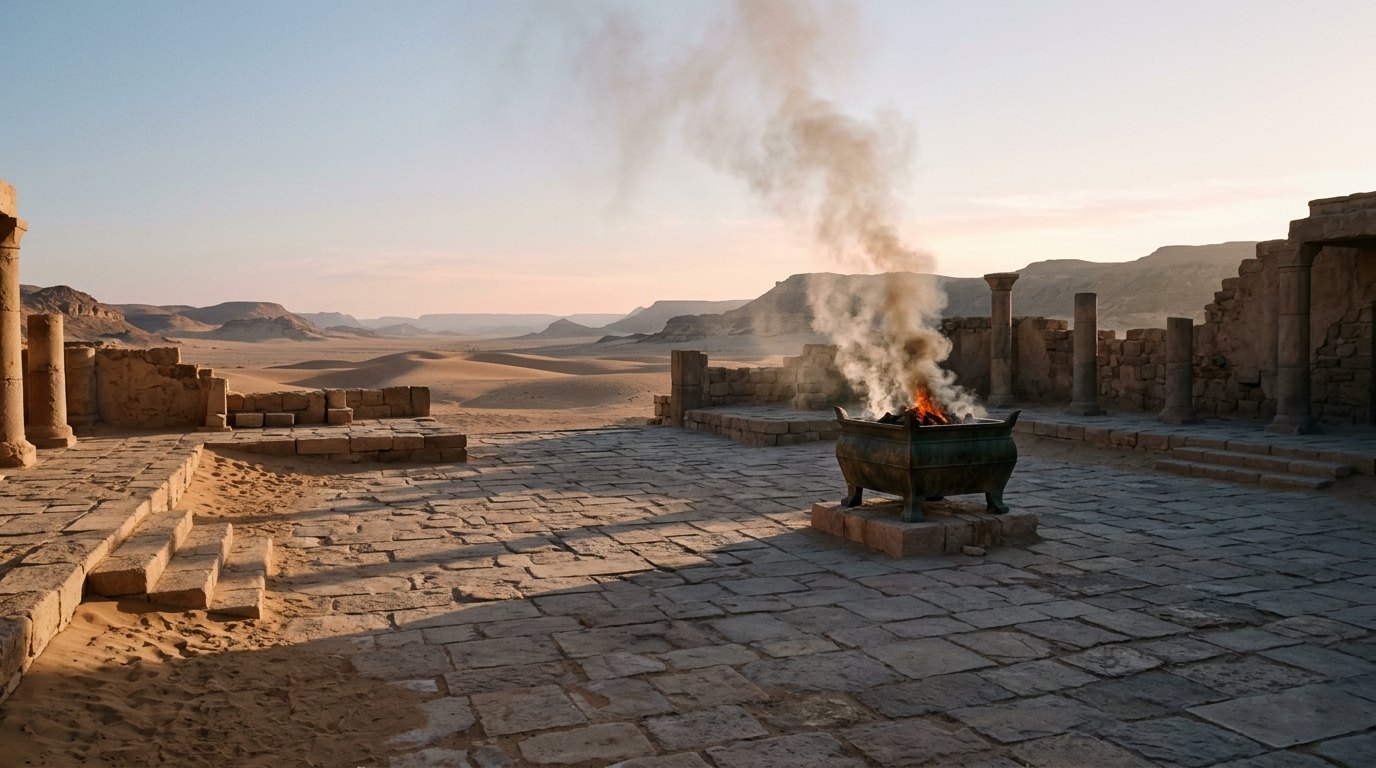
“This is what you are to offer on the altar regularly each day: two lambs a year old. Offer one in the morning and the other at twilight.
Exodus 29:38-39 (NIV)
The continual daily morning and evening sacrifice of lambs demonstrated the relentless requirement of blood for sinful people.
Under the Mosaic covenant, the daily routine of the sanctuary reinforced Israel's perpetual need for cleansing. God commanded Moses that two lambs a year old day by day continually be offered upon the bronze altar—one in the morning and the other at twilight (Exodus 29:38-39; Numbers 28:3-8). This unceasing rhythm of smoke and blood stood as an unrelenting testimony: sin separates man from God, and fellowship can be maintained only through ceaseless substitution (Exodus 29:40-42).
Whenever an individual sinned against the Lord's commandments, he was required to bring a spotless female lamb as a sin offering (Leviticus 4:32-35) or a trespass offering (Leviticus 5:5-6). The worshiper placed his hand firmly upon the head of the innocent victim, confessing his sin and transferring guilt, so that the animal died in his place. Yet the author of Hebrews underscores the limitation of this system: 'it is impossible for the blood of bulls and goats to take away sins' (Hebrews 10:1-4).
Those millions of slaughtered animals could only shadow what was to come. They functioned as a divine promissory note until Christ stepped into the heavenly tabernacle. Christ offered one sacrifice for sins for all time, entering through His own blood to secure an eternal redemption (Hebrews 9:11-14; Hebrews 10:10-14). Where the Levitical priests never sat down because their work was never finished, the true Lamb sat down at the right hand of God.
| Passage | What it says | Fulfilled |
|---|---|---|
| Exodus 29:38-42 | Two year-old lambs are offered day by day continually before the Lord at the tabernacle door. | Hebrews 7:27, Hebrews 10:11-12 |
| Leviticus 4:32-35 | An individual brings a spotless female lamb as a sin offering, laying hands on its head for atonement. | 2 Corinthians 5:21, Hebrews 9:22 |
| Leviticus 5:5-6 | A person guilty of sin confesses and brings a female lamb or kid as a trespass offering. | 1 John 1:7, 1 John 1:9 |
| Numbers 28:3-8 | Prescribes the continual morning and evening sacrifice of unblemished year-old lambs. | Hebrews 10:11-14 |
| Hebrews 9:11-14 | Contrasts the blood of sacrificial animals with Christ's unblemished self-offering. | |
| Hebrews 10:1-4 | Explains that animal sacrifices could never take away sins permanently. | |
| Hebrews 10:10-14 | Affirms that Christ offered one sacrifice for sins for all time. |
The Prophetic Servant
The silent lamb bears our iniquities to the slaughter.

He was oppressed and afflicted, yet he did not open his mouth; he was led like a lamb to the slaughter, and as a sheep before its shearers is silent, so he did not open his mouth.
Isaiah 53:7 (NIV)
Isaiah foretells the Messiah's willing submission and silent obedience as a lamb led to slaughter.
Seven centuries before the incarnation, the prophet Isaiah pulled back the veil to reveal the inner character and cosmic significance of the Messiah's sacrifice. In Isaiah 53:7, the prophet wrote: like a lamb that is led to the slaughter, and like a sheep that before its shearers is silent, so he opened not his mouth. Here the sacrificial animal of the tabernacle is revealed to be a conscious, willing Person who embraces suffering without resistance or retaliation (1 Peter 2:23).
Isaiah explained the great exchange taking place in this slaughter. We had all gone astray like wandering sheep, but the LORD has laid on him the iniquity of us all (Isaiah 53:4-6). Jesus was pierced for our transgressions and crushed for our iniquities (1 Peter 2:24-25). This was no tragic judicial accident; it pleased the Lord to crush Him, making His soul an offering for guilt so that through His knowledge He would justify many (Isaiah 53:10-12; Mark 10:45; Hebrews 9:28).
When the Ethiopian eunuch sat in his chariot reading this very passage, he asked Philip of whom the prophet spoke (Acts 8:32-34). Beginning from that very text, Philip opened his mouth and told him the good news about Jesus (Acts 8:35). In Jesus of Nazareth, the silent Lamb of Isaiah 53 bore the sins of the world, satisfying divine justice and securing everlasting peace for His people.
| Passage | What it says | Fulfilled |
|---|---|---|
| Isaiah 53:4-6 | The servant carries our griefs and sorrows, and the Lord lays on Him the iniquity of us all. | 1 Peter 2:24-25 |
| Isaiah 53:7 | He opens not His mouth under oppression, brought as a lamb to slaughter and sheep before shearers. | Acts 8:32-35, 1 Peter 2:23 |
| Isaiah 53:10-12 | His soul is made an offering for sin, bearing the sins of many and justifying them. | Mark 10:45, Hebrews 9:28 |
| Acts 8:32-35 | Philip explains Isaiah 53's led lamb as pointing directly to Jesus. |
The Baptist's Declaration
Jesus is publicly identified as the ultimate sin-bearing substitute.

The next day John saw Jesus coming toward him and said, “Look, the Lamb of God, who takes away the sin of the world!
John 1:29 (NIV)
John identifies Jesus as the Lamb provided by God whose singular sacrifice takes away the world's sin.
When John the Baptist saw Jesus coming toward him, he cried out with words that crystallized centuries of redemptive history: "Behold, the Lamb of God, who takes away the sin of the world!" (John 1:29). In this single declaration, John identified Christ not merely as an earthly king or moral reformer, but as the long-awaited substitute provided directly by God Himself. Every prior offering—from the ram Abraham found caught in the thicket to the morning and evening sacrifices prescribed in the tabernacle—had pointed forward to this singular person. While animal blood could only cover sin temporarily and ceremonially under the old covenant, Christ came as the divine reality capable of actually removing sin's guilt and penalty.
The following day, John reaffirmed this testimony before two of his own disciples. Gazing upon Jesus as He walked past, John stated plainly once more: "Behold, the Lamb of God!" (John 1:35-36). This public witness immediately directed men away from the forerunner and toward the Savior Himself, prompting Andrew and another disciple to follow Jesus. By designating Christ as the Lamb, John summoned the prophetic witness of Isaiah 53 and the memory of the Passover deliverance, announcing to Israel and the nations that God’s final, perfect sacrifice had at last arrived in human history to deal fully and decisively with human transgression.
| Passage | What it says |
|---|---|
| John 1:29 | John beholds Jesus approaching and proclaims Him the Lamb of God who takes away the sin of the world. |
| John 1:35-36 | Looking upon Jesus as He walked, John again declares to his disciples: 'Behold the Lamb of God!' |
The Spotless Sacrifice
The sinless Son of God redeems us by His precious blood.
For you know that it was not with perishable things such as silver or gold that you were redeemed from the empty way of life handed down to you from your ancestors, but with the precious blood of Christ, a lamb without blemish or defect.
1 Peter 1:18-19 (NIV)
Believers are redeemed not with perishable silver or gold, but with the precious blood of Christ as of a spotless lamb.
The efficacy of Christ's sacrificial death rests entirely upon His spotless moral perfection. As the apostle Peter reminds the church, believers were redeemed not with perishable things like silver or gold, but with the precious blood of Christ, as of a lamb without blemish and without spot (1 Peter 1:18-19). Under the Levitical law, any animal presented for sacrifice had to be physically unblemished to typify holiness; in Christ, this shadow met its absolute reality. John affirms this total purity, stating that Jesus "was manifested to take away our sins, and in Him there is no sin" (1 John 3:5).
Because Jesus lived in flawless obedience to the Father, He alone was qualified to act as our substitute. Paul sets forth the glorious divine exchange: God made Him who knew no sin to be sin for us, so that in Him we might become the righteousness of God (2 Corinthians 5:21). Peter underscores this same truth, recording that Christ "committed no sin, nor was deceit found in His mouth," yet He personally "bore our sins in His own body on the tree" (1 Peter 2:22-24). His blood is therefore an infinite satisfaction for divine justice, making Him the atoning propitiation for our sins, and not for ours only but also for the whole world (1 John 2:2).
| Passage | What it says |
|---|---|
| 1 Peter 1:18-19 | Redemption was bought with the precious blood of Christ, as of a lamb without blemish and without spot. |
| 1 John 3:5 | He was manifested to take away our sins, and in Him there is absolutely no sin. |
| 2 Corinthians 5:21 | God made Him who knew no sin to be sin for us, that we might become the righteousness of God. |
| 1 Peter 2:22-24 | He committed no sin, yet He Himself bore our sins in His own body upon the cross. |
| 1 John 2:2 | He is the atoning propitiation for our sins, and not for ours only but for the whole world. |
The Enthroned Lamb
The slain Lamb now reigns and receives universal worship.

Then I saw a Lamb, looking as if it had been slain, standing at the center of the throne, encircled by the four living creatures and the elders. The Lamb had seven horns and seven eyes, which are the seven spirits of God sent out into all the earth.
Revelation 5:6 (NIV)
In the midst of the throne stands a Lamb as though it had been slain, uniting sacrificial death with sovereign power.
The final book of Scripture reveals the eternal destiny of the sacrificial Savior: in the midst of the heavenly throne stands a Lamb as though it had been slain, radiating both sovereign authority and redeeming love (Revelation 5:6). The marks of His crucifixion remain as His everlasting glory, prompting the four living creatures and twenty-four elders to fall down in worship and sing a new song: "You are worthy... for You were slain, and have redeemed us to God by Your blood out of every tribe and tongue and people and nation" (Revelation 5:9-10). Myriads of angels join this chorus, proclaiming with a loud voice that the slain Lamb is worthy to receive all power, riches, wisdom, strength, honor, glory, and blessing (Revelation 5:12-13).
Throughout the vision of the end of the age, this triumphant Lamb secures His people and judges all unrighteousness. The redeemed wash their robes and make them white in the blood of the Lamb (Revelation 7:14), standing victorious upon Mount Zion with the Father's name written on their foreheads (Revelation 14:1-5). Though the kings of the earth tremble before the righteous wrath of the Lamb (Revelation 6:16-17), the saints conquer the ancient dragon by the blood of the Lamb and the word of their testimony (Revelation 12:11). Every believer’s name is permanently inscribed in the Book of Life of the Lamb slain from the foundation of the world (Revelation 13:8). Ultimately, the Lamb will overcome every hostile power as Lord of lords and King of kings (Revelation 17:14), welcoming His prepared Bride to the great marriage supper (Revelation 19:6-9). In the New Jerusalem, the city has no need of sun or moon, for the Lamb is its radiant light (Revelation 21:22-23), and from the throne of God and of the Lamb flows the pure river of the water of life for all eternity (Revelation 22:1-3).
| Passage | What it says |
|---|---|
| Revelation 5:6 | A Lamb standing as though it had been slain appears in the midst of the throne and elders. |
| Revelation 5:9-10 | The elders sing a new song to the Lamb who was slain and redeemed people to God by His blood. |
| Revelation 5:12-13 | Countless angels proclaim worthy is the Lamb that was slain to receive power, riches, wisdom, and honor. |
| Revelation 7:14 | The redeemed have washed their robes and made them white in the blood of the Lamb. |
| Revelation 21:22-23 | The city has no need of sun or moon, for the glory of God lightens it and the Lamb is its light. |
| Revelation 6:16-17 | Depicts the solemn, holy wrath of the enthroned Lamb against unrepentant earth. |
| Revelation 12:11 | Shows the saints conquering the dragon by the blood of the Lamb. |
| Revelation 13:8 | Names the book of life belonging to the Lamb slain from foundation. |
| Revelation 14:1-5 | Portrays the redeemed standing with the Lamb, having His Father's name. |
| Revelation 17:14 | Declares that the Lamb will conquer all enemies as Lord of lords. |
| Revelation 19:6-9 | Celebrates the marriage supper of the Lamb and His prepared Bride. |
| Revelation 22:1-3 | Reveals the river of life flowing from the throne of God and Lamb. |
Where in the Bible
| Book | Passages |
|---|---|
| Genesis | 2 · Genesis 22:7-8, Genesis 22:13-14 |
| Exodus | 4 · Exodus 12:3-7, Exodus 12:12-13, Exodus 12:46, Exodus 29:38-42 |
| Leviticus | 2 · Leviticus 4:32-35, Leviticus 5:5-6 |
| Numbers | 1 · Numbers 28:3-8 |
| Isaiah | 3 · Isaiah 53:4-6, Isaiah 53:7, Isaiah 53:10-12 |
| John | 3 · John 19:36, John 1:29, John 1:35-36 |
| Acts | 1 · Acts 8:32-35 |
| 1 Corinthians | 1 · 1 Corinthians 5:7 |
| 2 Corinthians | 1 · 2 Corinthians 5:21 |
| Hebrews | 3 · Hebrews 9:11-14, Hebrews 10:1-4, Hebrews 10:10-14 |
| 1 Peter | 2 · 1 Peter 1:18-19, 1 Peter 2:22-24 |
| 1 John | 2 · 1 John 3:5, 1 John 2:2 |
| Revelation | 12 · Revelation 5:6, Revelation 5:9-10, Revelation 5:12-13, Revelation 7:14, Revelation 21:22-23, Revelation 6:16-17, Revelation 12:11, Revelation 13:8, Revelation 14:1-5, Revelation 17:14, Revelation 19:6-9, Revelation 22:1-3 |
The story in order
- God provides a substitute (c. 2000 BC) · Genesis 22:13-14 · Abraham names the place 'The LORD Will Provide' after a ram is offered instead of Isaac.
- Passover lamb shields from wrath (c. 1445 BC) · Exodus 12:12-13 · The Lord passes over households marked with the lamb's blood.
- Daily sacrifices for atonement (c. 1445 BC) · Numbers 28:3-8 · Two lambs offered daily at the tabernacle, pointing to continuous atonement.
- Prophetic servant bears iniquity (c. 700 BC) · Isaiah 53:4-6 · The suffering servant carries our griefs and the Lord lays on Him our iniquity.
- Prophetic servant silent, led to slaughter (c. 700 BC) · Isaiah 53:7 · He is brought as a lamb to slaughter, opening not His mouth.
- John identifies Jesus as Lamb of God (AD 27) · John 1:29 · John the Baptist proclaims Jesus takes away the sin of the world.
- Christ's blood redeems without blemish (c. AD 60) · 1 Peter 1:18-19 · Redemption by the precious blood of Christ, the lamb without blemish.
- Christ is the atoning propitiation (c. AD 90) · 1 John 2:2 · He is the propitiation for our sins, and for the whole world.
- The Lamb slain receives worship (c. AD 95) · Revelation 5:12-13 · Angels proclaim the Lamb worthy to receive honor and power.
- The redeemed are in the Lamb's blood (c. AD 95) · Revelation 7:14 · The great multitude have washed their robes white in the blood of the Lamb.
- The Lamb conquers His enemies (c. AD 95) · Revelation 17:14 · The Lamb will conquer all enemies, being Lord of lords.
- The marriage supper of the Lamb (c. AD 95) · Revelation 19:6-9 · Celebration of the marriage supper of the Lamb and His Bride.
The Lamb's Work: Sin and Redemption
| The Problem: Sin | The Solution: The Lamb | The Result: Redemption | Passage |
|---|---|---|---|
| Sin separates from God | Christ's blood is the propitiation | We are redeemed by His blood | |
| We are stained by sin | Christ's sacrifice makes us righteous | We become the righteousness of God | 2 Corinthians 5:21 |
| Sin requires judgment | Christ bears our sins | He justifies many by bearing their sins | |
| The world's sin needs removal | Jesus is the Lamb who takes it away | He is the propitiation for the whole world |
Key words
- Lamb of God (ἀμνὸς τοῦ θεοῦ (amnos tou theou))
- Jesus, the divinely provided substitute whose sacrificial death removes sin. · John 1:29
- Sin (ἁμαρτία (hamartia))
- The state or act of rebellion against God's law. · 1 John 3:5
- Atonement (ἱλασμός (hilasmos))
- The reconciliation of God and humankind through the sacrificial death of a substitute. · 1 John 2:2
- Redemption (λύτρωσις (lutrosis))
- The act of being bought back or set free from sin and its consequences. · 1 Peter 1:18-19
- Propitiation (ἱλασμός (hilasmos))
- An offering that turns away wrath by satisfying divine justice. · 1 John 2:2
- Substitute (Undetermined)
- One who takes the place of another, especially in suffering or death. · Isaiah 53:4-6
Jesus is called the Lamb of God because God Himself provided the singular, perfect sacrifice that the blood of bulls and goats could never accomplish. For all who rest in Him, His blood cleanses from every stain, removes the sentence of condemnation, and secures an eternity of worship before His throne.
37 passages, each cited once.
Scripture cited
- John 1:29
- Isaiah 53:7
- 1 John 2:2
- 1 Peter 1:19
- 1 John 3:5
- 2 Corinthians 5:21
- 1 Peter 2:24