Why was Jesus baptized if he had no sin?

Matthew 3:13-17
13 Then Jesus came from Galilee to the Jordan to be baptized by John.
14 But John tried to deter him, saying, “I need to be baptized by you, and do you come to me?”
15 Jesus replied, “Let it be so now; it is proper for us to do this to fulfill all righteousness.” Then John consented.
16 As soon as Jesus was baptized, he went up out of the water. At that moment heaven was opened, and he saw the Spirit of God descending like a dove and alighting on him.
17 And a voice from heaven said, “This is my Son, whom I love; with him I am well pleased.”
New International Version (NIV)
The answer
Jesus was baptized not because He needed forgiveness, but to obey the Father completely, “fulfill all righteousness,” and identify Himself with the sinners He came to save. His baptism marked the sinless Son taking His place among sinful people as their righteous representative and substitute.
- It was not a confession of personal sin. People came to John confessing their sins, and John baptized in water for repentance (Matthew 3:6; Matthew 3:11). John’s objection to baptizing Jesus shows that he recognized Jesus was no ordinary penitent: “I need to be baptized by you, and you come to me?” (Matthew 3:14). Scripture plainly testifies that Jesus “didn’t sin” (1 Peter 2:22).
- It was an act of perfect obedience. Jesus answered, “Allow it now, for this is the fitting way for us to fulfill all righteousness” (Matthew 3:15). He was not admitting guilt; He was willingly submitting to everything in the Father’s righteous purpose. His obedience was part of the righteousness He accomplished as the obedient Son.
- It identified Him with the people whose sins He would bear. Isaiah foretold that God’s righteous Servant would “bear their iniquities” and be “counted with the transgressors” (Isaiah 53:11-12). At the Jordan, Jesus stood among repentant sinners without sharing their guilt, pointing forward to the cross, where He would bear their guilt for them. As 2 Corinthians 5:21 explains: “For him who knew no sin he made to be sin on our behalf, so that in him we might become the righteousness of God.”
- The Father publicly affirmed His Son and His mission. When Jesus came up from the water, the Spirit descended upon Him and the Father declared, “This is my beloved Son, with whom I am well pleased” (Matthew 3:16-17). Jesus was not being cleansed or becoming God’s Son at His baptism; the Father was openly declaring His pleasure in the beloved Son who had come to accomplish salvation.
Answered from Scripture · reviewed November 11, 2026
Jesus possessed no sin to confess or wash away, yet He traveled to the Jordan to receive John's baptism of repentance. His submission to the waters was not an act of personal cleansing, but the definitive public inauguration of His saving mission to fulfill all righteousness, stand in solidarity with sinners, and receive the Father's anointing as the beloved Son.
Divine Obedience
He Came to Fulfill All Righteousness

Jesus replied, “Let it be so now; it is proper for us to do this to fulfill all righteousness.” Then John consented.
Matthew 3:15 (NIV)
Jesus explicitly explains to John that His baptism is necessary to complete the entire scope of the Father's righteous purpose.
When John the Baptist recognized Jesus, he instinctively hesitated, understanding that the spotless Lamb of God had no guilt to purge. Yet in Matthew 3:15, Jesus answered him with unwavering purpose: "Permit it to be so now, for thus it is fitting for us to fulfill all righteousness." Our Lord was not asking for an exemption from God's requirements, nor was He seeking personal purification. Instead, His submission to John in the waters of the Jordan marked the willing commencement of His total covenant obedience. As Matthew 3:13-15 shows, Jesus deliberately journeyed from Galilee for this exact appointment, demonstrating that every righteous decree of the Father would be accomplished through Him.
This devotion to the Father's counsel fulfills the ancient prophetic posture recorded in Psalm 40:7-8, where the Messiah proclaims, "I delight to do Your will, O my God, and Your law is within my heart." Throughout His earthly ministry, Jesus lived this confession without compromise, telling His disciples in John 4:34 that His very food was to do the will of Him who sent Him and to finish His work. While Hebrews 4:15 affirms that Christ was tempted in every respect as we are yet remained entirely without sin, He never stood detached from the covenant obligations laid upon Israel. As Jesus stated in Matthew 5:17, He came not to abolish the Law or the Prophets, but to fulfill them in every detail. Under the terms of the divine plan, Galatians 4:4-5 explains that God sent forth His Son, born of a woman and born under the law, so that through His unbroken, active righteousness, He might redeem those who lay condemned under its curse.
| Passage | What it says |
|---|---|
| Matthew 3:13-15 | Jesus travels from Galilee to Jordan and overcomes John's hesitation by declaring baptism fitting to fulfill all righteousness. |
| Psalms 40:7-8 | The Messiah declares His delighted commitment to do the Father's will and uphold His law within His heart. |
| John 4:34 | Jesus defines His food as doing the will of Him who sent Him and completing His work. |
| Hebrews 4:15 | Scripture affirms Christ was tempted in every respect as we are, yet remained entirely without sin. |
| Matthew 5:17 | Jesus affirms that He came not to abolish the Law or the Prophets, but to fulfill them entirely. |
| Galatians 4:4-5 | God sent His Son, born under the law, to redeem those under the law by perfect covenant obedience. |
Solidarity and Substitution
He Stood Beside the Sinners He Came to Save

The next day John saw Jesus coming toward him and said, “Look, the Lamb of God, who takes away the sin of the world!
John 1:29 (NIV)
John identifies the sinless Jesus as the sacrificial Lamb of God whose mission is to bear away the world's guilt.
Standing on the banks of the Jordan, John pointed to Jesus and made an astonishing announcement recorded in John 1:29: "Behold! The Lamb of God who takes away the sin of the world!" John's baptism was explicitly a baptism of repentance for the remission of sins, and crowds of broken people stepped into those waters to confess their moral bankruptcy. By descending into the exact same waters, the sinless Christ did not contract their defilement; rather, He took His place beside them, formally numbering Himself with transgressors in deliberate, self-giving solidarity.
This act of descending into the water was a prophetic pledge of the cross. Centuries before, the prophet foretold in Isaiah 53:12 that the Servant of the Lord would pour out His soul unto death and be numbered with the transgressors while bearing the sins of many. The Apostle Paul unpacks the depths of this substitutionary exchange in 2 Corinthians 5:21, declaring that God made Him who knew no sin to be sin for us, that we might become the righteousness of God in Him. In Romans 8:3-4, Scripture confirms that God accomplished what the law was powerless to do by sending His own Son in the likeness of sinful flesh, condemning sin in the flesh on our behalf. As the hour of His passion drew near, Jesus reaffirmed in Luke 22:37 that this very prophecy must be fulfilled in His body. By His baptism, Jesus foreshadowed His ultimate work described in Hebrews 2:14-17, partaking of our flesh and blood so that through death He might destroy the devil's power and make reconciliation as a merciful and faithful High Priest.
| Passage | What it says |
|---|---|
| John 1:29 | John sees Jesus approaching and proclaims Him as the Lamb of God who takes away the sin of the world. |
| Isaiah 53:12 | The suffering Servant is numbered with the transgressors and bears the sins of many. |
| 2 Corinthians 5:21 | God made the sinless Christ to be sin for us so that we might become the righteousness of God. |
| Romans 8:3-4 | God sent His own Son in the likeness of sinful flesh to condemn sin in the flesh. |
| Luke 22:37 | Jesus declares that Isaiah's prophecy of being numbered among the transgressors must be fulfilled in Him. |
| Hebrews 2:14-17 | Christ partook of flesh and blood to be made like His brothers in every respect, becoming a faithful High Priest. |
Trinitarian Revelation
Heaven Opened and Declared the Beloved Son

As soon as Jesus was baptized, he went up out of the water. At that moment heaven was opened, and he saw the Spirit of God descending like a dove and alighting on him. And a voice from heaven said, “This is my Son, whom I love; with him I am well pleased.”
Matthew 3:16-17 (NIV)
The triune God is visibly and audibly manifested as the Spirit descends like a dove and the Father proclaims His Son.
The moment Jesus came up out of the river, the divine majesty of His person was publicly attested. Matthew 3:16-17 records the glorious scene: heavens were opened to Him, the Spirit of God descended like a dove upon Him, and a voice from heaven declared, "This is My beloved Son, in whom I am well pleased." In this singular historical moment, the triune nature of God was openly manifested at the Jordan. Mark 1:9-11 and Luke 3:21-22 record that as Jesus prayed, the Holy Spirit descended in a visible bodily shape, and the Father set His seal of sovereign delight upon His eternal Son before the eyes of men.
This visible anointing confirmed John's prophetic testimony. In John 1:31-34, John confessed that the sign revealing the Messiah was the Spirit descending and remaining upon Him, marking Jesus as the One who baptizes with the Holy Spirit. Here was the direct fulfillment of Isaiah 42:1, where the Lord said of His chosen Servant, "Behold! My Servant whom I uphold, My Elect One in whom My soul delights! I have put My Spirit upon Him." Peter later summarized the entire gospel mission in Acts 10:37-38 by pointing to this very event, explaining how God anointed Jesus of Nazareth with the Holy Spirit and with power following John's baptism. This fulfilled the royal promise of Isaiah 11:1-2 that the Spirit of wisdom, understanding, and might would rest upon the Branch of Jesse, as well as Isaiah 61:1, which Jesus openly claimed in Luke 4:18-19 when He announced that the Spirit was upon Him to preach good tidings to the poor.
| Passage | What it says |
|---|---|
| Matthew 3:16-17 | Jesus emerges from the water, the heavens open, the Spirit descends like a dove, and the Father speaks from heaven. |
| Mark 1:9-11 | Jesus is baptized by John in the Jordan and hears the Father's voice declaring His divine delight. |
| Luke 3:21-22 | While Jesus is baptized and praying, heaven opens and the Holy Spirit descends in bodily form as a dove. |
| John 1:31-34 | John testifies that seeing the Spirit remain upon Jesus revealed Him as the One baptizing with the Holy Spirit. |
| Isaiah 42:1 | The Father announces His chosen Servant in whom His soul delights and puts His Spirit upon Him. |
| Acts 10:37-38 | Peter recounts how God anointed Jesus of Nazareth with the Holy Spirit and with power following John's baptism. |
| Isaiah 11:1-2 | Prophecy that the Spirit of the Lord shall rest upon the Branch of Jesse with wisdom, counsel, and might. |
| Isaiah 61:1 | The Servant announces that the Spirit of the Lord God is upon Him because the Lord has anointed Him. |
| Luke 4:18-19 | Jesus applies Isaiah's prophecy of the Spirit's anointing directly to Himself at the launch of His public ministry. |
Pattern and Sanctification
He Consecrated the Waters for His Followers

Or don’t you know that all of us who were baptized into Christ Jesus were baptized into his death? We were therefore buried with him through baptism into death in order that, just as Christ was raised from the dead through the glory of the Father, we too may live a new life.
Romans 6:3-4 (NIV)
Believers are united to Christ through baptism into His death, that they might walk in newness of life.
By passing through the waters of the Jordan, Jesus did not receive sanctification; He sanctified the waters for all who would ever believe in His name. In Romans 6:3-4, the Apostle Paul reveals the profound theological reality undergirding Christian baptism: "Therefore we were buried with Him through baptism into death, that just as Christ was raised from the dead by the glory of the Father, even so we also should walk in newness of life." Jesus entered the waters as our federal head and representative, prefiguring His plunge into the dark judgment of the grave and His triumphant emergence into resurrected life.
Because Christ first consecrated the waters of baptism, His followers follow after Him with joy and confidence. As the Lord instructed His disciples in John 13:15, He gave His people a pattern to follow, embodying the humble pathway of righteousness that every redeemed child of God is summoned to walk. Before His ascension into heaven, Christ established this sacred ordinance as a perpetual command for the church in Matthew 28:19, directing His disciples to make disciples of all nations, baptizing them in the singular name of the Father, and of the Son, and of the Holy Spirit. Christian baptism is therefore never an empty ritual, but an obedient step of faith where the believer identifies with the Savior who first identified with them. As 1 Peter 2:21 reminds us, Christ walked this path of perfect submission, leaving us an enduring example that we should follow closely in His steps.
| Passage | What it says |
|---|---|
| Romans 6:3-4 | Paul explains that baptism unites believers into Christ's death and resurrection to walk in new life. |
| John 13:15 | Jesus commands His disciples to follow the humble pattern He established before them. |
| Matthew 28:19 | The risen Lord commands the disciples to make disciples of all nations, baptizing them in the Triune name. |
| 1 Peter 2:21 | Christ suffered and walked in perfect submission, leaving believers an example to follow in His steps. |
Priestly Consecration
Washed and Anointed to Serve as Great High Priest
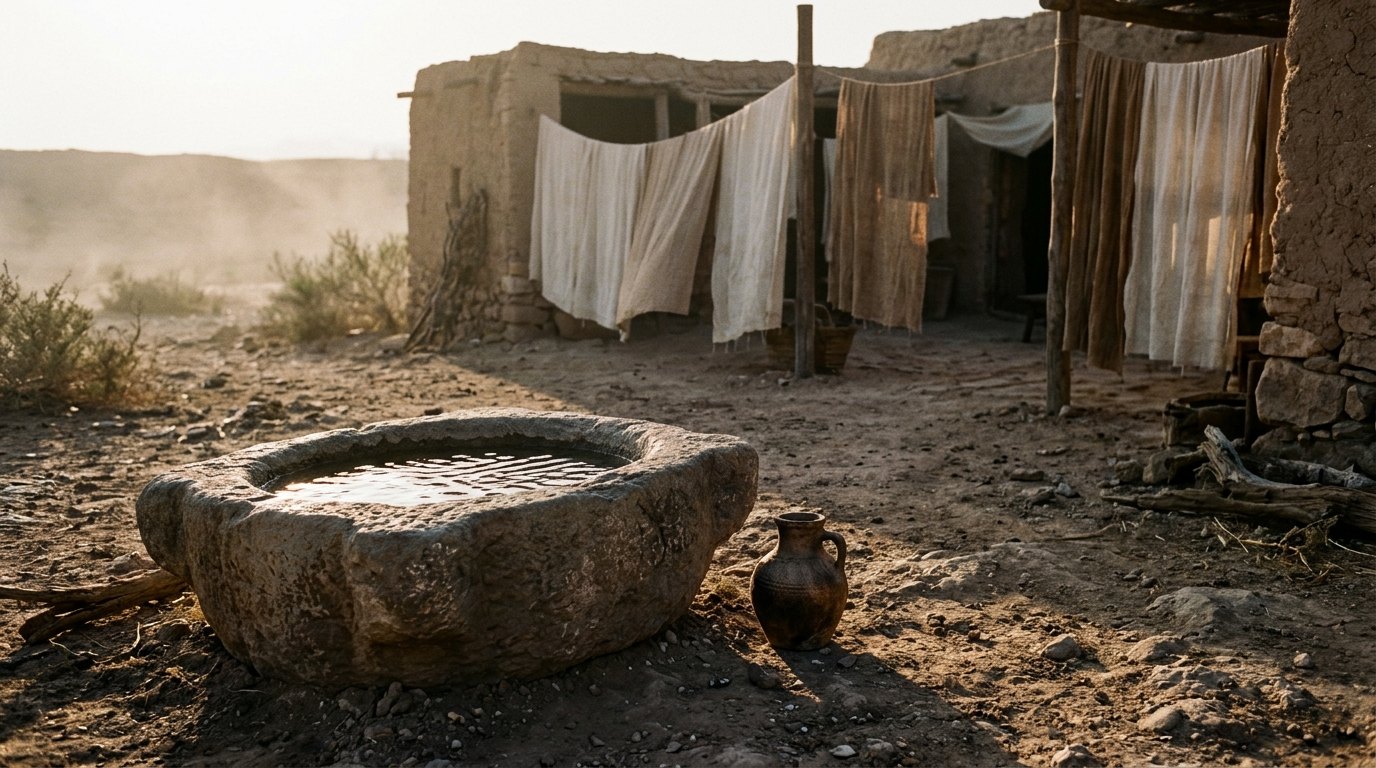
Then bring Aaron and his sons to the entrance to the tent of meeting and wash them with water.
Exodus 29:4 (NIV)
Aaron was washed with water and anointed before entering the priesthood, foreshadowing Jesus' baptism and anointing at age thirty.
When God established the Aaronic priesthood, He required a public rite before any man could offer sacrifice at His altar. In Exodus 29:4, the Lord commanded Moses to bring Aaron and his sons to the door of the tabernacle and wash them with water. Priestly consecration always began with ceremonial washing, followed immediately by the pouring of sacred anointing oil upon the head, as set out in Exodus 29:4-7. Moses carried out this exact ritual in Leviticus 8:6-12, presenting Aaron before the congregation, bathing him with water, and pouring oil upon his head to consecrate him for holy service.
This pattern found its true fulfillment at the Jordan River. When Jesus arrived to be baptized, He was stepping into His public vocation as our great High Priest. Matthew 3:13-17 records that as soon as Jesus came up from the water, the heavens opened, and the Spirit of God descended upon Him like a dove, matching the sequence of washing followed by anointing. Peter later summarized this moment in Acts 10:38 by proclaiming how God anointed Jesus of Nazareth with the Holy Spirit and with power. Furthermore, Numbers 4:3 mandated that Levites enter their priestly work in the tent of meeting at thirty years of age, aligning directly with Luke 3:23, which notes that Jesus began His ministry when He was about thirty years old. Though Jesus possessed no sin of His own to wash away, He submitted to the waters to fulfill this ancient legal pattern. As Hebrews 5:5-10 and Hebrews 7:26-28 explain, He is our holy, innocent, and blameless High Priest, consecrated not by human lineage, but by divine appointment to offer the ultimate sacrifice for sinners.
| Passage | What it says | Fulfilled |
|---|---|---|
| Exodus 29:4-7 | Aaron and his sons are washed with water before being anointed with oil to serve in the priesthood. | Matthew 3:13-17, Hebrews 5:5-10 |
| Leviticus 8:6-12 | Moses washes Aaron with water at the tent of meeting and pours anointing oil upon his head to consecrate him. | Matthew 3:16-17, Acts 10:38 |
| Numbers 4:3 | Priestly service and work in the tent of meeting began at thirty years of age. | Luke 3:23 |
| Hebrews 7:26-28 | Jesus is the holy, blameless High Priest appointed not by human law but by God's oath. |
Anticipating the Cross
The Jordan Shadowed His Plunge into Death and Resurrection

But I have a baptism to undergo, and what constraint I am under until it is completed!
Luke 12:50 (NIV)
Jesus explicitly links baptism to His coming passion, showing the Jordan immersion foreshadowed His cross.
The waters of the Jordan also pointed directly ahead to Calvary, portraying the immersion into judgment that Christ would endure on behalf of His people. In Luke 12:50, Jesus laid bare the deeper meaning of this imagery when He declared, "I have a baptism to be baptized with, and how great is my distress until it is accomplished!" Even long after His Jordan baptism had taken place, our Lord looked forward to the cross as the true, consuming plunge into the depths of divine wrath against human sin.
He echoed this profound connection in Mark 10:38-39 when James and John sought places of honor beside Him. Jesus asked them plainly whether they were able to drink the cup He drank or be baptized with the baptism with which He was baptized, directly associating baptism with His impending suffering and death. When the sinless Son went down beneath the dark waters of the Jordan, He symbolically entered the grave, standing as the substitute for the guilty. His emergence from the river prefigured His victory over death, an anticipation fulfilled when He broke the bonds of the tomb. In 1 Peter 3:21-22, the apostle confirms that baptism corresponds to the salvation achieved through the resurrection of Jesus Christ, who has conquered death and sat down at the right hand of God.
| Passage | What it says |
|---|---|
| Luke 12:50 | Jesus speaks of a baptism He has to be baptized with, expressing His distress until His death is accomplished. |
| Mark 10:38-39 | Jesus asks James and John if they can be baptized with the baptism of suffering and death He undergoes. |
| 1 Peter 3:21-22 | Baptism corresponds to salvation through the resurrection of Jesus Christ who has gone into heaven. |
Where in the Bible
| Book | Passages |
|---|---|
| Exodus | 1 · Exodus 29:4-7 |
| Leviticus | 1 · Leviticus 8:6-12 |
| Numbers | 1 · Numbers 4:3 |
| Psalms | 1 · Psalms 40:7-8 |
| Isaiah | 4 · Isaiah 53:12, Isaiah 42:1, Isaiah 11:1-2, Isaiah 61:1 |
| Matthew | 4 · Matthew 3:13-15, Matthew 5:17, Matthew 3:16-17, Matthew 28:19 |
| Mark | 2 · Mark 1:9-11, Mark 10:38-39 |
| Luke | 4 · Luke 22:37, Luke 3:21-22, Luke 4:18-19, Luke 12:50 |
| John | 4 · John 4:34, John 1:29, John 1:31-34, John 13:15 |
| Acts | 1 · Acts 10:37-38 |
| Romans | 2 · Romans 8:3-4, Romans 6:3-4 |
| 2 Corinthians | 1 · 2 Corinthians 5:21 |
| Galatians | 1 · Galatians 4:4-5 |
| Hebrews | 3 · Hebrews 4:15, Hebrews 2:14-17, Hebrews 7:26-28 |
| 1 Peter | 2 · 1 Peter 2:21, 1 Peter 3:21-22 |
The story in order
- Creation of the world (c. 4000 BC) · Genesis 1:1 · God's sovereign act in bringing the universe into being.
- The Fall of Man (c. 4000 BC) · Genesis 3:1-7 · Humanity's disobedience brought sin and death into the world.
- Abrahamic Covenant (c. 2000 BC) · Genesis 12:1-3 · God's promise to make Abraham a great nation and bless the world through him.
- Exodus from Egypt (c. 1446 BC) · Exodus 14:21-31 · God's deliverance of Israel from slavery, foreshadowing redemption.
- Giving of the Law (c. 1446 BC) · Exodus 20:1-17 · God's moral and ceremonial commands given at Sinai.
- Davidic Kingdom (c. 1000 BC) · 2 Samuel 7:11-16 · God's covenant with David, promising an everlasting dynasty.
- Prophetic Warnings (c. 740 BC) · Isaiah 1:16-17 · Calls for repentance and justice from God's messengers.
- The Exile (586 BC) · 2 Kings 25:1-12 · Judah's judgment and captivity in Babylon.
- Return from Exile (538 BC) · Ezra 1:1-4 · God's people return to Jerusalem to rebuild the temple.
- Jesus' Baptism (c. AD 27) · Matthew 3:13-17 · Jesus' public inauguration into His saving mission.
- Jesus' Crucifixion (AD 30) · John 19:17-30 · The atoning sacrifice for the sins of the world.
- Resurrection of Jesus (AD 30) · 1 Corinthians 15:3-8 · Christ's victory over death, confirming His divine identity.
- The Great Commission (c. AD 33) · Matthew 28:18-20 · Jesus commands disciples to make disciples and baptize.
- Apostolic Ministry (c. AD 33) · Acts 2:41-47 · The spread of the gospel and the growth of the early church.
The Trinitarian Revelation at the Jordan
| Person of the Trinity | Action/Declaration | Significance | Passage |
|---|---|---|---|
| Jesus | Emerges from the water, fulfilling righteousness | Inauguration into His saving mission | Matthew 3:13-15 |
| Holy Spirit | Descends like a dove | Anointing for service and confirmation of identity | |
| Father | Speaks from heaven, declaring Sonship | Divine affirmation and commissioning |
Baptism: Shadow and Substance
| Old Testament Foreshadowing | New Testament Reality | Meaning | Passage |
|---|---|---|---|
| Priestly washing (Exodus 29:4) | Jesus' baptism | Consecration for service | Matthew 3:13-15 |
| Cleansing from sin (Leviticus 16:19) | Jesus' baptism (though sinless) | Solidarity with sinners | Matthew 3:14-15 |
| Anointing with oil (Leviticus 8:12) | Spirit descending on Jesus | Empowerment by the Spirit for ministry | |
| Plunge into death (Luke 12:50) | Jesus' death and resurrection | Union with Christ's death and resurrection for believers |
Key words
- Fulfill (plēroō, πληρόω)
- To bring to completion, satisfy, or accomplish what was intended or promised. · Matthew 5:17
- Righteousness (dikaiosunē, δικαιοσύνη)
- Conformity to God's law and will; moral integrity and holiness. · Matthew 3:15
- Solidarity (metechō, μετέχω (related concept))
- Standing with, identifying with, or sharing the condition of others. · Hebrews 2:14-17
- Lamb of God (amnos tou theou, ἀμνὸς τοῦ θεοῦ)
- A title for Jesus, signifying His atoning sacrifice for sin. · John 1:29
- Anointing (chrisma, χρῖσμα)
- Consecration or empowerment by the Holy Spirit for a specific task.
- Baptism (baptisma, βάπτισμα)
- A ritual of washing with water, symbolizing cleansing, death, and new life. · Matthew 3:13
By stepping into the Jordan, Jesus consecrated the waters of baptism for all who would trust in Him. He took His place beside guilty sinners so that through His perfect obedience, cross, and resurrection, repentant believers might receive His spotless righteousness and be welcomed as beloved children of the Father.
32 passages, each cited once.
Scripture cited
- Matthew 3:13-17
- Matthew 3:1-12
- 2 Corinthians 5:21
- 1 Peter 2:22-25
- Isaiah 53:11-12