What does 'disciple' mean?
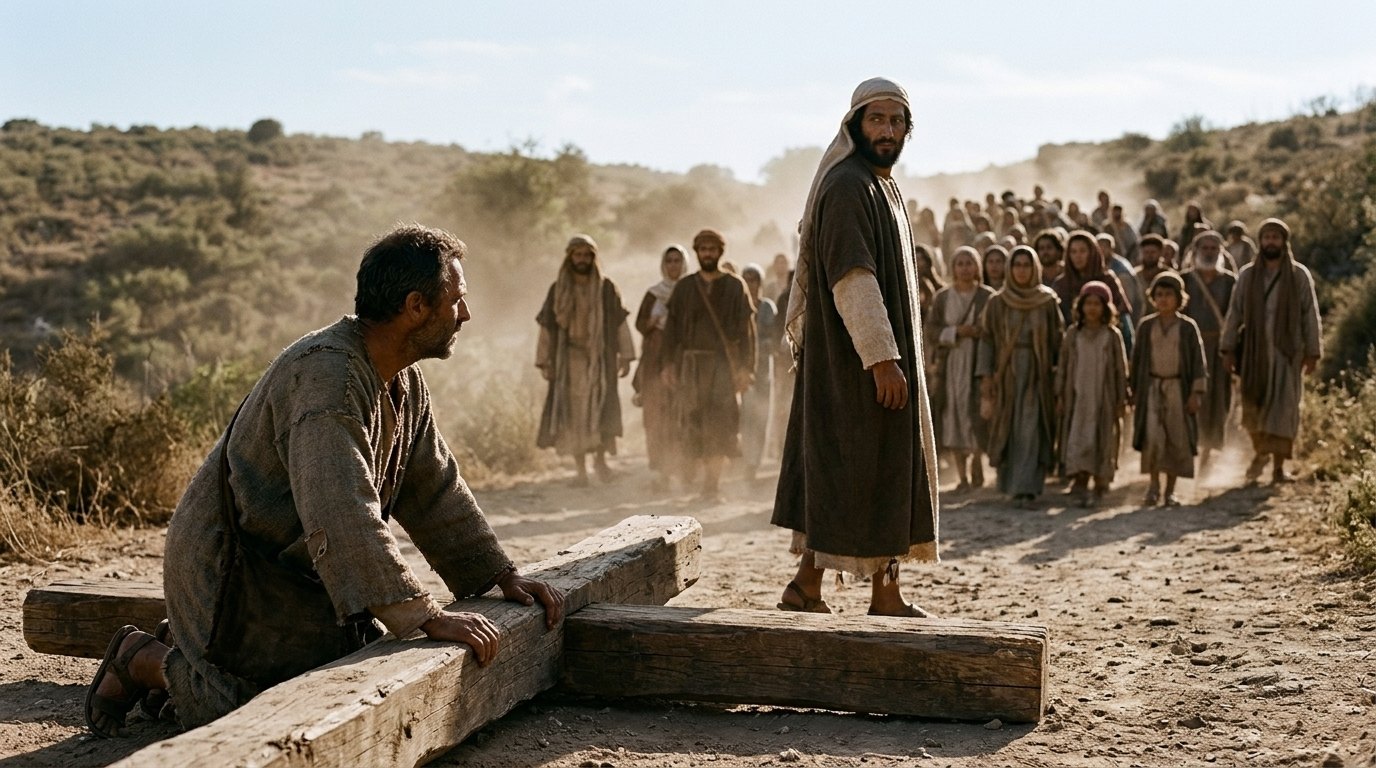
Luke 14:25-33
25 Large crowds were traveling with Jesus, and turning to them he said:
26 “If anyone comes to me and does not hate father and mother, wife and children, brothers and sisters—yes, even their own life—such a person cannot be my disciple.
27 And whoever does not carry their cross and follow me cannot be my disciple.
28 “Suppose one of you wants to build a tower. Won’t you first sit down and estimate the cost to see if you have enough money to complete it?
29 For if you lay the foundation and are not able to finish it, everyone who sees it will ridicule you,
30 saying, ‘This person began to build and wasn’t able to finish.’
31 “Or suppose a king is about to go to war against another king. Won’t he first sit down and consider whether he is able with ten thousand men to oppose the one coming against him with twenty thousand?
32 If he is not able, he will send a delegation while the other is still a long way off and will ask for terms of peace.
33 In the same way, those of you who do not give up everything you have cannot be my disciples.
New International Version (NIV)
The answer
Disciple (Greek mathētēs) means "a learner, a pupil" — a person who attaches himself to a teacher to learn his ways by following him. Jesus then defines what it means to be His disciple in this very passage, and His definition is far more than sitting in a class.
The Greek word behind "disciple" in Luke 14:26-27 is mathētēs, from manthanō, "to learn." A disciple in the ancient world was not a passive student but a follower: someone apprenticed to a master, learning by living with him and imitating him.
Jesus sets the terms in Luke 14:26-33 — a disciple of His is one who:
- Comes to Him, not merely near Him (Luke 14:26): discipleship is personal attachment to Christ Himself.
- Holds Christ above every natural bond and above his own life (Luke 14:26): father, mother, wife, children, brothers, sisters, and one's own life all stand lower than loyalty to Jesus.
- Bears his own cross and follows after Jesus (Luke 14:27): he takes up the instrument of shame and death, identified with Christ in the path He walks.
- Renounces all he has (Luke 14:33): everything, not just some things, is given over to Christ.
The scene makes the point sharply. In Luke 14:25 great multitudes were going with Him — a large crowd was moving in His direction. Jesus turns and distinguishes the real disciple from the fellow traveler. A disciple counts the cost first and then commits, like the builder who sits down before laying a foundation (Luke 14:28-30) and the king who sits down before going to war (Luke 14:31-32).
So a disciple is not part of the crowd that follows for a season or for benefits; a disciple is a learner who has counted the cost, renounced every rival claim, and follows Christ to the cross. Discipleship means belonging wholly to the Lord Jesus Christ.
Answered from Scripture · reviewed November 11, 2026
Scripture defines a disciple not as a casual admirer or a detached learner, but as an obedient follower whose life is entirely surrendered to Jesus Christ. In Luke 14, Jesus turns to eager crowds to dismantle cheap enthusiasm and lay down the non-negotiable price of genuine allegiance. To be his disciple is to count the full cost, reorder every earthly loyalty under his lordship, carry one's own cross, and forsake all worldly claim to walk after him.
The Sifting of the Crowds
Jesus Demands Deliberate Faith Over Casual Admiration
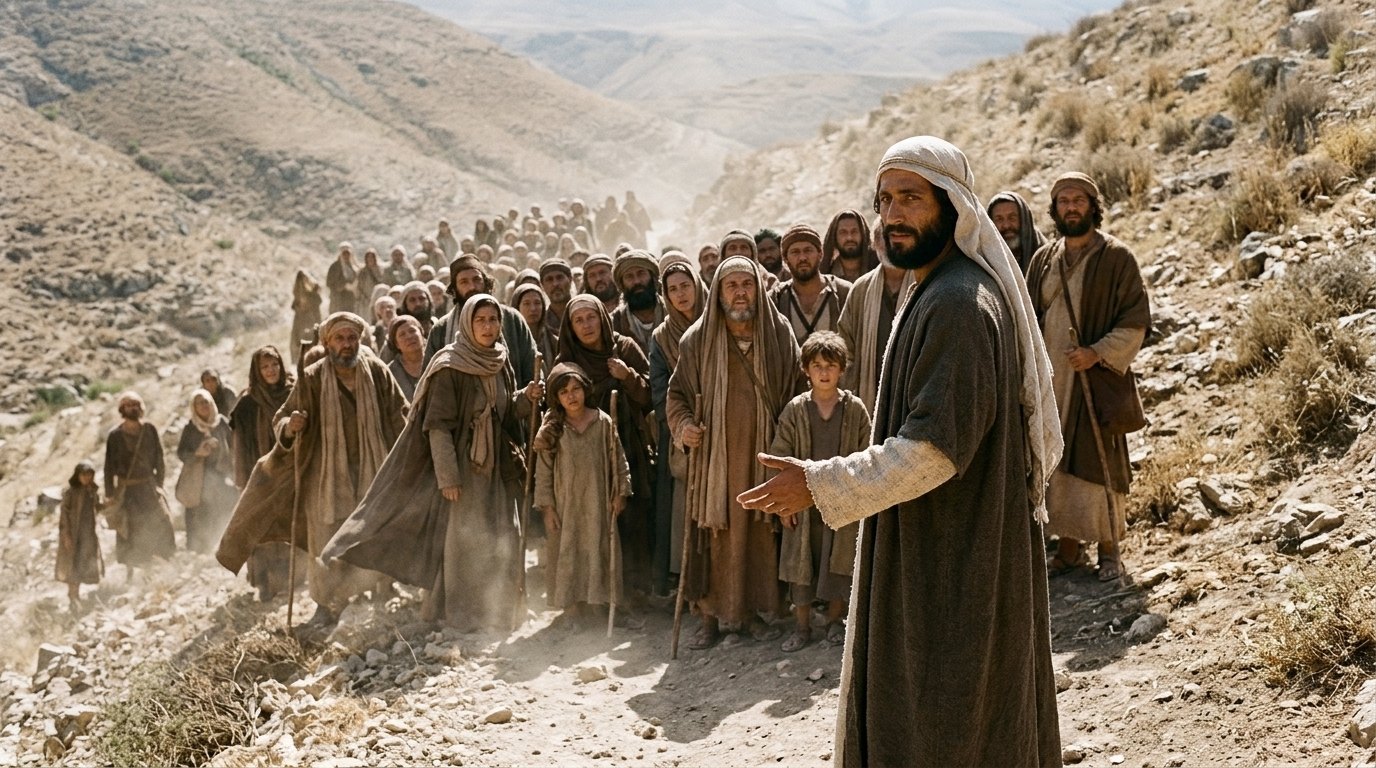
Large crowds were traveling with Jesus, and turning to them he said:
Luke 14:25 (NIV)
Jesus intentionally turns to confront a surging crowd, refusing to let shallow popularity stand in the place of authentic discipleship.
In Luke 14:25, Jesus halts the momentum of an enthusiastic procession, turning around to confront the swelling multitude with the sobering realities of kingdom allegiance. He did not measure success by raw attendance or superficial enthusiasm. Throughout his ministry, large gatherings regularly surrounded him, yet he continually checked hollow excitement. As recorded in Luke 12:1, when thousands pressed closely together in an unruly surge, Jesus turned his attention directly to his inner circle, warning against hypocrisy and the spiritual counterfeit of mere external participation. He knew the human heart's penchant for sensation without submission.
Christ persistently probed the hidden motives that drove men to pursue him. In John 6:26, he exposed the crowd that had crossed the sea simply because they had eaten their fill of the miraculous loaves, commanding them not to labor for perishable food but for eternal life. Popularity was never an end in itself; it was a testing ground. When Christ delivered difficult, uncompromising truths regarding true spiritual reliance upon him, shallow attachments evaporated. In John 6:66, many who had called themselves followers deliberately turned back and walked with him no more. A biblical disciple is therefore fundamentally distinct from a temporary companion or an intrigued spectator. Genuine discipleship begins where passive fascination ends and enduring conviction takes root.
| Passage | What it says |
|---|---|
| Luke 14:25 | Great multitudes journeyed alongside Jesus, prompting him to turn directly toward them with solemn terms of discipleship. |
| Luke 12:1 | Amid an innumerable multitude trampling one another, Jesus addressed his disciples first to warn against hypocritical, external religion. |
| John 6:26 | Jesus exposed the motive of seeking crowds who pursued him for physical bread rather than enduring spiritual life. |
| John 6:66 | Many of Jesus' casual followers turned back and walked with him no more after hearing his hard teaching. |
Supreme Allegiance
Christ Claims Preeminence Over Every Earthly Tie
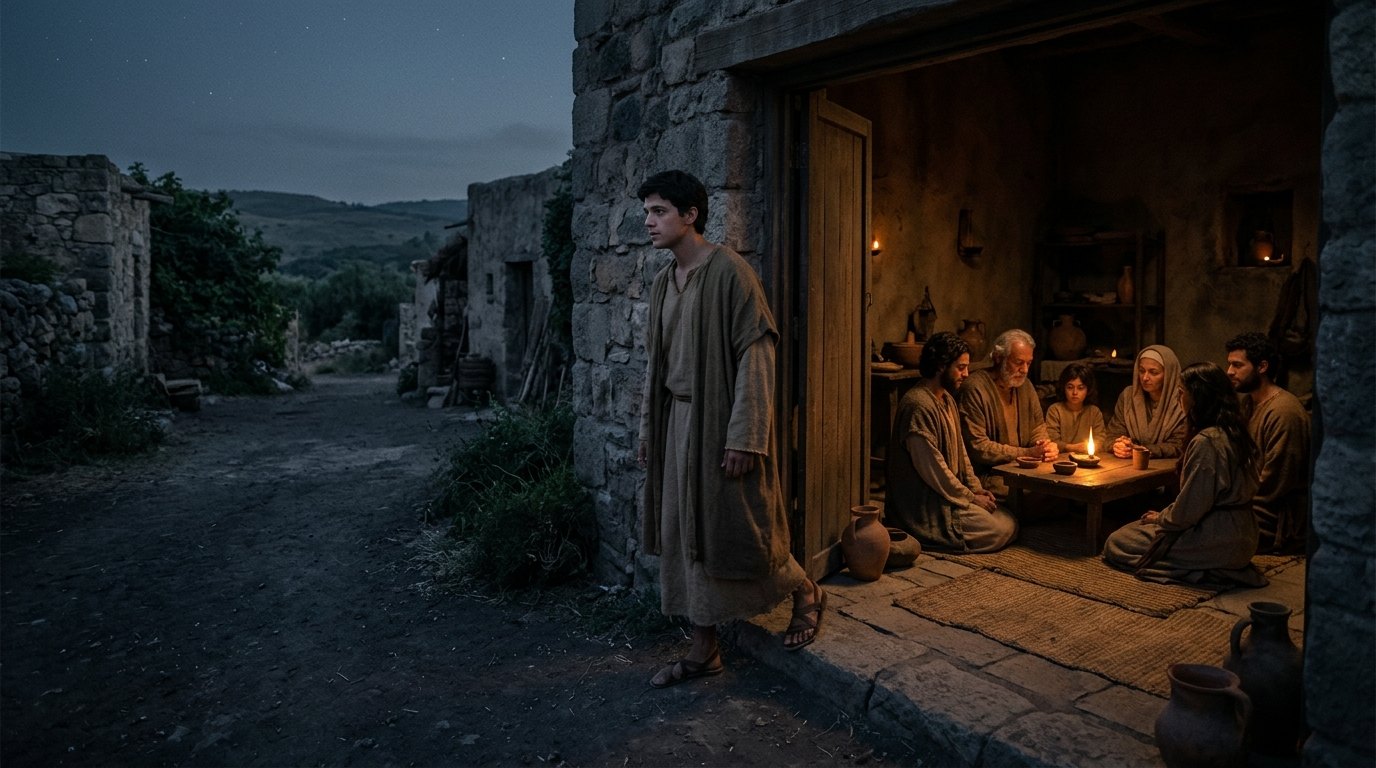
“If anyone comes to me and does not hate father and mother, wife and children, brothers and sisters—yes, even their own life—such a person cannot be my disciple.
Luke 14:26 (NIV)
The Lord establishes that loyalty to him must supersede even the dearest natural affections and life itself.
In Luke 14:26, Jesus delivers one of his most startling commands: supreme loyalty to Christ must decisively outshine all natural earthly affections. Using classic Semitic hyperbole, the Lord insists that love for parents, spouse, children, siblings, and even one's very breath must look like hatred by comparison to one's total devotion to him. He will brook no rival on the throne of the human heart. Parallel to this, Matthew 10:37 records the same standard plainly: whoever cherishes father or mother, son or daughter more than Christ is not worthy of him. The call to discipleship is an absolute summons that resets the hierarchy of all human devotion.
This principle anchors itself deeply within the historical demands of God's covenant. In Deuteronomy 13:6-8, Israel was commanded never to capitulate to the secret enticements of a brother, child, wife, or friend who sought to entice them away from the living God; allegiance to Yahweh held ultimate precedence over the closest kin. Yet Christ does not summon his followers into barren isolation without profound reward. In Mark 10:29-30, Jesus assures his followers that anyone who forsakes homes, family, or possessions for his sake and the gospel's receives a hundredfold now in spiritual community and fellowship, alongside the promise of eternal life in the age to come.
| Passage | What it says |
|---|---|
| Luke 14:26 | Jesus declares that whoever does not disregard father, mother, wife, children, siblings, and self cannot be his disciple. |
| Matthew 10:37 | Whoever loves father or mother or son or daughter more than Jesus is not worthy of him. |
| Deuteronomy 13:6-8 | Israel was forbidden to yield to the enticements of close family members when pulled away from the Lord. |
| Mark 10:29-30 | Jesus promises eternal reward to those who leave house, family, or lands for his sake and the gospel's. |
The Cross Borne Daily
Following Jesus Demands Personal Self-Denial Unto Death
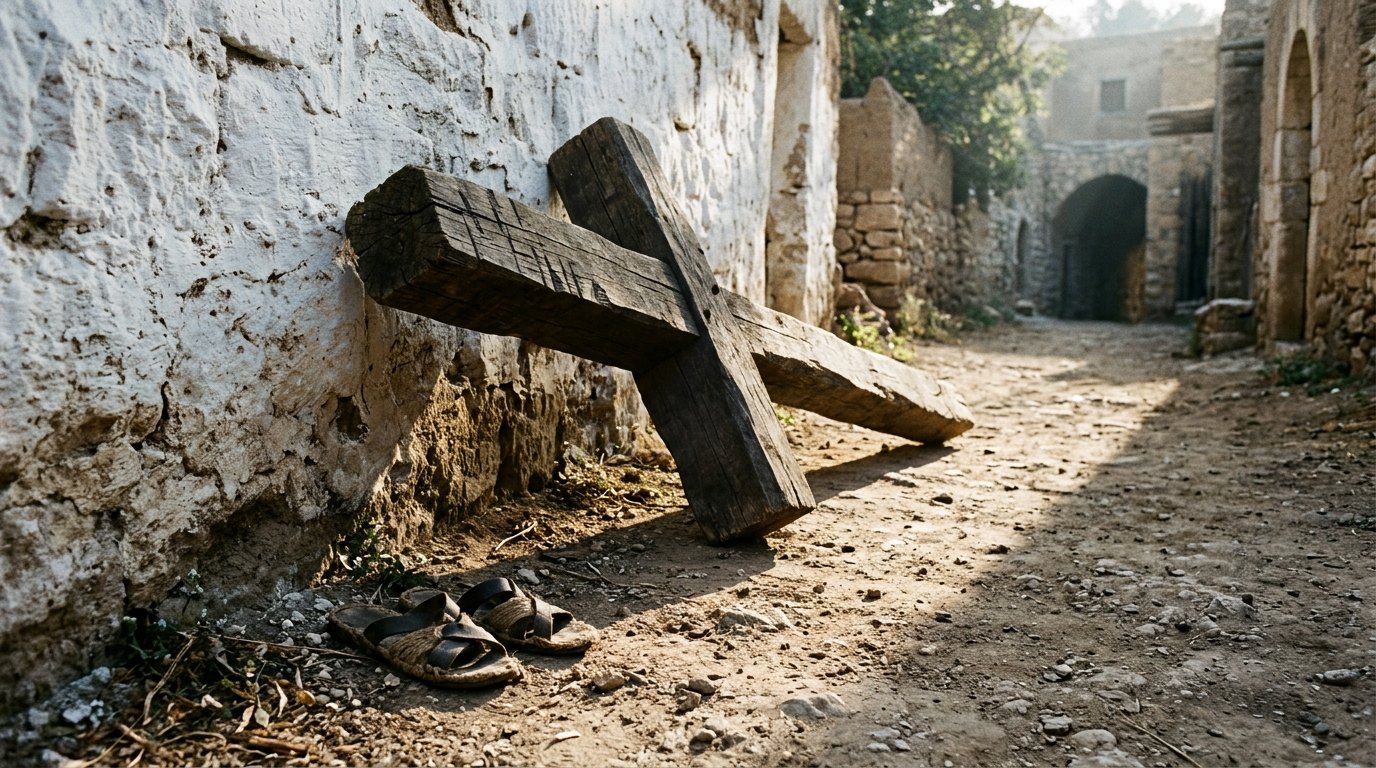
And whoever does not carry their cross and follow me cannot be my disciple.
Luke 14:27 (NIV)
Jesus identifies cross-bearing not as an occasional hardship, but as the indispensable path of every genuine follower.
In Luke 14:27, Jesus articulates the non-negotiable hallmark of authentic discipleship: whoever does not bear his own cross cannot be his disciple. To a first-century audience, the cross was not a polished piece of jewelry or a poetic metaphor; it was an instrument of excruciating, shameful Roman execution. Carrying a timber beam through the street signified a public walk toward total submission and death. Jesus reinforced this reality in Luke 9:23, commanding that anyone seeking to follow him must consciously deny self and shoulder that cross daily, trading personal autonomy for radical obedience.
True discipleship is therefore an ongoing participation in the death and resurrected life of the Lord Jesus Christ. In Galatians 2:20, the apostle Paul reflects this lifelong posture, declaring that he has been crucified with Christ, such that his former independent self has ceased to govern, and his present life in the flesh is sustained purely by faith in the Son of God. Furthermore, Romans 6:6 explains the transformative root of this daily surrender: our old self was definitively crucified with Christ so that the reigning power of sin might be permanently crushed. Cross-bearing is not grim passivity; it is the joyful, daily reckoning that one's old life belongs entirely to the Savior who bought it.
| Passage | What it says |
|---|---|
| Luke 14:27 | Jesus states that whoever does not bear his own cross and come after him cannot be his disciple. |
| Luke 9:23 | Jesus commands that anyone who would come after him must deny himself and take up his cross daily. |
| Galatians 2:20 | Paul testifies of being crucified with Christ so that Christ lives within him through faith. |
| Romans 6:6 | The old self was crucified with Christ so that the body of sin might be rendered powerless. |
Counting the Cost
Sober Calculation Precedes Unwavering Commitment to the King

“Suppose one of you wants to build a tower. Won’t you first sit down and estimate the cost to see if you have enough money to complete it?
Luke 14:28 (NIV)
The parable of the builder insists that a disciple must evaluate the full price before commencing the work.
In Luke 14:28, Jesus utilizes the imagery of a master builder: wisdom demands calculating the complete cost before laying a single foundation stone. The Lord does not hide the difficulty of discipleship behind easy invitations; he summons intentional deliberation. He paints the stark picture in Luke 14:29-30 of an individual who lays down a base but lacks the resources to complete the tower, leaving behind a ruined project that invites public ridicule from every onlooker. Halfhearted allegiance or emotional impulse will inevitably collapse beneath the pressures of real obedience.
Christ immediately reinforces the lesson with a second parable in Luke 14:31-32, describing a king marching toward conflict who must prudently evaluate whether his ten thousand can withstand an army of twenty thousand. If the cost is unpayable on his own terms, he sues for conditions of peace before disaster strikes. This demand for clear-eyed realism echoes the timeless guidance of Proverbs 24:27, which instructs a worker to establish his outer enterprise and complete his field preparations before building his permanent household. Discipleship requires sober, uncompromising honesty: calculating that while following Jesus will cost everything one possesses, refusing him ultimately forfeits eternal life.
| Passage | What it says |
|---|---|
| Luke 14:28 | Jesus asks what builder desiring a tower does not first sit down and count the cost to see if he can finish. |
| Luke 14:29-30 | An uncompleted foundation invites the mockery of onlookers who see someone begin what he could not finish. |
| Luke 14:31-32 | A king considering battle weighs whether ten thousand soldiers can confront twenty thousand or if terms of peace are required. |
| Proverbs 24:27 | Wisdom instructs preparing field work and building outside before establishing one's permanent house. |
Total Renunciation
Yielding All Earthly Treasure to Possess Christ
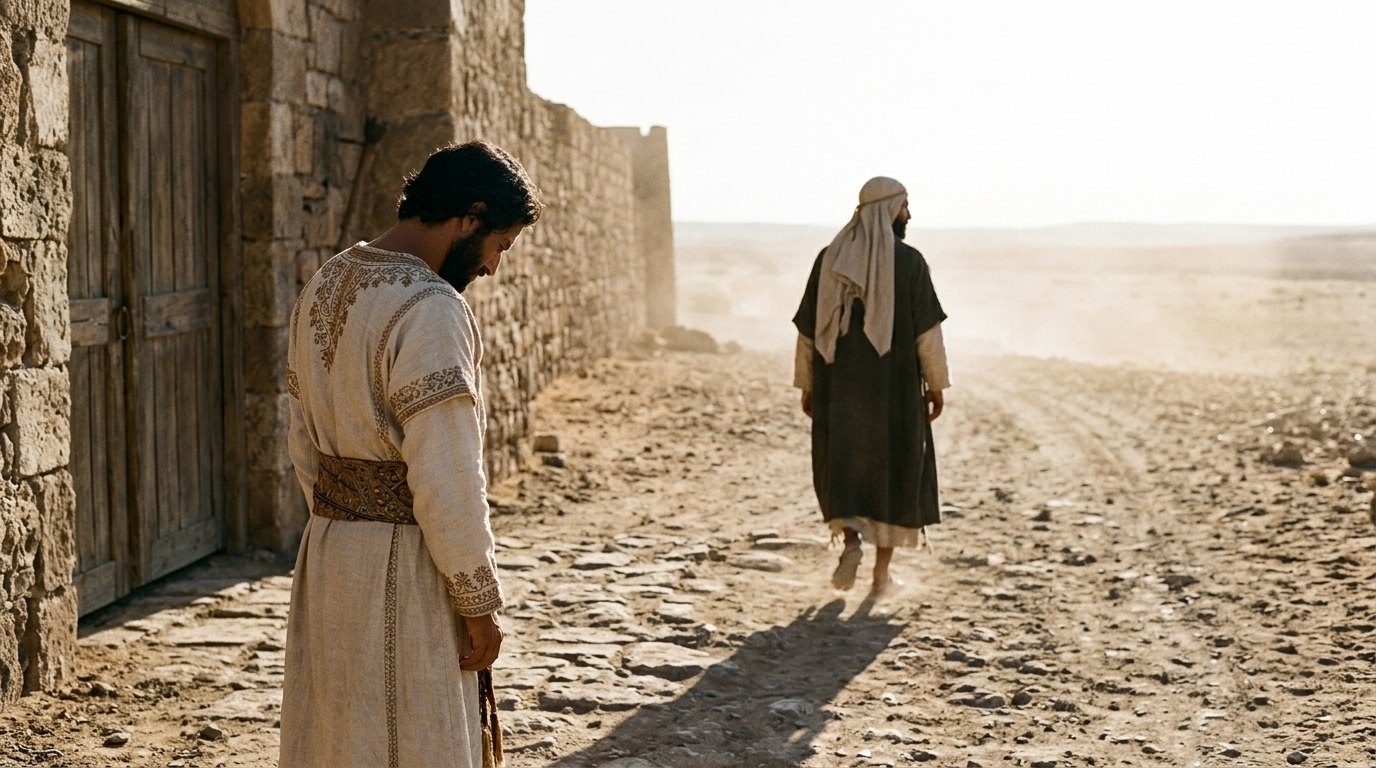
In the same way, those of you who do not give up everything you have cannot be my disciples.
Luke 14:33 (NIV)
Jesus delivers the definitive summary of discipleship by requiring an absolute surrender of all earthly goods.
In Luke 14:33, Jesus brings his sobering address to its uncompromising climax: "So therefore, any one of you who does not renounce all that he has cannot be my disciple." This demand is not a counsel of perfection reserved for a spiritual elite, but the foundational entrance requirement for any who would belong to him. Christ does not merely ask for a tithe of our resources or a secondary share of our devotion; he requires an absolute abdication of ownership. Whatever we grip with proprietary rights becomes an idol that prevents us from walking after him.
Yet this total surrender is not a grim loss, but an act of supreme wisdom. In Matthew 13:44, Jesus describes the kingdom of heaven as a treasure hidden in a field, which a man finds and covers up; then in his joy he goes and sells all that he has and buys that field. Renunciation is driven by the discovery of something infinitely superior. Where wealth grips the heart, however, it blinds the soul to true riches. When the wealthy young magistrate approached Jesus seeking eternal life, Luke 18:22 records the Master's diagnostic command: sell all you have, distribute to the poor, and follow me. The man went away sorrowful because his possessions possessed him.
The apostle Paul exemplifies the joyful reality of this exchange. Looking back on his pedigree, prestige, and religious achievements, he writes in Philippians 3:8, "I count everything as loss because of the surpassing worth of knowing Christ Jesus my Lord." To renounce all is simply to open hands clenched around dust so that Christ may fill them with himself.
| Passage | What it says |
|---|---|
| Luke 14:33 | Jesus concludes that whoever does not renounce all of his possessions cannot be his disciple. |
| Matthew 13:44 | A man sells all that he has with joy to purchase the field containing hidden treasure. |
| Luke 18:22 | Jesus instructed the rich ruler to sell all he had, distribute to the poor, and follow him. |
| Philippians 3:8 | Paul counts all things as loss and rubbish for the surpassing worth of knowing Christ Jesus his Lord. |
The Nature of a Disciple
A Disciple Is a Learner Transformed to Resemble the Master
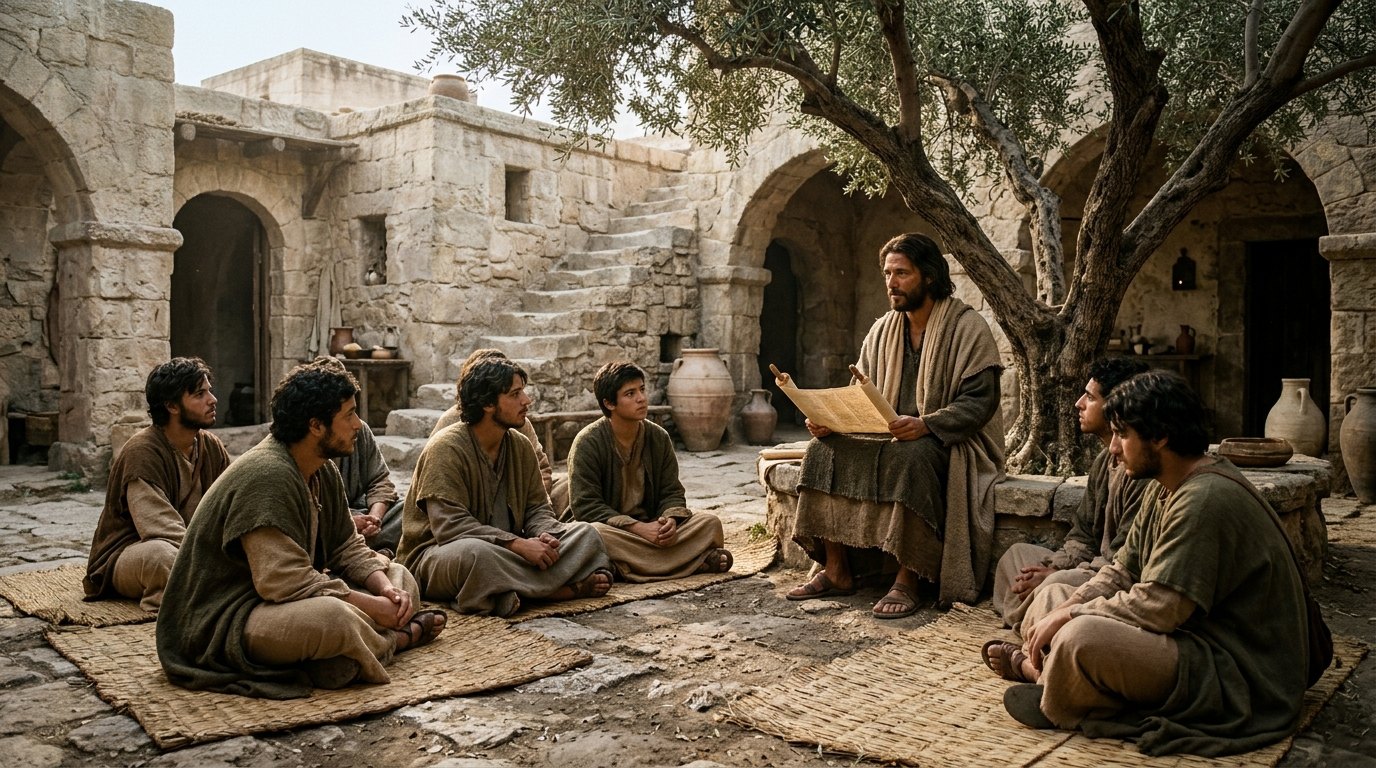
The student is not above the teacher, but everyone who is fully trained will be like their teacher.
Luke 6:40 (NIV)
This verse states the fundamental definition and ultimate goal of discipleship: becoming like the Teacher.
The ultimate aim of discipleship is defined concisely in Luke 6:40: "A disciple is not above his teacher, but everyone when he is fully trained will be like his teacher." The Greek term for disciple, mathetes, signifies a learner, apprentice, and adherent. A disciple does not simply register intellectual agreement with a set of propositions; he submits his mind, character, and conduct to a Master until the Master's likeness is reproduced in him. Biblical discipleship is thorough conformity to Christ.
This transformation begins with a gentle and restful submission. In Matthew 11:28-30, Jesus invites those who labor and are heavy laden to come to him, take his yoke upon them, and learn from him, for he is gentle and lowly in heart. His yoke is not the crushing burden of Pharisaic legalism, but the freeing alignment of the soul under his righteous instruction. Such learning requires steadfast persistence. In John 8:31-32, Jesus told those Jews who had believed him, "If you abide in my word, you are truly my disciples, and you will know the truth, and the truth will set you free." True disciples do not treat Christ's words as an occasional reference point; they dwell in them.
Because this apprenticeship produces tangible, observable holiness, it can be passed on by example. In 1 Corinthians 11:1, Paul could boldly urge the church, "Be imitators of me, as I am of Christ." Discipleship is an unbroken lineage of conformity to the Son of God, where mature believers mirror the Master so faithfully that younger believers can see the path ahead.
| Passage | What it says |
|---|---|
| Matthew 11:28-30 | Jesus invites the weary to take His yoke and learn from Him as a gentle teacher. |
| Luke 6:40 | A disciple is not above his teacher, but everyone fully trained will be like his teacher. |
| John 8:31-32 | Abiding in Jesus' word is the defining mark of true discipleship, leading to truth and freedom. |
| 1 Corinthians 11:1 | Paul urges believers to imitate him just as he imitates Christ. |
The Evidence and Mission
Disciples Bear Visible Fruit and Reproduce Faithful Followers
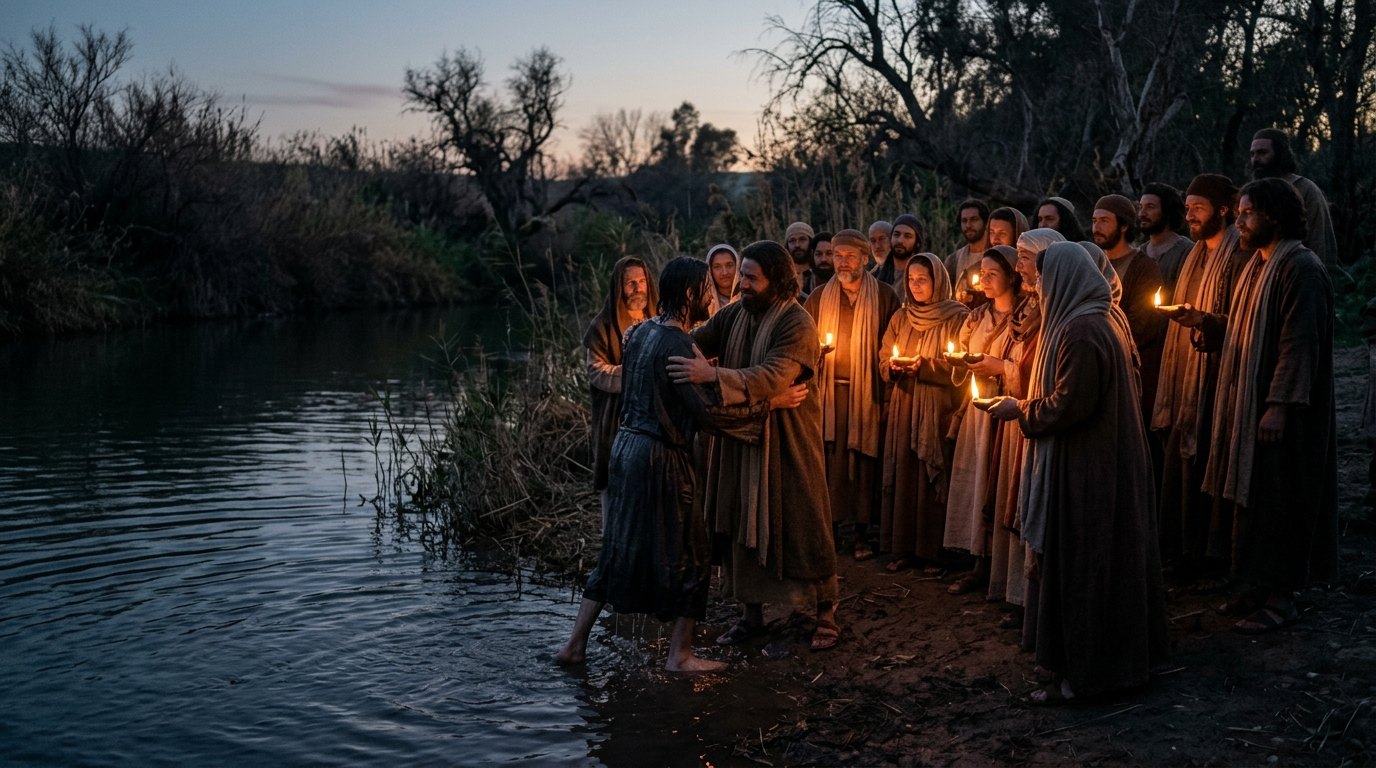
By this everyone will know that you are my disciples, if you love one another.”
John 13:35 (NIV)
It defines the unmistakable, external badge of true discipleship before a watching world.
Genuine discipleship inevitably produces external, verifiable evidence before the world. In John 13:35, Jesus establishes the definitive public badge of his followers: "By this all people will know that you are my disciples, if you have love for one another." Love within the body of believers is not an optional virtue or an internal sentiment; it is Christ's chosen apologetic to an observing world. This self-giving affection reflects the new commandment given in John 13:34, wherein believers love one another just as Christ loved them.
Such love is part of a broader harvest of spiritual vitality. In John 15:8, Jesus declares, "By this my Father is glorified, that you bear much fruit and so prove to be my disciples." A barren branch bears no credible witness to the vine; living attachment to Christ necessarily yields the fruit of righteousness, repentance, and obedience. This identity was so distinct that, as Acts 11:26 records, the believers in Antioch were publicly dubbed "Christians"—partisans or people of Christ—because their entire community mirrored his character.
Moreover, genuine disciples do not keep the life of the kingdom to themselves; they reproduce. In Matthew 28:19-20, the risen King commissions his church with authority: "Go therefore and make disciples of all nations, baptizing them in the name of the Father and of the Son and of the Holy Spirit, teaching them to observe all that I have commanded you." Discipleship is multigenerational. As Paul directed his protégé in 2 Timothy 2:2, what was heard before many witnesses must be entrusted to faithful men who will be able to teach others also.
| Passage | What it says |
|---|---|
| John 13:34-35 | Jesus declares that love among believers is the visible proof by which all will know they are His disciples. |
| John 15:8 | Bearing much fruit glorifies the Father and proves that one is truly a disciple of Jesus. |
| Matthew 28:19-20 | The risen Lord commands His followers to make disciples of all nations through baptism and teaching. |
| Acts 11:26 | The disciples were first called Christians in Antioch, identifying followers publicly with Christ. |
| 2 Timothy 2:2 | Paul charges Timothy to entrust the teaching to faithful men who will teach others also. |
Where in the Bible
| Book | Passages |
|---|---|
| Deuteronomy | 1 · Deuteronomy 13:6-8 |
| Proverbs | 1 · Proverbs 24:27 |
| Matthew | 4 · Matthew 10:37, Matthew 13:44, Matthew 11:28-30, Matthew 28:19-20 |
| Mark | 1 · Mark 10:29-30 |
| Luke | 11 · Luke 14:25, Luke 12:1, Luke 14:26, Luke 14:27, Luke 9:23, Luke 14:28, Luke 14:29-30, Luke 14:31-32, Luke 14:33, Luke 18:22, Luke 6:40 |
| John | 5 · John 6:26, John 6:66, John 8:31-32, John 13:34-35, John 15:8 |
| Acts | 1 · Acts 11:26 |
| Romans | 1 · Romans 6:6 |
| 1 Corinthians | 1 · 1 Corinthians 11:1 |
| Galatians | 1 · Galatians 2:20 |
| Philippians | 1 · Philippians 3:8 |
| 2 Timothy | 1 · 2 Timothy 2:2 |
The story in order
- Israel warned against family idolatry (c. 1400 BC) · Deuteronomy 13:6-8 · Shows God's people must prioritize him over family loyalty.
- Wisdom on counting costs for building (c. 900 BC) · Proverbs 24:27 · Illustrates the need for careful planning before commitment.
- Jesus calls great multitudes (c. AD 30) · Luke 14:25 · Sets the stage for Jesus' demanding teaching on discipleship.
- Jesus warns against hypocrisy (c. AD 30) · Luke 12:1 · Highlights the danger of outward religion without inner reality.
- Jesus exposes shallow followers (c. AD 30) · John 6:26 · Reveals motives of crowds seeking physical provision.
- Jesus demands the cost of discipleship (c. AD 30) · Luke 14:26-27 · Jesus states radical requirements: disregard family, bear cross.
- Jesus asks crowds to count the cost (c. AD 30) · Luke 14:28-32 · Uses parables of builder and king to illustrate planning.
- Jesus demands renunciation of possessions (c. AD 30) · Luke 14:33 · States that discipleship requires forsaking all possessions.
- Many followers turn back (c. AD 30) · John 6:66 · Shows that Jesus' hard teaching caused many to leave.
- Jesus promises reward for sacrifice (c. AD 30) · Mark 10:29-30 · Encourages followers by promising abundant return.
- Jesus invites the weary to learn (c. AD 30) · Matthew 11:28-30 · Presents himself as a gentle teacher offering rest.
- Jesus defines disciples by love (c. AD 30) · John 13:34-35 · Love for one another is the sign of true disciples.
- Paul testifies of crucifixion with Christ (c. AD 50) · Galatians 2:20 · Describes the inner reality of a disciple's life.
- Disciples are first called Christians (c. AD 40-60) · Acts 11:26 · Marks the public identification of followers with Christ.
Key words
- Disciple
- An obedient follower whose life is surrendered to Christ, willing to count the cost, bear the cross, and renounce all for him. · Luke 14:25-33
- Allegiance
- Christ claims preeminence over every earthly tie, requiring supreme loyalty. · Luke 14:26
- Cross
- Personal self-denial and willingness to face death for Christ. · Luke 14:27
- Cost
- Sober calculation and unwavering commitment required before following Christ. · Luke 14:28
- Renunciation
- Yielding all earthly possessions to possess Christ. · Luke 14:33
- Yoke (zygos, ζυγός)
- Jesus invites the weary to learn from Him, taking on His teachings and way of life. · Matthew 11:29
Discipleship in the New Testament is never presented as an optional tier for exceptionally zealous believers; it is the ordinary definition of following Jesus. The Lord makes the price unmistakable so that no one embarks under an illusion, inviting each of us to weigh our lives soberly and yield everything gladly to him. Those who lose their life for his sake find true life, discovering that Christ is worth far more than all they lay down.
29 passages, each cited once.
Scripture cited
- Luke 14:26-27
- Luke 14:26-33
- Luke 14:26
- Luke 14:27
- Luke 14:33
- Luke 14:25
- Luke 14:28-30
- Luke 14:31-32