What does the Bible say about family?

Psalms 127
1 Unless the LORD builds the house, the builders labor in vain. Unless the LORD watches over the city, the guards stand watch in vain.
2 In vain you rise early and stay up late, toiling for food to eat— for he grants sleep to those he loves.
3 Children are a heritage from the LORD, offspring a reward from him.
4 Like arrows in the hands of a warrior are children born in one’s youth.
5 Blessed is the man whose quiver is full of them. They will not be put to shame when they contend with their opponents in court.
New International Version (NIV)
The answer
Family is God’s good design, not a human invention. God established marriage as a lifelong, one-flesh union between a man and a woman (Matthew 19:4-6), gives children as a blessing (Psalm 127:3), and assigns love, honor, provision, and instruction within the home (Ephesians 5:22-33; Ephesians 6:1-4). Every believer—married or single—also belongs to God’s larger household in Christ (Ephesians 2:19-22).
Marriage is lifelong and self-giving
Jesus returned to creation: God made humanity “male and female,” and a man leaves his father and mother, is joined to his wife, and the two become “one flesh” (Matthew 19:4-5). His conclusion is plain: “What therefore God has joined together, don’t let man tear apart” (Matthew 19:6). Marriage is therefore a covenant union, not an arrangement to abandon at will.
Ephesians 5:22-24 calls wives to be subject to their own husbands as to the Lord and describes the husband as head, as Christ is head of the church. It then defines that headship by Christ’s sacrifice: “Husbands, love your wives, even as Christ also loved the assembly and gave himself up for her” (Ephesians 5:25). A husband must nourish, cherish, and love his wife as himself; a wife must respect her husband (Ephesians 5:28-29, 33). Harshness and selfish domination contradict this command.
Children are a blessing and a responsibility
Scripture declares, “children are a heritage of Yahweh. The fruit of the womb is his reward” (Psalm 127:3). Psalm 127:4-5 compares children to arrows in a warrior’s hand and calls the man with a full quiver happy.
Children are entrusted to parents for godly care and training:
- Teach continually: Parents are to keep God’s words on their hearts and teach them diligently to their children throughout ordinary daily life—at home, travelling, resting, and rising (Deuteronomy 6:6-7).
- Honor and obey: Children must obey their parents in the Lord and honor their father and mother (Ephesians 6:1-3).
- Train without harshness: Fathers must not provoke their children to wrath, but nurture them in the Lord’s discipline and instruction (Ephesians 6:4).
- Provide faithfully: First Timothy 5:8 treats refusal to provide for one’s own household as a denial of the faith.
God must build the house
“Unless Yahweh builds the house, they who build it labor in vain” (Psalm 127:1). Psalm 127:2 exposes anxious, self-reliant toil and says that God gives sleep to His loved ones. This is not permission for idleness: people make plans, but the Lord directs their steps (Proverbs 16:9). A household should work and plan diligently while depending on God rather than trusting human strength alone.
God also gives a spiritual family
Jesus identified whoever does God’s will as His brother, sister, and mother (Mark 3:35). Through Christ, believers are no longer strangers but members of “the household of God,” built together with Christ as the chief cornerstone (Ephesians 2:19-22). This spiritual family does not cancel earthly family responsibilities; First Timothy 5:8 still stands.
Marriage and children are good gifts, but they do not determine a person’s spiritual worth. Each believer has a particular gift from God, and continued singleness can also be good (1 Corinthians 7:7-8). Single, widowed, and childless believers fully belong in God’s family.
Answered from Scripture · reviewed November 11, 2026
Scripture reveals that family is fundamentally God's creation and gift, established at creation and sustained by His design rather than human invention. From the lifelong covenant of marriage to the blessing of children and the duties of parents, the Bible outlines a clear and beautiful pattern for the home. Understanding what God's Word teaches on family equips believers to build households that honor Him across generations.
The Divine Foundation
God creates marriage and establishes the home

That is why a man leaves his father and mother and is united to his wife, and they become one flesh.
Genesis 2:24 (NIV)
This verse establishes God's original blueprint for the family: one man and one woman joined together as one flesh for life.
In Genesis 2:24, God sets down the unchanging blueprint for the household: a man leaves his father and mother to cling fast to his wife, and the two become one flesh. Family did not emerge by cultural evolution or social consensus; it originated by divine decree in Eden. When God made humanity in His own image, He designed them distinctly male and female, commanding them to be fruitful, multiply, and fill the earth (Genesis 1:27–28). Before sin ever entered the world, the Lord recognized that it was not good for man to dwell alone, creating an answering counterpart perfectly suited to him (Genesis 2:18).
This sacred union is a lifelong covenant witnessed by God Himself. Through the prophet Malachi, the Lord rebukes those who deal faithlessly with the wife of their youth, declaring that He made them one so that they might produce godly offspring (Malachi 2:14–15). When Pharisees tested Jesus regarding divorce, the Lord bypassed rabbinic debates and pointed straight back to Eden, declaring in Matthew 19:4–6 and Mark 10:6–9 that what God has joined together, no human authority may sever. Because marriage is the bedrock of the home and an institution forged by God, the author of Hebrews 13:4 commands that marriage be held in honor by all and that the marriage bed remain undefiled, warning that God will judge the sexually immoral.
| Passage | What it says |
|---|---|
| Genesis 1:27-28 | God creates man and woman in His image and commands them to be fruitful, multiply, and fill the earth. |
| Genesis 2:18 | The Lord declares that it is not good for man to be alone and determines to make a helper suitable for him. |
| Genesis 2:24 | A man leaves father and mother to hold fast to his wife, and the two become one flesh. |
| Malachi 2:14-15 | The Lord witnesses the marriage covenant and desires godly offspring from the union. |
| Matthew 19:4-6 | Jesus reaffirms creation's pattern, stating that what God has joined together, no man should separate. |
| Mark 10:6-9 | Christ reiterates the sanctity and permanence of the one-flesh union forged by God. |
| Hebrews 13:4 | Marriage is to be held in honor among all, and the marriage bed kept undefiled. |
The Lord's Building
Human labor depends entirely upon God's sovereign work

Unless the LORD builds the house, the builders labor in vain. Unless the LORD watches over the city, the guards stand watch in vain.
Psalms 127:1 (NIV)
It declares that any effort to build or preserve a home without the Lord's hand is empty vanity.
The bold truth of Psalms 127:1 cuts through human presumption: unless the Lord builds the house, those who build it labor in vain. Families often expend tremendous energy on financial security, social standing, and domestic management, yet Scripture insists that apart from God’s sovereign grace, every human effort amounts to empty futility. Left to our own devices, watchmen stay awake and builders toil without lasting effect.
The psalmist exposes the vanity of anxious self-reliance, warning against the frantic rhythm of rising early and retiring late merely to eat the bread of anxious toil, because the Lord provides peaceful sleep to His beloved (Psalms 127:2). Human ingenuity can neither manufacture spiritual fruitfulness nor secure a home against destruction. As Proverbs 16:9 observes, a person's heart plots his way, but it is the Lord who establishes his steps. There is no wisdom, no understanding, and no counsel that can prevail against Him; the horse is made ready for the day of battle, but safety and deliverance belong solely to the Lord (Proverbs 21:30–31). The apostle Paul echoes this fundamental principle for all ministry and family life in 1 Corinthians 3:7, reminding believers that neither the one who plants nor the one who waters is anything, but only God who gives the growth.
| Passage | What it says |
|---|---|
| Psalms 127:1 | Unless the Lord builds the house and guards the city, the builders and watchmen labor in vain. |
| Psalms 127:2 | Rising early and staying up late in anxious toil is vain, for God provides rest for His beloved. |
| Proverbs 16:9 | The human heart plans its course, but the Lord sovereignly establishes the steps. |
| Proverbs 21:30-31 | No human wisdom or counsel can prevail against God, and victory belongs solely to Him. |
| 1 Corinthians 3:7 | Neither the planter nor the waterer is anything, but only God who provides the increase. |
Children as Heritage
Offspring are a divine reward and weapon of light

Children are a heritage from the LORD, offspring a reward from him.
Psalms 127:3 (NIV)
This passage highlights children as a valuable heritage and direct reward from the Lord, never an accident or burden.
Scripture explicitly overturns worldly attitudes that view offspring as financial burdens or mere inconveniences: Psalms 127:3 declares that children are a heritage from the Lord, the fruit of the womb a reward. Every child conceived is a purposeful gift from God's hand, given to parents in stewardship to be nurtured for His kingdom.
The psalmist uses vivid imagery in Psalms 127:4 to compare children born in one's youth to sharp arrows in the hand of a mighty warrior. Just as an archer shapes and aims an arrow toward a distant mark, parents are called to raise their sons and daughters to impact the world for God's glory. The man whose quiver is full of them receives divine blessing, standing bold and unashamed when contending with adversaries in the public gate (Psalms 127:5). Turning to the home itself, Psalms 128:3 pictures the God-fearing wife as a fruitful vine flourishing in the inner rooms of the house, while the children gather around the table like vigorous young olive shoots destined for longevity and resilience. This generational blessing endures through the years, granting the faithful the joy of seeing their children's children and peace upon Israel (Psalms 128:6). As Proverbs 17:6 crowns the aged with their grandchildren, it seals the biblical truth that family lineage under God is an enduring crown of honor.
| Passage | What it says |
|---|---|
| Psalms 127:3 | Children are declared to be a heritage from the Lord and the fruit of the womb His reward. |
| Psalms 127:4 | Children born in one's youth are compared to sharp arrows in the hand of a mighty warrior. |
| Psalms 127:5 | Blessing rests upon the man with a full quiver, standing without shame before opponents at the gate. |
| Psalms 128:3 | A God-fearing home sees the wife as a fruitful vine and children as vigorous olive shoots around the table. |
| Psalms 128:6 | The faithful are blessed to see their children's children and peace resting upon God's people. |
| Proverbs 17:6 | Grandchildren are the crown of the aged, and the glory of children is their fathers. |
Husbands and Wives
Mutual devotion reflecting the covenant of Christ and church

Husbands, love your wives, just as Christ loved the church and gave himself up for her
Ephesians 5:25 (NIV)
Paul anchors the husband's calling in Christ's sacrificial, unconditional love for His church.
The New Testament elevates the marital bond into a living gospel picture, anchored in Ephesians 5:25 where husbands are commanded to love their wives just as Christ loved the church and gave Himself up for her. Christian marriage is not a mere contractual arrangement; it is designed to showcase the sacrificial, covenant-keeping love between the Savior and His bride.
Within this divine order, God calls wives to submit to their husbands as to the Lord, recognizing the husband's servant-leadership just as the church submits to Christ (Ephesians 5:22–24). Far from granting license for tyranny, the apostle binds husbands to a standard of cruciform devotion, charging them in Ephesians 5:26–28 to nourish and cherish their wives as their own bodies, sanctifying them by the washing of water with the word. In Ephesians 5:31–33, Paul quotes Genesis to unveil this profound mystery, concluding with the practical command that every husband love his wife as himself and every wife respect her husband. Paul repeats this household order succinctly in Colossians 3:18–19, commanding wives to submit fittingly in the Lord and warning husbands never to be harsh or bitter toward their wives. The apostle Peter similarly urges wives to cultivate an imperishable, quiet spirit that can win unbelieving husbands (1 Peter 3:1–2), while charging husbands to live with their wives with understanding and honor as joint heirs of the grace of life, lest their prayers be hindered (1 Peter 3:7).
| Passage | What it says |
|---|---|
| Ephesians 5:22-24 | Wives are instructed to submit to their husbands as to the Lord, honoring marriage's God-given order. |
| Ephesians 5:25-28 | Husbands are commanded to love their wives selflessly, just as Christ loved the church and gave Himself for her. |
| Ephesians 5:31-33 | Marriage points to the mystery of Christ and the church, calling for love and respect. |
| Colossians 3:18 | Wives are directed to submit to their husbands as is fitting in the Lord. |
| Colossians 3:19 | Husbands are commanded to love their wives and never treat them with harshness or bitterness. |
| 1 Peter 3:1-2 | Wives are urged to win unbelieving husbands through reverent, pure, and quiet conduct. |
| 1 Peter 3:7 | Husbands must live considerately with their wives as co-heirs of the grace of life, protecting their prayers. |
Parents and Children
Nurturing faith, obedience, and honor across generations
These commandments that I give you today are to be on your hearts. Impress them on your children. Talk about them when you sit at home and when you walk along the road, when you lie down and when you get up.
Deuteronomy 6:6-7 (NIV)
It shows that parents must diligently teach God's commandments in the rhythms of daily life.
In Deuteronomy 6:6-7, God commands His people to keep His words on their hearts and teach them diligently to their children in the ordinary rhythms of every day, whether sitting at home, walking along the road, lying down, or rising up. Faith is not meant to be outsourced to an institution; the primary training ground for discipleship is the living room, the table, and the quiet moments between morning and night. This responsibility flows alongside the call for children to respond in reverent honor. The Ten Commandments establish this priority in Exodus 20:12, promising blessing and longevity to those who honor father and mother. Proverbs echoes this structure, urging young sons in Proverbs 1:8-9 not to forsake their mother's teaching, and offering the enduring wisdom of Proverbs 22:6 to train up a child in the way he should go.
The New Testament deepens this covenantal duty without softening it. In Ephesians 6:1-3, Paul reasserts that children must obey their parents in the Lord as an act of obedience to God Himself, while Colossians 3:20 confirms that such honor pleases Christ. Yet Scripture guards against parental tyranny. Ephesians 6:4 explicitly charges fathers not to provoke their children to wrath, and Colossians 3:21 warns against embittering children so they do not become discouraged. Instead, fathers must nurture them in the discipline and instruction of the Lord. Biblical correction is never rooted in temper or frustration; Proverbs 13:24 explains that diligent discipline is the true mark of parental love, while Proverbs 29:17 promises that faithful guidance brings lasting peace to the household. The ultimate fruit of such steadfast, tender formation is seen in 2 Timothy 1:5, where genuine faith was handed down across three generations from grandmother Lois and mother Eunice to young Timothy.
| Passage | What it says |
|---|---|
| Exodus 20:12 | The fifth commandment directs children to honor father and mother that their days may be long. |
| Deuteronomy 6:6-7 | Parents must impress God's words on their hearts and teach them diligently when sitting, walking, or resting. |
| Proverbs 1:8-9 | Sons are instructed to hear a father's instruction and not forsake a mother's law. |
| Proverbs 22:6 | Training up a child in the way he should go yields lifelong perseverance in truth. |
| Ephesians 6:1-3 | Children are commanded to obey their parents in the Lord and honor them according to the first commandment. |
| Ephesians 6:4 | Fathers must not provoke children to anger, but bring them up in the discipline and instruction of Christ. |
| Colossians 3:20 | Children are instructed to obey their parents in everything, for this pleases the Lord. |
| Colossians 3:21 | Fathers are cautioned not to embitter their children, lest they become discouraged. |
| Proverbs 13:24 | Faithful discipline of a child is an expression of parental love rather than neglect. |
| Proverbs 29:17 | Disciplining a child brings quiet rest and delight to a parent's soul. |
| 2 Timothy 1:5 | Generational faith passed down from grandmother Lois and mother Eunice to Timothy. |
The Household in Unity
A house ordered toward worship and mutual care
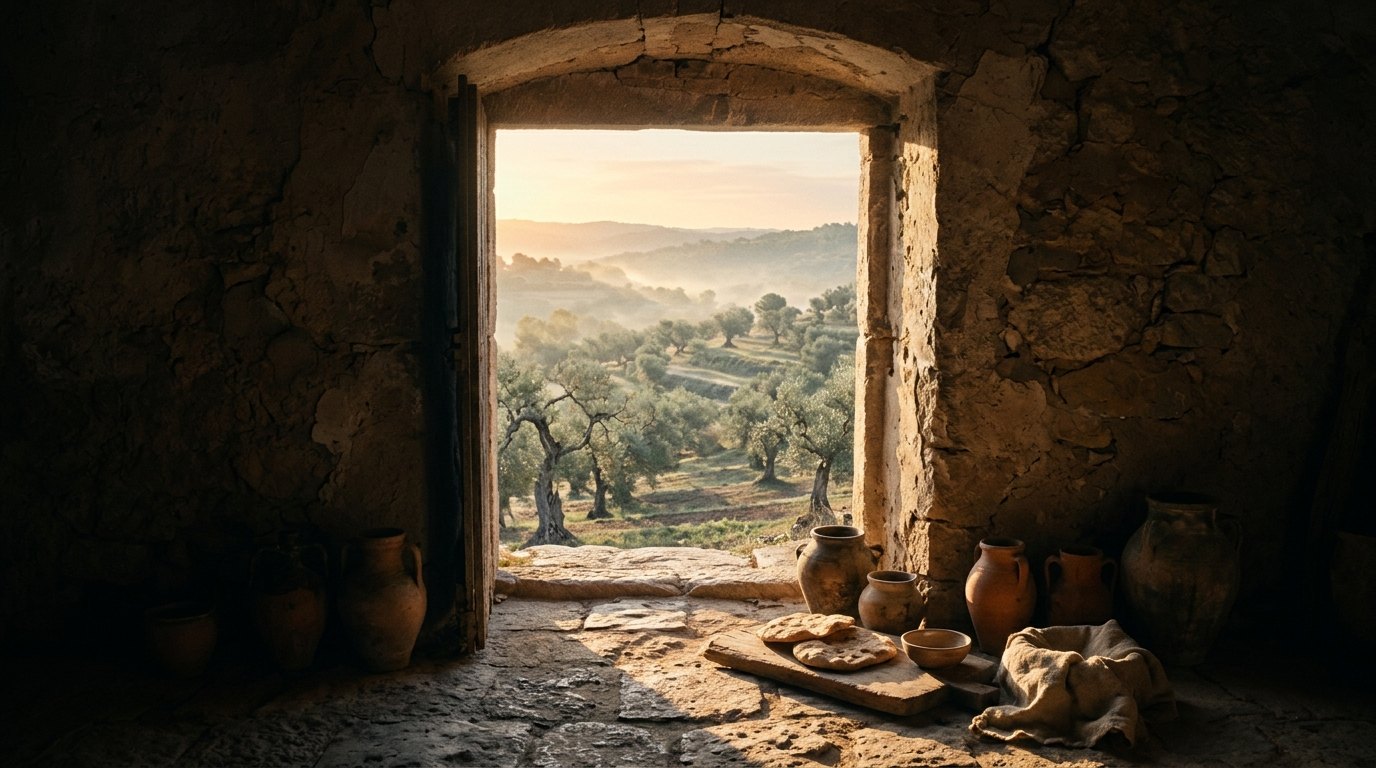
But if serving the LORD seems undesirable to you, then choose for yourselves this day whom you will serve, whether the gods your ancestors served beyond the Euphrates, or the gods of the Amorites, in whose land you are living. But as for me and my household, we will serve the LORD.”
Joshua 24:15 (NIV)
Joshua models courageous spiritual leadership by dedicating his entire household to the worship of Yahweh alone.
When Joshua addressed the assembled tribes at Shechem in Joshua 24:15, he made an uncompromising declaration: as for me and my house, we will serve the Lord. In a culture swept by surrounding pagan idolatry, the covenant household stood as an intentional sanctuary of undivided worship. This shared devotion creates the sweet fellowship celebrated in Psalm 133:1, which praises how good and pleasant it is when brethren dwell together in harmonious unity. The home is intended by God to be a place of safety, order, and deep affection, reflecting His peace.
Because the family is God's foundational institution, it serves as the proving ground for spiritual character and ministry. Paul instructs in 1 Timothy 3:4-5 that an elder must manage his own household well with dignity, because a man who cannot shepherd his immediate family cannot care for the church of God. This care is intensely practical: 1 Timothy 5:8 declares that anyone who fails to provide for his relatives, especially his own household, has denied the faith and is worse than an unbeliever. Honoring family includes caring for elderly parents and widowed grandparents, which 1 Timothy 5:4 calls pleasing to God. Far from being an inward-facing fortress, a godly home naturally overflows into kingdom mission. In 1 Corinthians 16:19, Aquila and Prisca opened their domestic life to host a local church within their living quarters. Similarly, in Acts 16:31-34, when the Philippian jailer believed in Christ, his entire household heard the word, embraced the gospel, and received baptism together with great joy.
| Passage | What it says |
|---|---|
| Joshua 24:15 | Joshua declares his household's resolute choice to serve Yahweh regardless of surrounding cultural idolatry. |
| Psalms 133:1 | The psalmist proclaims how good and pleasant it is when brethren dwell together in harmonious unity. |
| 1 Timothy 3:4-5 | Church leaders must manage their households well with dignity, demonstrating faithful care over their families. |
| 1 Timothy 5:8 | Providing for one's relatives and household is declared an essential duty of genuine faith. |
| 1 Corinthians 16:19 | Aquila and Prisca send warm greetings alongside the local church that meets within their home. |
| 1 Timothy 5:4 | Children and grandchildren must put religion into practice by caring for their own households. |
| Acts 16:31-34 | The Philippian jailer and his entire household believe and are baptized in the Lord. |
The Spiritual Family
Believers Belong to the Eternal Household of Faith

Then he looked at those seated in a circle around him and said, “Here are my mother and my brothers! Whoever does God’s will is my brother and sister and mother.”
Mark 3:34-35 (NIV)
Jesus reveals that obedience to the Father unites believers into a family that transcends biological ties.
When Jesus was told that His mother and brothers stood outside seeking Him in Mark 3:34-35, He looked at those seated around Him and declared, whoever does the will of God is my brother and sister and mother. Christ did not disparage biological family, but He revealed that spiritual kinship forged in the gospel is ultimate and eternal. Natural family ties, though given by God, can become an idol if placed above the Creator. Therefore, Jesus warned in Matthew 10:37 that anyone who loves father, mother, son, or daughter more than Him is not worthy of Him. Wholehearted allegiance belongs to the King alone.
Through Christ's redemptive work, every believer is brought into a permanent spiritual household that transcends biology, culture, and earthly borders. Galatians 6:10 urges believers to do good to everyone, but especially to those who belong to the household of faith. In Ephesians 2:19, Paul rejoices that gentile believers are no longer strangers or aliens, but fellow citizens with the saints and members of God's own family. This is not a distant legal status, but an adoption marked by infinite grace; 1 John 3:1 calls believers to behold the profound love the Father has lavished on us, that we should be called the children of God. For anyone who has known brokenness or loss in an earthly family, Christ provides an indestructible, eternal communion of brothers and sisters rooted in His blood.
| Passage | What it says |
|---|---|
| Mark 3:33-35 | Jesus defines his true family as whoever does the will of God. |
| Matthew 10:37 | Devotion to Christ must surpass supreme affection even for father, mother, son, or daughter. |
| Galatians 6:10 | Believers are called to do good especially to the household of faith. |
| Ephesians 2:19 | Believers are no longer strangers, but fellow citizens and members of the household of God. |
| 1 John 3:1 | The Father has lavished great love on us that we should be called children of God. |
Where in the Bible
| Book | Passages |
|---|---|
| Genesis | 3 · Genesis 1:27-28, Genesis 2:18, Genesis 2:24 |
| Exodus | 1 · Exodus 20:12 |
| Deuteronomy | 1 · Deuteronomy 6:6-7 |
| Joshua | 1 · Joshua 24:15 |
| Psalms | 8 · Psalms 127:1, Psalms 127:2, Psalms 127:3, Psalms 127:4, Psalms 127:5, Psalms 128:3, Psalms 128:6, Psalms 133:1 |
| Proverbs | 7 · Proverbs 16:9, Proverbs 21:30-31, Proverbs 17:6, Proverbs 1:8-9, Proverbs 22:6, Proverbs 13:24, Proverbs 29:17 |
| Malachi | 1 · Malachi 2:14-15 |
| Matthew | 2 · Matthew 19:4-6, Matthew 10:37 |
| Mark | 2 · Mark 10:6-9, Mark 3:33-35 |
| Acts | 1 · Acts 16:31-34 |
| 1 Corinthians | 2 · 1 Corinthians 3:7, 1 Corinthians 16:19 |
| Galatians | 1 · Galatians 6:10 |
| Ephesians | 6 · Ephesians 5:22-24, Ephesians 5:25-28, Ephesians 5:31-33, Ephesians 6:1-3, Ephesians 6:4, Ephesians 2:19 |
| Colossians | 4 · Colossians 3:18, Colossians 3:19, Colossians 3:20, Colossians 3:21 |
| 1 Timothy | 3 · 1 Timothy 3:4-5, 1 Timothy 5:8, 1 Timothy 5:4 |
| 2 Timothy | 1 · 2 Timothy 1:5 |
| Hebrews | 1 · Hebrews 13:4 |
| 1 Peter | 2 · 1 Peter 3:1-2, 1 Peter 3:7 |
| 1 John | 1 · 1 John 3:1 |
The story in order
- God creates man and woman (c. 4000 BC) · Genesis 1:27-28 · Establishes the foundation for human family and procreation.
- The marriage covenant is established (c. 4000 BC) · Genesis 2:24 · Defines the union of husband and wife as one flesh.
- The Law is given to Israel (c. 1450 BC) · Exodus 20:12 · Includes the commandment to honor parents.
- Wisdom literature on family life (c. 950 BC) · Proverbs 1:8-9 · Emphasizes instruction from parents and the value of children.
- Prophets speak on marriage covenant (c. 450 BC) · Malachi 2:14-15 · God witnesses the marriage covenant and desires godly offspring.
- Jesus affirms marriage's divine origin (c. AD 30) · Matthew 19:4-6 · Reaffirms the permanence of the one-flesh union.
- Jesus defines spiritual family (c. AD 30) · Mark 3:33-35 · True family is doing God's will.
- Apostles instruct on household order (c. AD 60) · Ephesians 5:22-33 · Defines roles and mutual love within marriage.
- Instructions for Christian households (c. AD 60) · Colossians 3:18-21 · Commands on wives, husbands, and children's conduct.
- Early church meets in homes (c. AD 55) · 1 Corinthians 16:19 · Illustrates the integration of family and church life.
- Generational faith transmission (c. AD 65) · 2 Timothy 1:5 · Highlights faith passed from Lois and Eunice to Timothy.
- Believers as God's household (c. AD 60) · Ephesians 2:19 · Believers are fellow citizens and members of God's household.
The Family as God's Building
| God's Work | Human Effort | Result | Passage |
|---|---|---|---|
| Unless the Lord builds the house | Builders labor in vain | Psalms 127:1 | Psalms 127:1 |
| God provides rest | Anxious toil, rising early, staying up late | Psalms 127:2 | Psalms 127:2 |
| The Lord establishes the steps | The heart plans its course | Proverbs 16:9 | Proverbs 16:9 |
| God gives the increase | Neither the planter nor the waterer is anything | 1 Corinthians 3:7 | 1 Corinthians 3:7 |
Children: Heritage and Blessing
| Description | Significance | Reference | Passage |
|---|---|---|---|
| A heritage from the Lord | The fruit of the womb His reward | Psalms 127:3 | Psalms 127:3 |
| Like arrows in a warrior's hand | For defense and purpose in youth | Psalms 127:4 | Psalms 127:4 |
| A full quiver | Blessing and security against opponents | Psalms 127:5 | Psalms 127:5 |
| A fruitful vine and olive shoots | Prosperity and vibrant family life | Psalms 128:3 | Psalms 128:3 |
| Grandchildren | The crown of the aged | Proverbs 17:6 | Proverbs 17:6 |
Key words
- One Flesh (basar echad, בָּשָׂר אֶחָד)
- The profound union of husband and wife, becoming a single entity in God's design. · Genesis 2:24
- Heritage (nachalah, נַחֲלָה)
- Children are a gift and possession from the Lord, a divine reward for parents. · Psalms 127:3
- Honor (kabad, כָּבַד)
- To show deep respect, reverence, and value, especially towards parents and marriage. · Exodus 20:12
- Discipline (paideia, παιδεία)
- Instruction and training, often involving correction, aimed at shaping character and behavior. · Ephesians 6:4
- Household of Faith (oikos pisteos, οἶκος πίστεως)
- The community of believers, united as God's spiritual family through Christ. · Galatians 6:10
Ultimately, a family endures not through mere human striving, but through the faithful guidance and sovereign blessing of the Lord. When husbands, wives, parents, and children walk in the roles God has graciously given, the home becomes a living picture of Christ's love and a fortress of truth for the next generation. May our homes be built upon His Word, resting in His care and shining His light to a watching world.
48 passages, each cited once.
Scripture cited
- Proverbs 16:9
- Matthew 19:4-6
- Deuteronomy 6:4-7
- Ephesians 5:22-33
- Ephesians 6:1-4
- 1 Timothy 5:8
- Mark 3:31-35
- Ephesians 2:19-22
- 1 Corinthians 7:7-8